
THE STRUCTURE AND FUNCTION OF THE AUDITORY SYSTEM


- Slides: 66
THE STRUCTURE AND FUNCTION OF THE AUDITORY SYSTEM Nicholas A. Lesica Ear Institute University College London www. lesicalab. com UCL
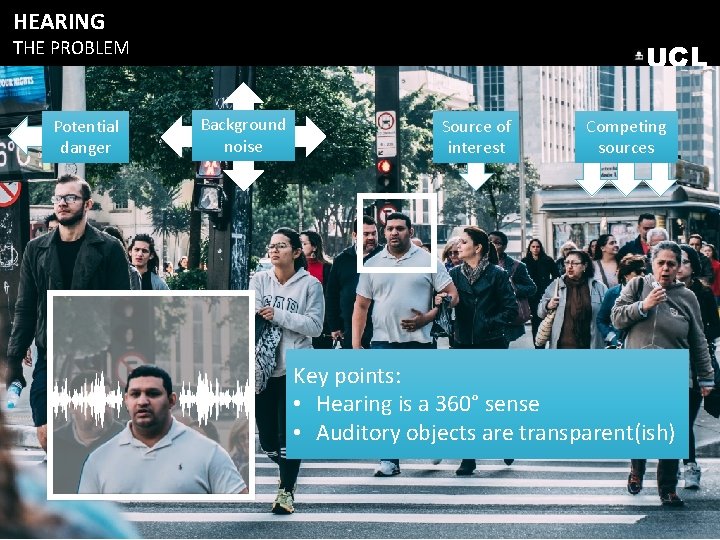
HEARING THE PROBLEM Potential danger UCL Background noise Source of interest Competing sources Key points: • Hearing is a 360° sense • Auditory objects are transparent(ish)
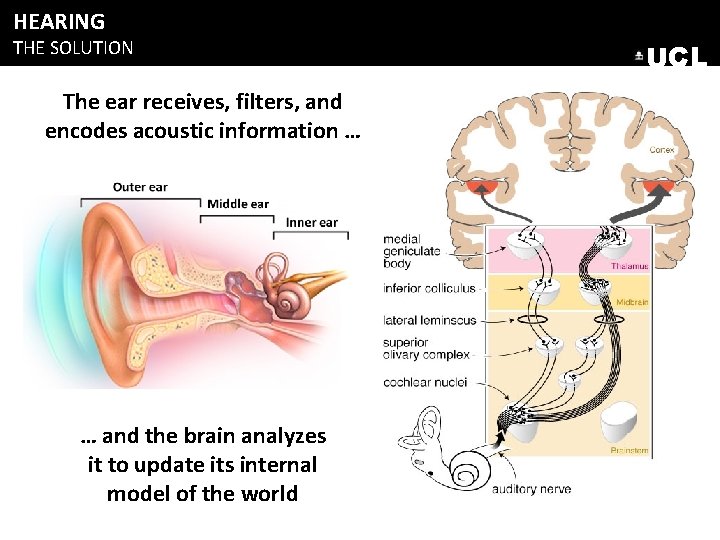
HEARING THE SOLUTION The ear receives, filters, and encodes acoustic information … … and the brain analyzes it to update its internal model of the world UCL
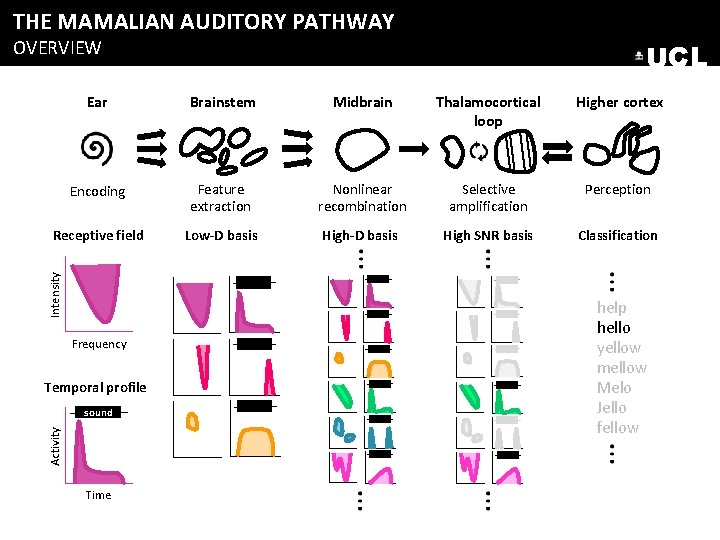
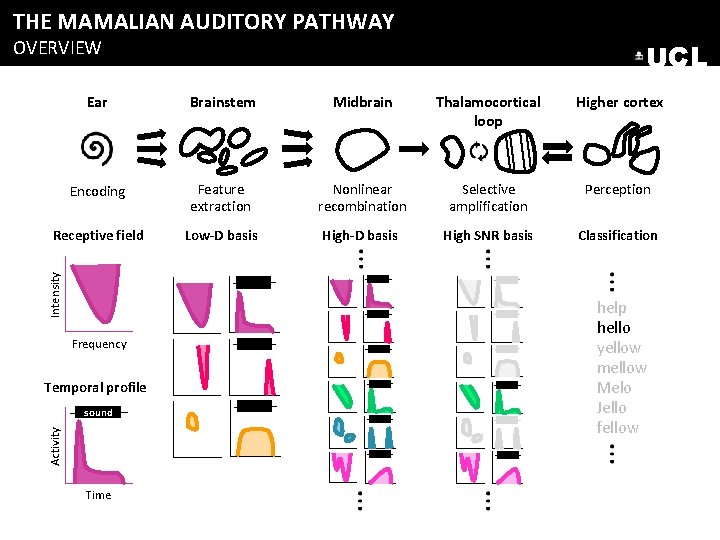
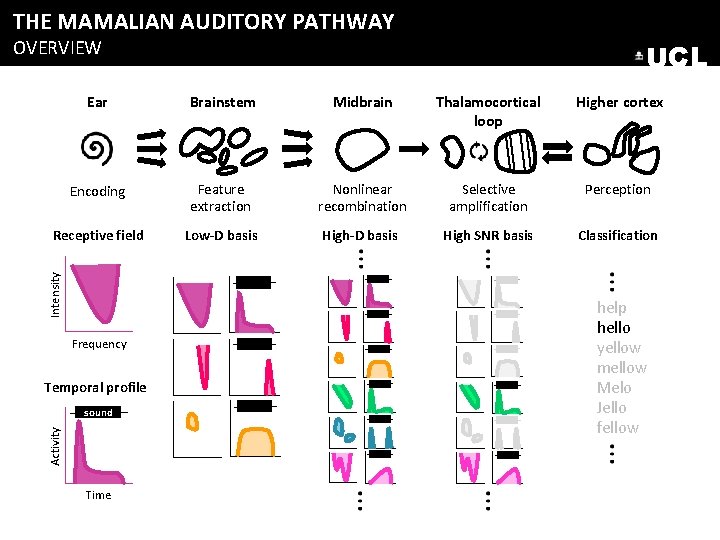
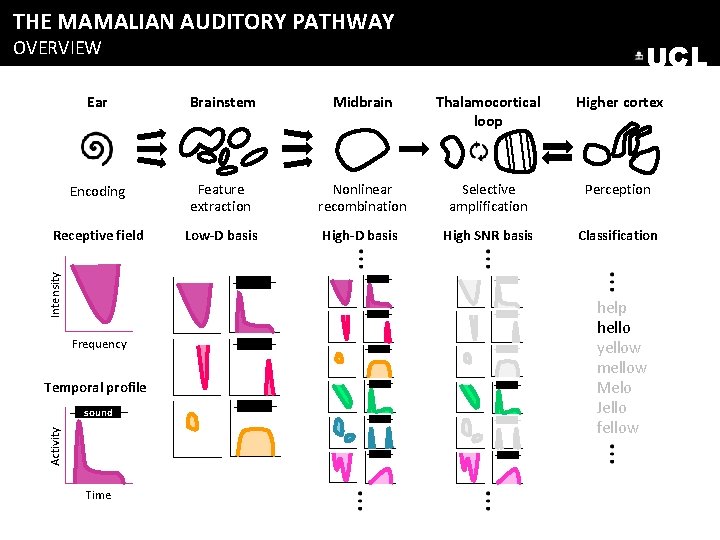
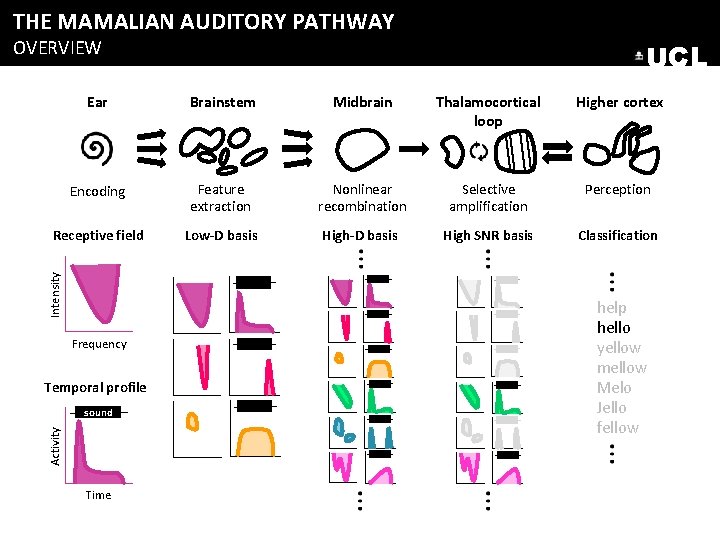
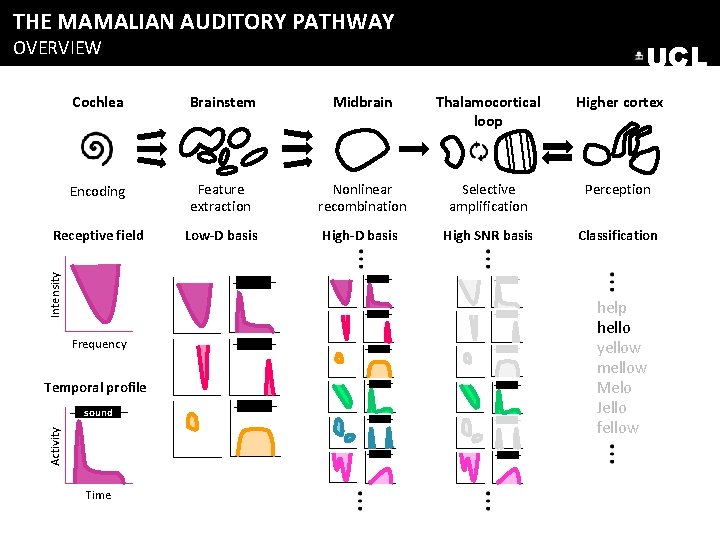
THE MAMALIAN AUDITORY PATHWAY OVERVIEW UCL Brainstem Midbrain Thalamocortical loop Higher cortex Encoding Feature extraction Nonlinear recombination Selective amplification Perception Receptive field Low-D basis High SNR basis Classification Intensity Ear Frequency Temporal profile Activity sound Time help hello yellow mellow Melo Jello fellow
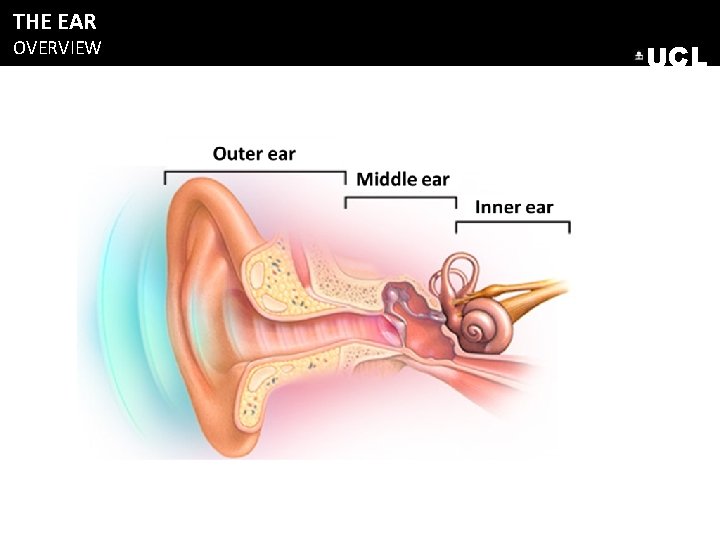
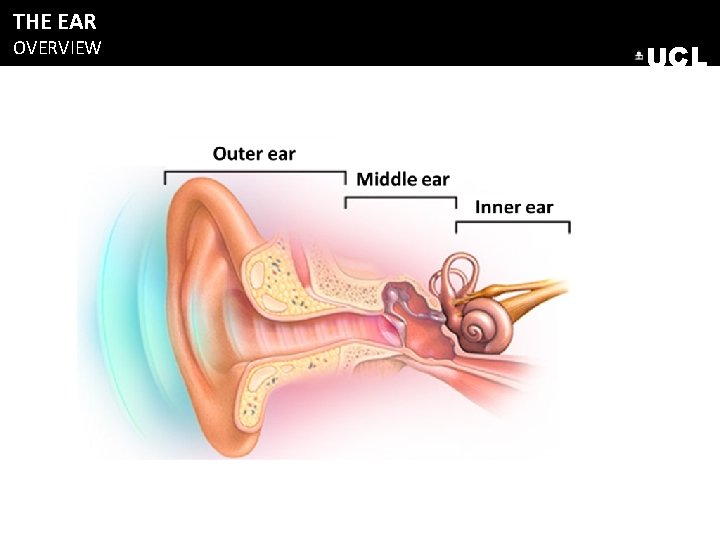
THE EAR OVERVIEW UCL
THE OUTER EAR UCL The outer ear collects sound amplifies low frequencies … +15° 0° -15° … and also filters high frequencies in a location-dependent manner
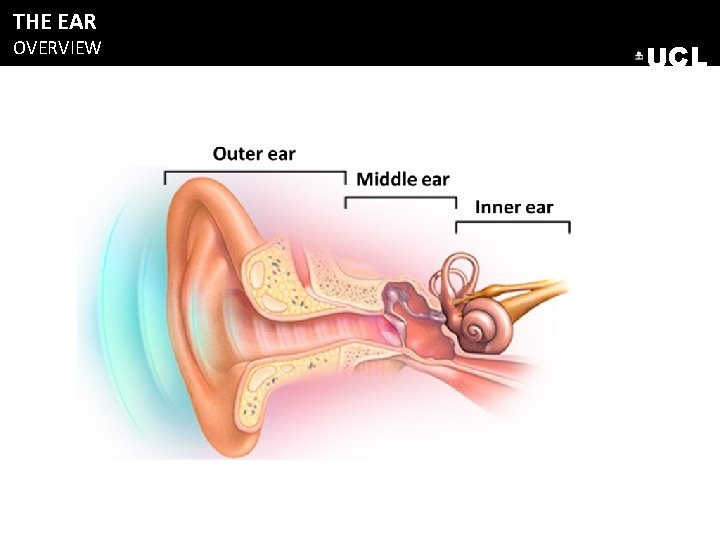
THE EAR OVERVIEW UCL
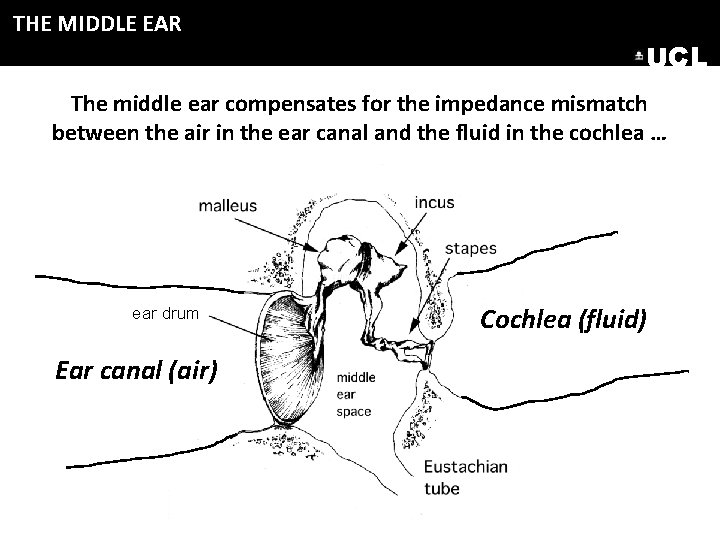
THE MIDDLE EAR UCL The middle ear compensates for the impedance mismatch between the air in the ear canal and the fluid in the cochlea … ear drum Ear canal (air) Cochlea (fluid)
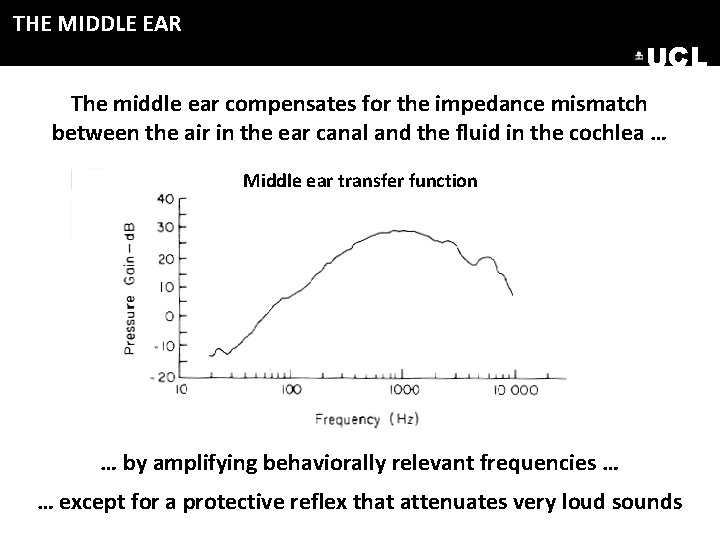
THE MIDDLE EAR UCL The middle ear compensates for the impedance mismatch between the air in the ear canal and the fluid in the cochlea … Middle ear transfer function … by amplifying behaviorally relevant frequencies … … except for a protective reflex that attenuates very loud sounds
THE EAR OVERVIEW UCL
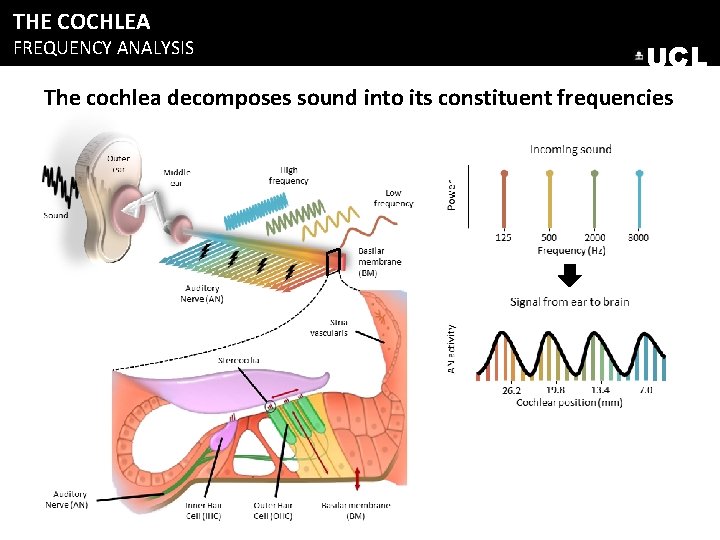
THE COCHLEA FREQUENCY ANALYSIS UCL The cochlea decomposes sound into its constituent frequencies
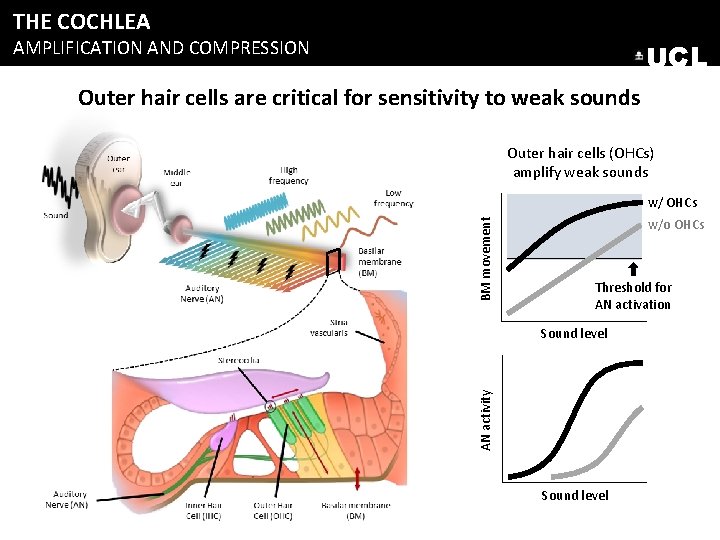
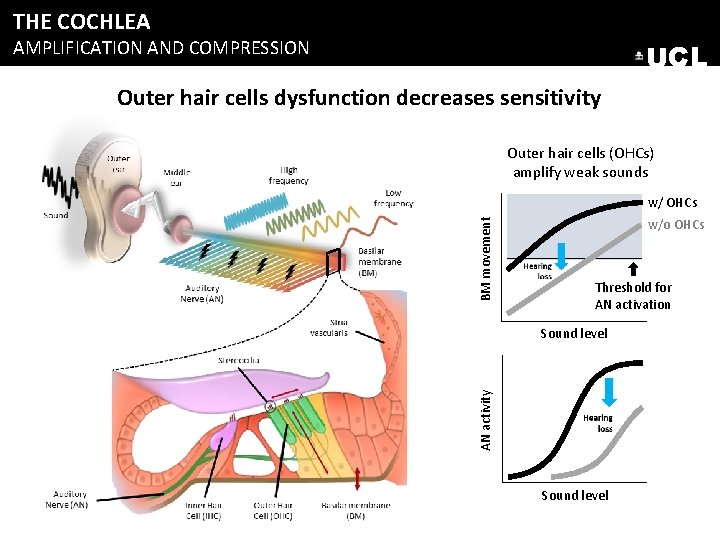
THE COCHLEA AMPLIFICATION AND COMPRESSION UCL Outer hair cells are critical for sensitivity to weak sounds Outer hair cells (OHCs) amplify weak sounds BM movement w/ OHCs w/o OHCs Threshold for AN activation AN activity Sound level
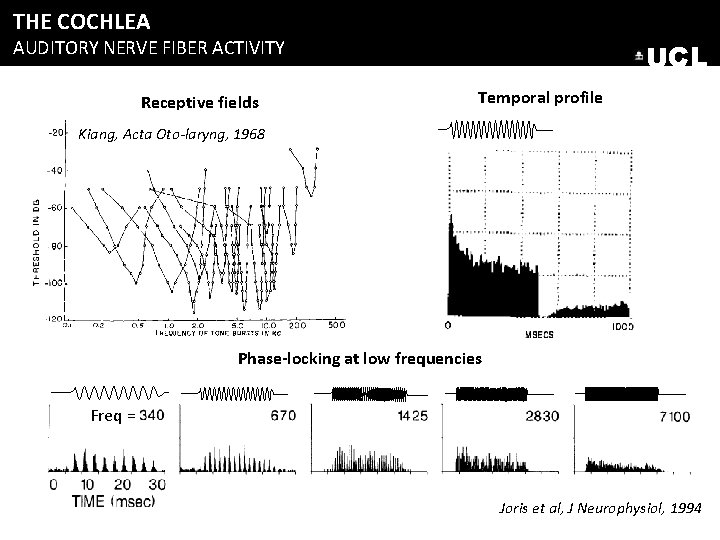
THE COCHLEA AUDITORY NERVE FIBER ACTIVITY Receptive fields UCL Temporal profile Kiang, Acta Oto-laryng, 1968 Phase-locking at low frequencies Freq = Joris et al, J Neurophysiol, 1994
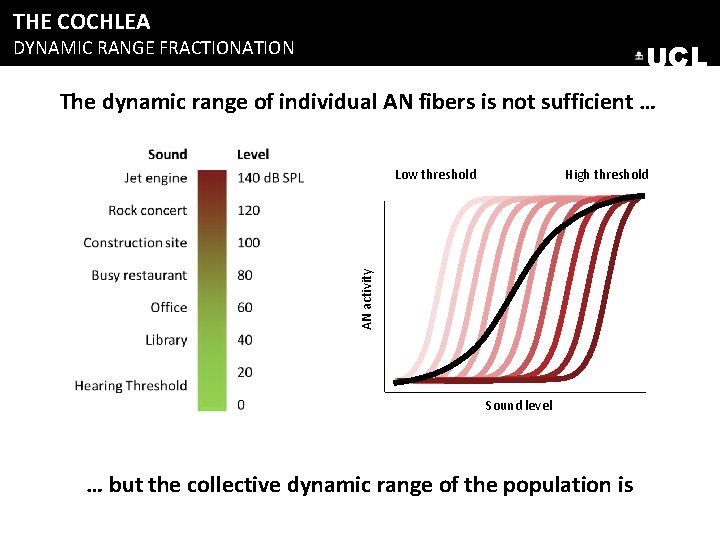
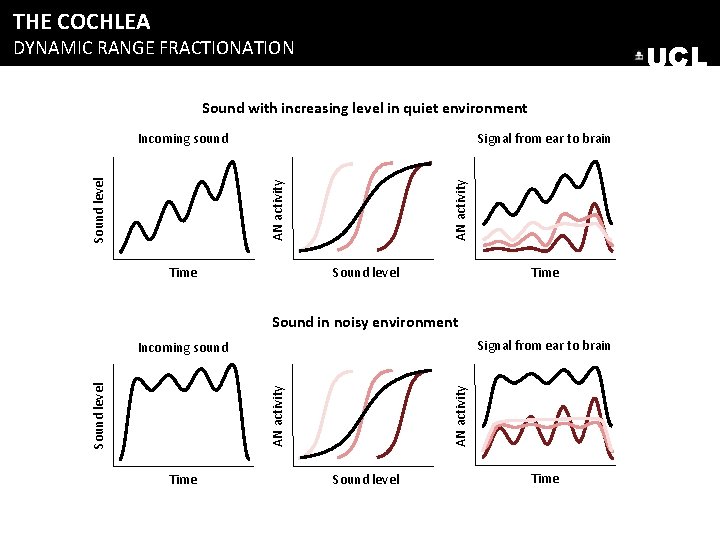
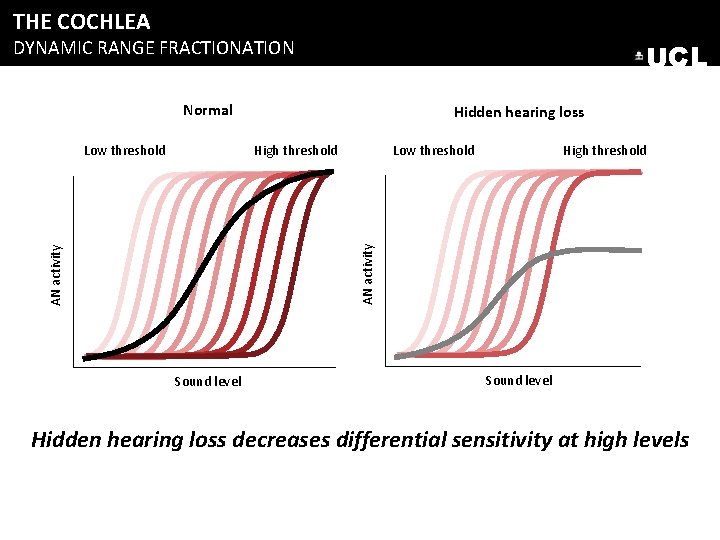
THE COCHLEA DYNAMIC RANGE FRACTIONATION UCL The dynamic range of individual AN fibers is not sufficient … High threshold AN activity Low threshold Sound level … but the collective dynamic range of the population is
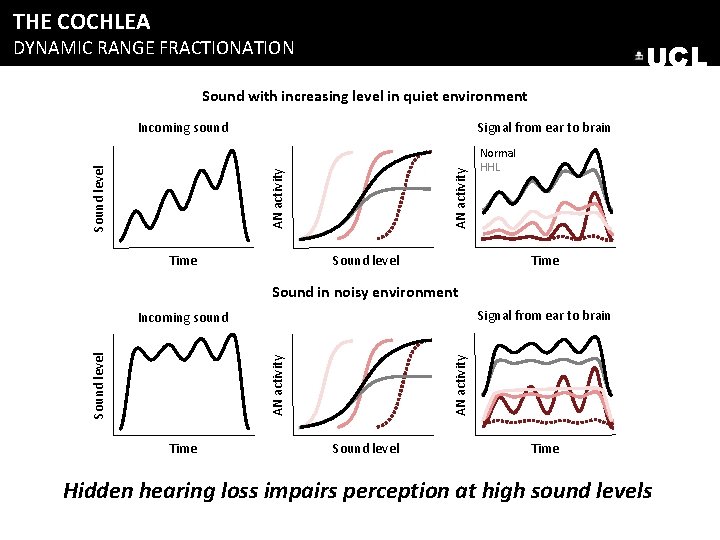
THE COCHLEA DYNAMIC RANGE FRACTIONATION UCL Sound with increasing level in quiet environment Signal from ear to brain AN activity Sound level Incoming sound Time Sound level Time Sound in noisy environment Signal from ear to brain AN activity Sound level Incoming sound Time Sound level Time
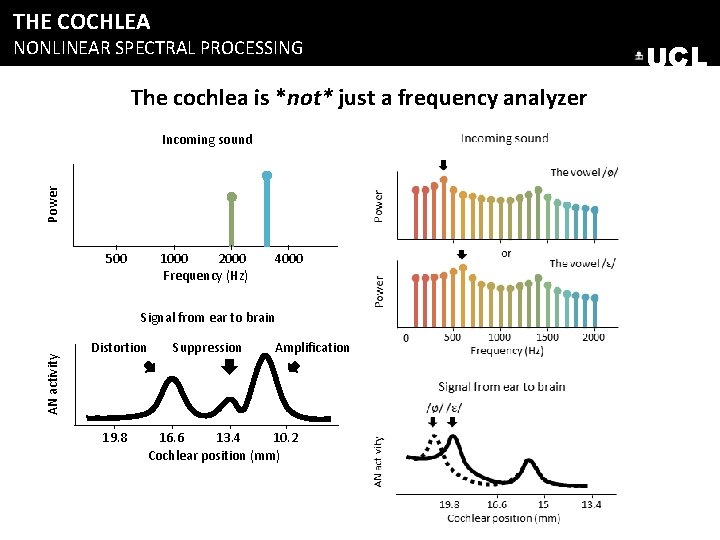
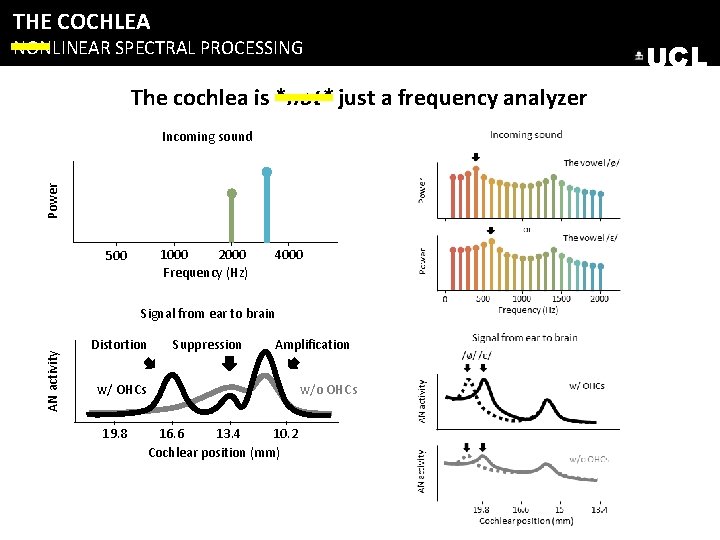
THE COCHLEA NONLINEAR SPECTRAL PROCESSING The cochlea is *not* just a frequency analyzer Power Incoming sound 1000 2000 Frequency (Hz) 500 4000 AN activity Signal from ear to brain Distortion 19. 8 Suppression Amplification 16. 6 13. 4 10. 2 Cochlear position (mm) UCL
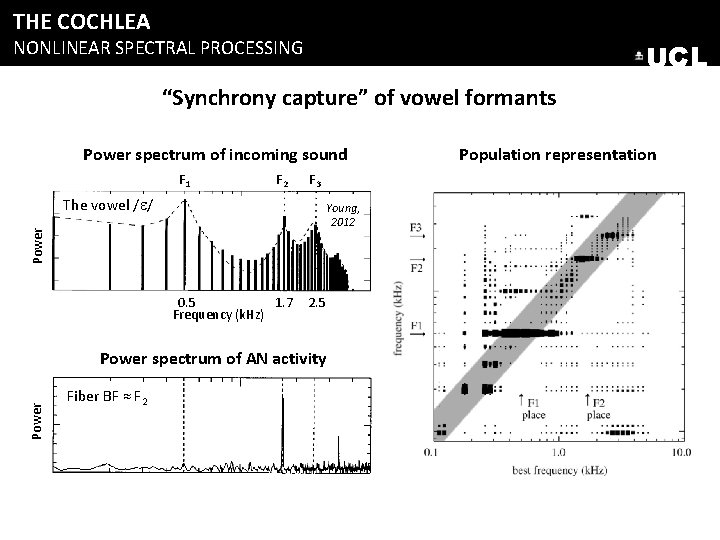
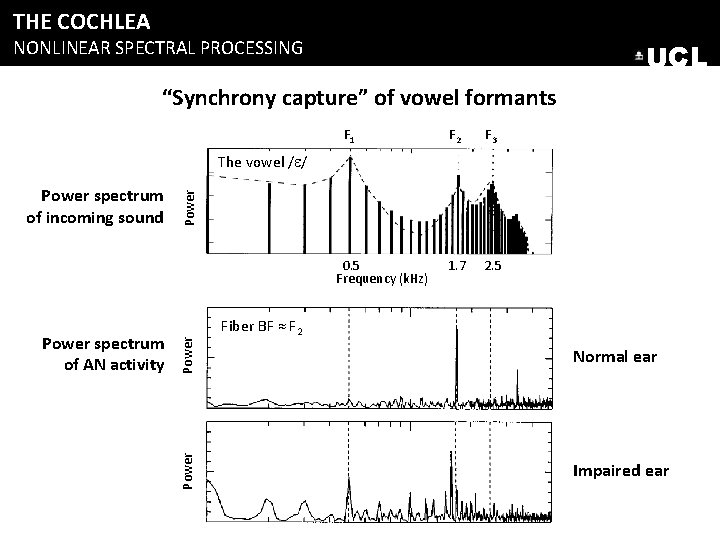
THE COCHLEA NONLINEAR SPECTRAL PROCESSING UCL “Synchrony capture” of vowel formants Power spectrum of incoming sound F 1 F 2 F 3 The vowel /e/ Power Young, 2012 0. 5 1. 7 Frequency (k. Hz) 2. 5 Power spectrum of AN activity Fiber BF ≈ F 2 Population representation
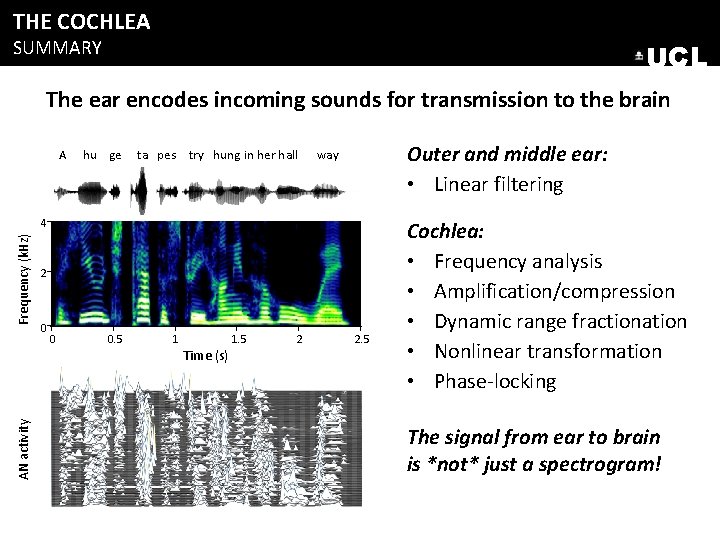
THE COCHLEA SUMMARY UCL The ear encodes incoming sounds for transmission to the brain A hu ge ta pes try hung in her hall Outer and middle ear: • Linear filtering way Frequency (k. Hz) 4 2 0 0 0. 5 1 1. 5 AN activity Time (s) 2 2. 5 Cochlea: • Frequency analysis • Amplification/compression • Dynamic range fractionation • Nonlinear transformation • Phase-locking The signal from ear to brain is *not* just a spectrogram!
THE MAMALIAN AUDITORY PATHWAY OVERVIEW UCL Brainstem Midbrain Thalamocortical loop Higher cortex Encoding Feature extraction Nonlinear recombination Selective amplification Perception Receptive field Low-D basis High SNR basis Classification Intensity Ear Frequency Temporal profile Activity sound Time help hello yellow mellow Melo Jello fellow
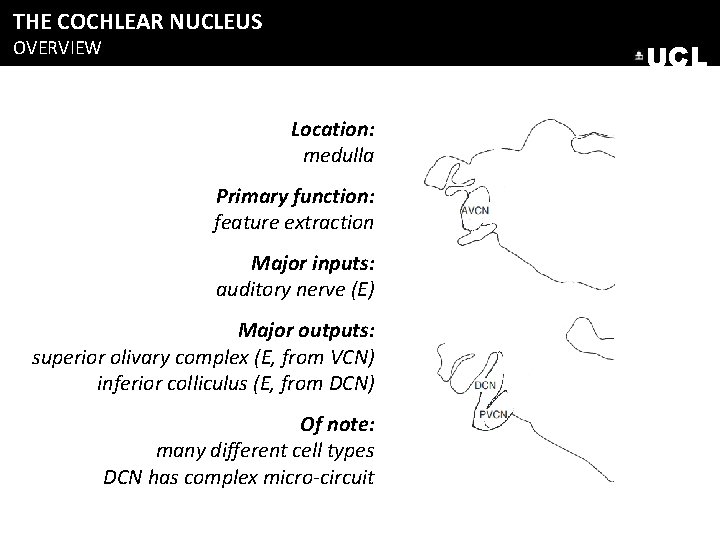
THE COCHLEAR NUCLEUS OVERVIEW UCL Location: medulla Primary function: feature extraction Major inputs: auditory nerve (E) Major outputs: superior olivary complex (E, from VCN) inferior colliculus (E, from DCN) Of note: many different cell types DCN has complex micro-circuit
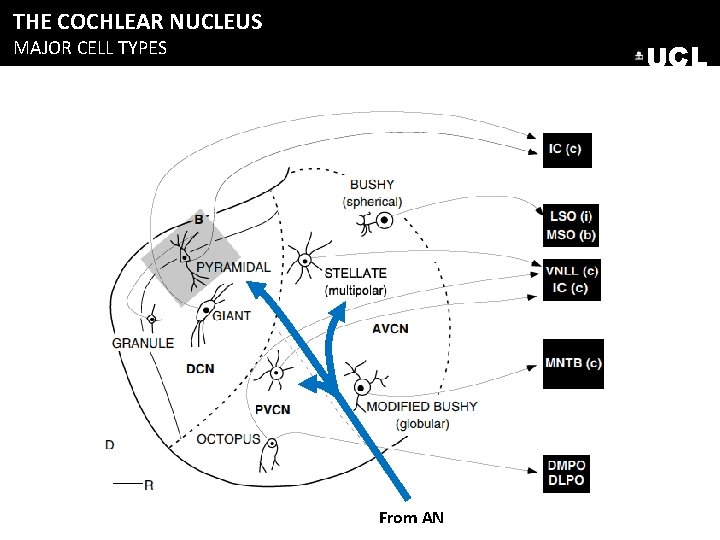
THE COCHLEAR NUCLEUS MAJOR CELL TYPES UCL From AN
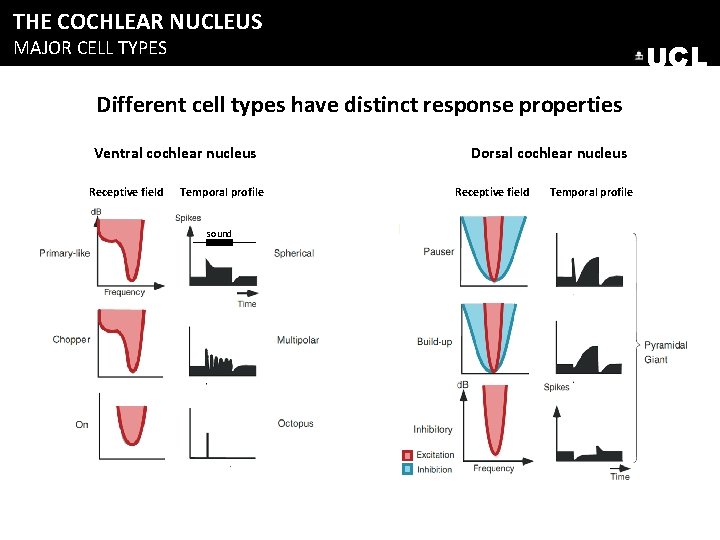
THE COCHLEAR NUCLEUS MAJOR CELL TYPES UCL Different cell types have distinct response properties Ventral cochlear nucleus Receptive field Temporal profile sound Dorsal cochlear nucleus Receptive field Temporal profile
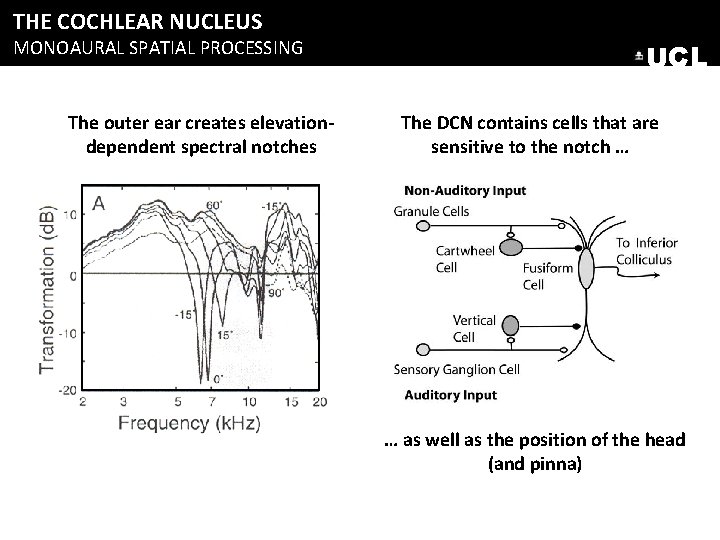
THE COCHLEAR NUCLEUS MONOAURAL SPATIAL PROCESSING The outer ear creates elevationdependent spectral notches UCL The DCN contains cells that are sensitive to the notch … … as well as the position of the head (and pinna)
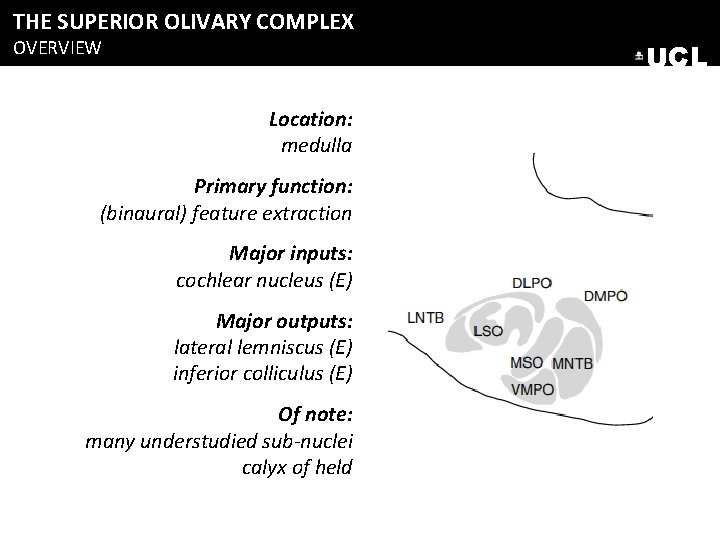
THE SUPERIOR OLIVARY COMPLEX OVERVIEW UCL Location: medulla Primary function: (binaural) feature extraction Major inputs: cochlear nucleus (E) Major outputs: lateral lemniscus (E) inferior colliculus (E) Of note: many understudied sub-nuclei calyx of held
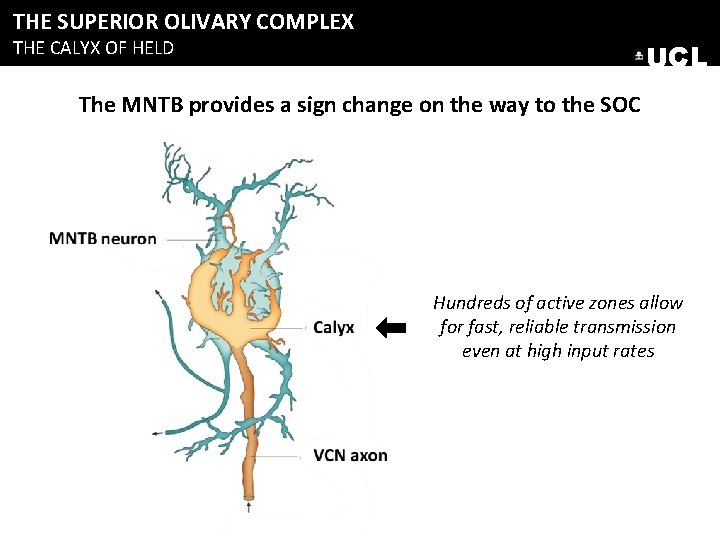
THE SUPERIOR OLIVARY COMPLEX THE CALYX OF HELD UCL The MNTB provides a sign change on the way to the SOC Hundreds of active zones allow for fast, reliable transmission even at high input rates
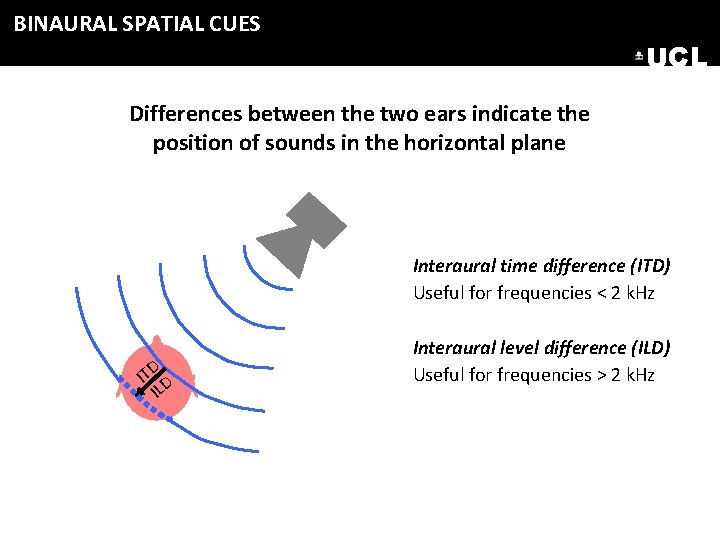
BINAURAL SPATIAL CUES UCL Differences between the two ears indicate the position of sounds in the horizontal plane Interaural time difference (ITD) Useful for frequencies < 2 k. Hz ITD D IL Interaural level difference (ILD) Useful for frequencies > 2 k. Hz
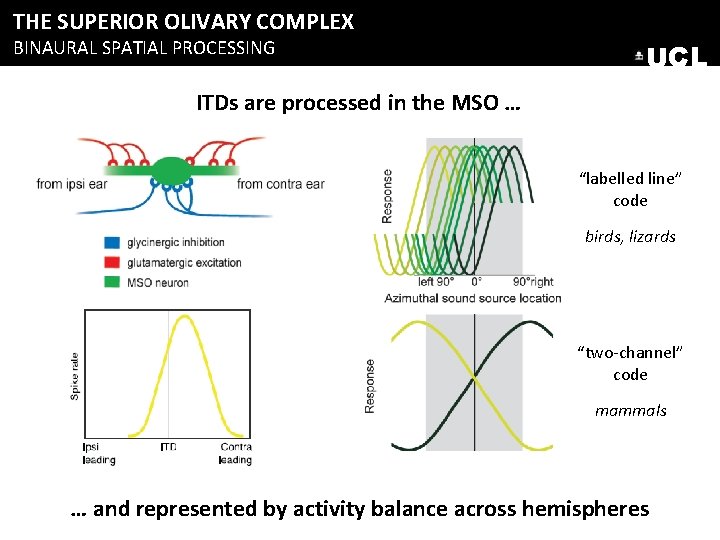
THE SUPERIOR OLIVARY COMPLEX BINAURAL SPATIAL PROCESSING UCL ITDs are processed in the MSO … “labelled line” code birds, lizards “two-channel” code mammals … and represented by activity balance across hemispheres
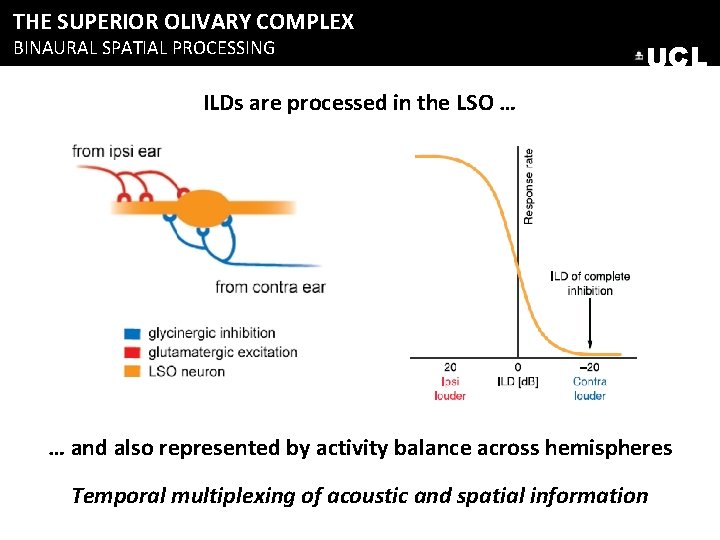
THE SUPERIOR OLIVARY COMPLEX BINAURAL SPATIAL PROCESSING UCL ILDs are processed in the LSO … … and also represented by activity balance across hemispheres Temporal multiplexing of acoustic and spatial information
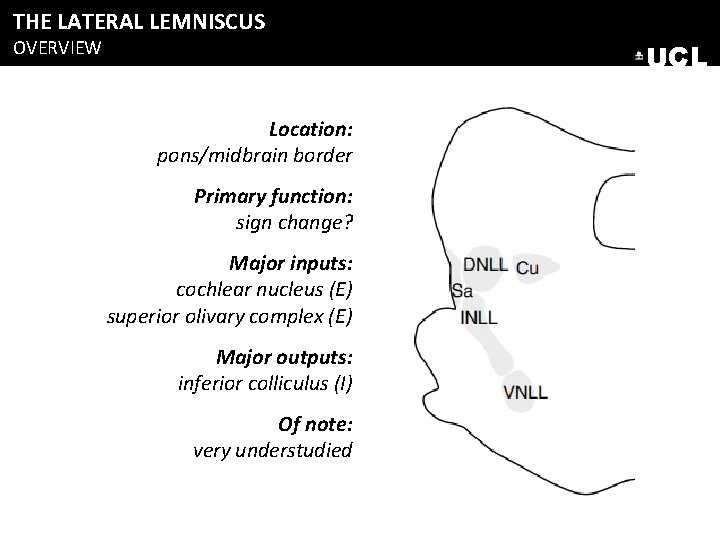
THE LATERAL LEMNISCUS OVERVIEW UCL Location: pons/midbrain border Primary function: sign change? Major inputs: cochlear nucleus (E) superior olivary complex (E) Major outputs: inferior colliculus (I) Of note: very understudied
THE MAMALIAN AUDITORY PATHWAY OVERVIEW UCL Brainstem Midbrain Thalamocortical loop Higher cortex Encoding Feature extraction Nonlinear recombination Selective amplification Perception Receptive field Low-D basis High SNR basis Classification Intensity Ear Frequency Temporal profile Activity sound Time help hello yellow mellow Melo Jello fellow
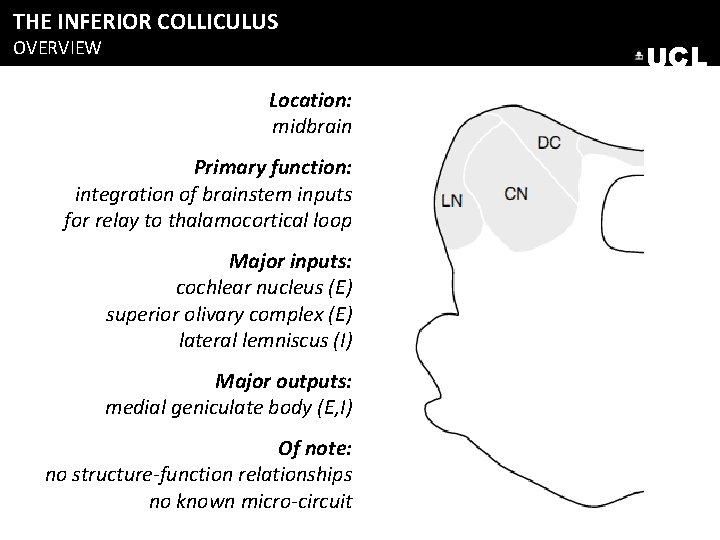
THE INFERIOR COLLICULUS OVERVIEW UCL Location: midbrain Primary function: integration of brainstem inputs for relay to thalamocortical loop Major inputs: cochlear nucleus (E) superior olivary complex (E) lateral lemniscus (I) Major outputs: medial geniculate body (E, I) Of note: no structure-function relationships no known micro-circuit
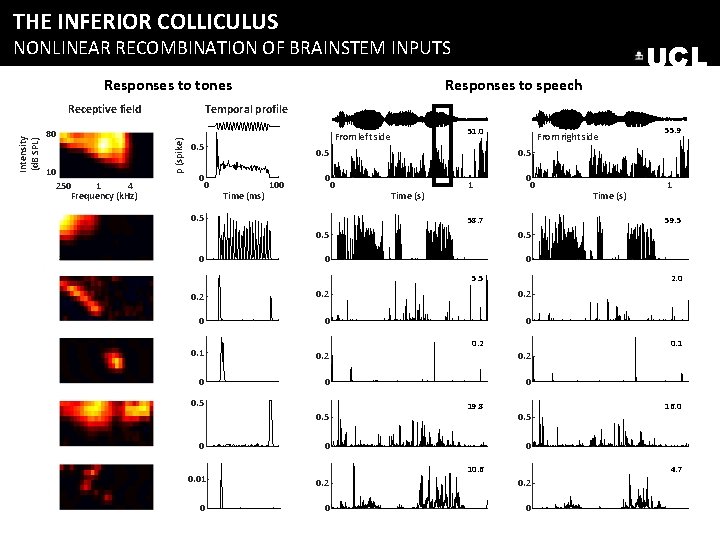
THE INFERIOR COLLICULUS NONLINEAR RECOMBINATION OF BRAINSTEM INPUTS Responses to tones p (spike) Intensity (d. B SPL) 10 250 1 4 Frequency (k. Hz) Responses to speech Temporal profile Receptive field 80 UCL 0. 5 0 0 0. 5 Time (ms) 100 0 0 0. 5 0 51. 0 From left side From right side 0. 5 Time (s) 1 0 0 0. 5 0 0 5. 5 0. 2 0 0. 1 0. 2 0 0. 2 19. 8 1 2. 0 0. 2 0. 5 Time (s) 59. 5 58. 7 0. 5 55. 9 0. 1 0. 5 0 0 0. 01 0. 2 0 0 0 16. 0 0 10. 6 4. 7
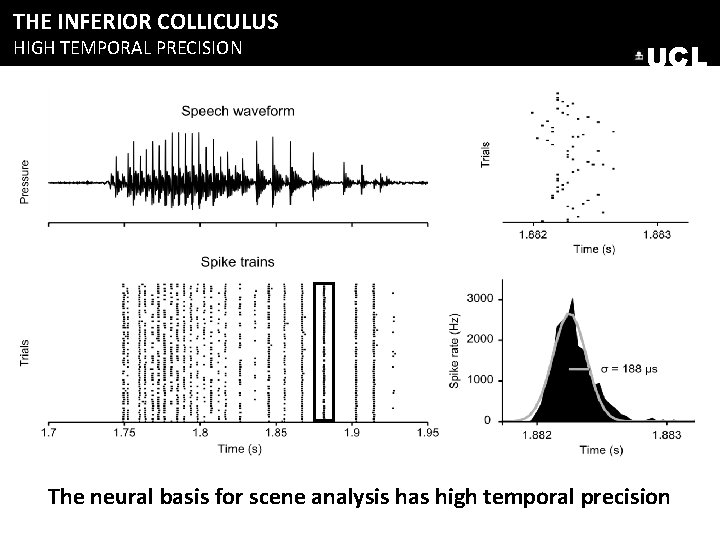
THE INFERIOR COLLICULUS HIGH TEMPORAL PRECISION UCL The neural basis for scene analysis has high temporal precision
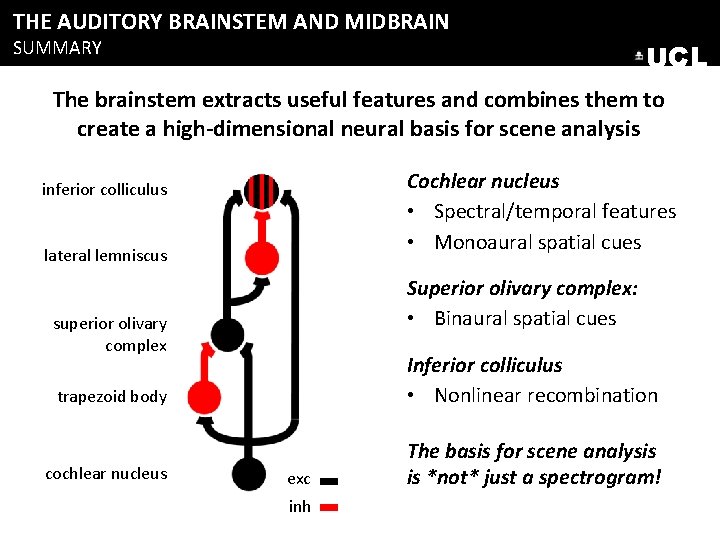
THE AUDITORY BRAINSTEM AND MIDBRAIN SUMMARY UCL The brainstem extracts useful features and combines them to create a high-dimensional neural basis for scene analysis Cochlear nucleus • Spectral/temporal features • Monoaural spatial cues inferior colliculus lateral lemniscus Superior olivary complex: • Binaural spatial cues superior olivary complex trapezoid body Inferior colliculus • Nonlinear recombination cochlear nucleus The basis for scene analysis is *not* just a spectrogram! exc inh
THE MAMALIAN AUDITORY PATHWAY OVERVIEW UCL Brainstem Midbrain Thalamocortical loop Higher cortex Encoding Feature extraction Nonlinear recombination Selective amplification Perception Receptive field Low-D basis High SNR basis Classification Intensity Ear Frequency Temporal profile Activity sound Time help hello yellow mellow Melo Jello fellow
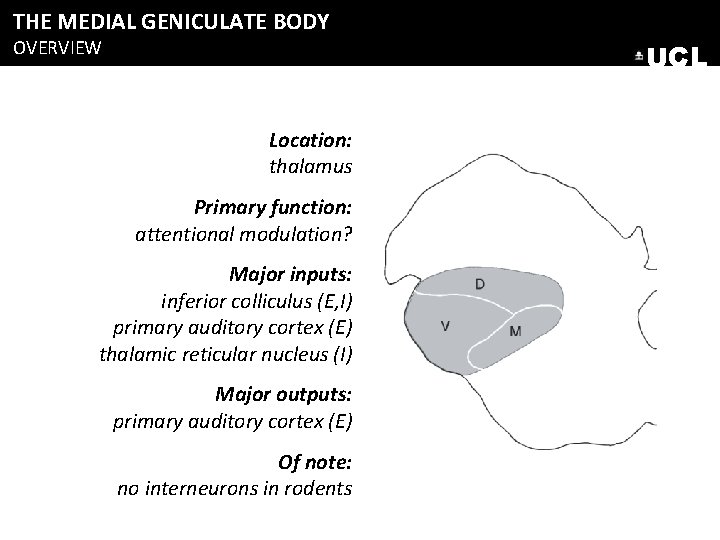
THE MEDIAL GENICULATE BODY OVERVIEW UCL Location: thalamus Primary function: attentional modulation? Major inputs: inferior colliculus (E, I) primary auditory cortex (E) thalamic reticular nucleus (I) Major outputs: primary auditory cortex (E) Of note: no interneurons in rodents
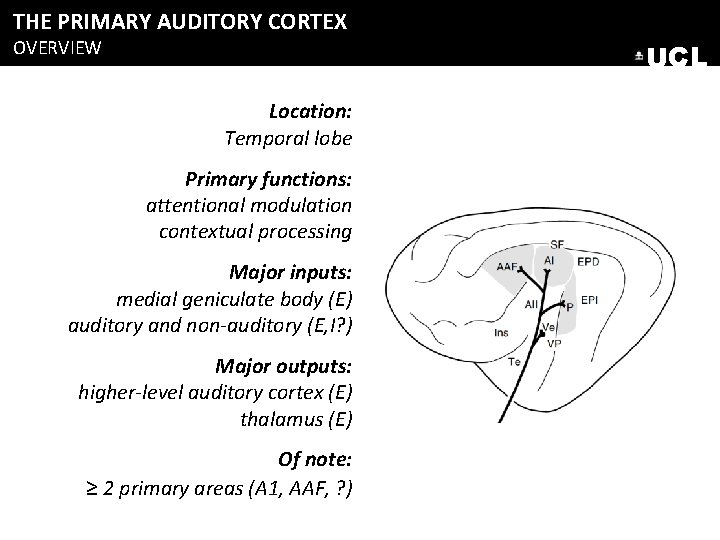
THE PRIMARY AUDITORY CORTEX OVERVIEW UCL Location: Temporal lobe Primary functions: attentional modulation contextual processing Major inputs: medial geniculate body (E) auditory and non-auditory (E, I? ) Major outputs: higher-level auditory cortex (E) thalamus (E) Of note: ≥ 2 primary areas (A 1, AAF, ? )
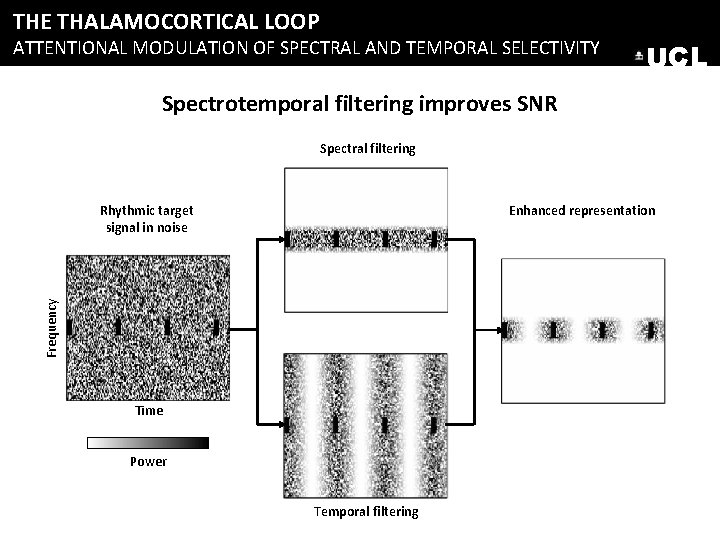
THE THALAMOCORTICAL LOOP ATTENTIONAL MODULATION OF SPECTRAL AND TEMPORAL SELECTIVITY UCL Spectrotemporal filtering improves SNR Spectral filtering Rhythmic target signal in noise Frequency Enhanced representation Time Power Temporal filtering
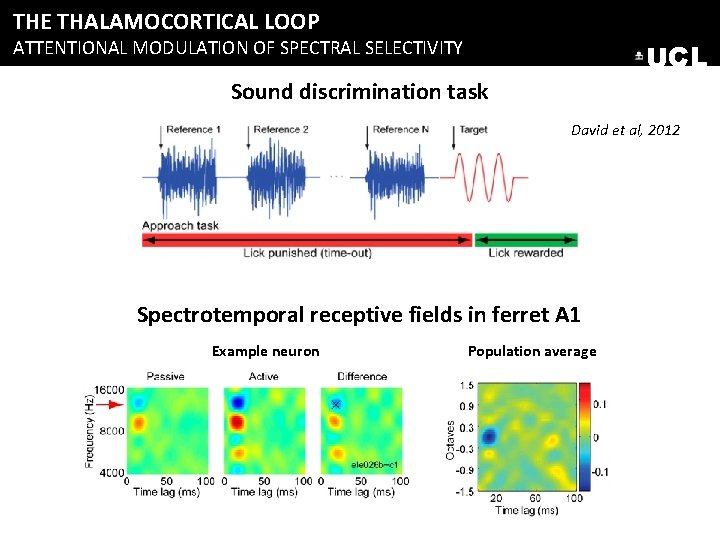
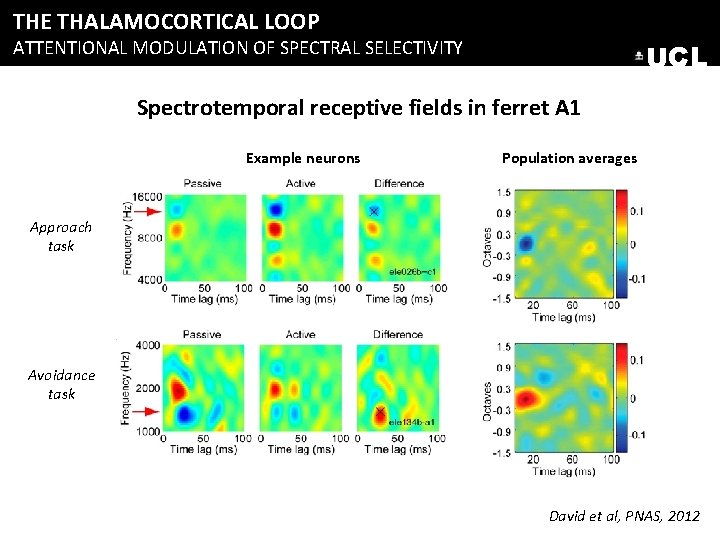
THE THALAMOCORTICAL LOOP ATTENTIONAL MODULATION OF SPECTRAL SELECTIVITY UCL Sound discrimination task David et al, 2012 Spectrotemporal receptive fields in ferret A 1 Example neuron Population average
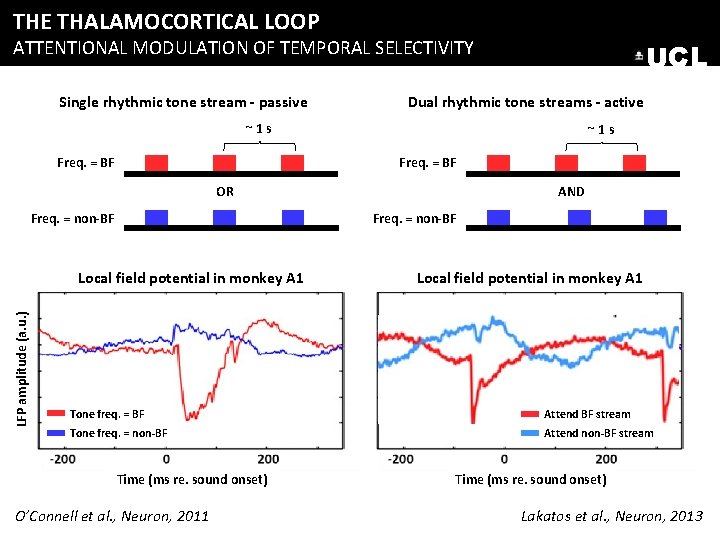
THE THALAMOCORTICAL LOOP ATTENTIONAL MODULATION OF TEMPORAL SELECTIVITY Single rhythmic tone stream - passive UCL Dual rhythmic tone streams - active ~1 s Freq. = BF OR Freq. = non-BF Local field potential in monkey A 1 LFP amplitude (a. u. ) AND Local field potential in monkey A 1 Tone freq. = BF Attend BF stream Tone freq. = non-BF Attend non-BF stream Time (ms re. sound onset) O’Connell et al. , Neuron, 2011 Time (ms re. sound onset) Lakatos et al. , Neuron, 2013
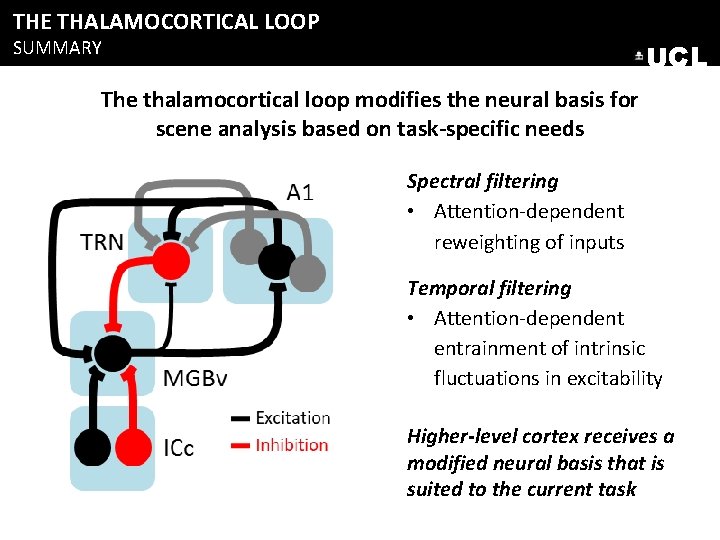
THE THALAMOCORTICAL LOOP SUMMARY UCL The thalamocortical loop modifies the neural basis for scene analysis based on task-specific needs Spectral filtering • Attention-dependent reweighting of inputs Temporal filtering • Attention-dependent entrainment of intrinsic fluctuations in excitability Higher-level cortex receives a modified neural basis that is suited to the current task
THE MAMALIAN AUDITORY PATHWAY OVERVIEW UCL Brainstem Midbrain Thalamocortical loop Higher cortex Encoding Feature extraction Nonlinear recombination Selective amplification Perception Receptive field Low-D basis High SNR basis Classification Intensity Ear Frequency Temporal profile Activity sound Time help hello yellow mellow Melo Jello fellow
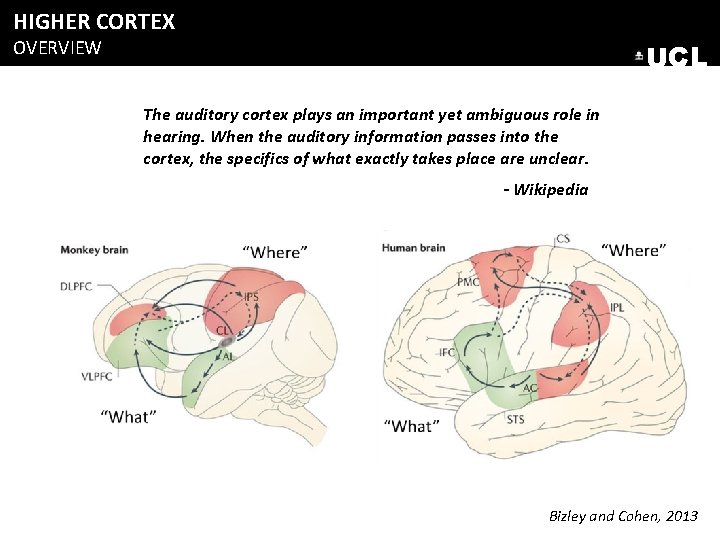
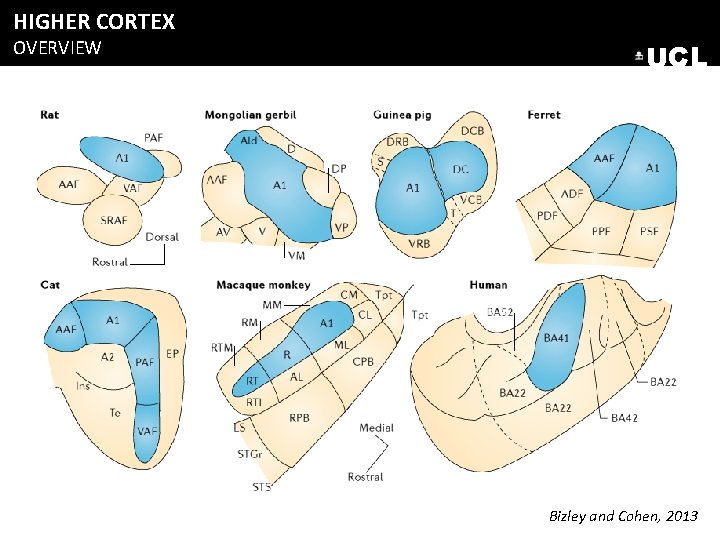
HIGHER CORTEX OVERVIEW UCL The auditory cortex plays an important yet ambiguous role in hearing. When the auditory information passes into the cortex, the specifics of what exactly takes place are unclear. - Wikipedia Bizley and Cohen, 2013
HIGHER CORTEX OVERVIEW UCL “Where” “What” Bizley and Cohen, 2013
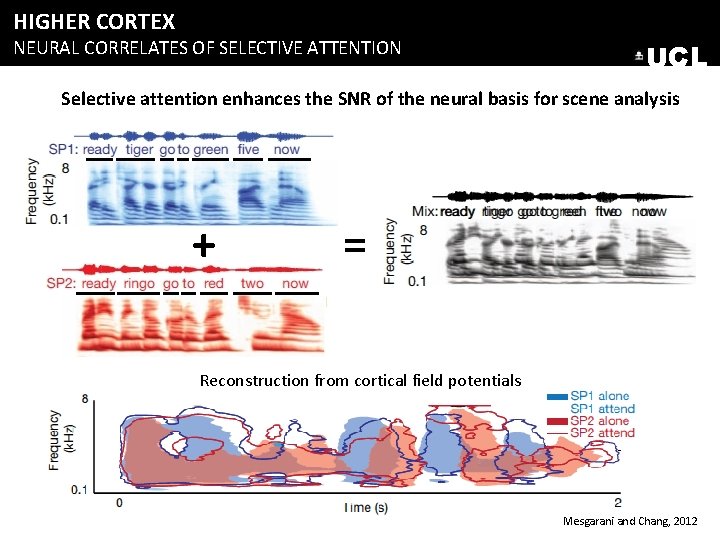
HIGHER CORTEX NEURAL CORRELATES OF SELECTIVE ATTENTION UCL Selective attention enhances the SNR of the neural basis for scene analysis + = Reconstruction from cortical field potentials Mesgarani and Chang, 2012
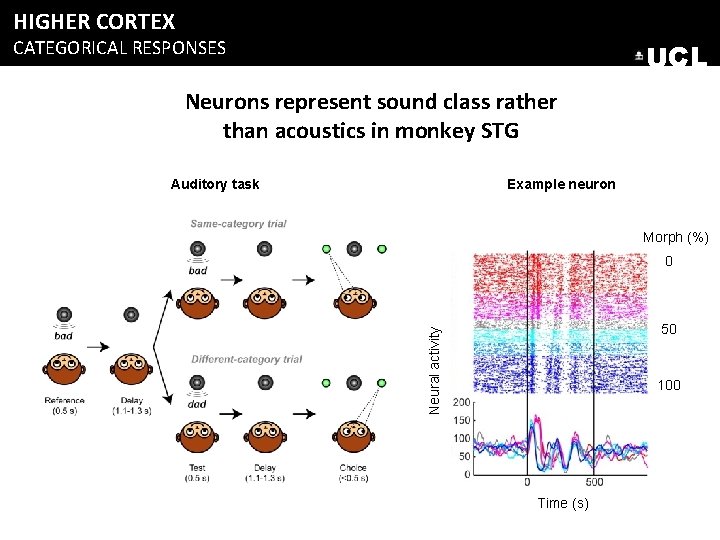
HIGHER CORTEX CATEGORICAL RESPONSES UCL Neurons represent sound class rather than acoustics in monkey STG Auditory task Example neuron Morph (%) 0 Neural activity 50 100 Time (s)
THE MAMALIAN AUDITORY PATHWAY OVERVIEW UCL Brainstem Midbrain Thalamocortical loop Higher cortex Encoding Feature extraction Nonlinear recombination Selective amplification Perception Receptive field Low-D basis High SNR basis Classification Intensity Cochlea Frequency Temporal profile Activity sound Time help hello yellow mellow Melo Jello fellow
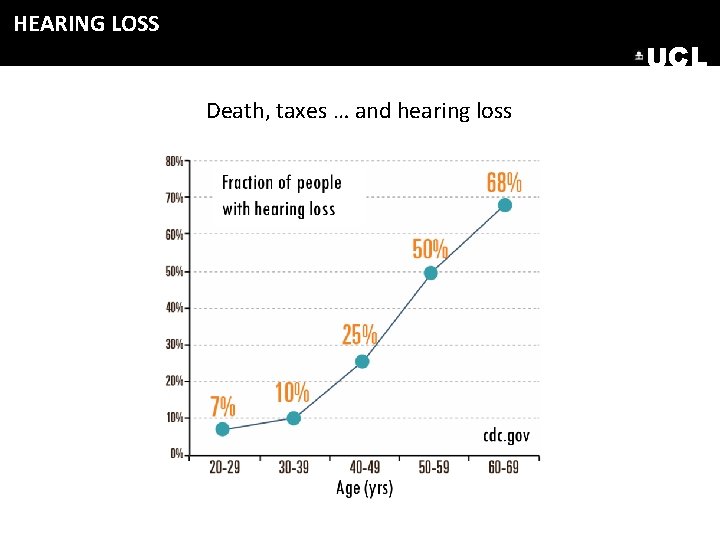
HEARING LOSS UCL Death, taxes … and hearing loss
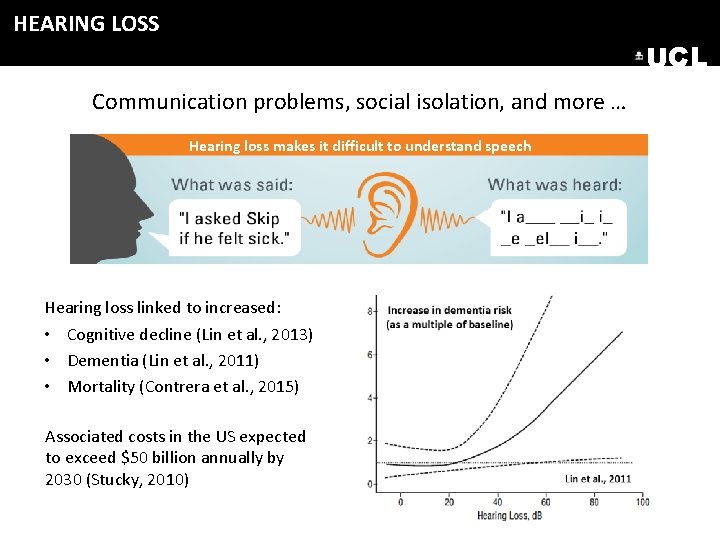
HEARING LOSS UCL Communication problems, social isolation, and more … Hearing loss makes it difficult to understand speech Hearing loss linked to increased: • Cognitive decline (Lin et al. , 2013) • Dementia (Lin et al. , 2011) • Mortality (Contrera et al. , 2015) Associated costs in the US expected to exceed $50 billion annually by 2030 (Stucky, 2010)
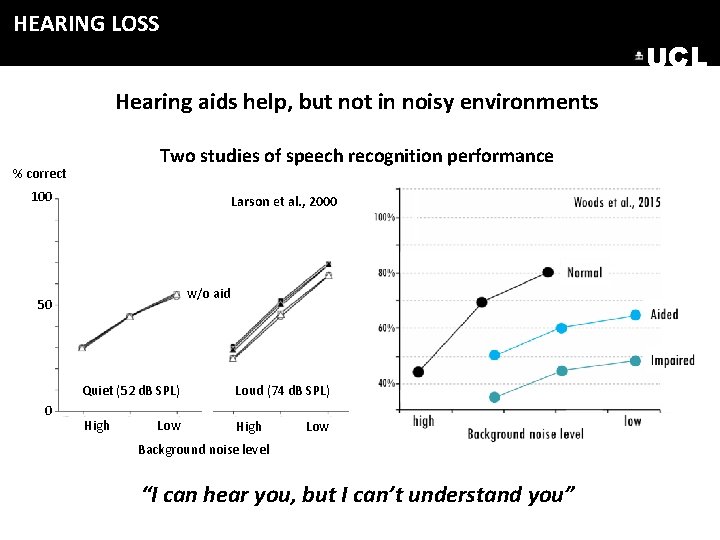
HEARING LOSS UCL Hearing aids help, but not in noisy environments Two studies of speech recognition performance % correct 100 Larson et al. , 2000 w/ aid w/o aid 50 0 Quiet (52 d. B SPL) Loud (74 d. B SPL) High Low Background noise level “I can hear you, but I can’t understand you”
THE COCHLEA AMPLIFICATION AND COMPRESSION UCL Outer hair cells dysfunction decreases sensitivity Outer hair cells (OHCs) amplify weak sounds BM movement w/ OHCs w/o OHCs Threshold for AN activation AN activity Sound level
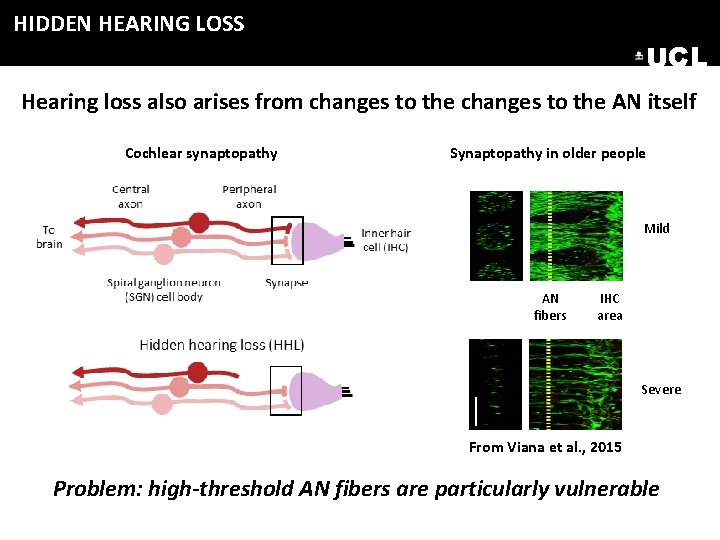
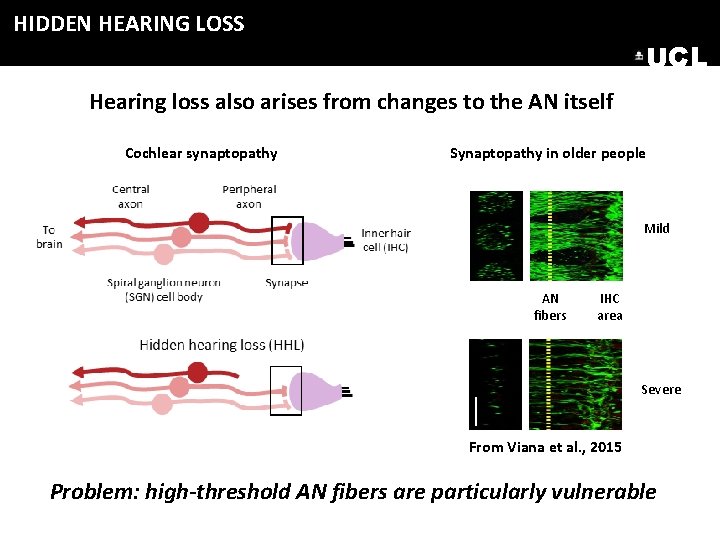
HIDDEN HEARING LOSS UCL Hearing loss also arises from changes to the AN itself Cochlear synaptopathy Synaptopathy in older people Mild AN fibers IHC area Severe From Viana et al. , 2015 Problem: high-threshold AN fibers are particularly vulnerable
THE COCHLEA NONLINEAR SPECTRAL PROCESSING The cochlea is *not* just a frequency analyzer Power Incoming sound 1000 2000 Frequency (Hz) 500 4000 AN activity Signal from ear to brain Distortion Suppression Amplification w/ OHCs 19. 8 w/o OHCs 16. 6 13. 4 10. 2 Cochlear position (mm) UCL
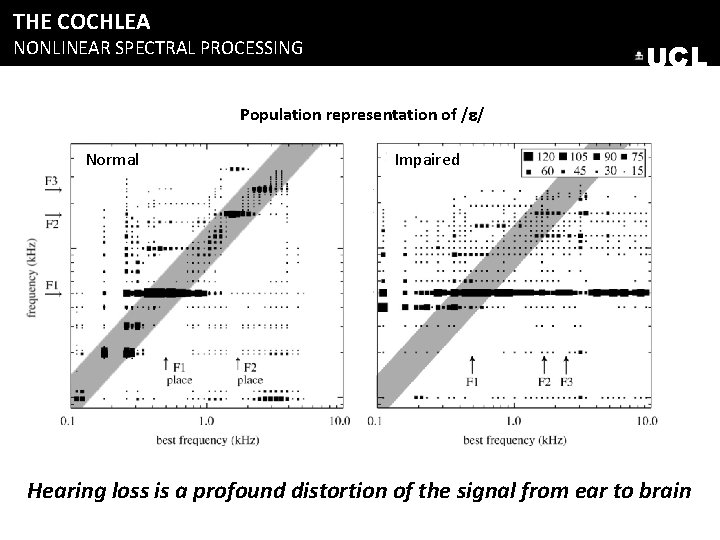
THE COCHLEA NONLINEAR SPECTRAL PROCESSING UCL “Synchrony capture” of vowel formants F 1 F 2 F 3 1. 7 2. 5 Power spectrum of incoming sound Power The vowel /e/ Power spectrum of AN activity Power 0. 5 Frequency (k. Hz) Fiber BF ≈ F 2 Normal ear Impaired ear
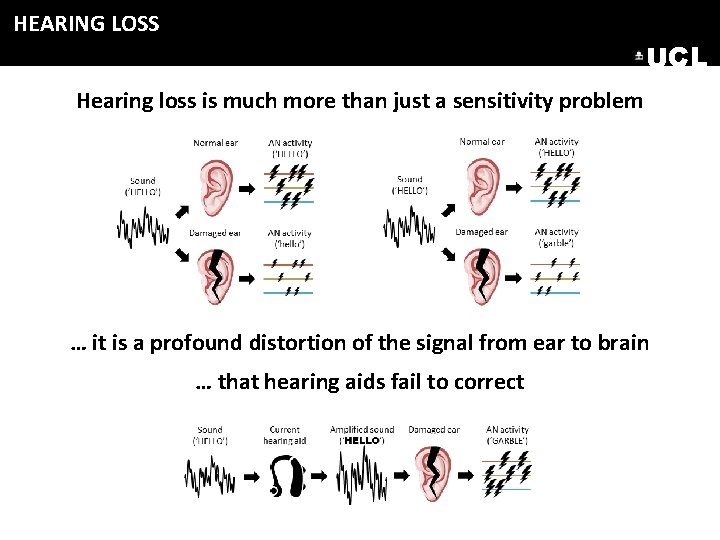
THE COCHLEA NONLINEAR SPECTRAL PROCESSING UCL Population representation of /e/ Normal Impaired Hearing loss is a profound distortion of the signal from ear to brain
HIDDEN HEARING LOSS UCL Hearing loss also arises from changes to the AN itself Cochlear synaptopathy Synaptopathy in older people Mild AN fibers IHC area Severe From Viana et al. , 2015 Problem: high-threshold AN fibers are particularly vulnerable
THE COCHLEA DYNAMIC RANGE FRACTIONATION UCL Normal Low threshold High threshold AN activity Low threshold Hidden hearing loss Sound level Hidden hearing loss decreases differential sensitivity at high levels
THE COCHLEA DYNAMIC RANGE FRACTIONATION UCL Sound with increasing level in quiet environment AN activity Signal from ear to brain AN activity Sound level Incoming sound Time Normal HHL Time Sound level Sound in noisy environment Signal from ear to brain AN activity Sound level Incoming sound Time Sound level Time Hidden hearing loss impairs perception at high sound levels
HEARING LOSS UCL Hearing loss is much more than just a sensitivity problem … it is a profound distortion of the signal from ear to brain … that hearing aids fail to correct
WHY DO HEARING AIDS FAIL TO RESTORE NORMAL AUDITORY PERCEPTION? Nicholas A. Lesica Ear Institute University College London www. lesicalab. com UCL
UCL Sound Jet engine Level 140 d. B SPL Rock concert 120 Construction site 100 Busy restaurant 80 Office 60 Library 40 Hearing Threshold 20 0
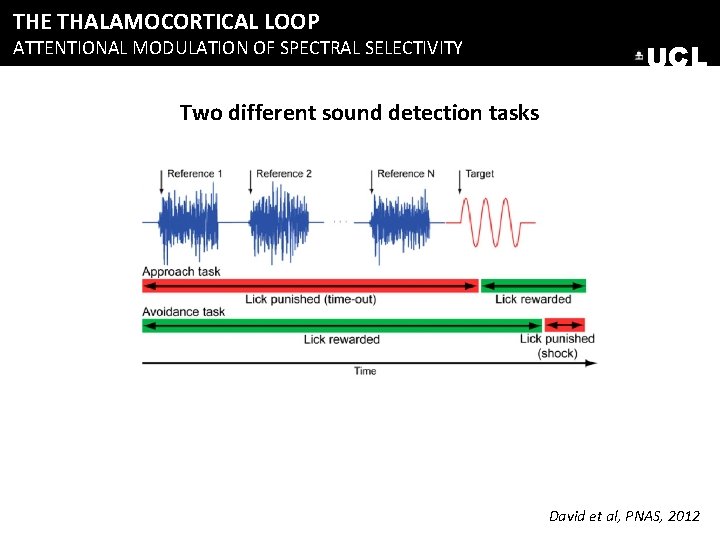
THE THALAMOCORTICAL LOOP ATTENTIONAL MODULATION OF SPECTRAL SELECTIVITY UCL Two different sound detection tasks David et al, PNAS, 2012
THE THALAMOCORTICAL LOOP ATTENTIONAL MODULATION OF SPECTRAL SELECTIVITY UCL Spectrotemporal receptive fields in ferret A 1 Example neurons Population averages Approach task Avoidance task David et al, PNAS, 2012
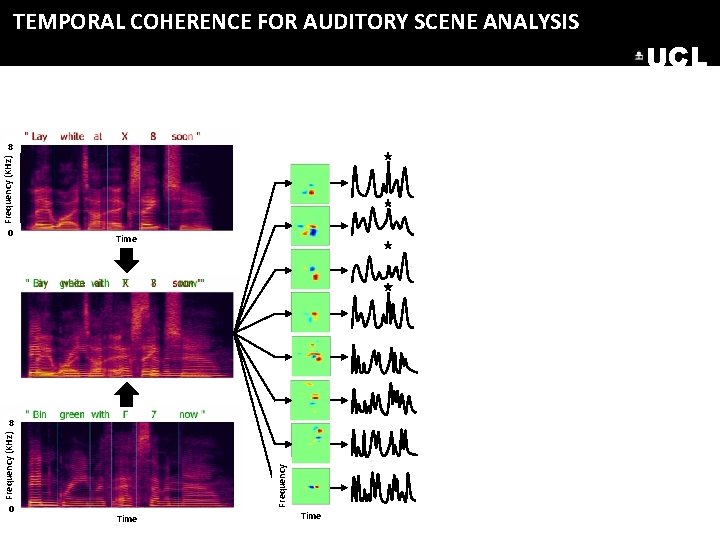
TEMPORAL COHERENCE FOR AUDITORY SCENE ANALYSIS UCL Frequency (KHz) 8 0 Time 0 Frequency (KHz) 8 Time
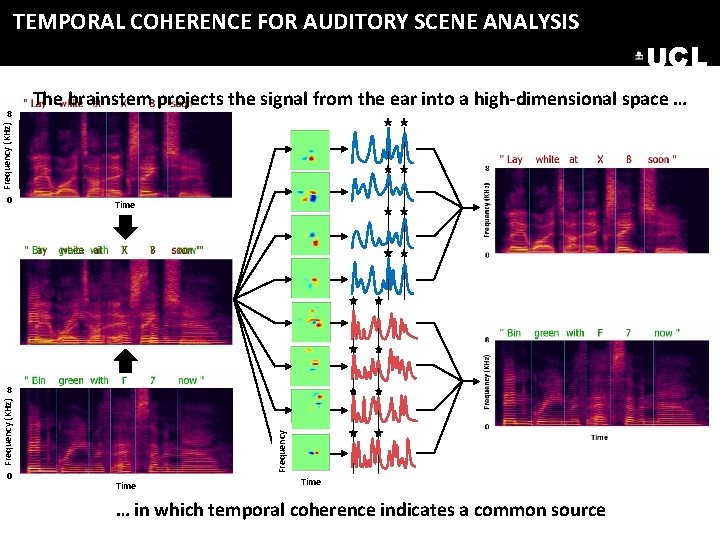
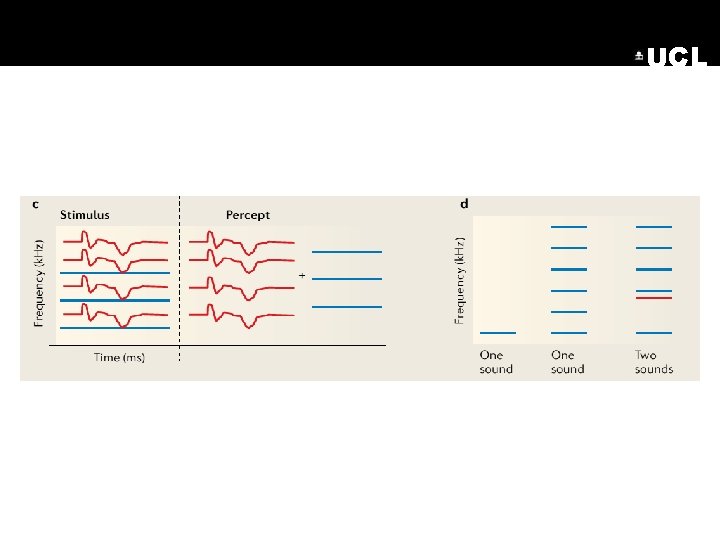
TEMPORAL COHERENCE FOR AUDITORY SCENE ANALYSIS UCL The brainstem projects the signal from the ear into a high-dimensional space … Frequency (KHz) 8 0 Time 0 Frequency (KHz) 8 Time … in which temporal coherence indicates a common source
UCL