
The Structure and Function of Macromolecules What are

- Slides: 65
The Structure and Function of Macromolecules
What are Macromolecules? They are ENORMOUS…as far as molecules go. n Many are composed of thousands of atoms Extremely complex n Shape is often vital to function Most biological molecules are macromolecules n This does NOT mean that smaller and/or inorganic molecules are unimportant to life.
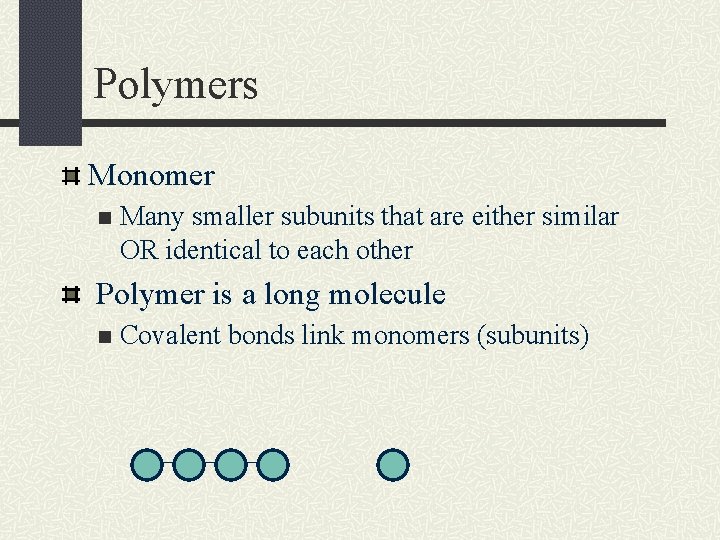
Polymers Monomer n Many smaller subunits that are either similar OR identical to each other Polymer is a long molecule n Covalent bonds link monomers (subunits)
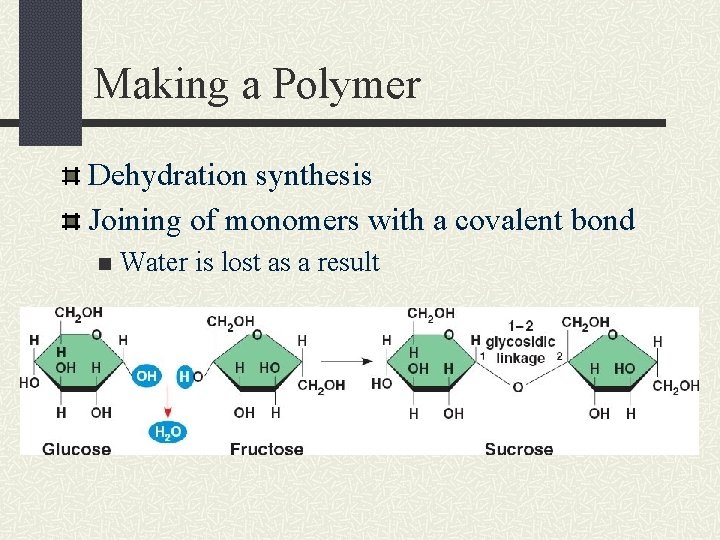
Making a Polymer Dehydration synthesis Joining of monomers with a covalent bond n Water is lost as a result
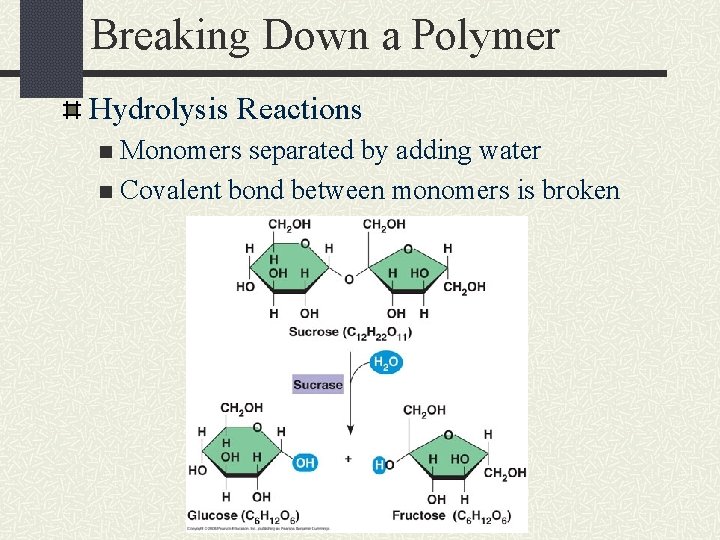
Breaking Down a Polymer Hydrolysis Reactions Monomers separated by adding water n Covalent bond between monomers is broken n
Variety of Organic Macromolecules Relatively few building blocks still lead to incredible variety in the molecules made This is due to the ARRANGEMENT of the molecules – HOW they are put together.
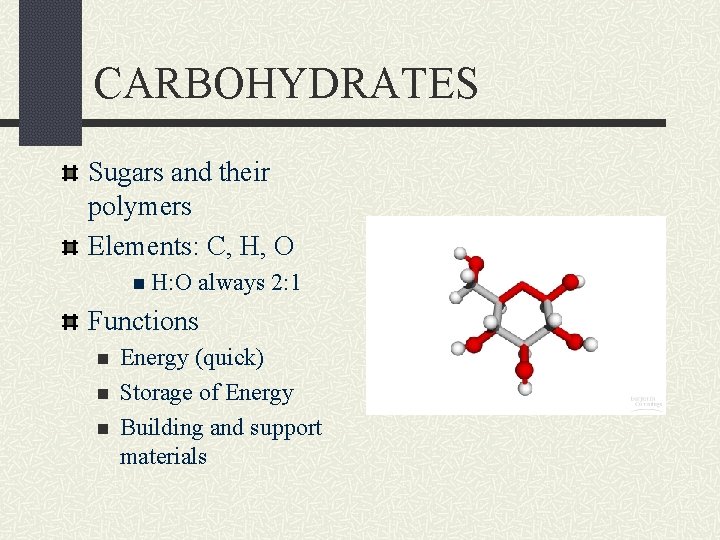
CARBOHYDRATES Sugars and their polymers Elements: C, H, O n H: O always 2: 1 Functions n n n Energy (quick) Storage of Energy Building and support materials
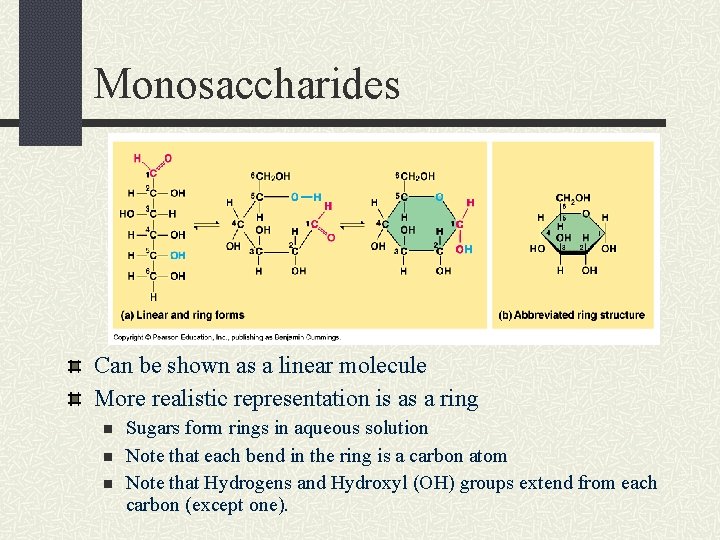
Monosaccharides (simple sugars) MONOMERS of the carbohydrate n Monosaccharide = simple sugar n (CH 2 O)n n Glucose (C 6 H 12 O 6) most common FUNCTION: quick energy and as monomers for all other carbohydrate molecules
Monosaccharides Can be shown as a linear molecule More realistic representation is as a ring n n n Sugars form rings in aqueous solution Note that each bend in the ring is a carbon atom Note that Hydrogens and Hydroxyl (OH) groups extend from each carbon (except one).
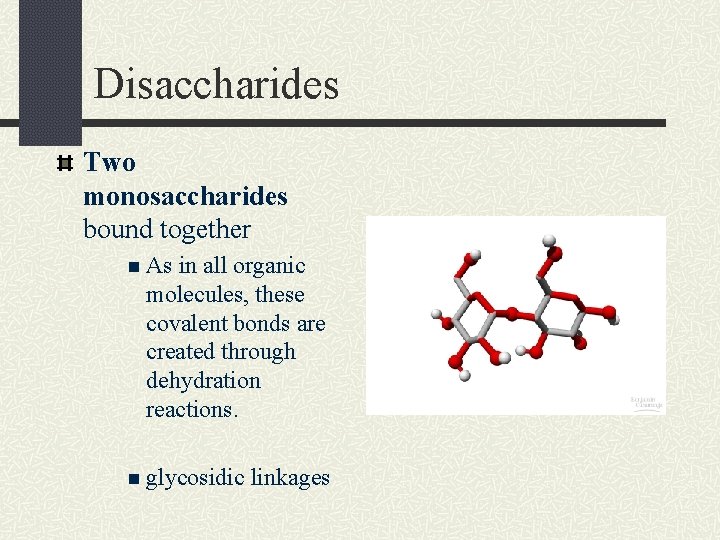
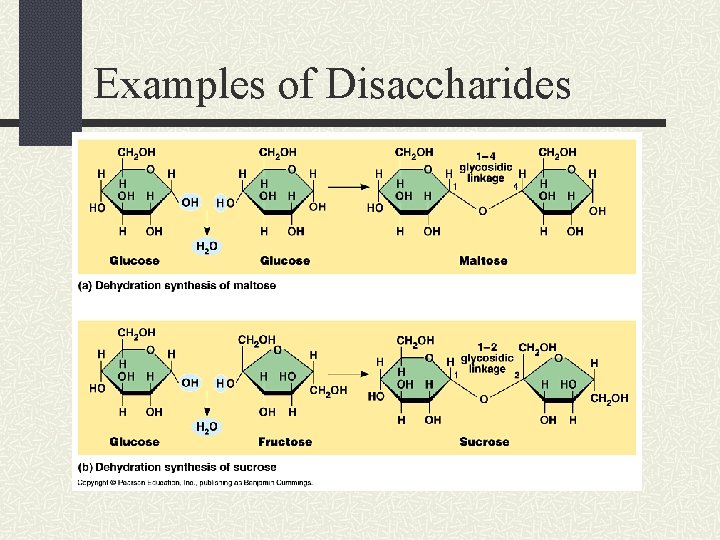
Disaccharides Two monosaccharides bound together n As in all organic molecules, these covalent bonds are created through dehydration reactions. n glycosidic linkages
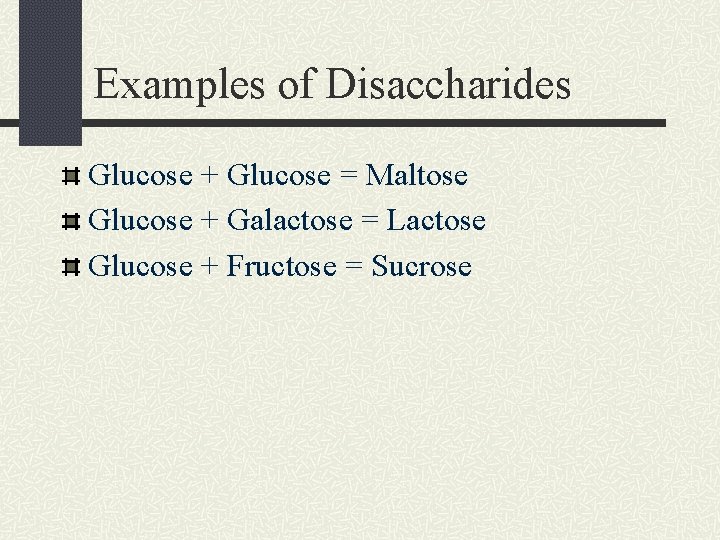
Examples of Disaccharides Glucose + Glucose = Maltose Glucose + Galactose = Lactose Glucose + Fructose = Sucrose
Examples of Disaccharides
Functions of Disaccharides Function 1 Transport in plants n Sugar being transported from leaves to roots is more safe (resists being consumed by the plant) when transported as sucrose. n Side note: Few adult mammals have the necessary enzymes to break down lactose n Preserves milk supply for young who need it n
Polysaccharides macromolecule - few hundred to a few thousand monosaccharides linked covalently (glycosidic linkages) FUNCTION 1 n Energy Storage FUNCTION 2 n Building and support material
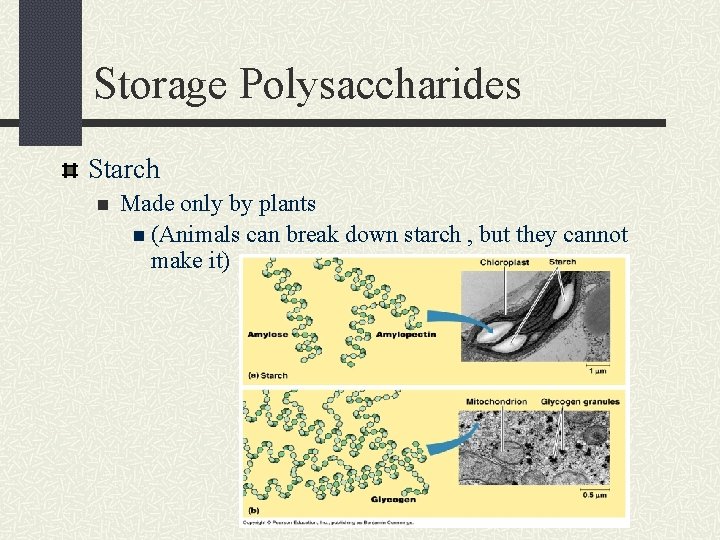
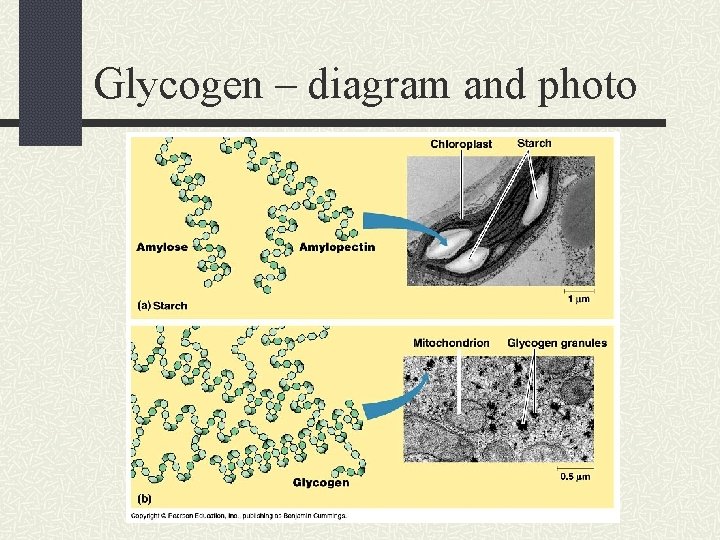
Storage Polysaccharides Starch n Made only by plants n (Animals can break down starch , but they cannot make it)
Storage Polysaccharides Glycogen Storage polysaccharide created and used by ANIMALS n Found in the liver and muscles n Highly branched chains of glucose n Only about a day’s supply of glycogen is stored in the body n Note: Polysaccharides are NOT the major energy storage compound in animals that they are in plants n
Glycogen – diagram and photo
Structural Polysaccharides Structural polysaccharides are those that are used in building physical structures in an organism Most often we think of cell walls in plants, but there are others.
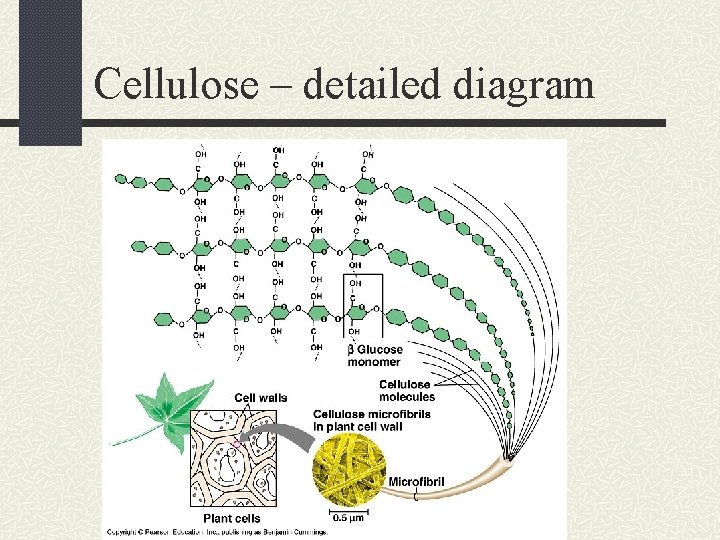
Cellulose Structural polysaccharide that makes up plant cell walls The bulk of the woody part of a plant Cellulose structure n n n Long chains of glucose – similar to starch Glucose molecules are linked differently from starch Difference makes cellulose indigestible to almost all organisms EXCEPT bacteria and some other microbes
Cellulose – detailed diagram
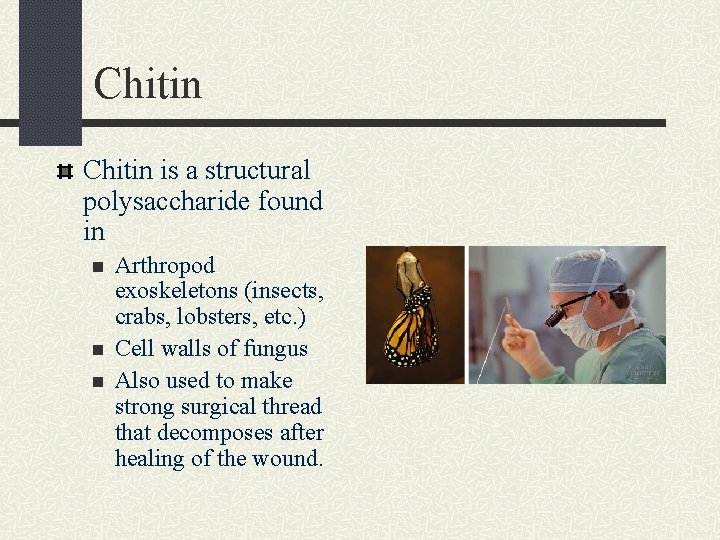
Chitin is a structural polysaccharide found in n Arthropod exoskeletons (insects, crabs, lobsters, etc. ) Cell walls of fungus Also used to make strong surgical thread that decomposes after healing of the wound.
LIPIDS Elements : C, H, O (way less O than Carbs) Major types n n Fats and oils Waxes Phospholipids steroids Functions n n Energy storage Insulation Cushioning Cell communication
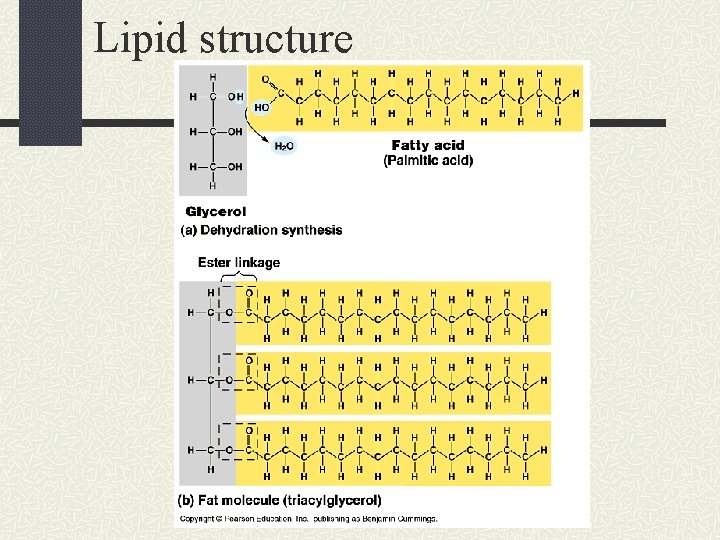
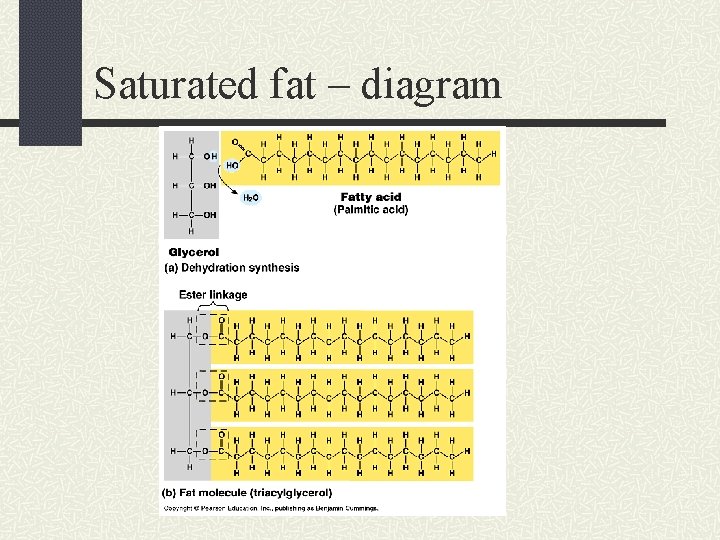
Lipid Structure Composed of two kinds of smaller molecules n Glycerol n n n Fatty acids n n An alcohol 3 carbons each with an –OH group LONG carbon / hydrogen chains Carboxyl group at one end Hydrocarbon tail makes up bulk of the fatty acid Glycerol linked to 3 fatty acids with ester bonds/linkages n Ester bond = type of covalent bond
Lipid structure
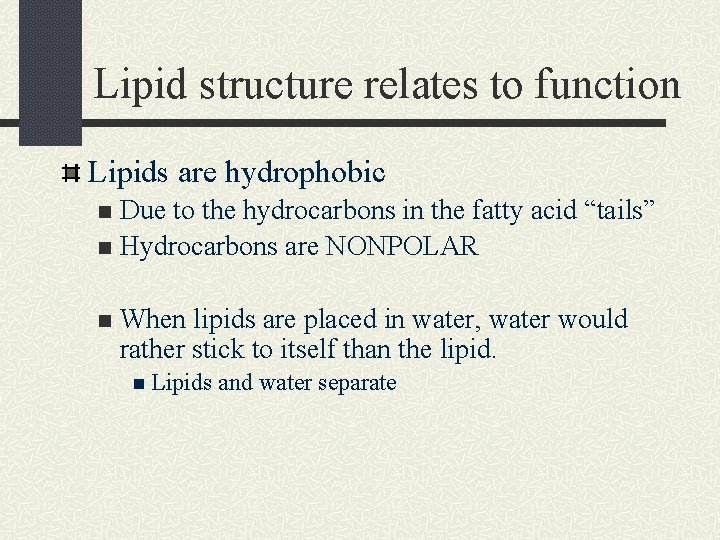
Lipid structure relates to function Lipids are hydrophobic Due to the hydrocarbons in the fatty acid “tails” n Hydrocarbons are NONPOLAR n n When lipids are placed in water, water would rather stick to itself than the lipid. n Lipids and water separate
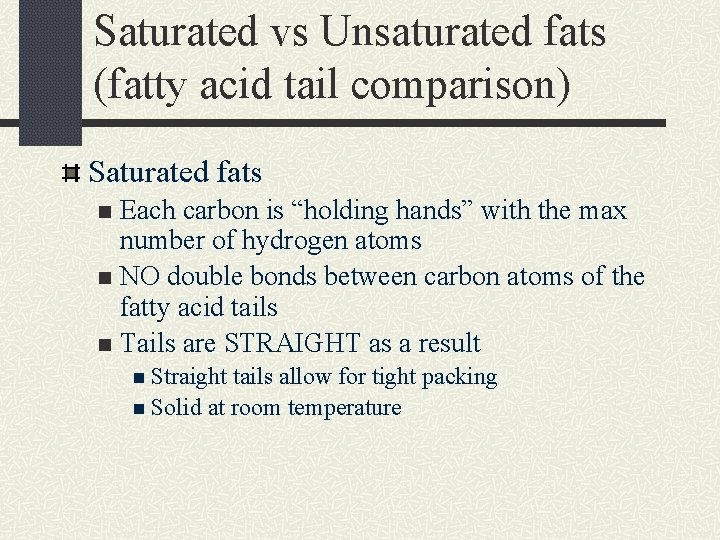
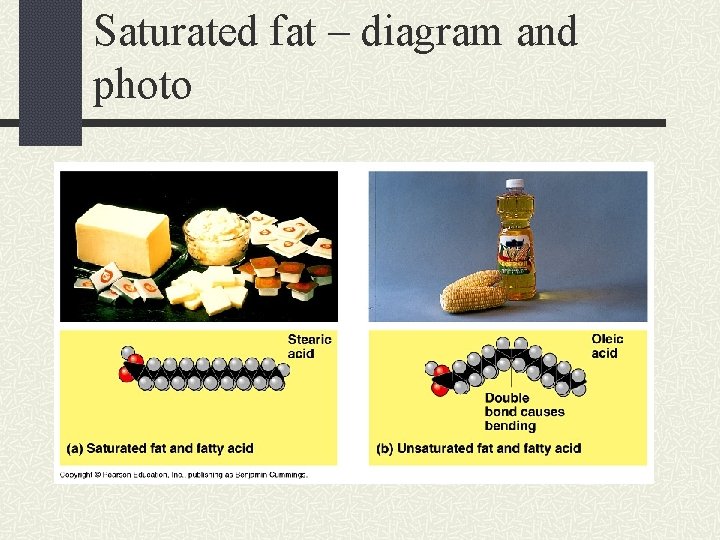
Saturated vs Unsaturated fats (fatty acid tail comparison) Saturated fats Each carbon is “holding hands” with the max number of hydrogen atoms n NO double bonds between carbon atoms of the fatty acid tails n Tails are STRAIGHT as a result n Straight tails allow for tight packing n Solid at room temperature n
Saturated fat – diagram
Saturated fat – diagram and photo
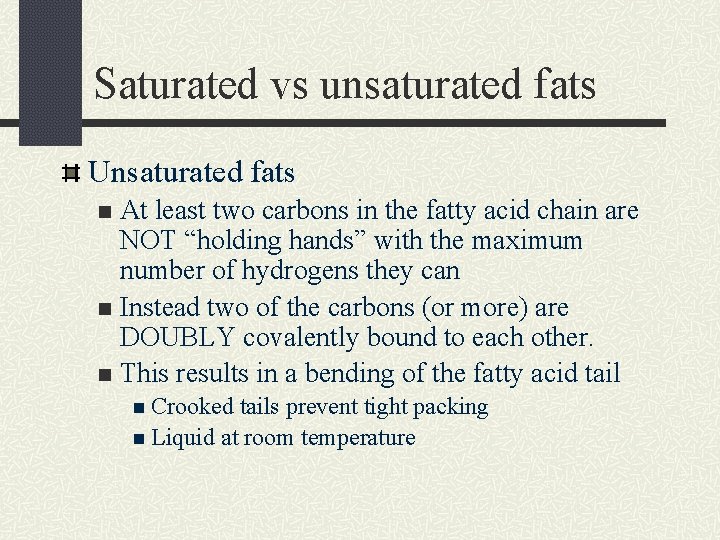
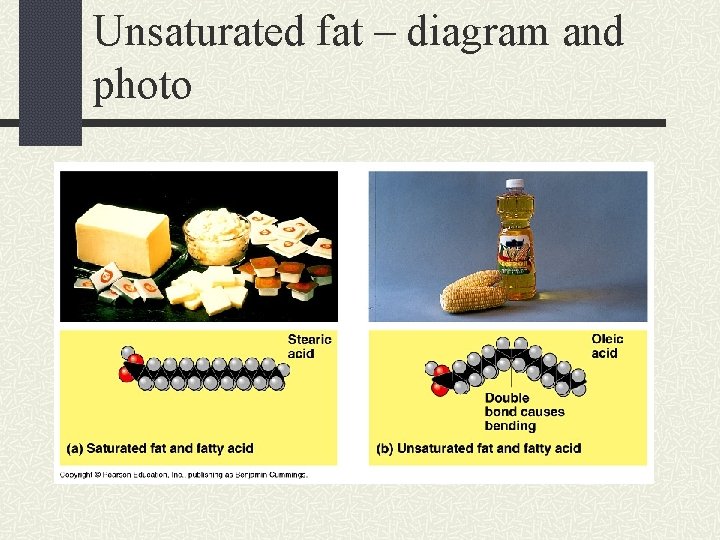
Saturated vs unsaturated fats Unsaturated fats At least two carbons in the fatty acid chain are NOT “holding hands” with the maximum number of hydrogens they can n Instead two of the carbons (or more) are DOUBLY covalently bound to each other. n This results in a bending of the fatty acid tail n Crooked tails prevent tight packing n Liquid at room temperature n
Unsaturated fat – diagram and photo
Functions of Fat Primary function = Energy Storage One gram of fat stores twice the energy of a gram of polysaccharide n Advantageous to animals that have to move around – unlike plants that can have unlimited bulk without concern for mobility. n Cells that store fat – adipose cells n
Functions of Fat Other functions specifically related to FAT Cushioning n Insulation n
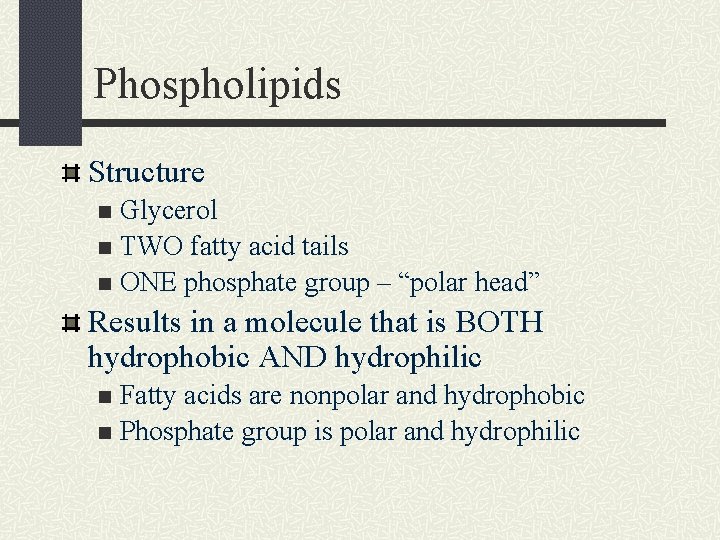
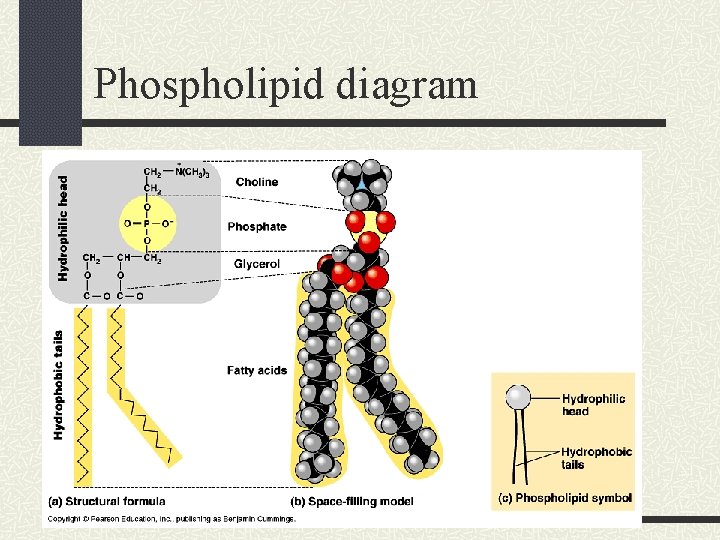
Phospholipids Structure Glycerol n TWO fatty acid tails n ONE phosphate group – “polar head” n Results in a molecule that is BOTH hydrophobic AND hydrophilic Fatty acids are nonpolar and hydrophobic n Phosphate group is polar and hydrophilic n
Phospholipid diagram
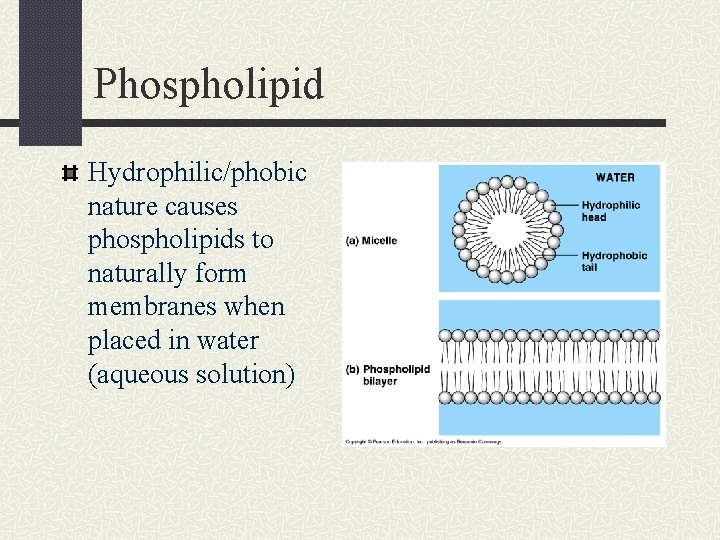
Phospholipid Hydrophilic/phobic nature causes phospholipids to naturally form membranes when placed in water (aqueous solution)
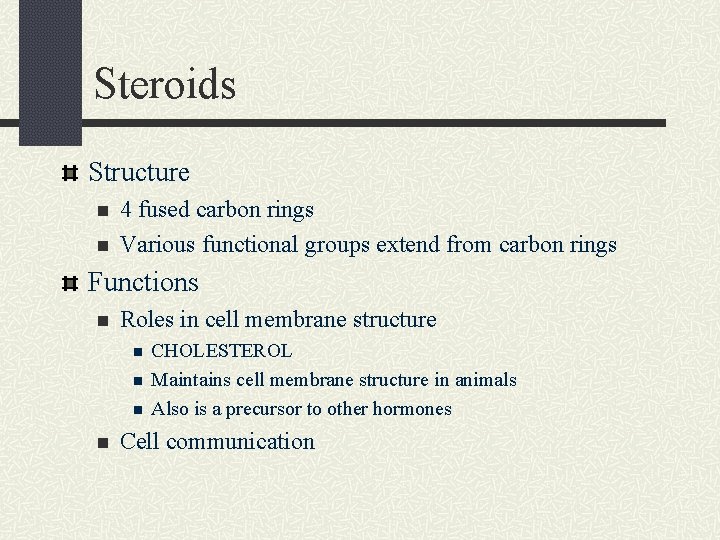
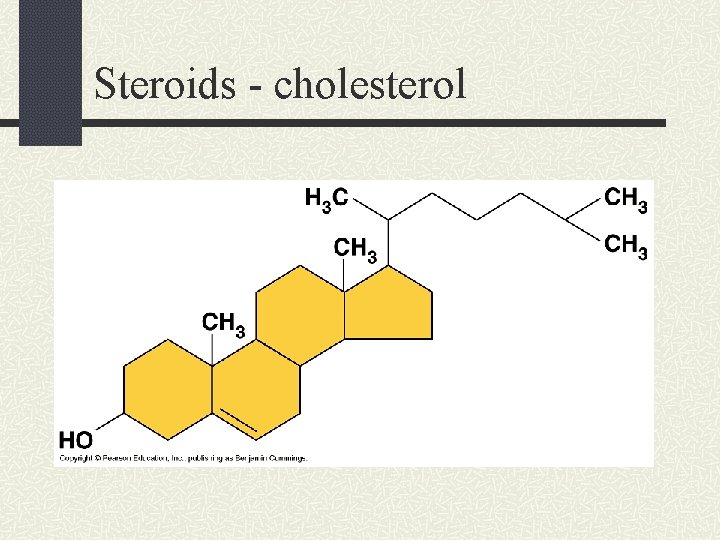
Steroids Structure n n 4 fused carbon rings Various functional groups extend from carbon rings Functions n Roles in cell membrane structure n n CHOLESTEROL Maintains cell membrane structure in animals Also is a precursor to other hormones Cell communication
Steroids - cholesterol
PROTEINS MANY Important Functions n Structural proteins – support n n Storage proteins – storage of amino acids n n n hemoglobin Hormonal proteins – coordination of activities n n Albumin in egg white; casein in milk Transport proteins – transport many substances across cell membranes or through the body n n Silk in cocoons/webs; collagen in connective tissue Insulin – controls concentration of sugar in the blood Receptor proteins – receive chemical stimuli and respond Contractile proteins – movement Defensive proteins – protection against disease Enzymatic proteins – speed up chemical reactions!!
Variety of Proteins Variety within the different types of proteins is staggering! n There are many thousands of different types of enzymes alone – each specifically designed for a particular chemical reaction.
Importance of Shape Conformation – term for the unique 3 -D shape of a protein Shape is absolutely critical to protein function!!
Protein Structure Elements: CHON Monomers = AMINO ACIDS POLYPEPTIDE is a polymer of amino acids n Polypeptide may or may NOT be a fully functional protein One or more polypeptides configured in it’s particular shape = a protein
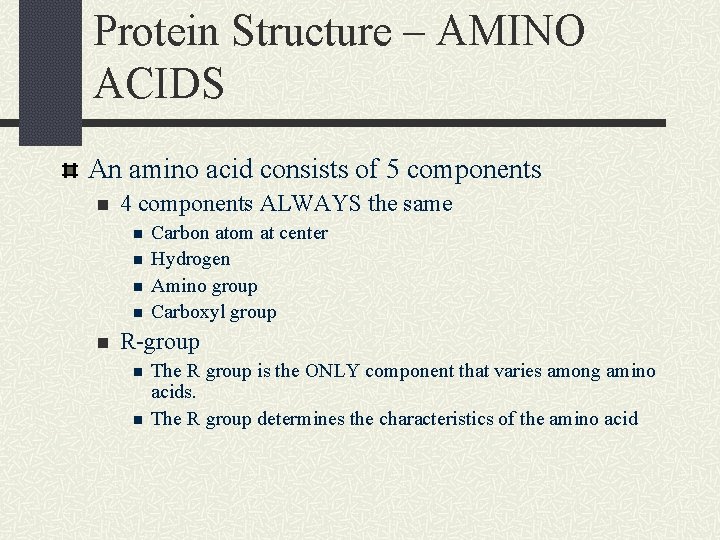
Protein Structure – AMINO ACIDS An amino acid consists of 5 components n 4 components ALWAYS the same n n n Carbon atom at center Hydrogen Amino group Carboxyl group R-group n n The R group is the ONLY component that varies among amino acids. The R group determines the characteristics of the amino acid
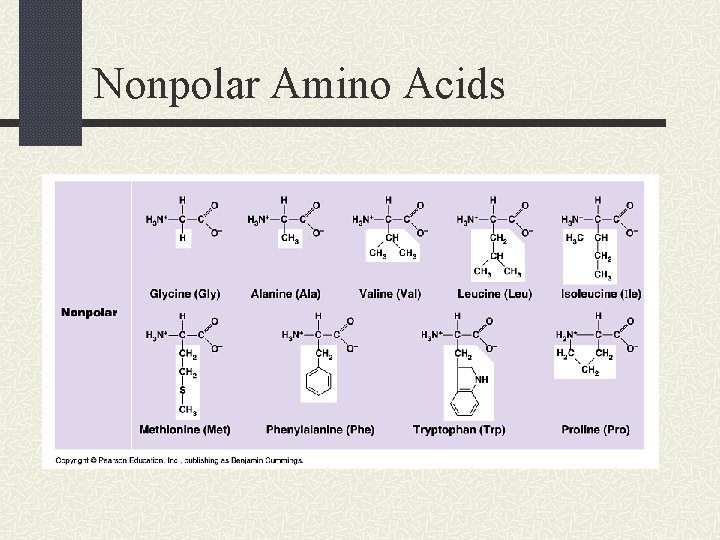
Nonpolar Amino Acids
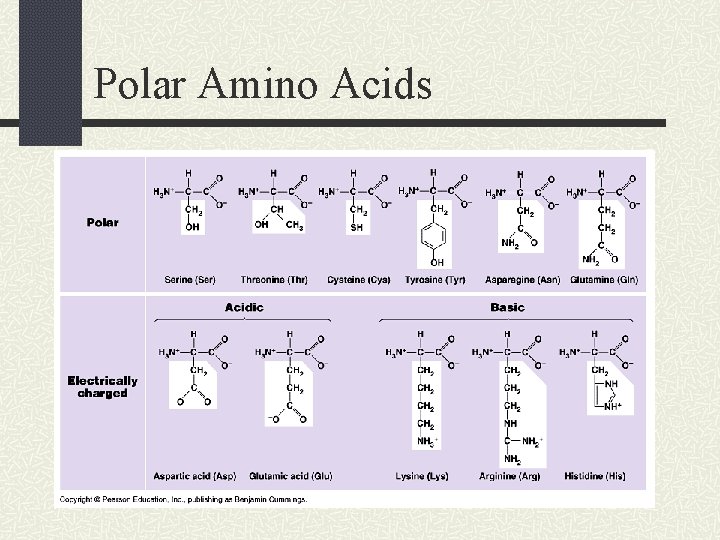
Polar Amino Acids
Forming a Polypeptide 20 different amino acids exist Can be assembled in any order Options for HUGE variety of polypeptides
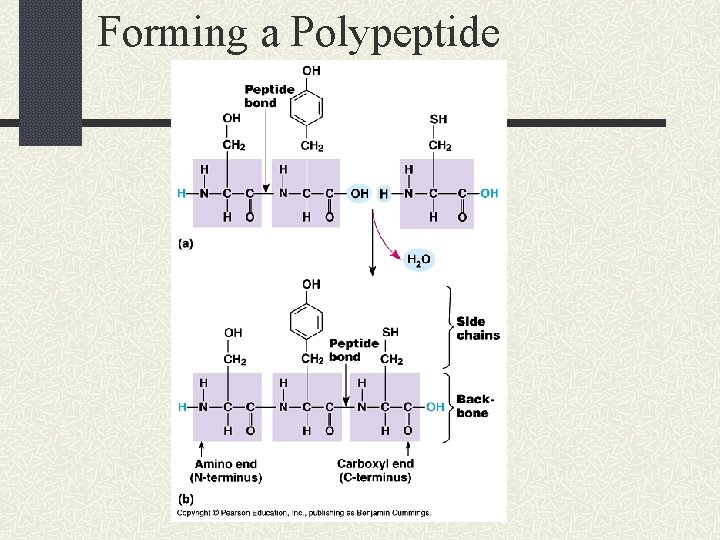
Forming a Polypeptide To join two amino acids: Carboxyl group of one must meet the amino group of another n An enzyme will join them via a dehydration reaction n The resulting bond is called a peptide bond n Repeating the process over and over creates a polypeptide n
Forming a Polypeptide
Formation of a Polypeptide The repeated sequence of atoms that remains constant from one amino acid to the next is the polypeptide backbone. The different appendages attached to the backbone are the R groups n The reactivity of the R groups with each other determines many unique properties of each polypeptide chain
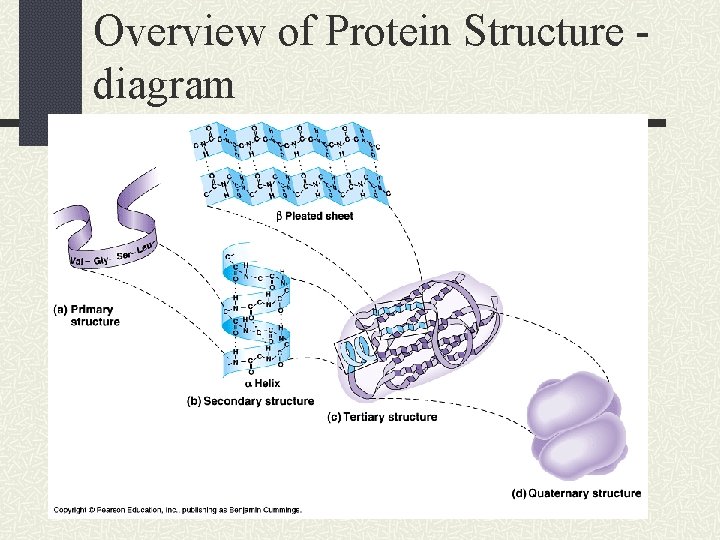
Four Levels of Protein Structure A functional protein is NOT just a polypeptide chain n It is one or MORE polypeptide chains precisely twisted, folded and coiled into a uniquely shaped molecule ORDER OF AMINO ACIDS determine the 3 -D SHAPE determines how the protein WORKS.
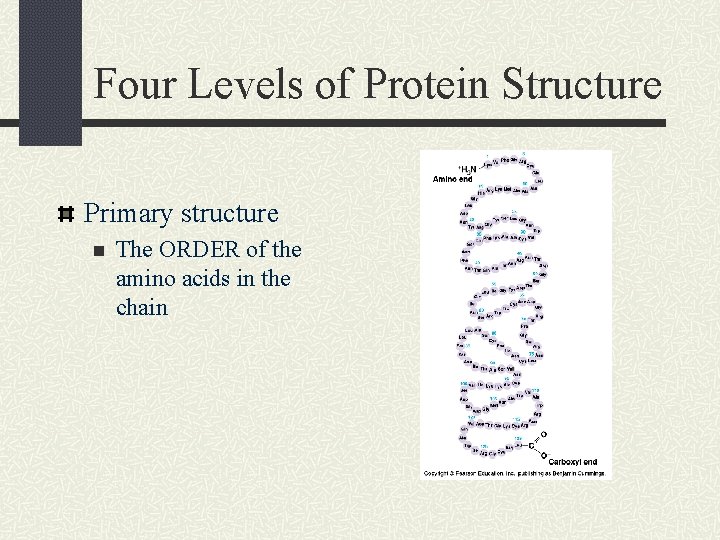
Four Levels of Protein Structure Primary structure n The ORDER of the amino acids in the chain
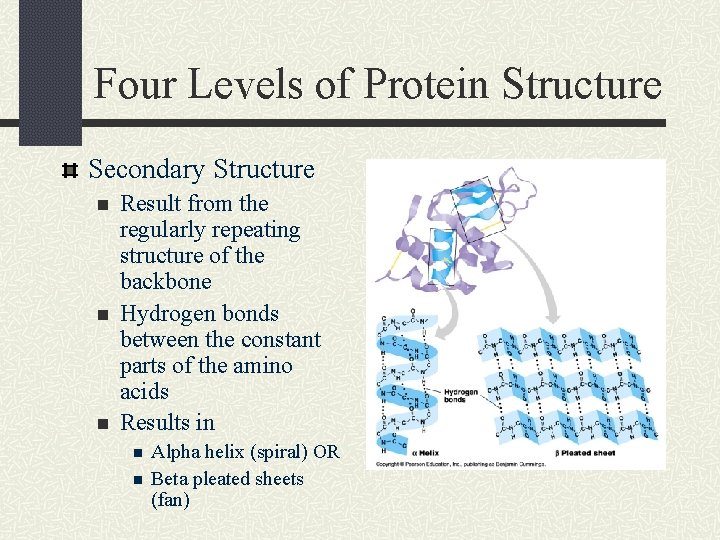
Four Levels of Protein Structure Secondary Structure n n n Result from the regularly repeating structure of the backbone Hydrogen bonds between the constant parts of the amino acids Results in n n Alpha helix (spiral) OR Beta pleated sheets (fan)
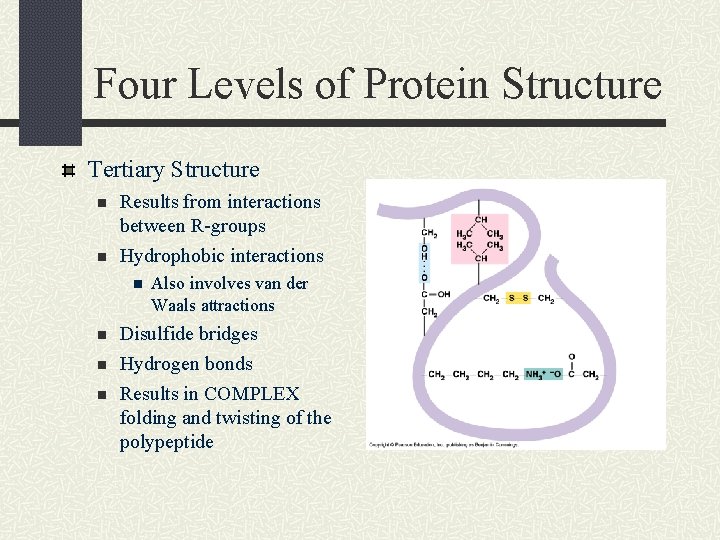
Four Levels of Protein Structure Tertiary Structure n n Results from interactions between R-groups Hydrophobic interactions n n Also involves van der Waals attractions Disulfide bridges Hydrogen bonds Results in COMPLEX folding and twisting of the polypeptide
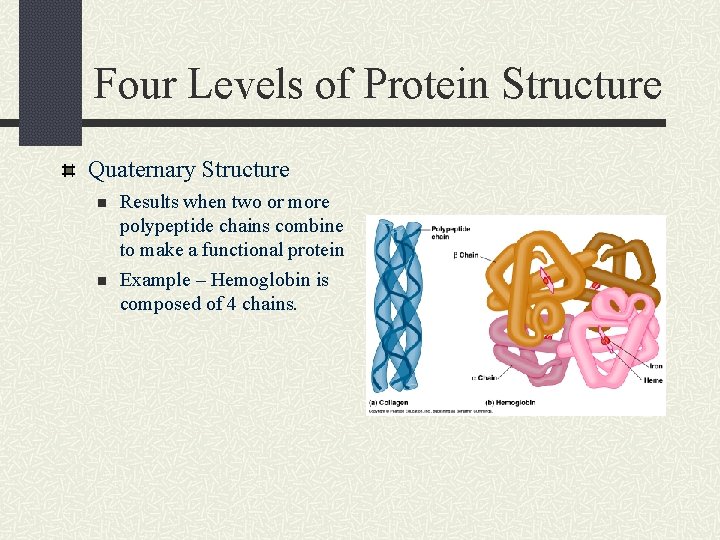
Four Levels of Protein Structure Quaternary Structure n n Results when two or more polypeptide chains combine to make a functional protein Example – Hemoglobin is composed of 4 chains.
Overview of Protein Structure diagram
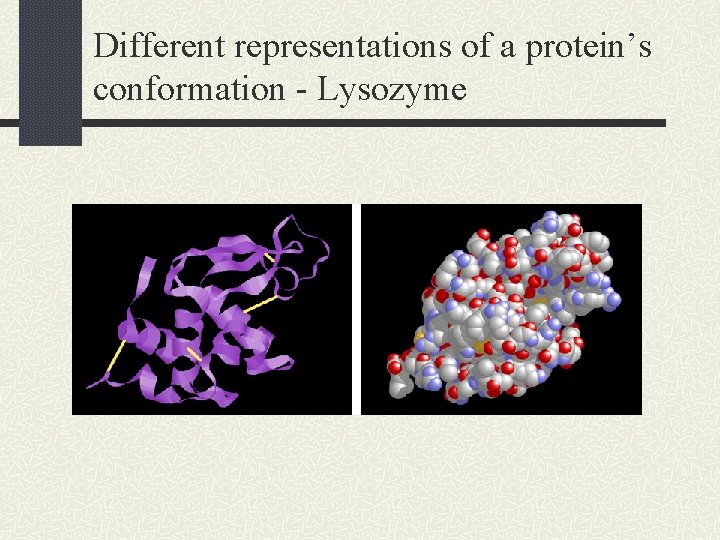
Different representations of a protein’s conformation - Lysozyme
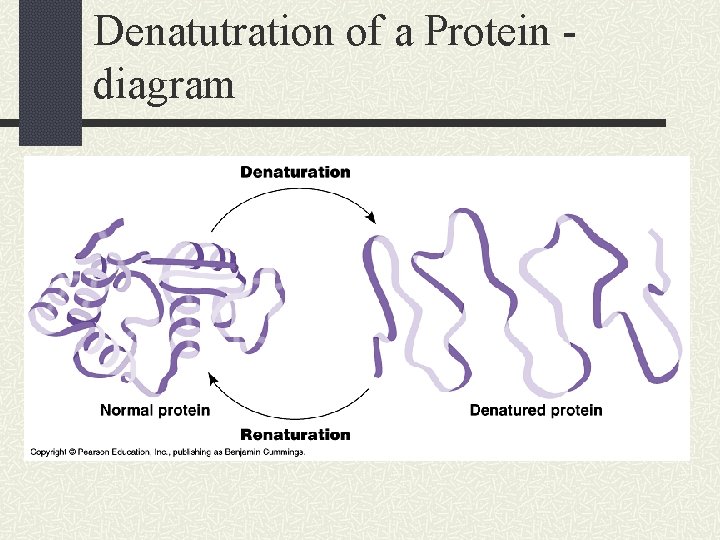
Environment and Protein Conformation (SHAPE) Environment plays an important role in shape of a protein Environment unsuitable, protein can DENATURE n – loss of a protein’s SHAPE (conformation)
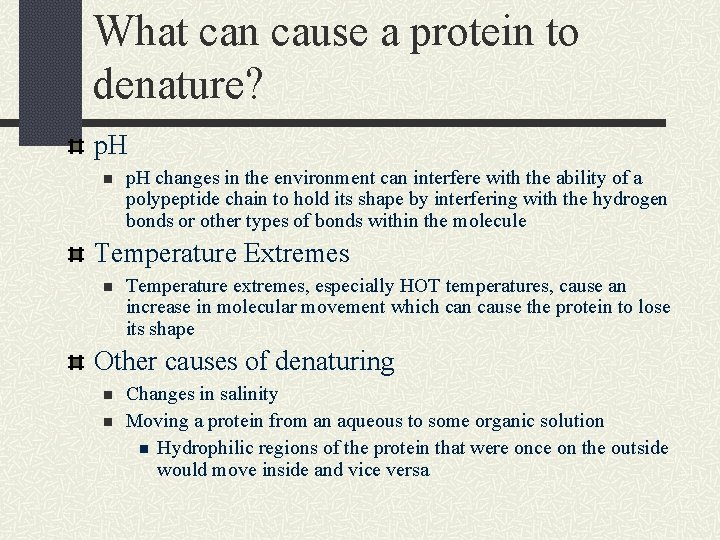
What can cause a protein to denature? p. H n p. H changes in the environment can interfere with the ability of a polypeptide chain to hold its shape by interfering with the hydrogen bonds or other types of bonds within the molecule Temperature Extremes n Temperature extremes, especially HOT temperatures, cause an increase in molecular movement which can cause the protein to lose its shape Other causes of denaturing n n Changes in salinity Moving a protein from an aqueous to some organic solution n Hydrophilic regions of the protein that were once on the outside would move inside and vice versa
Denatutration of a Protein diagram
NUCLEIC ACIDS Genes give the information for constructing proteins Genes are made of nucleic acids
Two types of Nucleic Acid DNA n Deoxyribonucleic Acid RNA n Ribonucleic Acid
Nucleic Acid Structure Nucleic Acids (both RNA and DNA) are polymers The monomers making up these polymers are nucleotides
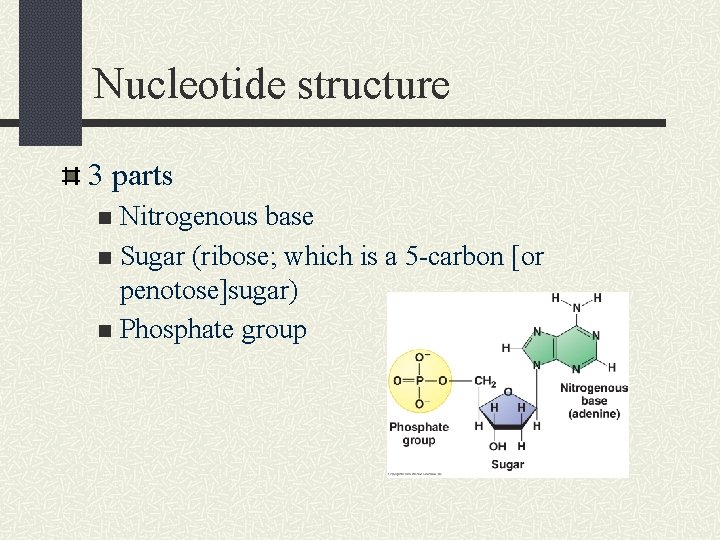
Nucleotide structure 3 parts Nitrogenous base n Sugar (ribose; which is a 5 -carbon [or penotose]sugar) n Phosphate group n
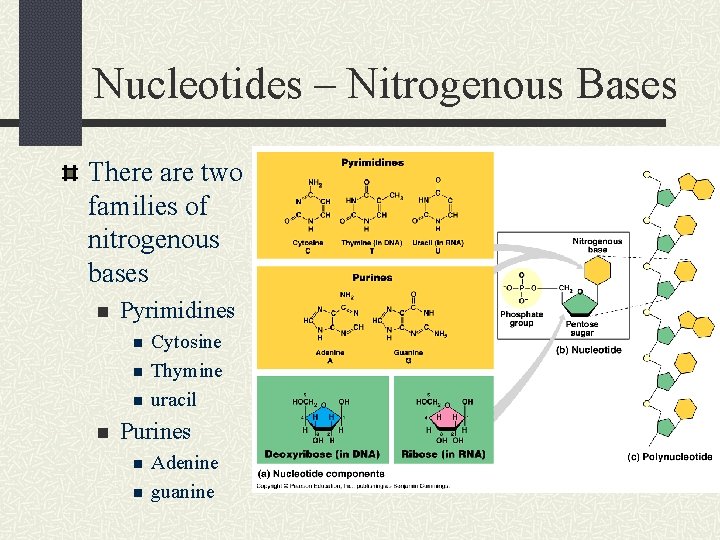
Nucleotides – Nitrogenous Bases There are two families of nitrogenous bases n Pyrimidines n n Cytosine Thymine uracil Purines n n Adenine guanine
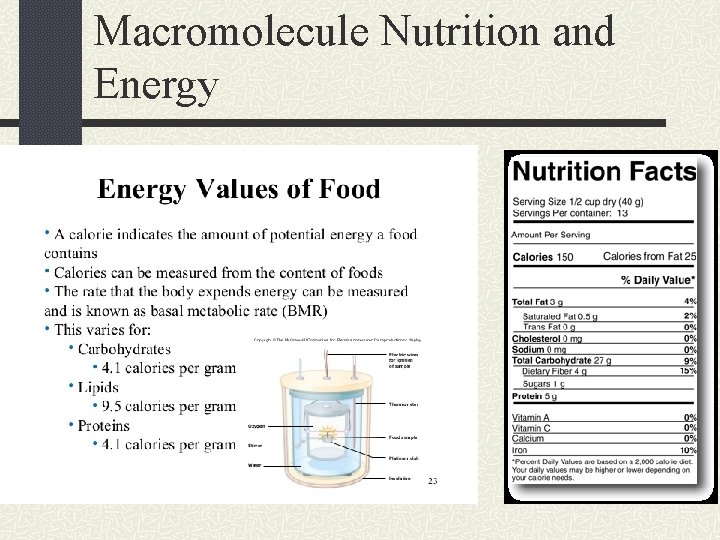
Macromolecule Nutrition and Energy
65