
The Structure and Function of Macromolecules Carbohydrates Lipids
The Structure and Function of Macromolecules: Carbohydrates, Lipids & Phospholipids
The FOUR Classes of Large Biomolecules • All living things are made up of four classes of large biological molecules: • • Carbohydrates Lipids Protein Nucleic Acids • Macromolecules are large molecules composed of thousands of covalently bonded atoms • Molecular structure and function are inseparable 2
The FOUR Classes of Large Biomolecules • Macromolecules are polymers, built from monomers • A polymer is a long molecule consisting of many similar building blocks • These small building-block molecules are called monomers • Three of the four classes of life’s organic molecules are polymers – Carbohydrates – Proteins – Nucleic acids 3
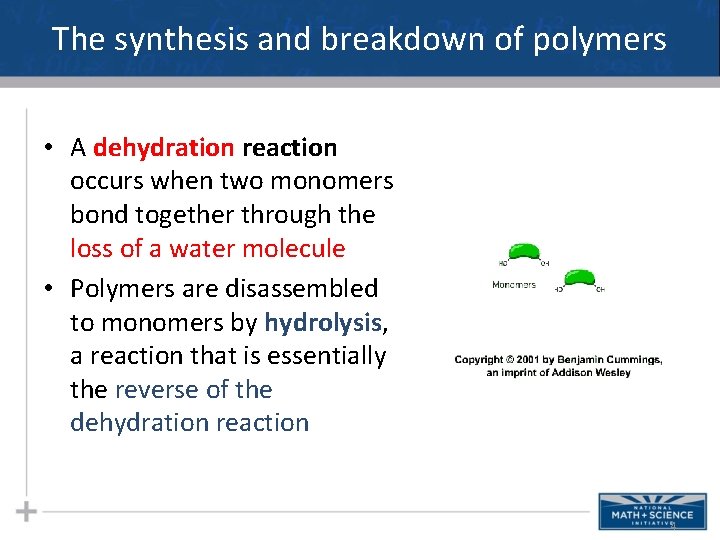
The synthesis and breakdown of polymers • A dehydration reaction occurs when two monomers bond together through the loss of a water molecule • Polymers are disassembled to monomers by hydrolysis, a reaction that is essentially the reverse of the dehydration reaction 4
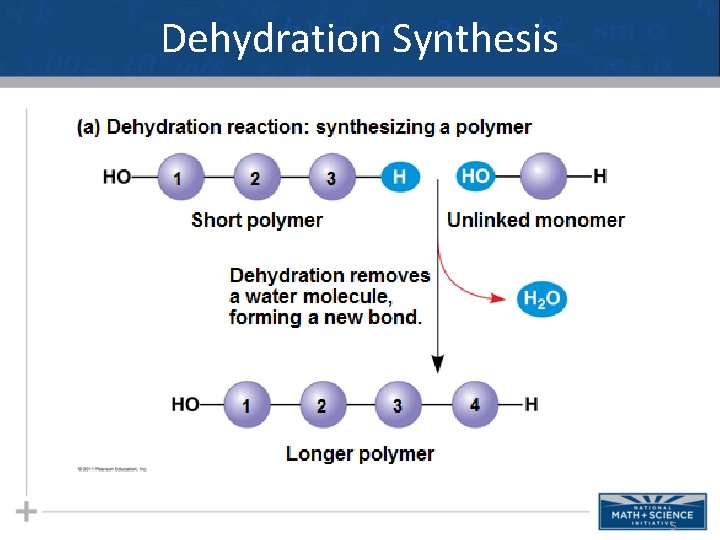
Dehydration Synthesis 5
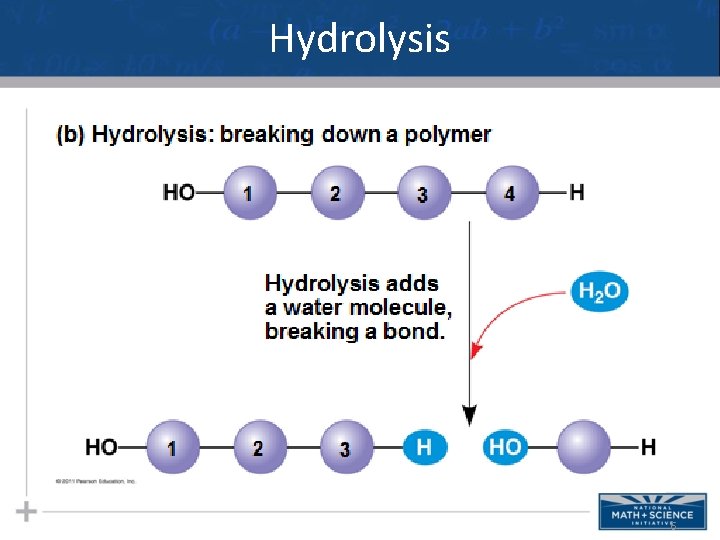
Hydrolysis 6
The Diversity of Polymers • Each cell has thousands of different macromolecules • Macromolecules vary among cells of an organism, vary more within a species, and vary even more between species • An immense variety of polymers can be built from a small set of monomers 7
Carbohydrates Serve as Fuel & Building Material • Carbohydrates include sugars and the polymers of sugars • The simplest carbohydrates are monosaccharides, or single sugars • Carbohydrate macromolecules are polysaccharides, polymers composed of many sugar building blocks 8
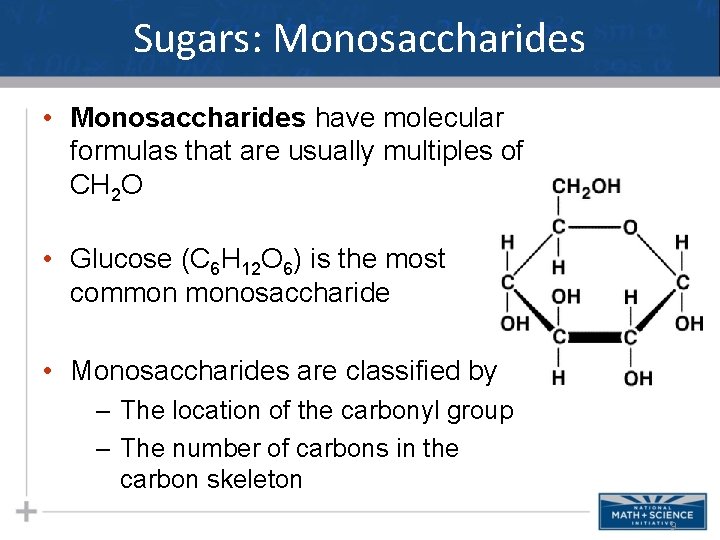
Sugars: Monosaccharides • Monosaccharides have molecular formulas that are usually multiples of CH 2 O • Glucose (C 6 H 12 O 6) is the most common monosaccharide • Monosaccharides are classified by – The location of the carbonyl group – The number of carbons in the carbon skeleton 9
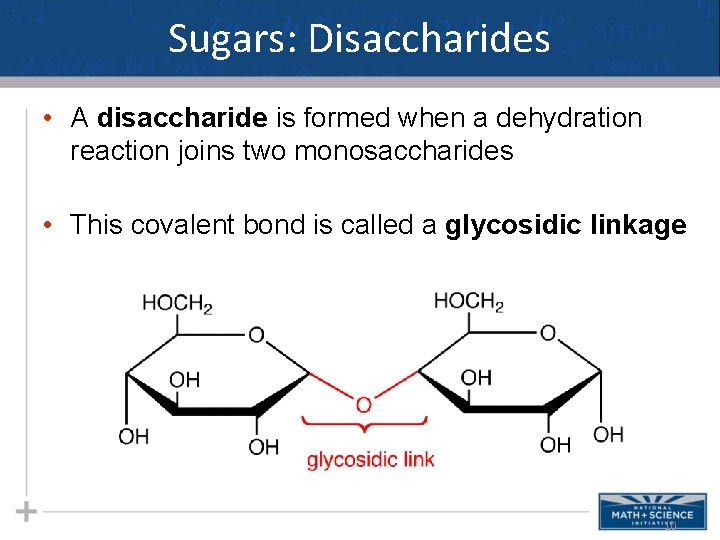
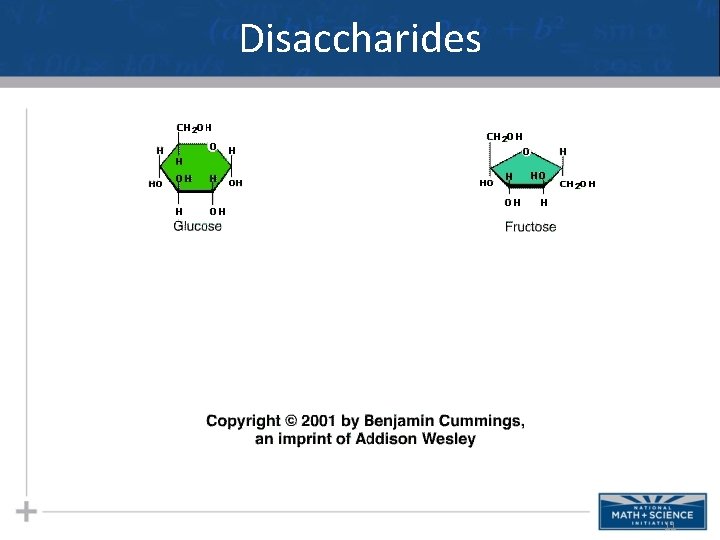
Sugars: Disaccharides • A disaccharide is formed when a dehydration reaction joins two monosaccharides • This covalent bond is called a glycosidic linkage 10
Disaccharides 11
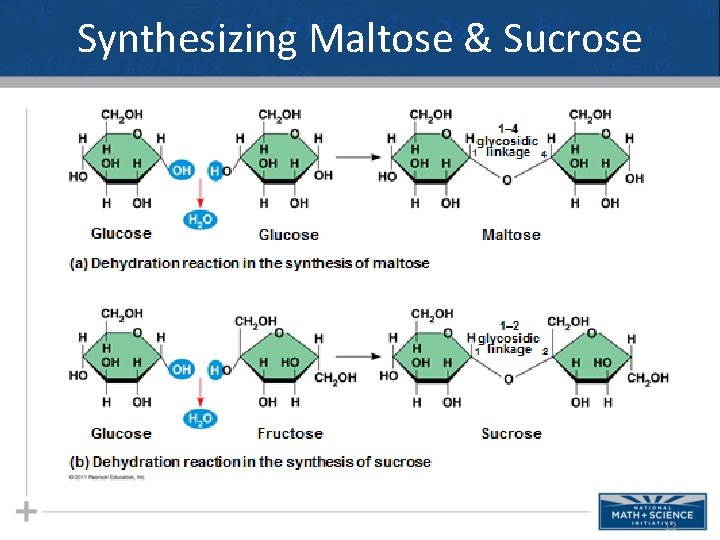
Synthesizing Maltose & Sucrose 12
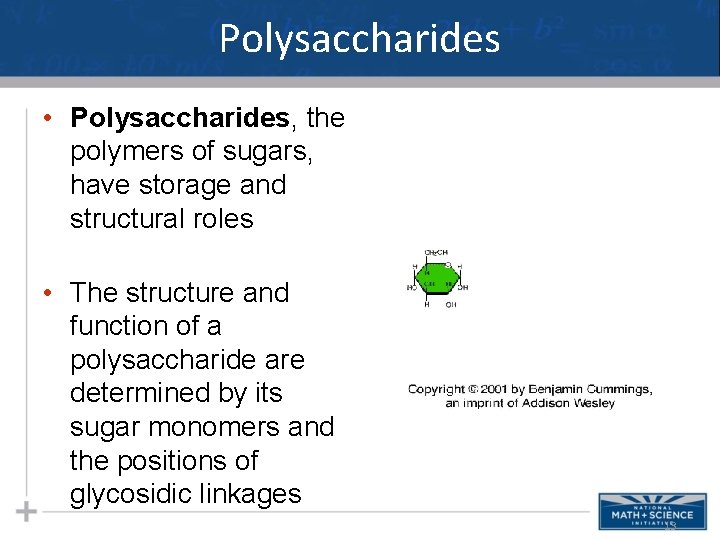
Polysaccharides • Polysaccharides, the polymers of sugars, have storage and structural roles • The structure and function of a polysaccharide are determined by its sugar monomers and the positions of glycosidic linkages 13
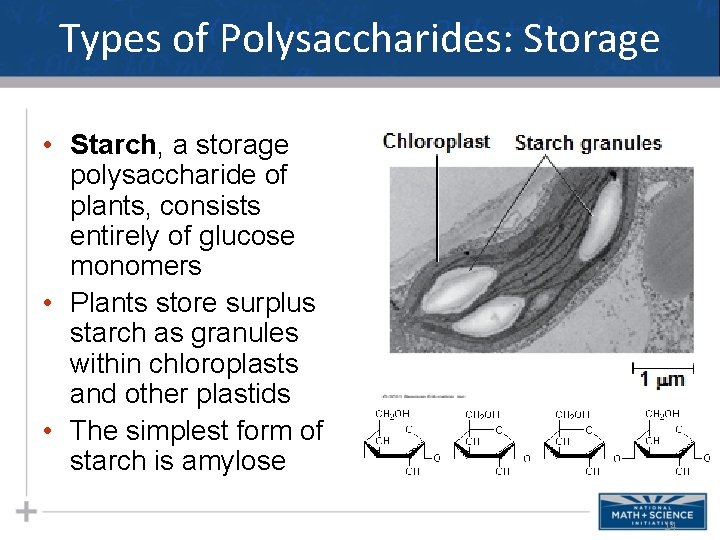
Types of Polysaccharides: Storage • Starch, a storage polysaccharide of plants, consists entirely of glucose monomers • Plants store surplus starch as granules within chloroplasts and other plastids • The simplest form of starch is amylose 14
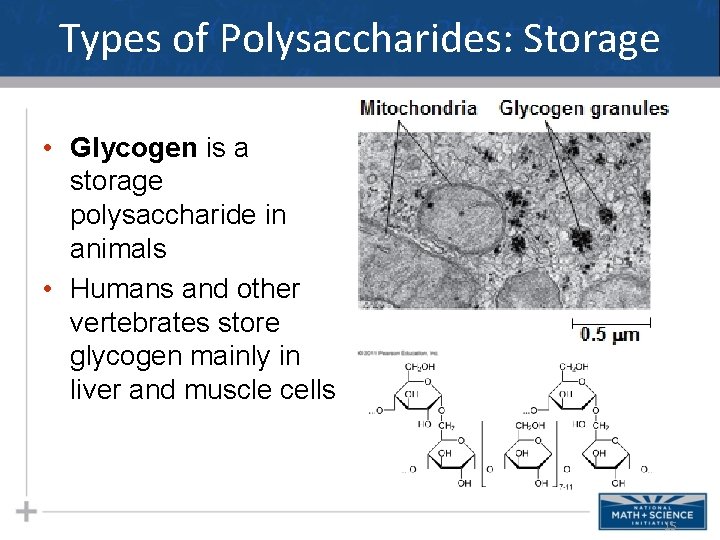
Types of Polysaccharides: Storage • Glycogen is a storage polysaccharide in animals • Humans and other vertebrates store glycogen mainly in liver and muscle cells 15
Types of Polysaccharides: Structural • The polysaccharide cellulose is a major component of the tough wall of plant cells • Like starch, cellulose is a polymer of glucose, but the glycosidic linkages differ • The difference is based on two ring forms for glucose: alpha ( ) and beta ( ) 16
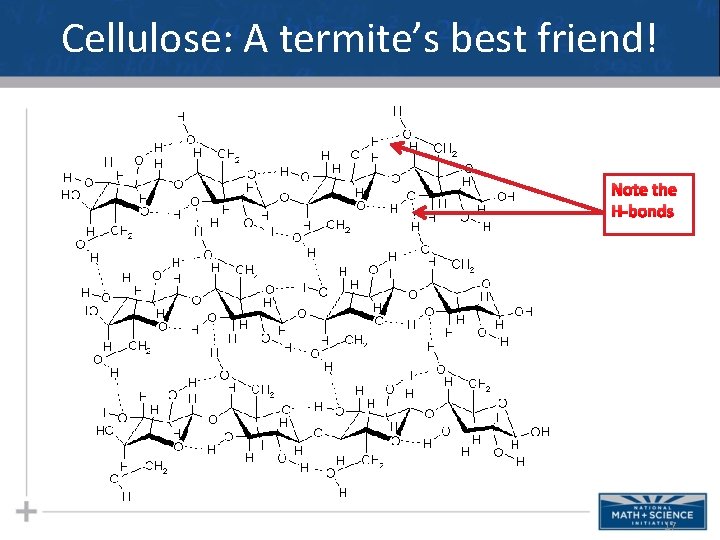
Cellulose: A termite’s best friend! Note the H-bonds 17
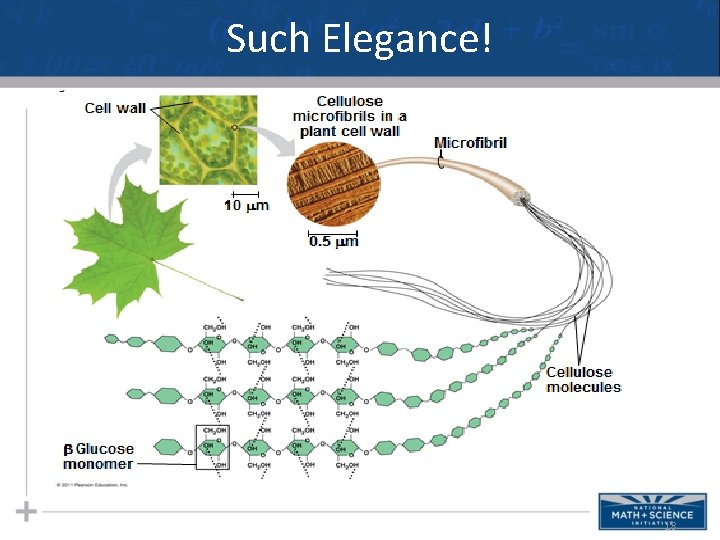
Such Elegance! 18
Polysaccharide Random Acts of Biology • Cellulose in human food passes through the digestive tract as insoluble fiber • Some microbes use enzymes to digest cellulose • Many herbivores, from cows to termites, have symbiotic relationships with these microbes • Chitin, another structural polysaccharide, is found in the exoskeleton of arthropods (crunch!) • Chitin also provides structural support for the cell walls of many fungi 19
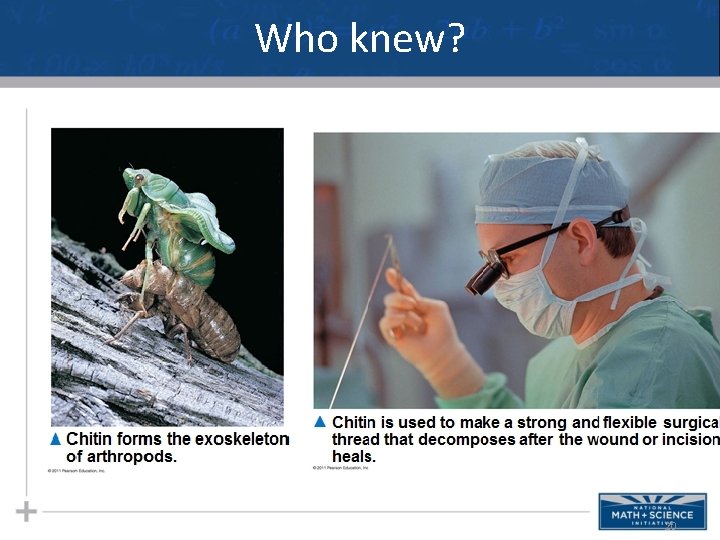
Who knew? 20
Lipids Are Hydrophobic Lipids are a diverse group of hydrophobic molecules • Lipids are the one class of large biological molecules that do not form polymers • The unifying feature of lipids is having little or no affinity for water (water fearing) • Lipids are hydrophobic because they consist mostly of hydrocarbons, which form nonpolar covalent bonds • The most biologically important lipids are fats, phospholipids, and steroids 21
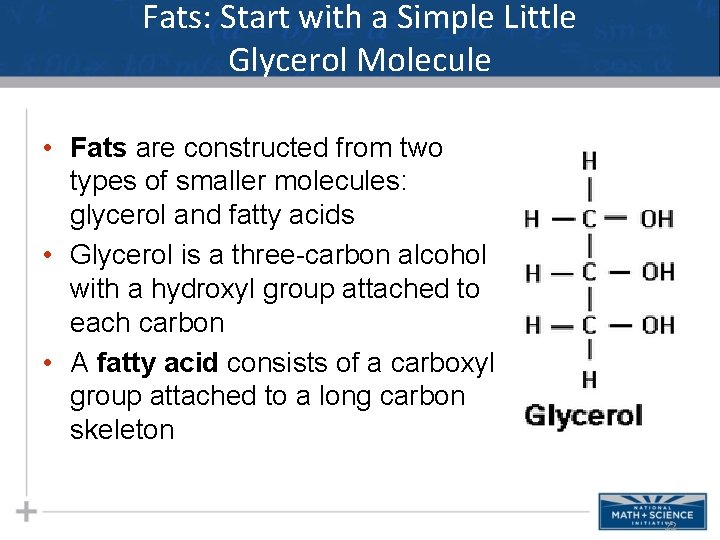
Fats: Start with a Simple Little Glycerol Molecule • Fats are constructed from two types of smaller molecules: glycerol and fatty acids • Glycerol is a three-carbon alcohol with a hydroxyl group attached to each carbon • A fatty acid consists of a carboxyl group attached to a long carbon skeleton 22
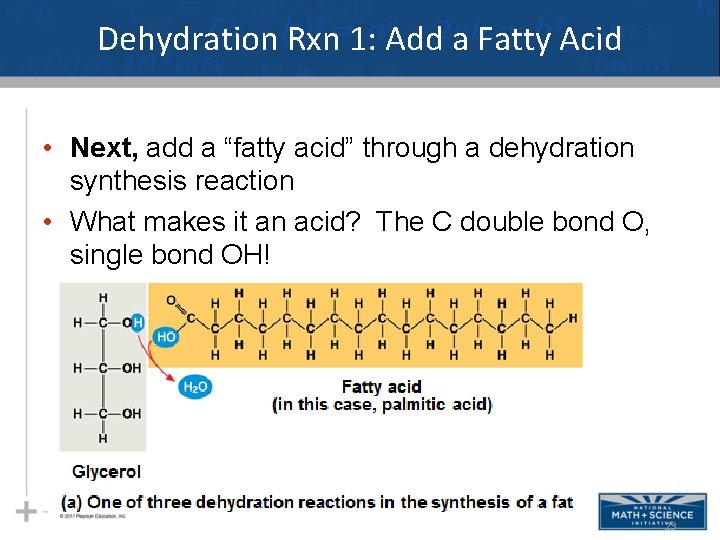
Dehydration Rxn 1: Add a Fatty Acid • Next, add a “fatty acid” through a dehydration synthesis reaction • What makes it an acid? The C double bond O, single bond OH! 23
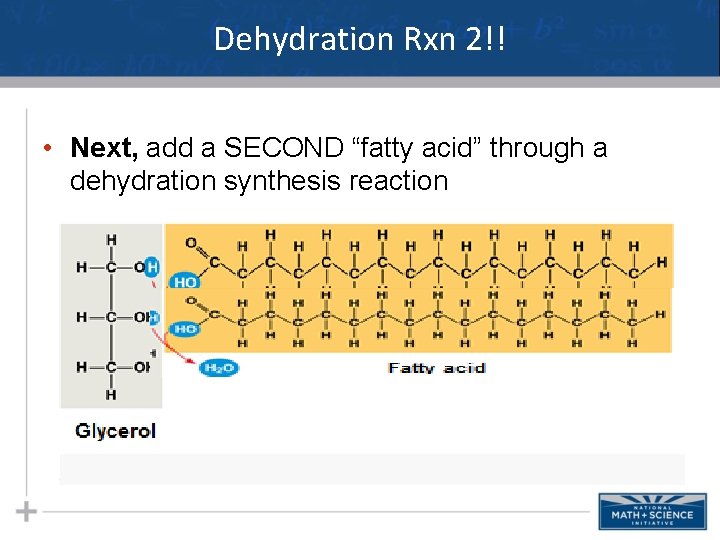
Dehydration Rxn 2!! • Next, add a SECOND “fatty acid” through a dehydration synthesis reaction
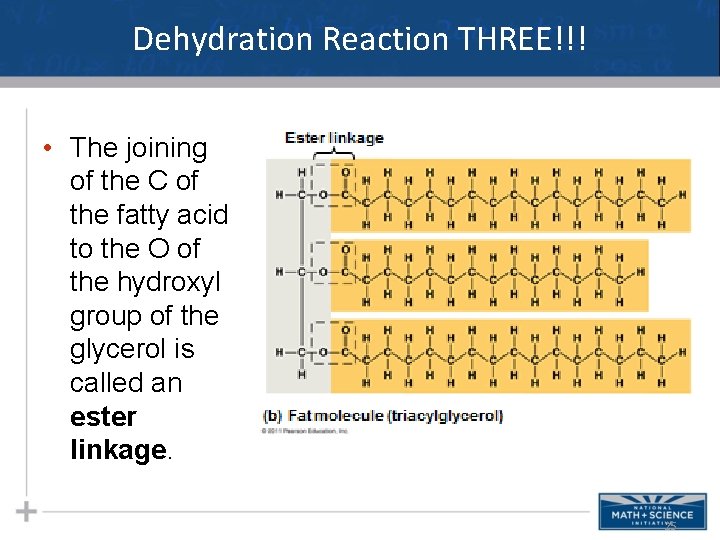
Dehydration Reaction THREE!!! • The joining of the C of the fatty acid to the O of the hydroxyl group of the glycerol is called an ester linkage. 25
Fats Are Insoluble In Aqueous Environments • Fats separate from water because water molecules form hydrogen bonds with each other and exclude the fats • In a fat, three fatty acids are joined to glycerol by an ester linkage, creating a triacylglycerol, or triglyceride 26
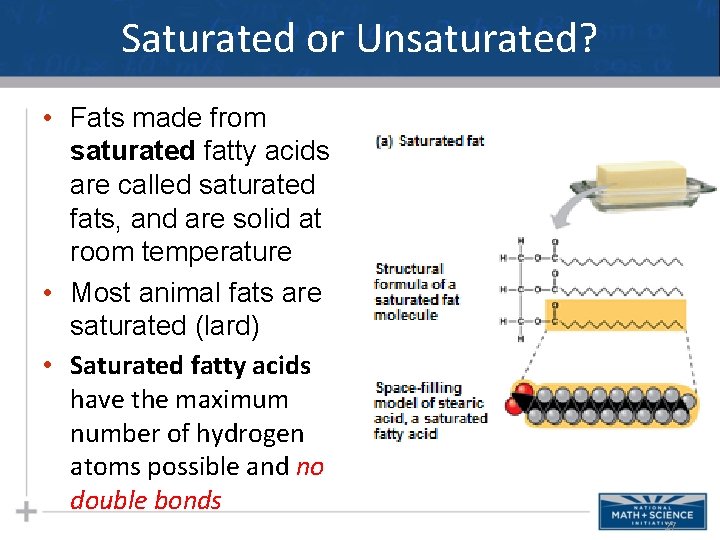
Saturated or Unsaturated? • Fats made from saturated fatty acids are called saturated fats, and are solid at room temperature • Most animal fats are saturated (lard) • Saturated fatty acids have the maximum number of hydrogen atoms possible and no double bonds 27
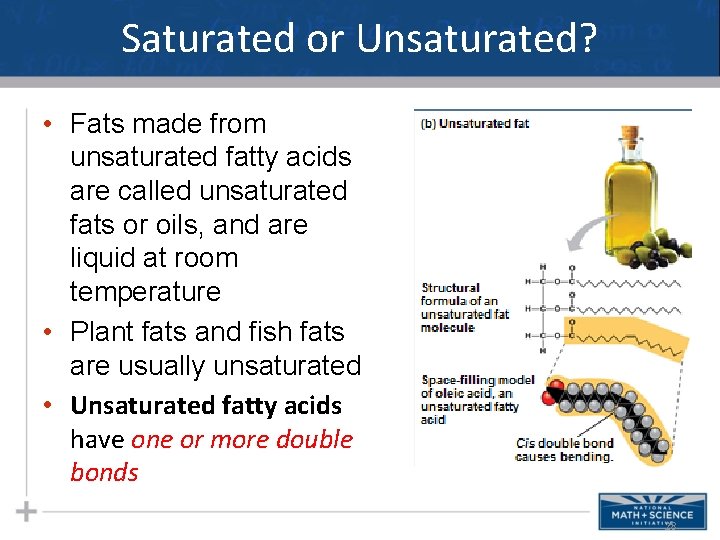
Saturated or Unsaturated? • Fats made from unsaturated fatty acids are called unsaturated fats or oils, and are liquid at room temperature • Plant fats and fish fats are usually unsaturated • Unsaturated fatty acids have one or more double bonds 28
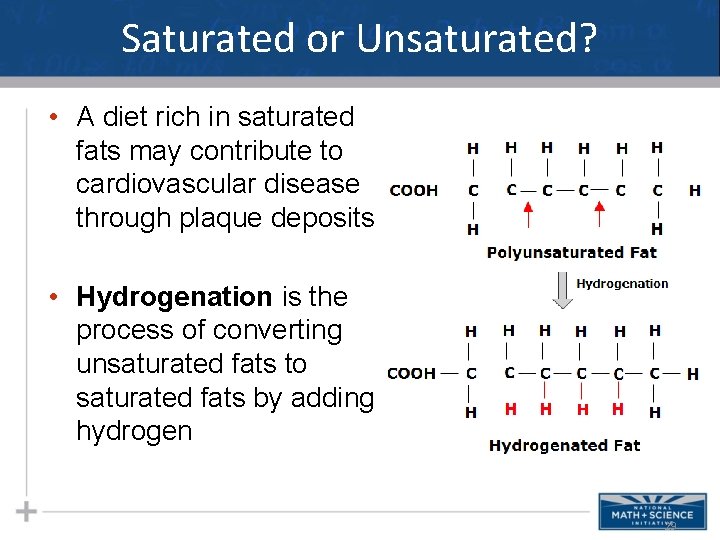
Saturated or Unsaturated? • A diet rich in saturated fats may contribute to cardiovascular disease through plaque deposits • Hydrogenation is the process of converting unsaturated fats to saturated fats by adding hydrogen 29
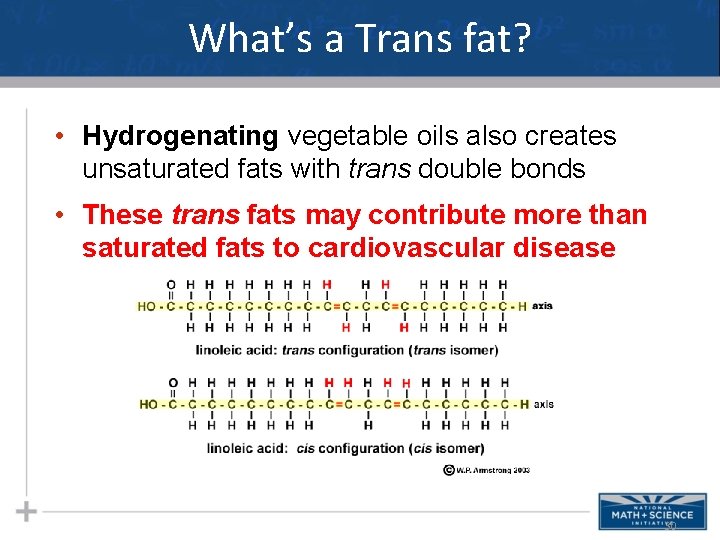
What’s a Trans fat? • Hydrogenating vegetable oils also creates unsaturated fats with trans double bonds • These trans fats may contribute more than saturated fats to cardiovascular disease 30
Saturated or Unsaturated? • Certain unsaturated fatty acids are not synthesized in the human body • These must be supplied in the diet • These essential fatty acids include the omega-3 fatty acids, required for normal growth, and thought to provide protection against cardiovascular disease 31
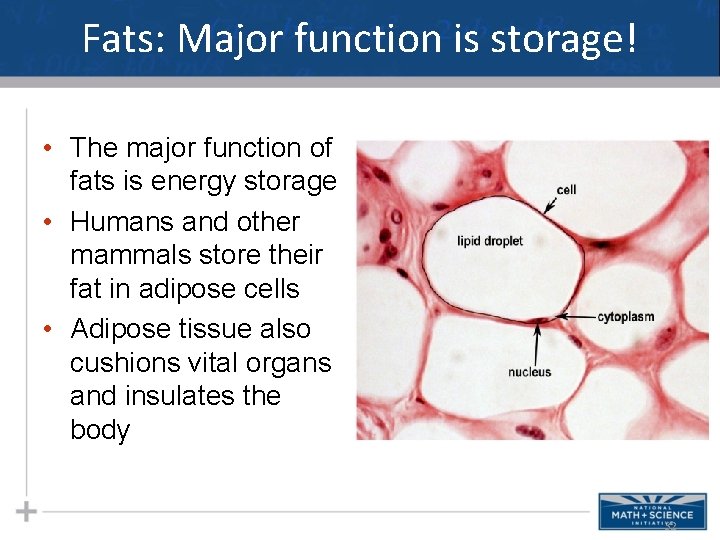
Fats: Major function is storage! • The major function of fats is energy storage • Humans and other mammals store their fat in adipose cells • Adipose tissue also cushions vital organs and insulates the body 32
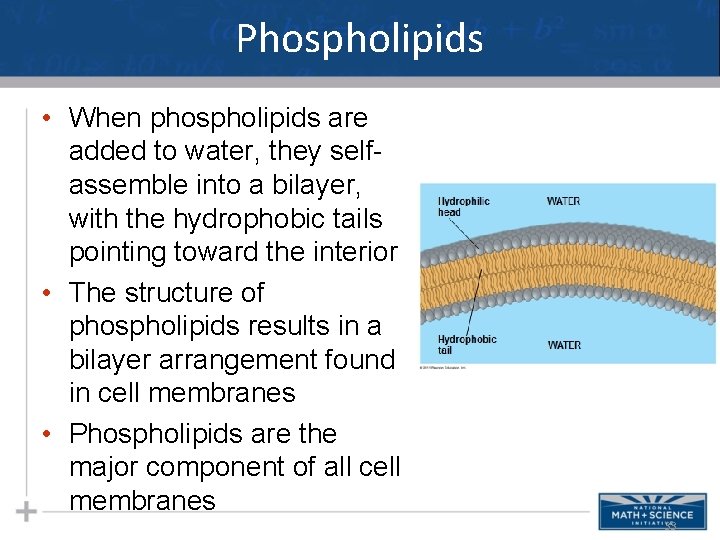
Phospholipids • When phospholipids are added to water, they selfassemble into a bilayer, with the hydrophobic tails pointing toward the interior • The structure of phospholipids results in a bilayer arrangement found in cell membranes • Phospholipids are the major component of all cell membranes 33
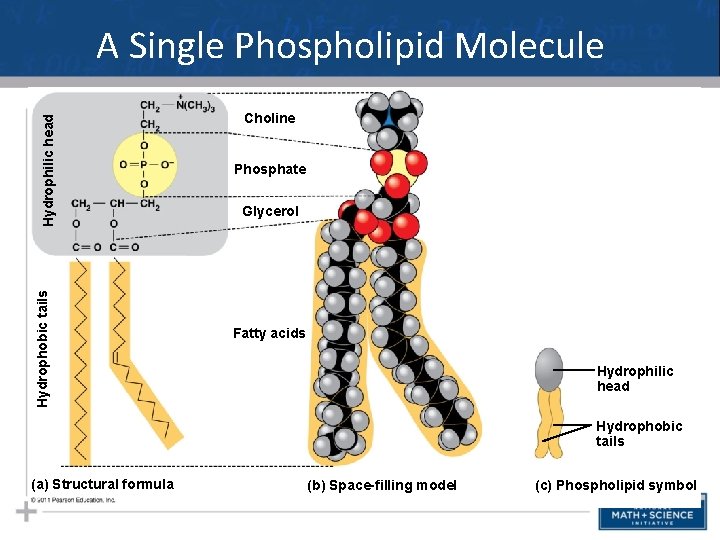
Hydrophobic tails Hydrophilic head A Single Phospholipid Molecule Choline Phosphate Glycerol Fatty acids Hydrophilic head Hydrophobic tails (a) Structural formula (b) Space-filling model (c) Phospholipid symbol
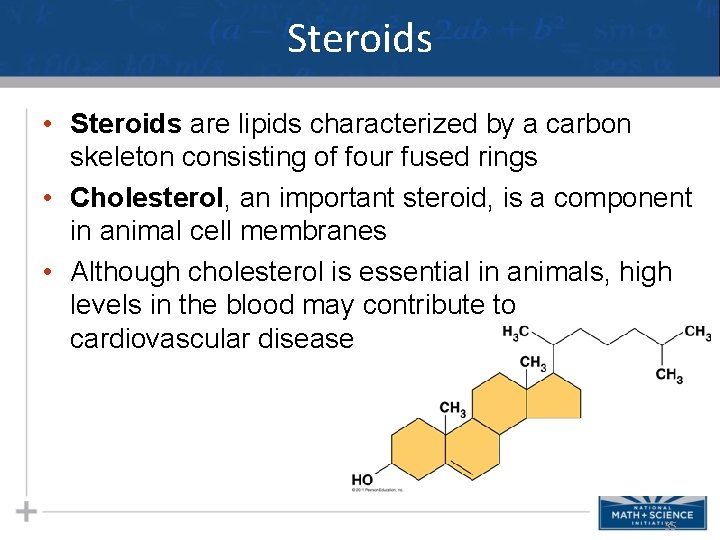
Steroids • Steroids are lipids characterized by a carbon skeleton consisting of four fused rings • Cholesterol, an important steroid, is a component in animal cell membranes • Although cholesterol is essential in animals, high levels in the blood may contribute to cardiovascular disease 35
Created by: René Mc. Cormick National Math and Science Dallas, TX
- Slides: 36