
The Structure and Evolution of a Sigmoid Observed
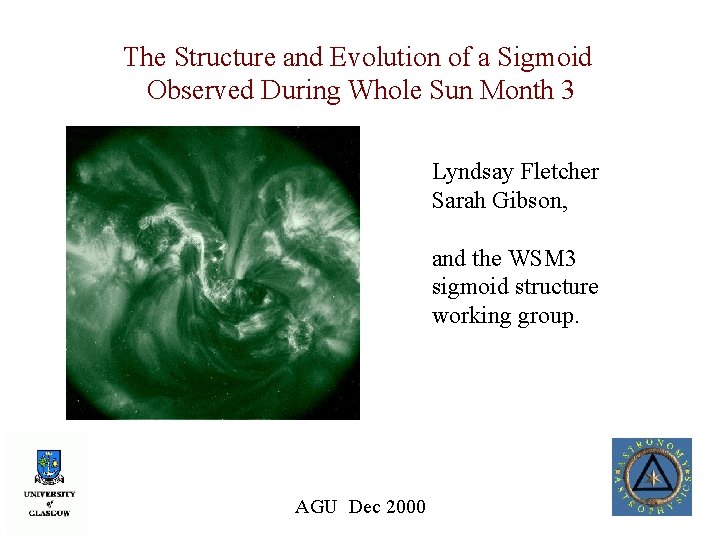
The Structure and Evolution of a Sigmoid Observed During Whole Sun Month 3 Lyndsay Fletcher Sarah Gibson, and the WSM 3 sigmoid structure working group. AGU Dec 2000
The WSM 3 working group is S. Gibson, L. Fletcher, D. Alexander, D. Biesecker, J. Burkepile, G. Del Zanna, P. Demoulin, C. Mandrini, H. Mason, Y. Liu, N. Nitta, C. D. Pike, J. Qiu, K. Ko, B. Schmieder, B. Thompson The sigmoid study uses data from: Yohkoh SXT, TRACE, So. HO CDS, EIT and UVCS, BBSO, MLSO CHIP and PICS AGU Dec 2000

The importance of sigmoids Canfield, Hudson and Mc. Kenzie (1999) found that large, sigmoidal active regions have a high correlation with eruptive signatures (seen in SXT). AGU Dec 2000
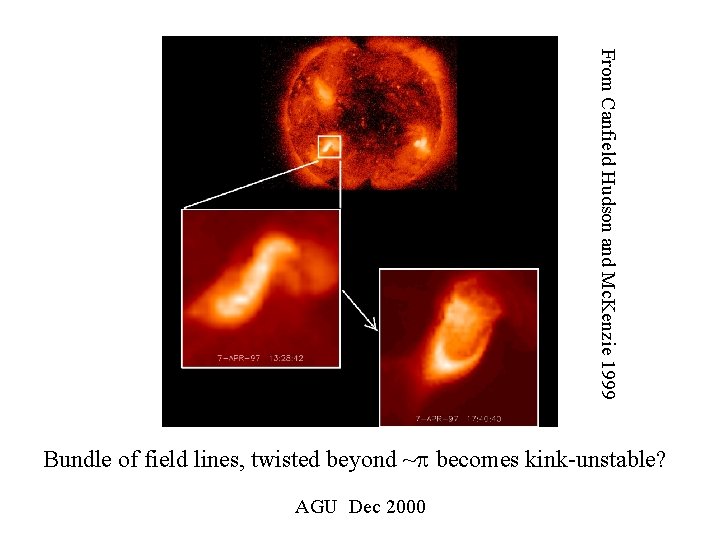
From Canfield Hudson and Mc. Kenzie 1999 Bundle of field lines, twisted beyond ~p becomes kink-unstable? AGU Dec 2000
Sigmoids as Predictors of Eruptive Activity Glover et al. (2000) find: � Of the ~100 sigmoidal regions studied by Canfield et al, only ~40% are � single loop� sigmoids � Other sigmoidal regions are formed by two or more sets of loops arranged in an � S� configuration. � 35% of � single loop� sigmoids were found to have eruptive signatures in LASCO - a slightly higher percentage than for multiple loop sigmoids. � Sigmoids may form prior to or following an eruption So the situation is somewhat more complex than the initial thoughts regarding the loss of stability of a twisted flux tube. AGU Dec 2000

Overall evolution of WSM sigmoid region �he sigmoid region, AR 8668 was tracked across the disk. T It underwent several eruptions, visible in SXT � The Ha filament formed in stages, partially disappeared and then � reformed in a slightly different orientation. �mall flares on Aug 16 - 17 are being analysed by Canfield et al. S Detailed magnetic field modelling on Aug 19 th by Liu et al. � The analysis of a jet seen on Aug 26 is being led by Ko � AGU Dec 2000
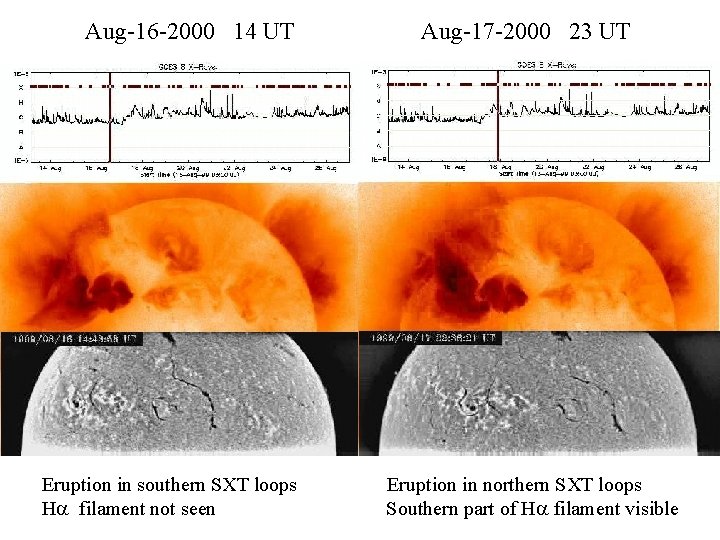
Aug-16 -2000 14 UT Eruption in southern SXT loops Ha filament not seen Aug-17 -2000 23 UT Eruption in northern SXT loops Southern part of Ha filament visible
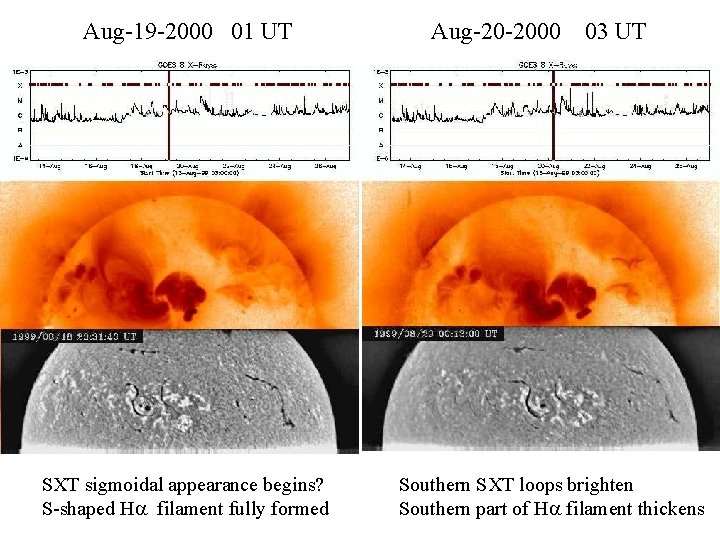
Aug-19 -2000 01 UT SXT sigmoidal appearance begins? S-shaped Ha filament fully formed Aug-20 -2000 03 UT Southern SXT loops brighten Southern part of Ha filament thickens
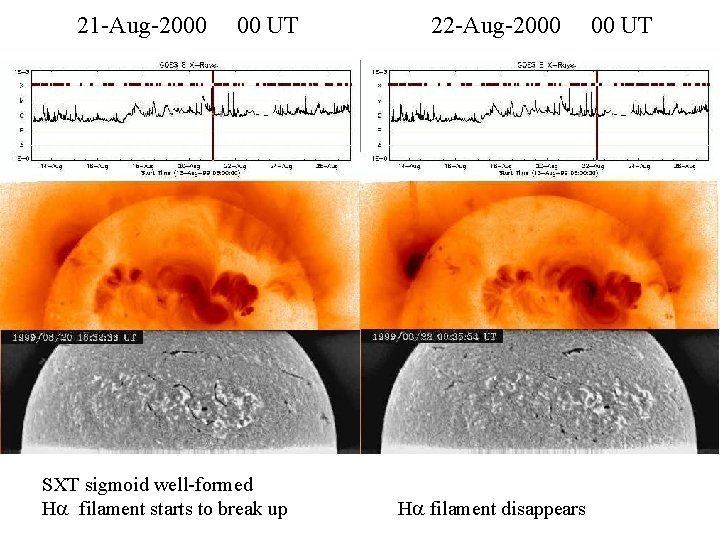
21 -Aug-2000 00 UT SXT sigmoid well-formed Ha filament starts to break up 22 -Aug-2000 Ha filament disappears 00 UT
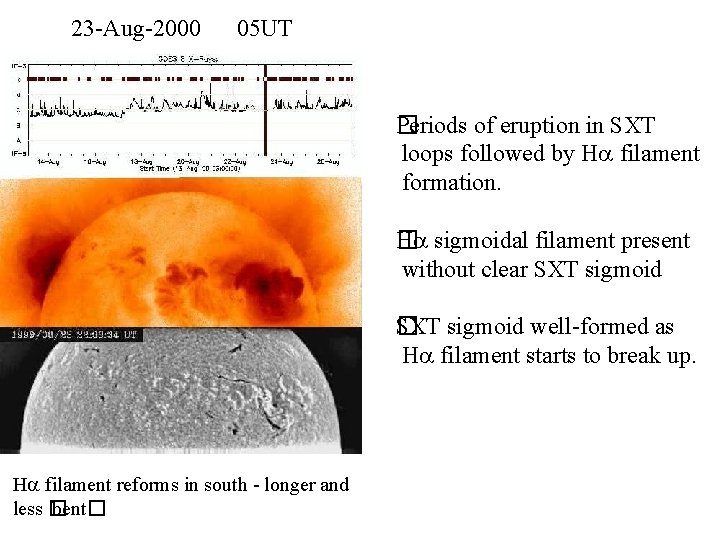
23 -Aug-2000 05 UT �eriods of eruption in SXT P loops followed by Ha filament formation. �a sigmoidal filament present H without clear SXT sigmoid �XT sigmoid well-formed as S Ha filament starts to break up. Ha filament reforms in south - longer and less � bent�
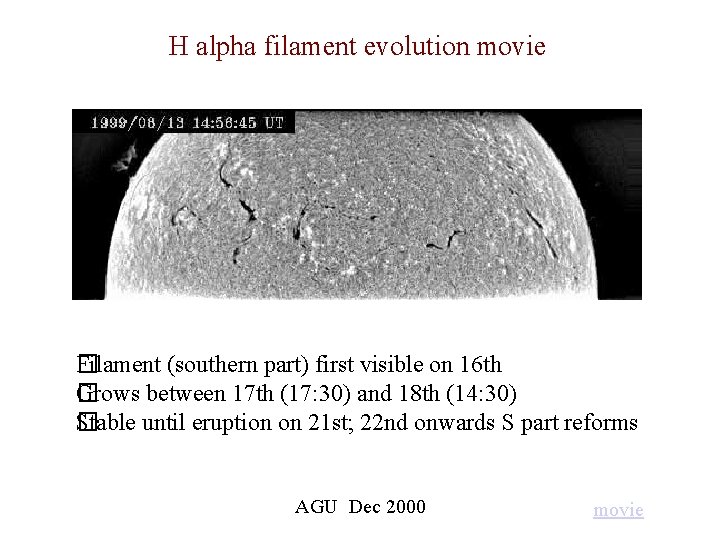
H alpha filament evolution movie �ilament (southern part) first visible on 16 th F Grows between 17 th (17: 30) and 18 th (14: 30) � Stable until eruption on 21 st; 22 nd onwards S part reforms � AGU Dec 2000 movie
August 19 - well-formed filament. Liu et al. have performed various field extrapolations Potential Non-linear FF Linear FF Non-linear FF fields show twisted, dipped field lines which could provide filament support. AGU Dec 2000
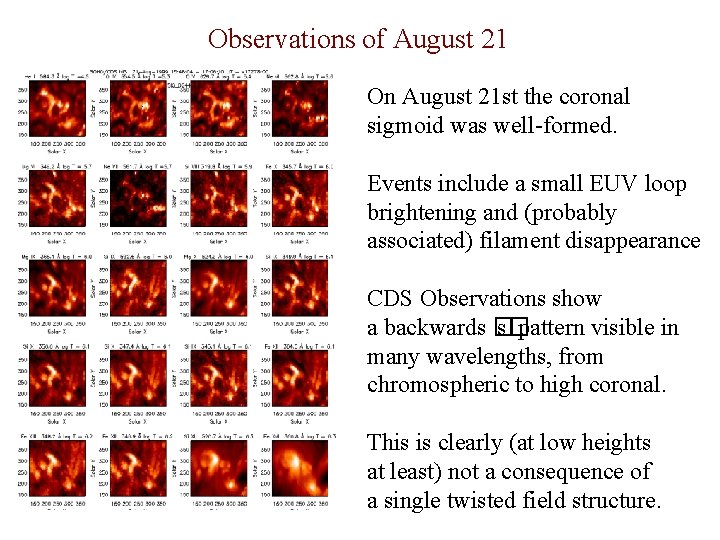
Observations of August 21 On August 21 st the coronal sigmoid was well-formed. Events include a small EUV loop brightening and (probably associated) filament disappearance CDS Observations show a backwards � s� pattern visible in many wavelengths, from chromospheric to high coronal. This is clearly (at low heights at least) not a consequence of a single twisted field structure.
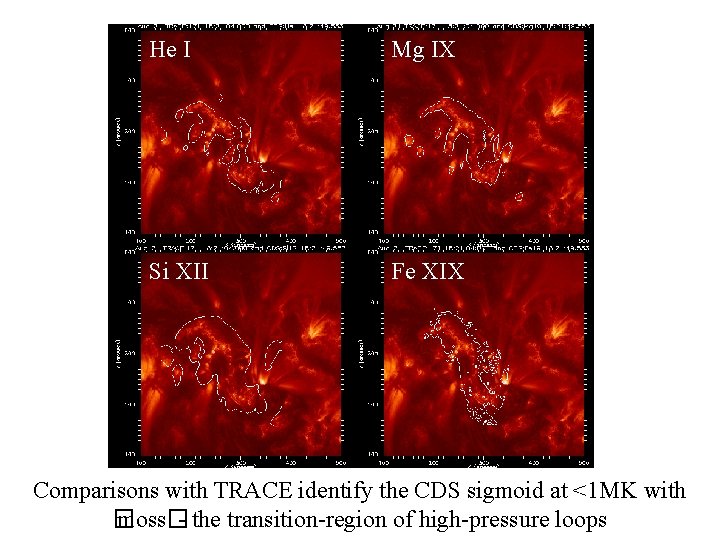
He I Mg IX Si XII Fe XIX Comparisons with TRACE identify the CDS sigmoid at <1 MK with � moss� - the transition-region of high-pressure loops
The low-lying sigmoid shape is determined by the distribution of magnetic plage. AGU Dec 2000
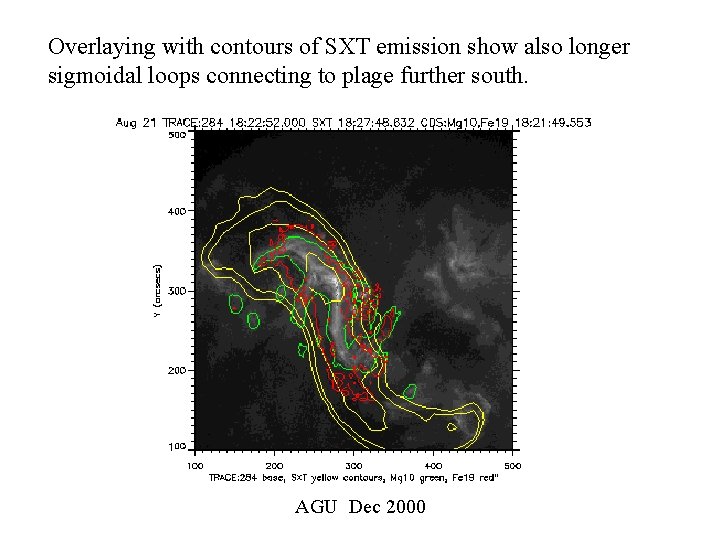
Overlaying with contours of SXT emission show also longer sigmoidal loops connecting to plage further south. AGU Dec 2000
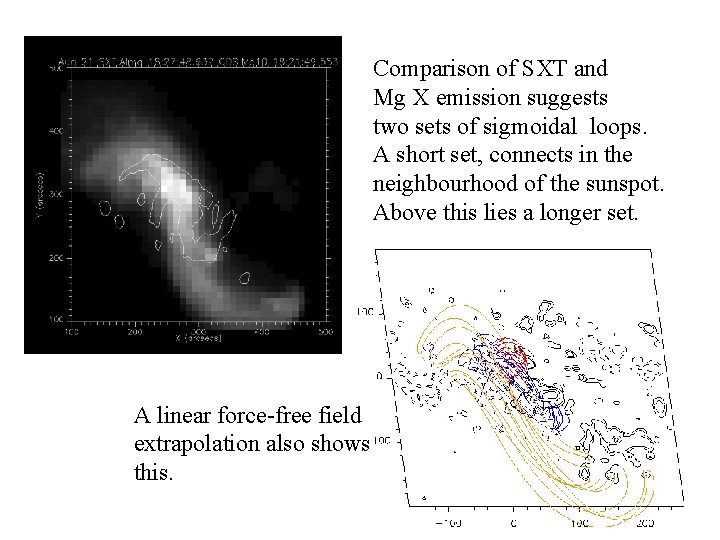
Comparison of SXT and Mg X emission suggests two sets of sigmoidal loops. A short set, connects in the neighbourhood of the sunspot. Above this lies a longer set. A linear force-free field extrapolation also shows this.
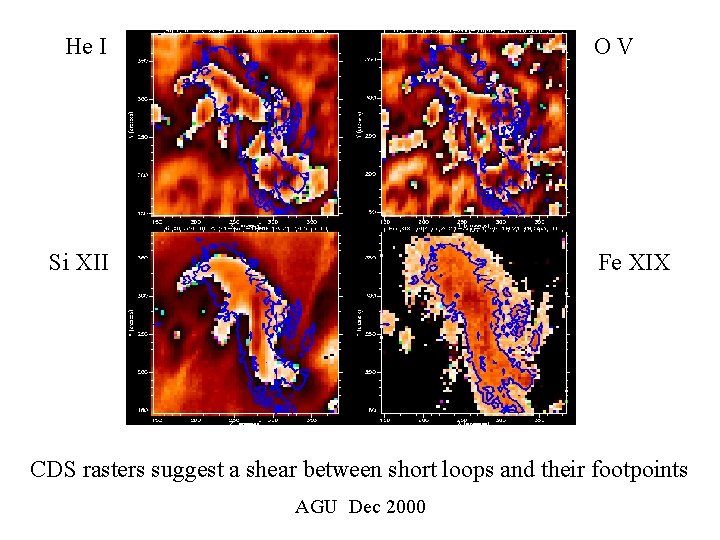
He I OV Si XII Fe XIX CDS rasters suggest a shear between short loops and their footpoints AGU Dec 2000
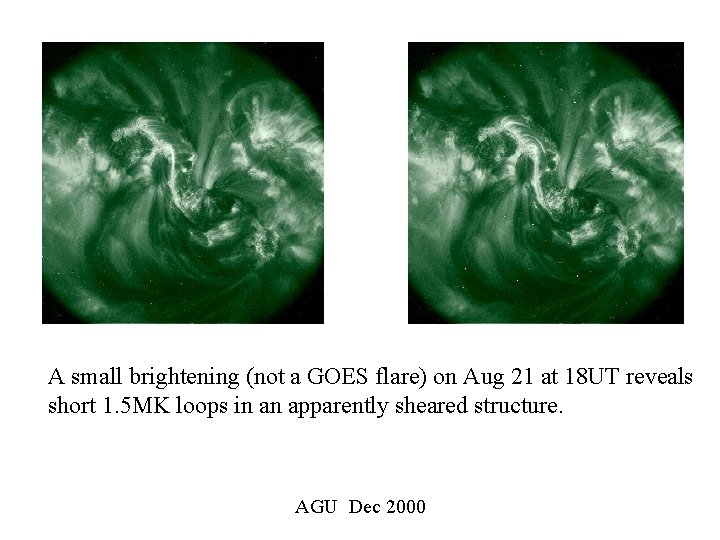
A small brightening (not a GOES flare) on Aug 21 at 18 UT reveals short 1. 5 MK loops in an apparently sheared structure. AGU Dec 2000
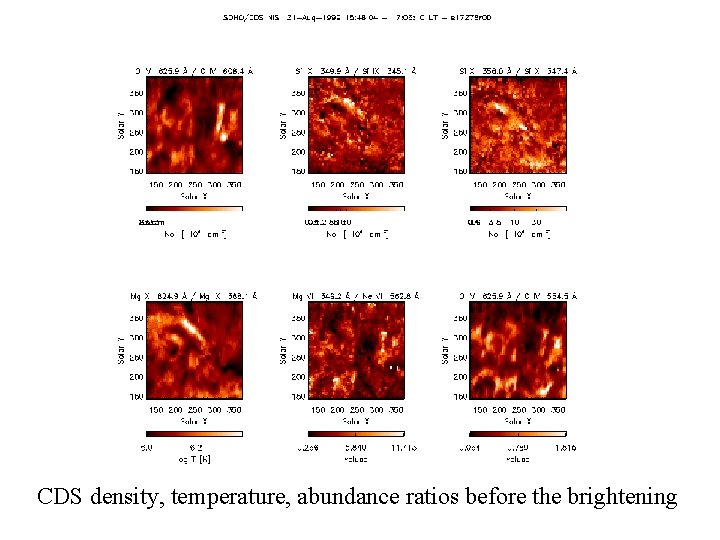
CDS density, temperature, AGU abundance ratios before the brightening Dec 2000
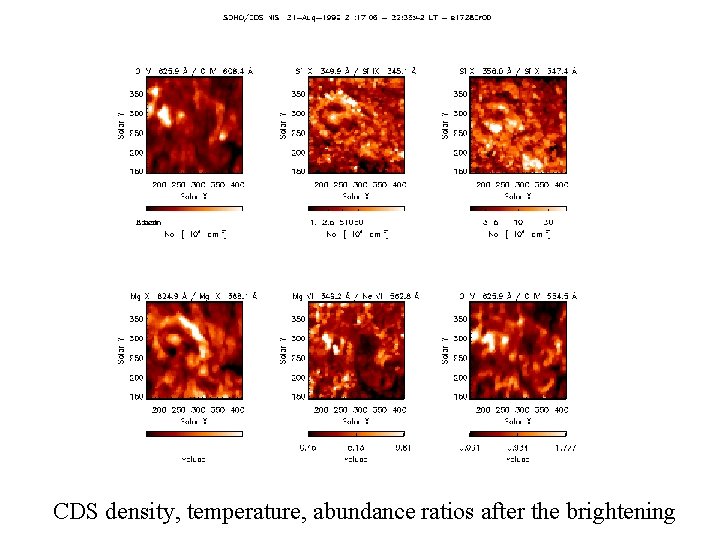
Dec 2000 ratios after the brightening CDS density, temperature, AGU abundance
Following the brightening, CDS Si XII lineshifts show upflows of ~ 30 -40 km/s at the ends of the short sigmoidal loops This may suggest that the brightening leads to evaporation of chromospheric material into the loops -Could be used to assist in the identification of � active� field lines in magnetic modelling?
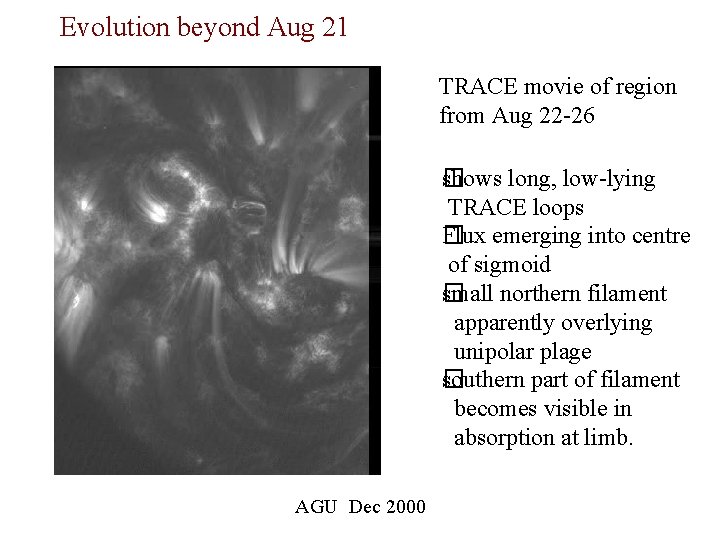
Evolution beyond Aug 21 TRACE movie of region from Aug 22 -26 s� hows long, low-lying TRACE loops Flux emerging into centre � of sigmoid small northern filament � apparently overlying unipolar plage southern part of filament � becomes visible in absorption at limb. AGU Dec 2000
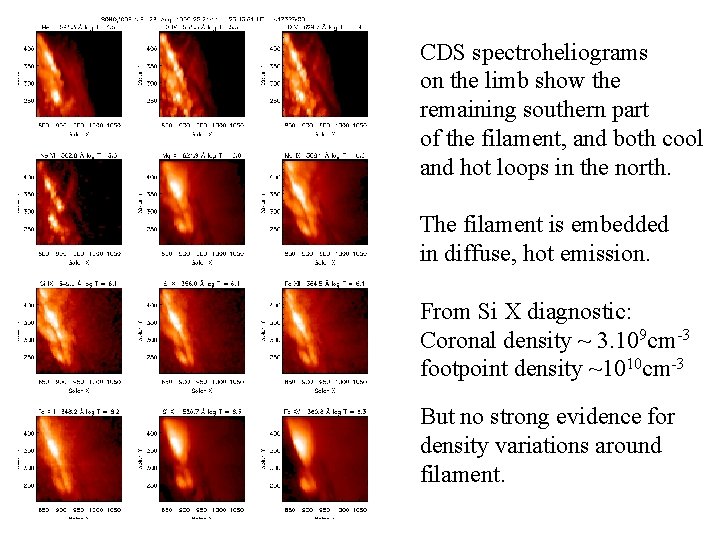
CDS spectroheliograms on the limb show the remaining southern part of the filament, and both cool and hot loops in the north. The filament is embedded in diffuse, hot emission. From Si X diagnostic: Coronal density ~ 3. 109 cm-3 footpoint density ~1010 cm-3 But no strong evidence for density variations around filament.
Summary All wavelengths show evidence of sigmoidal shape � �omplex relationship between presence of Ha s-shaped C filament and coronal sigmoid - eruptions can both (a)result in field-lines necessary to support filament material (b)lead to destabilisation and ejection of filament � Two (or more) sets of loops? Interfaces may provide locations for reconnection and loss of stability ( e. g. brightening on 21 st followed by filament eruption) � Helicity or just complexity? Short TRACE/SXT loops must be fit with non-potential fields; long ones with potential fields (interface with rest of corona? ) Excellent set of sigmoid data for comprehensive analysis �
- Slides: 25