
The Structure and Composition of Enceladus Plume Results

- Slides: 35
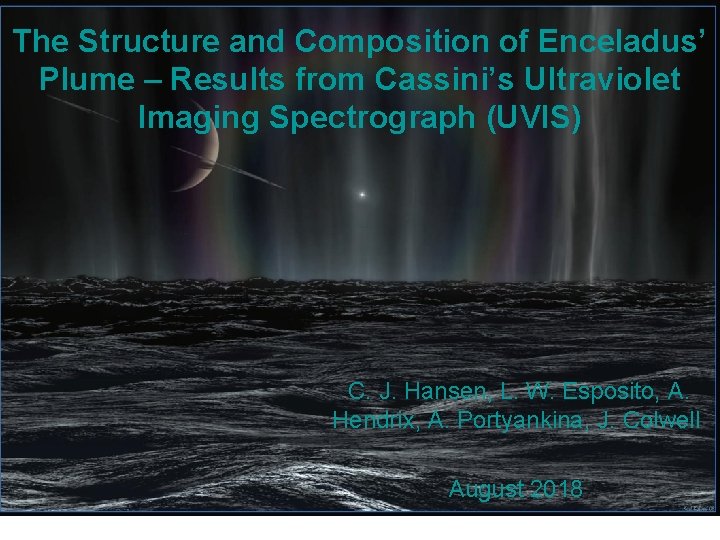
The Structure and Composition of Enceladus’ Plume – Results from Cassini’s Ultraviolet Imaging Spectrograph (UVIS) C. J. Hansen, L. W. Esposito, A. Hendrix, A. Portyankina, J. Colwell August 2018
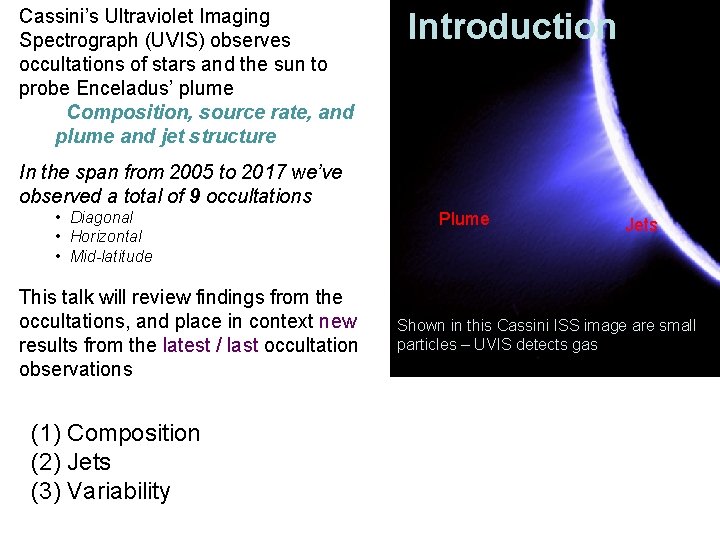
Cassini’s Ultraviolet Imaging Spectrograph (UVIS) observes occultations of stars and the sun to probe Enceladus’ plume Composition, source rate, and plume and jet structure Introduction In the span from 2005 to 2017 we’ve observed a total of 9 occultations • Diagonal • Horizontal • Mid-latitude This talk will review findings from the occultations, and place in context new results from the latest / last occultation observations (1) Composition (2) Jets (3) Variability Plume Jets Shown in this Cassini ISS image are small particles – UVIS detects gas
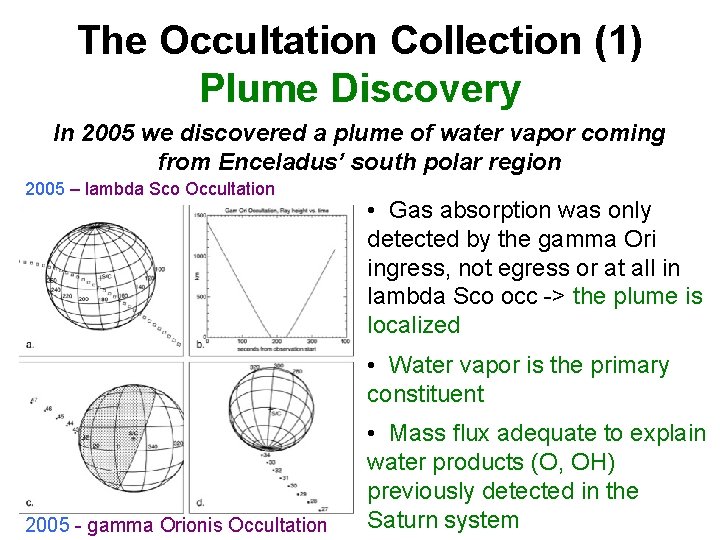
The Occultation Collection (1) Plume Discovery In 2005 we discovered a plume of water vapor coming from Enceladus’ south polar region 2005 – lambda Sco Occultation • Gas absorption was only detected by the gamma Ori ingress, not egress or at all in lambda Sco occ -> the plume is localized • Water vapor is the primary constituent 2005 - gamma Orionis Occultation • Mass flux adequate to explain water products (O, OH) previously detected in the Saturn system
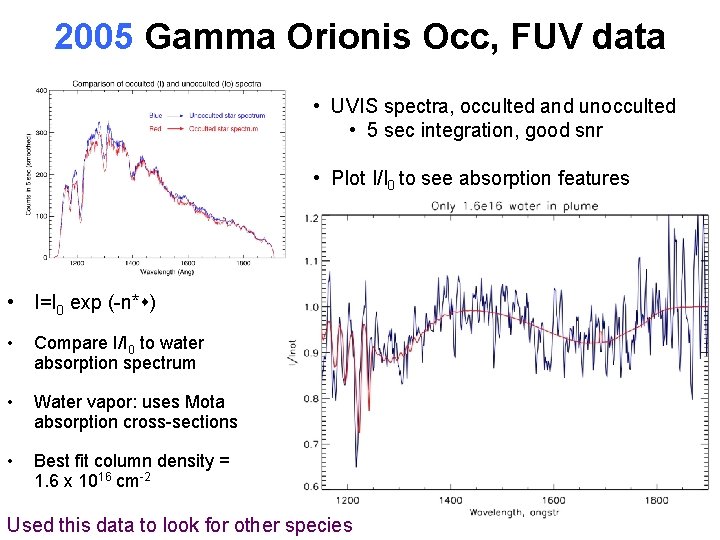
2005 Gamma Orionis Occ, FUV data • UVIS spectra, occulted and unocculted • 5 sec integration, good snr • Plot I/I 0 to see absorption features • I=I 0 exp (-n* ) • Compare I/I 0 to water absorption spectrum • Water vapor: uses Mota absorption cross-sections • Best fit column density = 1. 6 x 1016 cm-2 Used this data to look for other species
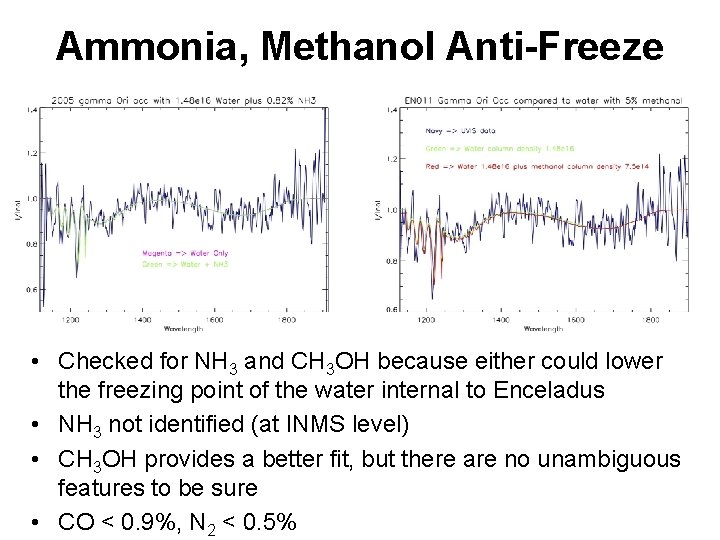
Ammonia, Methanol Anti-Freeze • Checked for NH 3 and CH 3 OH because either could lower the freezing point of the water internal to Enceladus • NH 3 not identified (at INMS level) • CH 3 OH provides a better fit, but there are no unambiguous features to be sure • CO < 0. 9%, N 2 < 0. 5%
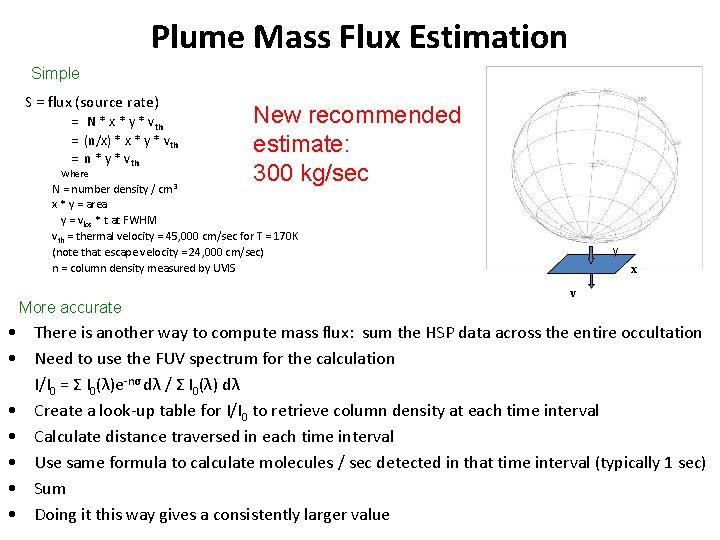
Plume Mass Flux Estimation Simple S = flux (source rate) = N * x * y * vth = (n/x) * x * y * vth = n * y * vth Where New recommended estimate: 300 kg/sec N = number density / cm 3 x * y = area y = vlos * t at FWHM vth = thermal velocity = 45, 000 cm/sec for T = 170 K (note that escape velocity = 24, 000 cm/sec) n = column density measured by UVIS More accurate y x v • There is another way to compute mass flux: sum the HSP data across the entire occultation • Need to use the FUV spectrum for the calculation I/I 0 = Σ I 0(λ)e-nσ dλ / Σ I 0(λ) dλ • Create a look-up table for I/I 0 to retrieve column density at each time interval • Calculate distance traversed in each time interval • Use same formula to calculate molecules / sec detected in that time interval (typically 1 sec) • Sum • Doing it this way gives a consistently larger value
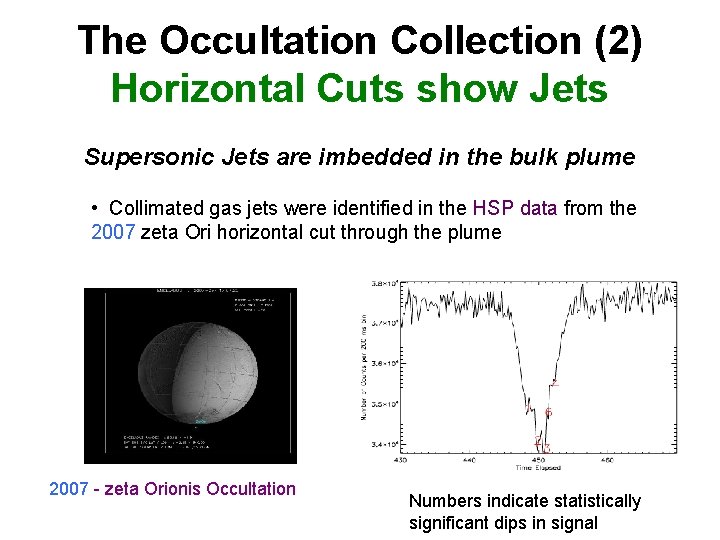
The Occultation Collection (2) Horizontal Cuts show Jets Supersonic Jets are imbedded in the bulk plume • Collimated gas jets were identified in the HSP data from the 2007 zeta Ori horizontal cut through the plume 2007 - zeta Orionis Occultation Numbers indicate statistically significant dips in signal
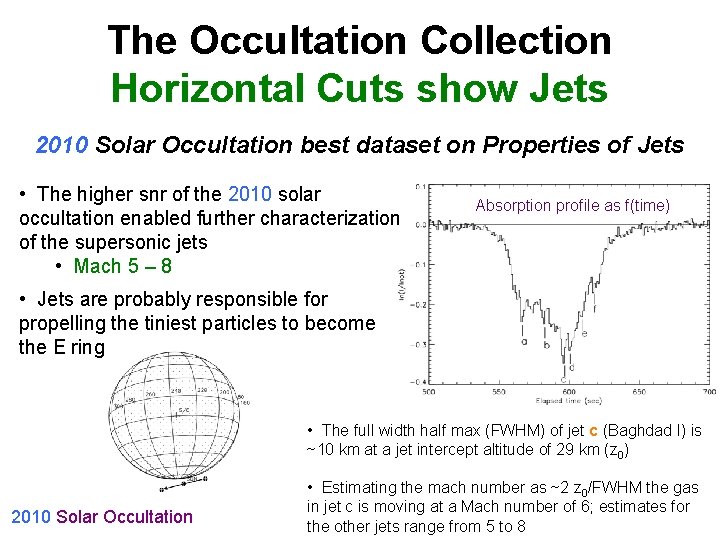
The Occultation Collection Horizontal Cuts show Jets 2010 Solar Occultation best dataset on Properties of Jets • The higher snr of the 2010 solar occultation enabled further characterization of the supersonic jets • Mach 5 – 8 Absorption profile as f(time) • Jets are probably responsible for propelling the tiniest particles to become the E ring • The full width half max (FWHM) of jet c (Baghdad I) is ~10 km at a jet intercept altitude of 29 km (z 0) 2010 Solar Occultation • Estimating the mach number as ~2 z 0/FWHM the gas in jet c is moving at a Mach number of 6; estimates for the other jets range from 5 to 8
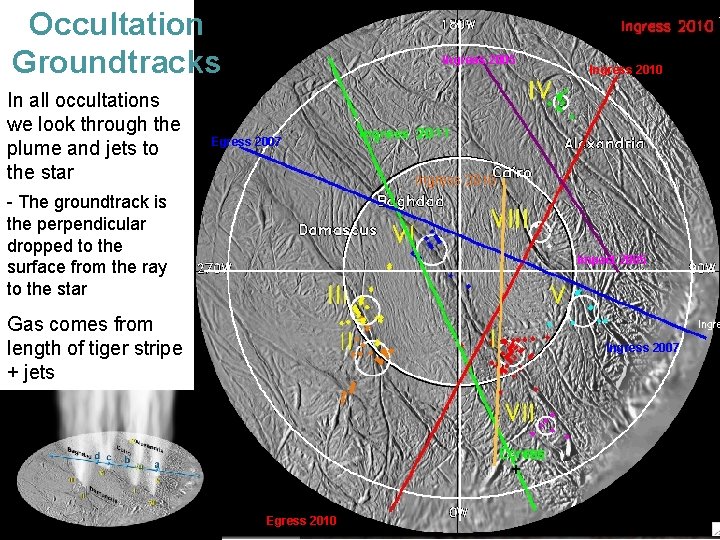
Occultation Groundtracks In all occultations we look through the plume and jets to * the star * Ingress 2005 Ingress 2010 Egress 2007 Ingress 2016 Impact 2016 - The groundtrack is the perpendicular dropped to the surface from the ray to the star Impact 2005 Gas comes from length of tiger stripe + jets * Ingress 2007 Ingress 2016 * Egress 2010
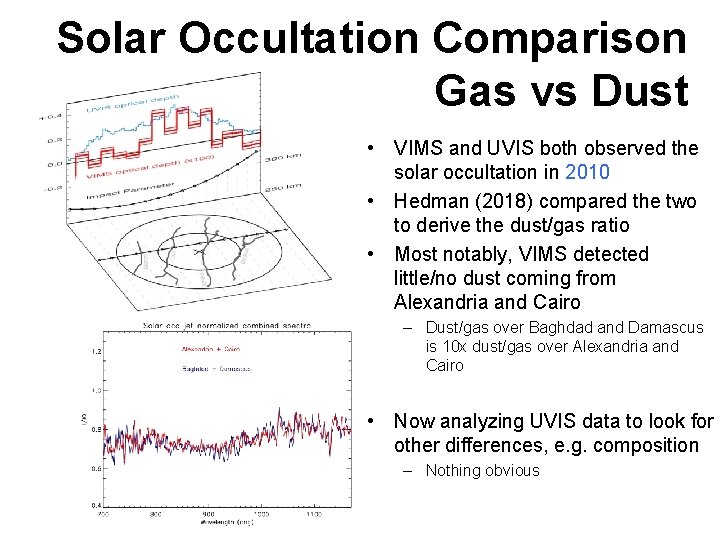
Solar Occultation Comparison Gas vs Dust • VIMS and UVIS both observed the solar occultation in 2010 • Hedman (2018) compared the two to derive the dust/gas ratio • Most notably, VIMS detected little/no dust coming from Alexandria and Cairo – Dust/gas over Baghdad and Damascus is 10 x dust/gas over Alexandria and Cairo • Now analyzing UVIS data to look for other differences, e. g. composition – Nothing obvious
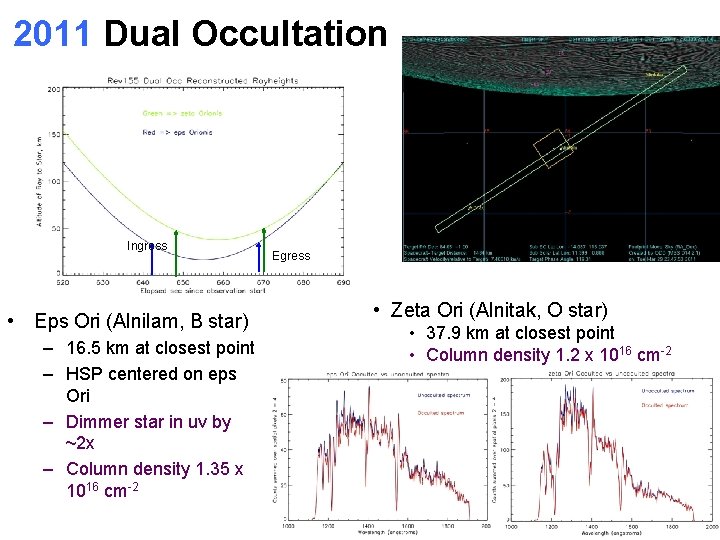
2011 Dual Occultation Ingress • Eps Ori (Alnilam, B star) – 16. 5 km at closest point – HSP centered on eps Ori – Dimmer star in uv by ~2 x – Column density 1. 35 x 1016 cm-2 Egress • Zeta Ori (Alnitak, O star) • 37. 9 km at closest point • Column density 1. 2 x 1016 cm-2
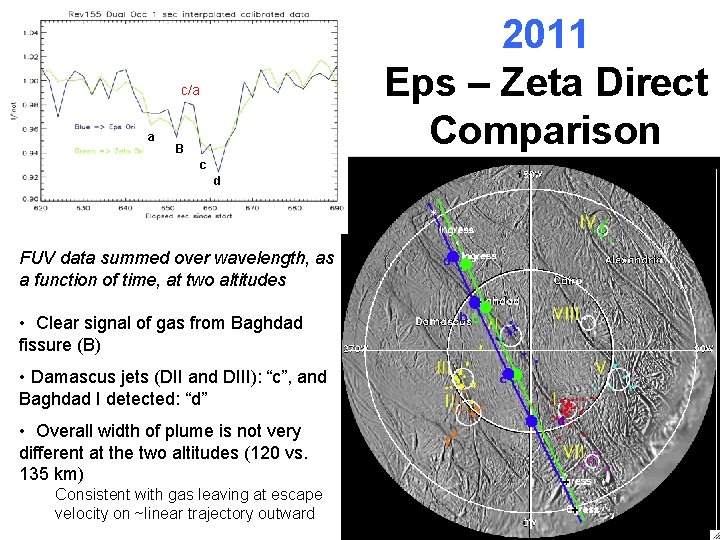
2011 Eps – Zeta Direct Comparison c/a a B c d FUV data summed over wavelength, as a function of time, at two altitudes • Clear signal of gas from Baghdad fissure (B) • Damascus jets (DII and DIII): “c”, and Baghdad I detected: “d” • Overall width of plume is not very different at the two altitudes (120 vs. 135 km) Consistent with gas leaving at escape velocity on ~linear trajectory outward S/C
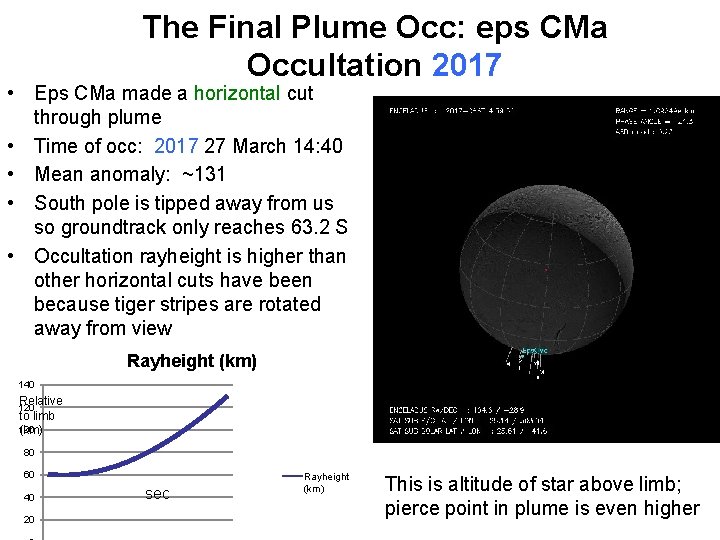
The Final Plume Occ: eps CMa Occultation 2017 • Eps CMa made a horizontal cut through plume • Time of occ: 2017 27 March 14: 40 • Mean anomaly: ~131 • South pole is tipped away from us so groundtrack only reaches 63. 2 S • Occultation rayheight is higher than other horizontal cuts have been because tiger stripes are rotated away from view Rayheight (km) 140 Relative to limb 100 (km) 120 80 60 40 20 sec Rayheight (km) This is altitude of star above limb; pierce point in plume is even higher
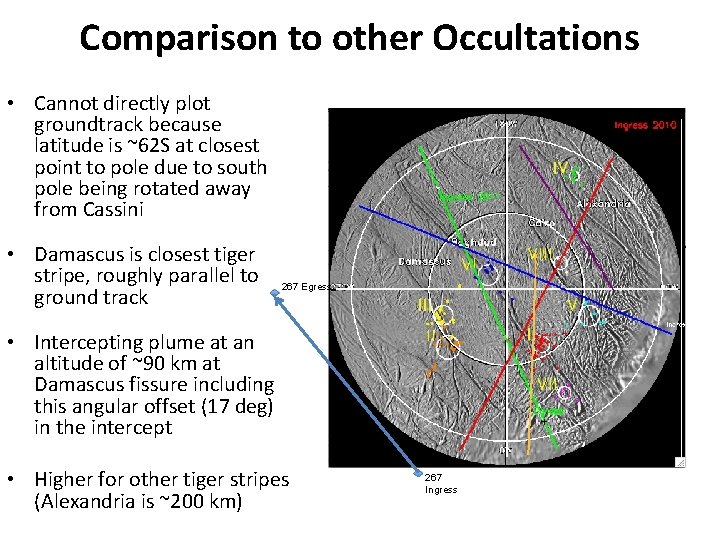
Comparison to other Occultations • Cannot directly plot groundtrack because latitude is ~62 S at closest point to pole due to south pole being rotated away from Cassini • Damascus is closest tiger stripe, roughly parallel to ground track 267 Egress • Intercepting plume at an altitude of ~90 km at Damascus fissure including this angular offset (17 deg) in the intercept • Higher for other tiger stripes (Alexandria is ~200 km) 267 Ingress
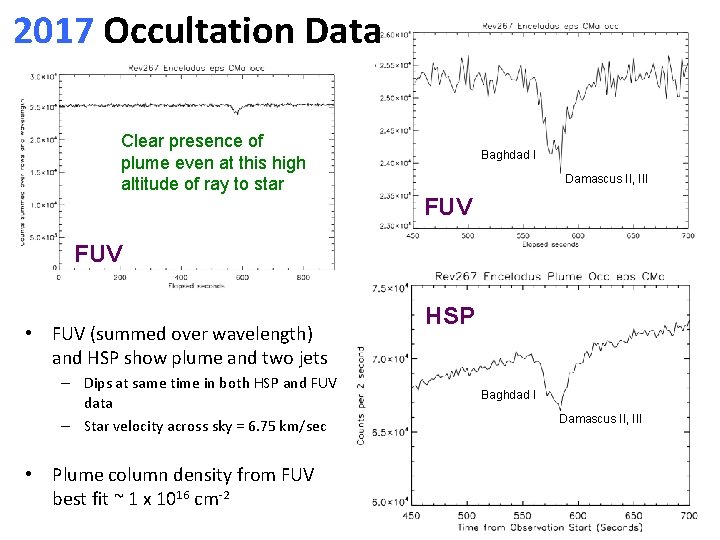
2017 Occultation Data Clear presence of plume even at this high altitude of ray to star Baghdad I Damascus II, III FUV • FUV (summed over wavelength) and HSP show plume and two jets – Dips at same time in both HSP and FUV data – Star velocity across sky = 6. 75 km/sec • Plume column density from FUV best fit ~ 1 x 1016 cm-2 HSP Baghdad I Damascus II, III
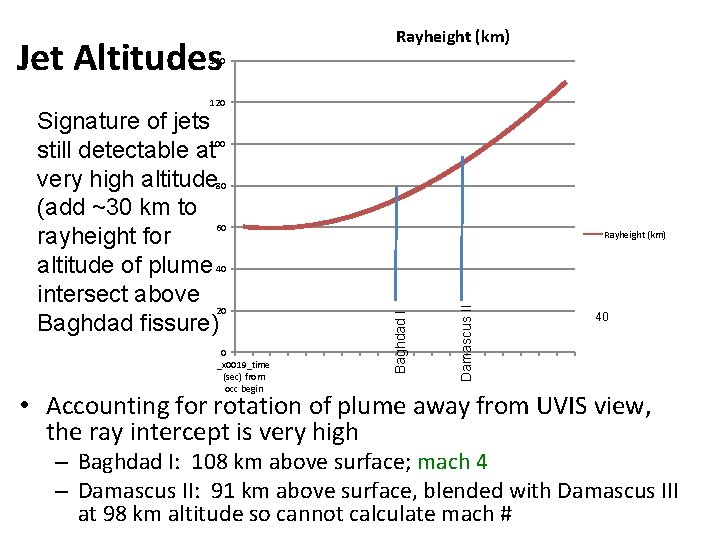
Jet Altitudes Rayheight (km) 140 120 Damascus II 0 _x 0019_time (sec) from occ begin Rayheight (km) Baghdad I Signature of jets still detectable at 100 very high altitude 80 (add ~30 km to 60 rayheight for altitude of plume 40 intersect above 20 Baghdad fissure) 40 • Accounting for rotation of plume away from UVIS view, the ray intercept is very high – Baghdad I: 108 km above surface; mach 4 – Damascus II: 91 km above surface, blended with Damascus III at 98 km altitude so cannot calculate mach #
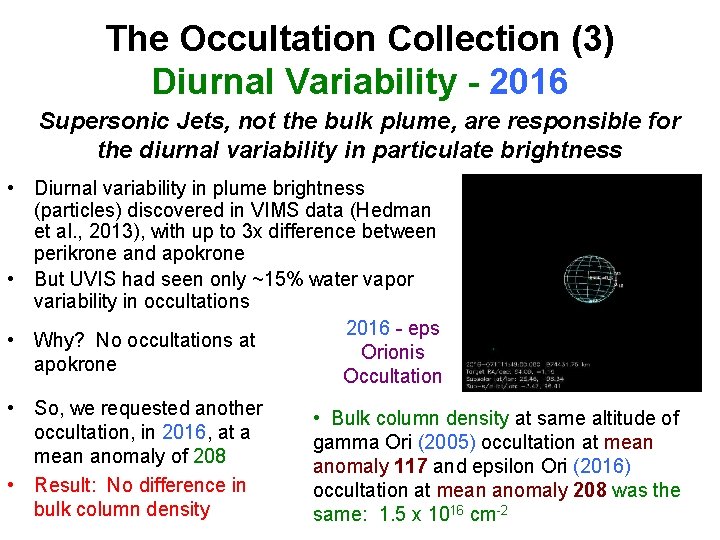
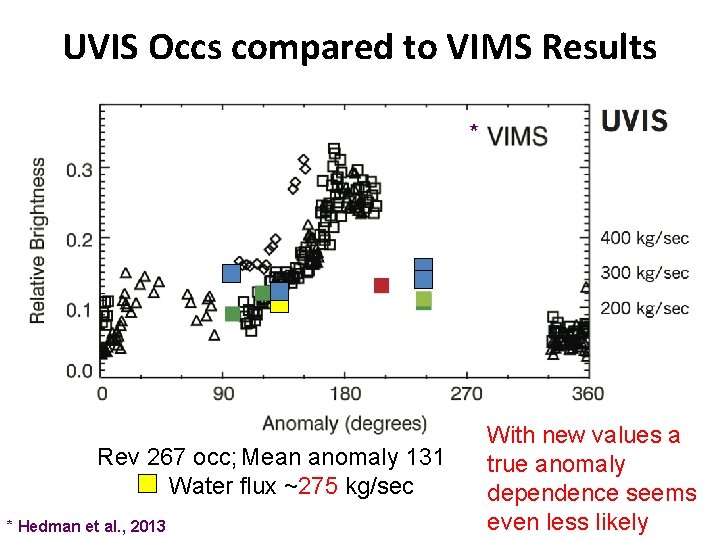
The Occultation Collection (3) Diurnal Variability - 2016 Supersonic Jets, not the bulk plume, are responsible for the diurnal variability in particulate brightness • Diurnal variability in plume brightness (particles) discovered in VIMS data (Hedman et al. , 2013), with up to 3 x difference between perikrone and apokrone • But UVIS had seen only ~15% water vapor variability in occultations 2016 - eps • Why? No occultations at Orionis apokrone Occultation • So, we requested another occultation, in 2016, at a mean anomaly of 208 • Result: No difference in bulk column density • Bulk column density at same altitude of gamma Ori (2005) occultation at mean anomaly 117 and epsilon Ori (2016) occultation at mean anomaly 208 was the same: 1. 5 x 1016 cm-2
Variability in Jet Properties with Orbital Longitude? YES Compare Baghdad I gas jet at other times • The previous estimate of column density from the 2011 zeta Orionis occultation, mean anomaly 237, at ~same altitude, was 1. 6 x 1016 cm-2 • 2016 column density = 2. 0 x 1016 cm-2 • Previous estimate from the 2010 solar occultation was mach number = 6 • 2016 mach number = 8 – 9 Conclusion: there is more gas in this jet, going faster • This is not inconsistent with the overall plume mass flux: – The Baghdad I jet typically contributes 2% to the total plume, at this orbital longitude that has increased to 8% – The jets only contribute 3 -4 % of the molecules exiting Enceladus, so even if the density and velocity increase it is still a minimal effect
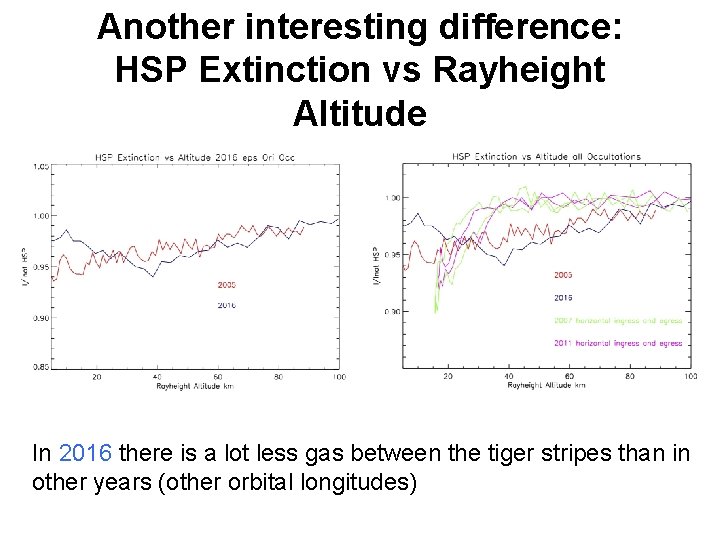
Another interesting difference: HSP Extinction vs Rayheight Altitude In 2016 there is a lot less gas between the tiger stripes than in other years (other orbital longitudes)
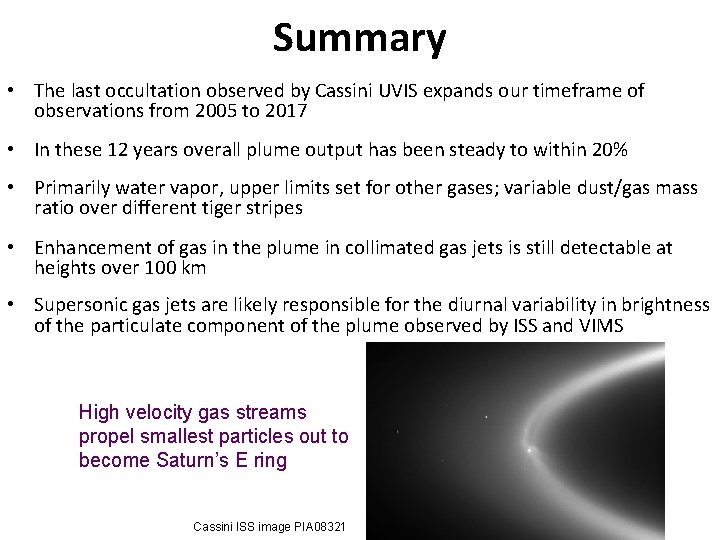
Summary • The last occultation observed by Cassini UVIS expands our timeframe of observations from 2005 to 2017 • In these 12 years overall plume output has been steady to within 20% • Primarily water vapor, upper limits set for other gases; variable dust/gas mass ratio over different tiger stripes • Enhancement of gas in the plume in collimated gas jets is still detectable at heights over 100 km • Supersonic gas jets are likely responsible for the diurnal variability in brightness of the particulate component of the plume observed by ISS and VIMS High velocity gas streams propel smallest particles out to become Saturn’s E ring Cassini ISS image PIA 08321
Backup Slides
A cautionary note… Europa Enceladus
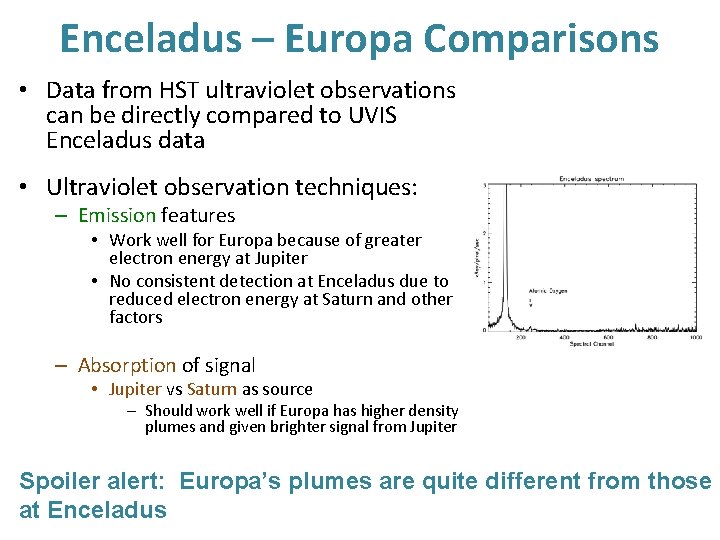
Enceladus – Europa Comparisons • Data from HST ultraviolet observations can be directly compared to UVIS Enceladus data • Ultraviolet observation techniques: – Emission features • Work well for Europa because of greater electron energy at Jupiter • No consistent detection at Enceladus due to reduced electron energy at Saturn and other factors – Absorption of signal • Jupiter vs Saturn as source – Should work well if Europa has higher density plumes and given brighter signal from Jupiter Spoiler alert: Europa’s plumes are quite different from those at Enceladus
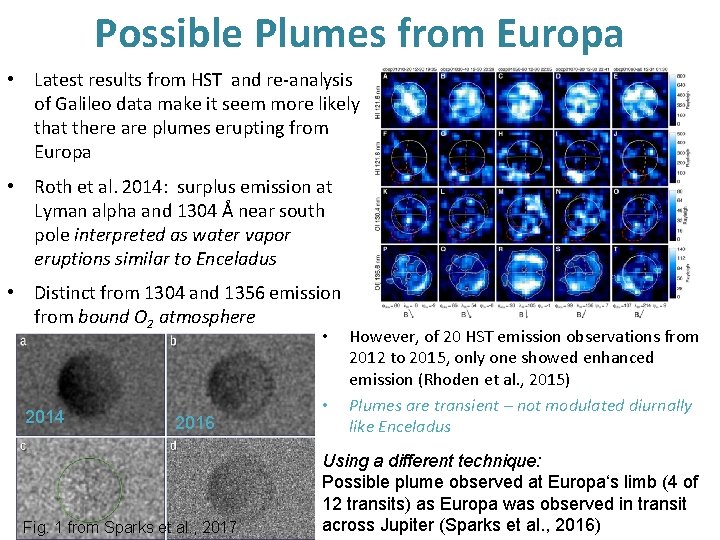
Possible Plumes from Europa • Latest results from HST and re-analysis of Galileo data make it seem more likely that there are plumes erupting from Europa • Roth et al. 2014: surplus emission at Lyman alpha and 1304 Å near south pole interpreted as water vapor eruptions similar to Enceladus • Distinct from 1304 and 1356 emission from bound O 2 atmosphere • 2014 2016 Fig. 1 from Sparks et al. , 2017 • However, of 20 HST emission observations from 2012 to 2015, only one showed enhanced emission (Rhoden et al. , 2015) Plumes are transient – not modulated diurnally like Enceladus Using a different technique: Possible plume observed at Europa‘s limb (4 of 12 transits) as Europa was observed in transit across Jupiter (Sparks et al. , 2016)
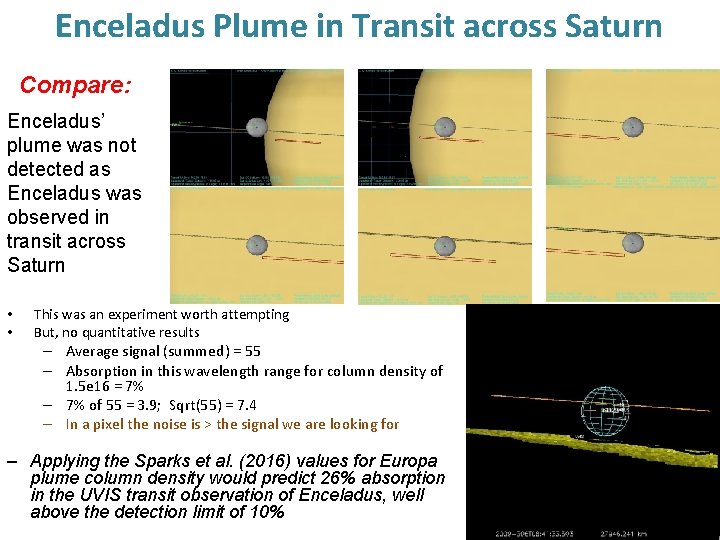
Enceladus Plume in Transit across Saturn Compare: Enceladus’ plume was not detected as Enceladus was observed in transit across Saturn • • This was an experiment worth attempting But, no quantitative results – Average signal (summed) = 55 – Absorption in this wavelength range for column density of 1. 5 e 16 = 7% – 7% of 55 = 3. 9; Sqrt(55) = 7. 4 – In a pixel the noise is > the signal we are looking for – Applying the Sparks et al. (2016) values for Europa plume column density would predict 26% absorption in the UVIS transit observation of Enceladus, well above the detection limit of 10%
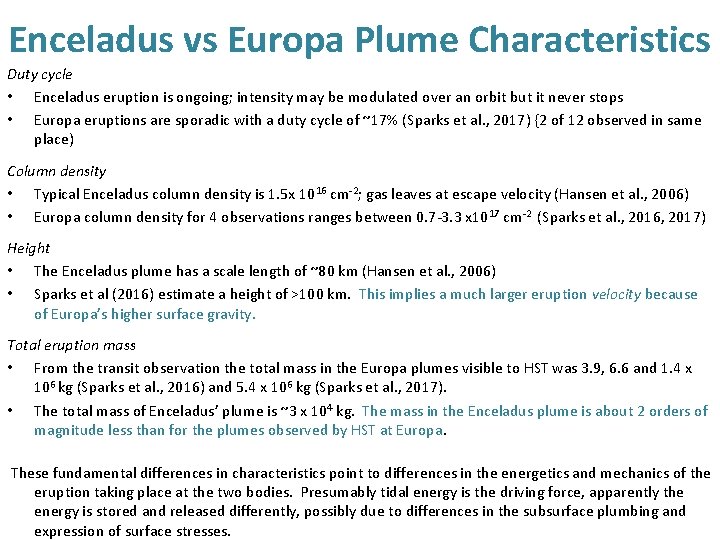
Enceladus vs Europa Plume Characteristics Duty cycle • Enceladus eruption is ongoing; intensity may be modulated over an orbit but it never stops • Europa eruptions are sporadic with a duty cycle of ~17% (Sparks et al. , 2017) {2 of 12 observed in same place) Column density • Typical Enceladus column density is 1. 5 x 1016 cm-2; gas leaves at escape velocity (Hansen et al. , 2006) • Europa column density for 4 observations ranges between 0. 7 -3. 3 x 1017 cm-2 (Sparks et al. , 2016, 2017) Height • The Enceladus plume has a scale length of ~80 km (Hansen et al. , 2006) • Sparks et al (2016) estimate a height of >100 km. This implies a much larger eruption velocity because of Europa’s higher surface gravity. Total eruption mass • From the transit observation the total mass in the Europa plumes visible to HST was 3. 9, 6. 6 and 1. 4 x 10⁶ kg (Sparks et al. , 2016) and 5. 4 x 10⁶ kg (Sparks et al. , 2017). • The total mass of Enceladus’ plume is ~3 x 10⁴ kg. The mass in the Enceladus plume is about 2 orders of magnitude less than for the plumes observed by HST at Europa. These fundamental differences in characteristics point to differences in the energetics and mechanics of the eruption taking place at the two bodies. Presumably tidal energy is the driving force, apparently the energy is stored and released differently, possibly due to differences in the subsurface plumbing and expression of surface stresses.
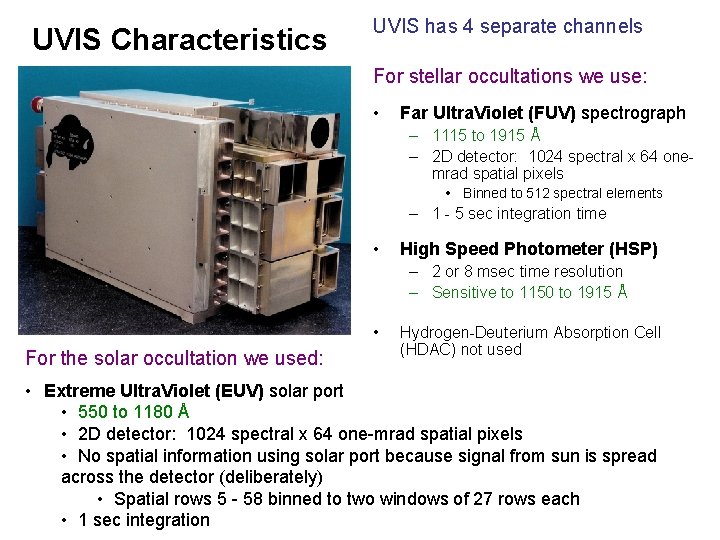
UVIS Characteristics UVIS has 4 separate channels For stellar occultations we use: • Far Ultra. Violet (FUV) spectrograph – 1115 to 1915 Å – 2 D detector: 1024 spectral x 64 onemrad spatial pixels • Binned to 512 spectral elements – 1 - 5 sec integration time • High Speed Photometer (HSP) – 2 or 8 msec time resolution – Sensitive to 1150 to 1915 Å • For the solar occultation we used: Hydrogen-Deuterium Absorption Cell (HDAC) not used • Extreme Ultra. Violet (EUV) solar port • 550 to 1180 Å • 2 D detector: 1024 spectral x 64 one-mrad spatial pixels • No spatial information using solar port because signal from sun is spread across the detector (deliberately) • Spatial rows 5 - 58 binned to two windows of 27 rows each • 1 sec integration
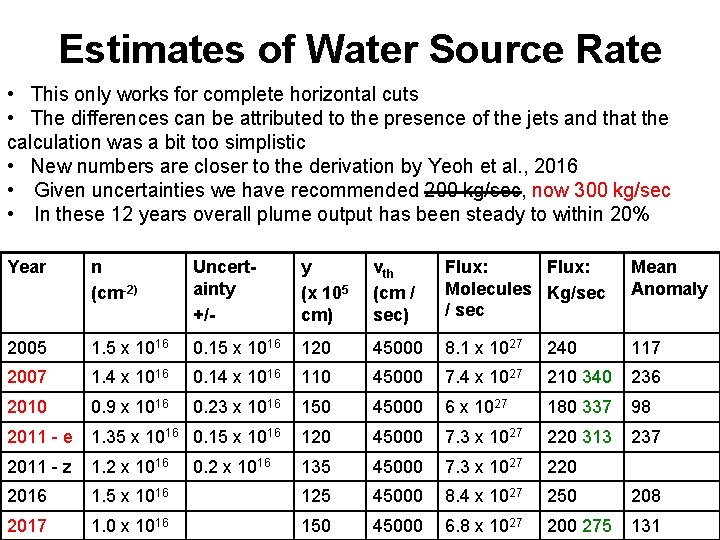
Estimates of Water Source Rate • This only works for complete horizontal cuts • The differences can be attributed to the presence of the jets and that the calculation was a bit too simplistic • New numbers are closer to the derivation by Yeoh et al. , 2016 • Given uncertainties we have recommended 200 kg/sec, now 300 kg/sec • In these 12 years overall plume output has been steady to within 20% Year n (cm-2) Uncertainty +/- y (x 105 cm) vth (cm / sec) Flux: Molecules Kg/sec / sec Mean Anomaly 2005 1. 5 x 10¹⁶ 0. 15 x 1016 120 45000 8. 1 x 1027 240 117 2007 1. 4 x 10¹⁶ 0. 14 x 1016 110 45000 7. 4 x 1027 210 340 236 2010 0. 9 x 10¹⁶ 0. 23 x 1016 150 45000 6 x 1027 180 337 98 2011 - e 1. 35 x 1016 0. 15 x 1016 120 45000 7. 3 x 1027 220 313 237 2011 - z 1. 2 x 10¹⁶ 135 45000 7. 3 x 1027 220 2016 1. 5 x 10¹⁶ 125 45000 8. 4 x 1027 250 208 2017 1. 0 x 1016 150 45000 6. 8 x 1027 200 275 131 0. 2 x 10¹⁶
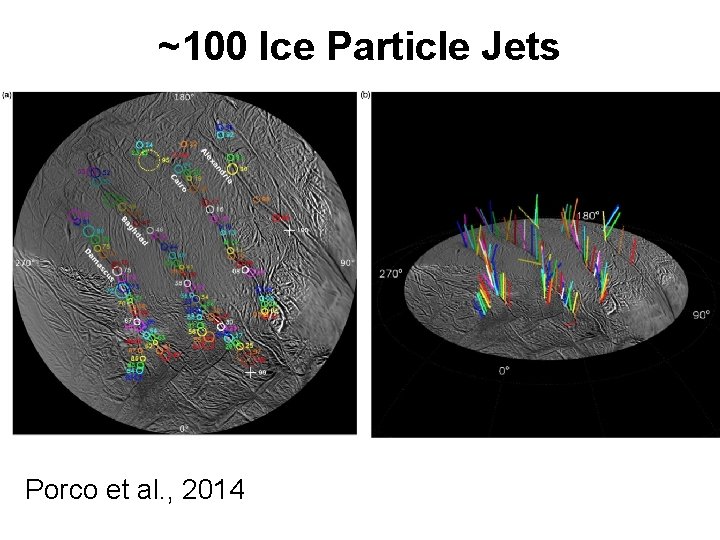
~100 Ice Particle Jets Porco et al. , 2014
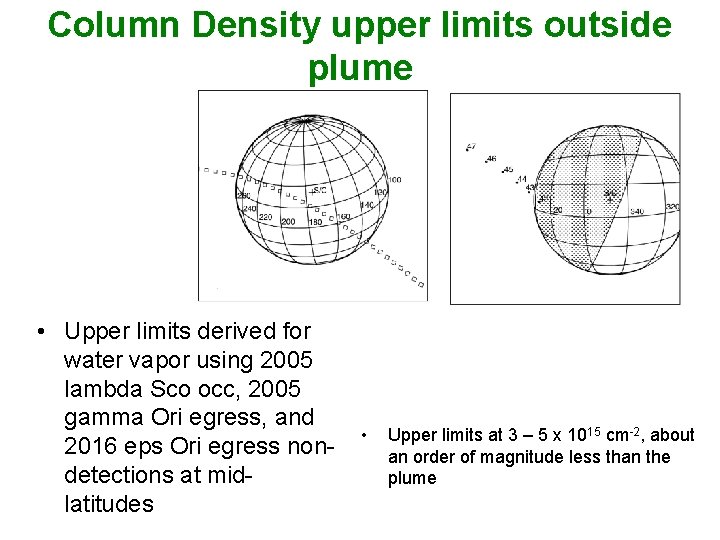
Column Density upper limits outside plume • Upper limits derived for water vapor using 2005 lambda Sco occ, 2005 gamma Ori egress, and 2016 eps Ori egress nondetections at midlatitudes • Upper limits at 3 – 5 x 1015 cm-2, about an order of magnitude less than the plume
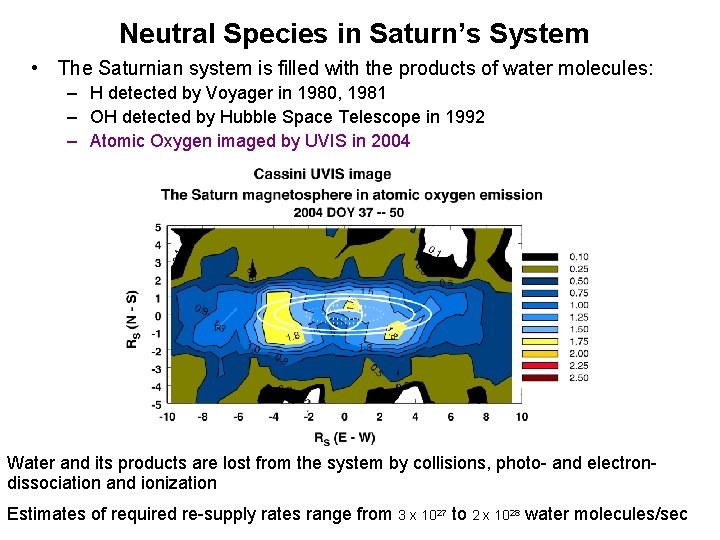
Neutral Species in Saturn’s System • The Saturnian system is filled with the products of water molecules: – H detected by Voyager in 1980, 1981 – OH detected by Hubble Space Telescope in 1992 – Atomic Oxygen imaged by UVIS in 2004 Water and its products are lost from the system by collisions, photo- and electrondissociation and ionization Estimates of required re-supply rates range from 3 x 1027 to 2 x 1028 water molecules/sec
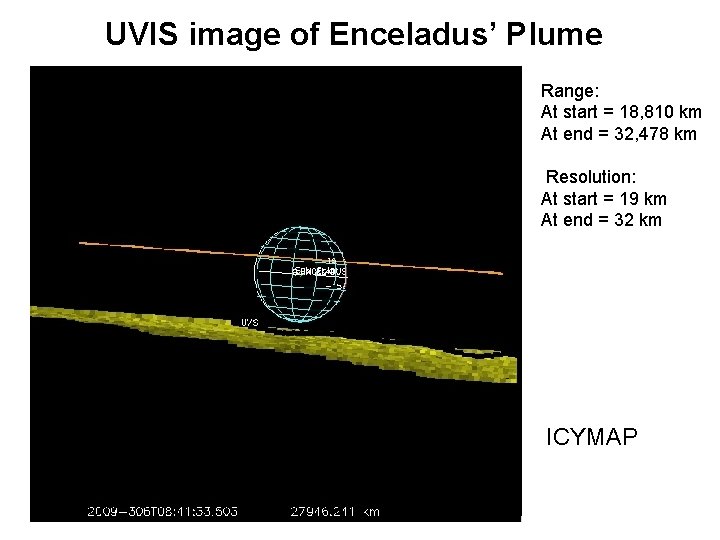
UVIS image of Enceladus’ Plume Range: At start = 18, 810 km At end = 32, 478 km Resolution: At start = 19 km At end = 32 km ICYMAP
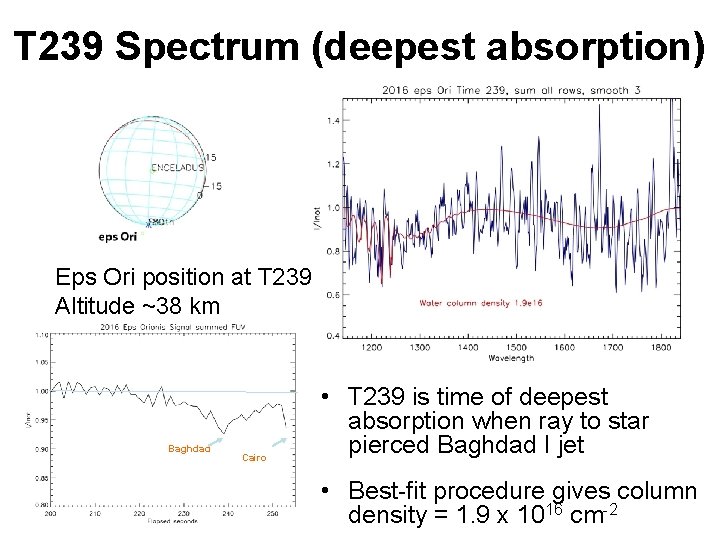
T 239 Spectrum (deepest absorption) Eps Ori position at T 239 Altitude ~38 km Baghdad Cairo • T 239 is time of deepest absorption when ray to star pierced Baghdad I jet • Best-fit procedure gives column density = 1. 9 x 1016 cm-2
UVIS Occs compared to VIMS Results * Rev 267 occ; Mean anomaly 131 Water flux ~275 kg/sec * Hedman et al. , 2013 With new values a true anomaly dependence seems even less likely
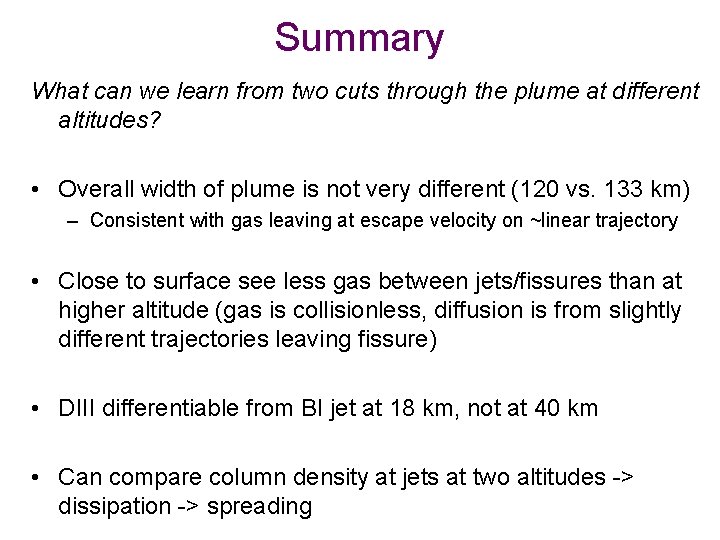
Summary What can we learn from two cuts through the plume at different altitudes? • Overall width of plume is not very different (120 vs. 133 km) – Consistent with gas leaving at escape velocity on ~linear trajectory • Close to surface see less gas between jets/fissures than at higher altitude (gas is collisionless, diffusion is from slightly different trajectories leaving fissure) • DIII differentiable from BI jet at 18 km, not at 40 km • Can compare column density at jets at two altitudes -> dissipation -> spreading