
The Strategy Change Cycle Chapter 2 John M

- Slides: 45
The Strategy Change Cycle Chapter 2 –John M. Bryson An Effective Strategic Planning Approach Lesia Skira Saluchok Actions, Results, Evaluative Judgements & Learning - Byrson 3 rd Edition Chapter 2 1
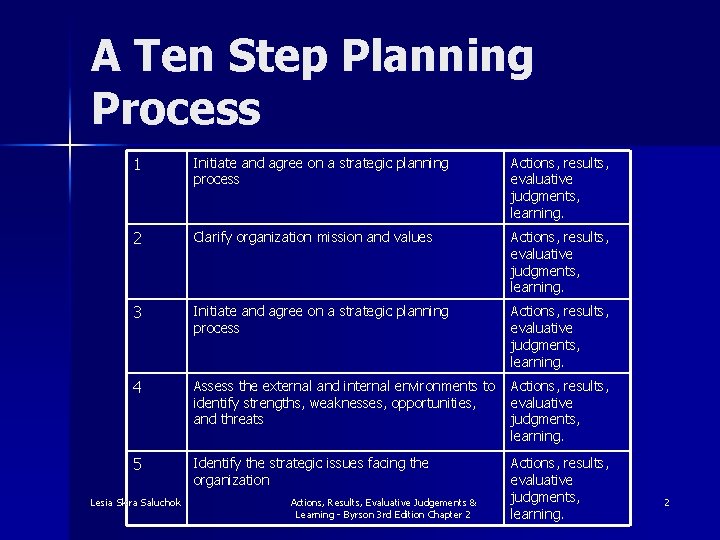
A Ten Step Planning Process 1 Initiate and agree on a strategic planning process Actions, results, evaluative judgments, learning. 2 Clarify organization mission and values Actions, results, evaluative judgments, learning. 3 Initiate and agree on a strategic planning process Actions, results, evaluative judgments, learning. 4 Assess the external and internal environments to identify strengths, weaknesses, opportunities, and threats Actions, results, evaluative judgments, learning. 5 Identify the strategic issues facing the organization Actions, results, evaluative judgments, learning. Lesia Skira Saluchok Actions, Results, Evaluative Judgements & Learning - Byrson 3 rd Edition Chapter 2 2
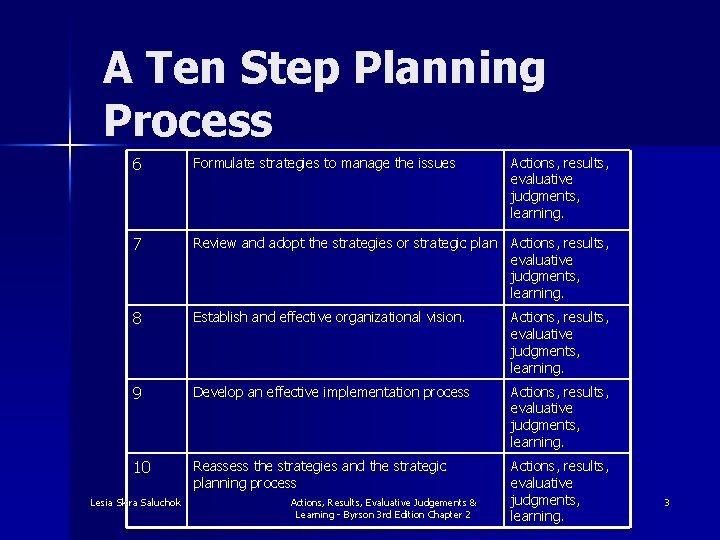
A Ten Step Planning Process 6 Formulate strategies to manage the issues 7 Review and adopt the strategies or strategic plan Actions, results, evaluative judgments, learning. 8 Establish and effective organizational vision. Actions, results, evaluative judgments, learning. 9 Develop an effective implementation process Actions, results, evaluative judgments, learning. 10 Reassess the strategies and the strategic planning process Actions, results, evaluative judgments, learning. Lesia Skira Saluchok Actions, Results, Evaluative Judgements & Learning - Byrson 3 rd Edition Chapter 2 Actions, results, evaluative judgments, learning. 3
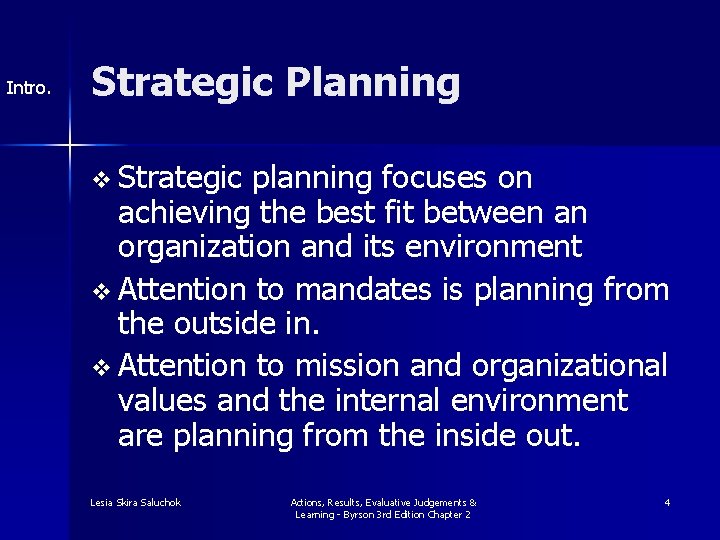
Intro. Strategic Planning v Strategic planning focuses on achieving the best fit between an organization and its environment v Attention to mandates is planning from the outside in. v Attention to mission and organizational values and the internal environment are planning from the inside out. Lesia Skira Saluchok Actions, Results, Evaluative Judgements & Learning - Byrson 3 rd Edition Chapter 2 4
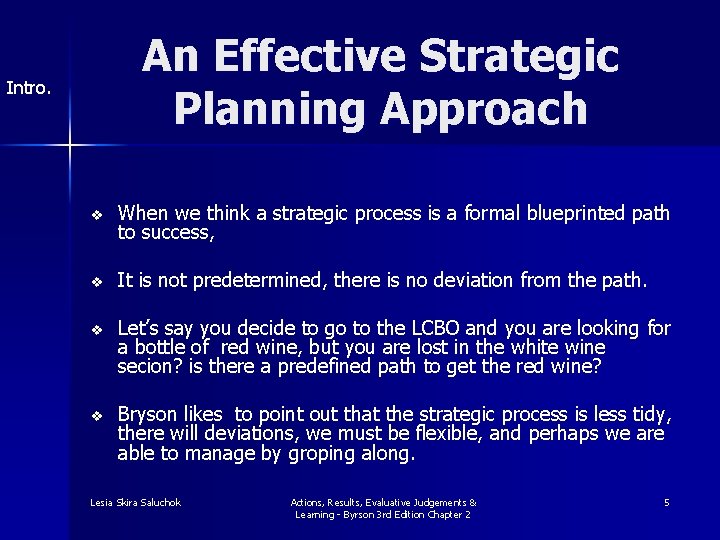
An Effective Strategic Planning Approach Intro. v When we think a strategic process is a formal blueprinted path to success, v It is not predetermined, there is no deviation from the path. v Let’s say you decide to go to the LCBO and you are looking for a bottle of red wine, but you are lost in the white wine secion? is there a predefined path to get the red wine? v Bryson likes to point out that the strategic process is less tidy, there will deviations, we must be flexible, and perhaps we are able to manage by groping along. Lesia Skira Saluchok Actions, Results, Evaluative Judgements & Learning - Byrson 3 rd Edition Chapter 2 5
Strategic Management Process Intro. n n Process is. . (Knezevich, 1984) and Kofman Refer back to last week, where we defined outcome and process. The Stragey Change Cycle becomes a strategic management process not just strategic planning. How can we link planning and implementation and management of an organization in a strategic way on an on going basis? Answer? ? ? Lesia Skira Saluchok Actions, Results, Evaluative Judgements & Learning - Byrson 3 rd Edition Chapter 2 6
Strategic Management Process Intro. v v v v ANSWER: USE THE STRATEGIC MANAGEMENT CYCLE Overall purpose of Strategic Management (Poister and Streib, 1999) Develop continuing commitment to the mission and vision of the organization (inside and authorizing environment). Nurture a culture that identifies and supports the mission and vision Maintain a clear focus on the organization’s strategic agenda throughout all its decision processes and activities. What is needed for the Strategy Change Cycle? v Research v Practical experience Lesia Skira Saluchok Actions, Results, Evaluative Judgements & Learning - Byrson 3 rd Edition Chapter 2 7
Intro. What is Process? n n Process is. . (Knezevich, 1984) and Kofman Refer back to last week, where we defined outcome and process. The Stragey Change Cycle becomes a strategic management process not just strategic planning. How can we link planning and implementation and management of an organization in a strategic way on an on going basis? Lesia Skira Saluchok Actions, Results, Evaluative Judgements & Learning - Byrson 3 rd Edition Chapter 2 8
Intro. Anything is possible with Diane Ackerman v Ambition v Imagination v Direction v Intelligence v Education v Training v Organization v Resources v Will v Staying power Lesia Skira Saluchok Actions, Results, Evaluative Judgements & Learning - Byrson 3 rd Edition Chapter 2 9
Intro. REMEMBER TO… v THINK STRATEGICALLY v ACT STRATEGICALLLY v LEARN STRATEGICALLY Lesia Skira Saluchok Actions, Results, Evaluative Judgements & Learning - Byrson 3 rd Edition Chapter 2 10
Intro. Timeline for the SPC TIMELINE n Know the details about the organization? (small, mid) n Larger – more time for effort an process, all steps followed in the SPC INITIAL n Three day retreat, one day meeting and then four weeks later to review the strategic plan. n Draft plan ADDITIONAL TIME: n Review n Sign-offs n securing information n advice from others to specifics of the plan Lesia Skira Saluchok Actions, Results, Evaluative Judgements & Learning - Byrson 3 rd Edition Chapter 2 11
#1 Initiate and Agree on a Strategic Planning Process v Negotiate agreement between key internal and external stakeholders v Agree on an overall strategic planning effort and the key planning steps. Lesia Skira Saluchok Actions, Results, Evaluative Judgements & Learning - Byrson 3 rd Edition Chapter 2 12
#1 The Success of SP Initiate and Agree on a Strategic Planning Process Depends on the key decision makers and their…. . v. Support and commitment v. Involvement v. At least one person or group must initiate the process. Lesia Skira Saluchok Actions, Results, Evaluative Judgements & Learning - Byrson 3 rd Edition Chapter 2 13
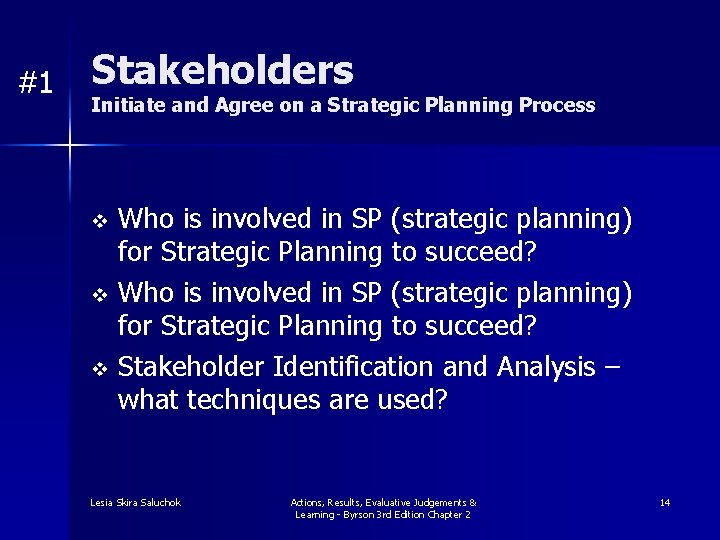
#1 Stakeholders Initiate and Agree on a Strategic Planning Process Who is involved in SP (strategic planning) for Strategic Planning to succeed? v Stakeholder Identification and Analysis – what techniques are used? v Lesia Skira Saluchok Actions, Results, Evaluative Judgements & Learning - Byrson 3 rd Edition Chapter 2 14
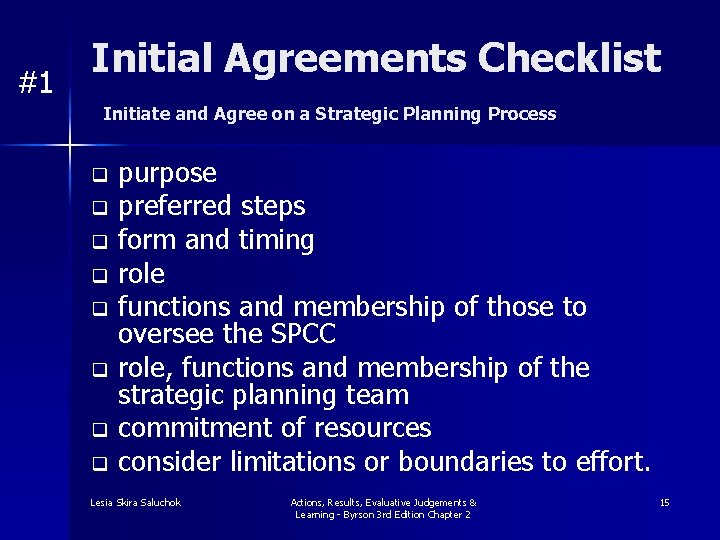
#1 Initial Agreements Checklist Initiate and Agree on a Strategic Planning Process purpose q preferred steps q form and timing q role q functions and membership of those to oversee the SPCC q role, functions and membership of the strategic planning team q commitment of resources q consider limitations or boundaries to effort. q Lesia Skira Saluchok Actions, Results, Evaluative Judgements & Learning - Byrson 3 rd Edition Chapter 2 15
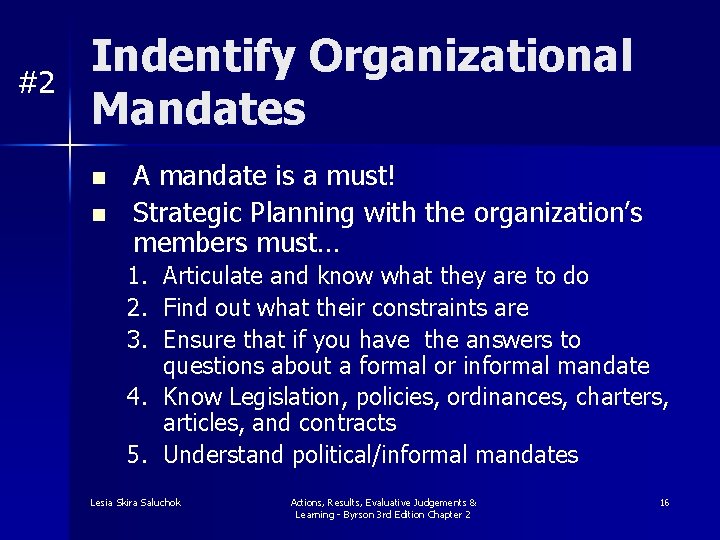
#2 Indentify Organizational Mandates n n A mandate is a must! Strategic Planning with the organization’s members must… 1. 2. 3. Articulate and know what they are to do Find out what their constraints are Ensure that if you have the answers to questions about a formal or informal mandate 4. Know Legislation, policies, ordinances, charters, articles, and contracts 5. Understand political/informal mandates Lesia Skira Saluchok Actions, Results, Evaluative Judgements & Learning - Byrson 3 rd Edition Chapter 2 16
#3 Clarify Organizational Mission and Values Lesia Skira Saluchok Actions, Results, Evaluative Judgements & Learning - Byrson 3 rd Edition Chapter 2 17
#4 Assess the External and Internal Environments Why assess? v v v STRENGTHS WEAKNESSES OPPORTUNITIES AND THREATS Bryson CHALLENGES Identify S. W. O. T. or S. W. O. C. Inside (more controlled) vs. outside factors (not controlled by organization). Present and future= strengths and weaknesses Present and Future = opportunities and challenges Change this way of thinking, look at the entire SWOT now and develop mock or potential future scenarios Lesia Skira Saluchok Actions, Results, Evaluative Judgements & Learning - Byrson 3 rd Edition Chapter 2 18
#4 Who and why SWOT ( C )? WHO? v Governing body of an organization v Board, governing board members (elected) v Employees WHY? v relate to external environment v Identification of distinctive/core competencies/capabilities, strongest abilities, most effective strategies or actions, best resources, easily replicable (Bryson page 41) Lesia Skira Saluchok Actions, Results, Evaluative Judgements & Learning - Byrson 3 rd Edition Chapter 2 19
#1 #4 Assess External and Internal Environments How to SWOT? HOW? v Monitor forces and trends (political, economic, educational, technological, physical environment) v Monitor external stakeholder groups v Monitor the competition v Attend to collaborative sources v Perform an external assessment v Identifies Critical Success Factors = Opportunities and challenges + stakeholder analysis which are must do’s (mandates, must do’s, criteria overlap) Lesia Skira Saluchok Actions, Results, Evaluative Judgements & Learning - Byrson 3 rd Edition Chapter 2 20
#4 Three steps of an External Assessment Process Assess External and Internal Environments 1. 2. 3. Scanning the environment to identify key trends Analyzing those key trends to interpret their importance and identify issues. Compile reports that are useful for planning and decision making without classifying information. (Pflaum and Delmont, 1987) Lesia Skira Saluchok Actions, Results, Evaluative Judgements & Learning - Byrson 3 rd Edition Chapter 2 21
#4 S. W. O. C/T. Assess External and Internal Environments Crisis = Opportunity Chinese Proverb Lesia Skira Saluchok Actions, Results, Evaluative Judgements & Learning - Byrson 3 rd Edition Chapter 2 22
#4 Official Future Assess External and Internal Environments v Official Future: develop various future scenarios v Forces working together v Influential forces v Non-influential v Avoids being blindsided Lesia Skira Saluchok Actions, Results, Evaluative Judgements & Learning - Byrson 3 rd Edition Chapter 2 23
#4 I. P. O. to Identify S & W Assess External and Internal Environments INPUT n Monitor resources (salaries, supplies, physical plant, FTE’s INPUT NEEDS n organizations philosophy, core values, distinctive competencies, and culture n Ensures stability and manages change Lesia Skira Saluchok Actions, Results, Evaluative Judgements & Learning - Byrson 3 rd Edition Chapter 2 24
#4 I. P. O. to Identify S & W Assess External and Internal Environments PROCESS n The Lesia Skira Saluchok present strategy Actions, Results, Evaluative Judgements & Learning - Byrson 3 rd Edition Chapter 2 25
#4 Assess External and Internal Environments OUTPUT n Performance, proper measurement? Existent? n Graduates versus no measure how educated are those graduates? n accountability of standardized tests? (Behn, 2003) n External stakeholders criteria vs. internal organization criteria need to meet at a common ground (Bryson, page 40) Lesia Skira Saluchok Actions, Results, Evaluative Judgements & Learning - Byrson 3 rd Edition Chapter 2 26
Assess External and Internal Environments #4 Discussion on Performance Measurement n Criteria or external organizations may not be the same as internal n Need measurement or external cannot, measure the relative effectiveness of alternative strategies, resources allocation (taxes), organizational design, distribution of power. n To political? What is the problem with standardized testing? n Pros and cons? n U. S. Government Performance and Results Act (GPRA). Canada is not far behind. n Will this be a critical success factor as it will be a must do n Example: schools other standardized tests, maybe colleges and universities and impose English competency tests. Lesia Skira Saluchok Actions, Results, Evaluative Judgements & Learning - Byrson 3 rd Edition Chapter 2 27
Links between I. P. O. #4 Assess External and Internal Environments Pros to link input, process and output: v Assists in what its strategies are and the value proposition. v Value added, logic model (Millar, Simeone, and Carnevale, 2001) /value chain (Porter, 1985) = interested stakeholders v Builds understanding of current strategy v Integrate human resource management, information technology and financial management. v Sustain, strengthen and protect desirable strategies. Lesia Skira Saluchok Actions, Results, Evaluative Judgements & Learning - Byrson 3 rd Edition Chapter 2 28
#5 Identify the Strategic Issues Facing the Organization Important Points (Bryson pg 42) 1. Strategic Issues are fundamental policy questions or critical challenges affecting the organization’s mandates, mission and values, product, service, level and mix, clients, users or payers, cost, financing, structure, process and management. 2. Involve conflicts 3. Prompt responses 4. Emotional intelligence (seen at stage 5) 5. Focuses organization on what is important to its survival, prosperity and effectiveness. Lesia Skira Saluchok Actions, Results, Evaluative Judgements & Learning - Byrson 3 rd Edition Chapter 2 29
#5 What may conflicts Involve? Identify the Strategic Issues Facing the Organization v Ends (what) v Means (how or how much) v Philosophy (why) v Location (where) v Timing (when) v Entities advantaged or disadvantaged by different ways of resolving the issue(who) Lesia Skira Saluchok Actions, Results, Evaluative Judgements & Learning - Byrson 3 rd Edition Chapter 2 30
#5 Statement of Strategic Issue Identify the Strategic Issues Facing the Organization 3 Elements 1. Describe the issue (one question, one paragraph, broad, options) 2. List challenge factors (why is the issue challenging the mission, mandates, values, internal strengths and weaknesses, external opportunities? ) 3. Statement of Consequences of failure to address the issue Lesia Skira Saluchok Actions, Results, Evaluative Judgements & Learning - Byrson 3 rd Edition Chapter 2 31
#5 Types of Strategic Issues Identify the Strategic Issues Facing the Organization 1. 2. 3. 4. Developmental Issues (or nondevelopmental, altering core business, change in products, service, customer, clients, service, sources of revenue) Issues that require constant monitoring (no immediate action) Horizon/Future action issues (part of Strategic Plan) Immediate response issues (not routine) Lesia Skira Saluchok Actions, Results, Evaluative Judgements & Learning - Byrson 3 rd Edition Chapter 2 32
#5 Seven Basic Approaches to Identifying the Strategic Issues Facing an Organization Direct approach (mandates, mission, SWOC’s, strategic issues) 2. Indirect approach( brainstorm options ie. stakeholders’ performance expectations) 3. Goals approach (performance indicators) 4. Vision of success approach (vision, identify issues) 5. Oval Mapping (actions, interconnectedness, mind map, inspiration. com) 6. Tensions approach (equity, innovation & change, tradition maintenance, productivity improvement, frame the issue) 7. Systems analysis approach (complex feedback Lesia Skira Saluchok Actions, Results, Evaluative Judgements & 33 effects) Learning - Byrson 3 rd Edition Chapter 2 1.
#6 Formulate Strategies to Manage the Issues Strategy can be defined as a pattern of purposes, policies, programs, actions, decisions or resource allocations that define what an organization is, what it does, and why it does it. Identify issues therefore formulate/develop strategies. Lesia Skira Saluchok Actions, Results, Evaluative Judgements & Learning - Byrson 3 rd Edition Chapter 2 34
#6 Strategy Formulation… Formulate strategies to manage the issues links rhetoric, choices, actions and consequences with consistency, v varies by level, function and time frame, v is tailored to fit an organizations culture, v may cause re-configuration of an organization v requires draft strategies, desired patterns & v can be reviewed at the end of step #6. v (Johnson & Scholes, 2002), Lesia Skira Saluchok Actions, Results, Evaluative Judgements & Learning - Byrson 3 rd Edition Chapter 2 35
#6 Effective Strategy Formulation Formulate strategies to manage the issues PART 1: Developing Strategies Through a Five Part-Part Process PART 2: Developing Strategies by Structuring Relationships Among Strategic Options (Bryson page 46) Lesia Skira Saluchok Actions, Results, Evaluative Judgements & Learning - Byrson 3 rd Edition Chapter 2 36
#6 PART #1 Developing Strategies Through a Five Part-Part Process Formulate strategies to manage the issues 1. 2. 3. 4. 5. Identify practical alternatives (do, get, buy, achieve) Enumerate the barriers Develop major proposals for achieving these alternatives (overcome barriers). Actions to implement major proposals (23 years) (implementation -step #9) Detailed work program (6 -12 months) (implementation -step #9) Lesia Skira Saluchok Actions, Results, Evaluative Judgements & Learning - Byrson 3 rd Edition Chapter 2 37
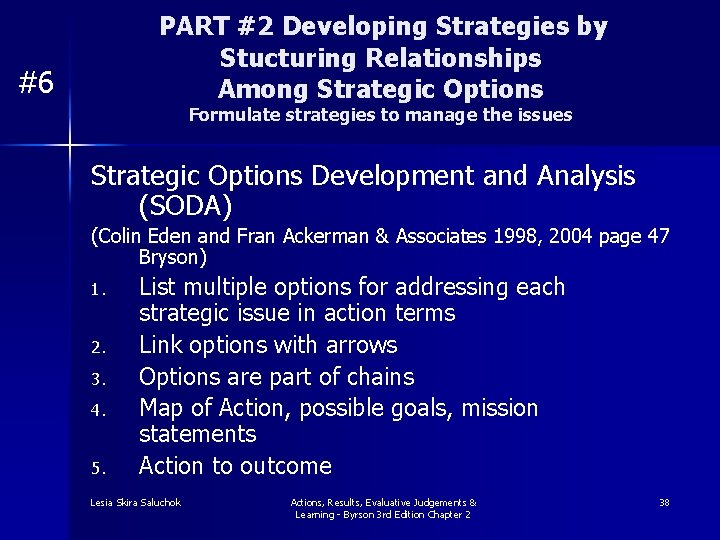
PART #2 Developing Strategies by Stucturing Relationships Among Strategic Options #6 Formulate strategies to manage the issues Strategic Options Development and Analysis (SODA) (Colin Eden and Fran Ackerman & Associates 1998, 2004 page 47 Bryson) 1. 2. 3. 4. 5. List multiple options for addressing each strategic issue in action terms Link options with arrows Options are part of chains Map of Action, possible goals, mission statements Action to outcome Lesia Skira Saluchok Actions, Results, Evaluative Judgements & Learning - Byrson 3 rd Edition Chapter 2 38
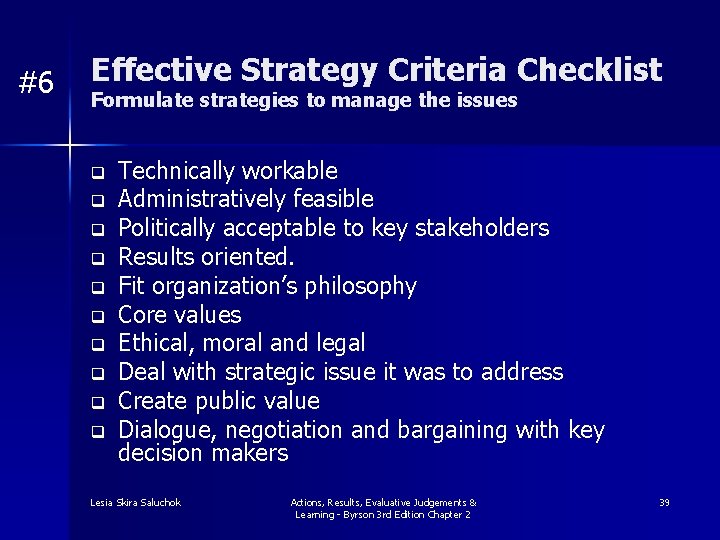
#6 Effective Strategy Criteria Checklist Formulate strategies to manage the issues q q q q q Technically workable Administratively feasible Politically acceptable to key stakeholders Results oriented. Fit organization’s philosophy Core values Ethical, moral and legal Deal with strategic issue it was to address Create public value Dialogue, negotiation and bargaining with key decision makers Lesia Skira Saluchok Actions, Results, Evaluative Judgements & Learning - Byrson 3 rd Edition Chapter 2 39
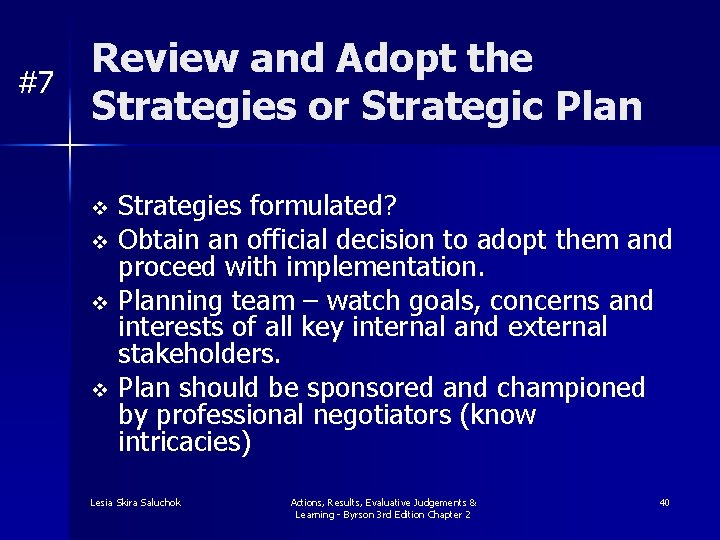
#7 Review and Adopt the Strategies or Strategic Plan Strategies formulated? v Obtain an official decision to adopt them and proceed with implementation. v Planning team – watch goals, concerns and interests of all key internal and external stakeholders. v Plan should be sponsored and championed by professional negotiators (know intricacies) v Lesia Skira Saluchok Actions, Results, Evaluative Judgements & Learning - Byrson 3 rd Edition Chapter 2 40
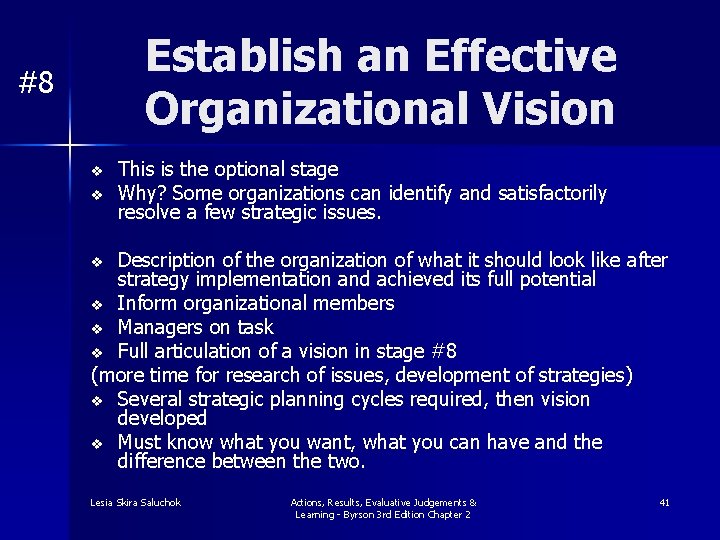
Establish an Effective Organizational Vision #8 v v This is the optional stage Why? Some organizations can identify and satisfactorily resolve a few strategic issues. Description of the organization of what it should look like after strategy implementation and achieved its full potential v Inform organizational members v Managers on task v Full articulation of a vision in stage #8 (more time for research of issues, development of strategies) v Several strategic planning cycles required, then vision developed v Must know what you want, what you can have and the difference between the two. v Lesia Skira Saluchok Actions, Results, Evaluative Judgements & Learning - Byrson 3 rd Edition Chapter 2 41
#8 Description of Vision Establish and Effective Organizational Vision v Organization’s mission v values v Philosophy v Basic strategies v Performance criteria v Decision rules v Ethical standards of all employees Lesia Skira Saluchok Actions, Results, Evaluative Judgements & Learning - Byrson 3 rd Edition Chapter 2 42
Develop an Effective Implementation Process #9 Realization step of the strategies in Step #6 ( ) v Depends on the size of the organization and circumstances (direct vs. staged implementation) v Small = incorporate step #9 into step #7 (Review and adopt the strategies or strategic plan. ) v Large = multiunit, inter-governmental need the action planning v Formulate Strategies to manage the issues Lesia Skira Saluchok Actions, Results, Evaluative Judgements & Learning - Byrson 3 rd Edition Chapter 2 43
#9 Action Plan Checklist Develop an Effective Implementation Process q q q q Implementation roles and responsibilities of oversight bodies, organizational teams or individuals Expected results and specific objectives and milestones Specific action steps and relevant details. schedules Resource requirements and sources Communication process Review, monitor, midcourse correction procedures Accountability procedures Budget the plan Avoid competition with new priorities at this stage Blend intentions with emerging strategies along the way Set of principals, norms, rules and decision making procedures developed. Check regimes and their usefullness Lesia Skira Saluchok Actions, Results, Evaluative Judgements & Learning - Byrson 3 rd Edition Chapter 2 44
#1 0 Reassess the Strategies and the Strategic Planning Process v Re-assess to prelude a new round of strategic planning v Ongoing work v Keep the process going (stop? Must follow all steps again) v Throw out unsuccessful strategies v Replace them v Organizational learning has occurred Lesia Skira Saluchok Actions, Results, Evaluative Judgements & Learning - Byrson 3 rd Edition Chapter 2 45