
The Strategic Sourcing Process 7 Measure Improve Performance



- Slides: 41
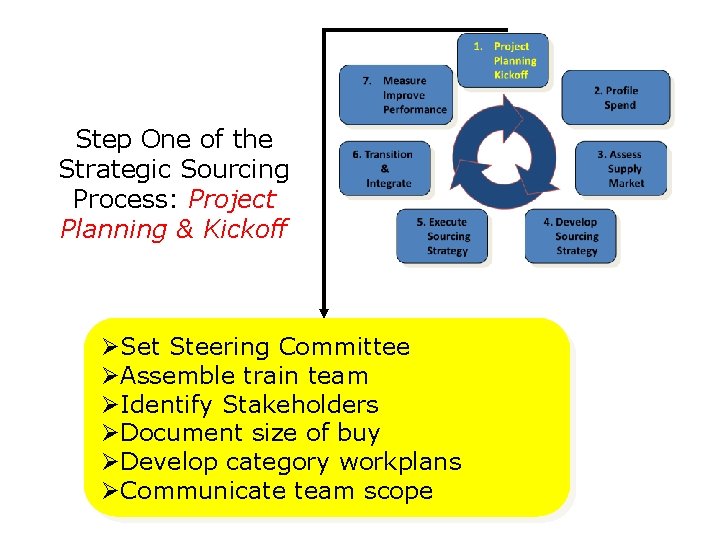
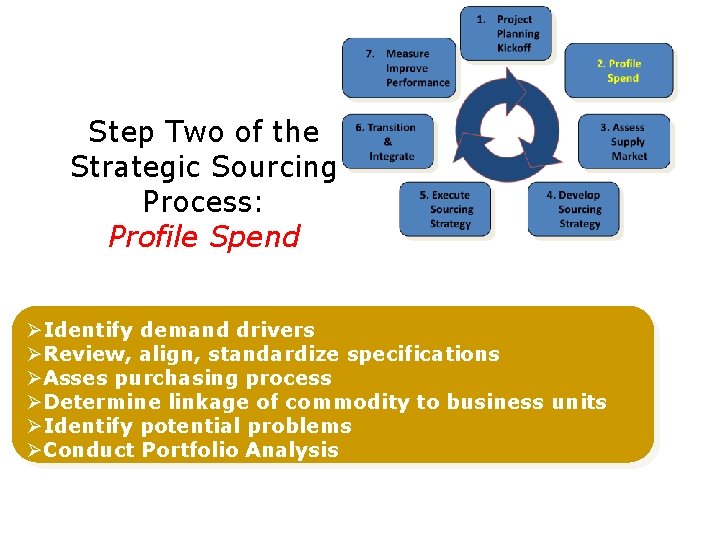
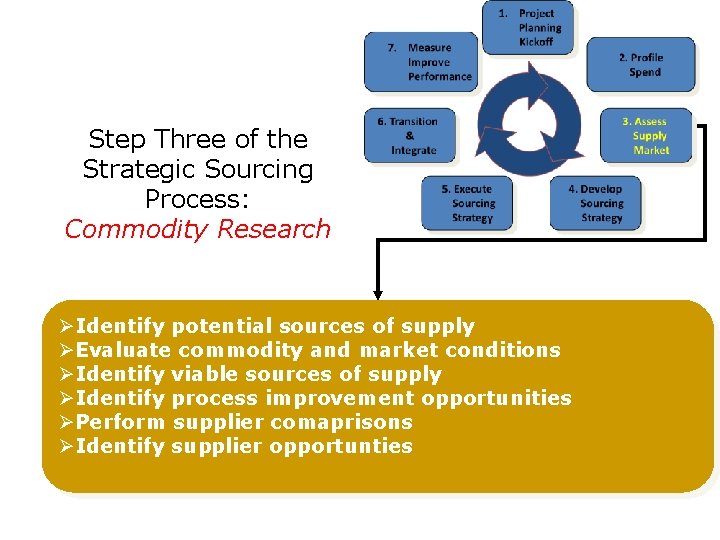
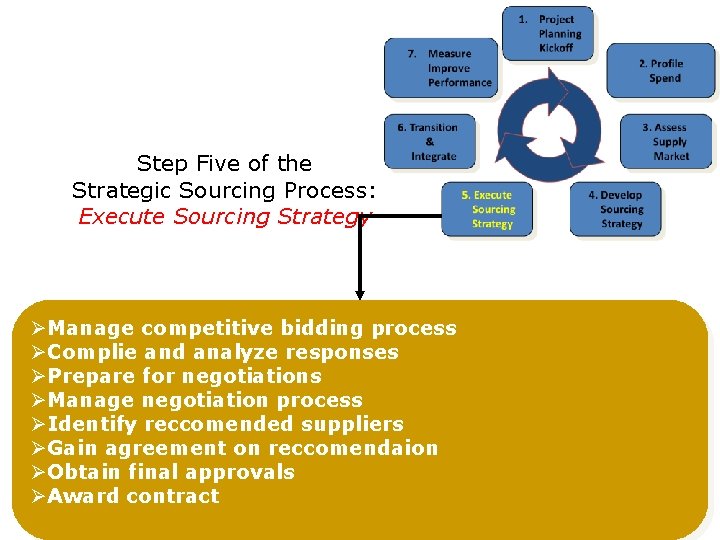
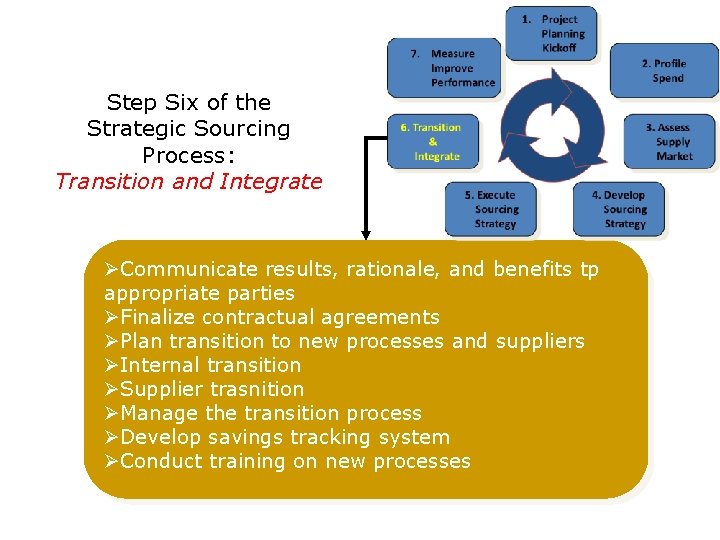
The Strategic Sourcing Process 7. Measure Improve Performance 1. Project Planning Kickoff 6. Transition & Integrate 5. Execute Sourcing Strategy 2. Profile Spend 3. Assess Supply Market 4. Develop Sourcing Strategy
Step One of the Strategic Sourcing Process: Project Planning & Kickoff ØSet Steering Committee ØAssemble train team ØIdentify Stakeholders ØDocument size of buy ØDevelop category workplans ØCommunicate team scope
Step Two of the Strategic Sourcing Process: Profile Spend ØIdentify demand drivers ØReview, align, standardize specifications ØAsses purchasing process ØDetermine linkage of commodity to business units ØIdentify potential problems ØConduct Portfolio Analysis
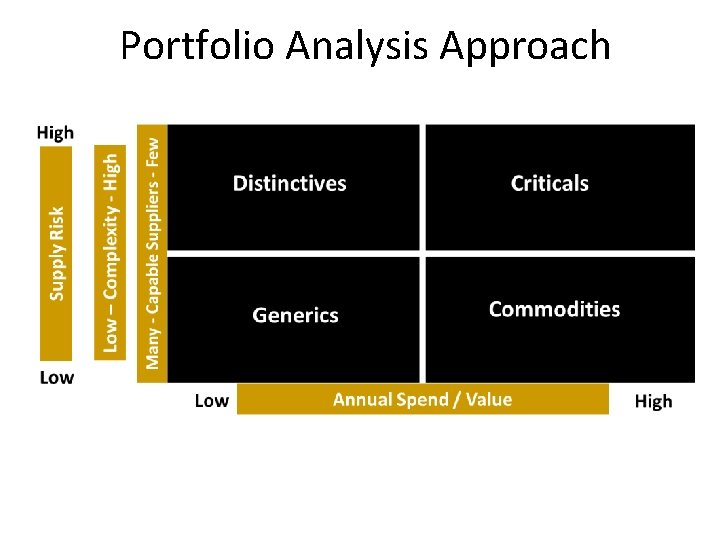
Portfolio Analysis Approach
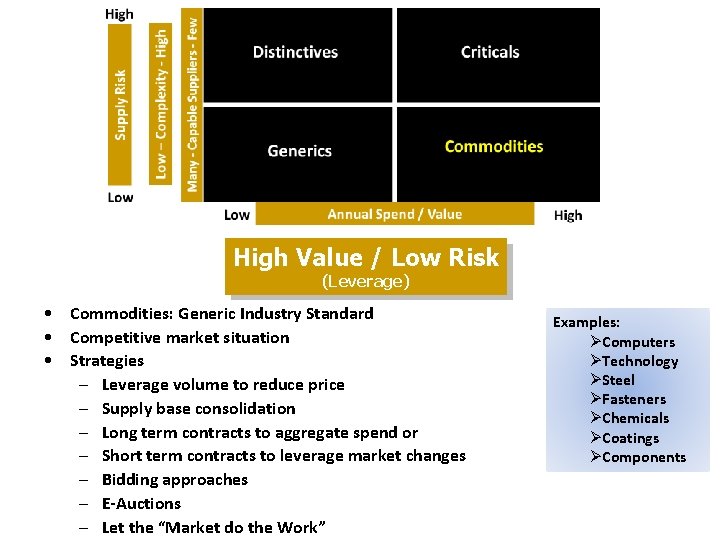
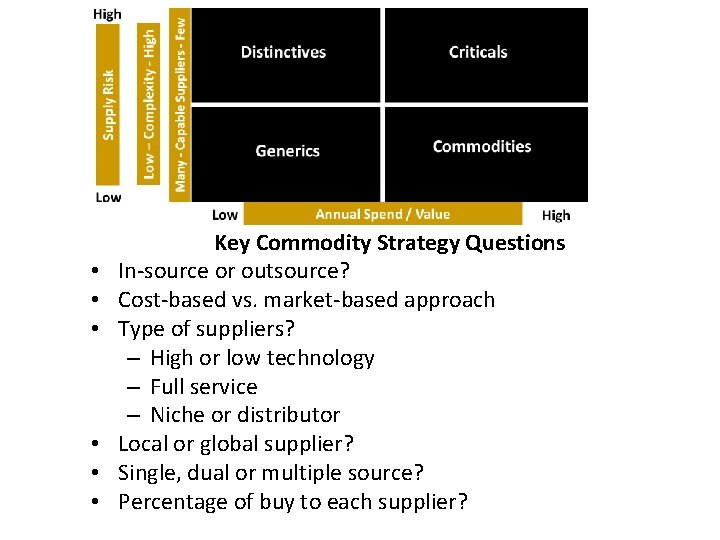
High Value / Low Risk (Leverage) • Commodities: Generic Industry Standard • Competitive market situation • Strategies – Leverage volume to reduce price – Supply base consolidation – Long term contracts to aggregate spend or – Short term contracts to leverage market changes – Bidding approaches – E-Auctions – Let the “Market do the Work” Examples: ØComputers ØTechnology ØSteel ØFasteners ØChemicals ØCoatings ØComponents
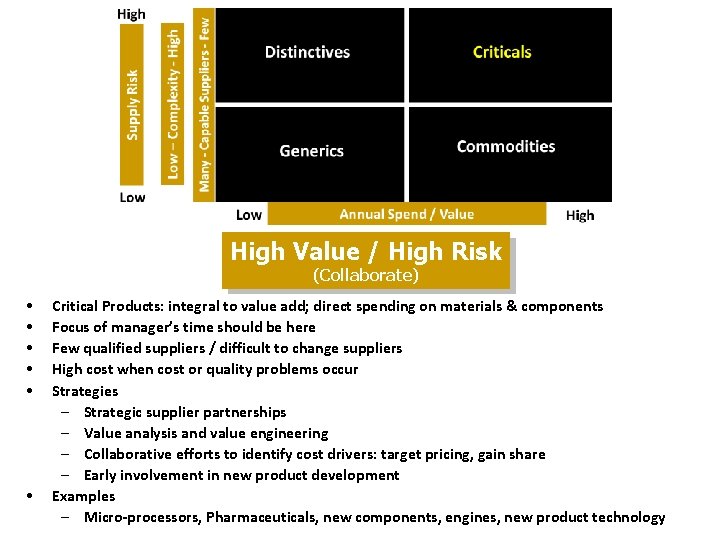
High Value / High Risk (Collaborate) • • • Critical Products: integral to value add; direct spending on materials & components Focus of manager’s time should be here Few qualified suppliers / difficult to change suppliers High cost when cost or quality problems occur Strategies – Strategic supplier partnerships – Value analysis and value engineering – Collaborative efforts to identify cost drivers: target pricing, gain share – Early involvement in new product development Examples – Micro-processors, Pharmaceuticals, new components, engines, new product technology
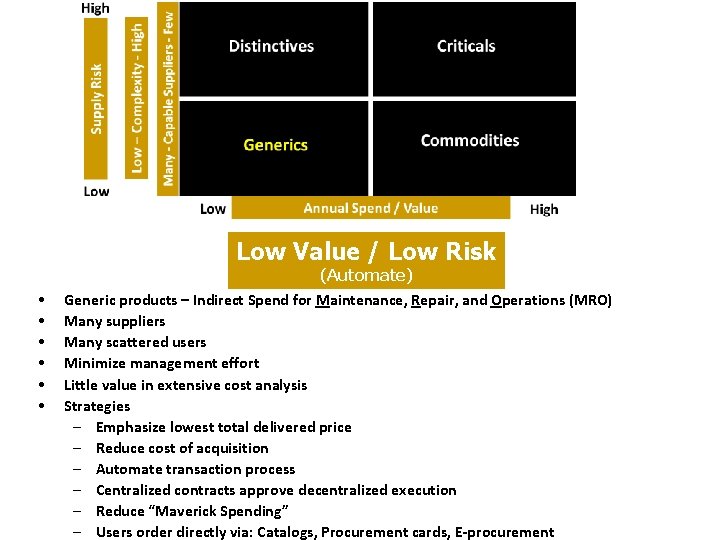
Low Value / Low Risk (Automate) • • • Generic products – Indirect Spend for Maintenance, Repair, and Operations (MRO) Many suppliers Many scattered users Minimize management effort Little value in extensive cost analysis Strategies – Emphasize lowest total delivered price – Reduce cost of acquisition – Automate transaction process – Centralized contracts approve decentralized execution – Reduce “Maverick Spending” – Users order directly via: Catalogs, Procurement cards, E-procurement
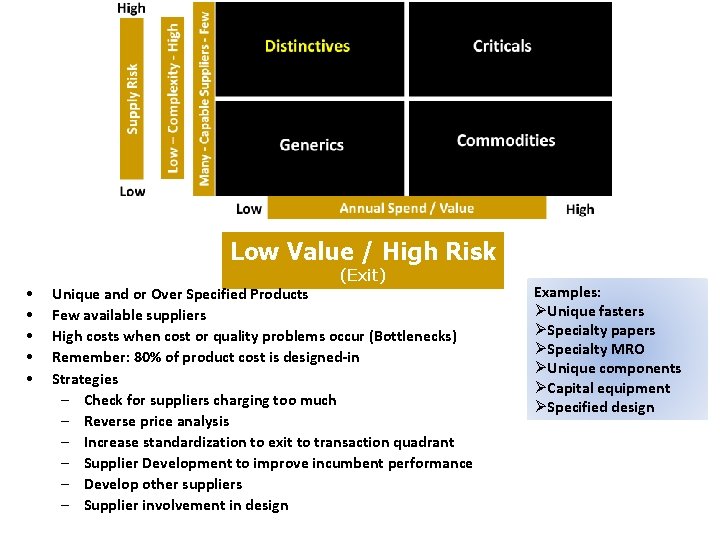
Low Value / High Risk • • • (Exit) Unique and or Over Specified Products Few available suppliers High costs when cost or quality problems occur (Bottlenecks) Remember: 80% of product cost is designed-in Strategies – Check for suppliers charging too much – Reverse price analysis – Increase standardization to exit to transaction quadrant – Supplier Development to improve incumbent performance – Develop other suppliers – Supplier involvement in design Examples: ØUnique fasters ØSpecialty papers ØSpecialty MRO ØUnique components ØCapital equipment ØSpecified design
Step Three of the Strategic Sourcing Process: Commodity Research ØIdentify potential sources of supply ØEvaluate commodity and market conditions ØIdentify viable sources of supply ØIdentify process improvement opportunities ØPerform supplier comaprisons ØIdentify supplier opportunties
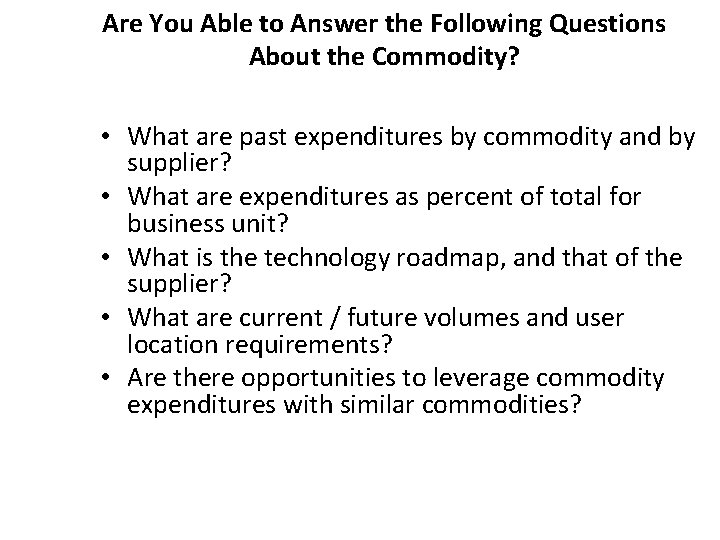
Are You Able to Answer the Following Questions About the Commodity? • What are past expenditures by commodity and by supplier? • What are expenditures as percent of total for business unit? • What is the technology roadmap, and that of the supplier? • What are current / future volumes and user location requirements? • Are there opportunities to leverage commodity expenditures with similar commodities?
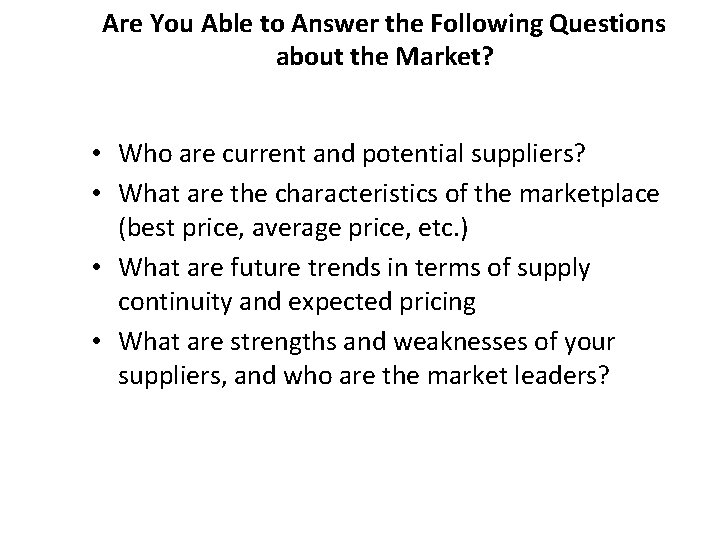
Are You Able to Answer the Following Questions about the Market? • Who are current and potential suppliers? • What are the characteristics of the marketplace (best price, average price, etc. ) • What are future trends in terms of supply continuity and expected pricing • What are strengths and weaknesses of your suppliers, and who are the market leaders?
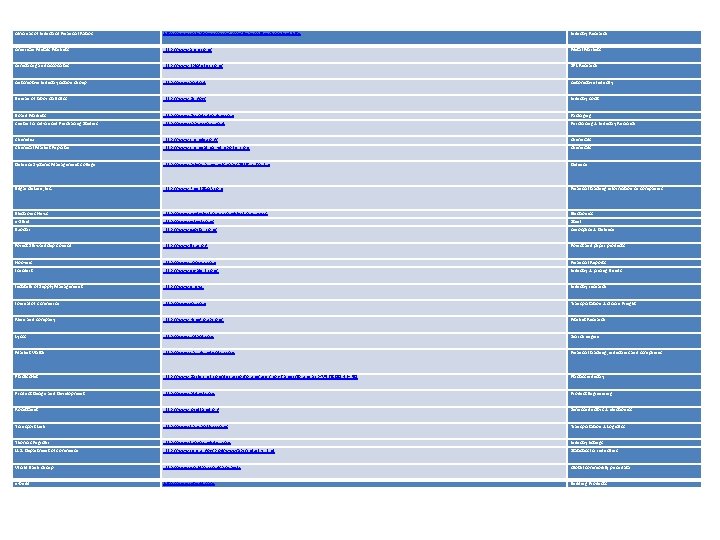
Almanac of Industrial Financial Ratios http: //www. valuationresources. com/Financial. Benchmarking. htm Industry Research American Metals Markets http: //www. amm. com/ Metal Markets Armstrong and Associates http: //www. 3 plogistics. com/ 3 PL Research Automotive Industry Action Group http: //www. aiag. org Automotive Industry Bureau of labor statistics http: //www. bls. gov/ Industry costs Board Markets http: //www. packaging-online. com Packaging Center for Advanced Purchasing Studies http: //www. capsresearch. org Purchasing & Industry Research Chemdex http: //www. chemdex. org/ Chemicals Chemical Market Reporter http: //www. chemicalmarketreporter. com Chemicals Defense Systems Management College http: //www. belvoir. army. mil/maps/DSMC_info. htm Defense Edgar On. Line, Inc. http: //www. Free. EDGAR. com Financial tracking information on companies Electronic News http: //www. reed-electronics. com/electronicnews/ Electronics e-Steel http: //www. esteel. com/ Steel Exostar http: //www. exostar. com/ Aerospace & Defense Forest Stewardship Council http: //www. fscus. org Forest and paper products Hoovers http: //www. hoovers. com Financial Reports Ice Alert http: //www. ice-alert. com/ Industry & pricing trends Institute of Supply Management http: //www. ism. ws Industry research Journal of Commerce http: //www. joc. com Transportation & Ocean Freight Kline and Company http: //www. klinegroup. com/ Market Research Lycos http: //www. hotbot. com Search engine Market Watch http: //www. cbs. marketwatch. com Financial tracking, industries and companies Plastics. Net http: //www. plasticsnet. com/discussionforums/user/non-frames/forums. asp? VNETCOOKIE=NO Plastics industry Product Design and Development http: //www. pddnet. com Product Engineering Rosettanet http: //www. rosettanet. org Semiconductors & electronics Transport Link http: //www. transportlink. com/ Transportation & Logistics Thomas Register http: //www. thomasregister. com Industry listings U. S. Department of Commerce http: //www. census. gov/prod/www/abs/industry. html Statistics for industries World Bank Group http: //www. worldbank. org/prospects Global commodity price data e-build http: //www. ebuild. com Building Products
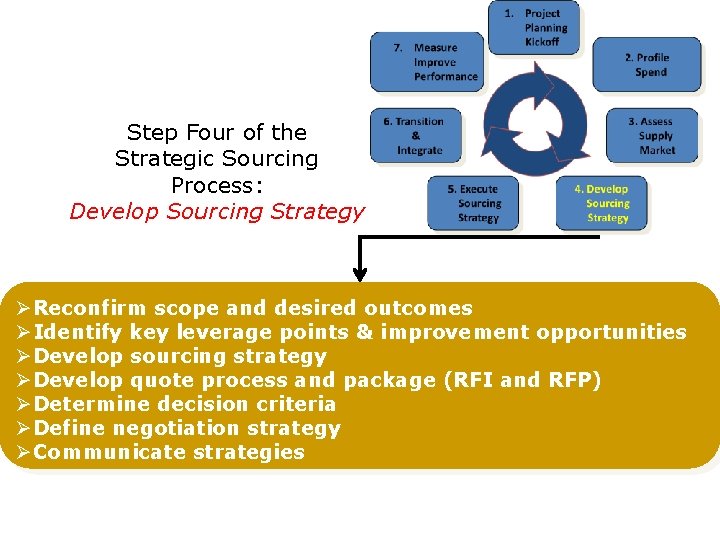
Step Four of the Strategic Sourcing Process: Develop Sourcing Strategy ØReconfirm scope and desired outcomes ØIdentify key leverage points & improvement opportunities ØDevelop sourcing strategy ØDevelop quote process and package (RFI and RFP) ØDetermine decision criteria ØDefine negotiation strategy ØCommunicate strategies
• • • Key Commodity Strategy Questions In-source or outsource? Cost-based vs. market-based approach Type of suppliers? – High or low technology – Full service – Niche or distributor Local or global supplier? Single, dual or multiple source? Percentage of buy to each supplier?
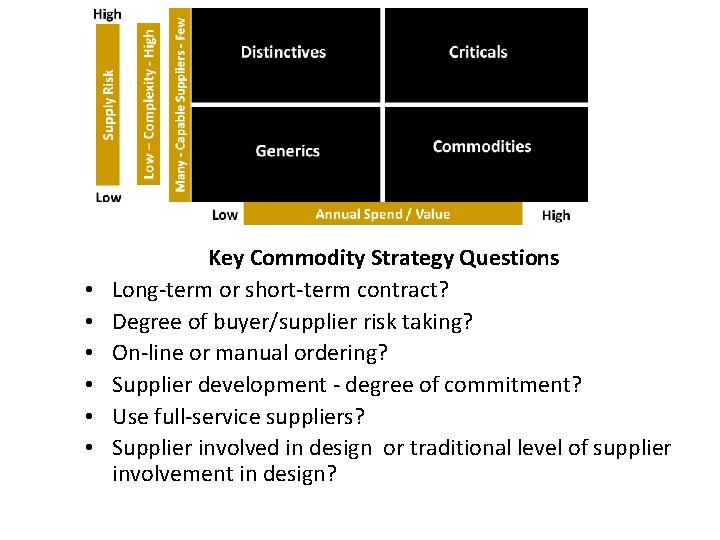
• • • Key Commodity Strategy Questions Long-term or short-term contract? Degree of buyer/supplier risk taking? On-line or manual ordering? Supplier development - degree of commitment? Use full-service suppliers? Supplier involved in design or traditional level of supplier involvement in design?
Step Five of the Strategic Sourcing Process: Execute Sourcing Strategy ØManage competitive bidding process ØComplie and analyze responses ØPrepare for negotiations ØManage negotiation process ØIdentify reccomended suppliers ØGain agreement on reccomendaion ØObtain final approvals ØAward contract
Step Six of the Strategic Sourcing Process: Transition and Integrate ØCommunicate results, rationale, and benefits tp appropriate parties ØFinalize contractual agreements ØPlan transition to new processes and suppliers ØInternal transition ØSupplier trasnition ØManage the transition process ØDevelop savings tracking system ØConduct training on new processes
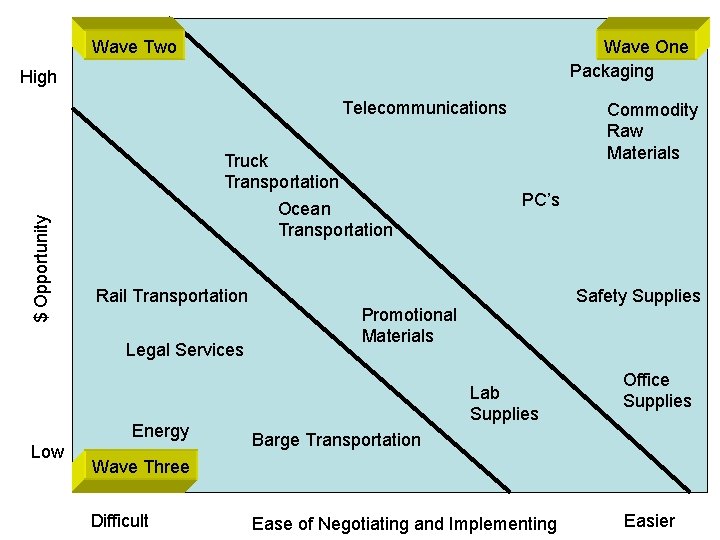
Wave Two Wave One Packaging High $ Opportunity Telecommunications Truck Transportation Ocean Transportation Rail Transportation Legal Services Energy Low Commodity Raw Materials PC’s Safety Supplies Promotional Materials Lab Supplies Office Supplies Barge Transportation Wave Three Difficult Ease of Negotiating and Implementing Easier
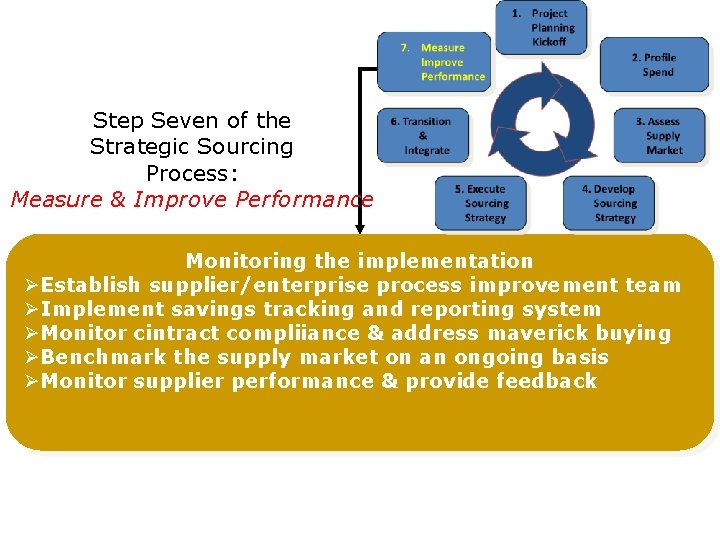
Step Seven of the Strategic Sourcing Process: Measure & Improve Performance Monitoring the implementation ØEstablish supplier/enterprise process improvement team ØImplement savings tracking and reporting system ØMonitor cintract compliiance & address maverick buying ØBenchmark the supply market on an ongoing basis ØMonitor supplier performance & provide feedback
Assignment 9. 1 Collins Global Portfolio Analysis 20
Introducing Collins Global • Collins provides wide range of electronics products: • Multimedia entertainment systems (MES) • Portable media devices (PMD) • Display devices (CRT and flat-panel technology) (CRT) • Copying and printing solutions that incorporate proprietary integrated circuit technology (CPS) – Company has various sales channels • Direct National Accounts • Distributors • Retailers • Direct Consumers through company website • OEM’s – Collins has expanded vastly in many product groups and the supply networks grew due to the acquisitions
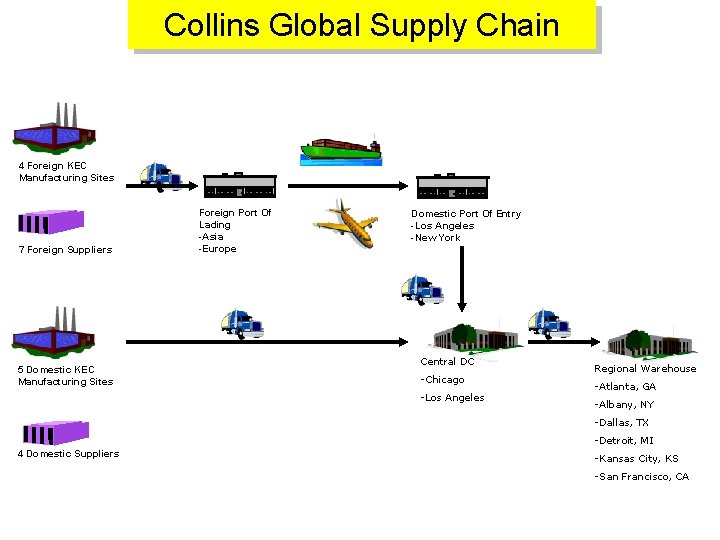
Collins Global Supply Chain 4 Foreign KEC Manufacturing Sites 7 Foreign Suppliers 5 Domestic KEC Manufacturing Sites Foreign Port Of Lading -Asia -Europe Domestic Port Of Entry -Los Angeles -New York Central DC -Chicago -Los Angeles Regional Warehouse -Atlanta, GA -Albany, NY -Dallas, TX -Detroit, MI 4 Domestic Suppliers -Kansas City, KS -San Francisco, CA
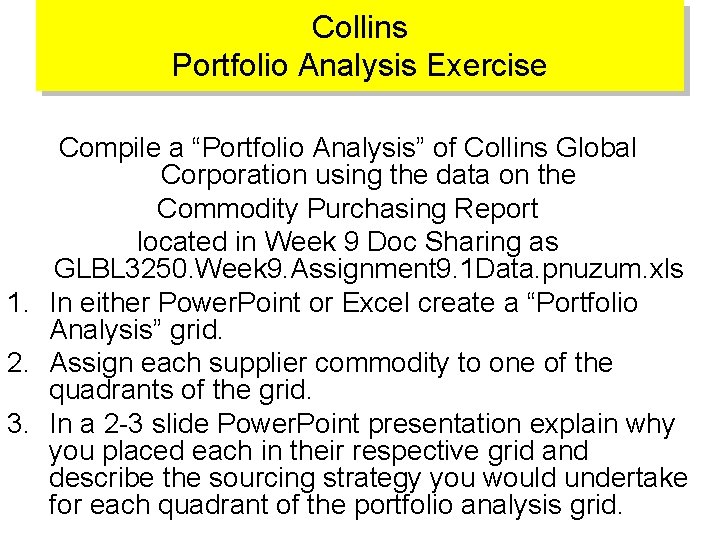
Collins Portfolio Analysis Exercise Compile a “Portfolio Analysis” of Collins Global Corporation using the data on the Commodity Purchasing Report located in Week 9 Doc Sharing as GLBL 3250. Week 9. Assignment 9. 1 Data. pnuzum. xls 1. In either Power. Point or Excel create a “Portfolio Analysis” grid. 2. Assign each supplier commodity to one of the quadrants of the grid. 3. In a 2 -3 slide Power. Point presentation explain why you placed each in their respective grid and describe the sourcing strategy you would undertake for each quadrant of the portfolio analysis grid.
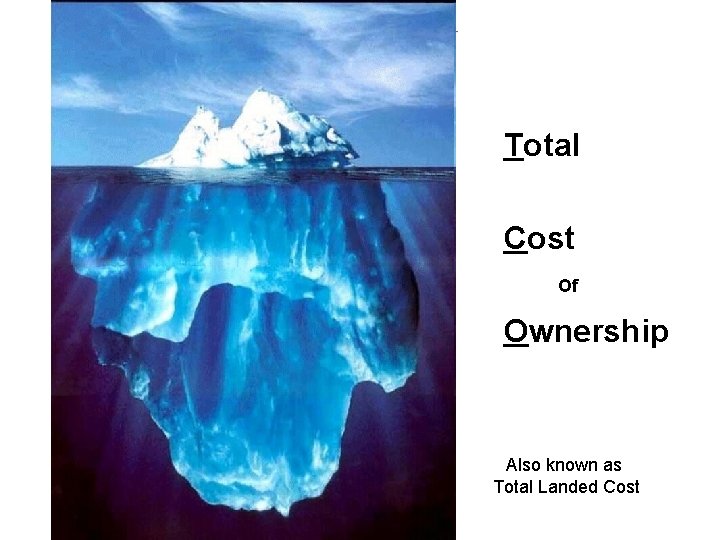
Total Cost Of Ownership Also known as Total Landed Cost
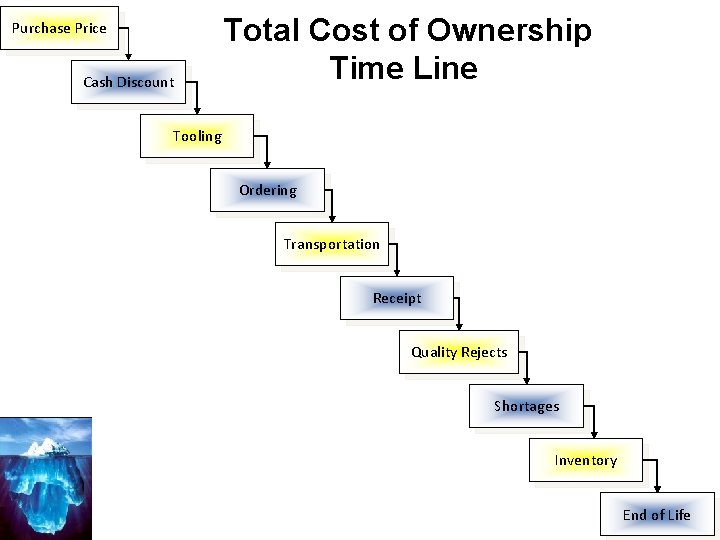
Total Cost of Ownership Ø The present value of all costs associated with a product, service, or capital equipment incurred over its expected life Ø Four broad categories of cost components making up the total cost of ownership: ØPurchase Price ØAcquisition Cost ØUsage Costs ØEnd-of-Life Costs
Building a Total Cost of Ownership Model Steps in building the model: 1) Map the process and develop TCO categories 2) Determine cost elements for each category 3) Determine how to measure each element 4) Gather data and quantify costs 5) Develop a cost time line
Purchase Price Cash Discount Total Cost of Ownership Time Line Tooling Ordering Transportation Receipt Quality Rejects Shortages Inventory End of Life
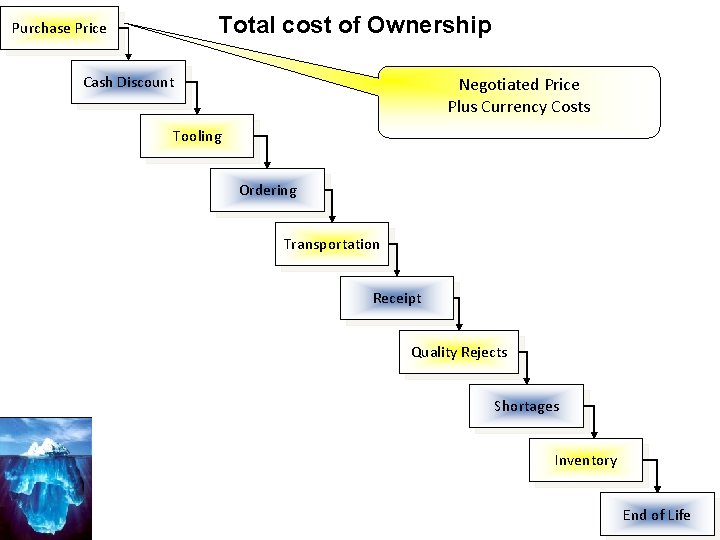
Total cost of Ownership Purchase Price Cash Discount Negotiated Price Plus Currency Costs Tooling Ordering Transportation Receipt Quality Rejects Shortages Inventory End of Life
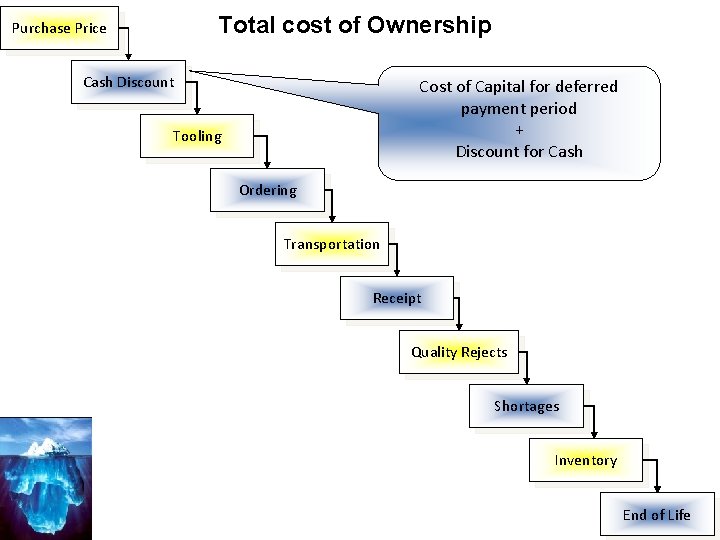
Total cost of Ownership Purchase Price Cash Discount Cost of Capital for deferred payment period + Discount for Cash Tooling Ordering Transportation Receipt Quality Rejects Shortages Inventory End of Life
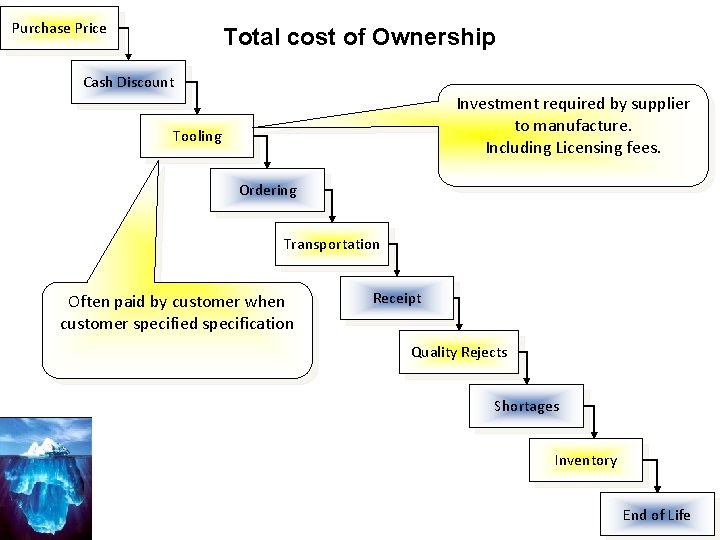
Purchase Price Total cost of Ownership Cash Discount Investment required by supplier to manufacture. Including Licensing fees. Tooling Ordering Transportation Often paid by customer when customer specified specification Receipt Quality Rejects Shortages Inventory End of Life
Purchase Price Total cost of Ownership Cash Discount Total Cost to Create a Purchase Order Conversion of MRP requirements to a PO Tooling Transmission Ordering System Updates Transportation Reconciling PO for Payment Receipt Cost to identify, qualify, and set-up new vendor Quality Rejects Shortages Inventory End of Life
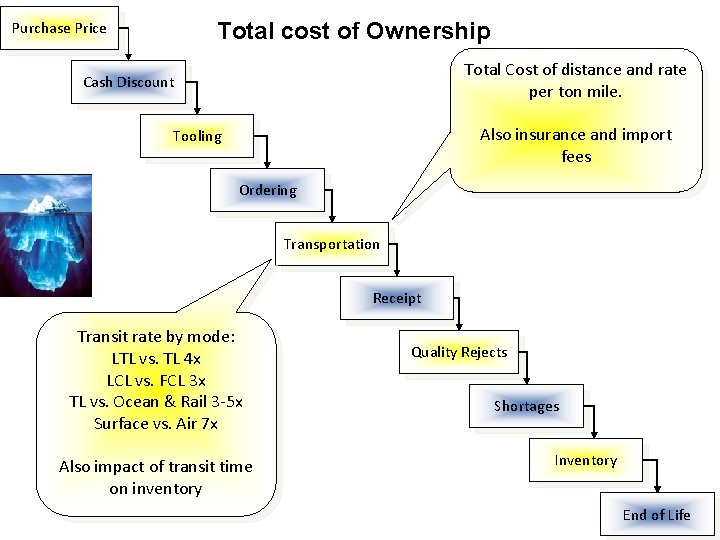
Total cost of Ownership Purchase Price Total Cost of distance and rate per ton mile. Cash Discount Also insurance and import fees Tooling Ordering Transportation Receipt Transit rate by mode: LTL vs. TL 4 x LCL vs. FCL 3 x TL vs. Ocean & Rail 3 -5 x Surface vs. Air 7 x Also impact of transit time on inventory Quality Rejects Shortages Inventory End of Life
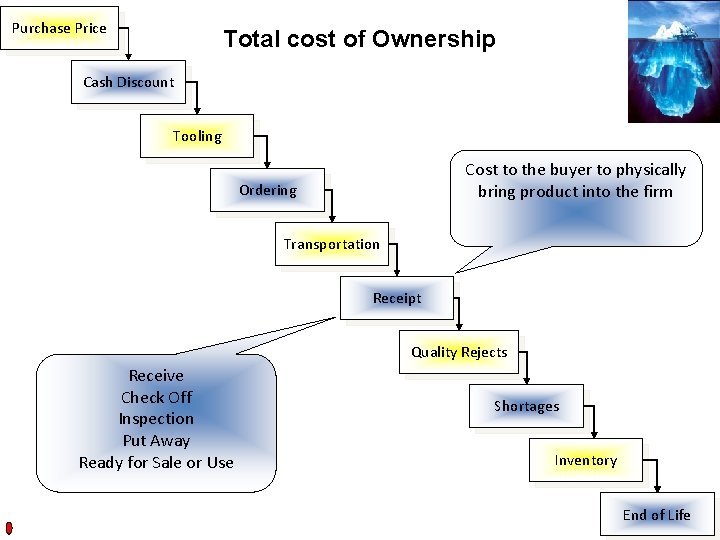
Purchase Price Total cost of Ownership Cash Discount Tooling Cost to the buyer to physically bring product into the firm Ordering Transportation Receipt Quality Rejects Receive Check Off Inspection Put Away Ready for Sale or Use Shortages Inventory End of Life
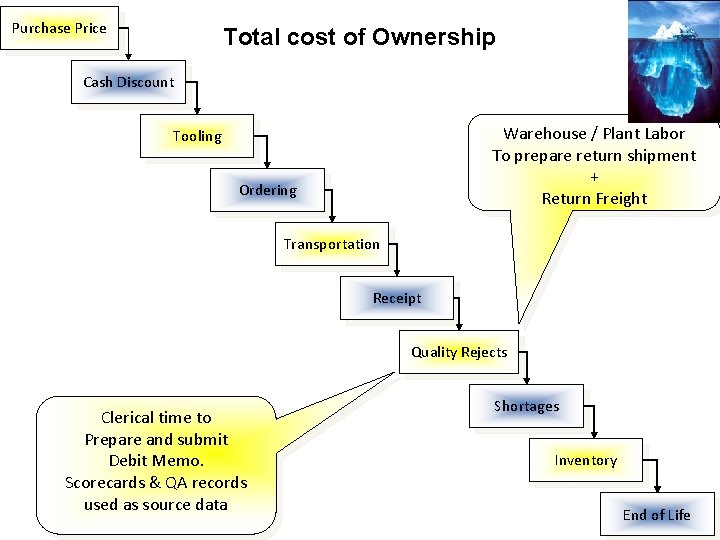
Purchase Price Total cost of Ownership Cash Discount Warehouse / Plant Labor To prepare return shipment + Return Freight Tooling Ordering Transportation Receipt Quality Rejects Clerical time to Prepare and submit Debit Memo. Scorecards & QA records used as source data Shortages Inventory End of Life
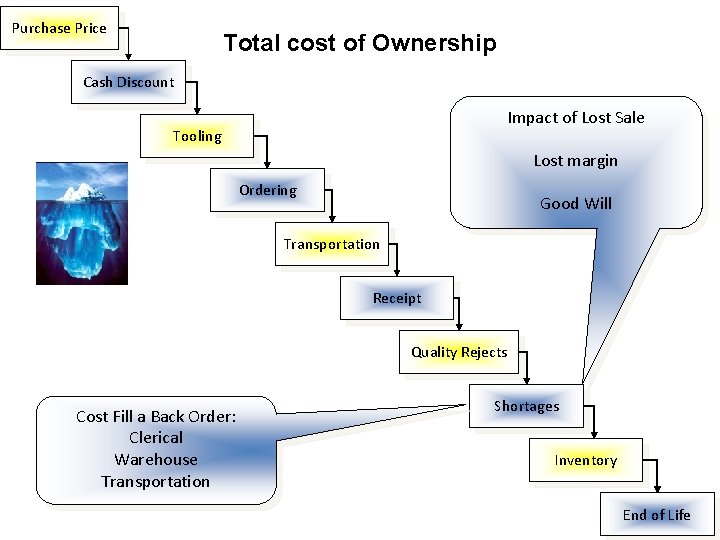
Purchase Price Total cost of Ownership Cash Discount Impact of Lost Sale Tooling Lost margin Ordering Good Will Transportation Receipt Quality Rejects Cost Fill a Back Order: Clerical Warehouse Transportation Shortages Inventory End of Life
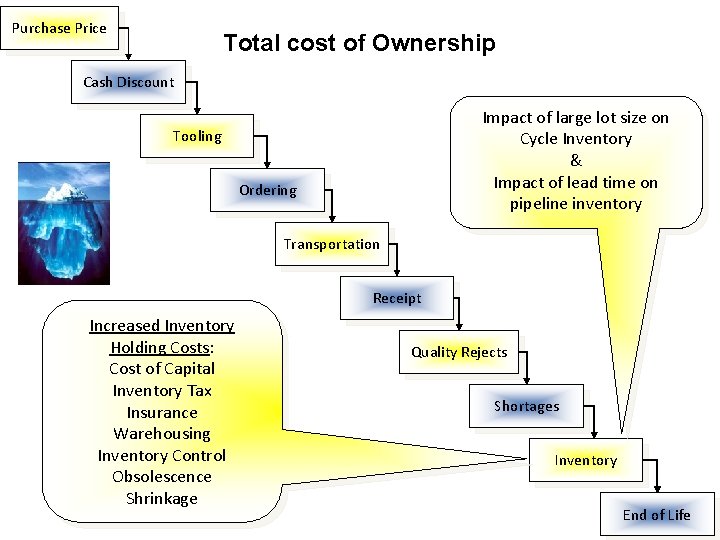
Purchase Price Total cost of Ownership Cash Discount Impact of large lot size on Cycle Inventory & Impact of lead time on pipeline inventory Tooling Ordering Transportation Receipt Increased Inventory Holding Costs: Cost of Capital Inventory Tax Insurance Warehousing Inventory Control Obsolescence Shrinkage Quality Rejects Shortages Inventory End of Life
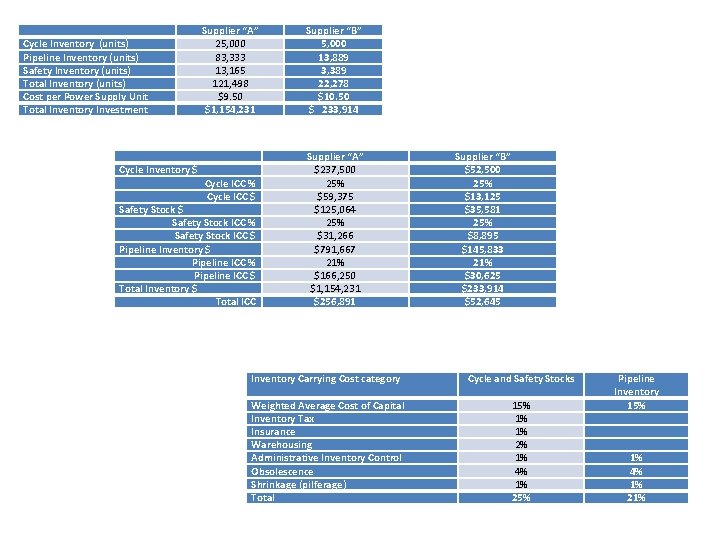
Cycle Inventory (units) Pipeline Inventory (units) Safety Inventory (units) Total Inventory (units) Cost per Power Supply Unit Total Inventory Investment Cycle Inventory $ Supplier “A” 25, 000 83, 333 13, 165 121, 498 $9. 50 $1, 154, 231 Cycle ICC % Cycle ICC $ Safety Stock ICC % Safety Stock ICC $ Pipeline Inventory $ Pipeline ICC % Pipeline ICC $ Total Inventory $ Total ICC Supplier “B” 5, 000 13, 889 3, 389 22, 278 $10. 50 $ 233, 914 Supplier “A” $237, 500 25% $59, 375 $125, 064 25% $31, 266 $791, 667 21% $166, 250 $1, 154, 231 $256, 891 Supplier “B” $52, 500 25% $13, 125 $35, 581 25% $8, 895 $145, 833 21% $30, 625 $233, 914 $52, 645 Inventory Carrying Cost category Cycle and Safety Stocks Weighted Average Cost of Capital Inventory Tax Insurance Warehousing Administrative Inventory Control Obsolescence Shrinkage (pilferage) Total 15% 1% 1% 2% 1% 4% 1% 25% Pipeline Inventory 15% 1% 4% 1% 21%
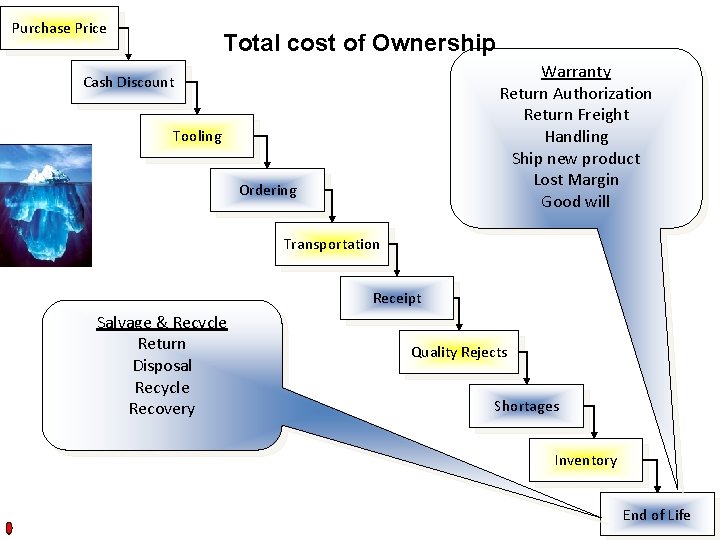
Purchase Price Total cost of Ownership Warranty Return Authorization Return Freight Handling Ship new product Lost Margin Good will Cash Discount Tooling Ordering Transportation Receipt Salvage & Recycle Return Disposal Recycle Recovery Quality Rejects Shortages Inventory End of Life
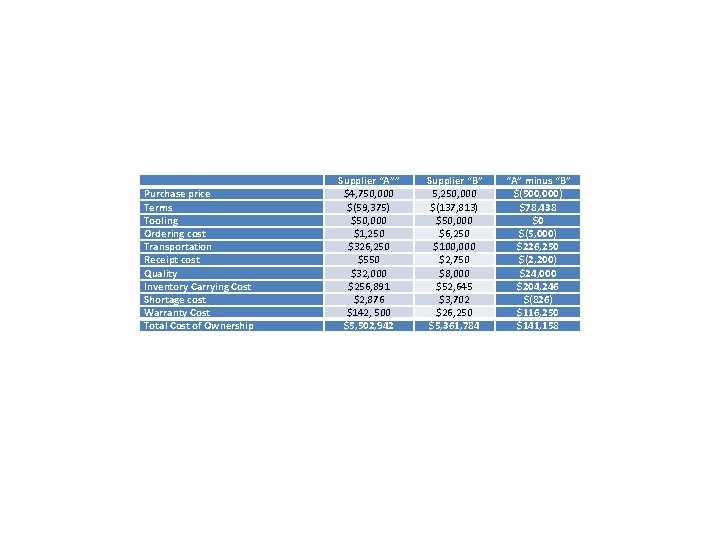
Purchase price Terms Tooling Ordering cost Transportation Receipt cost Quality Inventory Carrying Cost Shortage cost Warranty Cost Total Cost of Ownership Supplier “A”” $4, 750, 000 $(59, 375) $50, 000 $1, 250 $326, 250 $550 $32, 000 $256, 891 $2, 876 $142, 500 $5, 502, 942 Supplier “B” 5, 250, 000 $(137, 813) $50, 000 $6, 250 $100, 000 $2, 750 $8, 000 $52, 645 $3, 702 $26, 250 $5, 361, 784 “A” minus “B” $(500, 000) $78, 438 $0 $(5, 000) $226, 250 $(2, 200) $24, 000 $204, 246 $(826) $116, 250 $141, 158
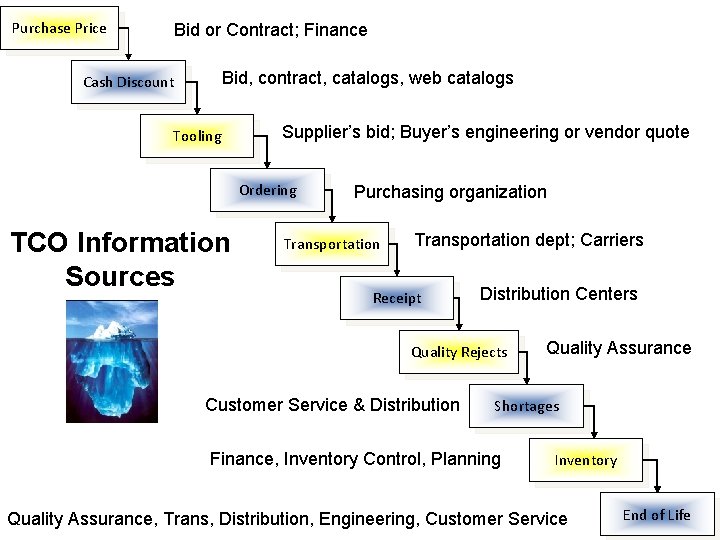
Purchase Price Bid or Contract; Finance Bid, contract, catalogs, web catalogs Cash Discount Tooling Supplier’s bid; Buyer’s engineering or vendor quote Ordering TCO Information Sources Purchasing organization Transportation dept; Carriers Receipt Distribution Centers Quality Rejects Customer Service & Distribution Quality Assurance Shortages Finance, Inventory Control, Planning Inventory Quality Assurance, Trans, Distribution, Engineering, Customer Service End of Life
Assignment 9. 2 Global Sourcing Decision See Week 9 Assignment 2 Details for this assignment 41