
The Story of Delivery under Blair Michael Barber

The Story of Delivery under Blair Michael Barber Moscow Higher School of Economics December 2009
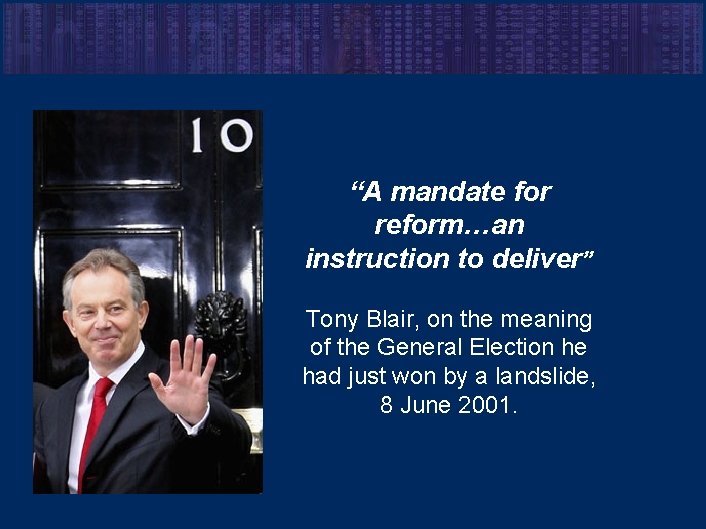
“A mandate for reform…an instruction to deliver” Tony Blair, on the meaning of the General Election he had just won by a landslide, 8 June 2001. 1
CAUSES OF FAILURE IN BUSINESS ORGANISATIONS • Complacency • Lack of guiding coalition • Underestimating vision • Under-communicating • Not removing obstacles • No short-term wins • Declaring victory too soon • Not changing the culture SOURCE: John Kotter 2
CAUSES OF FAILURE IN GOVERNMENT • Cynicism – track record of failure • Multiple small projects • Watered-down compromise • Lack of persistence • Institutional inertia • Poor design • Lack of clarity about goals • Incompetence SOURCE: Instruction to Deliver 3
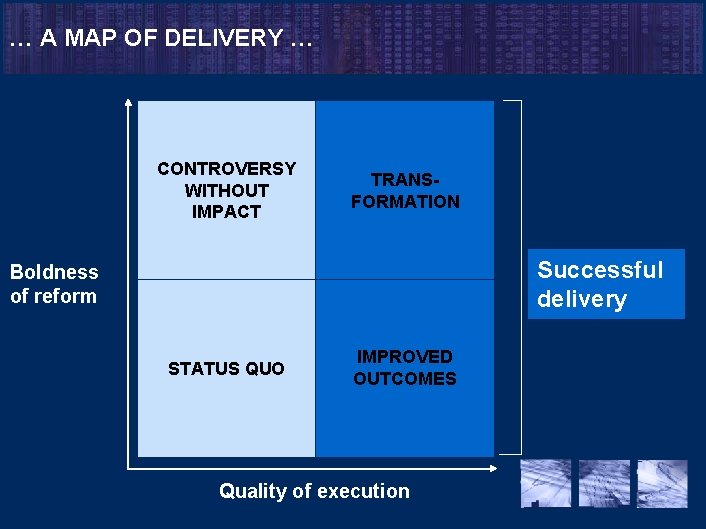
… A MAP OF DELIVERY … CONTROVERSY WITHOUT IMPACT TRANSFORMATION Successful delivery Boldness of reform STATUS QUO IMPROVED OUTCOMES Quality of execution 4
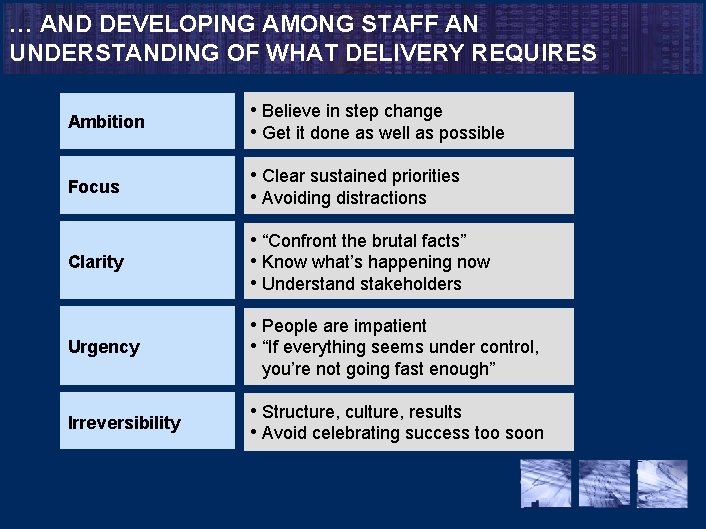
… AND DEVELOPING AMONG STAFF AN UNDERSTANDING OF WHAT DELIVERY REQUIRES Ambition • Believe in step change • Get it done as well as possible Focus • Clear sustained priorities • Avoiding distractions Clarity • “Confront the brutal facts” • Know what’s happening now • Understand stakeholders Urgency • People are impatient • “If everything seems under control, you’re not going fast enough” Irreversibility • Structure, culture, results • Avoid celebrating success too soon 5
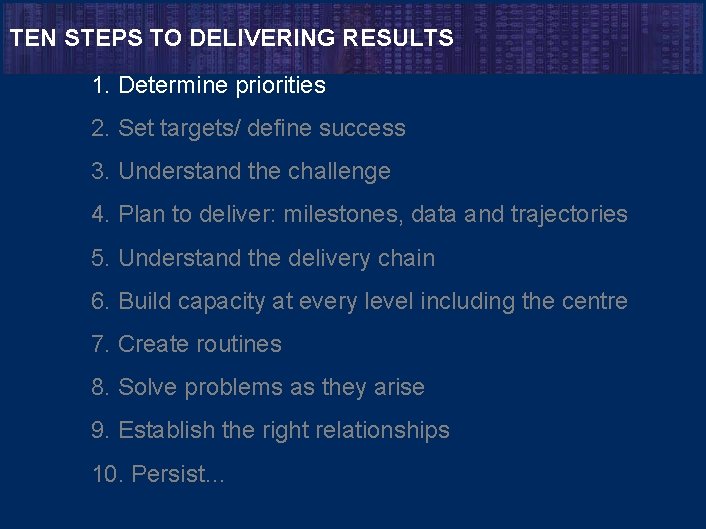
TEN STEPS TO DELIVERING RESULTS 1. Determine priorities 2. Set targets/ define success 3. Understand the challenge 4. Plan to deliver: milestones, data and trajectories 5. Understand the delivery chain 6. Build capacity at every level including the centre 7. Create routines 8. Solve problems as they arise 9. Establish the right relationships 10. Persist… 6
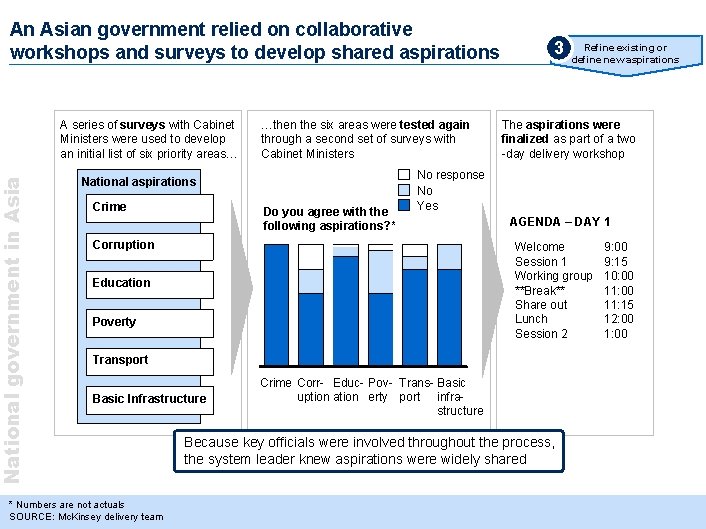
An Asian government relied on collaborative workshops and surveys to develop shared aspirations National government in Asia A series of surveys with Cabinet Ministers were used to develop an initial list of six priority areas… …then the six areas were tested again through a second set of surveys with Cabinet Ministers National aspirations Crime Do you agree with the following aspirations? * 3 The aspirations were finalized as part of a two -day delivery workshop No response No Yes Corruption AGENDA – DAY 1 Welcome Session 1 Working group **Break** Share out Lunch Session 2 Education Poverty Transport Basic Infrastructure * Numbers are not actuals SOURCE: Mc. Kinsey delivery team Refine existing or define new aspirations Crime Corr- Educ- Pov- Trans- Basic uption ation erty port infrastructure Because key officials were involved throughout the process, the system leader knew aspirations were widely shared 9: 00 9: 15 10: 00 11: 15 12: 00 1: 00
TEN STEPS TO DELIVERING RESULTS 1. Determine priorities 2. Set targets/ define success 3. Understand the challenge 4. Plan to deliver: milestones, data and trajectories 5. Understand the delivery chain 6. Build capacity at every level including the centre 7. Create routines 8. Solve problems as they arise 9. Establish the right relationships 10. Persist… 8
KEY QUESTIONS TO ANSWER IN A DELIVERY PLAN • What is the service delivery chain? • Who is accountable at the top. . . and all along the delivery chain? • What are the key actions (milestones)? • What is the timetable? • Who are the key stakeholders? How will they be brought on board? • What are the major risks? How will they be managed? • What impact will the actions have on the key outcomes (trajectories)? • What data do you need? Will it be early enough to act if progress is off track? 9
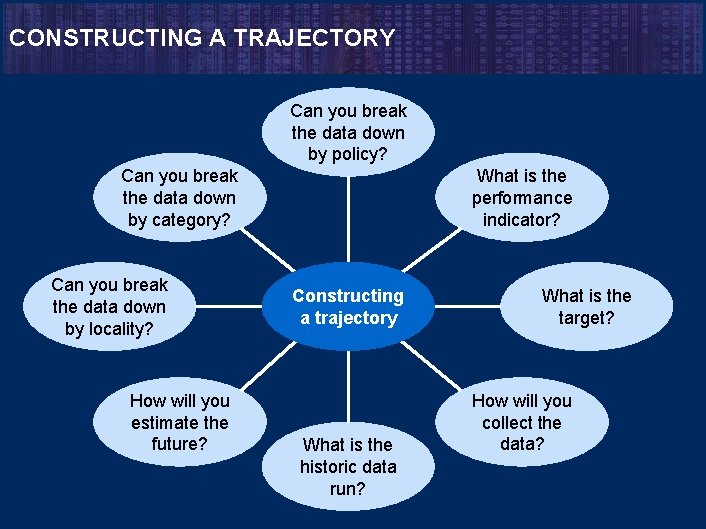
CONSTRUCTING A TRAJECTORY Can you break the data down by policy? Can you break the data down by category? Can you break the data down by locality? How will you estimate the future? What is the performance indicator? Constructing a trajectory What is the historic data run? What is the target? How will you collect the data? 10
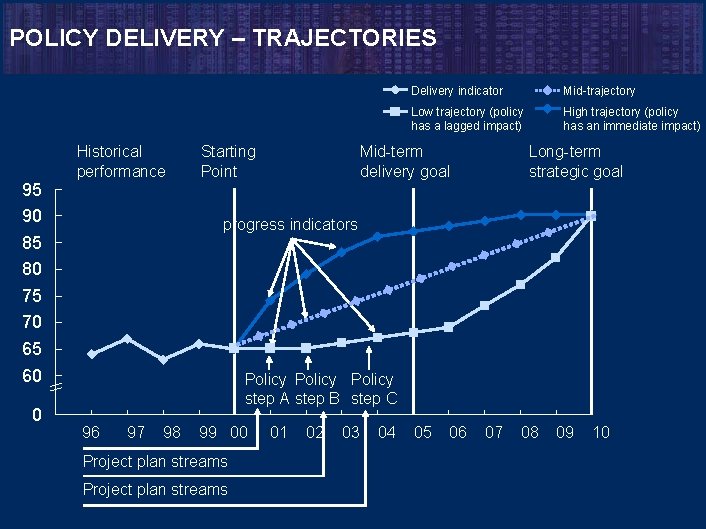
POLICY DELIVERY – TRAJECTORIES 95 90 85 80 75 70 65 60 0 Historical performance Starting Point Delivery indicator Mid-trajectory Low trajectory (policy has a lagged impact) High trajectory (policy has an immediate impact) Mid-term delivery goal Long-term strategic goal progress indicators Policy step A step B step C 96 97 98 99 00 01 02 03 04 05 06 07 08 09 10 Project plan streams 11
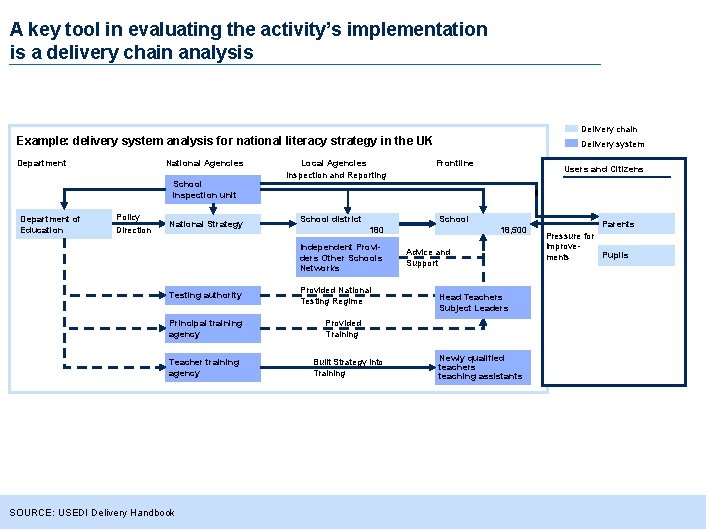
A key tool in evaluating the activity’s implementation is a delivery chain analysis Delivery chain Example: delivery system analysis for national literacy strategy in the UK Department National Agencies School inspection unit Department of Education Policy Direction National Strategy Local Agencies Inspection and Reporting Principal training agency Teacher training agency SOURCE: USEDI Delivery Handbook Frontline Users and Citizens School district 18, 500 180 Independent Providers Other Schools Networks Testing authority Delivery system Provided National Testing Regime Advice and Support Head Teachers Subject Leaders Provided Training Built Strategy into Training Newly qualified teachers teaching assistants Parents Pressure for improve. Pupils ments
TEN STEPS TO DELIVERING RESULTS 1. Determine priorities 2. Set targets/ define success 3. Understand the challenge 4. Plan to deliver: milestones, data and trajectories 5. Understand the delivery chain 6. Build capacity at every level including the centre 7. Create routines 8. Solve problems as they arise 9. Establish the right relationships 10. Persist… 13
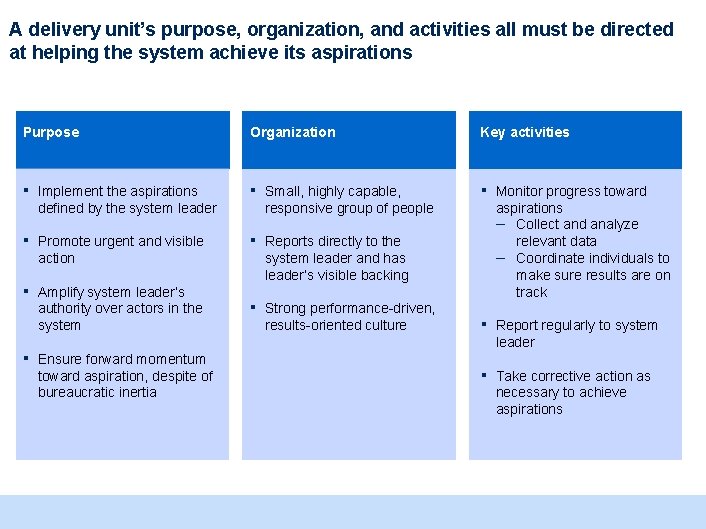
A delivery unit’s purpose, organization, and activities all must be directed at helping the system achieve its aspirations Purpose Organization Key activities ▪ Implement the aspirations defined by the system leader ▪ Small, highly capable, responsive group of people ▪ ▪ Promote urgent and visible action ▪ ▪ Reports directly to the system leader and has leader’s visible backing Amplify system leader’s authority over actors in the system ▪ Monitor progress toward aspirations – Collect and analyze relevant data – Coordinate individuals to make sure results are on track Strong performance-driven, results-oriented culture ▪ Report regularly to system leader ▪ Take corrective action as necessary to achieve aspirations ▪ Ensure forward momentum toward aspiration, despite of bureaucratic inertia
TEN STEPS TO DELIVERING RESULTS 1. Determine priorities 2. Set targets/ define success 3. Understand the challenge 4. Plan to deliver: milestones, data and trajectories 5. Understand the delivery chain 6. Build capacity at every level including the centre 7. Create routines 8. Solve problems as they arise 9. Establish the right relationships 10. Persist… 15
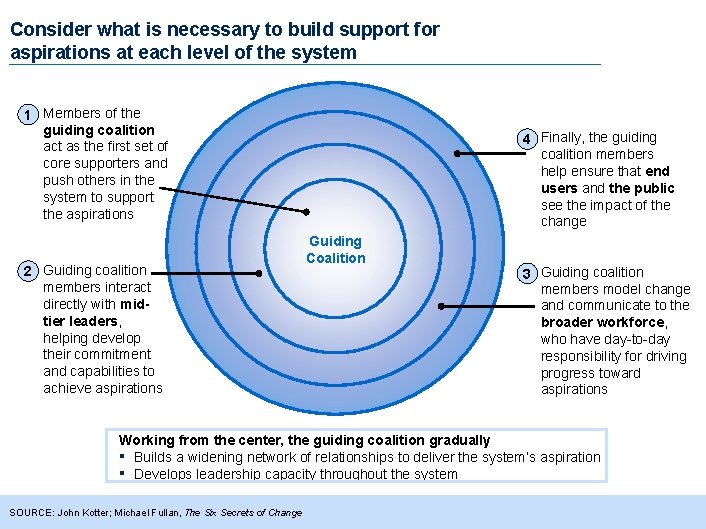
Consider what is necessary to build support for aspirations at each level of the system 1 Members of the guiding coalition act as the first set of core supporters and push others in the system to support the aspirations 2 Guiding coalition members interact directly with midtier leaders, helping develop their commitment and capabilities to achieve aspirations 4 Finally, the guiding coalition members help ensure that end users and the public see the impact of the change Guiding Coalition 3 Guiding coalition members model change and communicate to the broader workforce, who have day-to-day responsibility for driving progress toward aspirations Working from the center, the guiding coalition gradually ▪ Builds a widening network of relationships to deliver the system’s aspiration ▪ Develops leadership capacity throughout the system SOURCE: John Kotter; Michael Fullan, The Six Secrets of Change
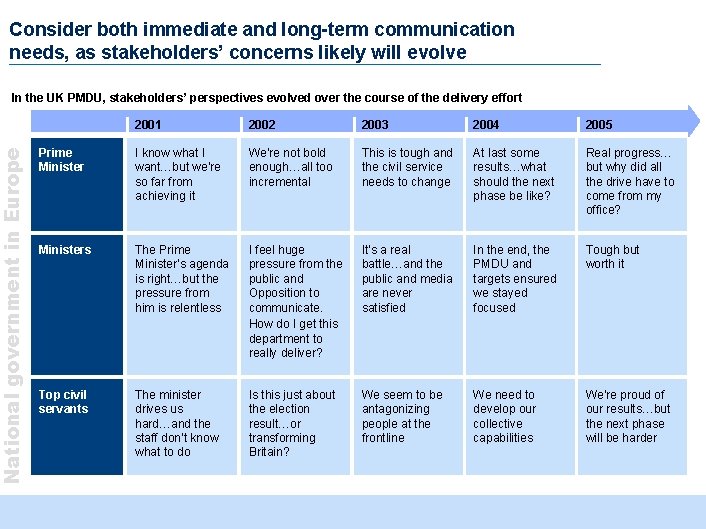
Consider both immediate and long-term communication needs, as stakeholders’ concerns likely will evolve National government in Europe In the UK PMDU, stakeholders’ perspectives evolved over the course of the delivery effort 2001 2002 2003 2004 2005 Prime Minister I know what I want…but we’re so far from achieving it We’re not bold enough…all too incremental This is tough and the civil service needs to change At last some results…what should the next phase be like? Real progress… but why did all the drive have to come from my office? Ministers The Prime Minister’s agenda is right…but the pressure from him is relentless I feel huge pressure from the public and Opposition to communicate. How do I get this department to really deliver? It’s a real battle…and the public and media are never satisfied In the end, the PMDU and targets ensured we stayed focused Tough but worth it Top civil servants The minister drives us hard…and the staff don’t know what to do Is this just about the election result…or transforming Britain? We seem to be antagonizing people at the frontline We need to develop our collective capabilities We’re proud of our results…but the next phase will be harder
The problem of Autumn: Grinding out improved rail reliability 18
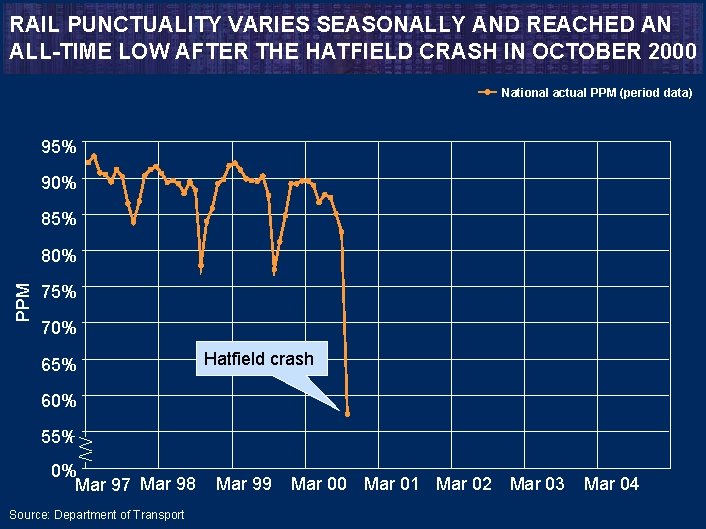
RAIL PUNCTUALITY VARIES SEASONALLY AND REACHED AN ALL-TIME LOW AFTER THE HATFIELD CRASH IN OCTOBER 2000 National actual PPM (period data) 95% 90% 85% PPM 80% 75% 70% 65% Hatfield crash 60% 55% 0% Mar 97 Mar 98 Source: Department of Transport Mar 99 Mar 00 Mar 01 Mar 02 Mar 03 Mar 04 19
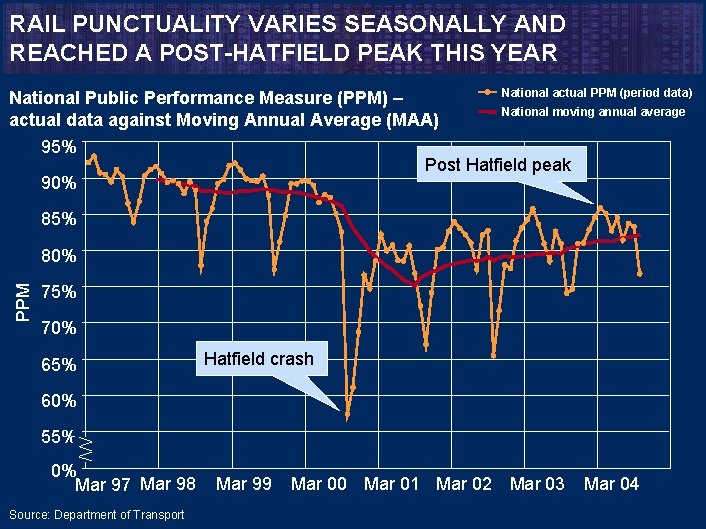
RAIL PUNCTUALITY VARIES SEASONALLY AND REACHED A POST-HATFIELD PEAK THIS YEAR National Public Performance Measure (PPM) – actual data against Moving Annual Average (MAA) 95% National actual PPM (period data) National moving annual average Post Hatfield peak 90% 85% PPM 80% 75% 70% 65% Hatfield crash 60% 55% 0% Mar 97 Mar 98 Source: Department of Transport Mar 99 Mar 00 Mar 01 Mar 02 Mar 03 Mar 04 20
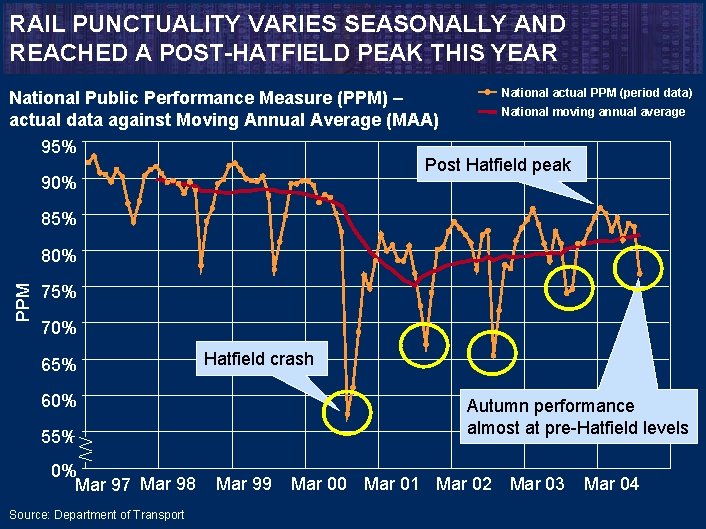
RAIL PUNCTUALITY VARIES SEASONALLY AND REACHED A POST-HATFIELD PEAK THIS YEAR National Public Performance Measure (PPM) – actual data against Moving Annual Average (MAA) 95% National actual PPM (period data) National moving annual average Post Hatfield peak 90% 85% PPM 80% 75% 70% 65% Hatfield crash 60% Autumn performance almost at pre-Hatfield levels 55% 0% Mar 97 Mar 98 Source: Department of Transport Mar 99 Mar 00 Mar 01 Mar 02 Mar 03 Mar 04 21
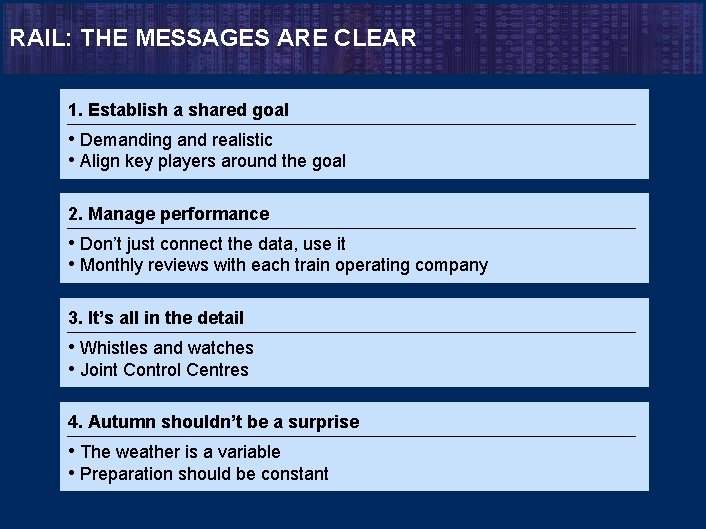
RAIL: THE MESSAGES ARE CLEAR 1. Establish a shared goal • Demanding and realistic • Align key players around the goal 2. Manage performance • Don’t just connect the data, use it • Monthly reviews with each train operating company 3. It’s all in the detail • Whistles and watches • Joint Control Centres 4. Autumn shouldn’t be a surprise • The weather is a variable • Preparation should be constant 22
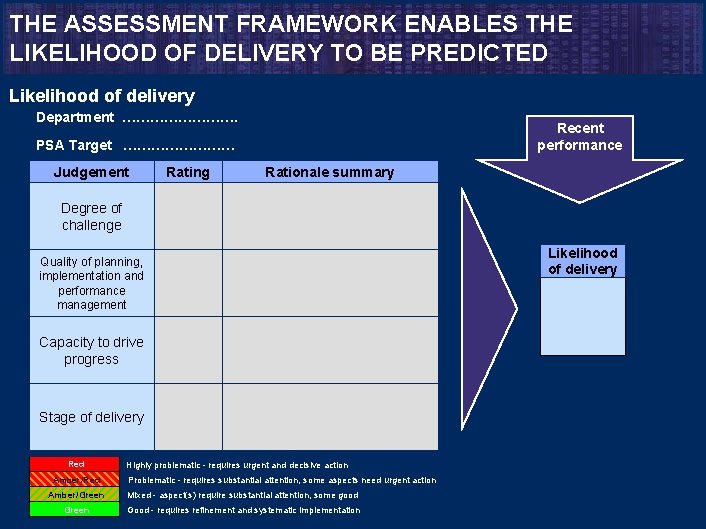
THE ASSESSMENT FRAMEWORK ENABLES THE LIKELIHOOD OF DELIVERY TO BE PREDICTED Likelihood of delivery Department …………. Recent performance PSA Target ………… Judgement Rating Rationale summary Degree of challenge Quality of planning, implementation and performance management Capacity to drive progress Stage of delivery Red Amber/Red Highly problematic - requires urgent and decisive action Problematic - requires substantial attention, some aspects need urgent action Amber/Green Mixed - aspect(s) require substantial attention, some good Green Good - requires refinement and systematic implementation Likelihood of delivery
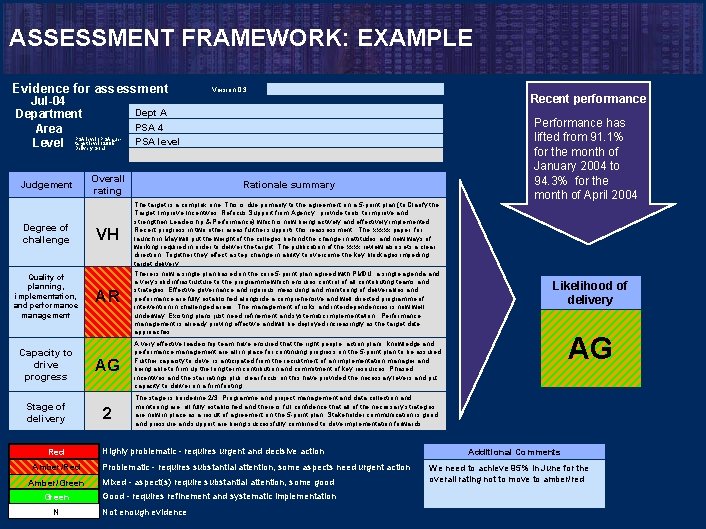
ASSESSMENT FRAMEWORK: EXAMPLE Evidence for assessment Jul-04 Department Area PSA level / PSA subtarget level / 2005 Level Delivery Goal Judgement VH Quality of planning, implementation, and performance management AR Capacity to drive progress Stage of delivery Red Amber/Red PSA 4 PSA level Rationale summary The target is a complex one. This is due primarily to the agreement on a 5 -point plan (to Clarify the Target, Improve Incentives, Refocus Support from Agency , provide tools to improve and strengthen Leadership & Performance) which is now being actively and effectively implemented. Recent progress in two other areas further supports this reassessment. The xxxxx paper for launch in May will put the weight of the colleges behind the change in attitudes and new ways of working required in order to deliver the target. The publication of the xxxx review also sets a clear direction. Together they effect a step change in ability to overcome the key blockages impeding target delivery. There is now a single plan based on the core 5 -point plan agreed with PMDU, a single agenda and a very solid infrastructure to the programme which ensures control of all contributing teams and strategies. Effective governance and rigorous measuring and monitoring of deliverables and performance are fully established alongside a comprehensive and well directed programme of intervention in challenged areas. The management of risks and interdependencies is now well underway. Existing plans just need refinement and systematic implementation. Performance management is already proving effective and will be deployed increasingly as the target date approaches. AG A very effective leadership team have ensured that the right people, action plans, knowledge and performance management are all in place for continuing progress on the 5 -point plan to be assured. Further capacity to drive is anticipated from the recruitment of an implementation manager and being able to firm up the long term contribution and commitment of key resources. Phased incentives and the star ratings plus clear focus on this have provided the necessary levers and put capacity to deliver on a firm footing. 2 The stage is borderline 2/3. Programme and project management and data collection and monitoring are all fully established and there is full confidence that all of the necessary strategies are now in place as a result of agreement on the 5 -point plan. Stakeholder communication is good and pressure and support are being successfully combined to drive implementation forwards. Highly problematic - requires urgent and decisive action Problematic - requires substantial attention, some aspects need urgent action Amber/Green Mixed - aspect(s) require substantial attention, some good Green Good - requires refinement and systematic implementation N Recent performance Dept A Overall rating Degree of challenge Version 0. 3 Not enough evidence Performance has lifted from 91. 1% for the month of January 2004 to 94. 3% for the month of April 2004 Likelihood of delivery AG Additional Comments We need to achieve 95% in June for the overall rating not to move to amber/red 24
THE DELIVERY REPORT: LEAGUE TABLE – JULY 2004 Rank (out of 21) 25

PROGRESS ON THE PRIME MINISTER’S PRIORITIES CAN BE SUMMARISED IN A LEAGUE TABLE Rank (out of 21) = 1 3 4 5 6 = 7 = 7 = 10 12 13 = 14 = 16 = 18 20 21 26
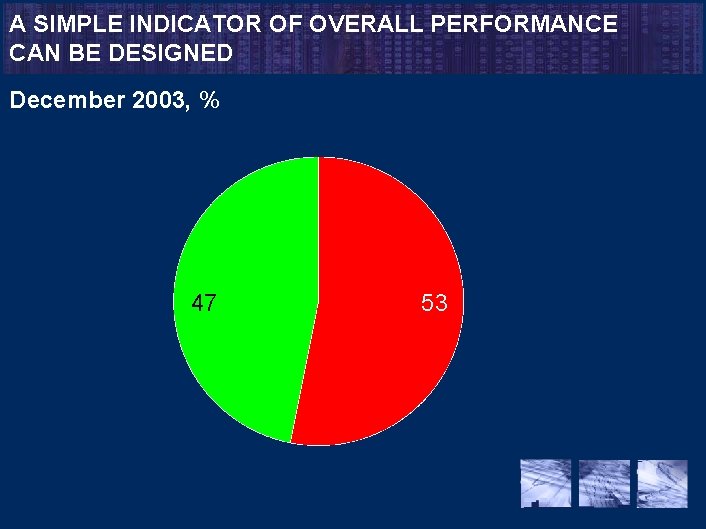
A SIMPLE INDICATOR OF OVERALL PERFORMANCE CAN BE DESIGNED December 2003, % 47 53
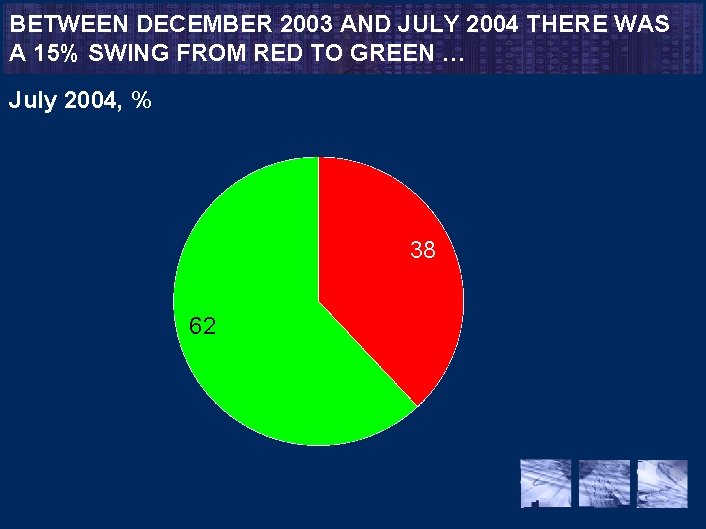
BETWEEN DECEMBER 2003 AND JULY 2004 THERE WAS A 15% SWING FROM RED TO GREEN … July 2004, % 38 62

… AND BY DECEMBER 2004 A FURTHER 21% SWING FROM RED TO GREEN December 2004, % 17 83
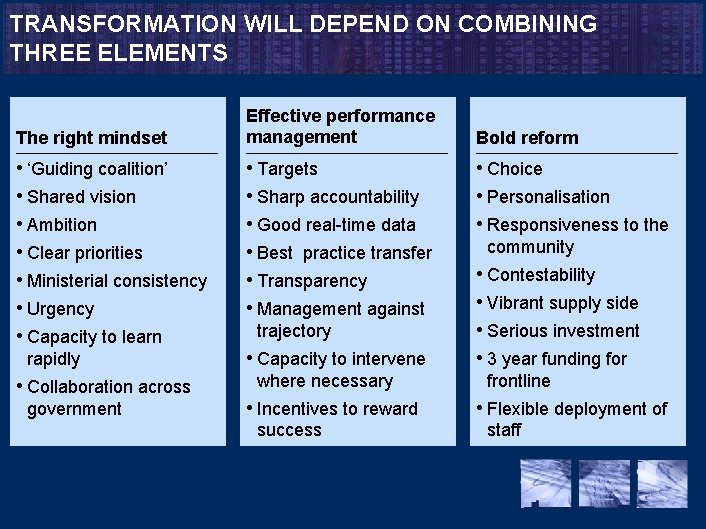
TRANSFORMATION WILL DEPEND ON COMBINING THREE ELEMENTS The right mindset • ‘Guiding coalition’ • Shared vision • Ambition • Clear priorities • Ministerial consistency • Urgency • Capacity to learn rapidly • Collaboration across government Effective performance management • Targets • Sharp accountability • Good real-time data • Best practice transfer • Transparency • Management against trajectory • Capacity to intervene where necessary • Incentives to reward success Bold reform • Choice • Personalisation • Responsiveness to the community • Contestability • Vibrant supply side • Serious investment • 3 year funding for frontline • Flexible deployment of staff
- Slides: 31