
The Story is at the Heart of Science
- Slides: 35
The Story is at the Heart of Science MOLECULAR MECHANISMS OF AFFECT Guide to giving an interesting talk
Why Storytelling in Science? Have you ever seen? A Bad Talk? A Bad Poster Presentation? A Bad Class Lecture? A Inaccurate News Report on Science? A Popular Movie that Misrepresented Scientific Information?
Why Does Style Matter? Have you ever read? A Bad Scientific Article? The data may be very good… but… The POINT of the research is hard to understand The INTERPRETATION of the research is confusing The LARGER PICTURE is missing The Larger Picture is not cohesive
Even More to the Point… Have you ever Heard a Scientific Talk That you COULD have Understood? … but… The language used was so filled with JARGON Language specific to a SINGLE LAB was used o Specific to a sub-field of investigation
Even More to the Point… Have you ever Heard a Scientific Talk That you COULD have Understood? … but… “Sciencey ” language replaced plain English o Satiate rather than Satisfy or Sate o Acclimatization vs Acclimation There were Acronyms or Abbreviations That were NOT defined The Specific Aims were NOT Spelled Out Hypotheses were NOT clear
So What? Ultimately our jobs in Science Depends on PUBLIC support If the value of our efforts is not widely understood Less Public Approval of and Support for Science
So What? YOUR Future JOB or Promotion or FUNDING Depends on Impressing (Future) Colleagues And People are good at Smelling bullshit
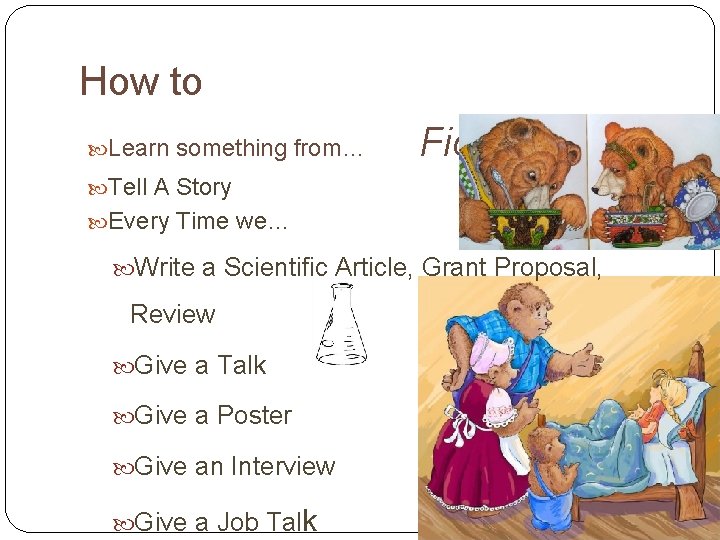
How to Learn something from… Fiction Tell A Story Every Time we… Write a Scientific Article, Grant Proposal, Review Give a Talk Give a Poster Give an Interview Give a Job Talk
What Does it Mean to Tell a Story? All Communications Need: A defined Beginning, Middle, and End A Linear Narrative
What Does it Mean to Tell a Story? Scientific Communications Need: Simplified Language (where possible) A defined Big Picture Perspective and A Little Intrigue
Fundamentals of Story Telling A Story has 1. beginning, 2. middle, 3. end Each is Distinctive But follows some of the same rules Logical Flow is Paramount
Fundamentals of Story Telling Logical Flow: The Story Builds from WHAT YOU KNOW What’s known can NOT be assumed It MUST be built along the way
Fundamentals of Story Telling What’s known can NOT be assumed This is the MAIN reason for FAILED communication Scientists OFTEN assume that their Audience Knows more than they REALLY do If you are speaking to the PUBLIC → DISASTER
Fundamentals of Story Telling The Story Builds from WHAT YOU KNOW If you are writing a GRANT PROPOSAL… Ask Yourself Is this what you would want at a JOB Interview
Fundamentals of Story Telling In the Beginning Start with simple, plain language You may need the Jargon , but ease into it Define the Special Use Words Define Abbreviations and Acronyms
Fundamentals of Story Telling In the Beginning Introduce the characters (Ideas) Tell what the problem is Tell what is known so far
Fundamentals of Story Telling In the Beginning of a Talk/Presentation Delivery and Style Really Matter A Presentation should NEVER be READ Look the Audience in the EYE
Fundamentals of Story Telling Talk/Presentation NEVER be READ Slides should have BULLET POINTS NOT Sentences o. Sentences are not really necessary
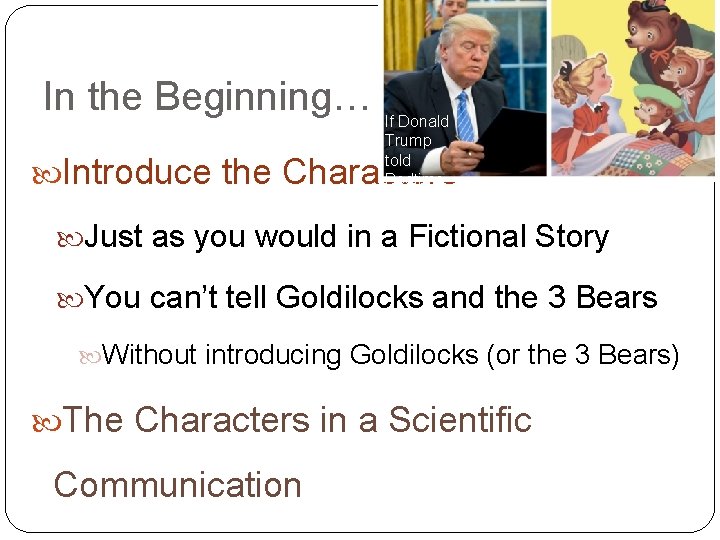
In the Beginning… If Donald Trump told Bedtime Stories Introduce the Characters Just as you would in a Fictional Story You can’t tell Goldilocks and the 3 Bears Without introducing Goldilocks (or the 3 Bears) The Characters in a Scientific Communication
In the Beginning… Characters in Scientific Communication are Ideas Or Themes But… Built from Chemical Factors, Structural Elements, Circuits/Physical Communication, Genetics
In the Beginning… Tell What the Problem is Every Scientific endeavor is Filled with Intrigue Is a Story Interesting without some Suspense? The Intrigue helps explain why we CARE
In the Beginning… Tell What is Known So Far This is the Firm Foundation for the Intrigue Weave the Ideas Together as a Story Tell What ISN’T Known Woven Together with Rest builds the
In the Beginning… Telling Why It’s Important is Critical What the problem is What’s known What isn’t known Build the story of Why the Research is Important
The Middle: Methods and Results Tell Why the METHODS solve the problem Connect each Result
The Middle: Methods and Results Connecting Results With the Ideas/Problem from the Beginning With the other Results Tell the Story of the Results In a Logical Oder That Logically Impels the Narrative It is a mistake to retell results in the order of the experiments Unless that makes the most sense
METHODS: Advanced Techniques explained Tell Why particular Techniques are used Why they solve the problem GIVE ENOUGH INFORMATION That the Reader/Listener knows why these techniques solve the research problem Do you need enough to REPEAT THE EXPERIMENT? For Talks – NO For Articles – Maybe o Depends on the Journal o Depends on the Experiment
Results: KISS Keep it Simple Why? Because these are the results If the audience doesn’t understand these
Results: KISS Data and Experimental Design determine Complexity of the Story from here Don’t add to it artificially Label the Graphics as much as necessary Keep the Figures as Simple as Possible Figure Legends should be straight forward and help tell the story Results text should be straight forward
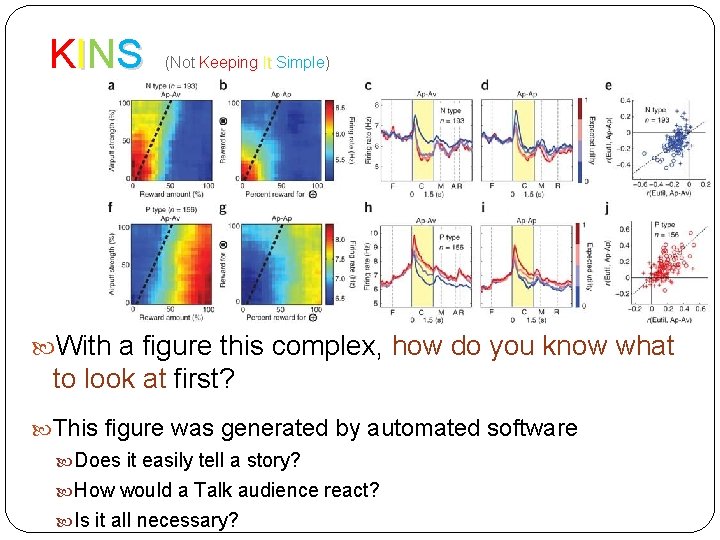
K I NS (Not Keeping It Simple) With a figure this complex, how do you know what to look at first? This figure was generated by automated software Does it easily tell a story? How would a Talk audience react? Is it all necessary?
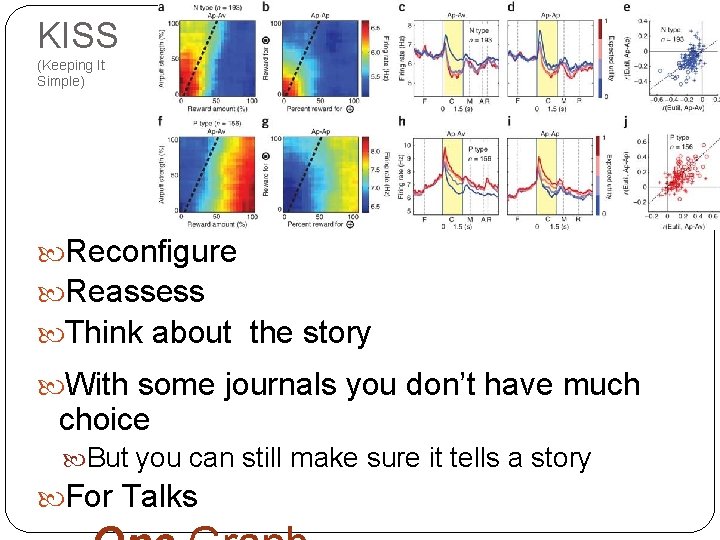
KISS (Keeping It Simple) Reconfigure Reassess Think about the story With some journals you don’t have much choice But you can still make sure it tells a story For Talks
ONE Graph Rule One Graph per slide always can NOT be one plate of graphs After a series of one graph slides if necessary You can follow with a summary That includes several graphs
Take Home Messages Think of your discussion Or the End of Your Talk Relative to the Messages the Audience will Take Away The Characters/Ideas + Intrigue/Problem + Methods-Results/Solution - Integrated Woven together Into the Conclusion of the Story
Take Home Messages Integrated Ideas + Problem + Solution Just like in Fiction It should be Satisfying
Take Home Messages The Reader or Listener should understand The Value of the Science What it means for the Public As well as for the scientific
My Take Home Message Not Everyone believes that Science is a valuable enterprise That is our fault We have to do a better job of communicating With each other And