
The stomach and small intestine This week we





- Slides: 19
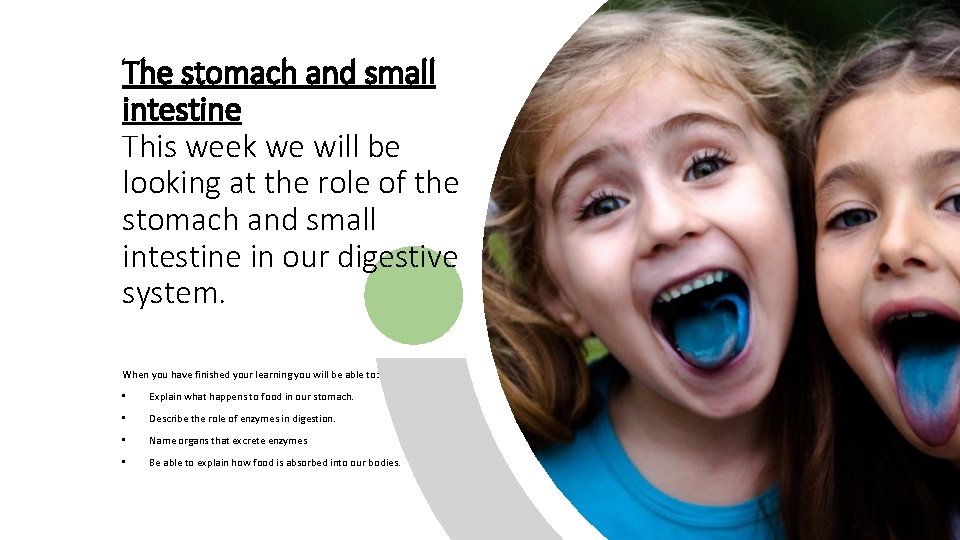
The stomach and small intestine This week we will be looking at the role of the stomach and small intestine in our digestive system. When you have finished your learning you will be able to: • Explain what happens to food in our stomach. • Describe the role of enzymes in digestion. • Name organs that excrete enzymes • Be able to explain how food is absorbed into our bodies.
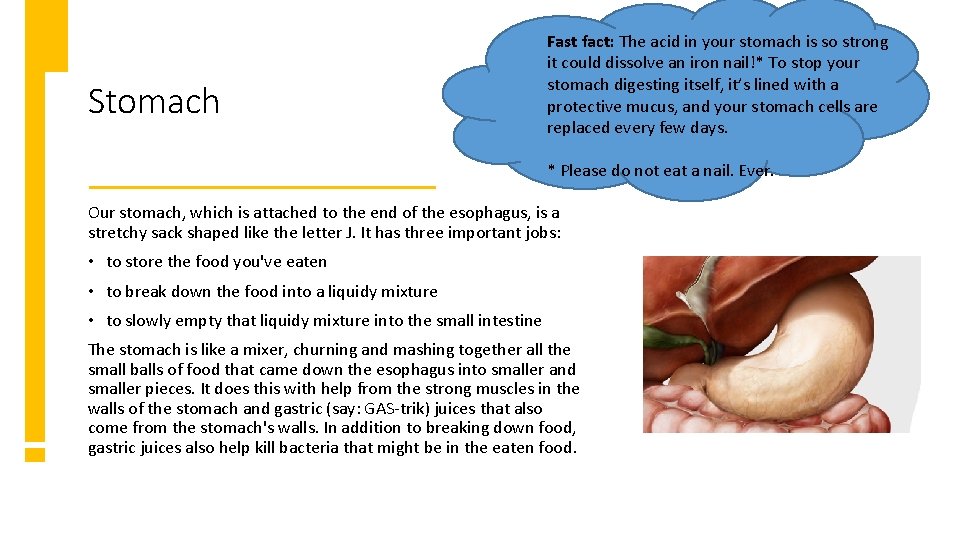
Stomach Fast fact: The acid in your stomach is so strong it could dissolve an iron nail!* To stop your stomach digesting itself, it’s lined with a protective mucus, and your stomach cells are replaced every few days. * Please do not eat a nail. Ever. Our stomach, which is attached to the end of the esophagus, is a stretchy sack shaped like the letter J. It has three important jobs: • to store the food you've eaten • to break down the food into a liquidy mixture • to slowly empty that liquidy mixture into the small intestine The stomach is like a mixer, churning and mashing together all the small balls of food that came down the esophagus into smaller and smaller pieces. It does this with help from the strong muscles in the walls of the stomach and gastric (say: GAS-trik) juices that also come from the stomach's walls. In addition to breaking down food, gastric juices also help kill bacteria that might be in the eaten food.
What does the acid in our stomach do? • These next two activities are optional but are a fun way of understanding what is happening in our stomachs. • An explanation of what is happening and how it models digestion in our stomachs is on the slide after the two activities. • You can do the activities at any time you want. Feel free to record them and upload to See Saw if you wish.
What does the acid in our stomach do? • You will need egg; vinegar; cup, jar or small bowl; and a spoon. 1. Put the egg in the cup and pour vinegar until the egg is completely covered. Cover with a lid or clingfilm to avoid the house smelling of vinegar 2. Wait at least 24 hours. Pour out vinegar and replace with fresh vinegar and leave for another 24 hours. 3. Rinse off egg. What do you notice?
What does the acid in our stomach do? • You will need small clear bottle of cola; half fat milk or full fat mixed half and half with water. 1. Remove the label from the bottle so you can see the experiment. 2. Open bottle an pour in some milk so that the liquid is just 2 -3 cm (inch) from the top. 3. Put lid back on and watch. It can take up to an hour. 4. See what happens when you leave it overnight.
What does the acid in our stomach do? What both of these experimental models show us is how acids break down tough chemical bonds. The vinegar is a weak acid but it leaches (removes) all the calcium form the egg shell. In the same way the stronger acids in the stomach remove all of the minerals from our food ready to be absorbed into our body. The phosphoric acid in the cola made the proteins in milk break down and curdle. In our model, it also made the caramel and colouring agents clump with the milk protein. The strong acids in the stomach break down proteins to even smaller clumps which will make them easier to break down in the small intestine.
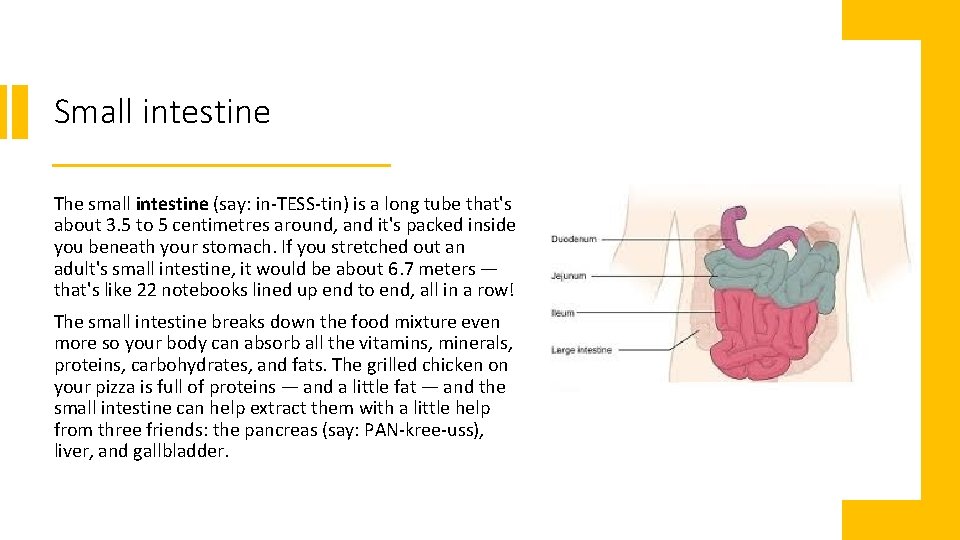
Small intestine The small intestine (say: in-TESS-tin) is a long tube that's about 3. 5 to 5 centimetres around, and it's packed inside you beneath your stomach. If you stretched out an adult's small intestine, it would be about 6. 7 meters — that's like 22 notebooks lined up end to end, all in a row! The small intestine breaks down the food mixture even more so your body can absorb all the vitamins, minerals, proteins, carbohydrates, and fats. The grilled chicken on your pizza is full of proteins — and a little fat — and the small intestine can help extract them with a little help from three friends: the pancreas (say: PAN-kree-uss), liver, and gallbladder.
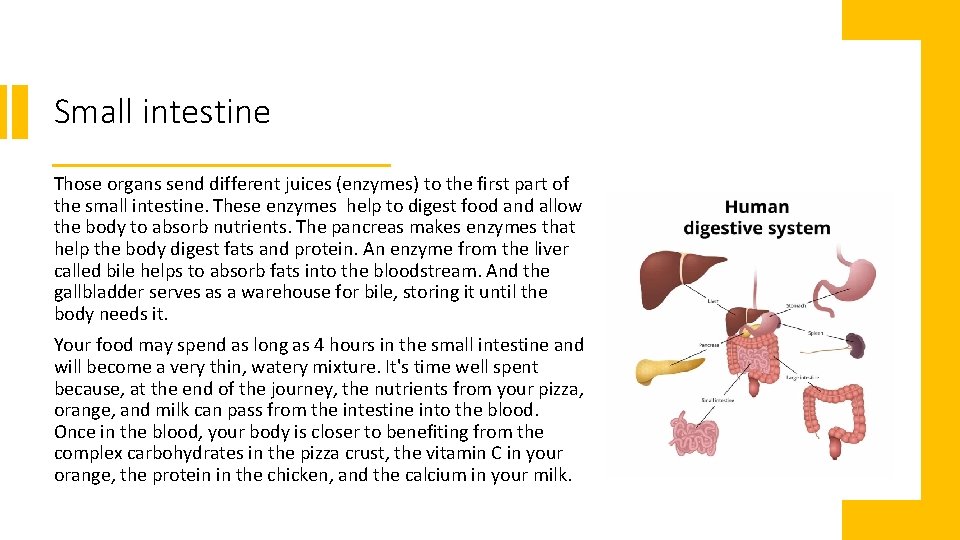
Small intestine Those organs send different juices (enzymes) to the first part of the small intestine. These enzymes help to digest food and allow the body to absorb nutrients. The pancreas makes enzymes that help the body digest fats and protein. An enzyme from the liver called bile helps to absorb fats into the bloodstream. And the gallbladder serves as a warehouse for bile, storing it until the body needs it. Your food may spend as long as 4 hours in the small intestine and will become a very thin, watery mixture. It's time well spent because, at the end of the journey, the nutrients from your pizza, orange, and milk can pass from the intestine into the blood. Once in the blood, your body is closer to benefiting from the complex carbohydrates in the pizza crust, the vitamin C in your orange, the protein in the chicken, and the calcium in your milk.
How do enzymes work? The next activity is optional but is a fun way of understanding what enzymes do in the small intestine. You may not have the fruit needed alternatives to pineapple are papaya, mango, guava, ginger, kiwi and figs but I have not tried these yet. Any fruit can be used instead of the peaches. You can even try lots of different fruit to see what happens afterwards. An explanation of what is happening and how it models digestion in small intestine is on the slide after the activity. You can do the activity at any time you want. Feel free to record it and upload to See Saw if you wish.
How do enzymes work? You will need: enough gelatin or jelly (sugar free) to fill 4 bowls, 1 peach, 1 pineapple, a can of peaches, a can of pineapple. 1. Cut fruit into bite size pieces. 2. Make jelly in four bowls according to packet instructions 3. Add a different fruit to each bowl and label each one. So you will have fresh peach, canned peach, fresh pineapple and canned pinapple. 4. Observe by touching the jelly (gelatin) every 10 minutes. When it doesn’t stick to your finger the gelatin has set. Record the time. 5. Which took the longest to set?
How do enzymes work? What this experiment shows is that enzymes in the pineapple are able to break down the gelatin and slow or stop the jelly setting. In canned fruit, these enzymes are destroyed in the canning process. In the same way, in the small intestine enzymes are breaking down our food into small molecules so that they can be absorbed into our body.
How nutrients are absorbed into the blood The inner wall of the small intestine is covered with millions of microscopic, finger-like projections called villi (VIH-lie). The villi are the vehicles through which nutrients can be absorbed into the blood. It can do this because the nutrients are now so small they can pass through the intestine lining and into the blood stream. The folds in the intestine lining that make up the villi increase the area of the intestine by about 3 times making absorption much more
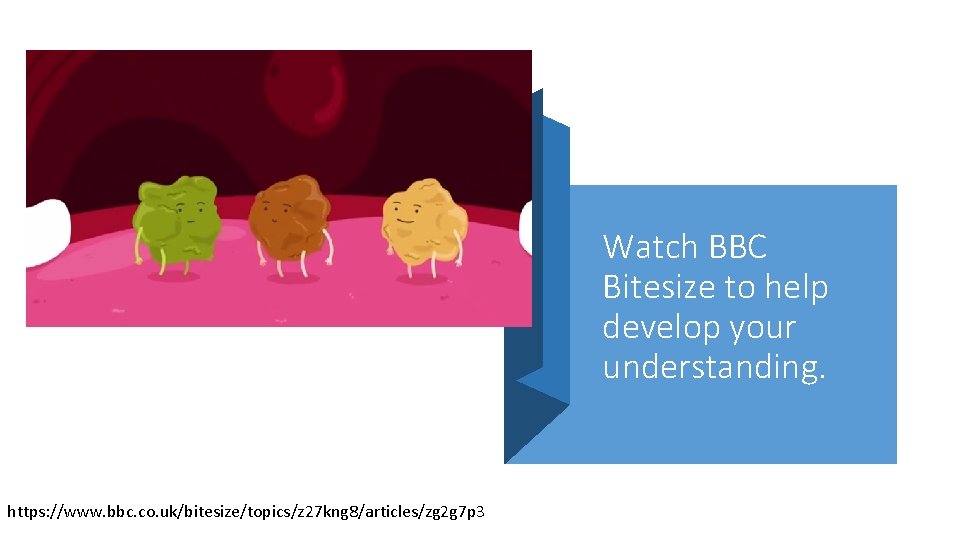
Watch BBC Bitesize to help develop your understanding. https: //www. bbc. co. uk/bitesize/topics/z 27 kng 8/articles/zg 2 g 7 p 3
Can I explain the role of the stomach and small intestine in digestion? Complete the quiz to test your knowledge and understanding.
Q 1 True of false the stomach is responsible for killing a lot of bad bacteria we eat? Q 2 When they reach the stomach, mashed-up food particles mix with: A) Guava juice B) Gastric juices C) Mucus D) Bile
Q 3 Bile is made in the: A) Large intestine B) Stomach C) Liver D) All of the above Q 4 Your food can spend up to this long in the small intestine: A) 4 minutes B) 4 months C) 4 seconds D) 4 hours
Q 5 Which organs help with the absorption of nutrients by making enzymes? A) Pancreas, liver, and gall bladder B) Liver, heart, and spleen C) Gall bladder, kidneys, and appendix D) Kidneys, liver, and bladder Q 6 How long is an adult’s small intestine? A) 6. 7 metres B) 50 centimetres C) 30 miles D) 5. 2 metres
Q 7 What type of nutrient does the enzyme bile breakdown? A) Carbohydrates B) Proteins C) Fats Q 8 The nutrients digested by enzymes are absorbed through the A) Aston Villa B) Villi C) Stomach D) Pancreas
Answers 1. 2. 3. 4. 5. 6. 7. 8. True B C D A A C B