
The status of the CEBAF Upgrade Fulvia Pilat
The status of the CEBAF Upgrade Fulvia Pilat TTC Meeting – JLAB November 5 -8 2012
Outline • • Introduction to JLAB and the 12 Ge. V Upgrade Timeline and present status • C 100 cryomodule: design, production, performance What was done differently for C 100 program • • RF, Cryogenics, magnets New SRF infrastructures • JLAB future plans: 12 Ge. V commissioning and physics running Electron-ion Collider Page 2
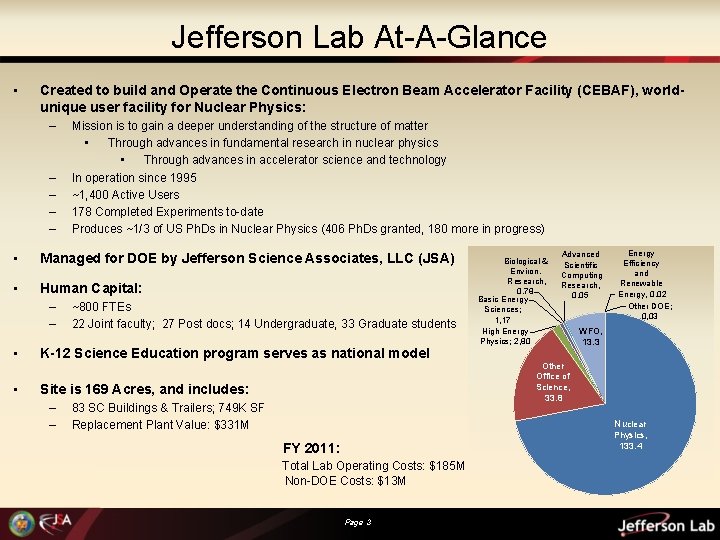
Jefferson Lab At-A-Glance • Created to build and Operate the Continuous Electron Beam Accelerator Facility (CEBAF), worldunique user facility for Nuclear Physics: – – – Mission is to gain a deeper understanding of the structure of matter • Through advances in fundamental research in nuclear physics • Through advances in accelerator science and technology In operation since 1995 ~1, 400 Active Users 178 Completed Experiments to-date Produces ~1/3 of US Ph. Ds in Nuclear Physics (406 Ph. Ds granted, 180 more in progress) • Managed for DOE by Jefferson Science Associates, LLC (JSA) • Human Capital: – – ~800 FTEs 22 Joint faculty; 27 Post docs; 14 Undergraduate, 33 Graduate students • K-12 Science Education program serves as national model • Site is 169 Acres, and includes: – – 83 SC Buildings & Trailers; 749 K SF Replacement Plant Value: $331 M Biological & Environ. Research, 0. 78 Basic Energy Sciences; 1, 17 High Energy Physics; 2, 80 Advanced Scientific Computing Research, 0. 05 Energy Efficiency and Renewable Energy, 0. 02 Other DOE; 0, 03 WFO, 13. 3 Other Office of Science, 33. 8 Nuclear Physics, 133. 4 FY 2011: Total Lab Operating Costs: $185 M Non-DOE Costs: $13 M Page 3
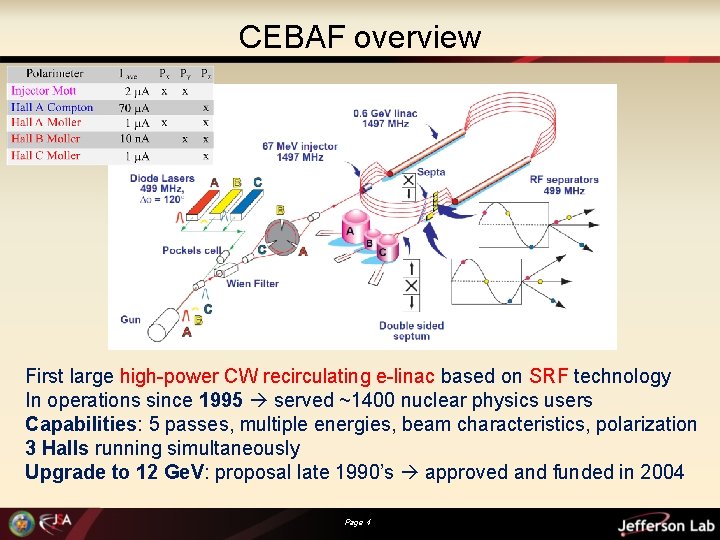
CEBAF overview First large high-power CW recirculating e-linac based on SRF technology In operations since 1995 served ~1400 nuclear physics users Capabilities: 5 passes, multiple energies, beam characteristics, polarization 3 Halls running simultaneously Upgrade to 12 Ge. V: proposal late 1990’s approved and funded in 2004 Page 4
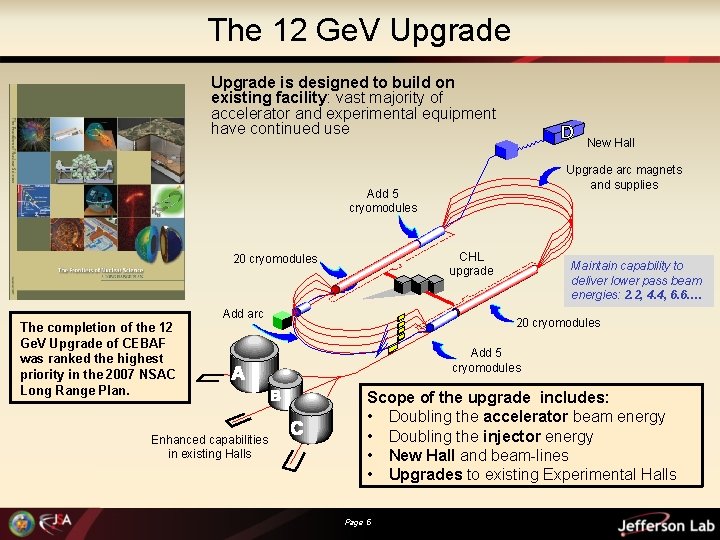
The 12 Ge. V Upgrade is designed to build on existing facility: vast majority of accelerator and experimental equipment have continued use New Hall Upgrade arc magnets and supplies Add 5 cryomodules CHL upgrade 20 cryomodules Add arc The completion of the 12 Ge. V Upgrade of CEBAF was ranked the highest priority in the 2007 NSAC Long Range Plan. Enhanced capabilities in existing Halls Maintain capability to deliver lower pass beam energies: 2. 2, 4. 4, 6. 6…. 20 cryomodules Add 5 cryomodules Scope of the upgrade includes: • Doubling the accelerator beam energy • Doubling the injector energy • New Hall and beam-lines • Upgrades to existing Experimental Halls Page 5

6 Ge. V CEBAF Two 0. 6 GV linacs Page 6
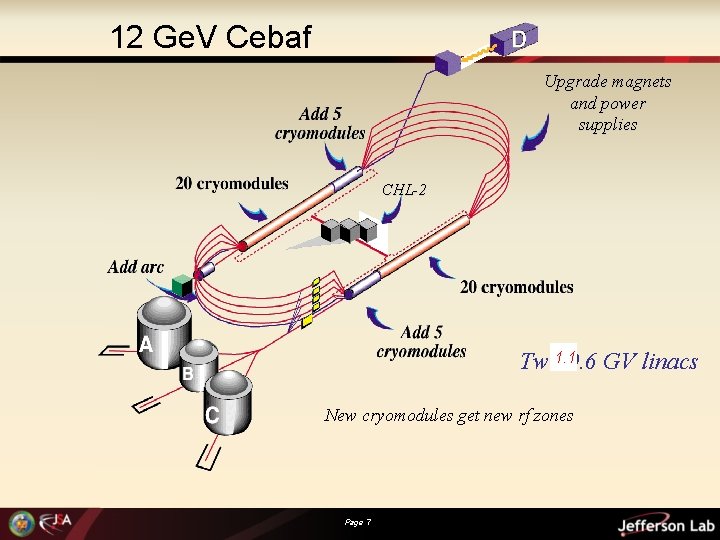
12 Ge. V Cebaf Upgrade magnets and power supplies CHL-2 Two 1. 10. 6 GV linacs New cryomodules get new rf zones Page 7
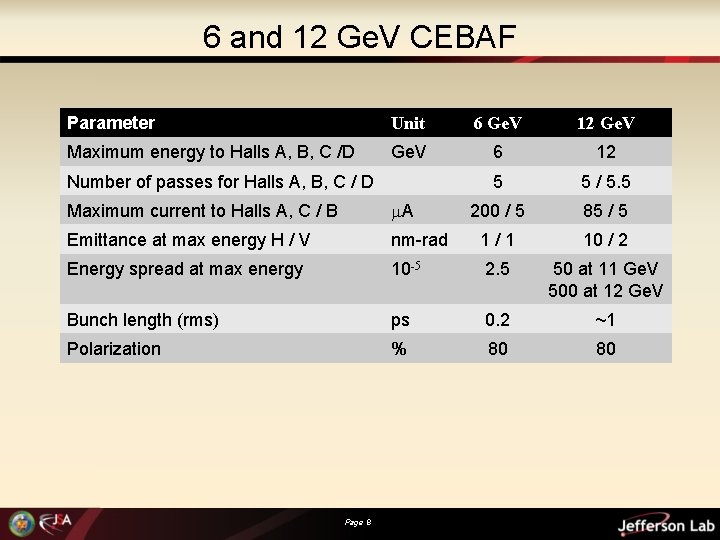
6 and 12 Ge. V CEBAF Parameter Unit 6 Ge. V 12 Ge. V Maximum energy to Halls A, B, C /D Ge. V 6 12 5 5 / 5. 5 200 / 5 85 / 5 Number of passes for Halls A, B, C / D Maximum current to Halls A, C / B m. A Emittance at max energy H / V nm-rad 1/1 10 / 2 Energy spread at max energy 10 -5 2. 5 50 at 11 Ge. V 500 at 12 Ge. V Bunch length (rms) ps 0. 2 ~1 Polarization % 80 80 Page 8
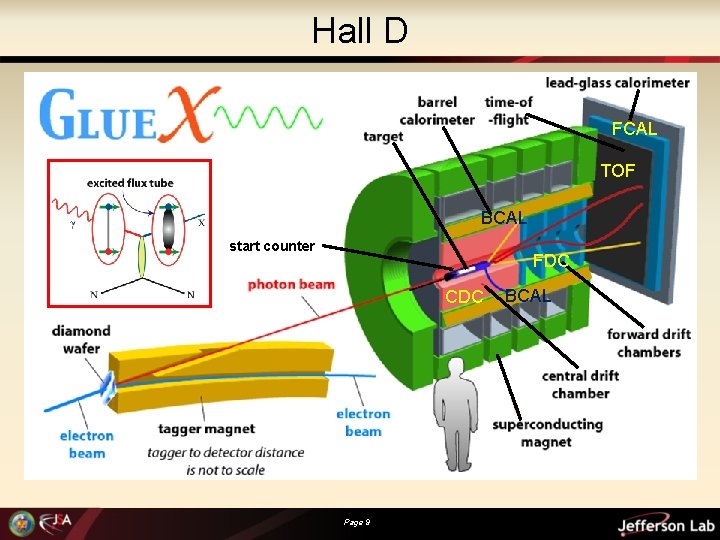
Hall D FCAL TOF BCAL start counter FDC CDC Page 9 BCAL
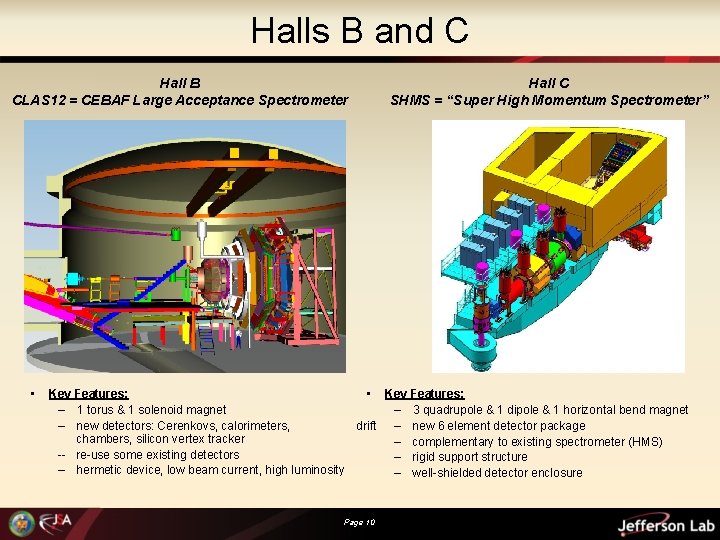
Halls B and C Hall B CLAS 12 = CEBAF Large Acceptance Spectrometer • Hall C SHMS = “Super High Momentum Spectrometer” Key Features: • Key Features: – 1 torus & 1 solenoid magnet – 3 quadrupole & 1 dipole & 1 horizontal bend magnet – new detectors: Cerenkovs, calorimeters, drift – new 6 element detector package chambers, silicon vertex tracker – complementary to existing spectrometer (HMS) -- re-use some existing detectors – rigid support structure – hermetic device, low beam current, high luminosity – well-shielded detector enclosure Page 10
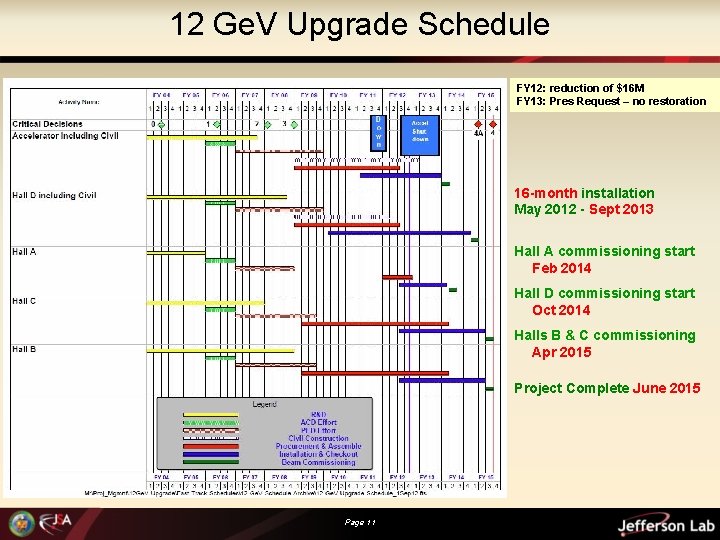
12 Ge. V Upgrade Schedule FY 12: reduction of $16 M FY 13: Pres Request – no restoration 16 -month installation May 2012 - Sept 2013 Hall A commissioning start Feb 2014 Hall D commissioning start Oct 2014 Halls B & C commissioning Apr 2015 Project Complete June 2015 Page 11
12 Ge. V Upgrade organization and status 12 Ge. V Project, with project management structure and practices Total Project Cost: 310 M$ (Injector Upgrade off project) Project 68% complete, 79% obligated Upgrade to 12 Ge. V planned over 2 operations shutdowns: 6 months (May-Nov 2011) and 16 months (May 2012 – Sep 2013) Run last 6 Ge. V physics run (Nov 2011 -May 2012) Test in operations critical upgrade components (C 100 cryo-module and reworked and new magnets) Vast scope of work ongoing concurrently at JLAB during shut-downs (12 Ge. V upgrade, running of FEL, construction of a 30 M$ Facility, 2 buildings to integrate engineering capabilities and doubling the SRF infrastructures Lab-wide coordination of shutdown activities 6 - month shutdown a success, exceeded scope of work in magnet upgrade Page 12
The C 100 cryomodule • Cavity production • Cryomodule test and performance Page 13
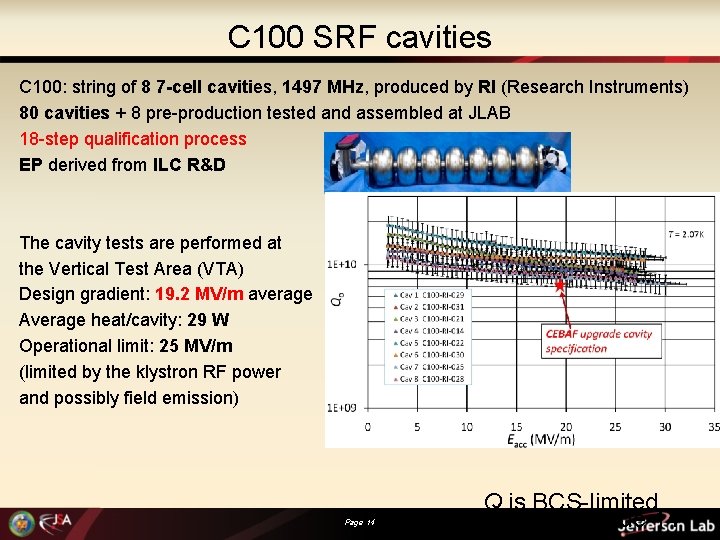
C 100 SRF cavities C 100: string of 8 7 -cell cavities, 1497 MHz, produced by RI (Research Instruments) 80 cavities + 8 pre-production tested and assembled at JLAB 18 -step qualification process EP derived from ILC R&D The cavity tests are performed at the Vertical Test Area (VTA) Design gradient: 19. 2 MV/m average Average heat/cavity: 29 W Operational limit: 25 MV/m (limited by the klystron RF power and possibly field emission) Page 14 Q is BCS-limited Slide 14
Storyline for 12 Ge. V Cavities • • 2000 -2002 Design and prototypes After prototype set, cavity design optimization to adjust input coupling, reduce fundamental field at HOM couplers (thermal issue), and get as-welded cavity closer to target frequency. Default surface prep: heavy BCP [all tests met project requirements] Outside-of-project effort to apply controlled EP encouraged by ILC R&D work, also streamlined preparation process developed. Result: Increased Q in the 17 – 24 MV/m range from EP added Technical Contingency in cryoload with minimal, if any, cost impact. Project acceptance. Cavity acceptance test performance exceeded requirements. Principal remaining performance-limiting phenomenon was field emission, but none with enough significance to not meet project requirements. Page 15
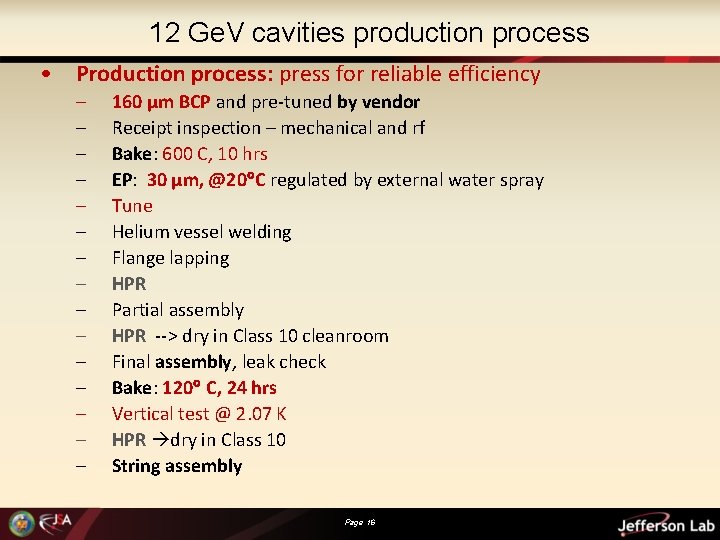
12 Ge. V cavities production process • Production process: press for reliable efficiency – – – – 160 µm BCP and pre-tuned by vendor Receipt inspection – mechanical and rf Bake: 600 C, 10 hrs EP: 30 µm, @20 C regulated by external water spray Tune Helium vessel welding Flange lapping HPR Partial assembly HPR --> dry in Class 10 cleanroom Final assembly, leak check Bake: 120 C, 24 hrs Vertical test @ 2. 07 K HPR dry in Class 10 String assembly Page 16
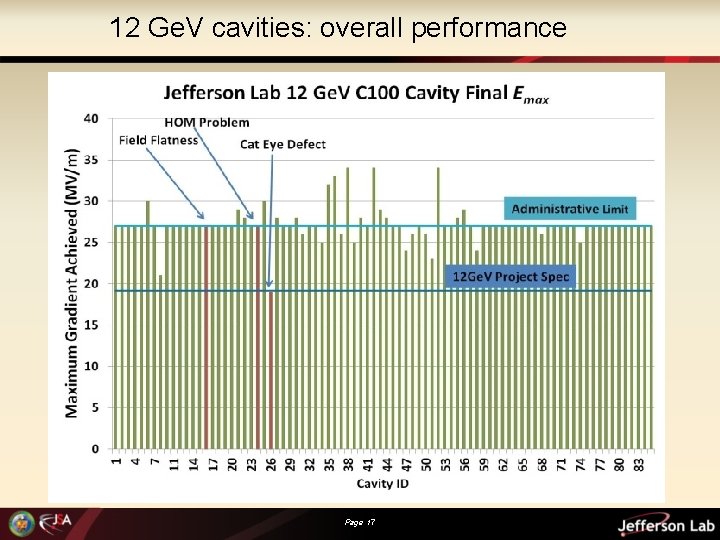
12 Ge. V cavities: overall performance Page 17
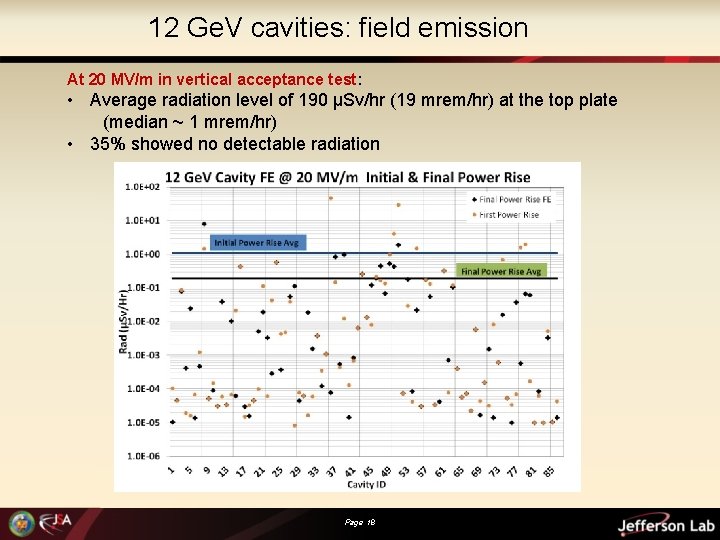
12 Ge. V cavities: field emission At 20 MV/m in vertical acceptance test: • Average radiation level of 190 μSv/hr (19 mrem/hr) at the top plate (median ~ 1 mrem/hr) • 35% showed no detectable radiation Page 18
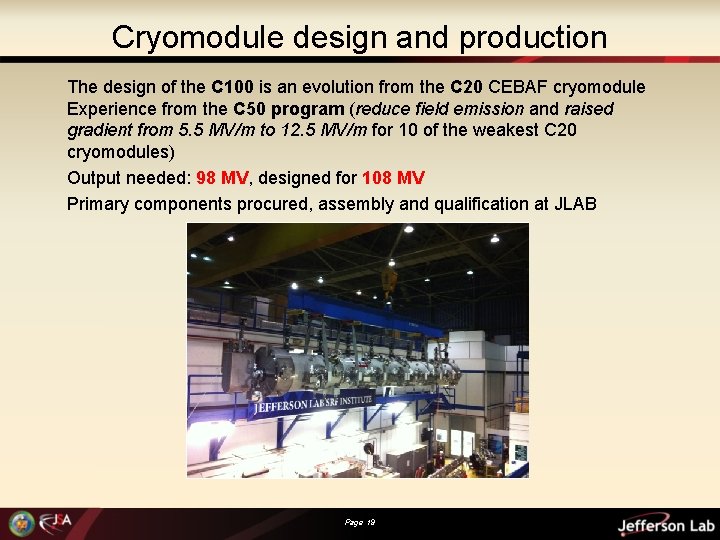
Cryomodule design and production The design of the C 100 is an evolution from the C 20 CEBAF cryomodule Experience from the C 50 program (reduce field emission and raised gradient from 5. 5 MV/m to 12. 5 MV/m for 10 of the weakest C 20 cryomodules) Output needed: 98 MV, designed for 108 MV Primary components procured, assembly and qualification at JLAB Page 19
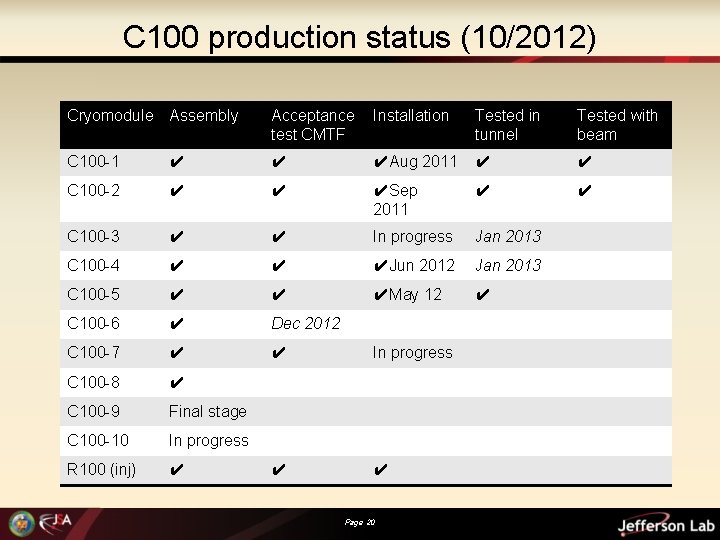
C 100 production status (10/2012) Cryomodule Assembly Acceptance test CMTF Installation Tested in tunnel Tested with beam C 100 -1 ✔ ✔ ✔Aug 2011 ✔ ✔ C 100 -2 ✔ ✔ ✔Sep 2011 ✔ ✔ C 100 -3 ✔ ✔ In progress Jan 2013 C 100 -4 ✔ ✔ ✔Jun 2012 Jan 2013 C 100 -5 ✔ ✔ ✔May 12 ✔ C 100 -6 ✔ Dec 2012 C 100 -7 ✔ ✔ In progress C 100 -8 ✔ C 100 -9 Final stage C 100 -10 In progress R 100 (inj) ✔ ✔ ✔ Page 20
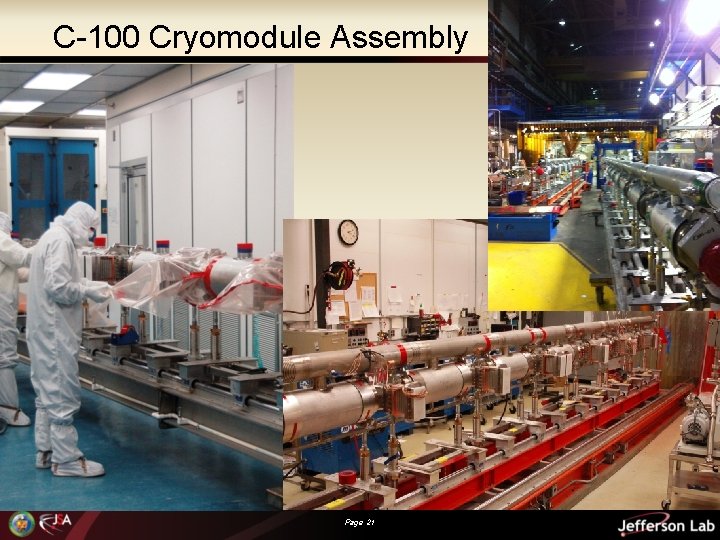
C-100 Cryomodule Assembly Page 21 21
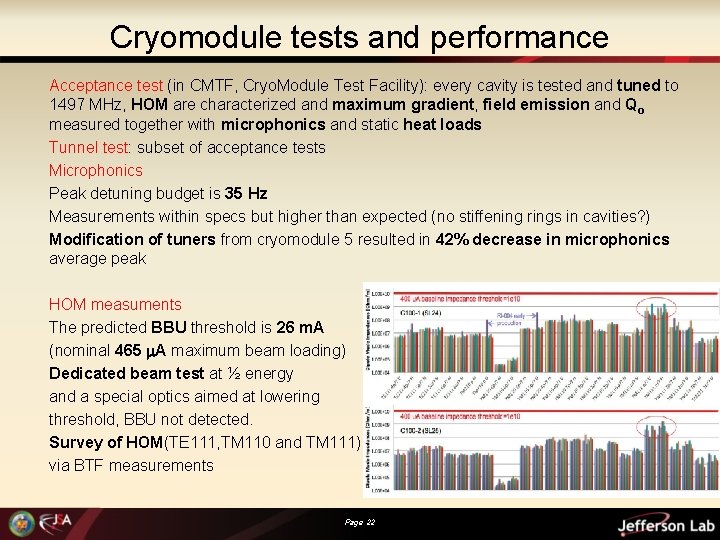
Cryomodule tests and performance Acceptance test (in CMTF, Cryo. Module Test Facility): every cavity is tested and tuned to 1497 MHz, HOM are characterized and maximum gradient, field emission and Qo measured together with microphonics and static heat loads Tunnel test: subset of acceptance tests Microphonics Peak detuning budget is 35 Hz Measurements within specs but higher than expected (no stiffening rings in cavities? ) Modification of tuners from cryomodule 5 resulted in 42% decrease in microphonics average peak HOM measuments The predicted BBU threshold is 26 m. A (nominal 465 m. A maximum beam loading) Dedicated beam test at ½ energy and a special optics aimed at lowering threshold, BBU not detected. Survey of HOM(TE 111, TM 110 and TM 111) via BTF measurements Page 22
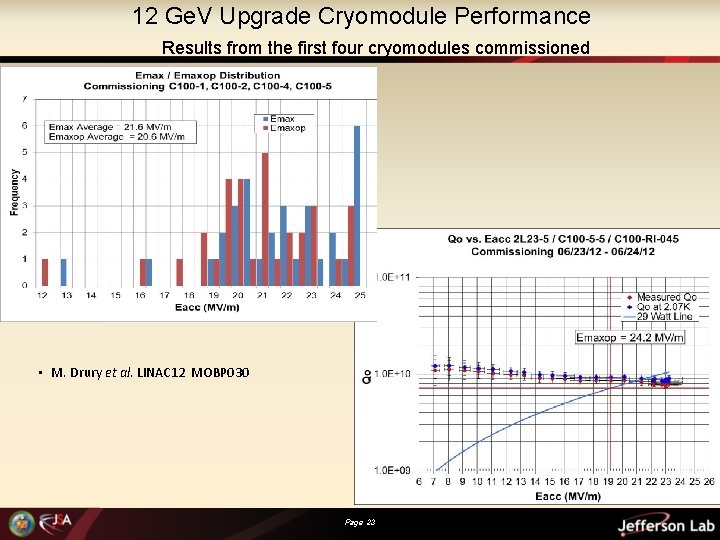
12 Ge. V Upgrade Cryomodule Performance Results from the first four cryomodules commissioned • M. Drury et al. LINAC 12 MOBP 030 Page 23
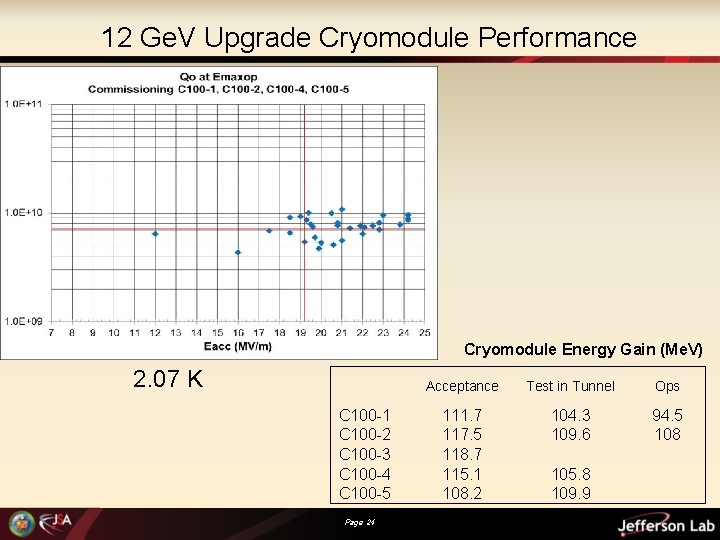
12 Ge. V Upgrade Cryomodule Performance Cryomodule Energy Gain (Me. V) 2. 07 K C 100 -1 C 100 -2 C 100 -3 C 100 -4 C 100 -5 Page 24 Acceptance Test in Tunnel Ops 111. 7 117. 5 118. 7 115. 1 108. 2 104. 3 109. 6 94. 5 108 105. 8 109. 9
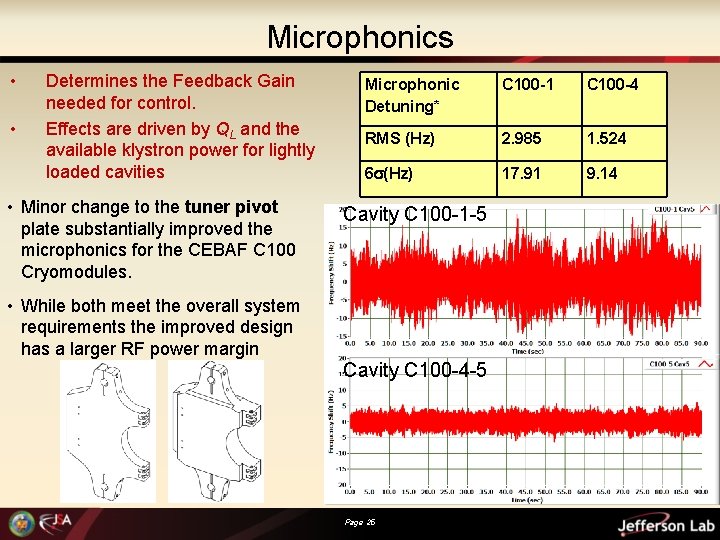
Microphonics • • Determines the Feedback Gain needed for control. Effects are driven by QL and the available klystron power for lightly loaded cavities • Minor change to the tuner pivot plate substantially improved the microphonics for the CEBAF C 100 Cryomodules. Microphonic Detuning* C 100 -1 C 100 -4 RMS (Hz) 2. 985 1. 524 6 s(Hz) 17. 91 9. 14 Cavity C 100 -1 -5 • While both meet the overall system requirements the improved design has a larger RF power margin Cavity C 100 -4 -5 Page 25
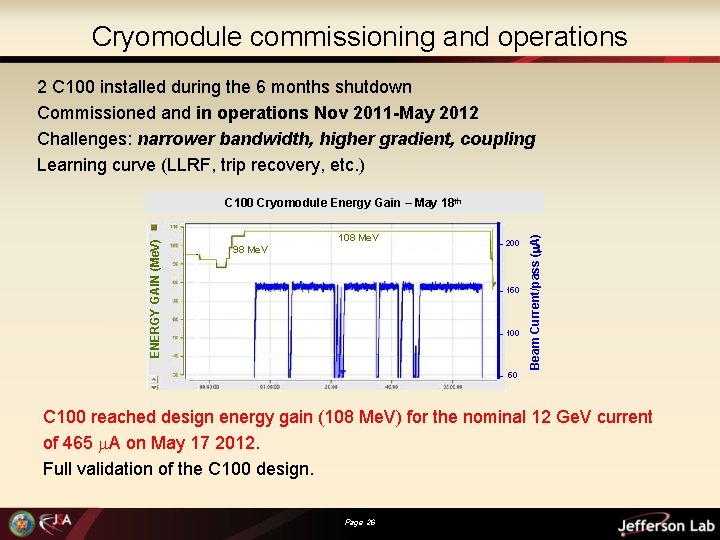
Cryomodule commissioning and operations 2 C 100 installed during the 6 months shutdown Commissioned and in operations Nov 2011 -May 2012 Challenges: narrower bandwidth, higher gradient, coupling Learning curve (LLRF, trip recovery, etc. ) 108 Me. V 98 Me. V – 200 – 150 – 100 Beam Current/pass (m. A) ENERGY GAIN (Me. V) C 100 Cryomodule Energy Gain – May 18 th – 50 C 100 reached design energy gain (108 Me. V) for the nominal 12 Ge. V current of 465 m. A on May 17 2012. Full validation of the C 100 design. Page 26
Quick glance at other upgrade systems: RF Cryogenics Magnets Page 27
RF Zone Page 28
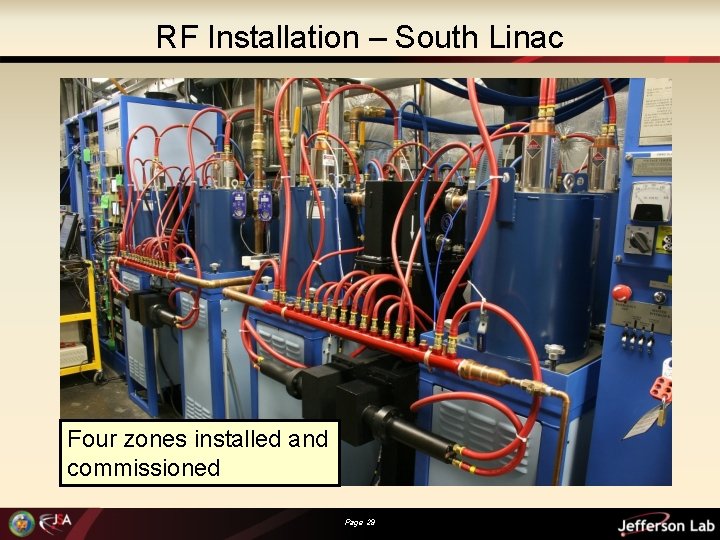
RF Installation – South Linac Four zones installed and commissioned Page 29
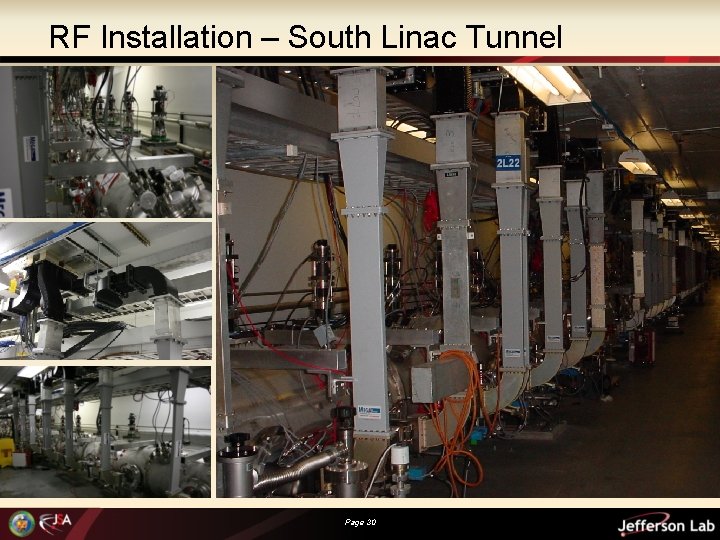
RF Installation – South Linac Tunnel Waveguide installation Page 30
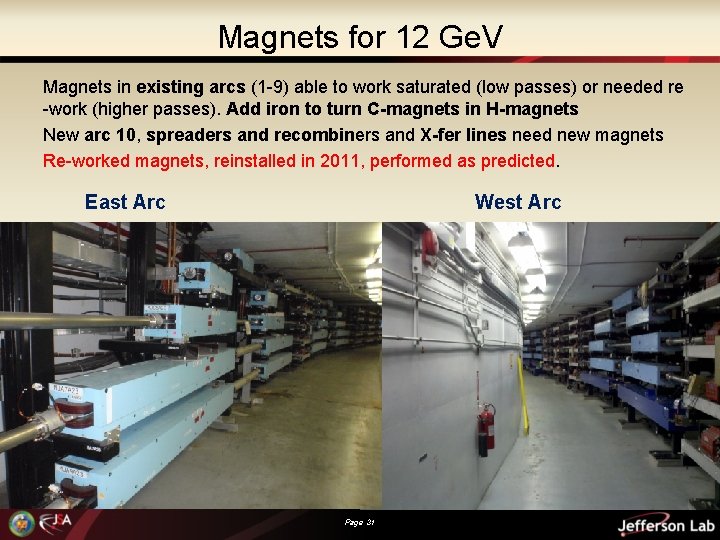
Magnets for 12 Ge. V Magnets in existing arcs (1 -9) able to work saturated (low passes) or needed re -work (higher passes). Add iron to turn C-magnets in H-magnets New arc 10, spreaders and recombiners and X-fer lines need new magnets Re-worked magnets, reinstalled in 2011, performed as predicted. East Arc West Arc Page 31
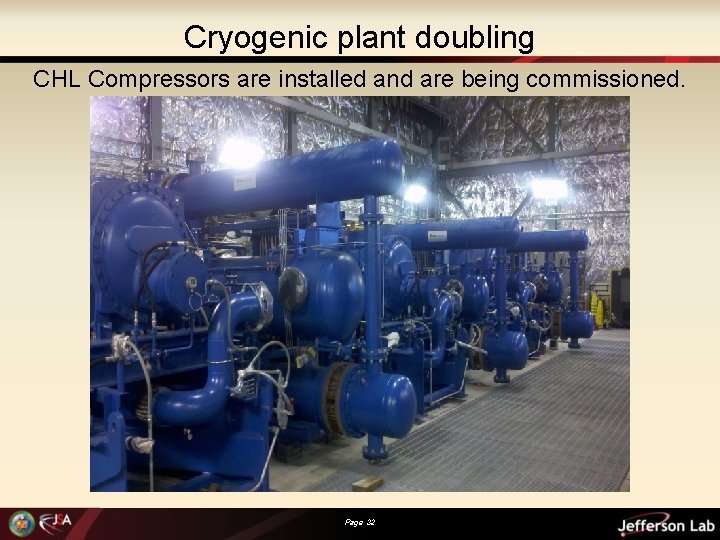
Cryogenic plant doubling CHL Compressors are installed and are being commissioned. Page 32
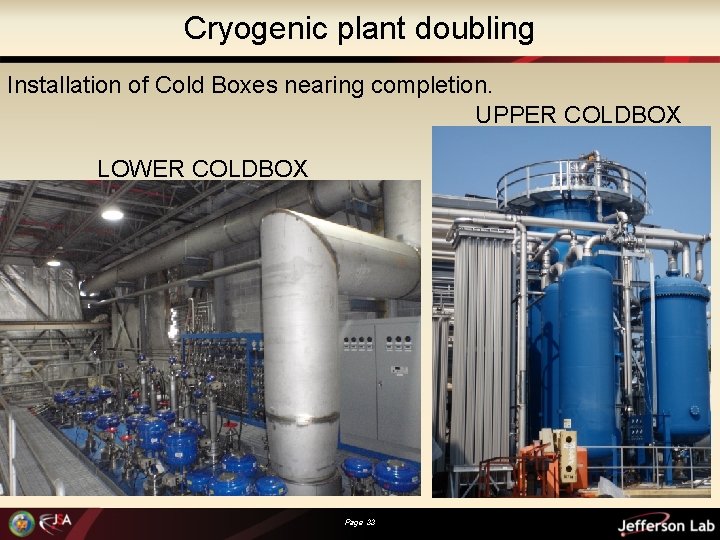
Cryogenic plant doubling Installation of Cold Boxes nearing completion. UPPER COLDBOX LOWER COLDBOX Page 33
New SRF infrastructures Page 34
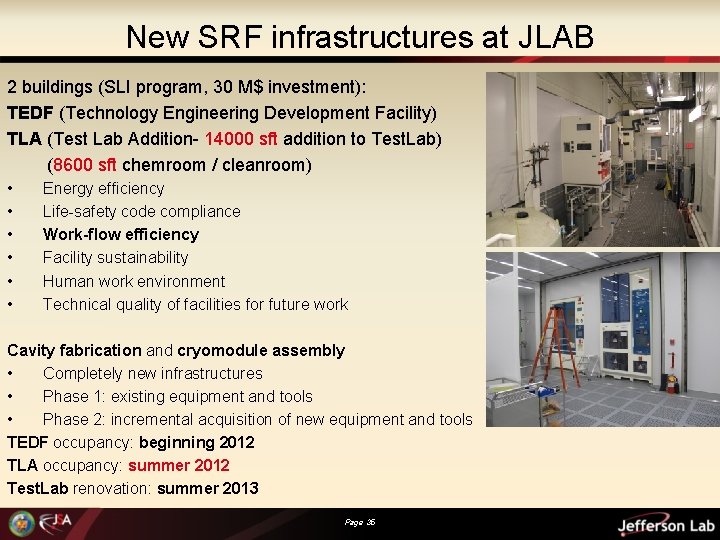
New SRF infrastructures at JLAB 2 buildings (SLI program, 30 M$ investment): TEDF (Technology Engineering Development Facility) TLA (Test Lab Addition- 14000 sft addition to Test. Lab) (8600 sft chemroom / cleanroom) • • • Energy efficiency Life-safety code compliance Work-flow efficiency Facility sustainability Human work environment Technical quality of facilities for future work Cavity fabrication and cryomodule assembly • Completely new infrastructures • Phase 1: existing equipment and tools • Phase 2: incremental acquisition of new equipment and tools TEDF occupancy: beginning 2012 TLA occupancy: summer 2012 Test. Lab renovation: summer 2013 Page 35
Improved Work-Flow Efficiency • Improved work flow of SRF work centers by consolidating to Test Lab Addition (TLA) – All work centers placed on first floor level with planned adjacencies to improve work flow – SRF machine shop, presses, tech shop, and electron beam welder consolidated to west end of TLA – Brazing and vacuum furnaces moved to one room – Parts clean & etch, R&D chemistry co-located to east end of TLA with improved integration with clean room – Consolidated R&D labs with similar purposes – Vertical attach clean room isolated from main ISO-4 clean room used for cavity processing and assembly via an air lock – Longer dedicated cryomodule assembly rail systems to enable simultaneous activities Page 36
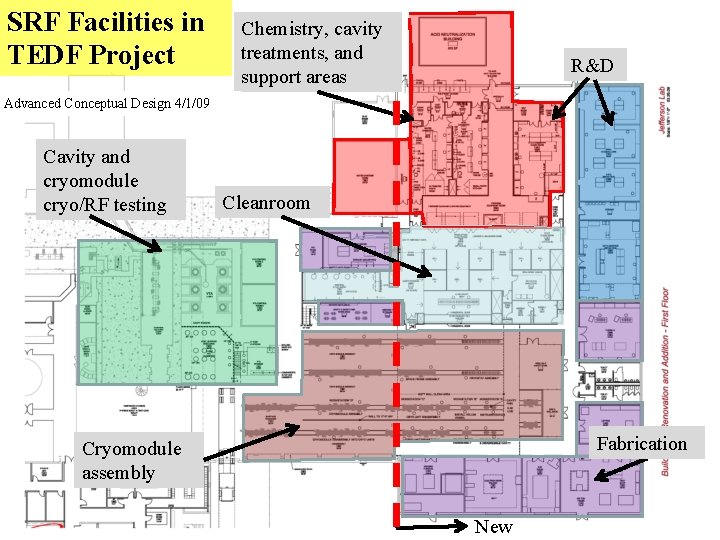
SRF Facilities in Chemistry, cavity SRF treatments, Facilities in JLab TEDF and TEDF Project support areas R&D Advanced Conceptual Design 4/1/09 Cavity and cryomodule cryo/RF testing Cleanroom Fabrication Cryomodule assembly Page 37 New
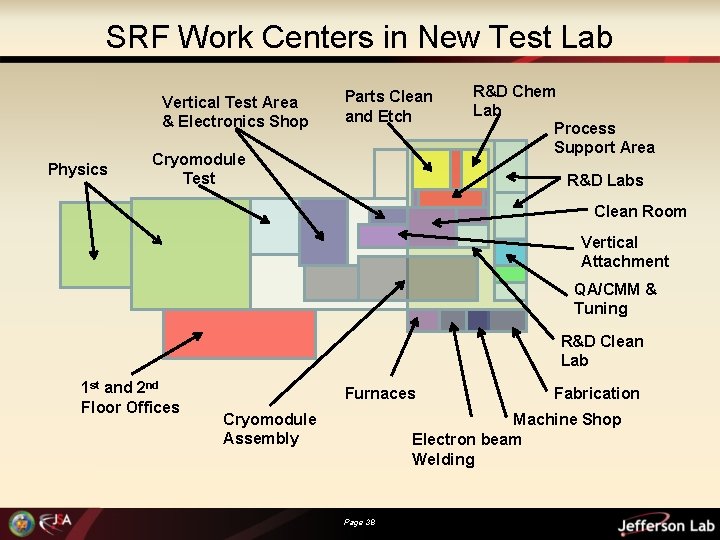
SRF Work Centers in New Test Lab Vertical Test Area & Electronics Shop Physics Parts Clean and Etch Cryomodule Test R&D Chem Lab Process Support Area R&D Labs Clean Room Vertical Attachment QA/CMM & Tuning R&D Clean Lab 1 st and 2 nd Floor Offices Furnaces Cryomodule Assembly Fabrication Machine Shop Electron beam Welding Page 38
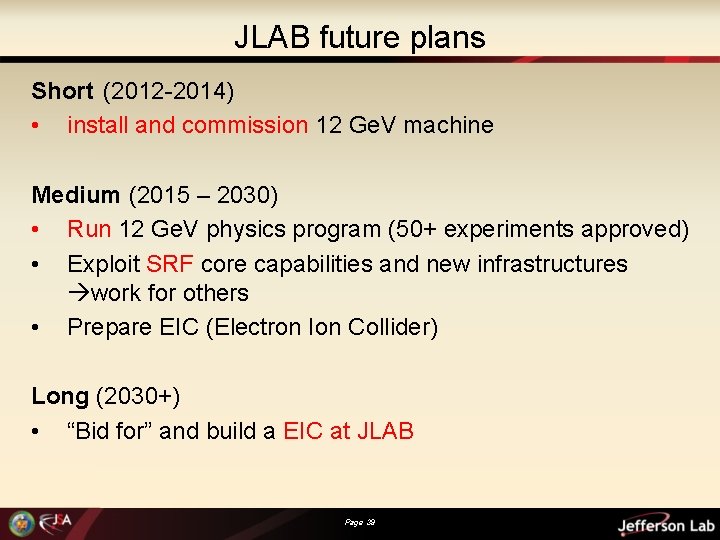
JLAB future plans Short (2012 -2014) • install and commission 12 Ge. V machine Medium (2015 – 2030) • Run 12 Ge. V physics program (50+ experiments approved) • Exploit SRF core capabilities and new infrastructures work for others • Prepare EIC (Electron Ion Collider) Long (2030+) • “Bid for” and build a EIC at JLAB Page 39
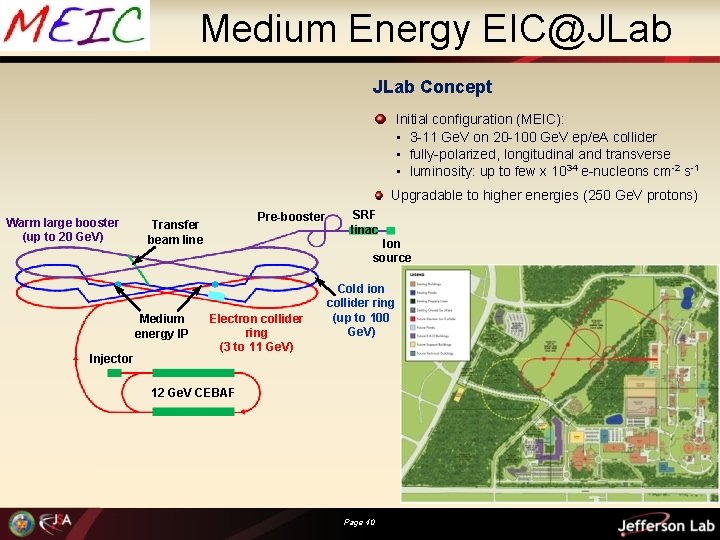
Medium Energy EIC@JLab Concept Initial configuration (MEIC): • 3 -11 Ge. V on 20 -100 Ge. V ep/e. A collider • fully-polarized, longitudinal and transverse • luminosity: up to few x 1034 e-nucleons cm-2 s-1 Upgradable to higher energies (250 Ge. V protons) Warm large booster (up to 20 Ge. V) Medium energy IP Injector Pre-booster Transfer beam line SRF linac Ion source Electron collider ring (3 to 11 Ge. V) Cold ion collider ring (up to 100 Ge. V) 12 Ge. V CEBAF Page 40
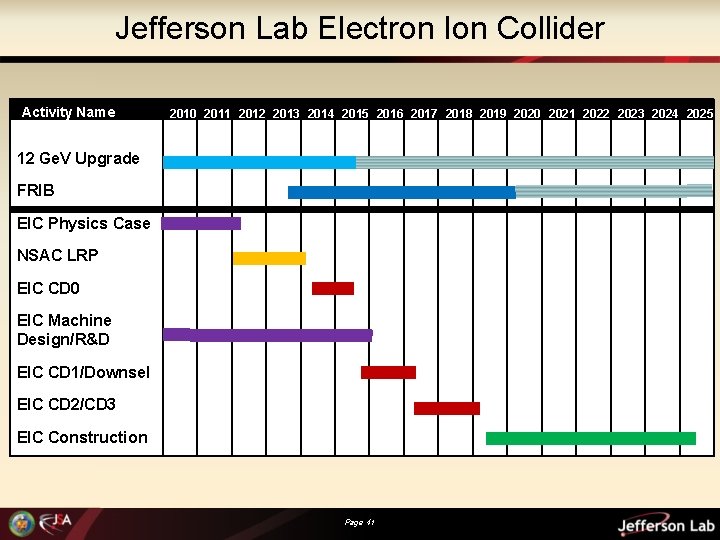
Jefferson Lab Electron Ion Collider Activity Name 2010 2011 2012 2013 2014 2015 2016 2017 2018 2019 2020 2021 2022 2023 2024 2025 12 Ge. V Upgrade FRIB EIC Physics Case NSAC LRP EIC CD 0 EIC Machine Design/R&D EIC CD 1/Downsel EIC CD 2/CD 3 EIC Construction Page 41
Conclusions • • The 12 Ge. V Upgrade for CEBAF at JLAB is progressing well and the start of commissioning is planned for the fall of 2013. A robust program of physics running will follow. JLAB will complete a doubling of its SRF infrastructure in summer 2013 greatly enhancing its future SRF R&D and production capabilities. An electron-ion collider is the long-term strategic goal of the laboratory. The conceptual design for a MEIC at JLAB has been published in August 2012. Page 42
Acknowledgements All JLAB staff working towards the 12 Ge. V Upgrade for their scientific and technical input For direct contributions to the slides: M. Drury, J. Guo, J. Hogan, K. Hovater, W. Merz, H. Montgomery, C. Reece, T. Reilly, C. Rode, T. Satogata. Page 43
Backup slides Page 44
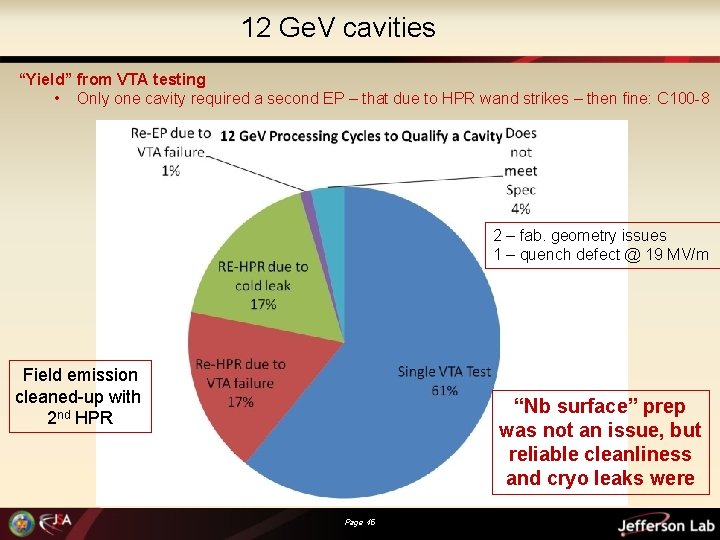
12 Ge. V cavities “Yield” from VTA testing • Only one cavity required a second EP – that due to HPR wand strikes – then fine: C 100 -8 2 – fab. geometry issues 1 – quench defect @ 19 MV/m Field emission cleaned-up with 2 nd HPR “Nb surface” prep was not an issue, but reliable cleanliness and cryo leaks were Page 45
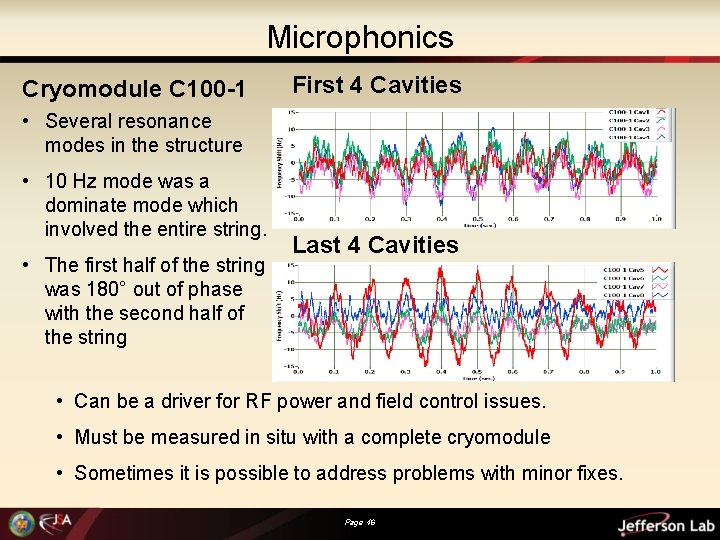
Microphonics Cryomodule C 100 -1 First 4 Cavities • Several resonance modes in the structure • 10 Hz mode was a dominate mode which involved the entire string. • The first half of the string was 180° out of phase with the second half of the string Last 4 Cavities • Can be a driver for RF power and field control issues. • Must be measured in situ with a complete cryomodule • Sometimes it is possible to address problems with minor fixes. Page 46
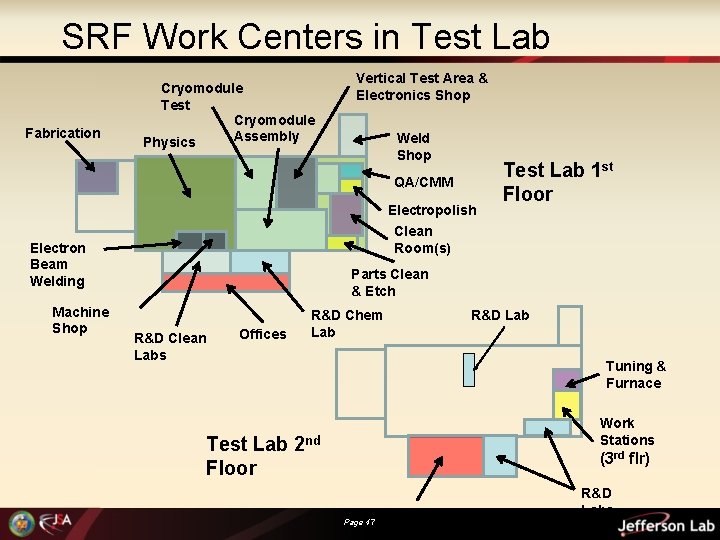
SRF Work Centers in Test Lab Fabrication Cryomodule Test Cryomodule Assembly Physics Vertical Test Area & Electronics Shop Weld Shop QA/CMM Electropolish Clean Room(s) Electron Beam Welding Machine Shop Test Lab 1 st Floor Parts Clean & Etch R&D Clean Labs Offices R&D Lab R&D Chem Lab Tuning & Furnace Work Stations Test Lab 2 nd Floor (3 rd flr) Page 47 Offices R&D Labs
- Slides: 47