
The Statistical Concepts Behind Six Sigma DMAICTools com
The Statistical Concepts Behind “Six Sigma” DMAICTools. com Image Source: Dassault Systems World class industrial robots, printers, and machinery
Six Sigma is Two Things • A Highly Capable Process – Long Term Statistical Defect Rate Prediction of 3. 4 Defects Per Million or Less – covered in this training • A Structured Process Improvement Approach – DMAIC = Define, Measure, Analyze, Improve, Control – Covered in https: //www. dmaictools. com/dmaic-training-powerpoint
Six Sigma Capability Can be Expressed at Two Levels • At the CTQ Level “The new press has Six Sigma capability on the 2. 5 mm +/-. 05 mm press dimension. ” • At the Overall Process Level “The fuel pump assembly line is a Six Sigma process. ” - Methods vary for calculating total process capability, like DPMO or Rolled Throughput Yield (RTY)
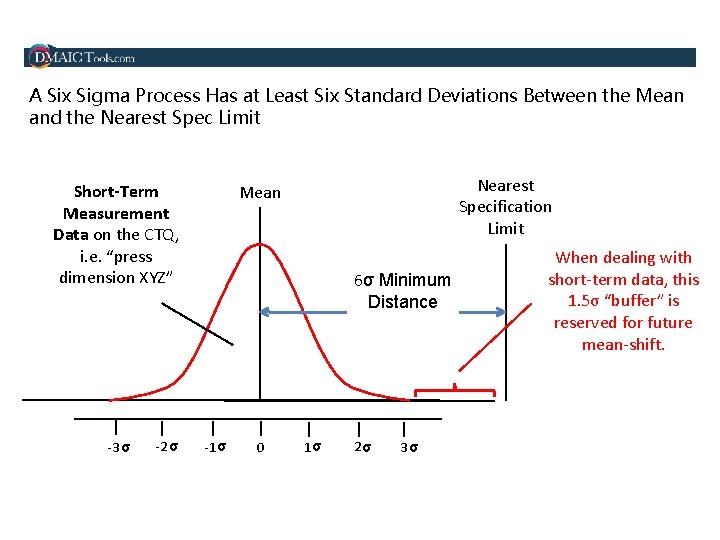
A Six Sigma Process Has at Least Six Standard Deviations Between the Mean and the Nearest Spec Limit Short-Term Measurement Data on the CTQ, i. e. “press dimension XYZ” -3 σ -2 σ Nearest Specification Limit Mean 6σ Minimum Distance -1σ 0 1σ 2σ 3σ When dealing with short-term data, this 1. 5σ “buffer” is reserved for future mean-shift.
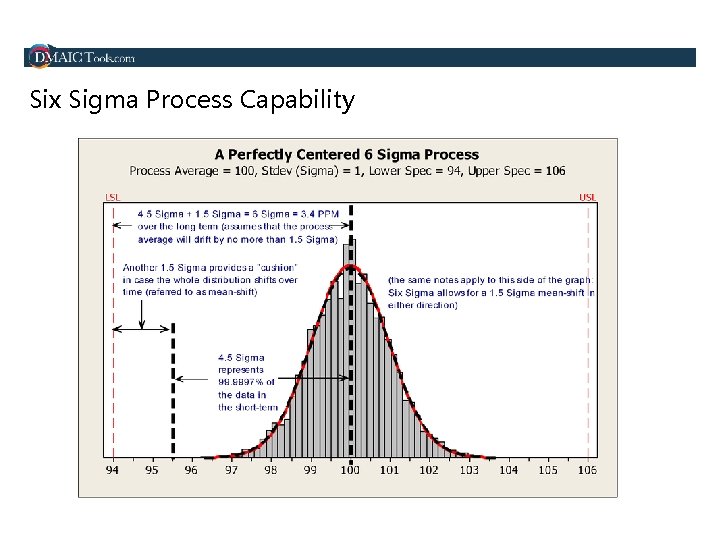
Six Sigma Process Capability
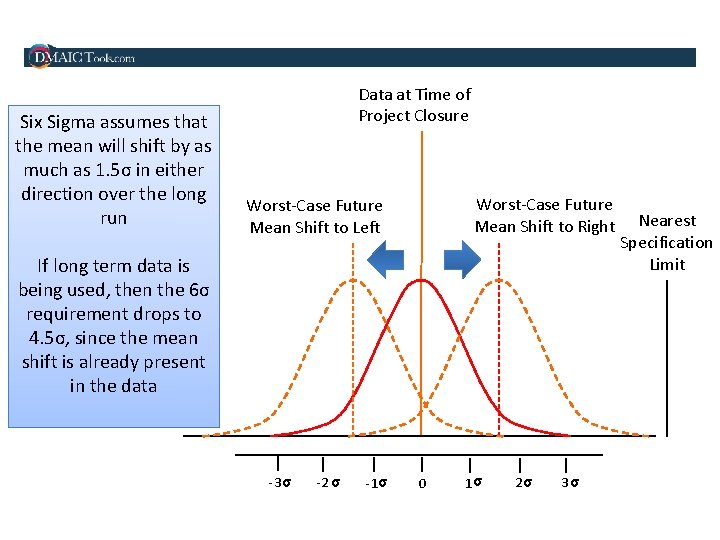
Six Sigma assumes that the mean will shift by as much as 1. 5σ in either direction over the long run Data at Time of Project Closure Worst-Case Future Mean Shift to Right Worst-Case Future Mean Shift to Left If long term data is being used, then the 6σ requirement drops to 4. 5σ, since the mean shift is already present in the data -3 σ -2 σ -1σ 0 1σ 2σ 3σ Nearest Specification Limit
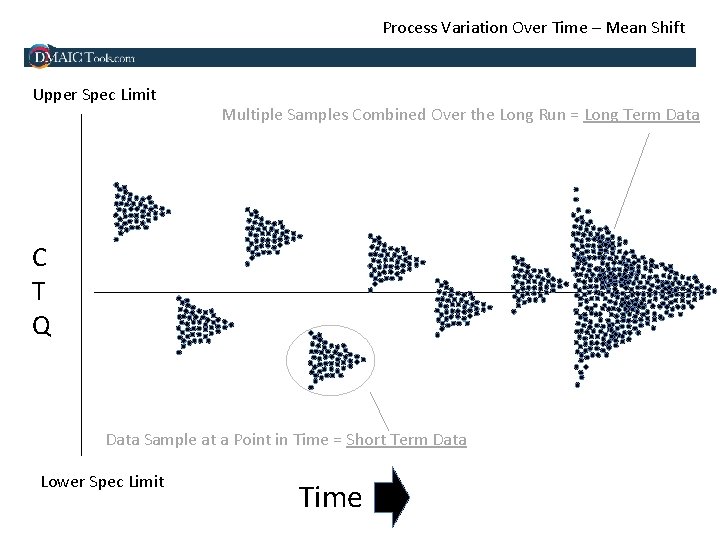
Process Variation Over Time – Mean Shift Upper Spec Limit Multiple Samples Combined Over the Long Run = Long Term Data C T Q Data Sample at a Point in Time = Short Term Data Lower Spec Limit Time
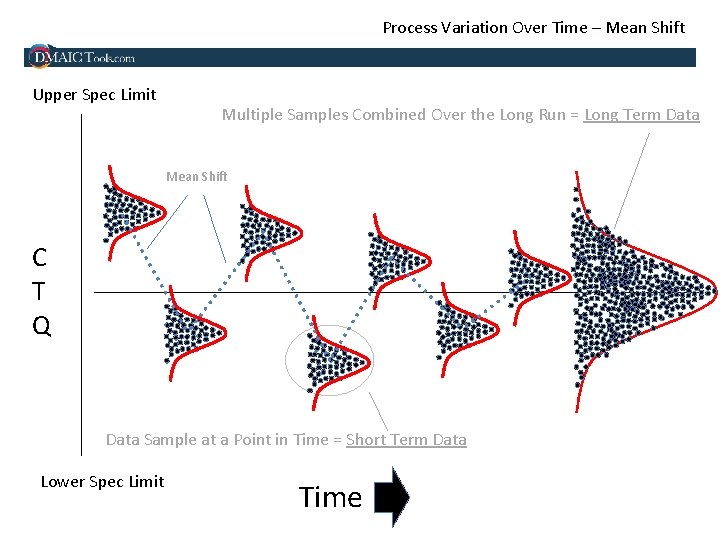
Process Variation Over Time – Mean Shift Upper Spec Limit Multiple Samples Combined Over the Long Run = Long Term Data Mean Shift C T Q Data Sample at a Point in Time = Short Term Data Lower Spec Limit Time
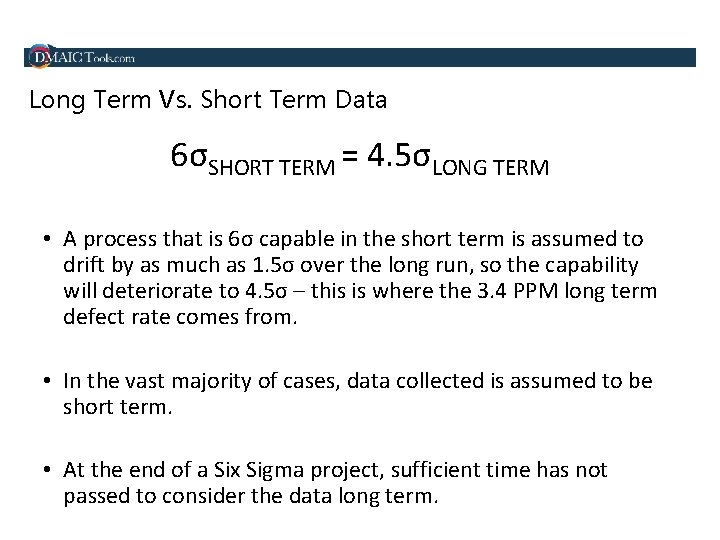
Long Term Vs. Short Term Data 6σSHORT TERM = 4. 5σLONG TERM • A process that is 6σ capable in the short term is assumed to drift by as much as 1. 5σ over the long run, so the capability will deteriorate to 4. 5σ – this is where the 3. 4 PPM long term defect rate comes from. • In the vast majority of cases, data collected is assumed to be short term. • At the end of a Six Sigma project, sufficient time has not passed to consider the data long term.
Six Sigma Capability – Wrap-Up When it comes to defining a process as ”capable” for production: • Six Sigma scrutinizes the data, beyond the fact that a small sample data might be within specification limits • The scrutiny comes from statistical analysis, measuring the process average and variation • Six Sigma requires an extra “buffer” between the statistical high and low predictions of where the data falls, so that there is room for the process to drift over time, while still falling inside the specification limits
- Slides: 10