
The Statistical Adjustment Model Module 10 2019 WIOA


- Slides: 27
The Statistical Adjustment Model Module 10 2019 WIOA National Performance Training U. S. Department of Labor Employment and Training Administration
What You Will Need For Modules 10 & 11 ü Handout – WIOA Statistical Adjustment Model Variables 2
The Objectives of this Session ü Overview of Statistical Adjustment Model ü How the model is used in the negotiation and performance evaluation processes ü Early tests of the model’s performance using reported data from PY 2017 ü Example of the importance of accurately reported data ü Ultimate Objective: Move up one level in your understanding of the model and how it is used 3
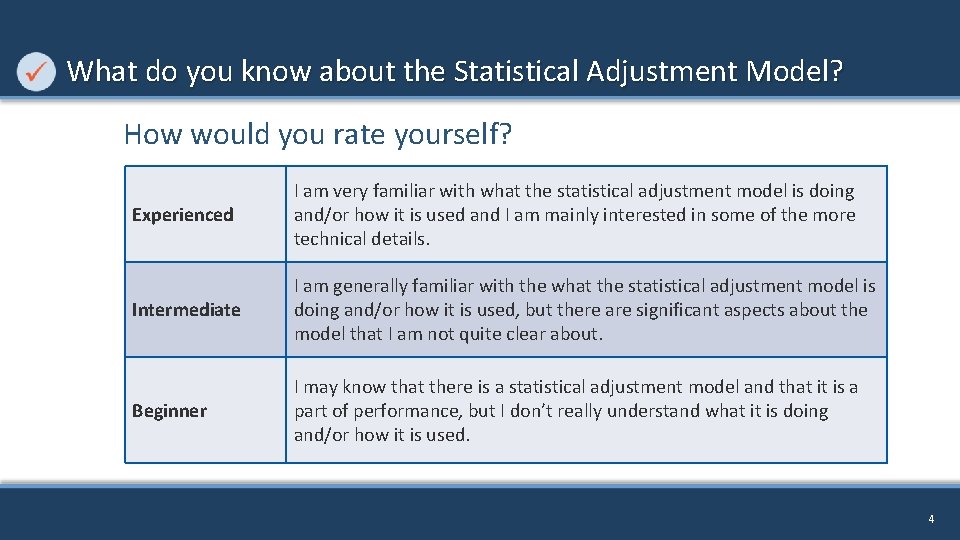
What do you know about the Statistical Adjustment Model? How would you rate yourself? Experienced I am very familiar with what the statistical adjustment model is doing and/or how it is used and I am mainly interested in some of the more technical details. Intermediate I am generally familiar with the what the statistical adjustment model is doing and/or how it is used, but there are significant aspects about the model that I am not quite clear about. Beginner I may know that there is a statistical adjustment model and that it is a part of performance, but I don’t really understand what it is doing and/or how it is used. 4
The Statistical Adjustment Model ü What does the model do? ü What are the general components of the model? ü Why is it important to report accurate data? 5
How is the model used – for negotiations? ü In the negotiation process: ►The model produces an estimate of the expected performance level for each indicator ►Historic program data are used ►This estimate is a factor in agreeing on a negotiated level of performance 6
How is the model used – for evaluation? ü In evaluation of performance: ►Actual participant outcomes are applied to the model estimates to create the adjustment factor ►The adjustment factor is applied to the negotiated level of performance ►State performance is measured against the adjusted level of performance 7
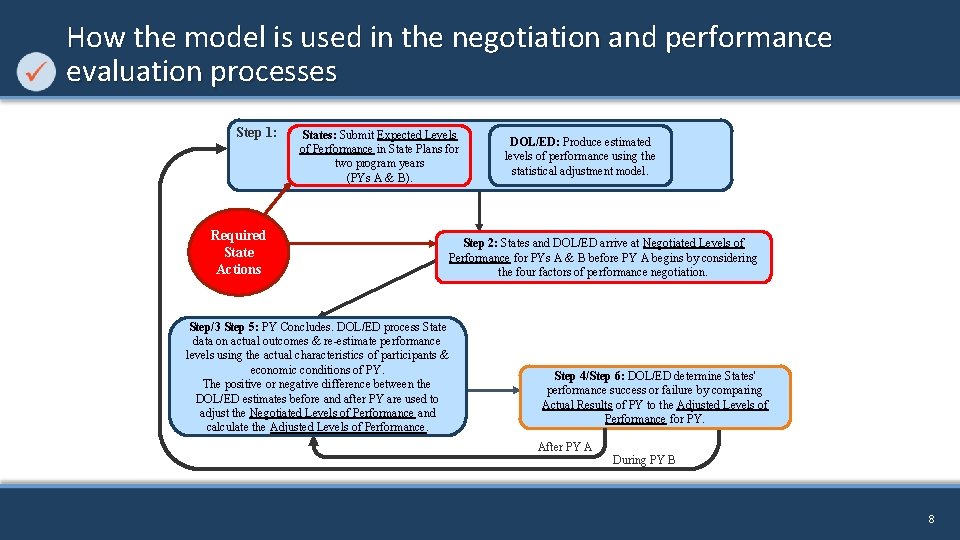
How the model is used in the negotiation and performance evaluation processes Step 1: States: Submit Expected Levels of Performance in State Plans for two program years (PYs A & B). Required State Actions Step/3 Step 5: PY Concludes. DOL/ED process State data on actual outcomes & re-estimate performance levels using the actual characteristics of participants & economic conditions of PY. The positive or negative difference between the DOL/ED estimates before and after PY are used to adjust the Negotiated Levels of Performance and calculate the Adjusted Levels of Performance. DOL/ED: Produce estimated levels of performance using the statistical adjustment model. Step 2: States and DOL/ED arrive at Negotiated Levels of Performance for PYs A & B before PY A begins by considering the four factors of performance negotiation. Step 4/Step 6: DOL/ED determine States' performance success or failure by comparing Actual Results of PY to the Adjusted Levels of Performance for PY. After PY A During PY B 8
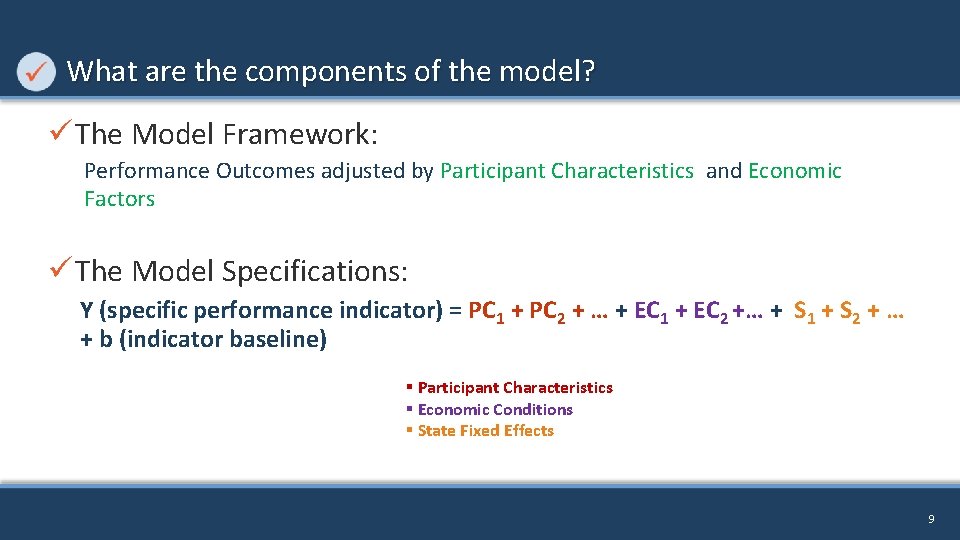
What are the components of the model? ü The Model Framework: Performance Outcomes adjusted by Participant Characteristics and Economic Factors ü The Model Specifications: Y (specific performance indicator) = PC 1 + PC 2 + … + EC 1 + EC 2 +… + S 1 + S 2 + … + b (indicator baseline) § Participant Characteristics § Economic Conditions § State Fixed Effects 9
What data are important? ü All PIRL data ► 46 PIRL elements are currently used in the statistical adjustment model for the participant characteristic variables ►Multiple PIRL elements are used to accurately measure performance indicators ►Additional PIRL elements (in addition to those in the handout) may be important in the future ü The better the data, the better the model! 10
Early Tests of the Statistical Adjustment Model Some caveats on these model tests: ü The adjustment factor ü The performance level score ü How the adjusted level compares to the original negotiated level Visualizations on the performance of the model that show measures of: ü The original predicted targets and corresponding variable values were estimated using WIA data (PY 2015 and earlier) ü The “actual” data used is the WIOA PY 2017 reported data 11
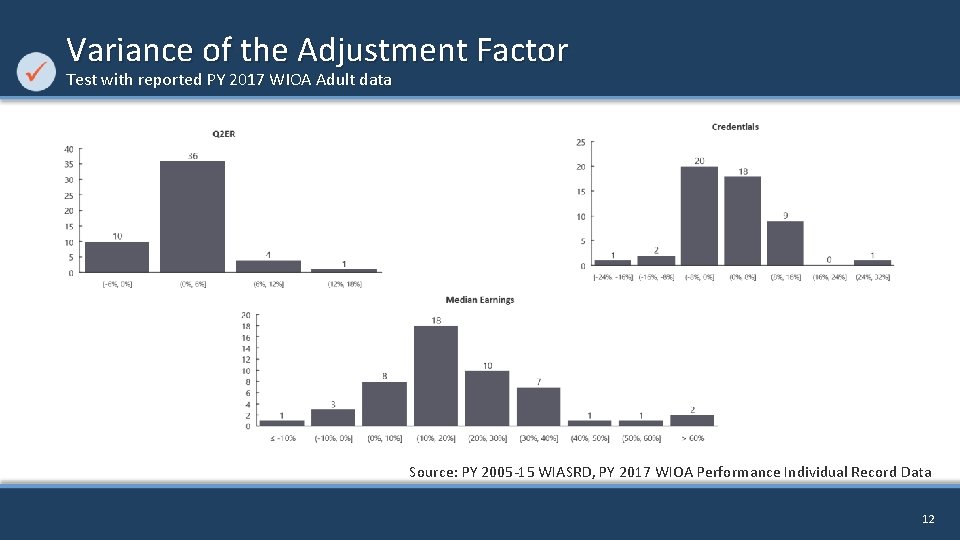
Variance of the Adjustment Factor Test with reported PY 2017 WIOA Adult data Source: PY 2005 -15 WIASRD, PY 2017 WIOA Performance Individual Record Data 12
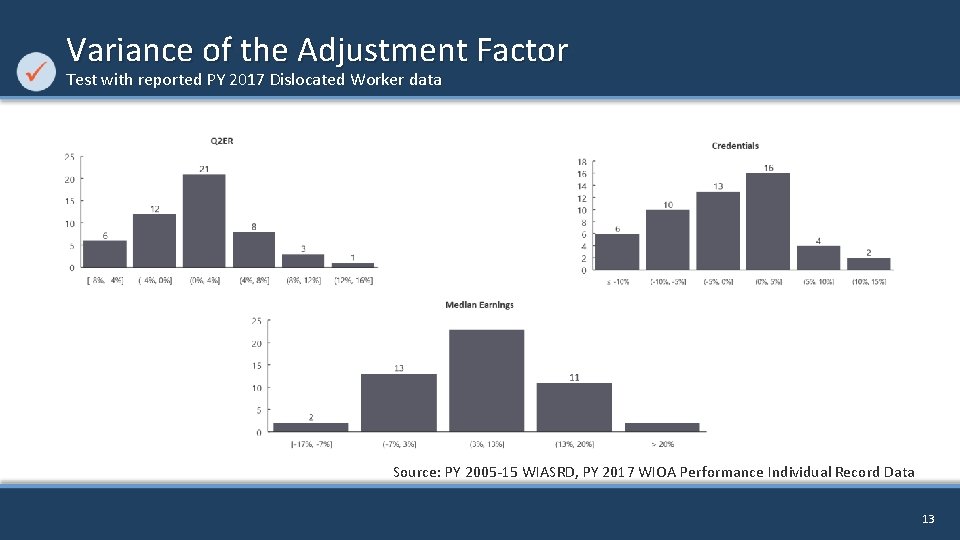
Variance of the Adjustment Factor Test with reported PY 2017 Dislocated Worker data Source: PY 2005 -15 WIASRD, PY 2017 WIOA Performance Individual Record Data 13
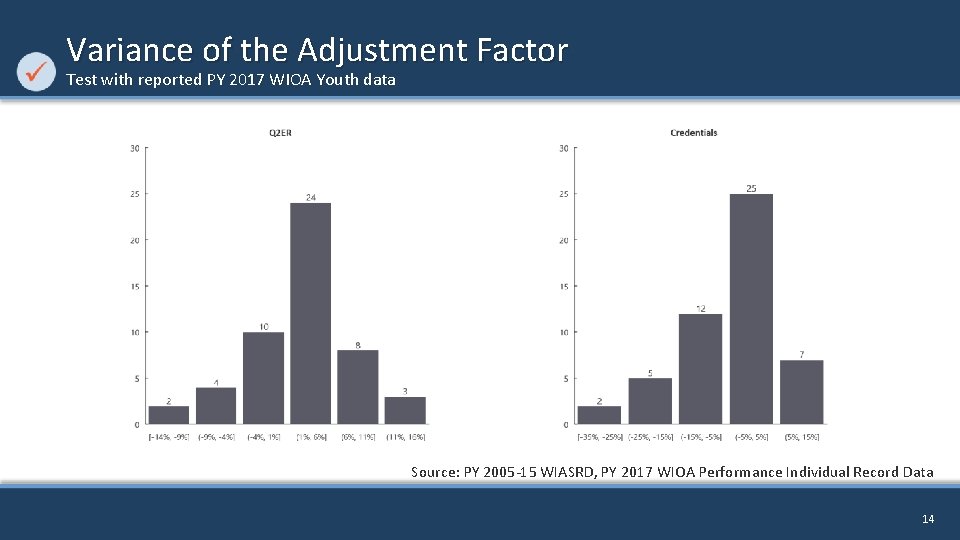
Variance of the Adjustment Factor Test with reported PY 2017 WIOA Youth data Source: PY 2005 -15 WIASRD, PY 2017 WIOA Performance Individual Record Data 14
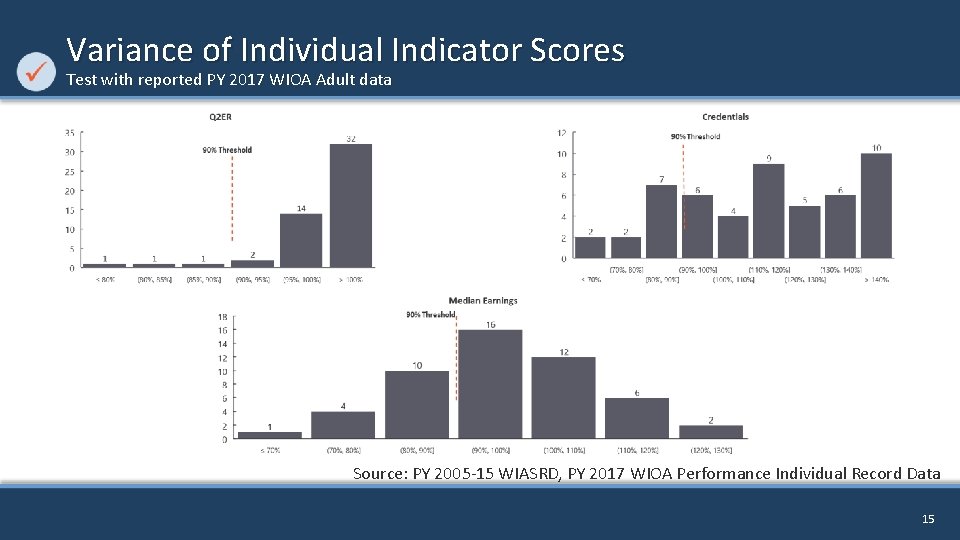
Variance of Individual Indicator Scores Test with reported PY 2017 WIOA Adult data Source: PY 2005 -15 WIASRD, PY 2017 WIOA Performance Individual Record Data 15
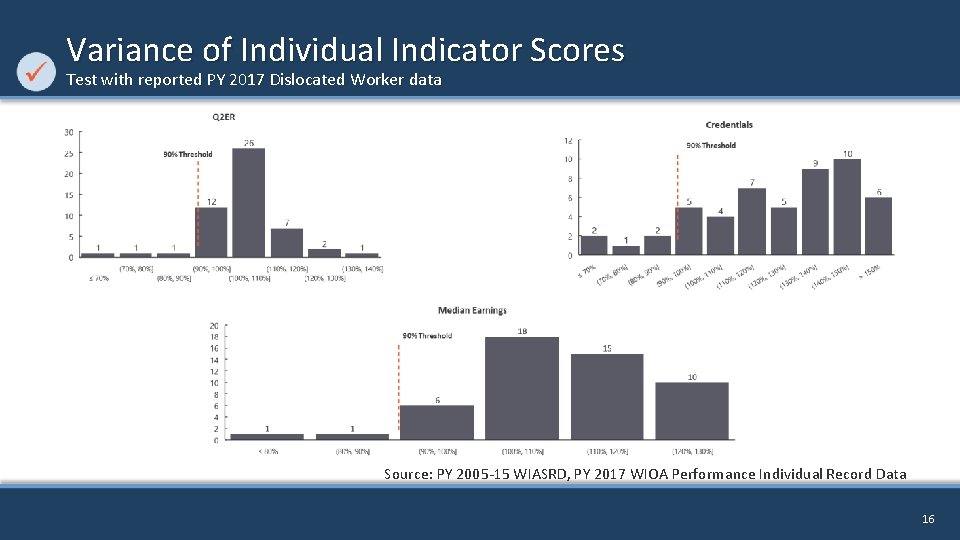
Variance of Individual Indicator Scores Test with reported PY 2017 Dislocated Worker data Source: PY 2005 -15 WIASRD, PY 2017 WIOA Performance Individual Record Data 16
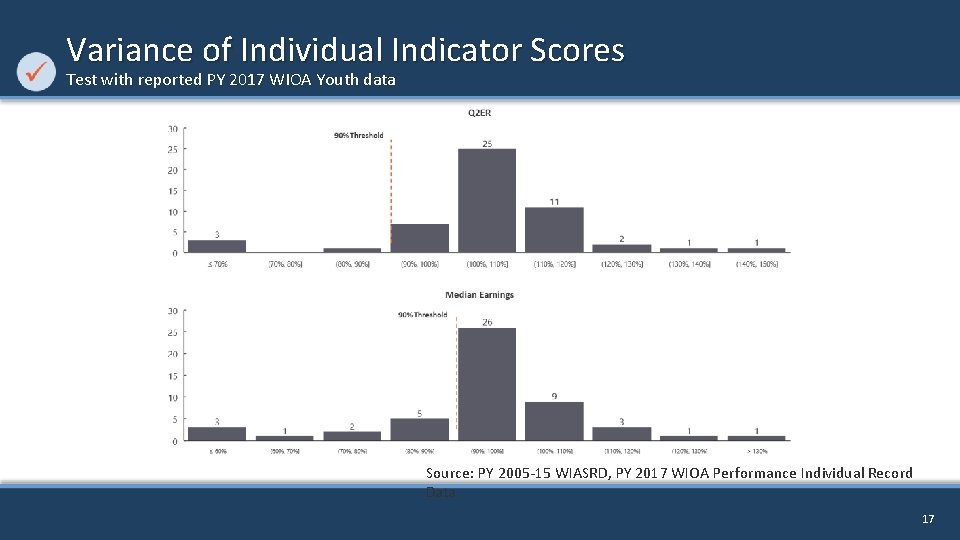
Variance of Individual Indicator Scores Test with reported PY 2017 WIOA Youth data Source: PY 2005 -15 WIASRD, PY 2017 WIOA Performance Individual Record Data 17
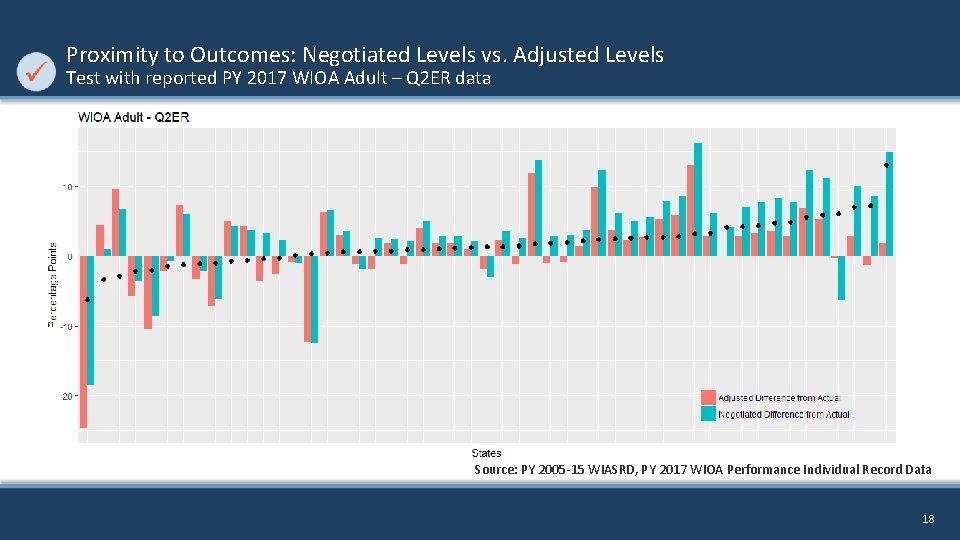
Proximity to Outcomes: Negotiated Levels vs. Adjusted Levels Test with reported PY 2017 WIOA Adult – Q 2 ER data Source: PY 2005 -15 WIASRD, PY 2017 WIOA Performance Individual Record Data 18
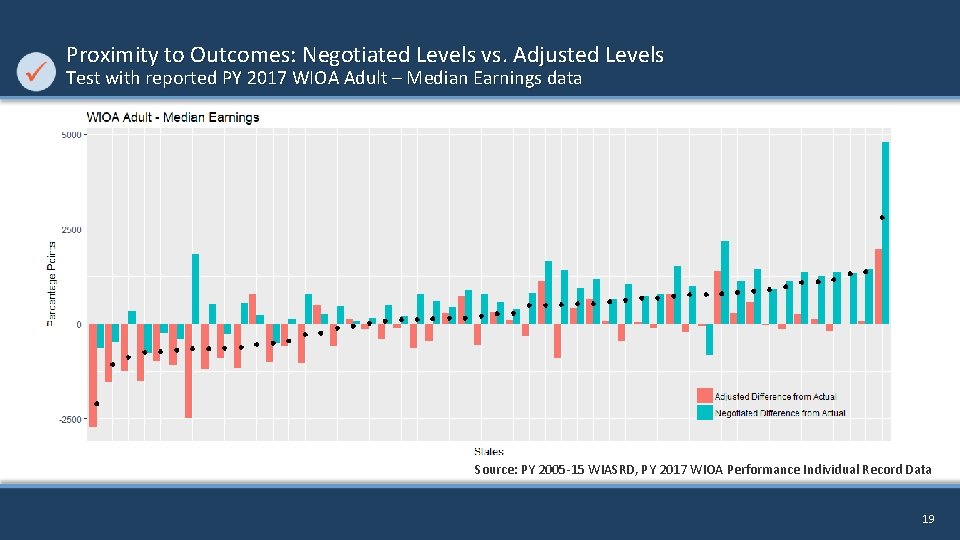
Proximity to Outcomes: Negotiated Levels vs. Adjusted Levels Test with reported PY 2017 WIOA Adult – Median Earnings data Source: PY 2005 -15 WIASRD, PY 2017 WIOA Performance Individual Record Data 19
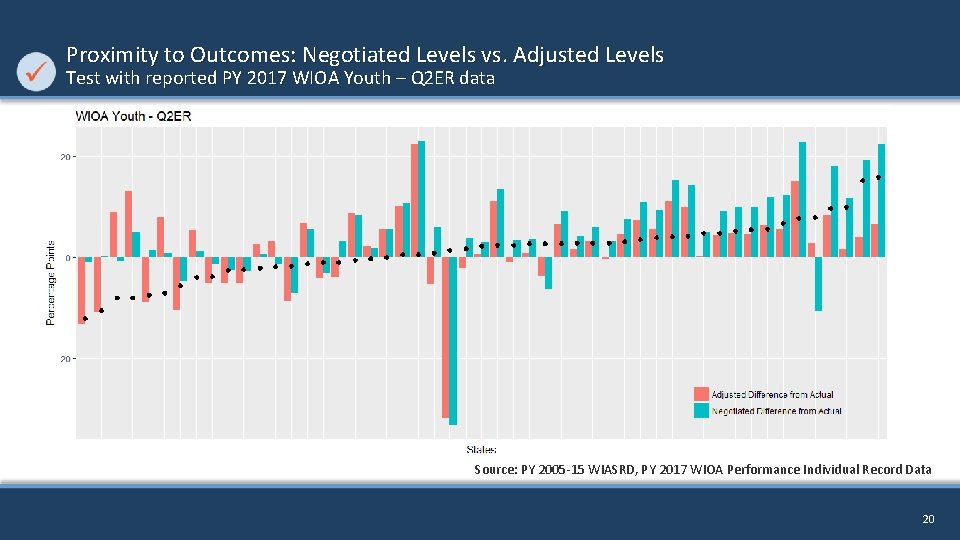
Proximity to Outcomes: Negotiated Levels vs. Adjusted Levels Test with reported PY 2017 WIOA Youth – Q 2 ER data Source: PY 2005 -15 WIASRD, PY 2017 WIOA Performance Individual Record Data 20
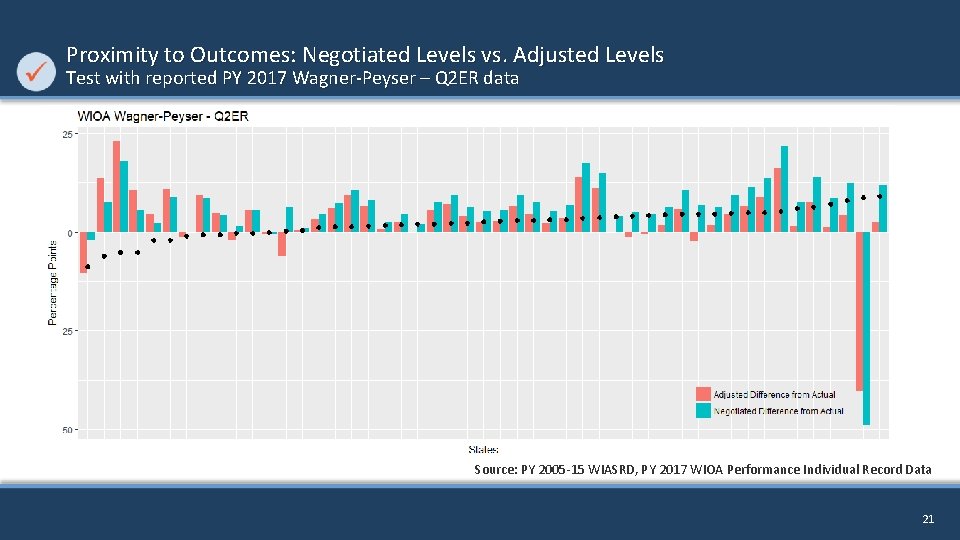
Proximity to Outcomes: Negotiated Levels vs. Adjusted Levels Test with reported PY 2017 Wagner-Peyser – Q 2 ER data Source: PY 2005 -15 WIASRD, PY 2017 WIOA Performance Individual Record Data 21
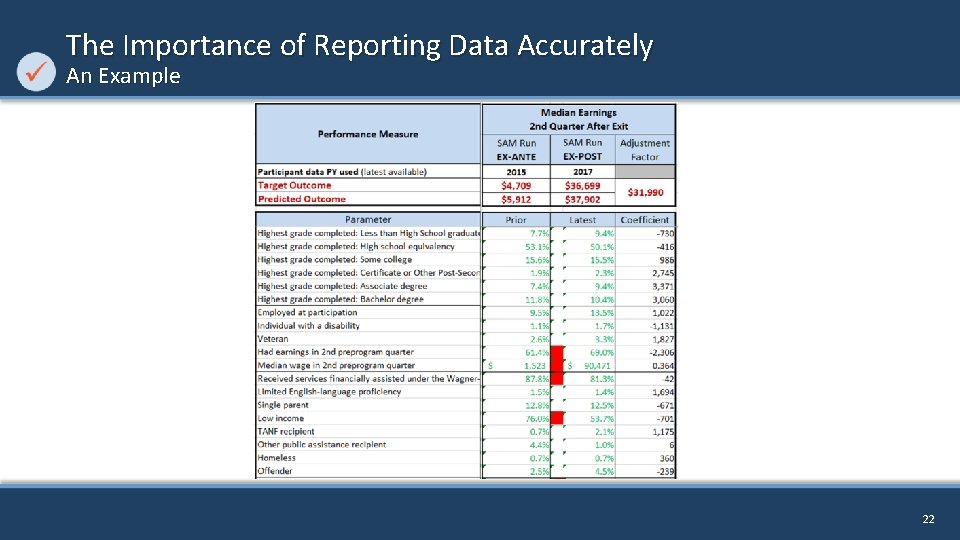
The Importance of Reporting Data Accurately An Example 22
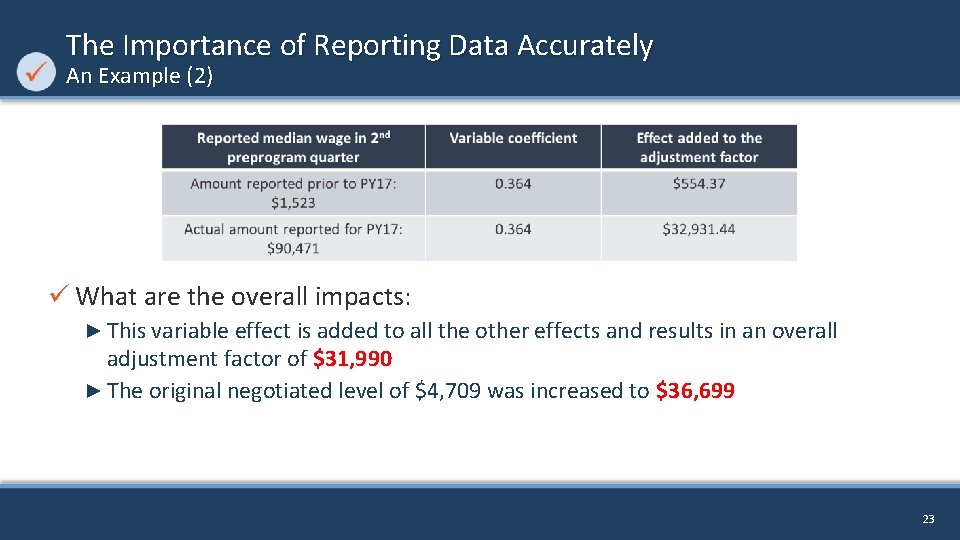
The Importance of Reporting Data Accurately An Example (2) ü What are the overall impacts: ► This variable effect is added to all the other effects and results in an overall adjustment factor of $31, 990 ► The original negotiated level of $4, 709 was increased to $36, 699 23
Any Questions? 24
Contact ETAPerforms@dol. gov 25
Resources ü Statistical Adjustment Model Summary https: //www. doleta. gov/performance/guida nce/docs/Statistical-Model-Summary-2 -1618. docx ü WIOA Statistical Model Methodology Report https: //www. doleta. gov/performance/guida nce/docs/WIOA_Statistical_Model_Methodol ogy_Report-6 -24 -2016. pdf ü WIOA Performance Negotiation Tool https: //www. doleta. gov/performance/guida nce/docs/PY 2018 -2019 -WIOA-Negotiation. Tool. xlsx ü Using the Statistical Adjustment Model for Negotiation WIOA Performance Levels https: //www. workforcegps. org/events/2018/ 02/16/14/00/Using-the-Statistical. Adjustment-Model-for-Negotiating-WIOAPerformance-Levels. Event 26
Please complete your evaluations. 27