
The state of the Integrated Information Theory its
![REFERENCES [1] Hawkins, S. L. 2011. William James, Gustav Fechner, and Early Psychophysics. Front.](https://slidetodoc.com/presentation_image_h2/4d6ad1cf3259f913d52480a8052a9240/image-11.jpg "REFERENCES [1] Hawkins, S. L. 2011. William James, Gustav Fechner, and Early Psychophysics. Front.")
- Slides: 11
The state of the Integrated Information Theory, its boundary cases and the question of ‘Phi-conscious’ AI TINE KOLENIK, MATJAŽ GAMS DEPARTMENT OF INTELLIGENT SYSTEMS, JOZEF STEFAN INSTITUTE, LJUBLJANA, SLOVENIA
OUTLINE • Introduction • State of the Integrated Information Theory (IIT) • • Outline Tools Experimental work Problems • Integrated Information Theory and artificial intelligence • Hypothesis on AI scoring better on IIT consciousness • Analysis • Conclusions & future work
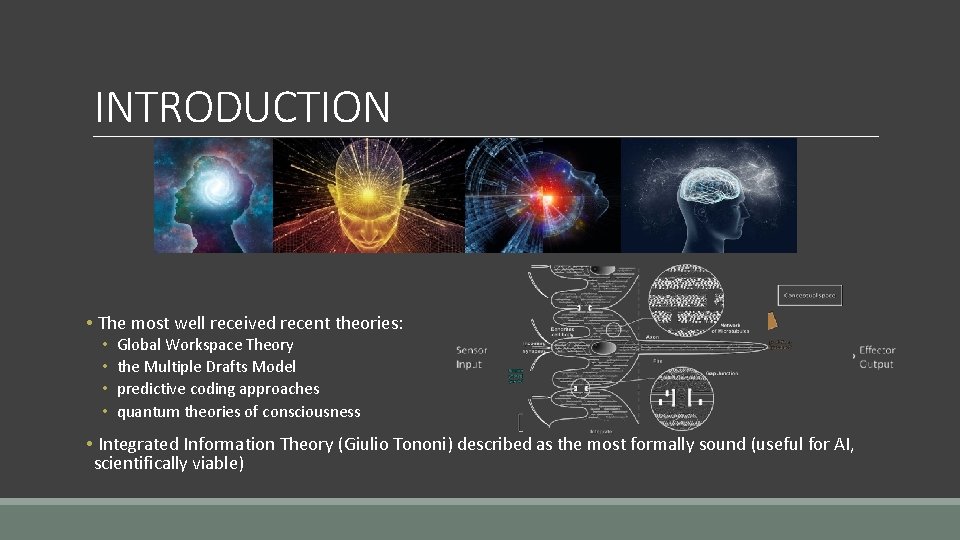
INTRODUCTION • The most well received recent theories: • • Global Workspace Theory the Multiple Drafts Model predictive coding approaches quantum theories of consciousness • Integrated Information Theory (Giulio Tononi) described as the most formally sound (useful for AI, scientifically viable)
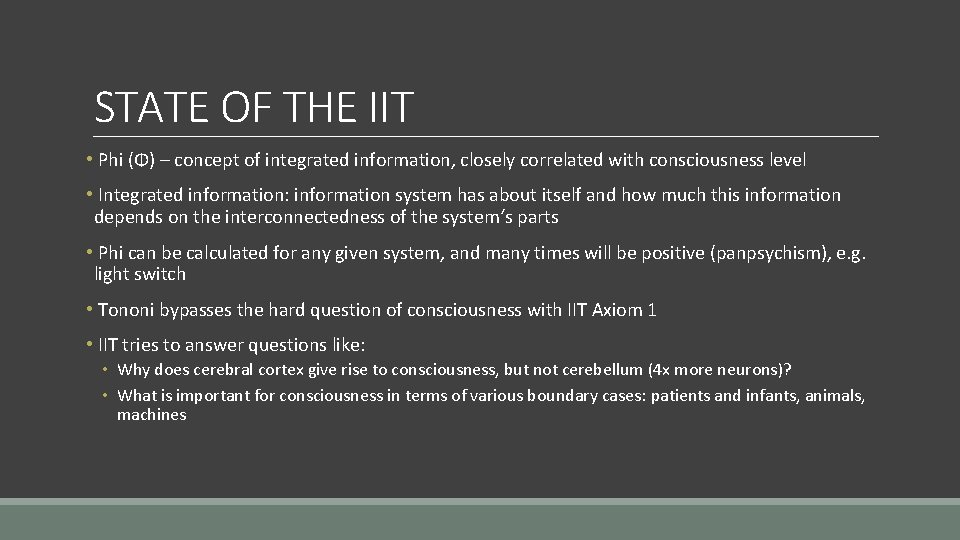
STATE OF THE IIT • Phi (Φ) – concept of integrated information, closely correlated with consciousness level • Integrated information: information system has about itself and how much this information depends on the interconnectedness of the system‘s parts • Phi can be calculated for any given system, and many times will be positive (panpsychism), e. g. light switch • Tononi bypasses the hard question of consciousness with IIT Axiom 1 • IIT tries to answer questions like: • Why does cerebral cortex give rise to consciousness, but not cerebellum (4 x more neurons)? • What is important for consciousness in terms of various boundary cases: patients and infants, animals, machines
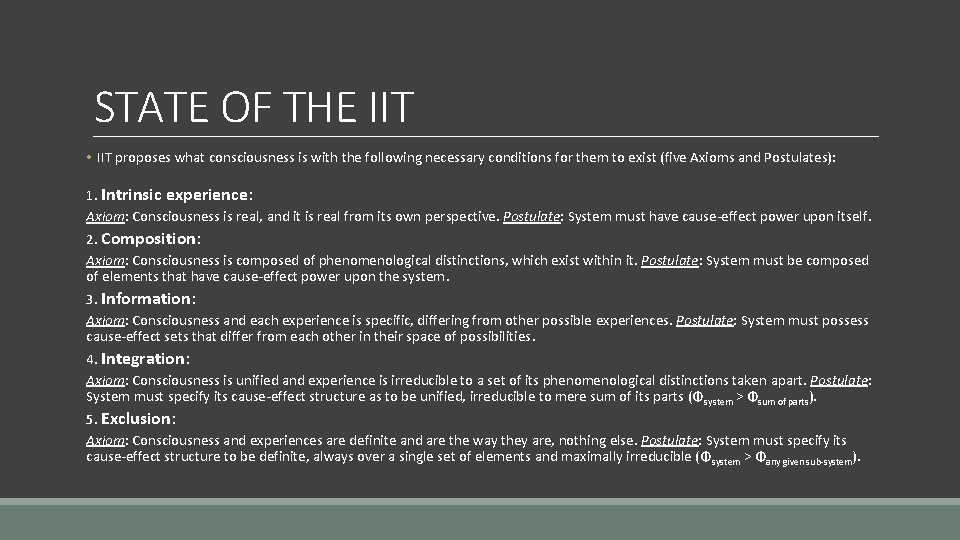
STATE OF THE IIT • IIT proposes what consciousness is with the following necessary conditions for them to exist (five Axioms and Postulates): 1. Intrinsic experience: Axiom: Consciousness is real, and it is real from its own perspective. Postulate: System must have cause-effect power upon itself. 2. Composition: Axiom: Consciousness is composed of phenomenological distinctions, which exist within it. Postulate: System must be composed of elements that have cause-effect power upon the system. 3. Information: Axiom: Consciousness and each experience is specific, differing from other possible experiences. Postulate: System must possess cause-effect sets that differ from each other in their space of possibilities. 4. Integration: Axiom: Consciousness is unified and experience is irreducible to a set of its phenomenological distinctions taken apart. Postulate: System must specify its cause-effect structure as to be unified, irreducible to mere sum of its parts (Φ system > Φsum of parts). 5. Exclusion: Axiom: Consciousness and experiences are definite and are the way they are, nothing else. Postulate: System must specify its cause-effect structure to be definite, always over a single set of elements and maximally irreducible (Φ system > Φany given sub-system).
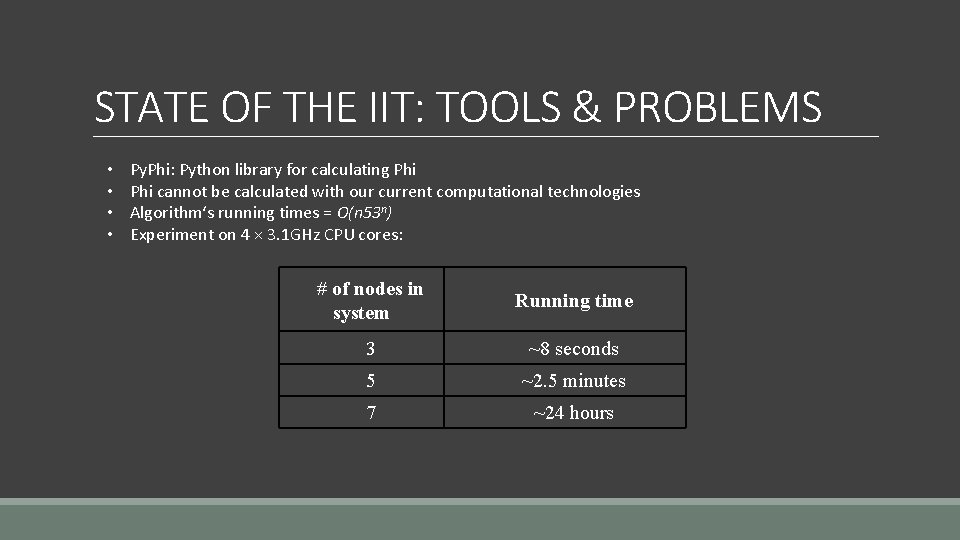
STATE OF THE IIT: TOOLS & PROBLEMS • • Py. Phi: Python library for calculating Phi cannot be calculated with our current computational technologies Algorithm‘s running times = O(n 53 n) Experiment on 4 × 3. 1 GHz CPU cores: # of nodes in system Running time 3 ~8 seconds 5 ~2. 5 minutes 7 ~24 hours
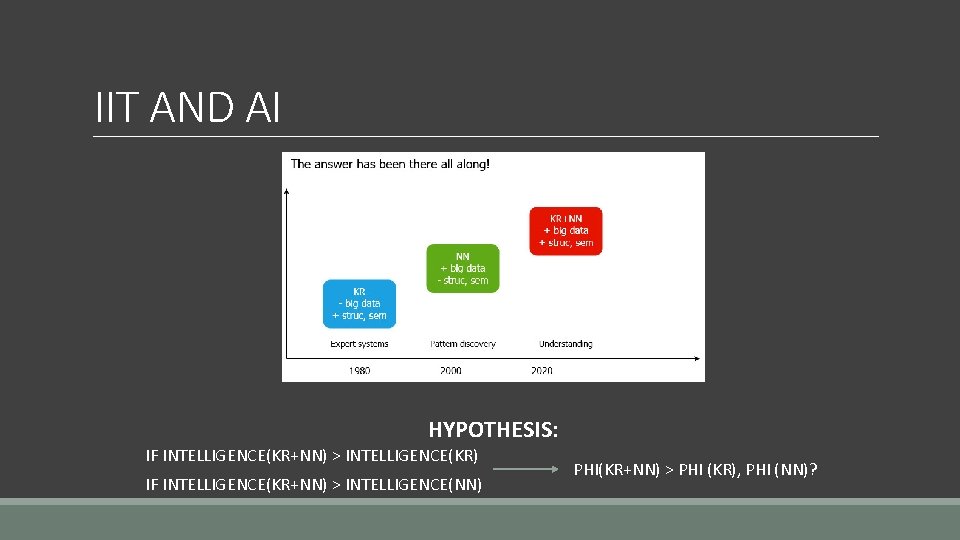
IIT AND AI HYPOTHESIS: IF INTELLIGENCE(KR+NN) > INTELLIGENCE(KR) IF INTELLIGENCE(KR+NN) > INTELLIGENCE(NN) PHI(KR+NN) > PHI (KR), PHI (NN)?
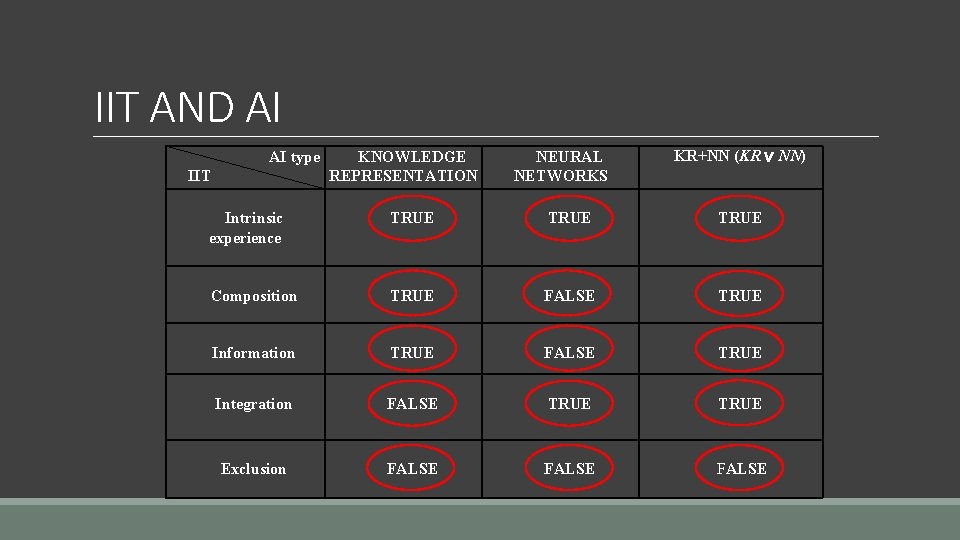
IIT AND AI AI type IIT KNOWLEDGE REPRESENTATION NEURAL NETWORKS KR+NN (KR ∨ NN) Intrinsic experience TRUE Composition TRUE FALSE TRUE Information TRUE FALSE TRUE Integration FALSE TRUE Exclusion FALSE
IIT AND AI • Tononi: IIT should be judged according to how it explains the empirical data about consciousness • AI inherently worse off as there is not empirical data on AI consciousness • Tononi presupposes consciousness and acts accordingly – that neurological data on the brain is in fact empirical data about consciousness, without calculating Φ to find out whether this is true • Can one presuppose it in robots and reverse engineer AI-Phi from there?
CONCLUSIONS AND FUTURE WORK • Contribution of this work: speculation on whether AI is Phi-conscious or not • We speculate about consciousness on various types of AI and hypothesize that combining different types brings us closer to Phi-conscious AI CONFIRMED • Future work: • Using AI methods as heuristics to shorten the time for calculating Phi • Confirming our hypothesis by calculating Phi • Calculating Phi for various machine and AI setups (e. g. two recurrently connected Turing machines‘ Phi vs two individual Turing machines‘ Phi)
REFERENCES [1] Hawkins, S. L. 2011. William James, Gustav Fechner, and Early Psychophysics. Front. Physiol. 2, 68 (2011). DOI= 10. 3389/fphys. 2011. 00068. [2] Chalmers, D. 1996. The Conscious Mind: In Search of a Fundamental Theory. Oxford University Press, Oxford. [3] Robinson, R. 2009. Exploring the "Global Workspace" of Consciousness. PLo. S Biol. 7, 3 (2009), e 1000066. DOI= 10. 1371/journal. pbio. 1000066. [4] Dennett, D. C. 1991. Consciousness Explained. Little, Brown & Co, Boston, MA. [5] Clark, A. 2013. Whatever next? Predictive brains, situated agents, and the future of cognitive science. Behav. Brain Sci. 36 (2013), 181 -204. DOI= 10. 1017/S 0140525 X 12000477. [6] Atmanspacher, H. 2019. Quantum Approaches to Consciousness. The Stanford Encyclopedia of Philosophy, (2019). [7] Tononi, G. , Boly, M. , Massimini, M. , and Koch, C. 2016. Integrated information theory: from consciousness to its physical substrate. Nat. Rev. Neurosci. 17, 7 (2016), 450 -461. DOI= 10. 1038/nrn. 2016. 44. [8] Gennaro, R. J. 2018. Consciousness. Springer, Cham. [9] Tononi, G. 2008. Consciousness as Integrated Information: a Provisional Manifesto. The Biological Bulletin. 215, 3 (2008), 216 -242. DOI= 10. 2307/25470707. [10] Alter, T. and Nagasawa, Y. 2015. Consciousness in the Physical World: Perspectives on Russellian Monism. Oxford University Press, Oxford. [11] Tononi, G. and Koch, C. 2015. Consciousness: here, there and everywhere? Phil. Trans. R. Soc. B. 370 (2015). DOI= 10. 1098/rstb. 2014. 0167. [12] Gams, M. 2015. Kochove meritve zavesti. In Cognitive science: proceedings of the 18 th International Multiconference Information Society – IS 2015 (Ljubljana, Slovenia, October 8 -9, 2015). Jožef Stefan Institute, 11 -14. [13] Oizumi, M. , Albantakis, L, and Tononi, G. 2014. From the Phenomenology to the Mechanisms of Consciousness: Integrated Information Theory 3. 0. PLo. S Comput. Biol. 10, 5 (2014), e 1003588. DOI= 10. 1371/journal. pcbi. 1003588. [14] Dehaene, S. 2015. Consciousness and the Brain. Viking, New York. [15] Bohannon, J. 2018. A computer program just ranked the most influential brain scientists of the modern era. Retrieved September 11, 2019, from https: //www. sciencemag. org/news/2016/11/computer-program -just-ranked-most-influential-brain-scientists-modern-era. [16] Bayne, T. 2018. On the axiomatic foundations of the integrated information theory of consciousness. Neuroscience of Consciousness, 2018, 1 (2018), niy 007. DOI= 10. 1093/nc/niy 007. [17] Mayner, W. G. P. , Marshall, W. , Albantakis, L, Findlay, G. , Marchman, R. , and Tononi, G. 2018. Py. Phi: A toolbox for integrated information theory. PLo. S Comput. Biol. 14, 7 (2018), e 1006343. DOI= 10. 1371/journal. pcbi. 1006343. [18] Robson, D. 2019. Are we close to solving the puzzle of consciousness? Retrieved September 11, 2019, from http: //www. bbc. com/future/story/20190326 -are-we-close-to-solving-the-puzzle-of-consciousness. [19] Marr, D. 2010. Vision: A Computational Investigation into the Human Representation and Processing of Visual Information. The MIT Press, Cambridge, MA. [20] Shoham, Y. Award for Research Excellence presentation. Invited Lecture. 2019 International Joint Conference on Artificial Intelligence. [21] Gams, M. 2001. Weak intelligence: through the principle and paradox of multiple knowledge. Nova Science, Hauppauge, NY.