
The State of Road Safety in South Africa

- Slides: 22
The State of Road Safety in South Africa: Is the Country Making Much Headway? 22 November 2011 1
INTRODUCTION § Annual road fatalities in 2009/10. § Road accidents during 2009/10 and 2010/11 festive seasons. § Measures put in place to address the carnage. § Are interventions yielding positive results? 2
INTRODUCTION § World Bank – more than 1. 7 million die on road crashes annually. § About 70% occur in developing countries. § Africa has the highest road injury fatality rate of all the WHO regions. 3
WHAT IS THE STATE OF AFFAIRS IN SA? § SA is not immune from the state of affairs § More than 16 000 die on SA’s roads annually, costing the country more than R 40 billion. § If nothing is done to curb the carnage, road crashes will be second largest cause of deaths by 2020, which is higher than HIV& AIDS & malaria put together. § Road safety strategies, but road accidents are not decreasing. § Arrive Alive Road Safety Campaign (1997). 4
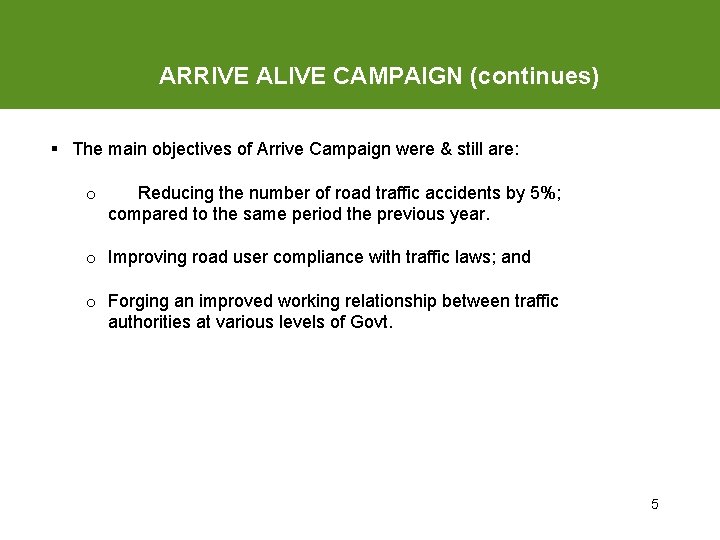
ARRIVE ALIVE CAMPAIGN (continues) § The main objectives of Arrive Campaign were & still are: o Reducing the number of road traffic accidents by 5%; compared to the same period the previous year. o Improving road user compliance with traffic laws; and o Forging an improved working relationship between traffic authorities at various levels of Govt. 5
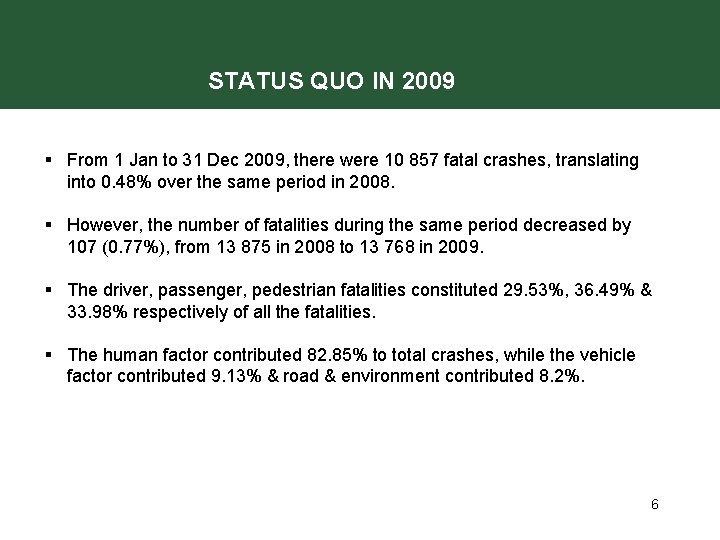
STATUS QUO IN 2009 § From 1 Jan to 31 Dec 2009, there were 10 857 fatal crashes, translating into 0. 48% over the same period in 2008. § However, the number of fatalities during the same period decreased by 107 (0. 77%), from 13 875 in 2008 to 13 768 in 2009. § The driver, passenger, pedestrian fatalities constituted 29. 53%, 36. 49% & 33. 98% respectively of all the fatalities. § The human factor contributed 82. 85% to total crashes, while the vehicle factor contributed 9. 13% & road & environment contributed 8. 2%. 6
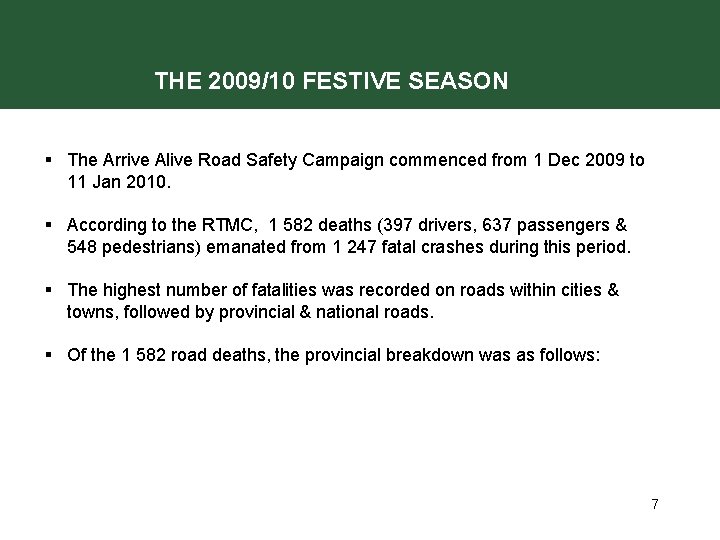
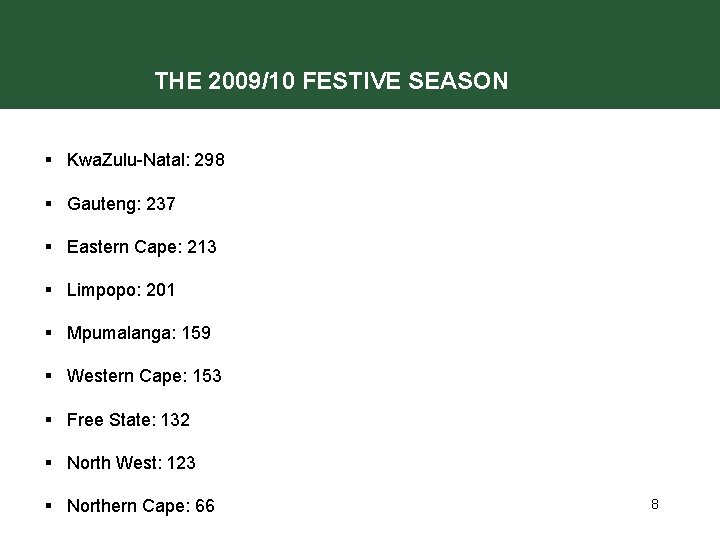
THE 2009/10 FESTIVE SEASON § The Arrive Alive Road Safety Campaign commenced from 1 Dec 2009 to 11 Jan 2010. § According to the RTMC, 1 582 deaths (397 drivers, 637 passengers & 548 pedestrians) emanated from 1 247 fatal crashes during this period. § The highest number of fatalities was recorded on roads within cities & towns, followed by provincial & national roads. § Of the 1 582 road deaths, the provincial breakdown was as follows: 7
THE 2009/10 FESTIVE SEASON § Kwa. Zulu-Natal: 298 § Gauteng: 237 § Eastern Cape: 213 § Limpopo: 201 § Mpumalanga: 159 § Western Cape: 153 § Free State: 132 § North West: 123 § Northern Cape: 66 8
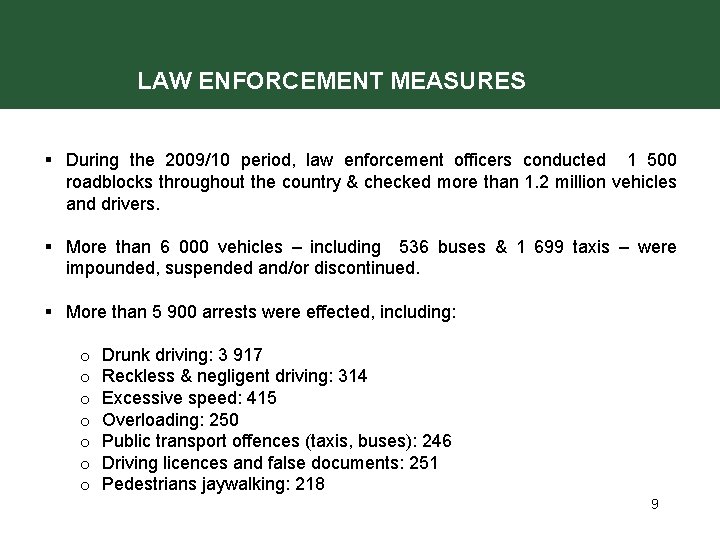
LAW ENFORCEMENT MEASURES § During the 2009/10 period, law enforcement officers conducted 1 500 roadblocks throughout the country & checked more than 1. 2 million vehicles and drivers. § More than 6 000 vehicles – including 536 buses & 1 699 taxis – were impounded, suspended and/or discontinued. § More than 5 900 arrests were effected, including: o o o o Drunk driving: 3 917 Reckless & negligent driving: 314 Excessive speed: 415 Overloading: 250 Public transport offences (taxis, buses): 246 Driving licences and false documents: 251 Pedestrians jaywalking: 218 9
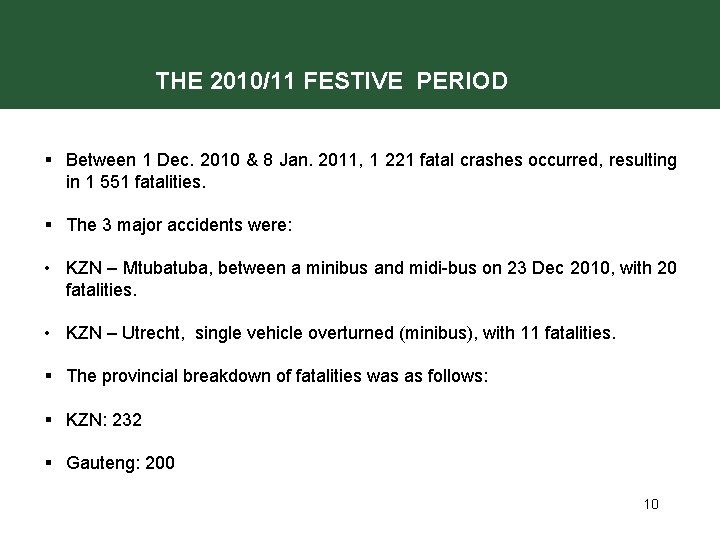
THE 2010/11 FESTIVE PERIOD § Between 1 Dec. 2010 & 8 Jan. 2011, 1 221 fatal crashes occurred, resulting in 1 551 fatalities. § The 3 major accidents were: • KZN – Mtuba, between a minibus and midi-bus on 23 Dec 2010, with 20 fatalities. • KZN – Utrecht, single vehicle overturned (minibus), with 11 fatalities. § The provincial breakdown of fatalities was as follows: § KZN: 232 § Gauteng: 200 10
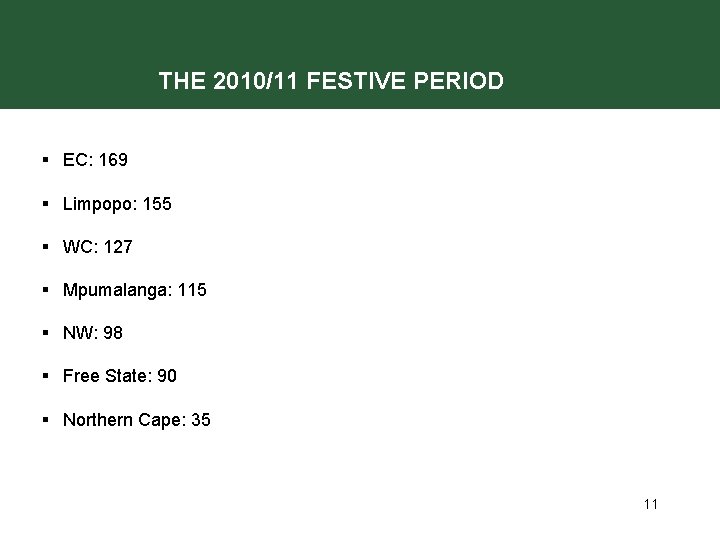
THE 2010/11 FESTIVE PERIOD § EC: 169 § Limpopo: 155 § WC: 127 § Mpumalanga: 115 § NW: 98 § Free State: 90 § Northern Cape: 35 11
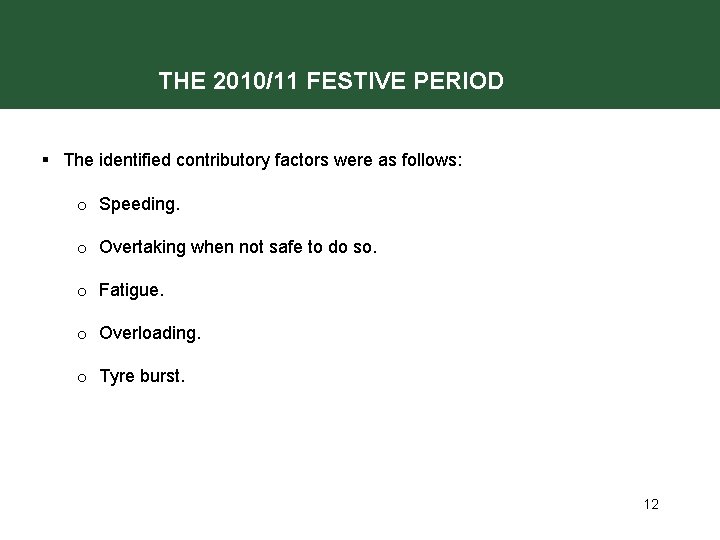
THE 2010/11 FESTIVE PERIOD § The identified contributory factors were as follows: o Speeding. o Overtaking when not safe to do so. o Fatigue. o Overloading. o Tyre burst. 12
LAW ENFORCEMENT IN 2010/11) § Between 1 Dec. 2010 & 8 Jan. 2011, 415 motorists were arrested for excessive speed & these included the ff. incidents: o On 8 Jan. 2011, a speedster was arrested for travelling at 208 km/h & being 3 times over the legal alcohol limit on the N 1 south near Jhb. o On 6 Jan. 2011, a HR officer was caught speeding at 221 km/h on the N 4 near Garankuwa. o Free State, MEC for Sport, Arts & Culture, Dan Kgothule, was arrested for speeding at 235 km/h in a 120 km/h zone. He pleaded guilty & was sentenced to a fine of R 20 000 in the Bloem Magistrate’s Court. 13
SA’s RESPONSE TO THE EPIDEMIC § The SA Govt has committed itself to reducing road fatalities by 50% between 2007 & 2015. § Concomitant with this commitment, Govt has joined the UN’s Decade of Action for Road Safety 2011 -2020 & devised an engaging & multi-pronged programme involving all organs of society with a view to arresting road deaths. § The programme includes, but not limited to: o Finalization and implementation of SA’s National Road Safety Strategy & Action Plan for 2011 - 2020. The Strategy focuses on better utilization of human and financial resources across the spheres of Govt to address road deaths. 14
SA’S RESPONSE (continues) o Each province, district municipality and local municipality must report every month on the number of road accidents occurring in their area, what the causal factors are & how these are being addressed. o On 15 April 2011, traffic officers who form part of SA’s first National Traffic Intervention Unit commenced duty. The Unit is deployed to high accident frequency locations & traffic hotspots across the country. o As of May 2011, no less than 10 000 drivers are screened every month for drinking & driving. o The new National Rolling Enforcement Plan (NREP) is vigorously enforced. o The Do. T has made amendments to the Road Traffic Act (No. 93 of 1996). 15
SA’S RESPONSE (continues) o Moreover, as of 20 Nov. 2011, driving over the prescribed speed by more than 30 km/h in an urban area and more than 40 km/h outside an urban area may result in the suspension or cancellation of one’s driving licence. o The Do. T has stated that the national roll-out of the AARTO Act (No. 46 of 1998) & the Points Demerit System will be announced in due course. o The Do. T is in discussions as regards proposals calling for the total ban on consuming alcohol whilst driving & or lowering the current legal alcohol limit, day time running lights & compulsory periodic vehicle testing. o The Do. T is strengthening partnerships with Govt, particularly with the Departments of Health, Soc. Development, Education & Police. 16
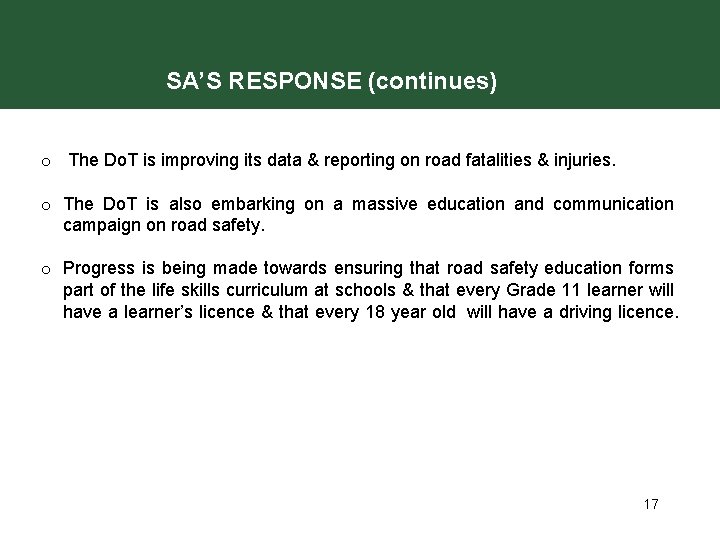
SA’S RESPONSE (continues) o The Do. T is improving its data & reporting on road fatalities & injuries. o The Do. T is also embarking on a massive education and communication campaign on road safety. o Progress is being made towards ensuring that road safety education forms part of the life skills curriculum at schools & that every Grade 11 learner will have a learner’s licence & that every 18 year old will have a driving licence. 17
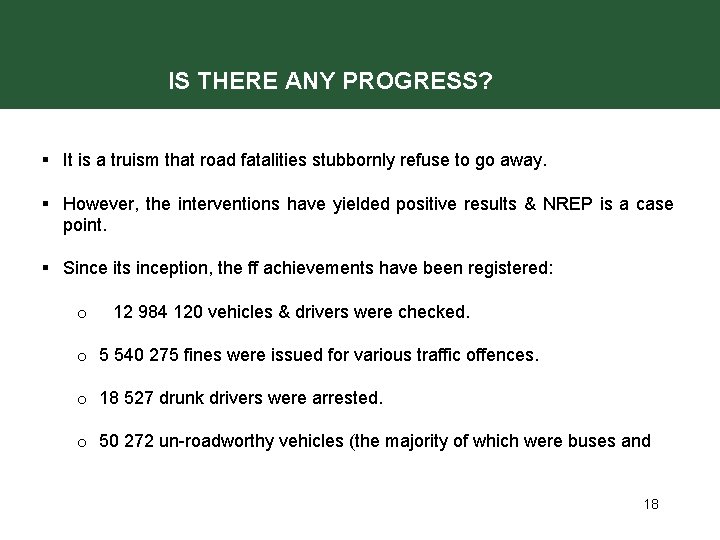
IS THERE ANY PROGRESS? § It is a truism that road fatalities stubbornly refuse to go away. § However, the interventions have yielded positive results & NREP is a case point. § Since its inception, the ff achievements have been registered: o 12 984 120 vehicles & drivers were checked. o 5 540 275 fines were issued for various traffic offences. o 18 527 drunk drivers were arrested. o 50 272 un-roadworthy vehicles (the majority of which were buses and 18
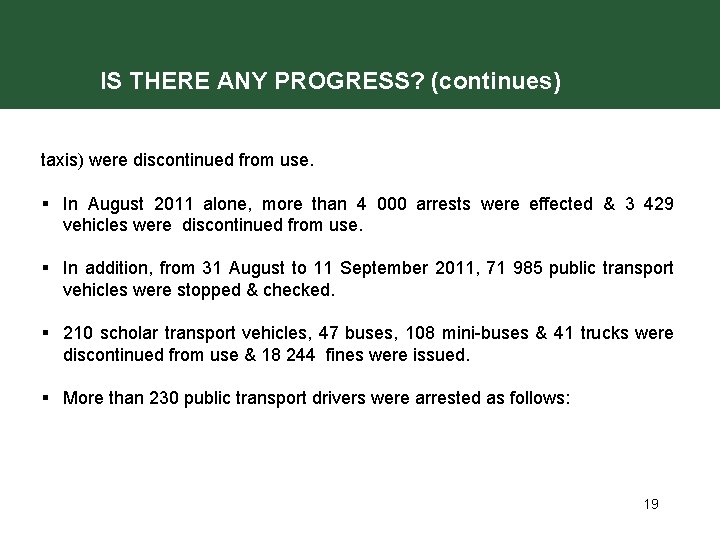
IS THERE ANY PROGRESS? (continues) taxis) were discontinued from use. § In August 2011 alone, more than 4 000 arrests were effected & 3 429 vehicles were discontinued from use. § In addition, from 31 August to 11 September 2011, 71 985 public transport vehicles were stopped & checked. § 210 scholar transport vehicles, 47 buses, 108 mini-buses & 41 trucks were discontinued from use & 18 244 fines were issued. § More than 230 public transport drivers were arrested as follows: 19
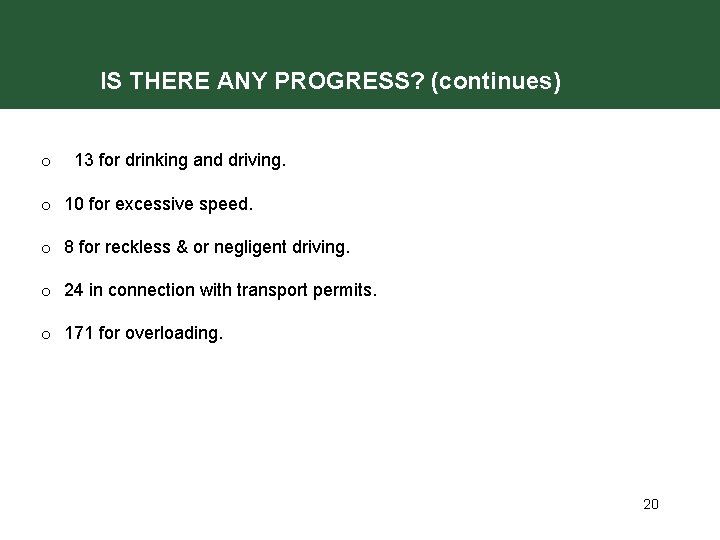
IS THERE ANY PROGRESS? (continues) o 13 for drinking and driving. o 10 for excessive speed. o 8 for reckless & or negligent driving. o 24 in connection with transport permits. o 171 for overloading. 20
CONCLUSION § Combating road fatalities is no longer Govt’s responsibility alone. An urgent mind shift is needed in order to substantially lower the fatal rates on South Africa’s roads. § All road users should take road safety very seriously & should make it a priority. § Government should continue with its campaigns, road shows & awareness programmes to educate the public about road safety. § The NB of safe road infrastructure should also not be underestimated. § Pedestrian safety should always be borne in mind when considering road safety, esp. in poorer communities where pedestrians are prevalent. 21
THANK YOU 22