
The state of Local Governance in South Africa

- Slides: 16
The state of Local Governance in South Africa Lessons from the Local Governance Barometer
Local Governance Barometer n Develop by Impact Alliance Members n n Pact Idasa SNV "governance" means: the process of decisionmaking and the process by which decisions are implemented (or not implemented).
Assessing Local Governance n n “if governance matters, measuring governance matters too” Complex n n n Multi-dimensional (economic, political, sociocultural) processes All levels of public & private interventions Subjective (perception)
LGB Applications n Countries n n n Botswana (Gaborone and Central District) South Africa (15 local authorities) Malawi (2 districts) Tanzania (1 district) Lesotho ( 2 districts) Respondents n Councillors, officials, ordinary citizens
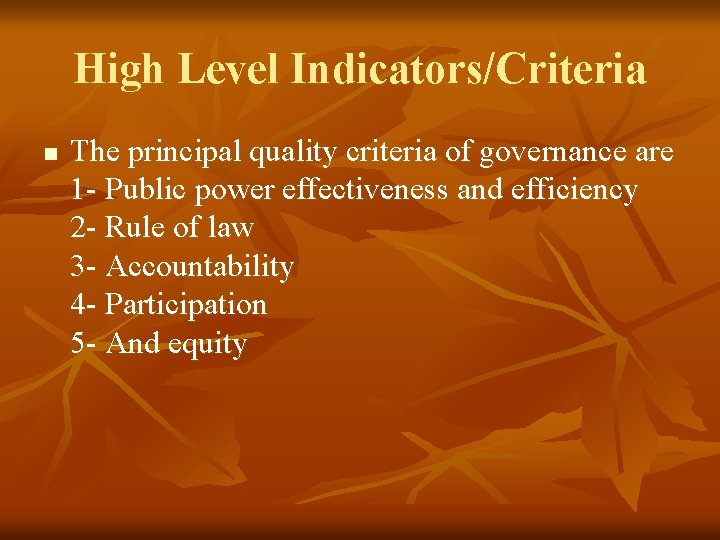
High Level Indicators/Criteria n The principal quality criteria of governance are 1 - Public power effectiveness and efficiency 2 - Rule of law 3 - Accountability 4 - Participation 5 - And equity
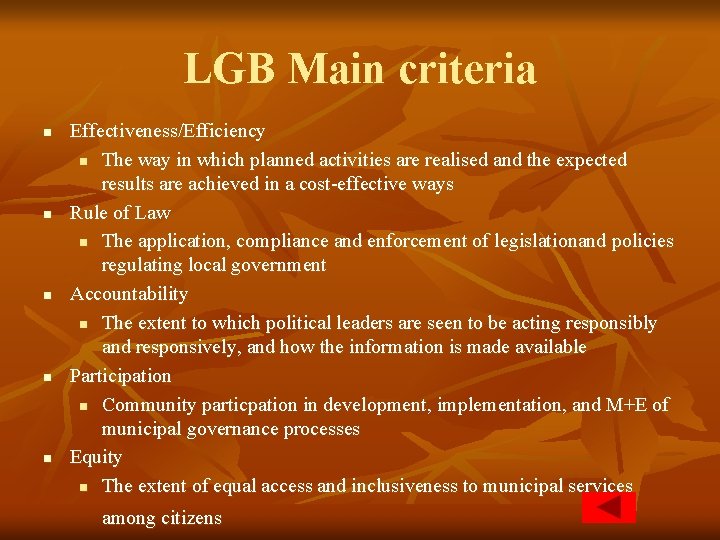
LGB Main criteria n n n Effectiveness/Efficiency n The way in which planned activities are realised and the expected results are achieved in a cost-effective ways Rule of Law n The application, compliance and enforcement of legislationand policies regulating local government Accountability n The extent to which political leaders are seen to be acting responsibly and responsively, and how the information is made available Participation n Community particpation in development, implementation, and M+E of municipal governance processes Equity n The extent of equal access and inclusiveness to municipal services among citizens
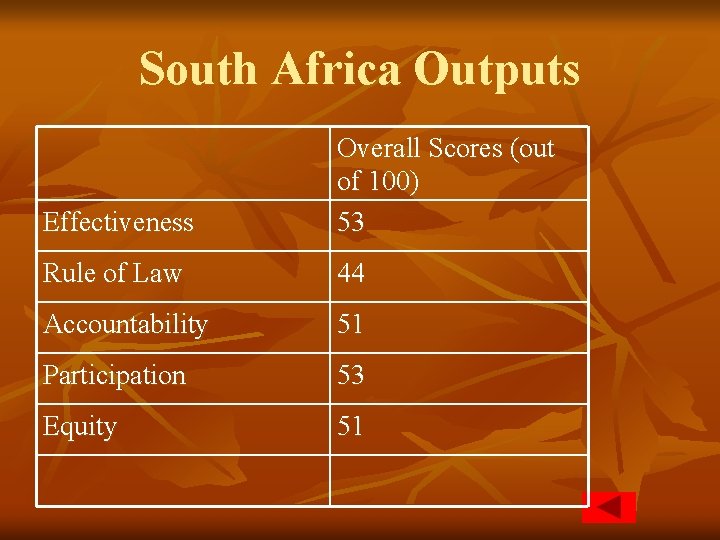
South Africa Outputs Effectiveness Overall Scores (out of 100) 53 Rule of Law 44 Accountability 51 Participation 53 Equity 51
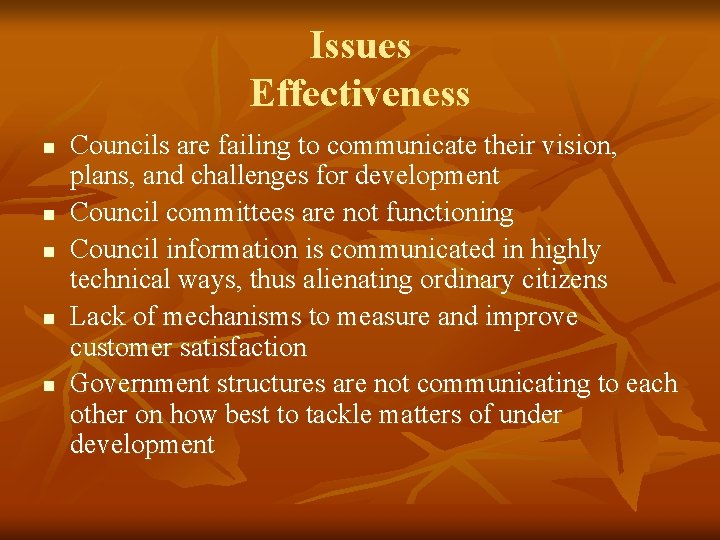
Issues Effectiveness n n n Councils are failing to communicate their vision, plans, and challenges for development Council committees are not functioning Council information is communicated in highly technical ways, thus alienating ordinary citizens Lack of mechanisms to measure and improve customer satisfaction Government structures are not communicating to each other on how best to tackle matters of under development
Issues Rule of Law n n Councillors do not adhere to their own code of conduct Admin staff are entangled in party-politics Lack of anti-corruption strategies Civil society’s lack of understanding of local government legislation and operations
Issues Accountability n n Poor information flow from councils to citizens CSOs inability to make use of existing mechanisms to hold councils accountable (lack of skills on advocacy and lobbying) Lack of mechanisms to review council decisions or to lodge complaints Statutory structures for participation are ineffective, yet CSO are unable to create alternative structures
Issues Participation and civic engagement n n Difference on perception btwn councillors (60) and citizens (40) Participation is according to law vs the need to engage and reach consensus Government listens to citizens but does not respond accordingly (Inability of citizens to influence decision making) Council meetings highly technical and citizens withdrawal from such ‘incomprehensible’ processes and discussions
Issues Equity n n n Under-representation of women in structures of government (councils and administration) Lack of government policies to adress special needs of the disabled, youth, women, and the elderly Municipalities’ inability to localise central government’s policies on HIV/Aids
Lessons Governments n n Municipalities struggle to “juggle” demands and supply pressures Citizens continually show consumerist behaviour patterns (demanding more and better quality services but are less willing or able to participate in the affairs of the state) Party political interests over-ride the interests of communities Local authorities have to perform functions that are poorly funded by national government
Lesson (cont. . ) n A need to build local government institutions that are: n n Catalytic (steer rather than row – see that services are provided rather than always delivering them directly Community-empowering (encourage local groups to solve their own problems) Competitive rather than monopolistic –by deregulating and privatising services that could be carried out by the private sector Customer driven
Lessons Civil Society n A need to create a CS that: n n n Knows and understand local government legislation and processes Has the ability to conduct proper budget analysis Is itself transparent and accountable and actively involves citizens Has skills of lobbying and advocacy Engages in civic education to enhance citizen’s understanding of their rights and duties
End Siyabonga Memela IDASA www. idasa. org. za smemela@idasa. org. za