
The State of Interoperable Communications in Texas PRESENTATION
The State of Interoperable Communications in Texas PRESENTATION BY MIKE SIMPSON TEXAS ASST. DIRECTOR FOR LAW ENFORCEMENT SUPPORT & STATEWIDE COMMUNICATIONS INTEROPERABILITY COORDINATOR (SWIC) To the Texas Homeland Security Conference - San Antonio, TX 4 -27 -11

SWIC Coordination Shared Responsibility Throughout the evolution of our homeland security paradigm, one feature most essential to our success has endured: the notion that homeland security is a shared responsibility built upon a foundation of partnerships. Federal, State, local, and Tribal governments, the private and non-profit sectors, communities, and individual citizens all share common goals and responsibilities – as well as accountability – for protecting and defending the Homeland. (National Strategy For Homeland Security, 2007) • No Radio / No Agency Left Behind “Collaboration is at the heart of success” • Governance from the operational level up – Texas Radio Coalition (bottom up), New Name: Texas Interoperable Communications Coalition (Tx. ICC) • All participants have a voice
SCIP Alignment with NECP Texas Responders identified the same initiatives in 2007 as proposed in the NECP one year later. Texas affirmed NECP vision: Emergency responders must be able to communicate— As needed, on demand, and as authorized; At all levels of government; and Across all disciplines.
NECP Implementation and Impact “We must plan, equip, train, and exercise many different response units to mobilize without warning for any emergency”… National Strategy For Homeland Security, 2007. • Goal 1 – Texas 5 UASIs demonstrate responselevel emergency communications within 1 hour • Goal 2 – Texas Methodology: 24 regions, 5, 300+ public safety agencies and nongovernmental organizations will demonstrate response-level emergency communications within 1 hour through approximately 30 multi -jurisdictional exercises across the state within approximately 6 months
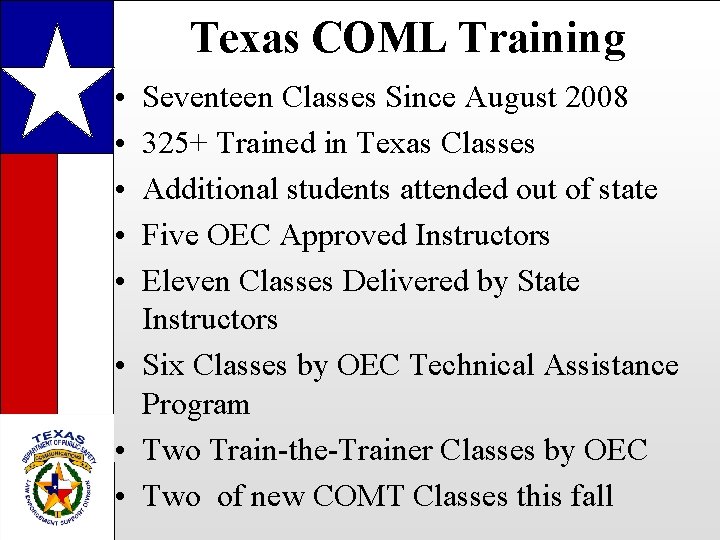
Texas COML Training • • • Seventeen Classes Since August 2008 325+ Trained in Texas Classes Additional students attended out of state Five OEC Approved Instructors Eleven Classes Delivered by State Instructors • Six Classes by OEC Technical Assistance Program • Two Train-the-Trainer Classes by OEC • Two of new COMT Classes this fall
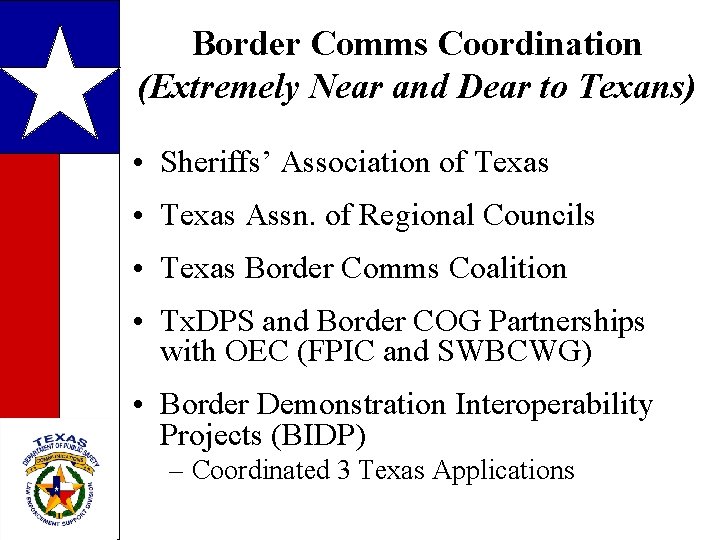
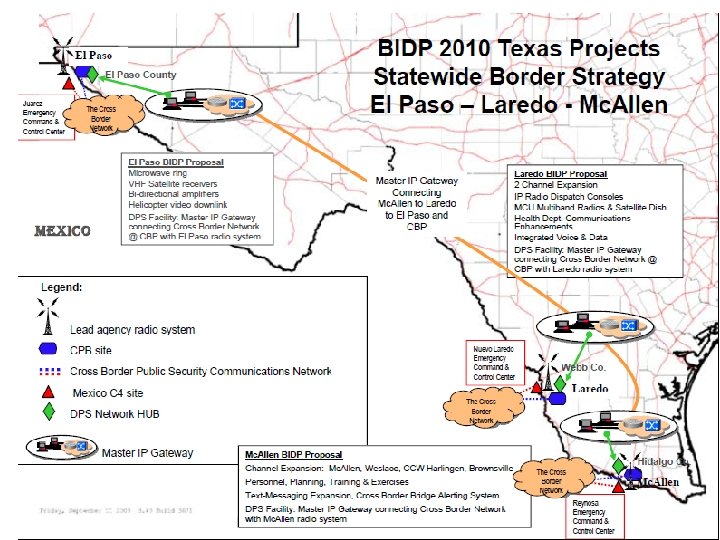
Border Comms Coordination (Extremely Near and Dear to Texans) • Sheriffs’ Association of Texas • Texas Assn. of Regional Councils • Texas Border Comms Coalition • Tx. DPS and Border COG Partnerships with OEC (FPIC and SWBCWG) • Border Demonstration Interoperability Projects (BIDP) – Coordinated 3 Texas Applications
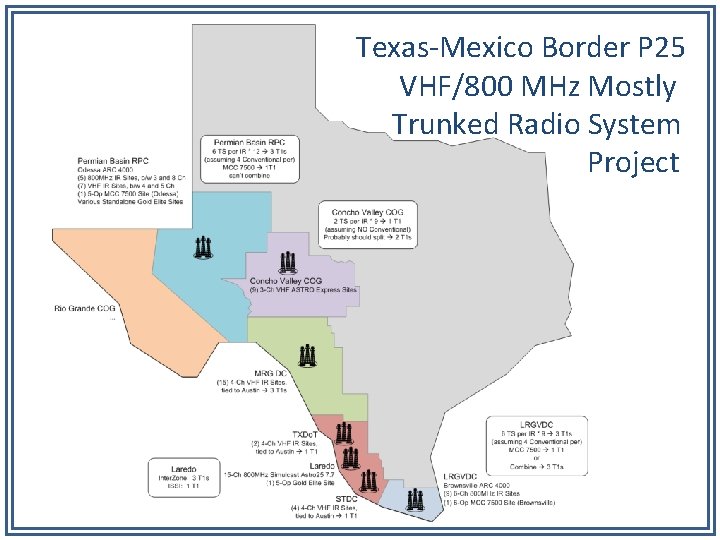
Texas-Mexico Border P 25 VHF/800 MHz Mostly Trunked Radio System Project
New Initiative: TEXAS INTEROPERABLE COMMUNICATIONS FIELD OPERATION GUIDE (TICFOG) Customized for each of the 24 COG Regions
Texas DPS Legislative Report (Status of Texas Statewide Communications Interoperability) • Texas Comms Interoperability Maturity Model • Regional Interoperability Status • Texas “Systemof-Regional. Systems”
Regional Interoperability Communications Plan Round #2 • Detailed Needs Assessment • Conceptual System Design • Detailed Migration Plan to achieve P 25 Interoperability by end of 2015 • Detailed Cost Estimate
Regional Interoperability Communications Plan Round #2 (RICP Rd 2) • Detailed Needs Assessment • Conceptual System Design • Detailed Migration Plan to achieve P 25 Interoperability by end of 2015 • Detailed Cost Estimate
Texas Legislative Report (Status of Texas Statewide Communications Interoperability) • Texas Maturity Model • Regional Status of Interoperability • Texas Regional System-of. Systems
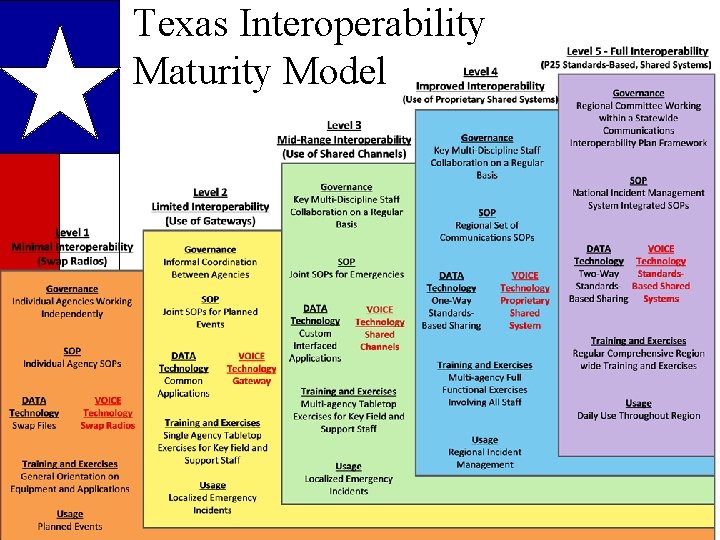
Texas Interoperability Maturity Model
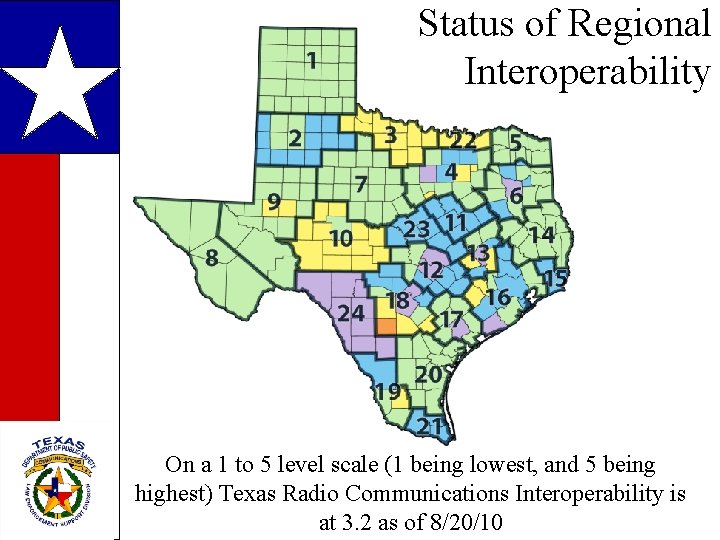
Status of Regional Interoperability On a 1 to 5 level scale (1 being lowest, and 5 being highest) Texas Radio Communications Interoperability is at 3. 2 as of 8/20/10
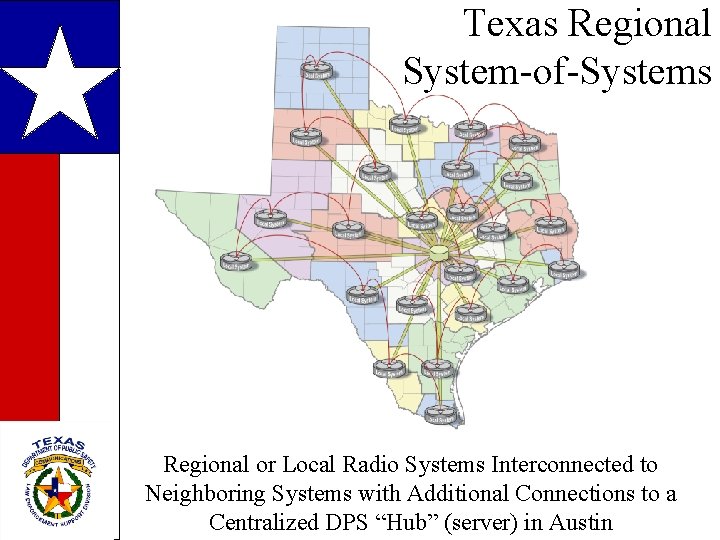
Texas Regional System-of-Systems Regional or Local Radio Systems Interconnected to Neighboring Systems with Additional Connections to a Centralized DPS “Hub” (server) in Austin
Identified Best Practices • Governance – Texas Radio Coalition • Regional Interoperable Communications Plans (RICPs) – Regional Governance – Regional Interoperable Migration Plan – Regional SOP • Project Management & Accountability – DPS Technical Assistance Unit – Vendor Equipment Quotes – Project Implementation
Future State of Emergency Communications • Next Generation 9 -1 -1 – Partnerships & Funding • Broadband/BTOP - DPS partnerships – Texas A&M University – Region 18 - Permian Basin • 700 MHz Waivers for Public Safety – San Antonio one of 21 granted – DPS petition for a State license waiver • DPS to provide statewide frequency coordination • Jurisdictions Build, Own & Manage systems
700 MHz Broadband - The Vision of Public Safety ► Broadband will provide to Tx. DPS additional “in-car” mobile data capacity that we do not currently have using cellular providers (such as streaming video) ► Greatly improved reliability during disasters (not subject to public demand as is the case with current commercial carrier systems) ► Priority access and adequate spectrum for growing public safety needs ► Improved network reliability, capacity, & security greater than currently provided by commercial carriers ► Coverage greater than currently provided by commercial carriers ► Public/Private Partnership(s) that will facilitate building a nationwide shared wireless broadband network (roaming to commercial systems) ► Public safety access to the latest commercial technologies ► A satellite component that will provide coverage when terrestrial service is disrupted or not available ► Federal government funding necessary to build out and maintain nationwide infrastructure 20
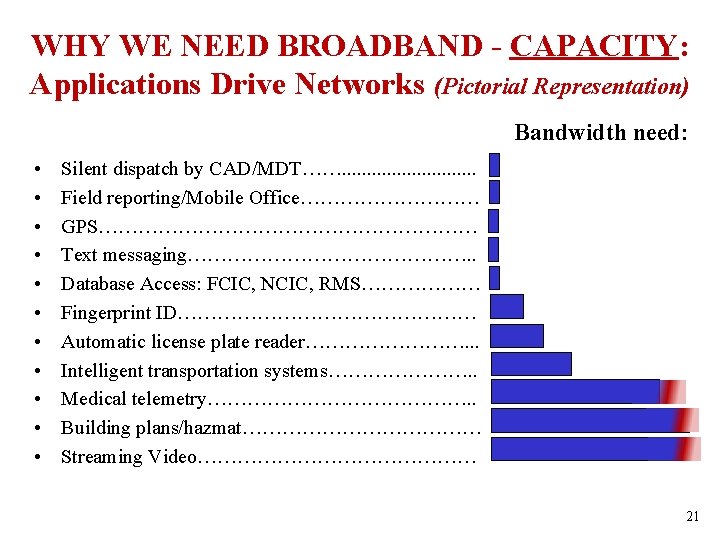
WHY WE NEED BROADBAND - CAPACITY: Applications Drive Networks (Pictorial Representation) Bandwidth need: • • • Silent dispatch by CAD/MDT……. . . . Field reporting/Mobile Office…………… GPS………………………… Text messaging…………………. . Database Access: FCIC, NCIC, RMS……………… Fingerprint ID…………………… Automatic license plate reader…………. . . Intelligent transportation systems…………………. . Medical telemetry…………………. . Building plans/hazmat……………… Streaming Video………………… 21
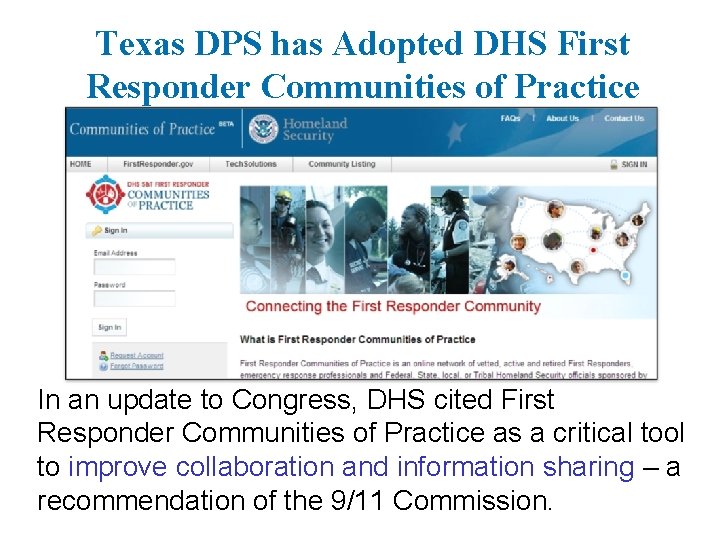
Texas DPS has Adopted DHS First Responder Communities of Practice In an update to Congress, DHS cited First Responder Communities of Practice as a critical tool to improve collaboration and information sharing – a recommendation of the 9/11 Commission.
Mike Simpson Assistant Director & SWIC Texas Dept. of Public Safety Law Enforcement Support Division 5805 N. Lamar - Building G, Rm. 219 Austin, Texas 78752 Office: (512) 424 -7427 mike. simpson@txdps. state. tx. us
- Slides: 23