
The State Audit Bureau of Kuwait Experience in
The State Audit Bureau of Kuwait Experience in Measuring Financial & Non-Financial Impacts
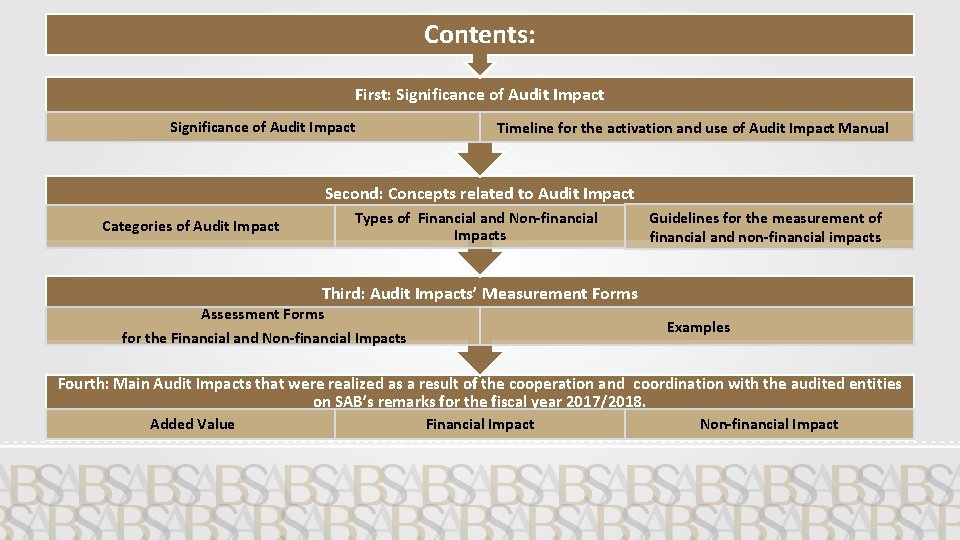
Contents: First: Significance of Audit Impact Timeline for the activation and use of Audit Impact Manual Second: Concepts related to Audit Impact Types of Financial and Non-financial Impacts Categories of Audit Impact Guidelines for the measurement of financial and non-financial impacts Third: Audit Impacts’ Measurement Forms Assessment Forms Examples for the Financial and Non-financial Impacts Fourth: Main Audit Impacts that were realized as a result of the cooperation and coordination with the audited entities on SAB’s remarks for the fiscal year 2017/2018. Added Value Financial Impact Non-financial Impact
First: Significance of Audit Impact
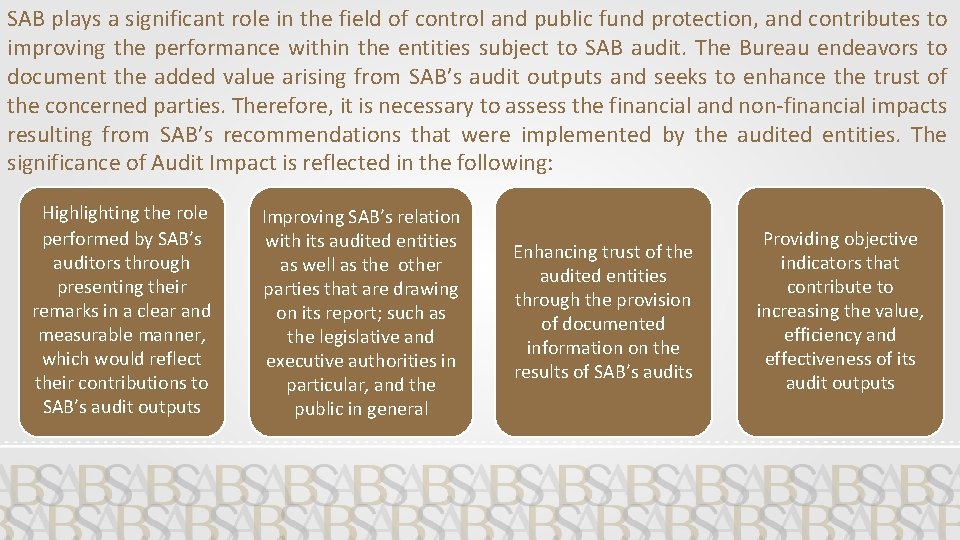
SAB plays a significant role in the field of control and public fund protection, and contributes to improving the performance within the entities subject to SAB audit. The Bureau endeavors to document the added value arising from SAB’s audit outputs and seeks to enhance the trust of the concerned parties. Therefore, it is necessary to assess the financial and non-financial impacts resulting from SAB’s recommendations that were implemented by the audited entities. The significance of Audit Impact is reflected in the following: Highlighting the role performed by SAB’s auditors through presenting their remarks in a clear and measurable manner, which would reflect their contributions to SAB’s audit outputs Improving SAB’s relation with its audited entities as well as the other parties that are drawing on its report; such as the legislative and executive authorities in particular, and the public in general Enhancing trust of the audited entities through the provision of documented information on the results of SAB’s audits Providing objective indicators that contribute to increasing the value, efficiency and effectiveness of its audit outputs
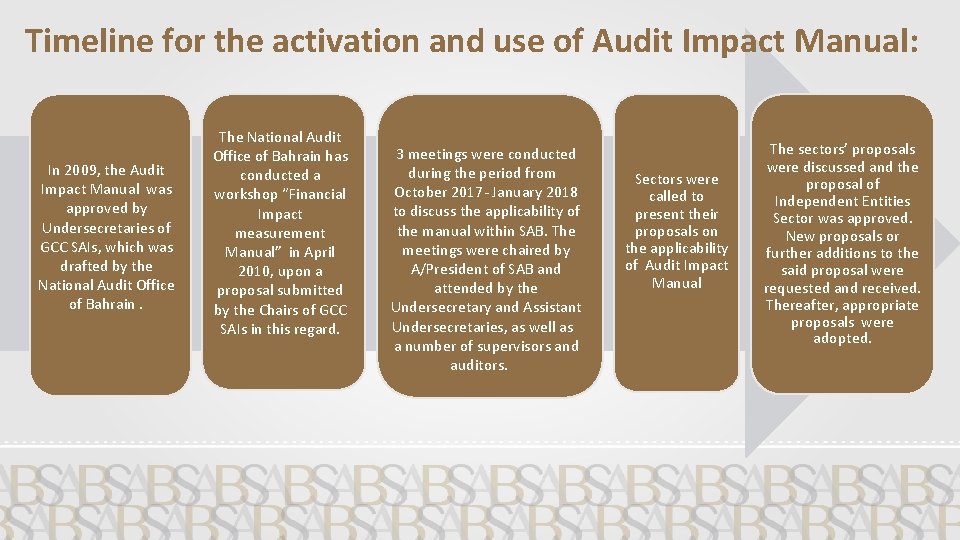
Timeline for the activation and use of Audit Impact Manual: In 2009, the Audit Impact Manual was approved by Undersecretaries of GCC SAIs, which was drafted by the National Audit Office of Bahrain. The National Audit Office of Bahrain has conducted a workshop “Financial Impact measurement Manual” in April 2010, upon a proposal submitted by the Chairs of GCC SAIs in this regard. 3 meetings were conducted during the period from October 2017 - January 2018 to discuss the applicability of the manual within SAB. The meetings were chaired by A/President of SAB and attended by the Undersecretary and Assistant Undersecretaries, as well as a number of supervisors and auditors. Sectors were called to present their proposals on the applicability of Audit Impact Manual The sectors’ proposals were discussed and the proposal of Independent Entities Sector was approved. New proposals or further additions to the said proposal were requested and received. Thereafter, appropriate proposals were adopted.
Second: Concepts related to Audit Impact
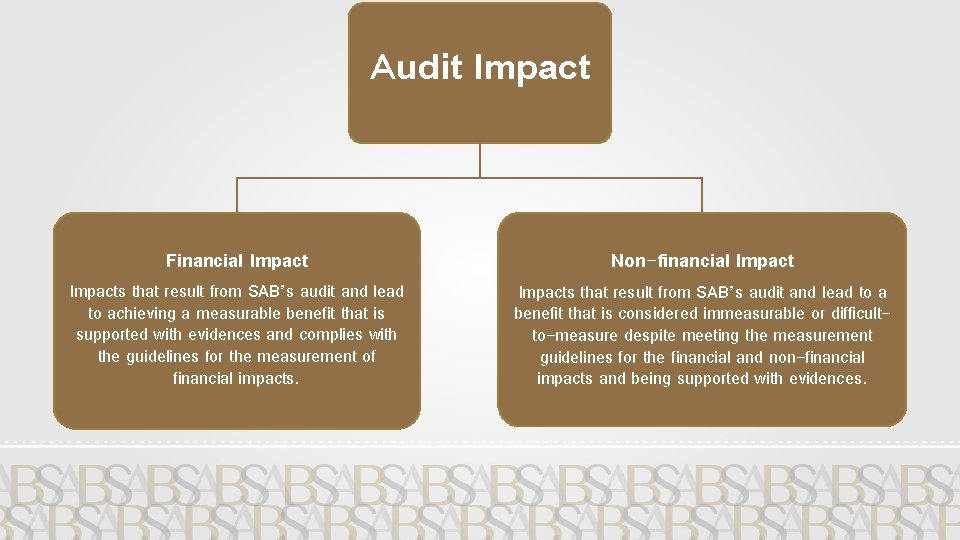
Audit Impact Financial Impacts that result from SAB’s audit and lead to achieving a measurable benefit that is supported with evidences and complies with the guidelines for the measurement of financial impacts. Non-financial Impacts that result from SAB’s audit and lead to a benefit that is considered immeasurable or difficultto-measure despite meeting the measurement guidelines for the financial and non-financial impacts and being supported with evidences.
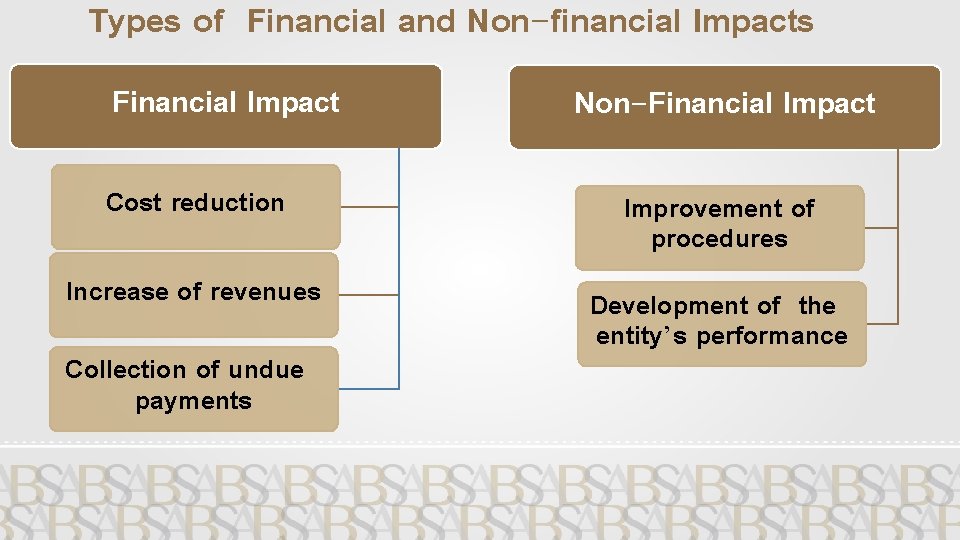
Types of Financial and Non-financial Impacts Financial Impact Cost reduction Increase of revenues Collection of undue payments Non-Financial Impact Improvement of procedures Development of the entity’s performance
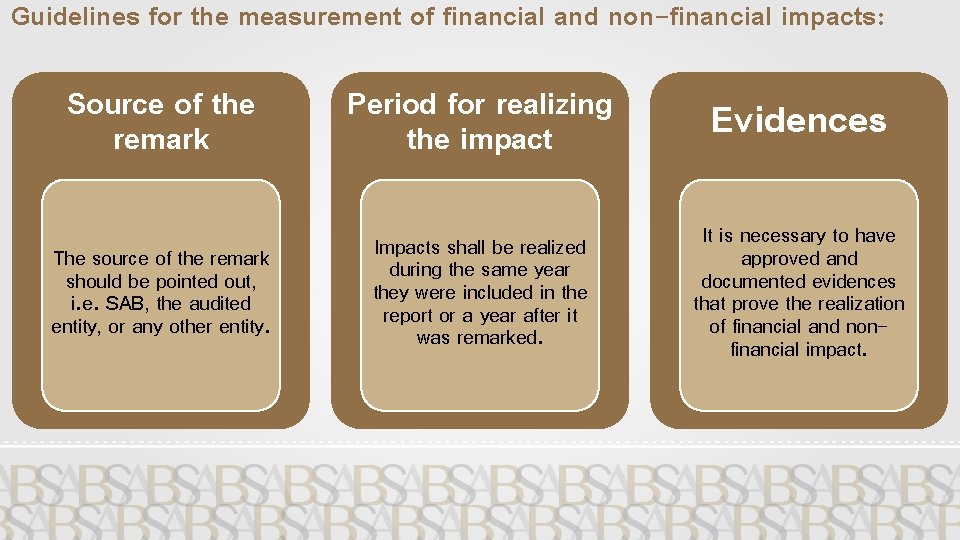
Guidelines for the measurement of financial and non-financial impacts: Source of the remark Period for realizing the impact Evidences The source of the remark should be pointed out, i. e. SAB, the audited entity, or any other entity. Impacts shall be realized during the same year they were included in the report or a year after it was remarked. It is necessary to have approved and documented evidences that prove the realization of financial and nonfinancial impact.
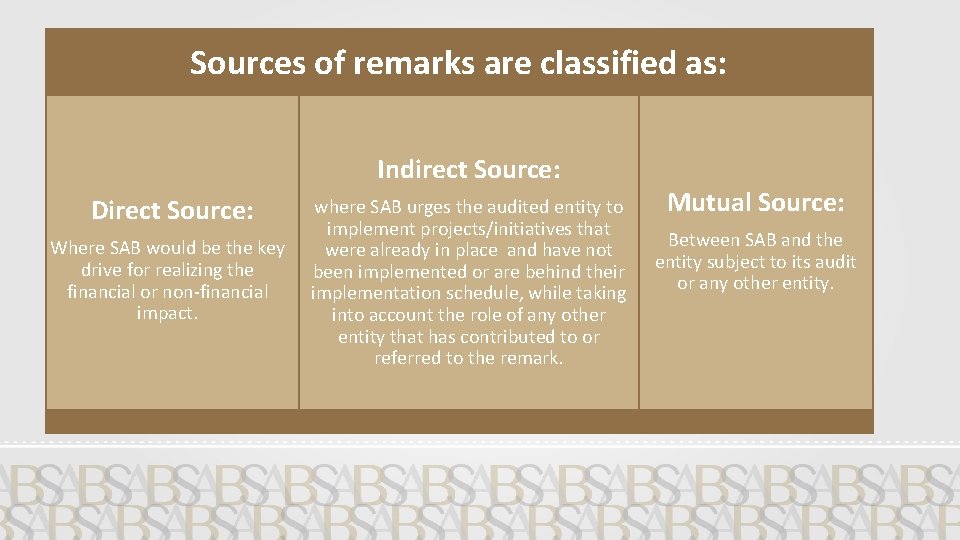
Sources of remarks are classified as: Indirect Source: Direct Source: Where SAB would be the key drive for realizing the financial or non-financial impact. where SAB urges the audited entity to implement projects/initiatives that were already in place and have not been implemented or are behind their implementation schedule, while taking into account the role of any other entity that has contributed to or referred to the remark. Mutual Source: Between SAB and the entity subject to its audit or any other entity.
Third: Audit Impact Measurement Forms
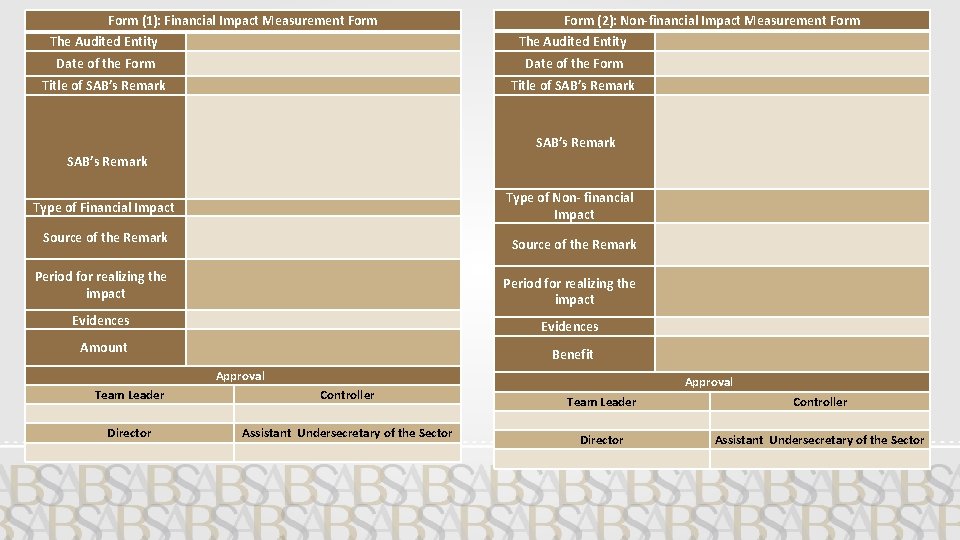
Form (1): Financial Impact Measurement Form The Audited Entity Form (2): Non-financial Impact Measurement Form The Audited Entity Date of the Form Title of SAB’s Remark Type of Financial Impact Type of Non- financial Impact Source of the Remark Period for realizing the impact Evidences Amount Benefit Approval Team Leader Director Controller Assistant Undersecretary of the Sector Approval Team Leader Director Controller Assistant Undersecretary of the Sector
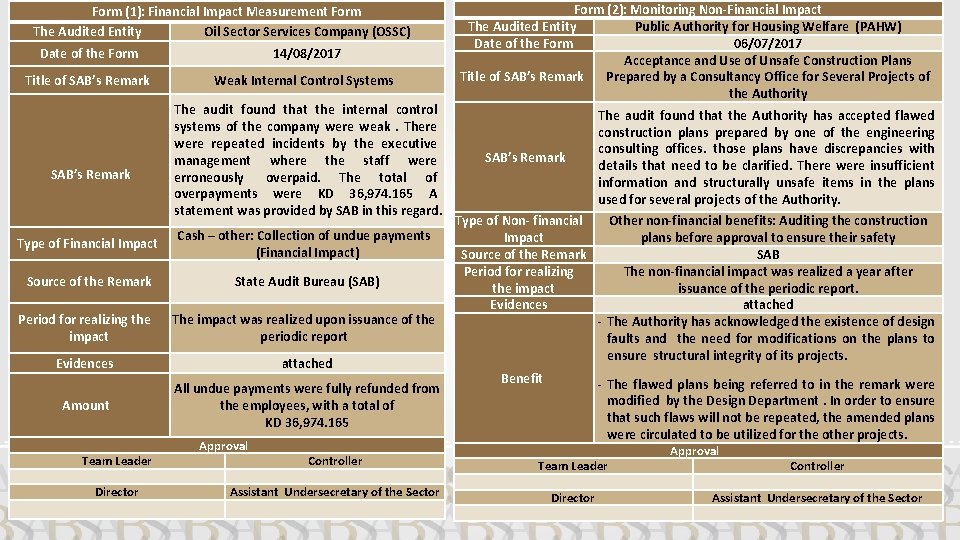
Form (1): Financial Impact Measurement Form The Audited Entity Oil Sector Services Company (OSSC) Date of the Form 14/08/2017 Title of SAB’s Remark Weak Internal Control Systems SAB’s Remark The audit found that the internal control systems of the company were weak . There were repeated incidents by the executive management where the staff were erroneously overpaid. The total of overpayments were KD 36, 974. 165 A statement was provided by SAB in this regard. Type of Financial Impact Cash – other: Collection of undue payments (Financial Impact) Source of the Remark State Audit Bureau (SAB) Period for realizing the impact The impact was realized upon issuance of the periodic report Evidences attached Amount Team Leader Director Form (2): Monitoring Non-Financial Impact The Audited Entity Public Authority for Housing Welfare (PAHW) Date of the Form 06/07/2017 Acceptance and Use of Unsafe Construction Plans Title of SAB’s Remark Prepared by a Consultancy Office for Several Projects of the Authority SAB’s Remark Type of Non- financial Impact Source of the Remark Period for realizing the impact Evidences Other non-financial benefits: Auditing the construction plans before approval to ensure their safety SAB The non-financial impact was realized a year after issuance of the periodic report. attached - The Authority has acknowledged the existence of design faults and the need for modifications on the plans to ensure structural integrity of its projects. Benefit - The flawed plans being referred to in the remark were modified by the Design Department. In order to ensure that such flaws will not be repeated, the amended plans were circulated to be utilized for the other projects. All undue payments were fully refunded from the employees, with a total of KD 36, 974. 165 Approval Controller Assistant Undersecretary of the Sector The audit found that the Authority has accepted flawed construction plans prepared by one of the engineering consulting offices. those plans have discrepancies with details that need to be clarified. There were insufficient information and structurally unsafe items in the plans used for several projects of the Authority. Team Leader Director Approval Controller Assistant Undersecretary of the Sector
Fourth: Main Audit Impacts that were realized as a result of the cooperation and coordination with the audited entities on SAB’s remarks for the fiscal year 2017/2018
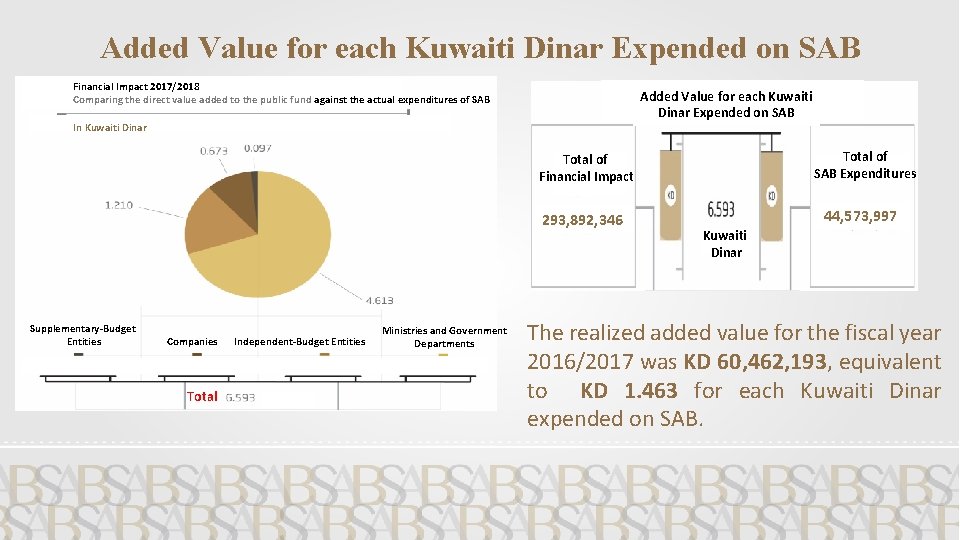
Added Value for each Kuwaiti Dinar Expended on SAB Financial Impact 2017/2018 Comparing the direct value added to the public fund against the actual expenditures of SAB Added Value for each Kuwaiti Dinar Expended on SAB In Kuwaiti Dinar Total of SAB Expenditures Total of Financial Impact 293, 892, 346 Supplementary-Budget Entities Companies Total Independent-Budget Entities Ministries and Government Departments 44, 573, 997 Kuwaiti Dinar The realized added value for the fiscal year 2016/2017 was KD 60, 462, 193, equivalent to KD 1. 463 for each Kuwaiti Dinar expended on SAB.
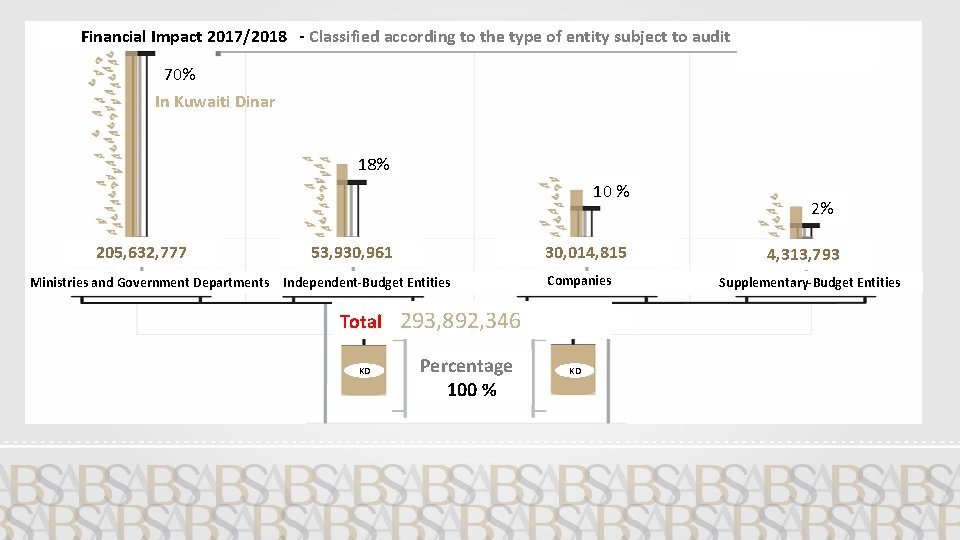
Financial Impact 2017/2018 - Classified according to the type of entity subject to audit 70% In Kuwaiti Dinar 18% 10 % 205, 632, 777 Ministries and Government Departments 53, 930, 961 30, 014, 815 Independent-Budget Entities Companies Total 293, 892, 346 KD Percentage 100 % KD 2% 4, 313, 793 Supplementary-Budget Entities
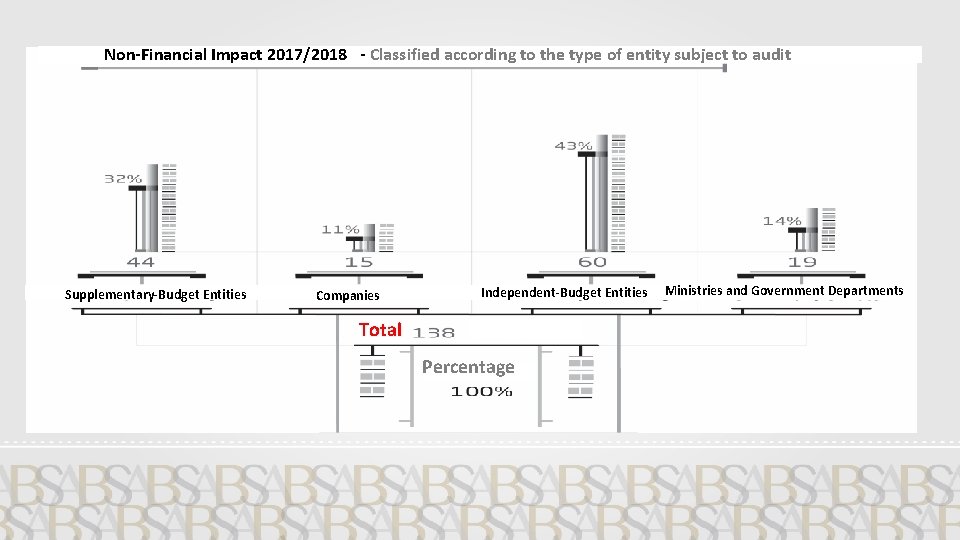
Non-Financial Impact 2017/2018 - Classified according to the type of entity subject to audit Supplementary-Budget Entities Companies Independent-Budget Entities Total Percentage Ministries and Government Departments
Thank You
- Slides: 20