
The START Information Access System Boris Katz http
The START Information Access System Boris Katz http: //www. ai. mit. edu/projects/infolab/ MIT Artificial Intelligence Laboratory — Research Directions
The Problem: Finding information on line Two Approaches: 1. Keyword search (search engines, e. g. , Alta. Vista) 2. Natural language processing MIT Artificial Intelligence Laboratory — Research Directions
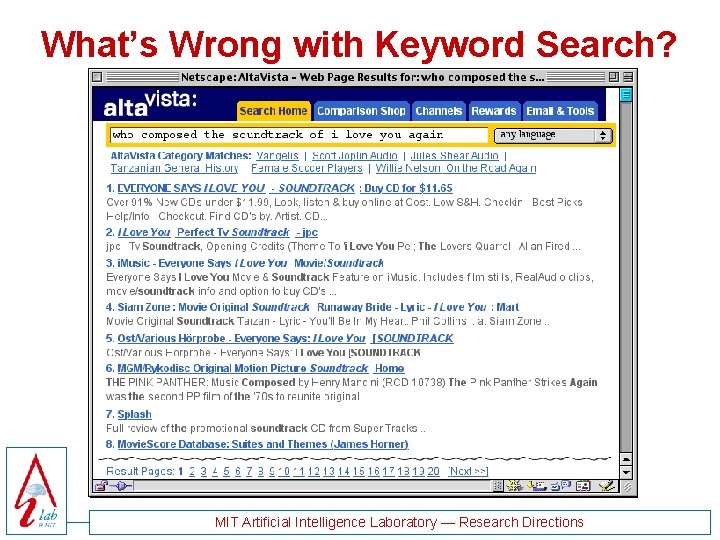
What’s Wrong with Keyword Search? MIT Artificial Intelligence Laboratory — Research Directions
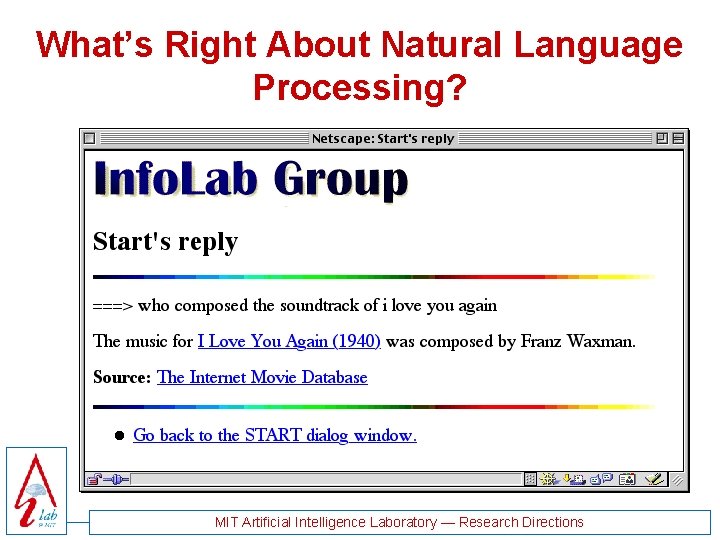
What’s Right About Natural Language Processing? MIT Artificial Intelligence Laboratory — Research Directions
What’s Wrong with Natural Language Processing (today)? 1. Too hard Full-text NL understanding still beyond reach • Intersentential reference • Paraphrasing • Summarization • Common sense implication 2. Too slow 3. Not all information is language Most Web resources are not textual • Maps and Images • Sound and Video • Multimedia Web resources are distributed across numerous non-traditional databases MIT Artificial Intelligence Laboratory — Research Directions
What is START? START (Syn. Tactic Analysis using Reversible Transformations) provides multimedia information access using natural language. Natural language is human language. You don’t have to learn a special language to use START. Ask your questions in English; enter information using English. Multimedia access using natural language annotations START lets you use English to access any kind of information: text, pictures, movies, and more. “Just the right information” START gives you the answer you want without including a thousand others. Virtual collaboration START retrieves information from its own knowledge base and from databases all over the Web. MIT Artificial Intelligence Laboratory — Research Directions
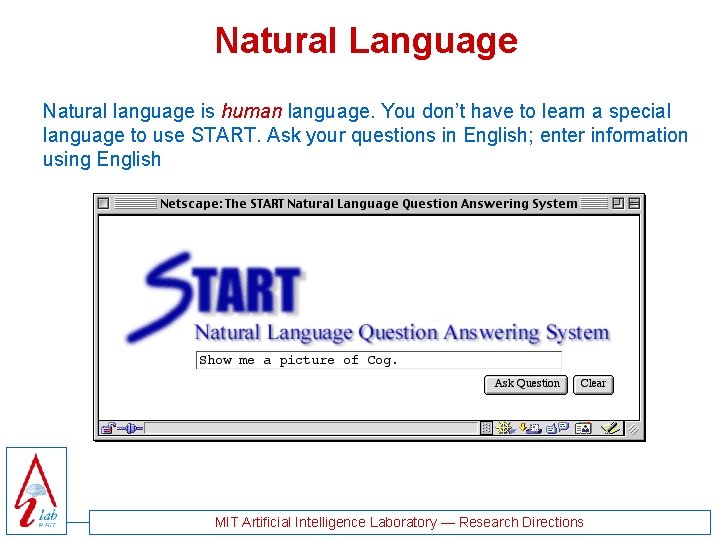
Natural Language Natural language is human language. You don’t have to learn a special language to use START. Ask your questions in English; enter information using English MIT Artificial Intelligence Laboratory — Research Directions
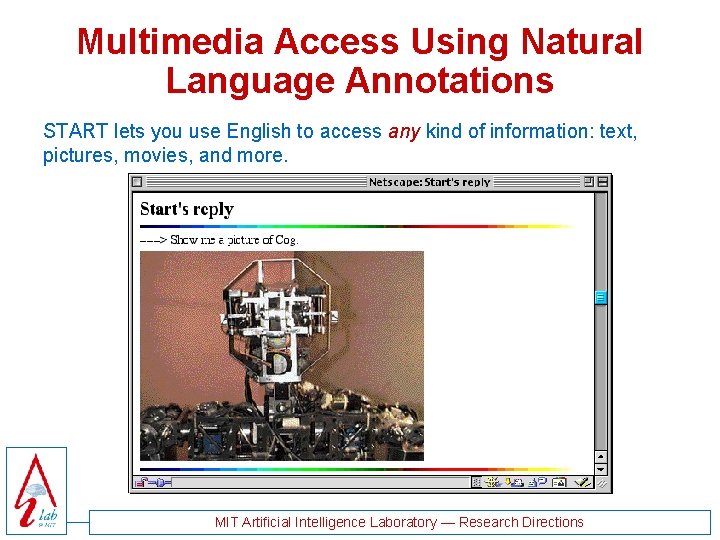
Multimedia Access Using Natural Language Annotations START lets you use English to access any kind of information: text, pictures, movies, and more. MIT Artificial Intelligence Laboratory — Research Directions
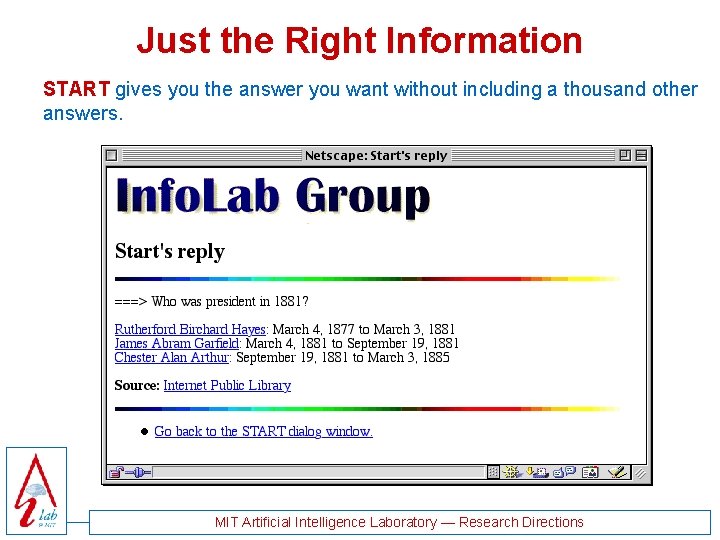
Just the Right Information START gives you the answer you want without including a thousand other answers. MIT Artificial Intelligence Laboratory — Research Directions
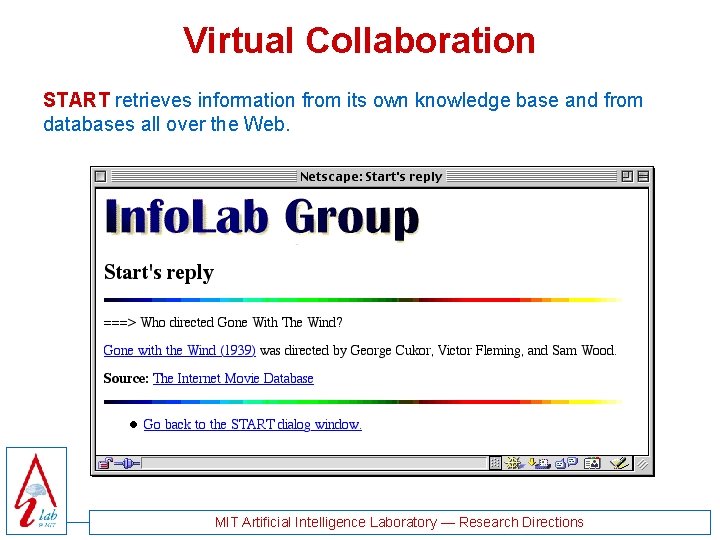
Virtual Collaboration START retrieves information from its own knowledge base and from databases all over the Web. MIT Artificial Intelligence Laboratory — Research Directions
Natural Language Annotations Bridge the gap between our ability to analyze natural language sentences and other information and our desire to access the huge amount of data now available on the Web. Annotations are collections of natural language sentences and phrases that describe the content of various information segments. START • analyzes these annotations • creates the necessary representational structures • produces special pointers to the information segments summarized by the annotations. MIT Artificial Intelligence Laboratory — Research Directions
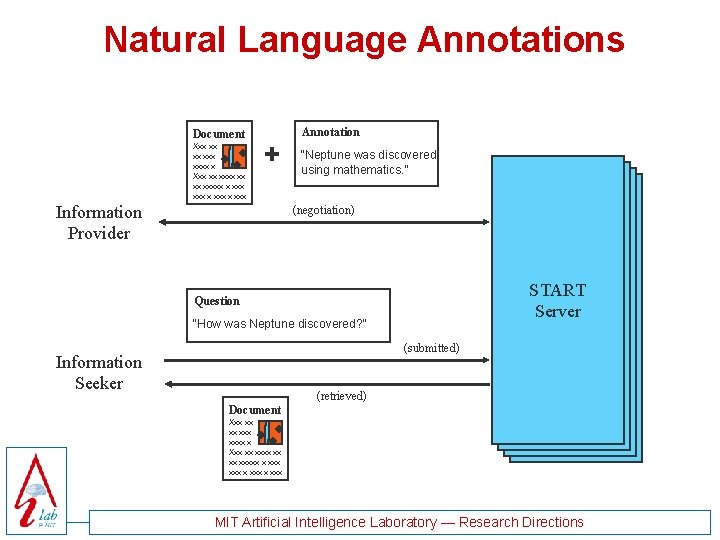
Natural Language Annotations Document Xxx xxxx x Xxx xxxxx x xxx Annotation + Information Provider “Neptune was discovered using mathematics. ” (negotiation) START Server Question “How was Neptune discovered? ” (submitted) Information Seeker Document (retrieved) Xxx xxxx x Xxx xxxxx x xxx MIT Artificial Intelligence Laboratory — Research Directions
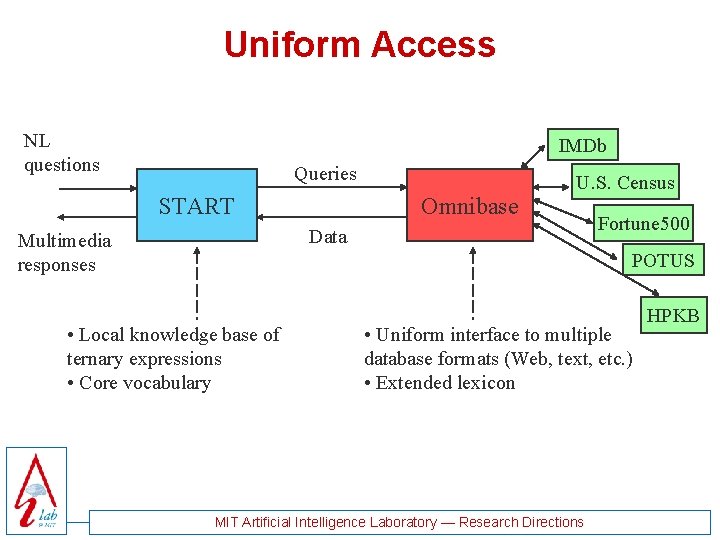
Uniform Access NL questions IMDb Queries START Omnibase U. S. Census Data Multimedia responses Fortune 500 POTUS • Local knowledge base of ternary expressions • Core vocabulary • Uniform interface to multiple database formats (Web, text, etc. ) • Extended lexicon MIT Artificial Intelligence Laboratory — Research Directions HPKB
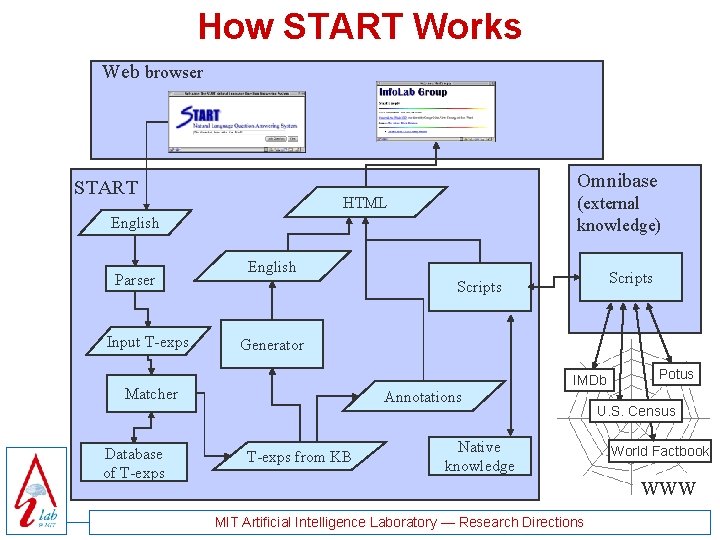
How START Works Web browser Omnibase START (external knowledge) HTML English Parser Input T-exps English Generator IMDb Matcher Database of T-exps Scripts Annotations T-exps from KB Native knowledge Potus U. S. Census World Factbook WWW MIT Artificial Intelligence Laboratory — Research Directions
MIT Artificial Intelligence Laboratory — Research Directions
- Slides: 15