
The StanleyBrown Safety Planning Intervention A First Contact
The Stanley/Brown Safety Planning Intervention: A First Contact Treatment Intervention of Those At-Risk of Suicide • Hosted by Oregon Health Authority Public Health Division’s SBHC Program and Suicide Prevention Program • Trainer: Adam Lesser, LCSW Deputy Director, The Columbia Lighthouse Project 1
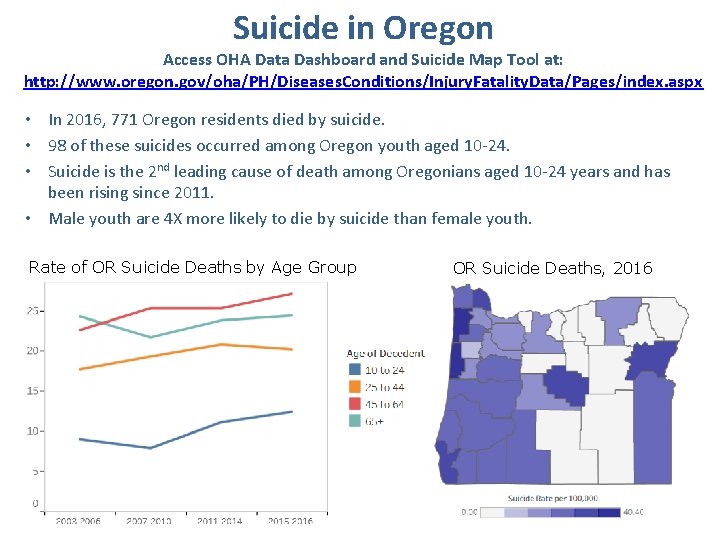
Suicide in Oregon Access OHA Data Dashboard and Suicide Map Tool at: http: //www. oregon. gov/oha/PH/Diseases. Conditions/Injury. Fatality. Data/Pages/index. aspx • In 2016, 771 Oregon residents died by suicide. • 98 of these suicides occurred among Oregon youth aged 10 -24. • Suicide is the 2 nd leading cause of death among Oregonians aged 10 -24 years and has been rising since 2011. • Male youth are 4 X more likely to die by suicide than female youth. Rate of OR Suicide Deaths by Age Group OR Suicide Deaths, 2016
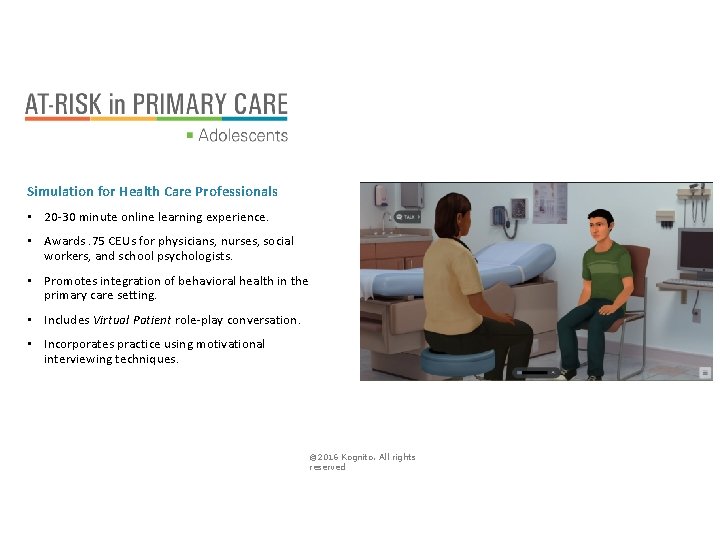
Simulation for Health Care Professionals • 20 -30 minute online learning experience. • Awards. 75 CEUs for physicians, nurses, social workers, and school psychologists. • Promotes integration of behavioral health in the primary care setting. • Includes Virtual Patient role-play conversation. • Incorporates practice using motivational interviewing techniques. © 2016 Kognito. All rights reserved
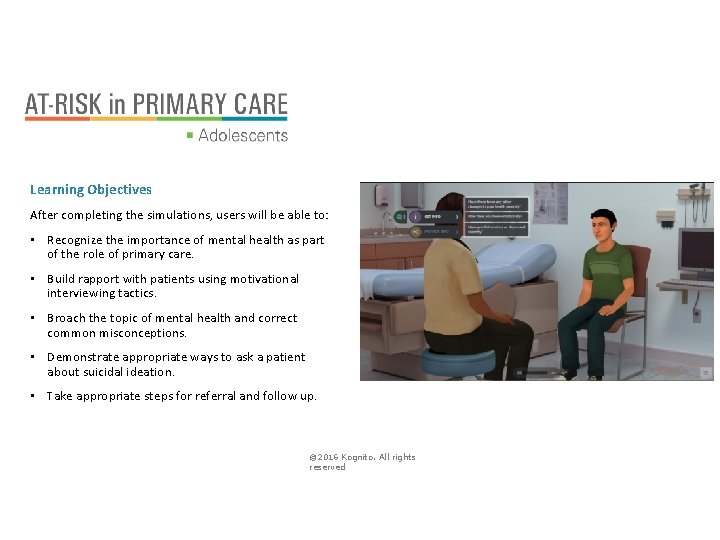
Learning Objectives After completing the simulations, users will be able to: • Recognize the importance of mental health as part of the role of primary care. • Build rapport with patients using motivational interviewing tactics. • Broach the topic of mental health and correct common misconceptions. • Demonstrate appropriate ways to ask a patient about suicidal ideation. • Take appropriate steps for referral and follow up. © 2016 Kognito. All rights reserved
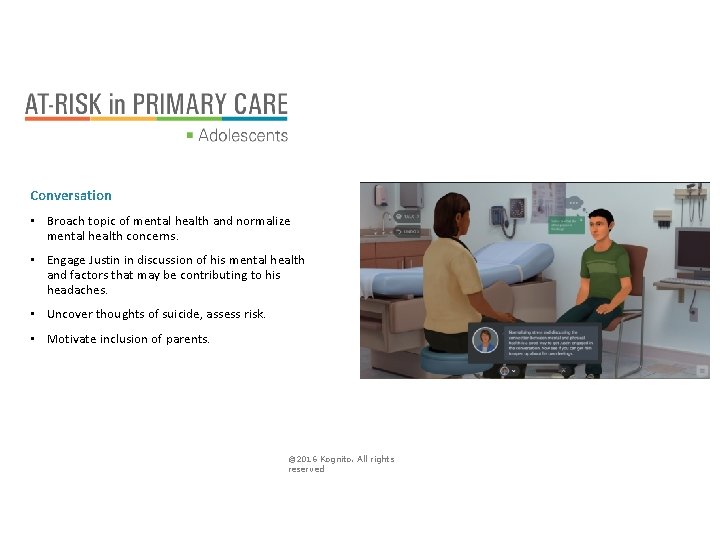
Conversation • Broach topic of mental health and normalize mental health concerns. • Engage Justin in discussion of his mental health and factors that may be contributing to his headaches. • Uncover thoughts of suicide, assess risk. • Motivate inclusion of parents. © 2016 Kognito. All rights reserved
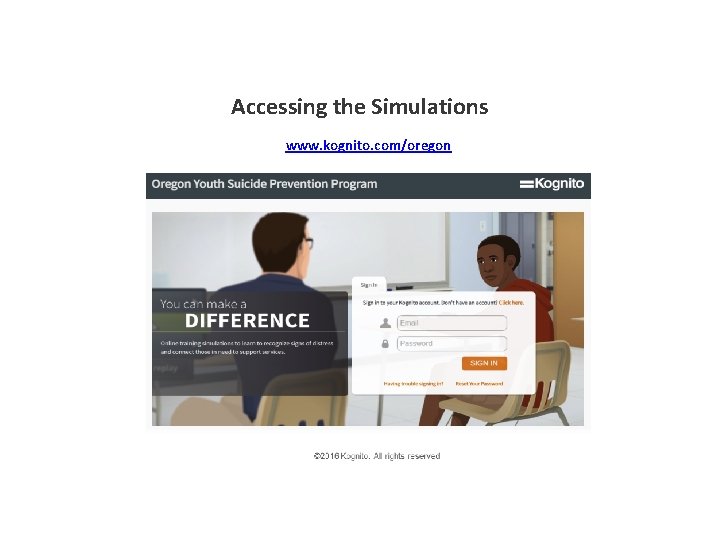
Accessing the Simulations www. kognito. com/oregon
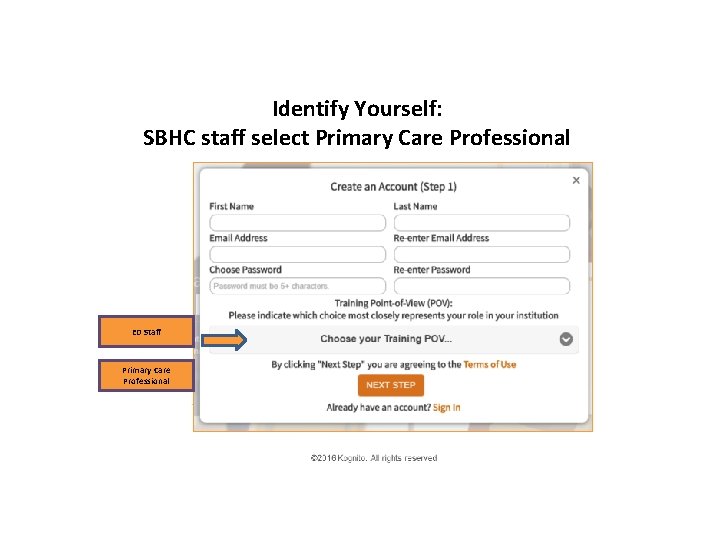
Identify Yourself: SBHC staff select Primary Care Professional ED Staff Primary Care Professional
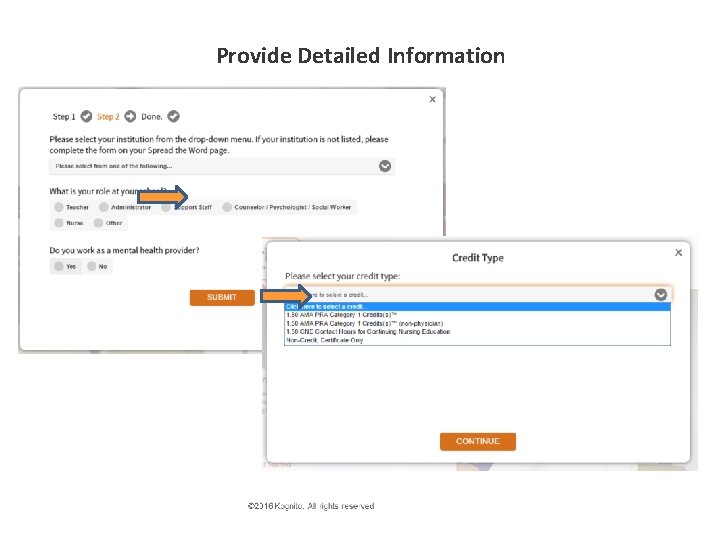
Provide Detailed Information
Oregon Zero Suicide Academy: Sept. 18 -19, 2018 & Oregon Community of Practice for Better Suicide Care The Zero Suicide Academy® is a two-day training for senior leaders of health and behavioral health care organizations that seek to dramatically reduce suicides among patients in their care. Using the Zero Suicide framework, participants learn how to incorporate best and promising practices into their organizations and processes to improve care and safety for individuals at risk. Zero Suicide faculty provide both interactive presentations and small group sessions, and collaborate with participants to develop organization-specific action plans. The Oregon Zero Suicide Academy is sponsored by the Oregon Health Authority, Public Health Division (OHA PHD). The will Oregon Community of Practice for Better Suicide Care begin in October 2018 as a member-driven group engaged in virtual learning to hear from state and national experts on their experiences implementing better suicide care practices. The Zero Suicide Academy and Oregon Community of Practice for Better Suicide Care application can be found at: https: //zerosuicide. sprc. org/zero-suicide-academy
Oregon Minor Consent/Confidentiality • In a healthcare setting • Minors 14 years and older may access outpatient mental health, drug or alcohol treatment without parental consent • Providers are expected to involve parents by the end of the minor’s treatment – Unless clear indicators to the contrary exist, sexual abuse is ID’d, the minor is emancipated, or the parent refuses • No legal “right” to disclosure or confidentiality. Providers use “best clinical judgment” • Mandatory reporter disclosure. 10
AAP Guidance: Safety Plan in Primary Care 11
Save the Date! • Identification and Triage Using the Columbia. Suicide Severity Rating Scale, Part II • August 8, 2019 7: 30 -9 AM • Webinar will be recorded and available at: www. healthoregon. org/sbhc 12
Meghan Crane Zero Suicide Program Coordinator Oregon Health Authority 971 -673 -1023 meghan. crane@state. or. us Kate O’Donnell School Mental Health Specialist Oregon Health Authority 971 -673 -1054 kathryn. m. odonnell@state. or. us 13
14 Safety Planning Intervention with Suicidal Individuals: A Brief Therapeutic Intervention
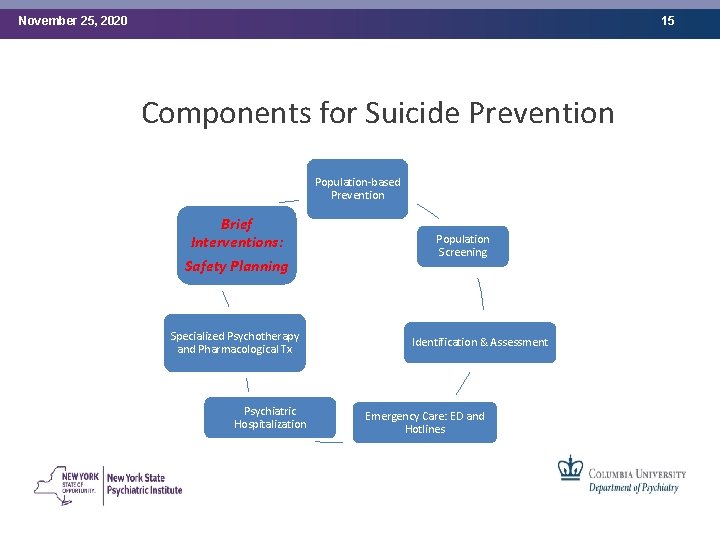
November 25, 2020 15 Components for Suicide Prevention Population-based Prevention Brief Interventions: Safety Planning Specialized Psychotherapy and Pharmacological Tx Psychiatric Hospitalization Population Screening Identification & Assessment Emergency Care: ED and Hotlines
November 25, 2020 16 What are brief interventions? • Brief Interventions range from single session to multiple sessions • May or may not include follow-up support • Variety of intervention approaches: – – – Psychoeducation Crisis response planning Cognitive behavior therapy Motivational interviewing/treatment engagement Outreach follow-up: Letters, postcards, phone calls
November 25, 2020 Rationale for Brief Interventions Crisis contact may be the ONLY contact the suicidal individual has with the mental health system –Suicidal patients are very difficult to engage in treatment. Rudd et al. (1996) –Up to 60% of suicide attempters do not even attend more than one week of treatment post-discharge from the ED (O’Brien et al. , 1987; Granboulan, et al. , 2001; King et al. , 1997; Piacentini et al. , 1995; Trautman et al. , 1993; Spirito et al. , 1989; Taylor & Stansfield, 1984; Kurz & Moller, 1984; Litt et al. , 1983). –After a year, 73% of attempters will no longer be in any treatment (Krulee & Hales 1988) 17
November 25, 2020 18 Rationale for Brief Interventions Ongoing outpatient treatment is not for everyone § Men and certain cultures - Stigma § Individuals with Borderline Personality Disorder are at high risk for suicide and suicide attempts, also difficult to engage and maintain in treatment § Adolescents tend to have attitudes that are inconsistent with long term therapy: § “The past is the past. It won’t reoccur. ” § When mood improves, it’s hard for them to imagine that it could worsen again. § Treatment may be unavailable during most high risk time or not at all (waitlist, rural)
November 25, 2020 19 Typical Strategy for Crisis Intervention • Assess imminent danger • Refer for treatment But, given the limited success of ED referrals, alternative strategies that include immediate intervention ought to be considered and may be able to increase its “therapeutic” capacity
November 25, 2020 20 At the same time, its important to not expect miracles from brief interventions. They should be considered one aspect of suicide prevention, e. g. cholesterol lower drugs for cardiac disease.
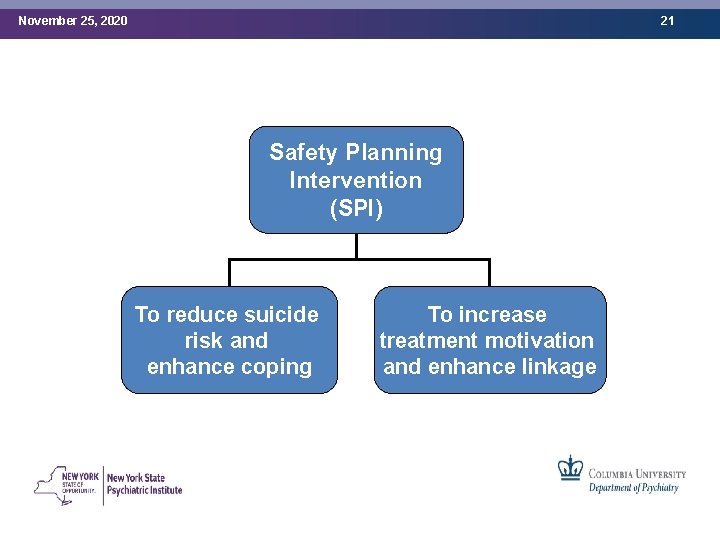
November 25, 2020 21 Safety Planning Intervention (SPI) To reduce suicide risk and enhance coping To increase treatment motivation and enhance linkage
November 25, 2020 22 Origin of Safety Planning Intervention (Stanley & Brown, 2008; 2012) • To maintain safety of high risk patients in outpatient treatment trials (Penn CT study for adults; TASA study for suicidal adolescents) • Compilation and ordering of evidenced-based suicide interventions • Expanded and modified as a stand alone intervention for the VA and in civilian EDs
November 25, 2020 23 3‘Theoretical’ Approaches Underlying SPI 1. Suicide risk fluctuates over time (e. g. , Diathesis-Stress Model of Suicidal Behavior, Mann et al. , 1999) 2. Problem solving capacity diminishes during crises---overpracticing and a specific template enhances coping (e. g. fire drills) 3. Cognitive behavioral approaches to behavior change • Behavioral strategies to identify individual stressors that have precipitated suicidal behavior in the past. • Clinician and suicidal individual collaborate to determine cognitivebehavioral strategies patient can use to manage suicidal crises.
November 25, 2020 Safety Planning Evidence Base Incorporates elements of four evidence-based suicide risk reduction strategies: • means restriction • teaching brief problem solving and coping skills (including distraction) • enhancing social support and identifying emergency contacts, and • motivational enhancement for further treatment. 24
November 25, 2020 Safety Plan Intervention: Overview • Clinical intervention where the individual at risk creates a one-page document with the help of a clinician to use when in crisis • Written list of coping strategies and resources that includes a step-wise increase in level of intervention from “within self” strategies up to going to psychiatric ER • Although the plan is stepwise, if one step is unavailable, don’t stop and wait till it is available – move on 25
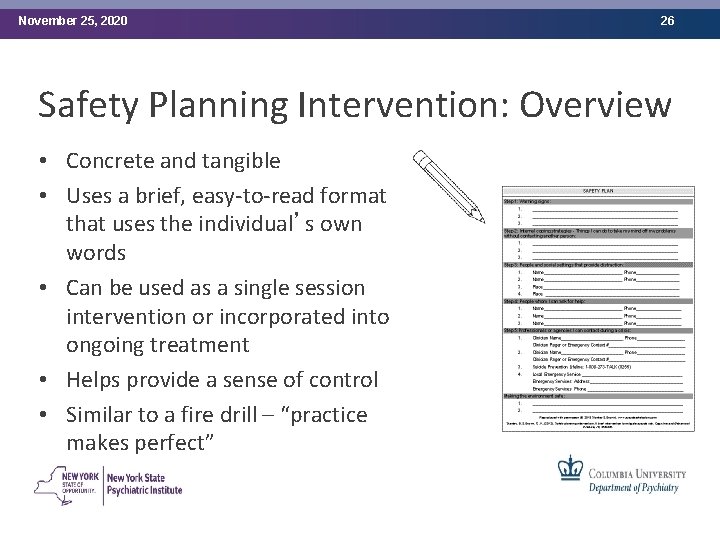
November 25, 2020 26 Safety Planning Intervention: Overview • Concrete and tangible • Uses a brief, easy-to-read format that uses the individual’s own words • Can be used as a single session intervention or incorporated into ongoing treatment • Helps provide a sense of control • Similar to a fire drill – “practice makes perfect”
November 25, 2020 27 SPI as a ‘Cast’ for Suicidal Patients • Safety Planning Intervention is the equivalent of putting a cast on a broken limb • Provides immediate intervention to those who do not need require inpatient hospitalization • Fills the gap between emergency room discharge and follow up treatment
November 25, 2020 Safety Plan Intervention: What it’s not • It does not substitute for treatment • It does not help if the individual is in imminent danger of attempting suicide • Safety Plans are not “no-suicide contracts” • No-suicide contracts ask patients to promise to stay alive without telling them how to stay alive – not effective 28
November 25, 2020 29 Target Population for Safety Planning Intervention • Individuals at increased risk but not requiring immediate rescue (e. g. on phone can’t report that they won’t act on SI) • Patients who have… – made a suicide attempt – suicide ideation particularly those in the moderate to high risk range – psychiatric disorders that increase suicide risk – otherwise been determined to be at risk for suicide
November 25, 2020 30 Beginning the Safety Plan “Telling the Story” • Have the suicidal individual describe the events and situations and their reactions to these events in as much detail as possible • Builds rapport • Creates “buy-in” • Beginning of the story: • Major decision point associated with increased suicide risk • Strong emotional reaction to a specific event • External event such as a significant loss • Internal event such as an automatic thought • Follows backwards in time – “What happened just before that? ”
November 25, 2020 31 “Telling the Story” • Understand the function of suicidal behavior or thinking from the individual’s perspective; that the behavior “makes sense” to the individual in the context of his or her history, vulnerability, and circumstances. • Empathize with the individual’s strong feelings and desire to be reduce distress. • Validate that they were trying their best to get out of a crisis situation • Refrain from trying to solve the individual’s problems before understanding the motivations for suicide.
November 25, 2020 32 Developing the Plan • After the risk assessment is done and the patient describes the suicidal crisis, the SPI can be developed • Solicit agreement to develop a plan • Explain the rationale for such a plan and when to use the SPI
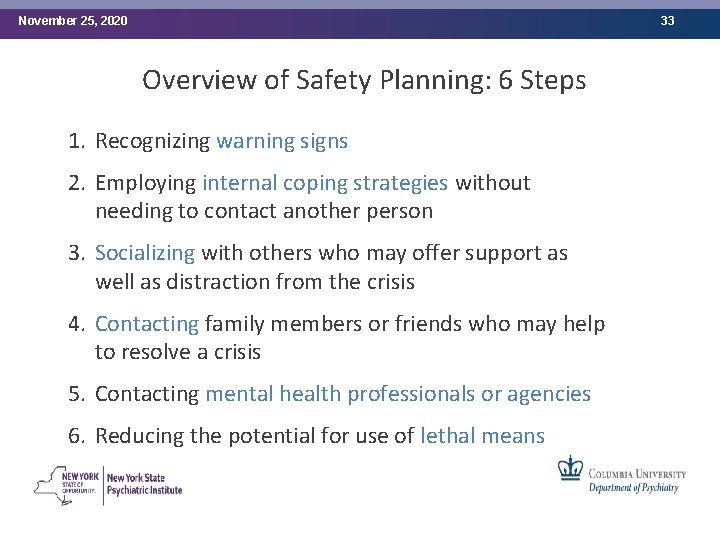
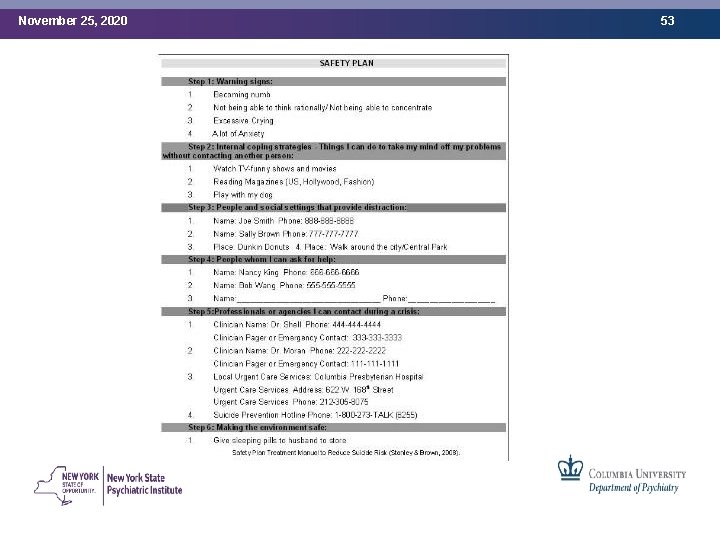
November 25, 2020 33 Overview of Safety Planning: 6 Steps 1. Recognizing warning signs 2. Employing internal coping strategies without needing to contact another person 3. Socializing with others who may offer support as well as distraction from the crisis 4. Contacting family members or friends who may help to resolve a crisis 5. Contacting mental health professionals or agencies 6. Reducing the potential for use of lethal means
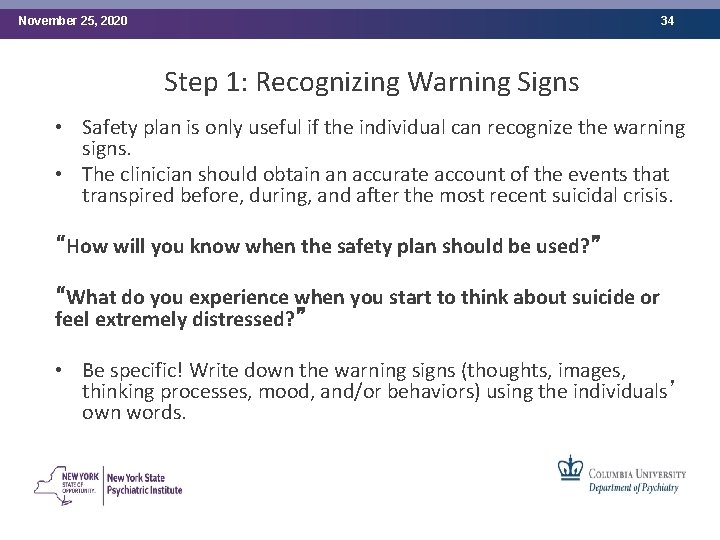
November 25, 2020 34 Step 1: Recognizing Warning Signs • Safety plan is only useful if the individual can recognize the warning signs. • The clinician should obtain an accurate account of the events that transpired before, during, and after the most recent suicidal crisis. “How will you know when the safety plan should be used? ” “What do you experience when you start to think about suicide or feel extremely distressed? ” • Be specific! Write down the warning signs (thoughts, images, thinking processes, mood, and/or behaviors) using the individuals’ own words.
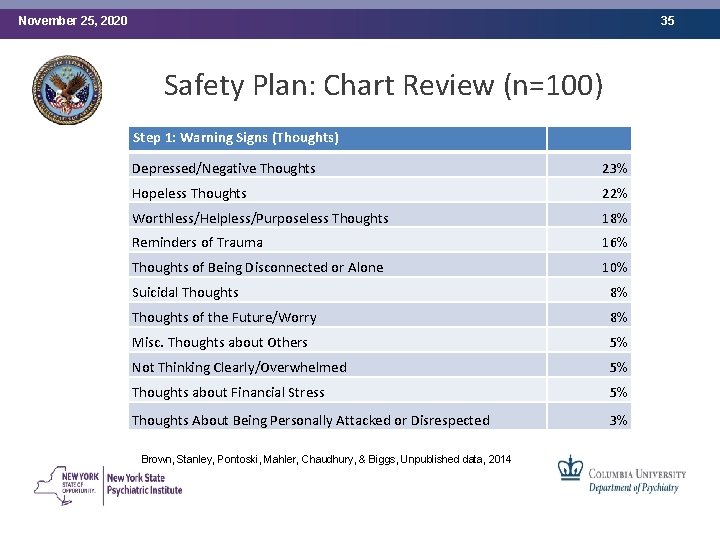
November 25, 2020 35 Safety Plan: Chart Review (n=100) Step 1: Warning Signs (Thoughts) Depressed/Negative Thoughts 23% Hopeless Thoughts 22% Worthless/Helpless/Purposeless Thoughts 18% Reminders of Trauma 16% Thoughts of Being Disconnected or Alone 10% Suicidal Thoughts 8% Thoughts of the Future/Worry 8% Misc. Thoughts about Others 5% Not Thinking Clearly/Overwhelmed 5% Thoughts about Financial Stress 5% Thoughts About Being Personally Attacked or Disrespected 3% Brown, Stanley, Pontoski, Mahler, Chaudhury, & Biggs, Unpublished data, 2014
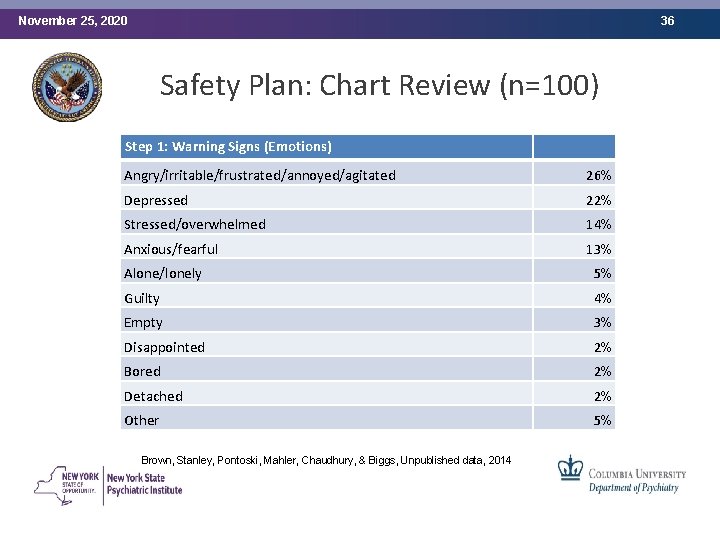
November 25, 2020 36 Safety Plan: Chart Review (n=100) Step 1: Warning Signs (Emotions) Angry/irritable/frustrated/annoyed/agitated 26% Depressed 22% Stressed/overwhelmed 14% Anxious/fearful 13% Alone/lonely 5% Guilty 4% Empty 3% Disappointed 2% Bored 2% Detached 2% Other 5% Brown, Stanley, Pontoski, Mahler, Chaudhury, & Biggs, Unpublished data, 2014
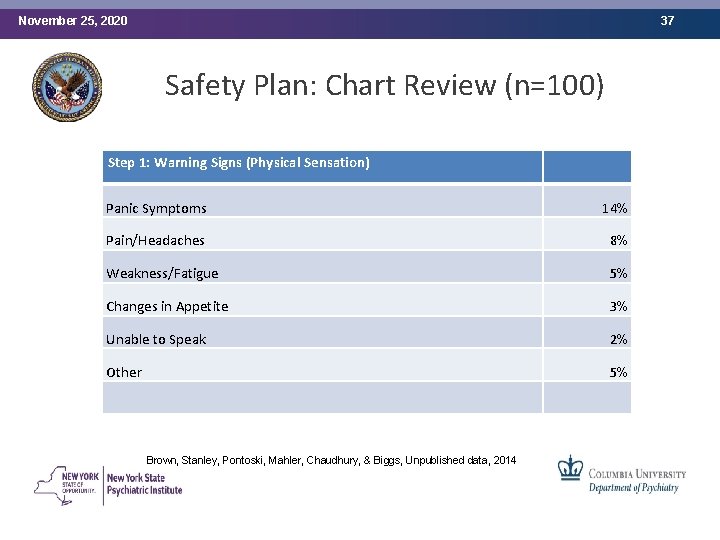
November 25, 2020 37 Safety Plan: Chart Review (n=100) Step 1: Warning Signs (Physical Sensation) Panic Symptoms 14% Pain/Headaches 8% Weakness/Fatigue 5% Changes in Appetite 3% Unable to Speak 2% Other 5% Brown, Stanley, Pontoski, Mahler, Chaudhury, & Biggs, Unpublished data, 2014
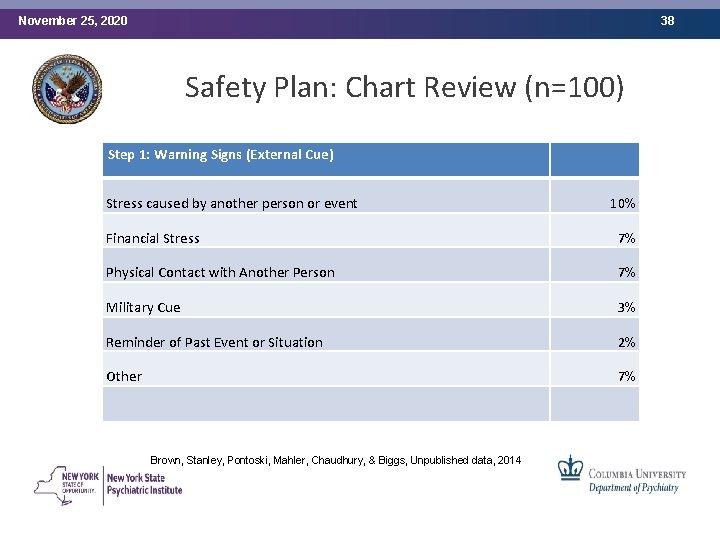
November 25, 2020 38 Safety Plan: Chart Review (n=100) Step 1: Warning Signs (External Cue) Stress caused by another person or event 10% Financial Stress 7% Physical Contact with Another Person 7% Military Cue 3% Reminder of Past Event or Situation 2% Other 7% Brown, Stanley, Pontoski, Mahler, Chaudhury, & Biggs, Unpublished data, 2014
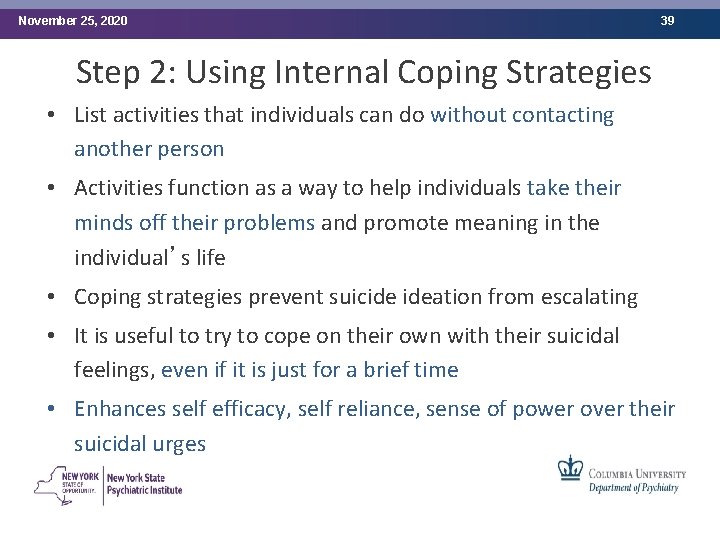
November 25, 2020 39 Step 2: Using Internal Coping Strategies • List activities that individuals can do without contacting another person • Activities function as a way to help individuals take their minds off their problems and promote meaning in the individual’s life • Coping strategies prevent suicide ideation from escalating • It is useful to try to cope on their own with their suicidal feelings, even if it is just for a brief time • Enhances self efficacy, self reliance, sense of power over their suicidal urges
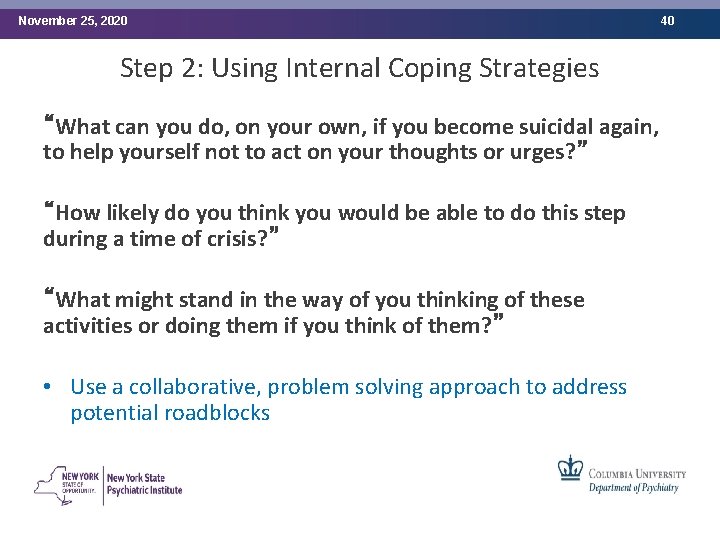
November 25, 2020 Step 2: Using Internal Coping Strategies “What can you do, on your own, if you become suicidal again, to help yourself not to act on your thoughts or urges? ” “How likely do you think you would be able to do this step during a time of crisis? ” “What might stand in the way of you thinking of these activities or doing them if you think of them? ” • Use a collaborative, problem solving approach to address potential roadblocks 40
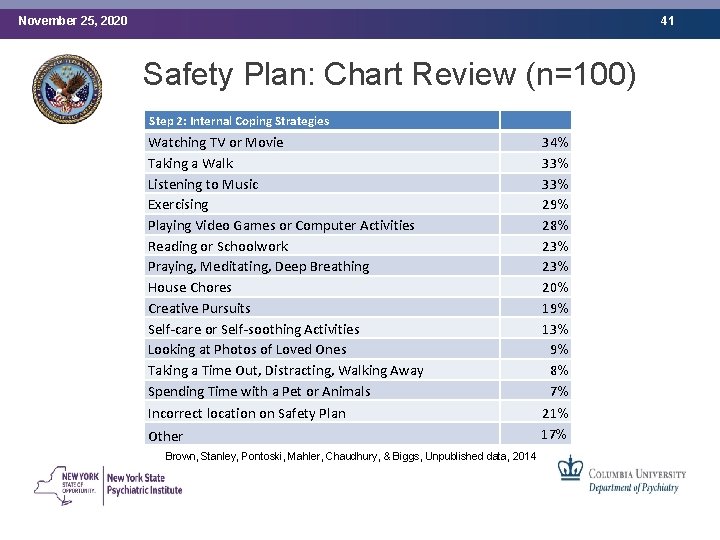
November 25, 2020 41 Safety Plan: Chart Review (n=100) Step 2: Internal Coping Strategies Watching TV or Movie Taking a Walk Listening to Music Exercising Playing Video Games or Computer Activities Reading or Schoolwork Praying, Meditating, Deep Breathing House Chores Creative Pursuits Self-care or Self-soothing Activities Looking at Photos of Loved Ones Taking a Time Out, Distracting, Walking Away Spending Time with a Pet or Animals Incorrect location on Safety Plan Other Brown, Stanley, Pontoski, Mahler, Chaudhury, & Biggs, Unpublished data, 2014 34% 33% 29% 28% 23% 20% 19% 13% 9% 8% 7% 21% 17%
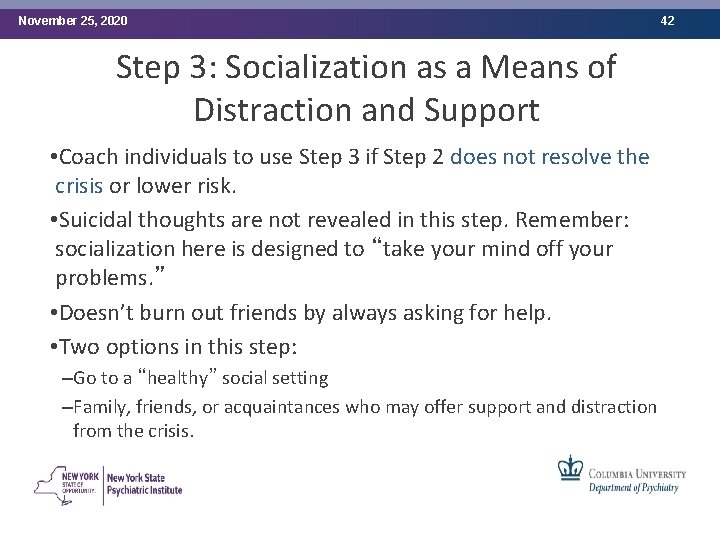
November 25, 2020 Step 3: Socialization as a Means of Distraction and Support • Coach individuals to use Step 3 if Step 2 does not resolve the crisis or lower risk. • Suicidal thoughts are not revealed in this step. Remember: socialization here is designed to “take your mind off your problems. ” • Doesn’t burn out friends by always asking for help. • Two options in this step: –Go to a “healthy” social setting –Family, friends, or acquaintances who may offer support and distraction from the crisis. 42
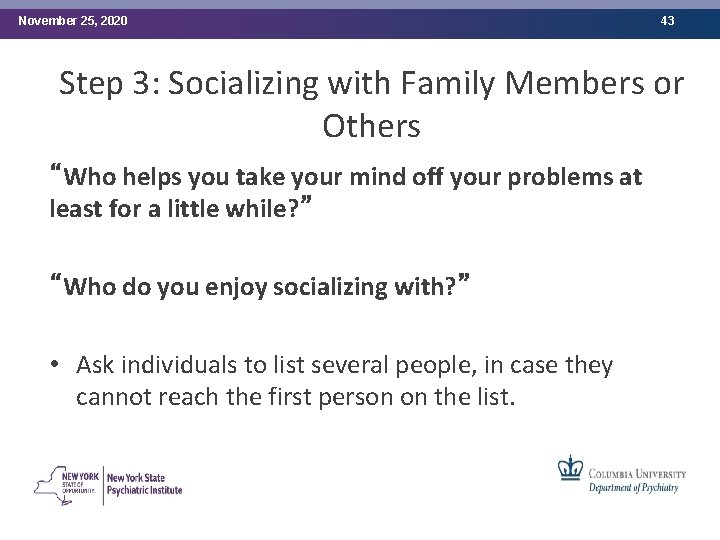
November 25, 2020 43 Step 3: Socializing with Family Members or Others “Who helps you take your mind off your problems at least for a little while? ” “Who do you enjoy socializing with? ” • Ask individuals to list several people, in case they cannot reach the first person on the list.
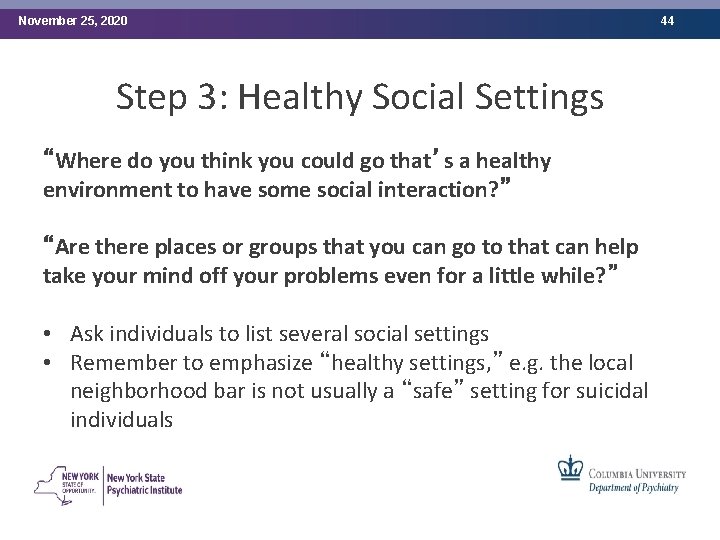
November 25, 2020 Step 3: Healthy Social Settings “Where do you think you could go that’s a healthy environment to have some social interaction? ” “Are there places or groups that you can go to that can help take your mind off your problems even for a little while? ” • Ask individuals to list several social settings • Remember to emphasize “healthy settings, ” e. g. the local neighborhood bar is not usually a “safe” setting for suicidal individuals 44
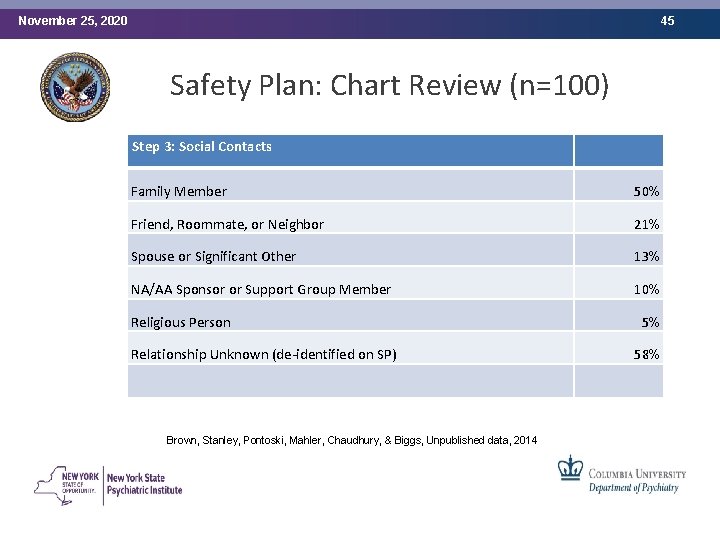
November 25, 2020 45 Safety Plan: Chart Review (n=100) Step 3: Social Contacts Family Member 50% Friend, Roommate, or Neighbor 21% Spouse or Significant Other 13% NA/AA Sponsor or Support Group Member 10% Religious Person Relationship Unknown (de-identified on SP) Brown, Stanley, Pontoski, Mahler, Chaudhury, & Biggs, Unpublished data, 2014 5% 58%
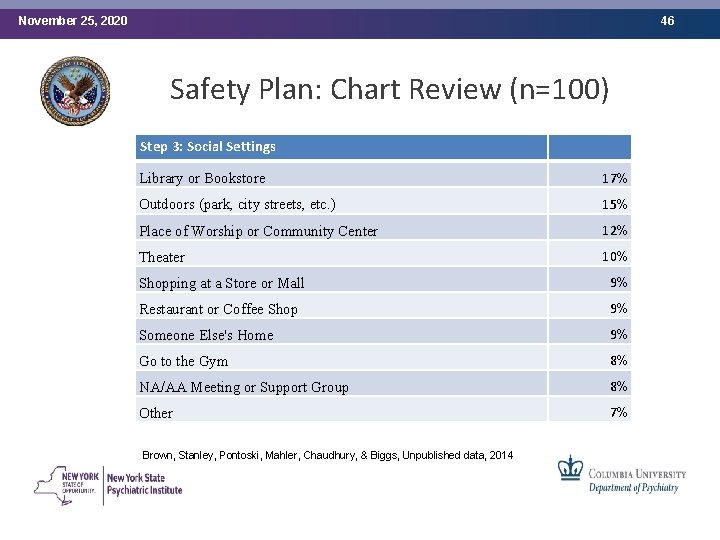
November 25, 2020 46 Safety Plan: Chart Review (n=100) Step 3: Social Settings Library or Bookstore 17% Outdoors (park, city streets, etc. ) 15% Place of Worship or Community Center 12% Theater 10% Shopping at a Store or Mall 9% Restaurant or Coffee Shop 9% Someone Else's Home 9% Go to the Gym 8% NA/AA Meeting or Support Group 8% Other 7% Brown, Stanley, Pontoski, Mahler, Chaudhury, & Biggs, Unpublished data, 2014
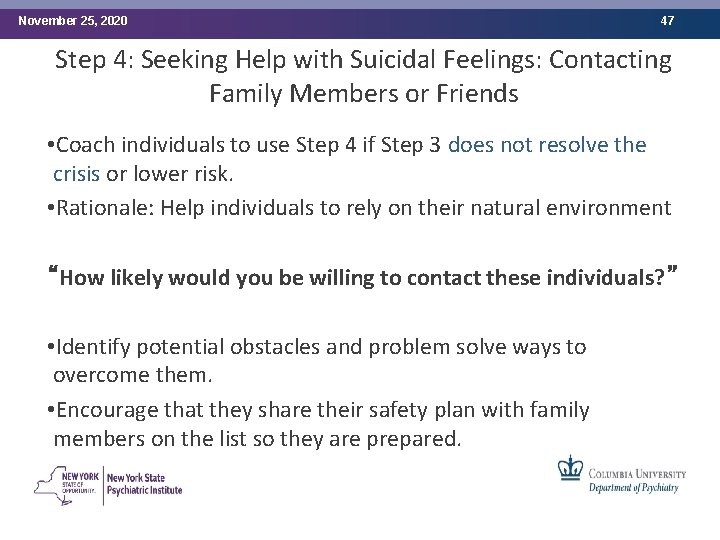
November 25, 2020 47 Step 4: Seeking Help with Suicidal Feelings: Contacting Family Members or Friends • Coach individuals to use Step 4 if Step 3 does not resolve the crisis or lower risk. • Rationale: Help individuals to rely on their natural environment “How likely would you be willing to contact these individuals? ” • Identify potential obstacles and problem solve ways to overcome them. • Encourage that they share their safety plan with family members on the list so they are prepared.
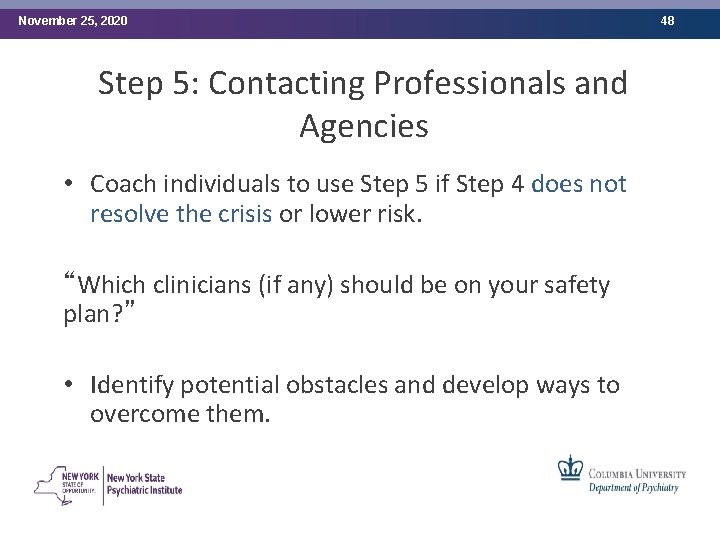
November 25, 2020 Step 5: Contacting Professionals and Agencies • Coach individuals to use Step 5 if Step 4 does not resolve the crisis or lower risk. “Which clinicians (if any) should be on your safety plan? ” • Identify potential obstacles and develop ways to overcome them. 48
November 25, 2020 Step 5: Contacting Professionals and Agencies • List names, numbers and/or locations of: • Clinicians • Local ED or other emergency services • Suicide Prevention Hotlines 800 -273 -TALK (8255) Text to 741741 49
November 25, 2020 50 Step 6: Reducing the Potential for Use of Lethal Means • Rationale for placement at the end of the safety plan: If individuals have a sense of alternatives to suicidal behavior, they are more likely to engage in a discussion of means restriction • The main idea is to put some distance/time between the suicidal person and the means to kill themselves. • Ask individuals what means they would consider using during a suicidal crisis. • Regardless, the counselor should always ask whether the individual has access to a firearm.
November 25, 2020 51 Step 6: Reducing the Potential for Use of Lethal Means • For methods with low lethality, counselors may ask individuals to remove or restrict their access to these methods themselves. – For example, if individuals are considering overdosing, discuss throwing out any unnecessary medication.
November 25, 2020 52 Step 6: Reducing the Potential for Use of Lethal Means • For methods with high lethality, collaboratively identify ways for a responsible person to secure or limit access. – For example, if individuals are considering shooting themselves, suggest that they ask a trusted family member to store the gun in a secure place.
November 25, 2020 53
November 25, 2020 Implementation: What is the Likelihood of Use? “Where will you keep your safety plan? ” “How will you remember that you have a safety plan when you are in a crisis? ” “How likely is it that you will use the safety plan when you notice the warning signs that we have discussed? ” “How can you fight the urge, if present, to not try to help yourself? ” 54
November 25, 2020 Implementation: What is the Likelihood of Use? “What might get in the way or serve as a barrier to your using the safety plan? ” –Help the individual find ways to overcome these barriers. –May be adapted for brief crisis cards, cell phones or other portable electronic devices – must be readily accessible and easy-to-use. –Identify cues to use the safety plan. 55
November 25, 2020 Implementation: Review the Safety Plan Periodically • Periodically review, discuss, and possibly revise the safety plan after each time is it used and on follow up calls. • The plan is not a static document. • It should be revised as individuals’ circumstances and needs change over time. 56
November 25, 2020 57 Important Caveats • Individuals may not want to do one step; encourage them to try but don’t insist on completing every step – Sometimes people can’t think of anything or anyone – People know that certain strategies “just don’t work for them. ” Leave it blank and make it a focus of treatment • Let individuals know that this is a tool to help them, and although there are prescribed steps, if they feel in imminent danger they should seek the level of care that will keep them safe.
November 25, 2020 58 Demonstration Video
November 25, 2020 59 Effectiveness of SPI • Interviewed 100 ‘moderate’ risk Veterans who were given the SPI in a VA ED • Interviewed 3 mo-2 years after ED visit • All remembered the SPI was done in ED • All could say where their plan was currently • 91% felt the safety plan was very helpful in making them feel connected to and cared for at the VA
November 25, 2020 60 SPI Evaluation • Most Veterans (93%) indicated that they would recommend the interventions to a friend (and 6% had already done so). • No Veteran thought the safety plan intervention was harmful • 5% felt it was too long, did not target anger enough or found it difficult to use when depressed.
November 25, 2020 61 Evaluation by Veteran Users When asked which aspects of the safety plan were most useful, – 8. 3% recognizing warning signs – 33. 3% internal coping strategies – 25% sources of social support – 12% reported that simply having a crisis plan was helpful – 12% reported that having the safety plan enhanced their sense of self efficacy. For example, one Veteran noted that “You don't realize what to do when you are in that (suicidal) situation, having planned activities like going to a coffee shop and remembering to breathe are effective. ”
November 25, 2020 62 Reactions “It helped me not to be such a tough guy and actually go for the help that I needed. ” “I would tell them (others at risk) it saved my life. ” “I never thought I could do anything about my suicidal feelings, now I know that I am not at their mercy. ” “How has the safety plan helped me? It has saved my life more than once. ”
November 25, 2020 63 Reactions cont. “I think it is very helpful, especially with people going through depression, with showing you and telling you how to use different coping skills……. ” “Gave me the opportunity to more clearly define signs, when my mood is beginning to deteriorate and when to start taking steps to prevent further worsening…. . . ” “I like the safety plan. I hung it on my wall…. it helps me remember how to deal with things. ” “It hadn’t occurred to me before that I could do something about my suicidal feelings. ”
November 25, 2020 64 Current Uses • VA • All High Suicide Risk Veterans • ED demonstration project for moderate risk Veterans not requiring hospitalization • Military---Clinical trial—Walter Reed—suicidal service members hospitalized • NY State OMH Outpatient Clinics---Standard of Care Crisis Hotlines (NSPL) particularly follow-up calls • EDs, Inpatient Units, Outpatient Clinics (as initial part of treatment with suicidal patients) • Identified as a Best Practice on the SPRC-AFSP - Registry of Best Practices for Suicide Prevention
November 25, 2020 Safety Planning Intervention Resources • Stanley B & Brown GK, A Brief Intervention to Mitigate Suicide Risk. Cognitive and Behavioral Practice, 19: 2, May 2012, 256 -264. • Safety Planning in the VA (Stanley & Brown VA Safety Planning Manual, 2008) • SPI designated as a Best Practice by the SPRC/AFSP Registry of Best for Suicide Prevention • Safety Plan template: www. suicidesafetyplan. com • Brenner LA et al. Executive Functioning and Suicidal Behavior Among Veterans with and without a History of Traumatic Brain Injury. Archives of Physical Medicine & Rehabilitation 65
- Slides: 65