
The Standard Model Part II The Future of
- Slides: 16
The Standard Model Part II
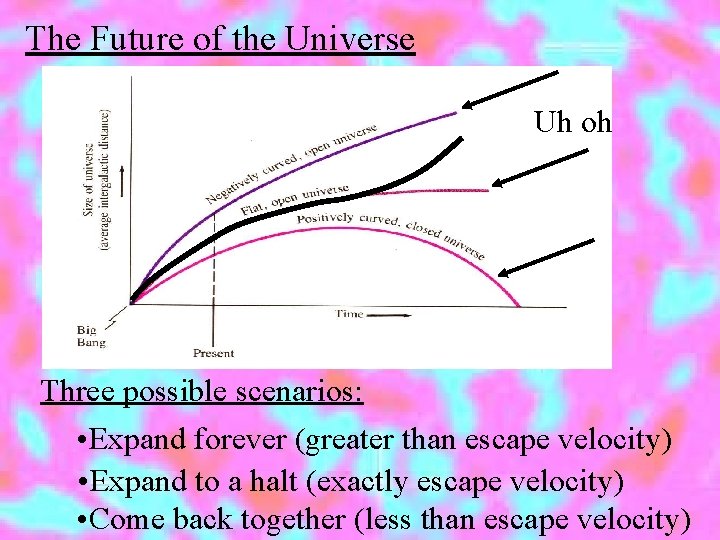
The Future of the Universe Uh oh Three possible scenarios: • Expand forever (greater than escape velocity) • Expand to a halt (exactly escape velocity) • Come back together (less than escape velocity)
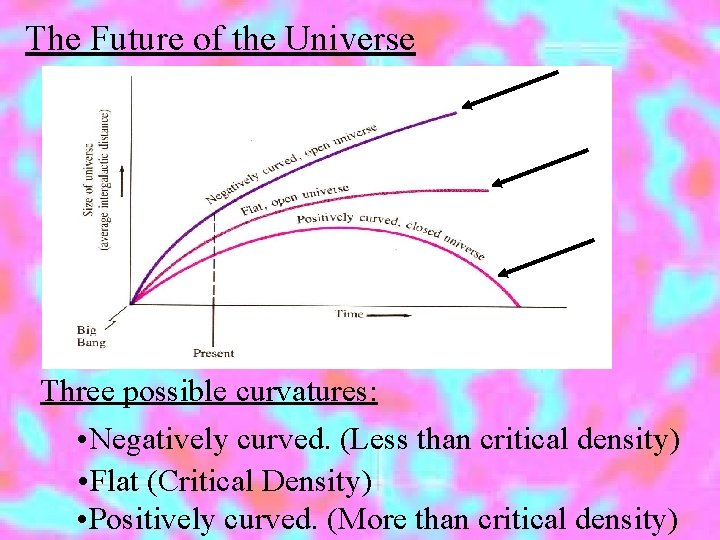
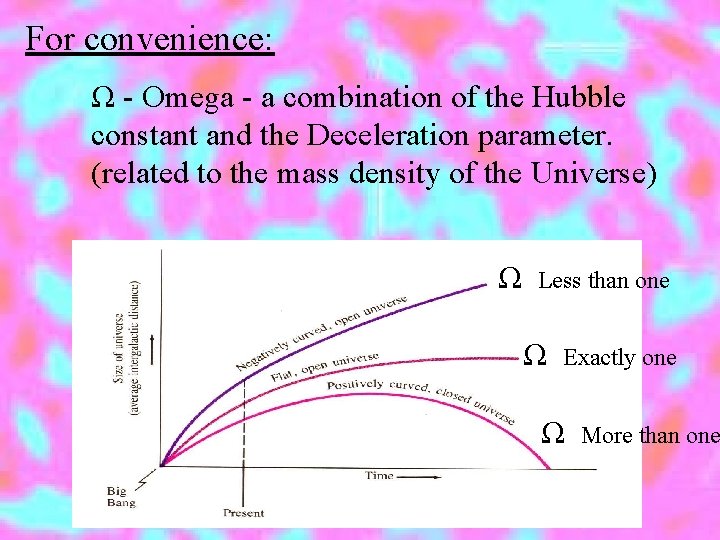
The Future of the Universe Three possible curvatures: • Negatively curved. (Less than critical density) • Flat (Critical Density) • Positively curved. (More than critical density)
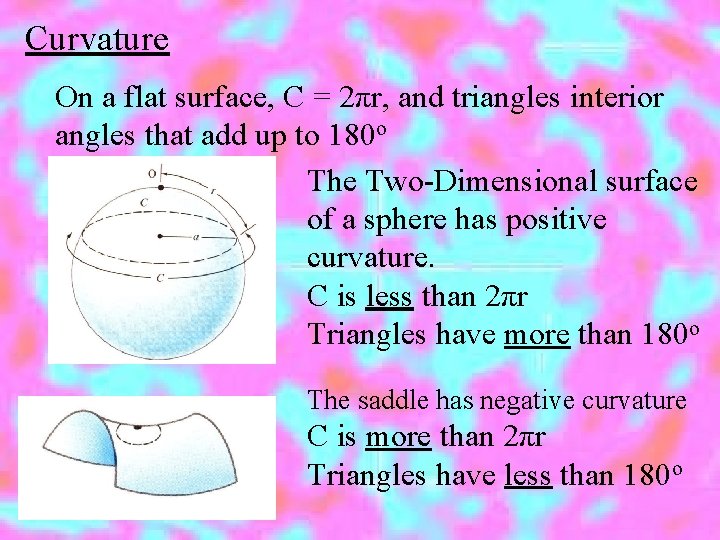
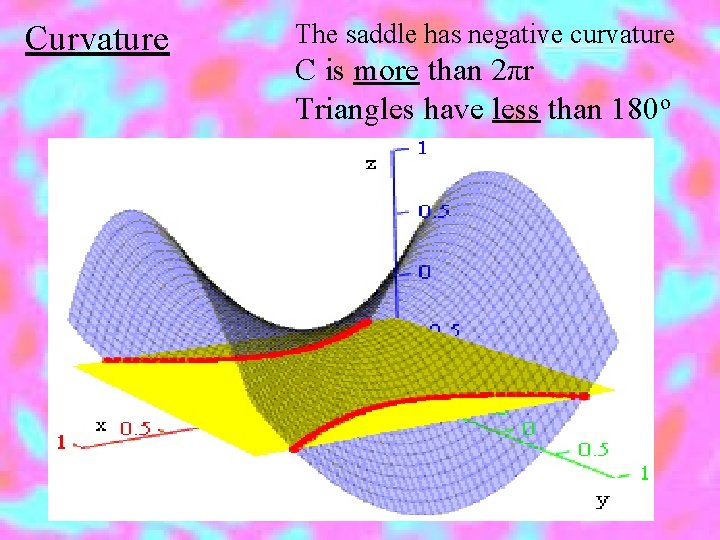
Curvature On a flat surface, C = 2πr, and triangles interior angles that add up to 180 o The Two-Dimensional surface of a sphere has positive curvature. C is less than 2πr Triangles have more than 180 o The saddle has negative curvature C is more than 2πr Triangles have less than 180 o
Curvature The saddle has negative curvature C is more than 2πr Triangles have less than 180 o
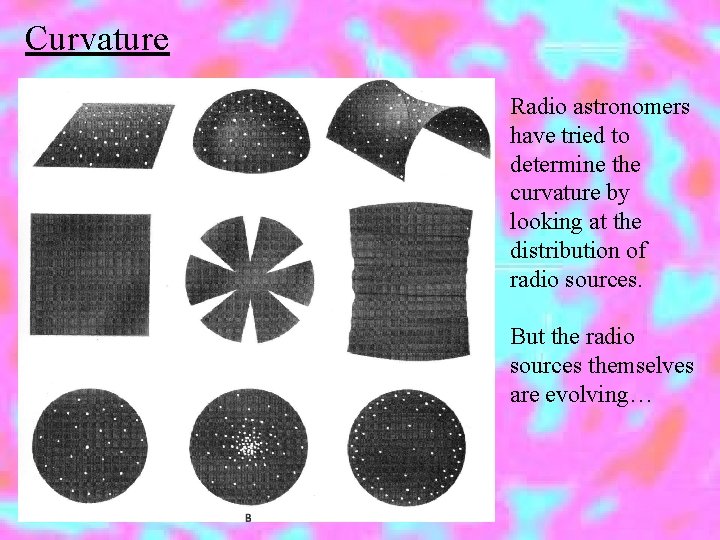
Curvature Radio astronomers have tried to determine the curvature by looking at the distribution of radio sources. But the radio sources themselves are evolving…
The search for 3 numbers… Ho - The Hubble constant The current rate of expansion We think it is 71± 2. 5 km/s/Mpc qo - The deceleration parameter Rate of braking due to gravity λ - The cosmological constant Anti gravity. (Nobody likes this one much)
For convenience: Ω - Omega - a combination of the Hubble constant and the Deceleration parameter. (related to the mass density of the Universe) Ω Less than one Ω Exactly one Ω More than one
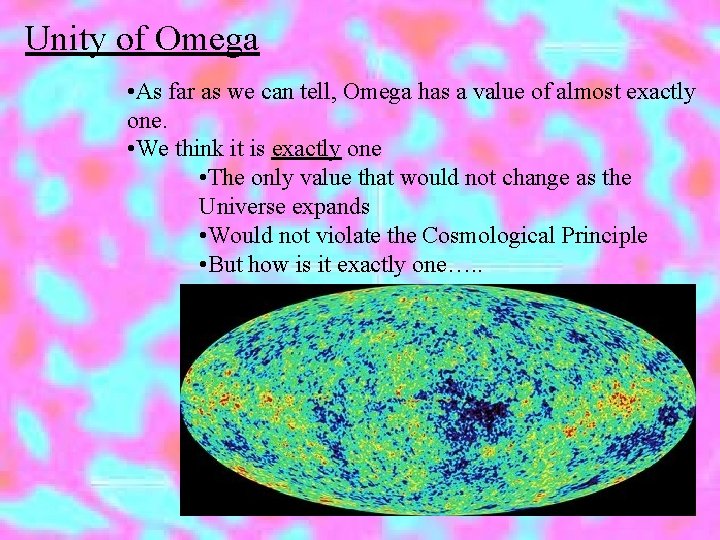
Unity of Omega • As far as we can tell, Omega has a value of almost exactly one. • We think it is exactly one • The only value that would not change as the Universe expands • Would not violate the Cosmological Principle • But how is it exactly one…. .
Inflationary Hypothesis • As far as we can see, the Universe is flat • Coincidence? • Inflationary hypothesis: • The early Universe expanded much faster than the speed of light. • The visible universe is much smaller than the entire universe (proton to earth) • It only appears flat. • We may never know the true curvature.
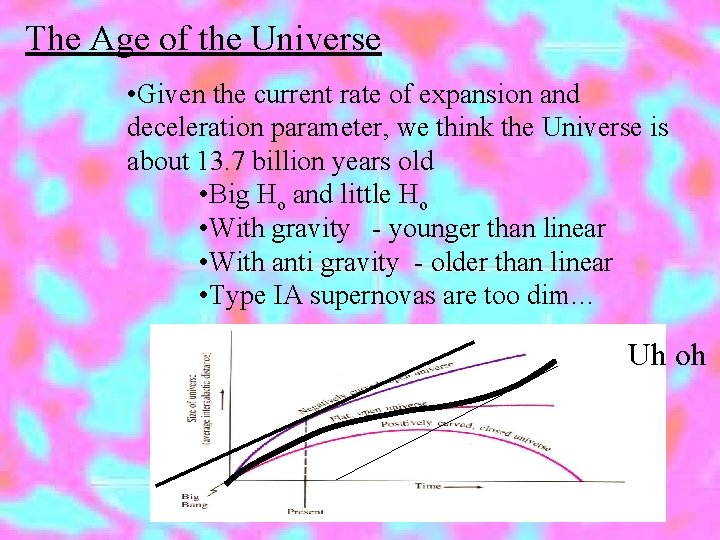
The Age of the Universe • Given the current rate of expansion and deceleration parameter, we think the Universe is about 13. 7 billion years old • Big Ho and little Ho • With gravity - younger than linear • With anti gravity - older than linear • Type IA supernovas are too dim… Uh oh
The Age of the Universe • Given the current rate of expansion and deceleration parameter, we think the Universe is about 13. 7 billion years old • Big Ho and little Ho • With gravity - older • With anti gravity - younger • Stellar physicists calculate that the oldest stars are also about 13. 7 billion years old • Nuclear decay also suggests an age around 13. 7 billion years. • Meteors from the solar system
Problems with the big bang • We can see only about 10% of the matter that we know must be there. • Deceleration parameter • Motion of galaxies • Spiral galaxies are perhaps stabilized by a halo of dark matter • Increase of the expansion rate (IA supernovas)
Where is all the matter? Two candidates for dark matter: • MAssive Compact Halo Objects. (MACHOs) - baryonic (normal) matter • Star cinders • Microlensing survey • Variable stars • Weakly Interacting Massive Particles (WIMPs) - non baryonic • Structure of galaxies implies WIMPS • Neutrinos • LSP
“Paradoxes” of the Big Bang: • There can be no effect without a cause. • Quantum mechanics deals with many things that have no cause. • God apparently does play with dice • You can’t get something from nothing. • The net energy of the universe may be zero • Gravitational energy is negative • Other energies are positive • Infinite regress: what came before? • May be a “bedrock” paradox • The universe might have arisen from a quantum fluctuation. A big one.
Other Theories (that pretty much everyone ignores) Expansion of the Universe • Tired Light theory • E = hf • Redshift is due to energy loss • C-Field • Matter is being created in all parts of the infinitely old Universe. • How do you explain the CMB? • Plasma model • Pulsations - some parts expand, others contract. • Hasn’t made testable predictions.