
THE STANDARD MODEL OF PARTICLE PHYSICS WITHOUT ANY




- Slides: 36
THE STANDARD MODEL OF PARTICLE PHYSICS (WITHOUT ANY COMPLICATED MATH) Michael Mc. Ginnis michaelmcginnis 2026@u. northwestern. edu
Expectations and goals Ask questions
What is the Standard Model? ■ The Standard Model is theory of elementary particles and how they interact. – 17 particles, 3 interactions – Immense predictive power, including the prediction of several particles and their properties before they were discovered. ■ Built upon quantum field theory: combines classical mechanics, quantum mechanics, and special relativity. – Fields are the fundamental object, and particles are certain (excited) states of those fields. – Fields are objects which take a value (scalar, vector, tensor) for each point in space and time. EX: Temperature field of this room. Gravitational field exerted by the Sun. ■ Model: The SM is not the truth it is a model. It is something that has been constructed under certain assumptions and can be used to make predictions but has a realm of relevance. – It works on the scale of particles but isn’t useful to understand planetary motion.
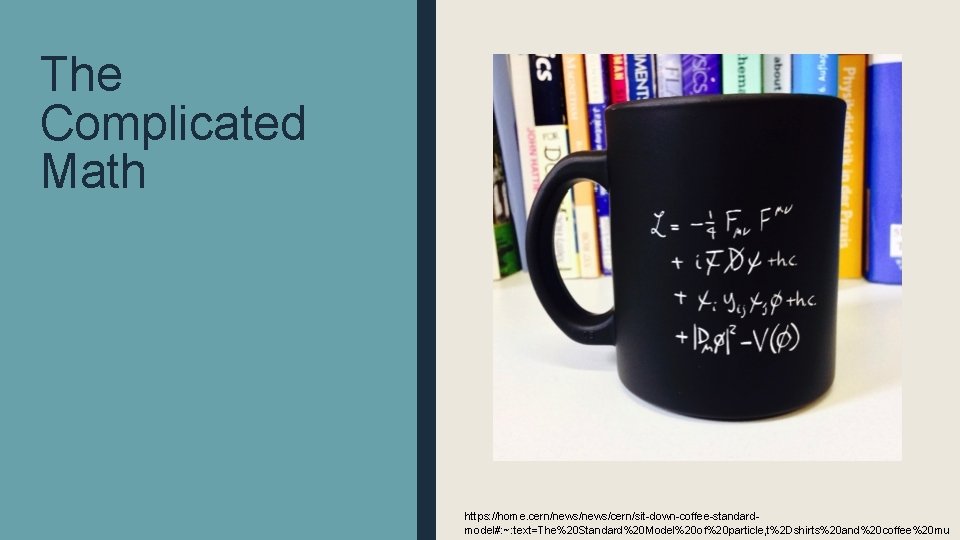
The Complicated Math https: //home. cern/news/cern/sit-down-coffee-standardmodel#: ~: text=The%20 Standard%20 Model%20 of%20 particle, t%2 Dshirts%20 and%20 coffee%20 mu
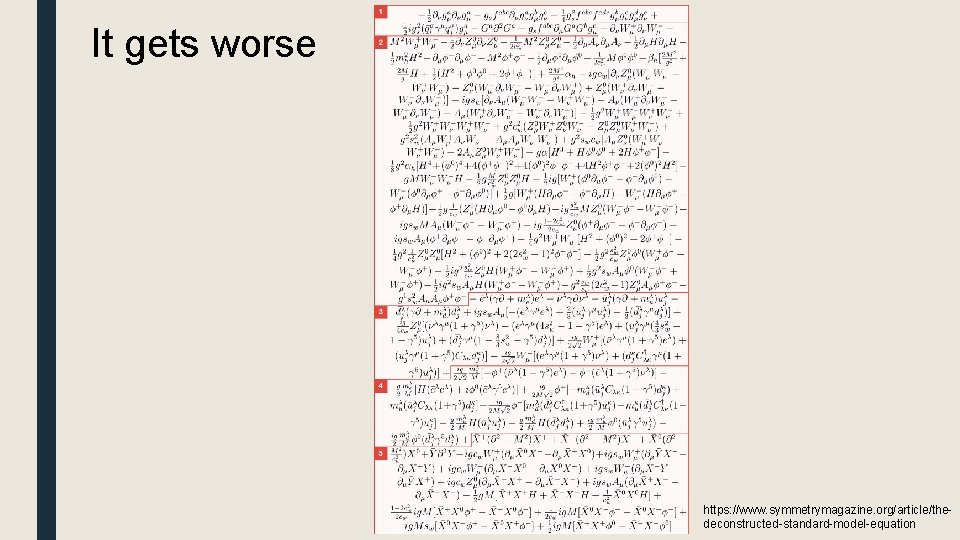
It gets worse https: //www. symmetrymagazine. org/article/thedeconstructed-standard-model-equation
PARTICLES OF THE STANDARD MODEL
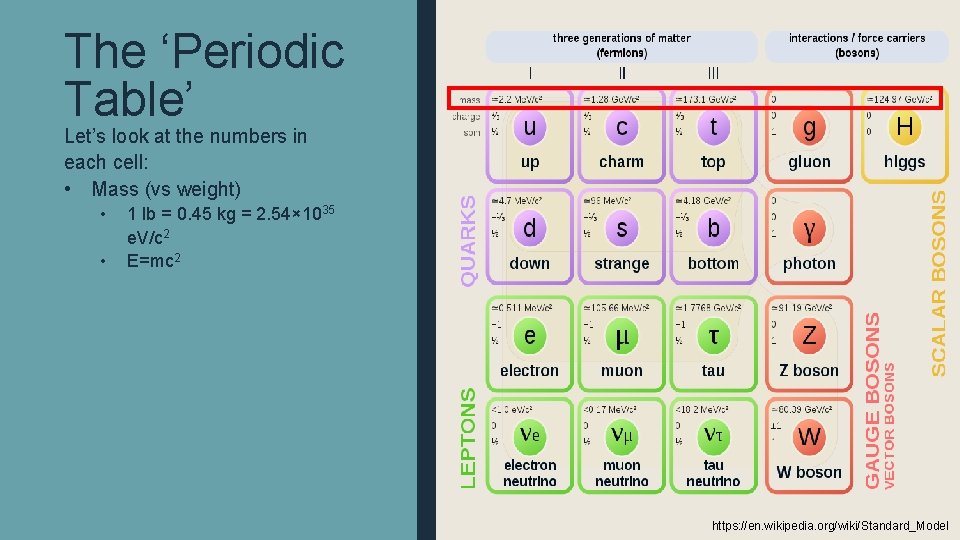
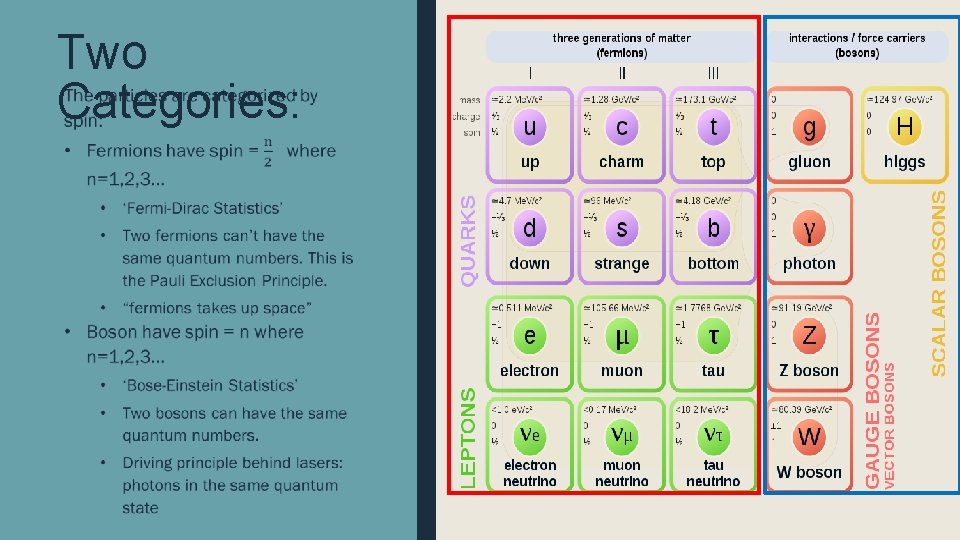
The ‘Periodic Table’ Let’s look at the numbers in each cell: • Mass (vs weight) • • 1 lb = 0. 45 kg = 2. 54× 1035 e. V/c 2 E=mc 2 https: //en. wikipedia. org/wiki/Standard_Model
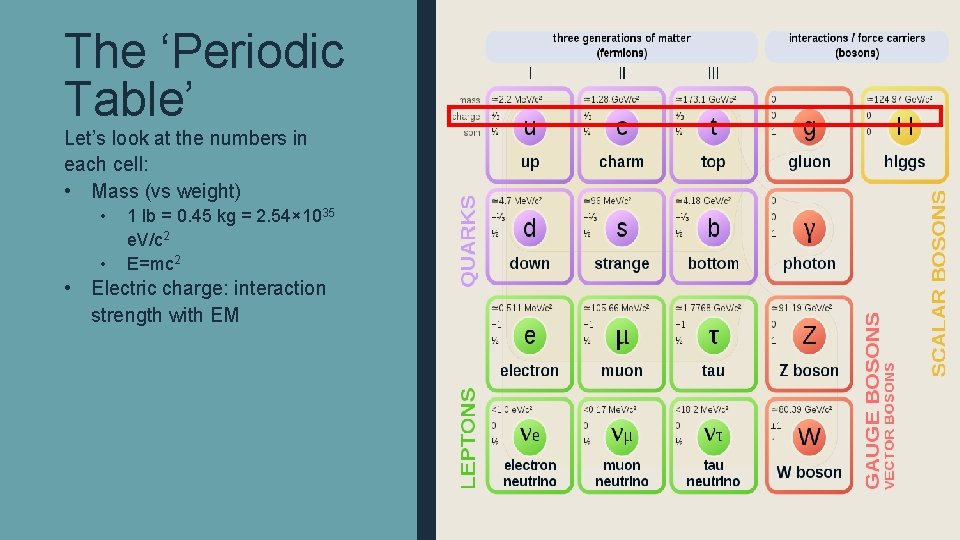
The ‘Periodic Table’ Let’s look at the numbers in each cell: • Mass (vs weight) • • 1 lb = 0. 45 kg = 2. 54× 1035 e. V/c 2 E=mc 2 • Electric charge: interaction strength with EM
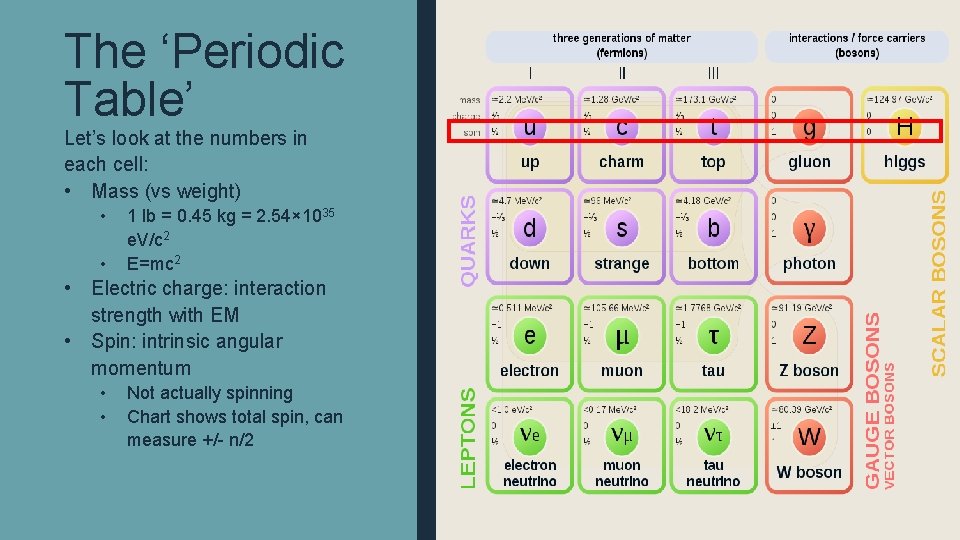
The ‘Periodic Table’ Let’s look at the numbers in each cell: • Mass (vs weight) • • 1 lb = 0. 45 kg = 2. 54× 1035 e. V/c 2 E=mc 2 • Electric charge: interaction strength with EM • Spin: intrinsic angular momentum • • Not actually spinning Chart shows total spin, can measure +/- n/2
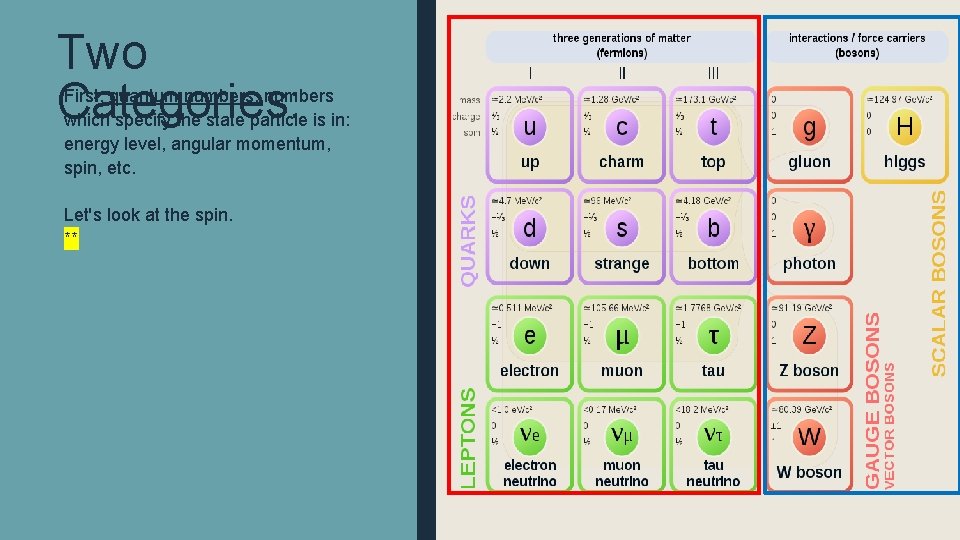
Two Categories: First, quantum numbers: numbers which specify the state particle is in: energy level, angular momentum, spin, etc. Let's look at the spin. **
Two Categories:
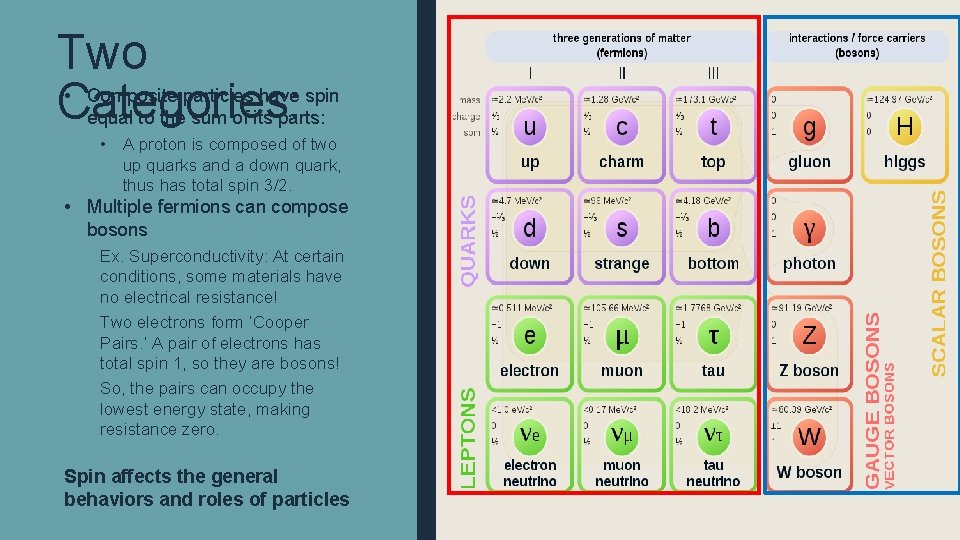
Two • Categories: Composite particles have spin equal to the sum of its parts: • A proton is composed of two up quarks and a down quark, thus has total spin 3/2. • Multiple fermions can compose bosons Ex. Superconductivity: At certain conditions, some materials have no electrical resistance! Two electrons form ‘Cooper Pairs. ’ A pair of electrons has total spin 1, so they are bosons! So, the pairs can occupy the lowest energy state, making resistance zero. Spin affects the general behaviors and roles of particles
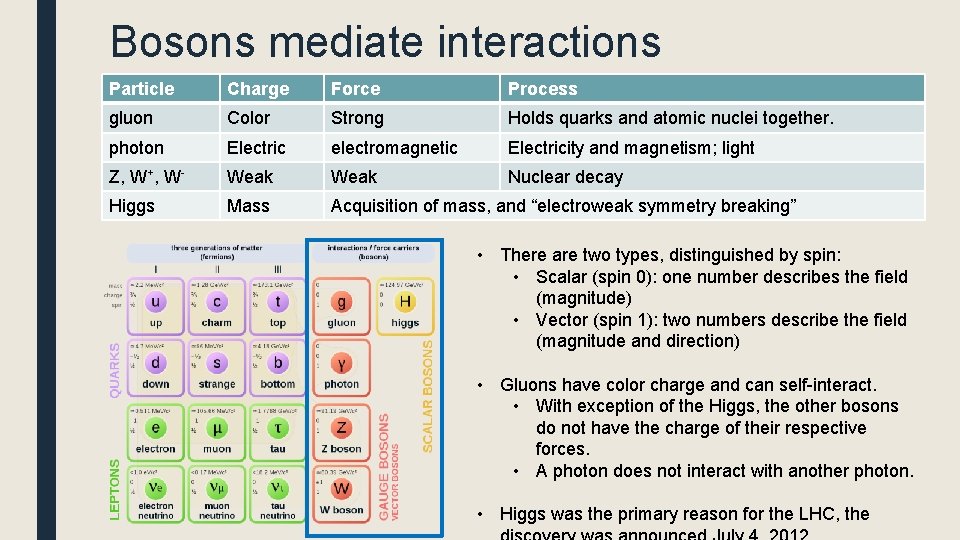
Bosons mediate interactions Particle Charge Force Process gluon Color Strong Holds quarks and atomic nuclei together. photon Electric electromagnetic Electricity and magnetism; light Z, W+, W- Weak Nuclear decay Higgs Mass Acquisition of mass, and “electroweak symmetry breaking” • There are two types, distinguished by spin: • Scalar (spin 0): one number describes the field (magnitude) • Vector (spin 1): two numbers describe the field (magnitude and direction) • Gluons have color charge and can self-interact. • With exception of the Higgs, the other bosons do not have the charge of their respective forces. • A photon does not interact with another photon. • Higgs was the primary reason for the LHC, the
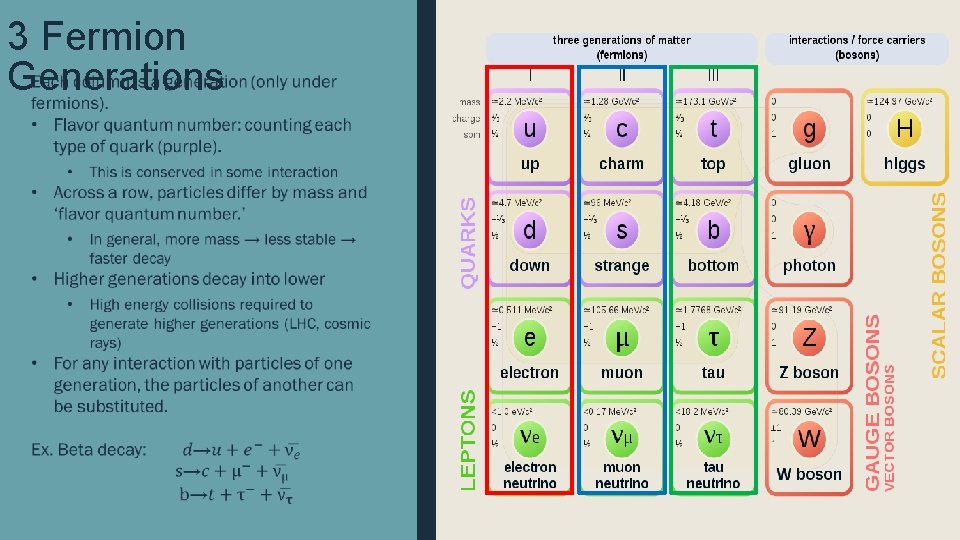
3 Fermion Generations
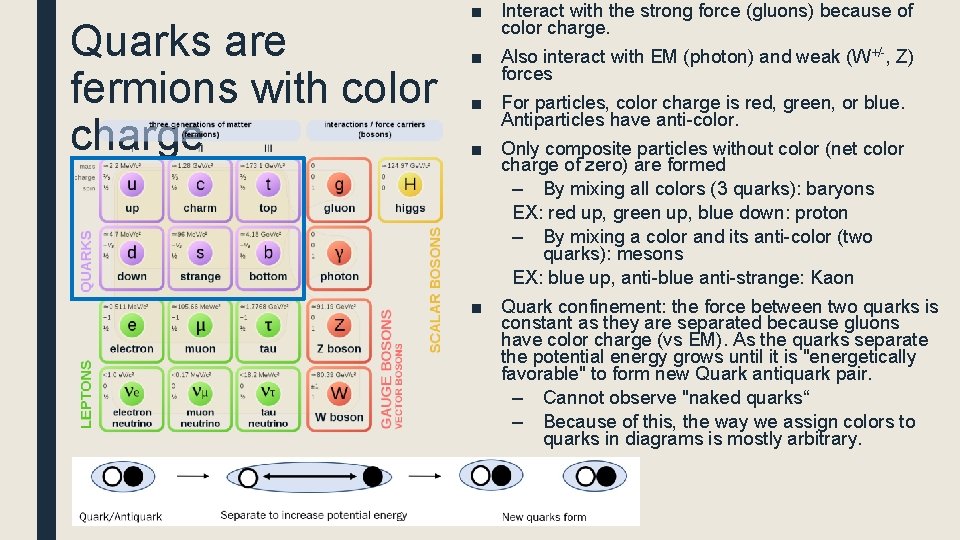
Quarks are fermions with color charge ■ Interact with the strong force (gluons) because of color charge. ■ Also interact with EM (photon) and weak (W+/-, Z) forces ■ For particles, color charge is red, green, or blue. Antiparticles have anti-color. ■ Only composite particles without color (net color charge of zero) are formed – By mixing all colors (3 quarks): baryons EX: red up, green up, blue down: proton – By mixing a color and its anti-color (two quarks): mesons EX: blue up, anti-blue anti-strange: Kaon ■ Quark confinement: the force between two quarks is constant as they are separated because gluons have color charge (vs EM). As the quarks separate the potential energy grows until it is "energetically favorable" to form new Quark antiquark pair. – Cannot observe "naked quarks“ – Because of this, the way we assign colors to quarks in diagrams is mostly arbitrary.
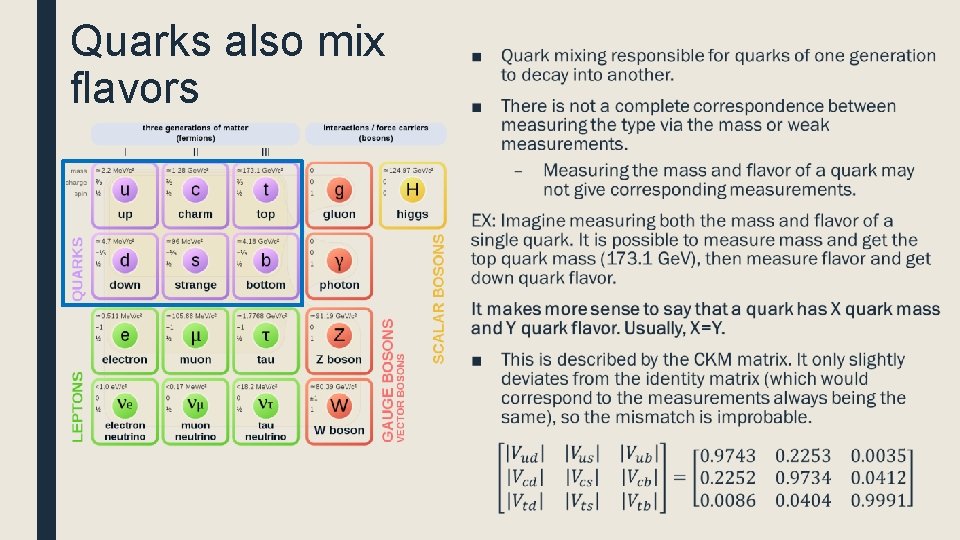
Quarks also mix flavors ■
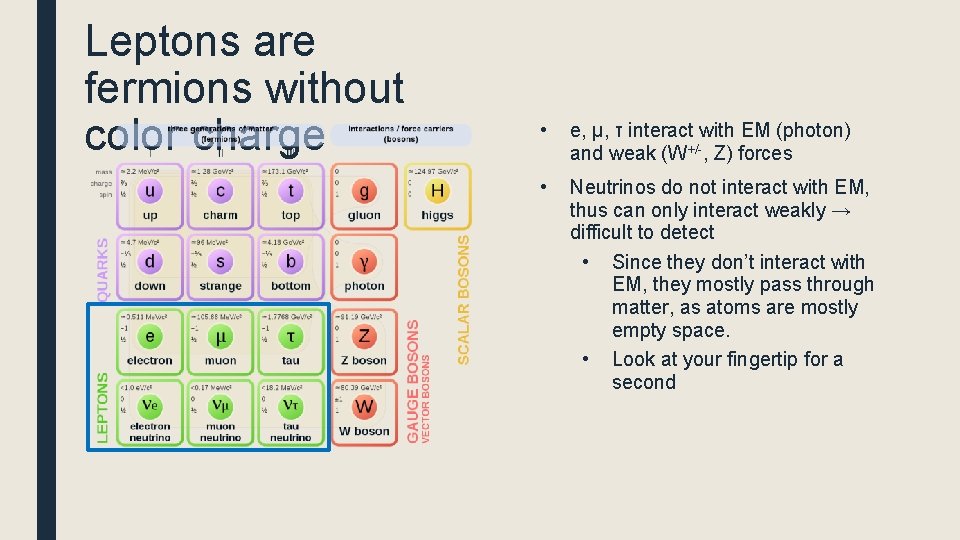
Leptons are fermions without color charge • e, µ, τ interact with EM (photon) and weak (W+/-, Z) forces • Neutrinos do not interact with EM, thus can only interact weakly → difficult to detect • Since they don’t interact with EM, they mostly pass through matter, as atoms are mostly empty space. • Look at your fingertip for a second
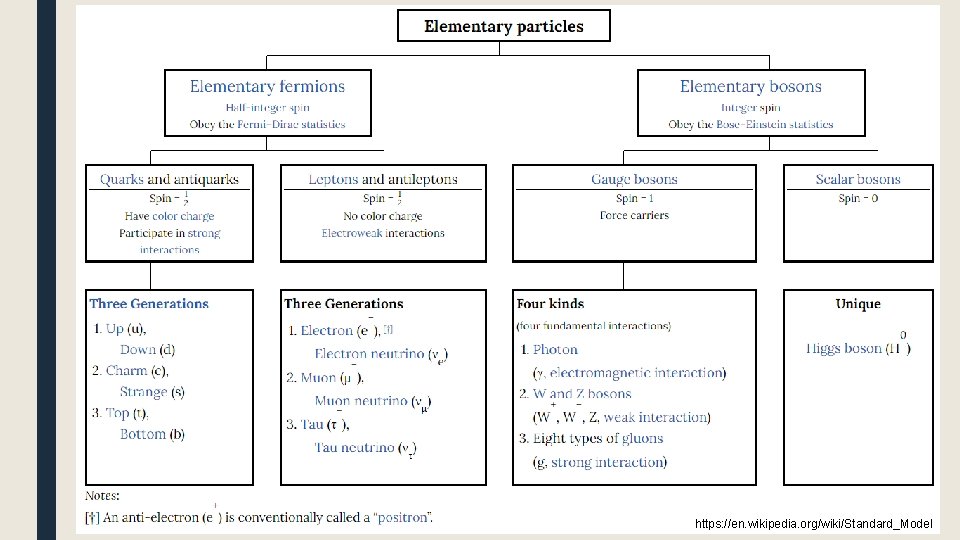
https: //en. wikipedia. org/wiki/Standard_Model
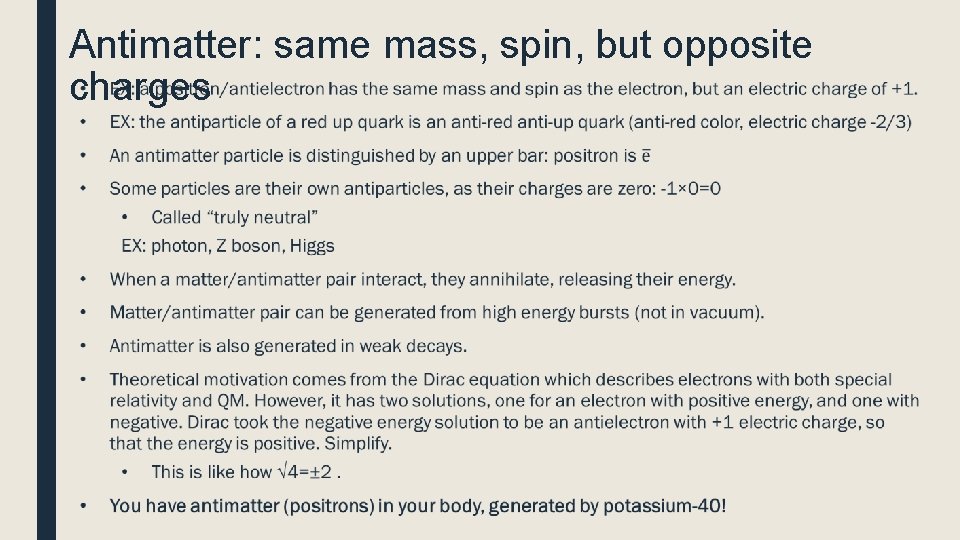
Antimatter: same mass, spin, but opposite ■ charges
INTERACTIONS OF THE STANDARD MODEL
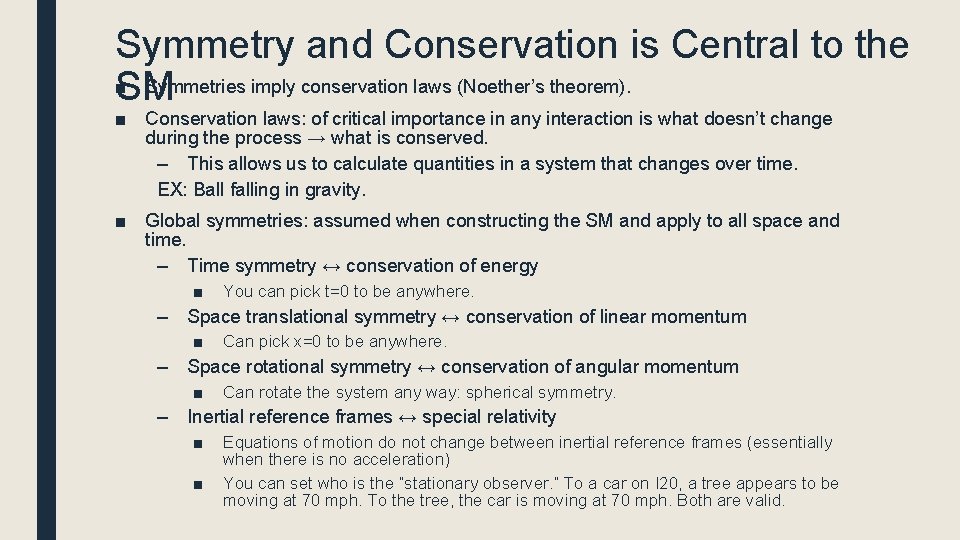
Symmetry and Conservation is Central to the ■ Symmetries imply conservation laws (Noether’s theorem). SM ■ Conservation laws: of critical importance in any interaction is what doesn’t change during the process → what is conserved. – This allows us to calculate quantities in a system that changes over time. EX: Ball falling in gravity. ■ Global symmetries: assumed when constructing the SM and apply to all space and time. – Time symmetry ↔ conservation of energy ■ You can pick t=0 to be anywhere. – Space translational symmetry ↔ conservation of linear momentum ■ Can pick x=0 to be anywhere. – Space rotational symmetry ↔ conservation of angular momentum ■ Can rotate the system any way: spherical symmetry. – Inertial reference frames ↔ special relativity ■ ■ Equations of motion do not change between inertial reference frames (essentially when there is no acceleration) You can set who is the “stationary observer. ” To a car on I 20, a tree appears to be moving at 70 mph. To the tree, the car is moving at 70 mph. Both are valid.
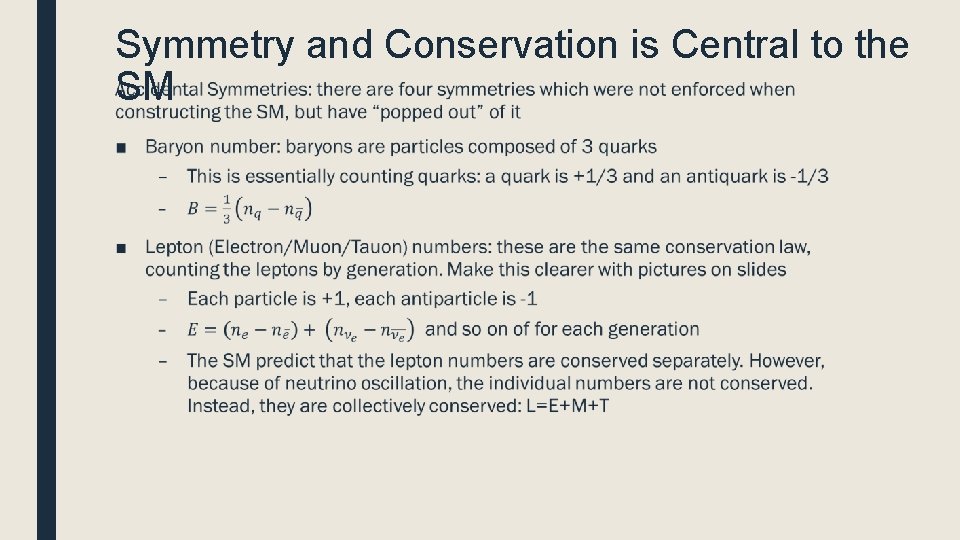
Symmetry and Conservation is Central to the ■ SM
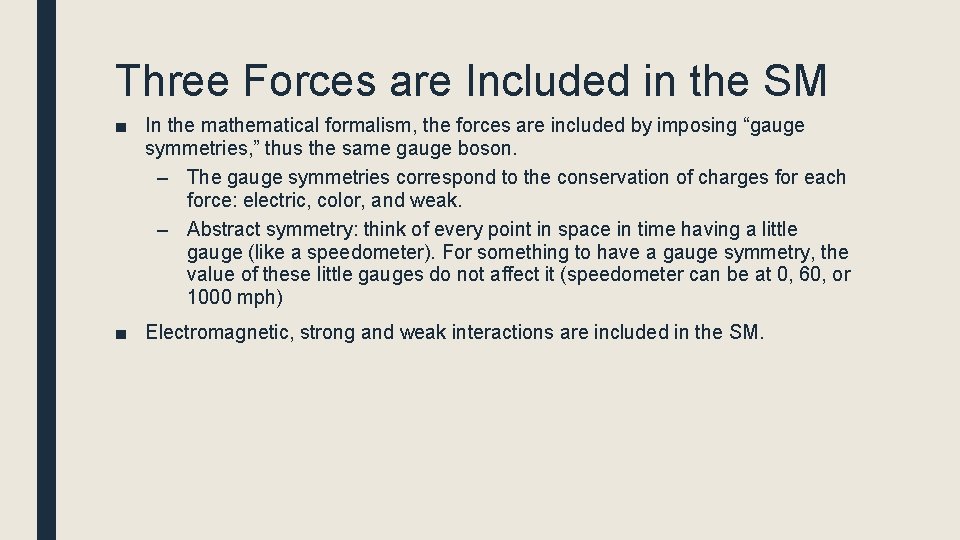
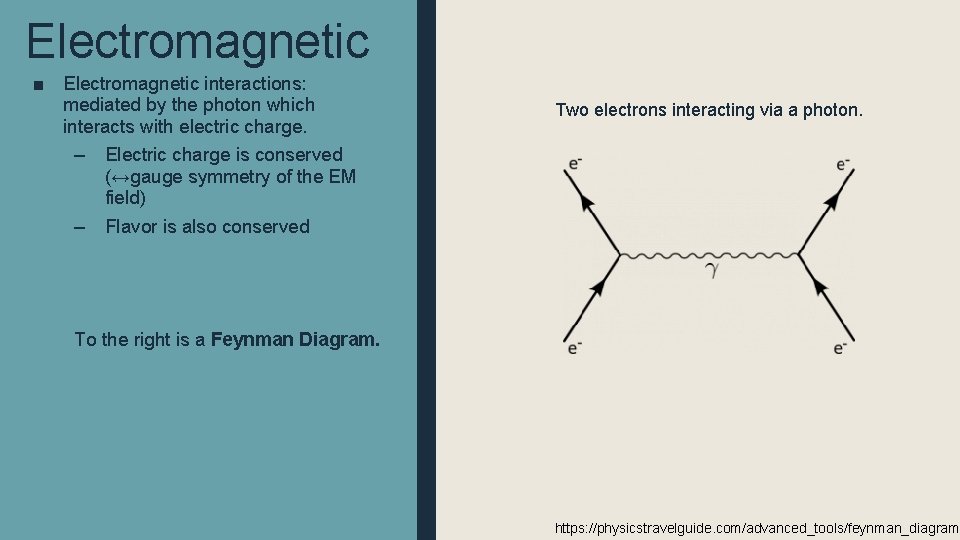
Three Forces are Included in the SM ■ In the mathematical formalism, the forces are included by imposing “gauge symmetries, ” thus the same gauge boson. – The gauge symmetries correspond to the conservation of charges for each force: electric, color, and weak. – Abstract symmetry: think of every point in space in time having a little gauge (like a speedometer). For something to have a gauge symmetry, the value of these little gauges do not affect it (speedometer can be at 0, 60, or 1000 mph) ■ Electromagnetic, strong and weak interactions are included in the SM.
Electromagnetic ■ Electromagnetic interactions: mediated by the photon which interacts with electric charge. – Electric charge is conserved (↔gauge symmetry of the EM field) – Flavor is also conserved Two electrons interacting via a photon. To the right is a Feynman Diagram. https: //physicstravelguide. com/advanced_tools/feynman_diagrams
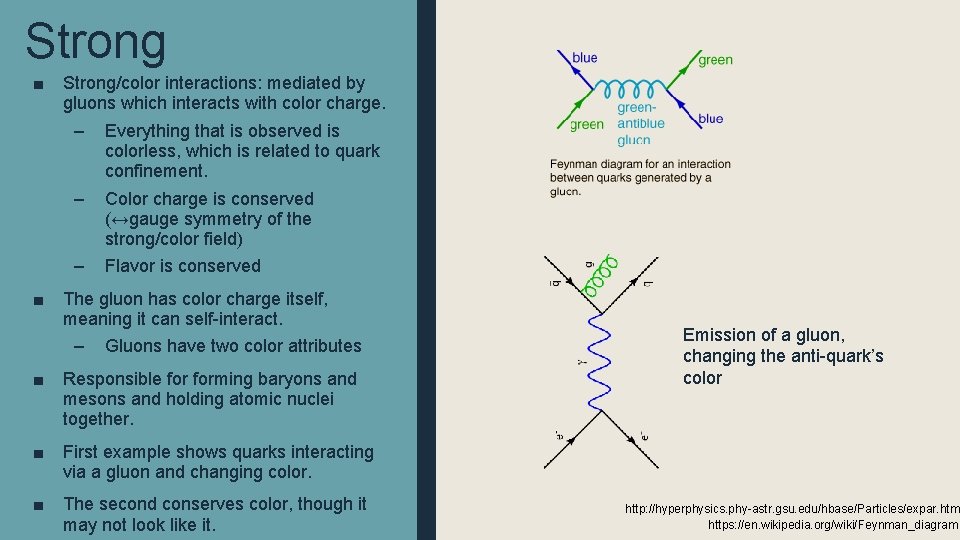
Strong ■ ■ Strong/color interactions: mediated by gluons which interacts with color charge. – Everything that is observed is colorless, which is related to quark confinement. – Color charge is conserved (↔gauge symmetry of the strong/color field) – Flavor is conserved The gluon has color charge itself, meaning it can self-interact. – Gluons have two color attributes ■ Responsible forming baryons and mesons and holding atomic nuclei together. ■ First example shows quarks interacting via a gluon and changing color. ■ The second conserves color, though it may not look like it. Emission of a gluon, changing the anti-quark’s color http: //hyperphysics. phy-astr. gsu. edu/hbase/Particles/expar. html https: //en. wikipedia. org/wiki/Feynman_diagram
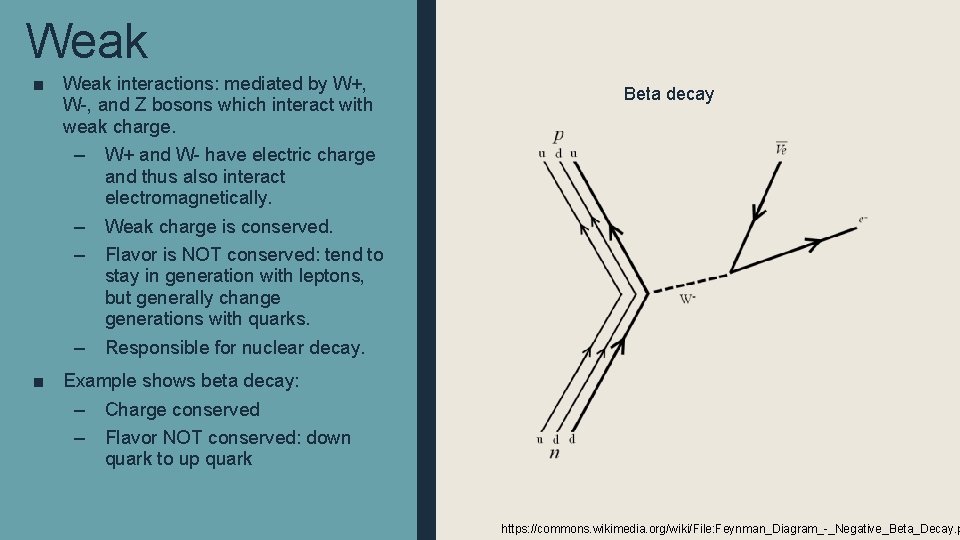
Weak ■ Weak interactions: mediated by W+, W-, and Z bosons which interact with weak charge. – W+ and W- have electric charge and thus also interact electromagnetically. – Weak charge is conserved. – Flavor is NOT conserved: tend to stay in generation with leptons, but generally change generations with quarks. – Responsible for nuclear decay. Beta decay ■ Example shows beta decay: – Charge conserved – Flavor NOT conserved: down quark to up quark https: //commons. wikimedia. org/wiki/File: Feynman_Diagram_-_Negative_Beta_Decay. p
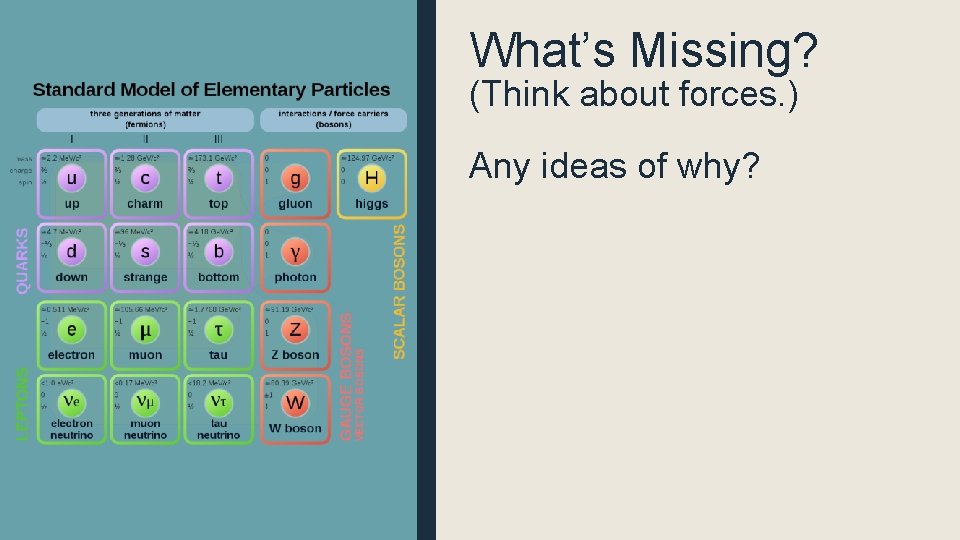
What’s Missing? (Think about forces. ) Any ideas of why?
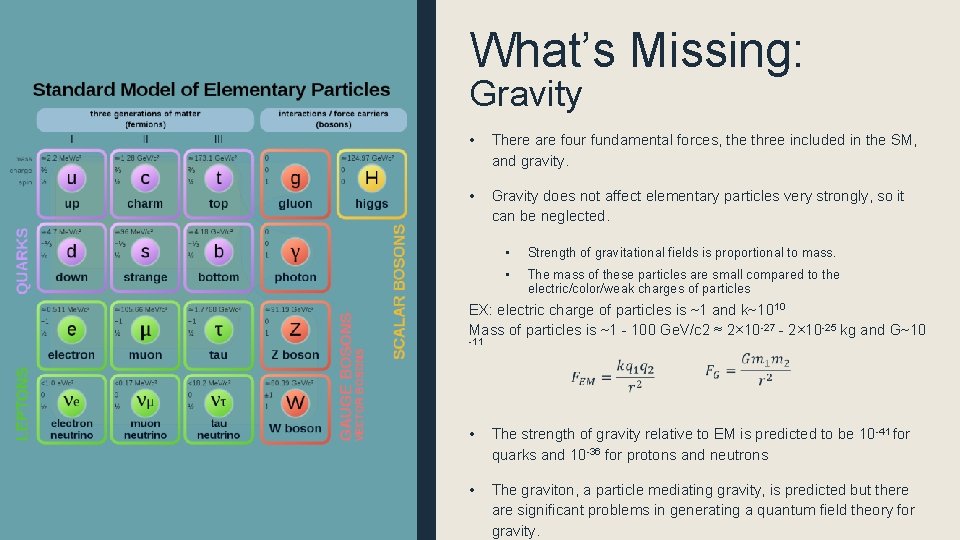
What’s Missing: Gravity • There are four fundamental forces, the three included in the SM, and gravity. • Gravity does not affect elementary particles very strongly, so it can be neglected. • Strength of gravitational fields is proportional to mass. • The mass of these particles are small compared to the electric/color/weak charges of particles EX: electric charge of particles is ~1 and k~1010 Mass of particles is ~1 - 100 Ge. V/c 2 ≈ 2× 10 -27 - 2× 10 -25 kg and G~10 -11 • The strength of gravity relative to EM is predicted to be 10 -41 for quarks and 10 -36 for protons and neutrons • The graviton, a particle mediating gravity, is predicted but there are significant problems in generating a quantum field theory for gravity.
The Higgs is important: why? ■ Some particles acquire mass through interacting with the Higgs field ■ Fermions also acquire mass by interacting with the Higgs, but in a different way. ■ Since the Higgs has mass, it interacts with itself – It decays through pair production (fermions or bosons) and productions of gluons and photons (requires and intermediate step)
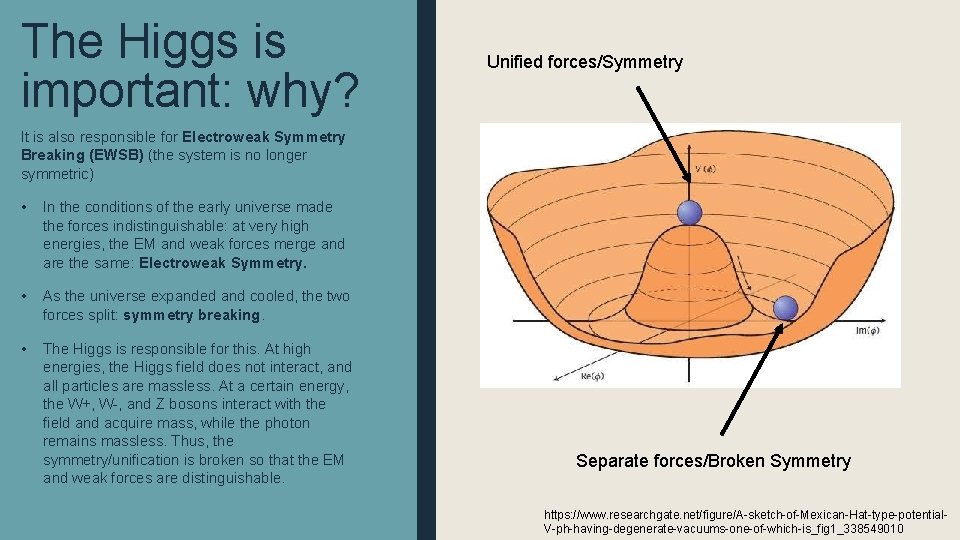
The Higgs is important: why? Unified forces/Symmetry It is also responsible for Electroweak Symmetry Breaking (EWSB) (the system is no longer symmetric) • In the conditions of the early universe made the forces indistinguishable: at very high energies, the EM and weak forces merge and are the same: Electroweak Symmetry. • As the universe expanded and cooled, the two forces split: symmetry breaking. • The Higgs is responsible for this. At high energies, the Higgs field does not interact, and all particles are massless. At a certain energy, the W+, W-, and Z bosons interact with the field and acquire mass, while the photon remains massless. Thus, the symmetry/unification is broken so that the EM and weak forces are distinguishable. Separate forces/Broken Symmetry https: //www. researchgate. net/figure/A-sketch-of-Mexican-Hat-type-potential. V-ph-having-degenerate-vacuums-one-of-which-is_fig 1_338549010
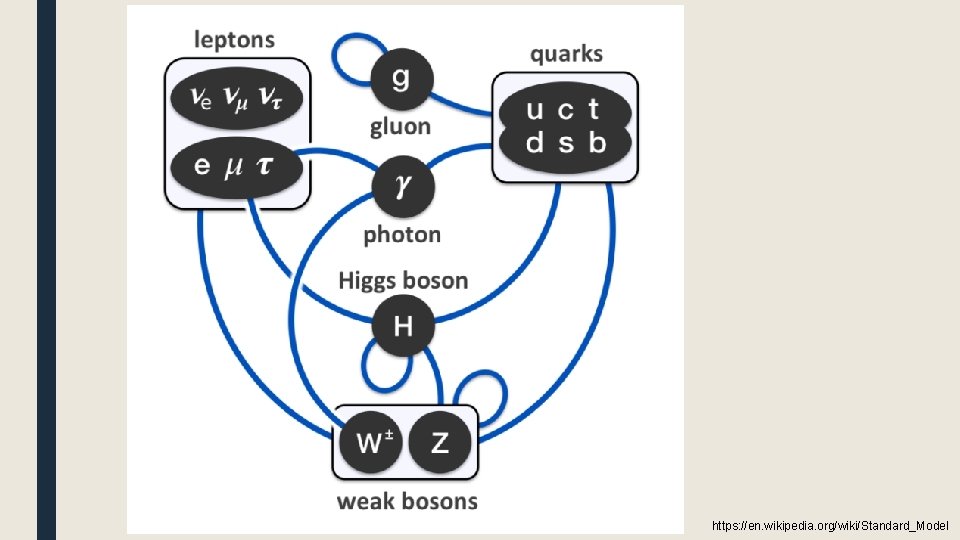
https: //en. wikipedia. org/wiki/Standard_Model
PROBLEMS OF THE STANDARD MODEL
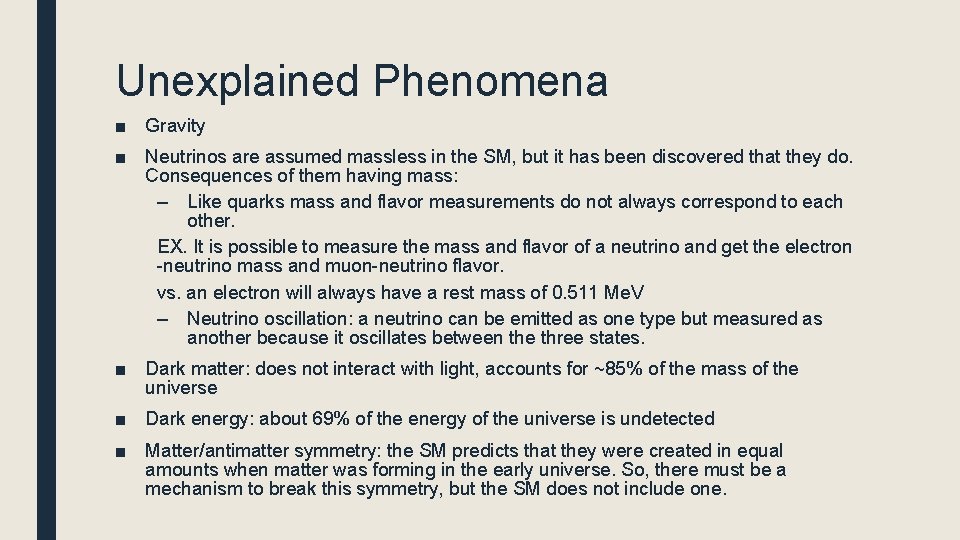
Unexplained Phenomena ■ Gravity ■ Neutrinos are assumed massless in the SM, but it has been discovered that they do. Consequences of them having mass: – Like quarks mass and flavor measurements do not always correspond to each other. EX. It is possible to measure the mass and flavor of a neutrino and get the electron -neutrino mass and muon-neutrino flavor. vs. an electron will always have a rest mass of 0. 511 Me. V – Neutrino oscillation: a neutrino can be emitted as one type but measured as another because it oscillates between the three states. ■ Dark matter: does not interact with light, accounts for ~85% of the mass of the universe ■ Dark energy: about 69% of the energy of the universe is undetected ■ Matter/antimatter symmetry: the SM predicts that they were created in equal amounts when matter was forming in the early universe. So, there must be a mechanism to break this symmetry, but the SM does not include one.
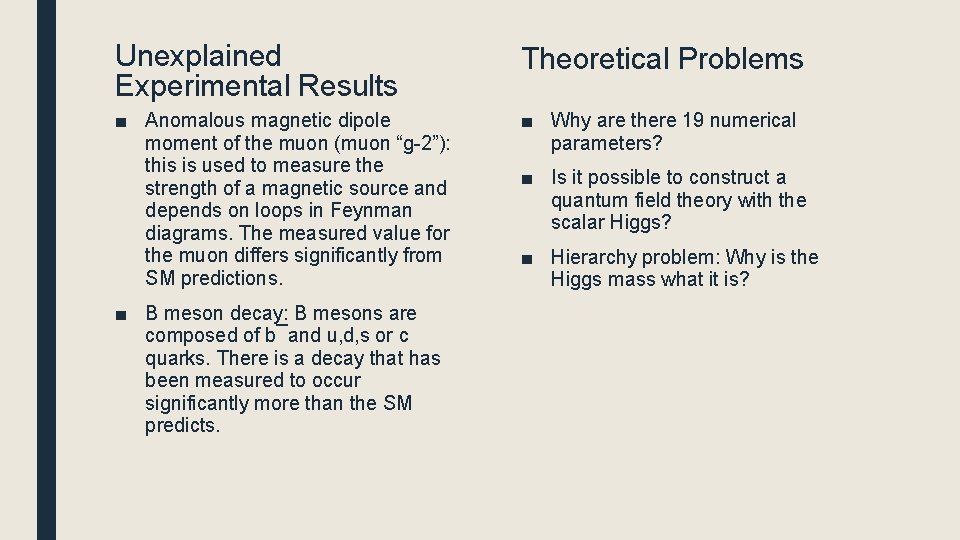
Unexplained Experimental Results Theoretical Problems ■ Anomalous magnetic dipole moment of the muon (muon “g-2”): this is used to measure the strength of a magnetic source and depends on loops in Feynman diagrams. The measured value for the muon differs significantly from SM predictions. ■ Why are there 19 numerical parameters? ■ B meson decay: B mesons are composed of b and u, d, s or c quarks. There is a decay that has been measured to occur significantly more than the SM predicts. ■ Is it possible to construct a quantum field theory with the scalar Higgs? ■ Hierarchy problem: Why is the Higgs mass what it is?
Some cool links ■ 3 D CERN event viewer: http: //opendata. cern. ch/visualise/events/cms# ■ Feynman diagram cheat sheet: https: //indico. cern. ch/event/570855/contributions/2315633/attachments/1497945 /2331732/Cheat. Sheet. pdf ■ Interactive periodic table of elementary particles: http: //www. thingsmadethinkable. com/item/elementary_particles. php ■ How to build your own particle detector: https: //www. symmetrymagazine. org/article/january-2015/how-to-build-your-ownparticle-detector
QUESTIONS? Suggestions: Feynman diagrams, Noether’s theorem, the LHC