
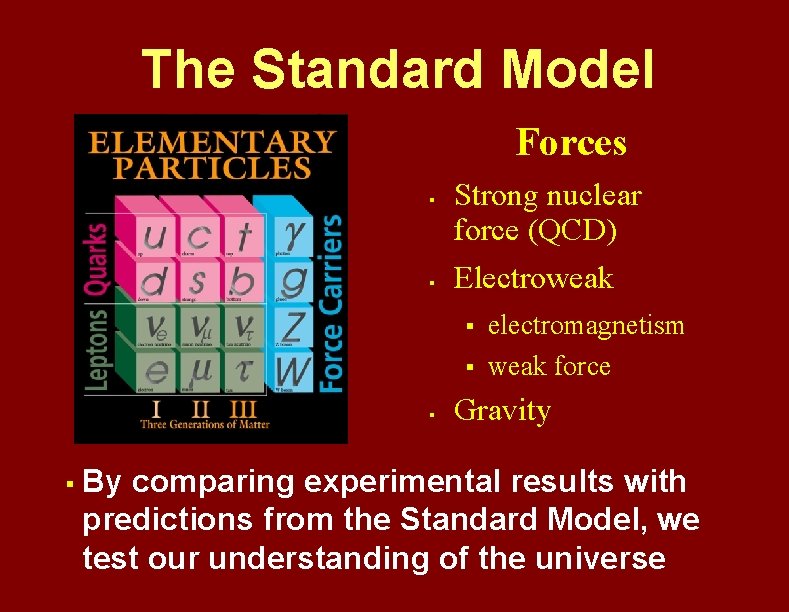
The Standard Model Forces Strong nuclear force QCD
- Slides: 18
The Standard Model Forces § § Strong nuclear force (QCD) Electroweak § § electromagnetism weak force Gravity By comparing experimental results with predictions from the Standard Model, we test our understanding of the universe
? ? ? What are the Big Questions to be Answered? ? ? What is the origin of mass? Can all of the forces be unified? How do neutrinos oscillate? ? ? Why do we see more matter than anti-matter? ? What is out there that we have never observed? ? ?
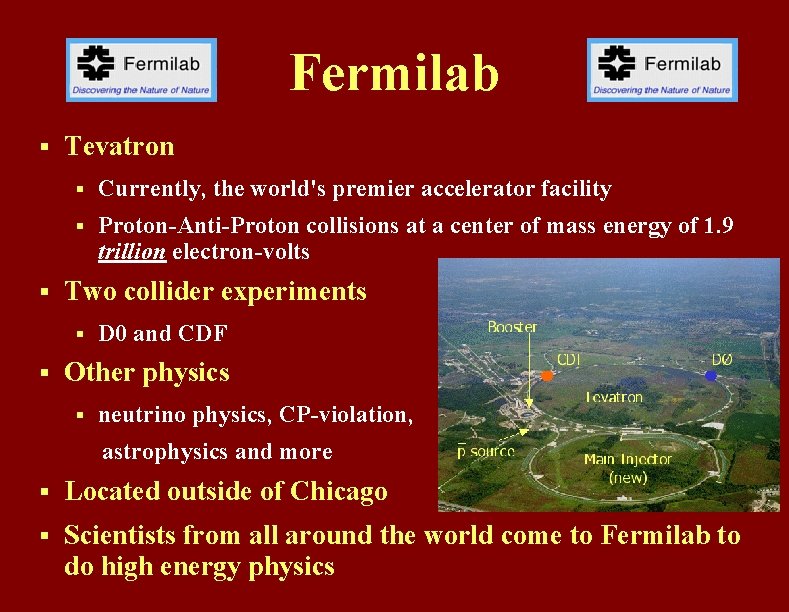
Fermilab § § Tevatron § Currently, the world's premier accelerator facility § Proton-Anti-Proton collisions at a center of mass energy of 1. 9 trillion electron-volts Two collider experiments § § D 0 and CDF Other physics § neutrino physics, CP-violation, astrophysics and more § Located outside of Chicago § Scientists from all around the world come to Fermilab to do high energy physics
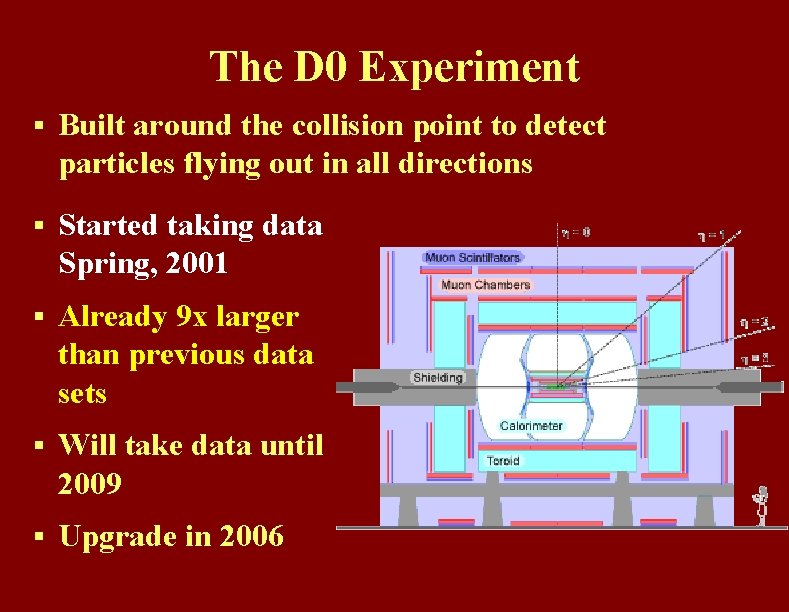
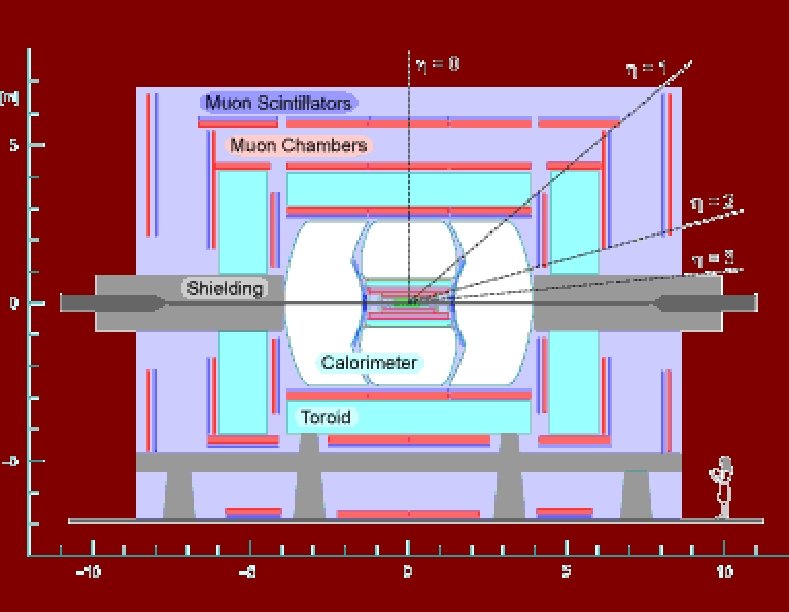
The D 0 Experiment § Built around the collision point to detect particles flying out in all directions § Started taking data Spring, 2001 § Already 9 x larger than previous data sets § Will take data until 2009 § Upgrade in 2006
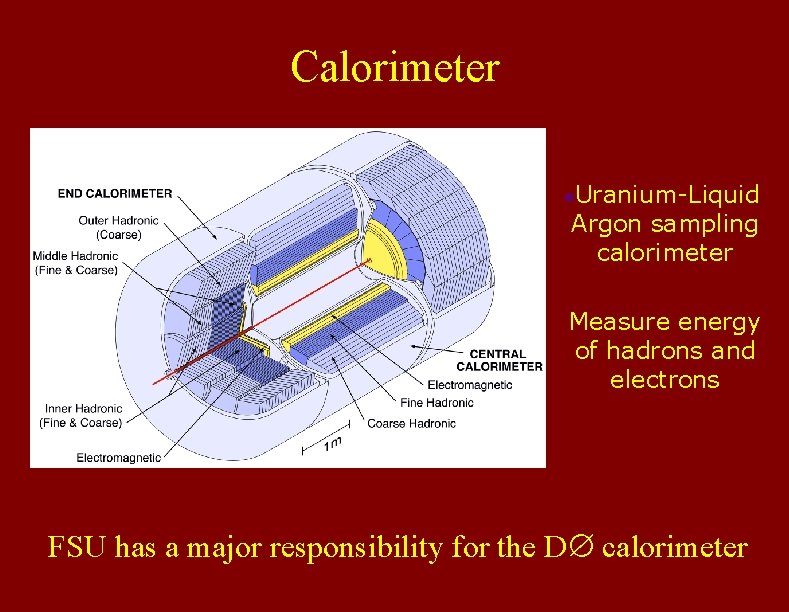
Calorimeter Uranium-Liquid Argon sampling calorimeter l Measure energy of hadrons and electrons FSU has a major responsibility for the D calorimeter
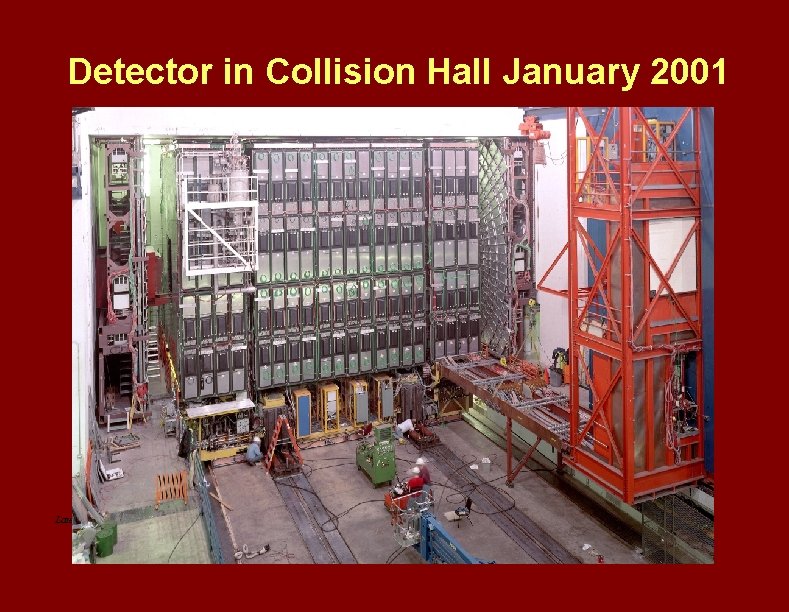
Detector in Collision Hall January 2001 Latest results from`pp Collisions at DØ
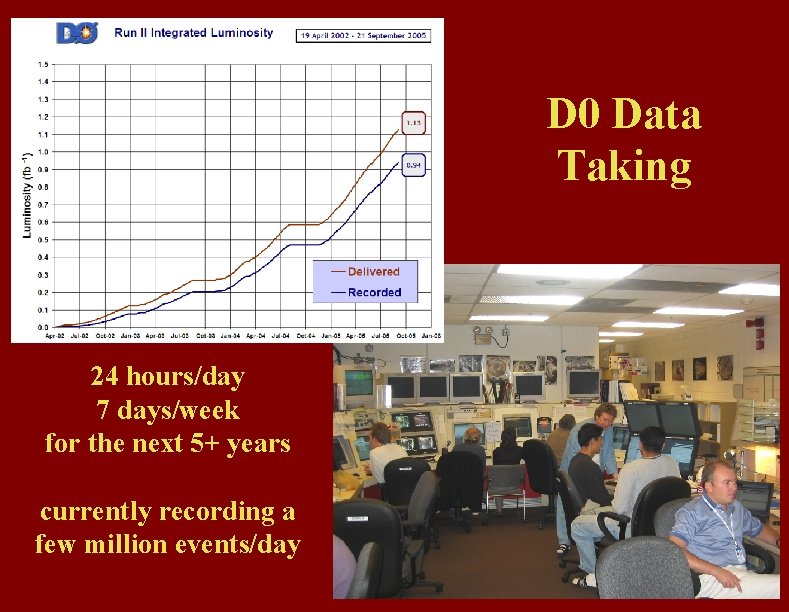
D 0 Data Taking 24 hours/day 7 days/week for the next 5+ years currently recording a few million events/day
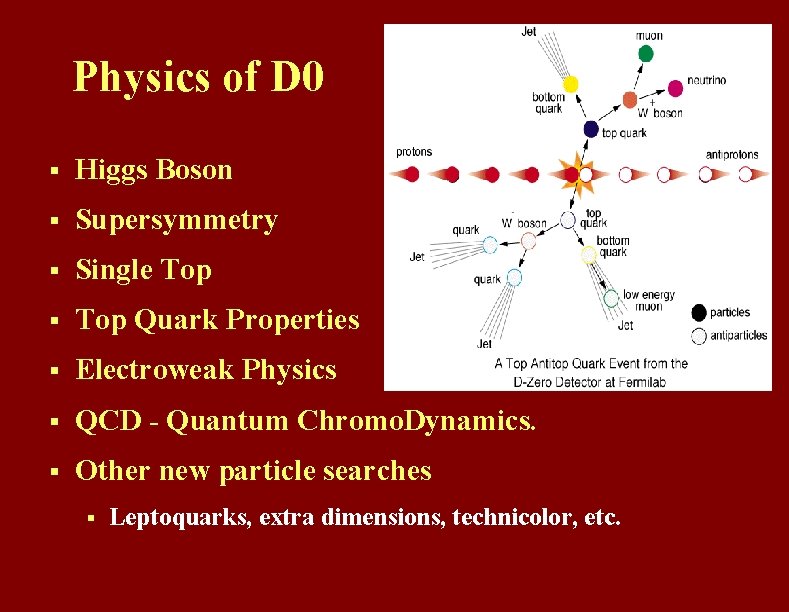
Physics of D 0 § Higgs Boson § Supersymmetry § Single Top § Top Quark Properties § Electroweak Physics § QCD - Quantum Chromo. Dynamics. § Other new particle searches § Leptoquarks, extra dimensions, technicolor, etc.
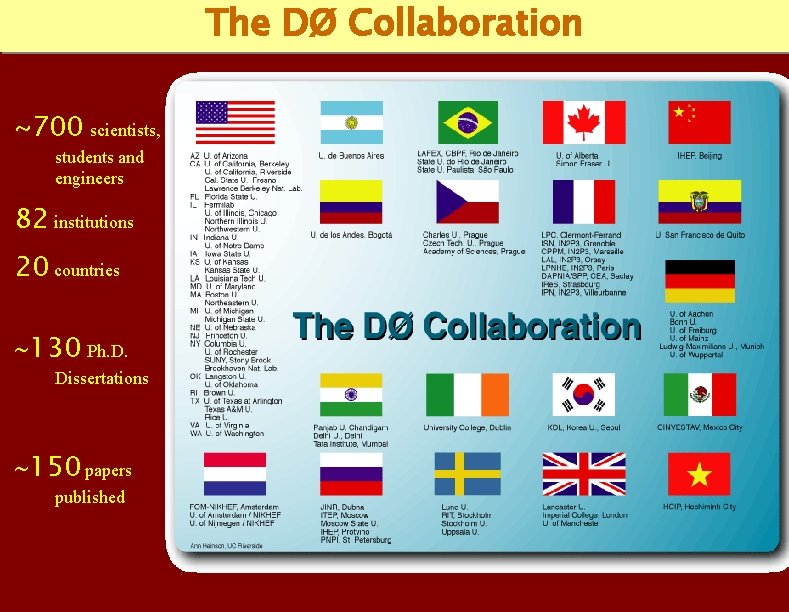
The DØ Collaboration ~700 scientists, students and engineers 82 institutions 20 countries 130 Ph. D. Dissertations 150 papers published
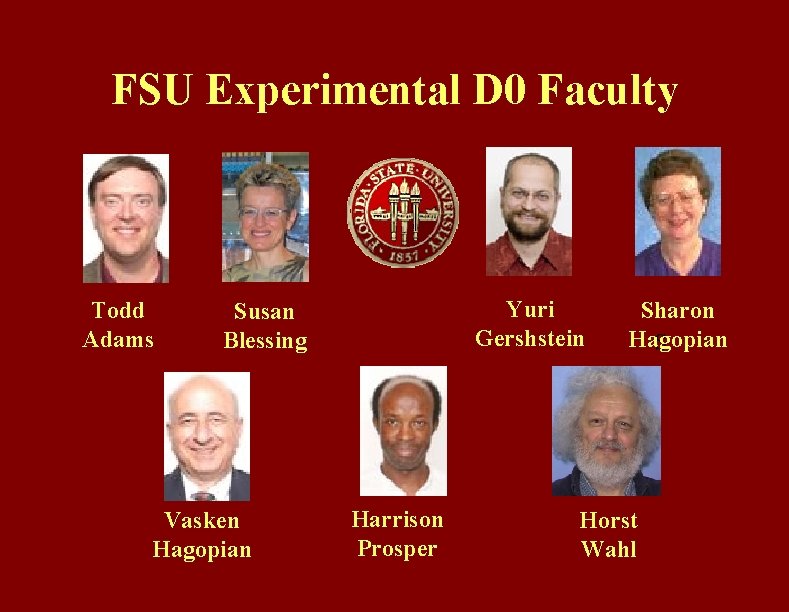
FSU Experimental D 0 Faculty Todd Adams Yuri Gershstein Susan Blessing Vasken Hagopian Harrison Prosper Sharon Hagopian S Horst Wahl
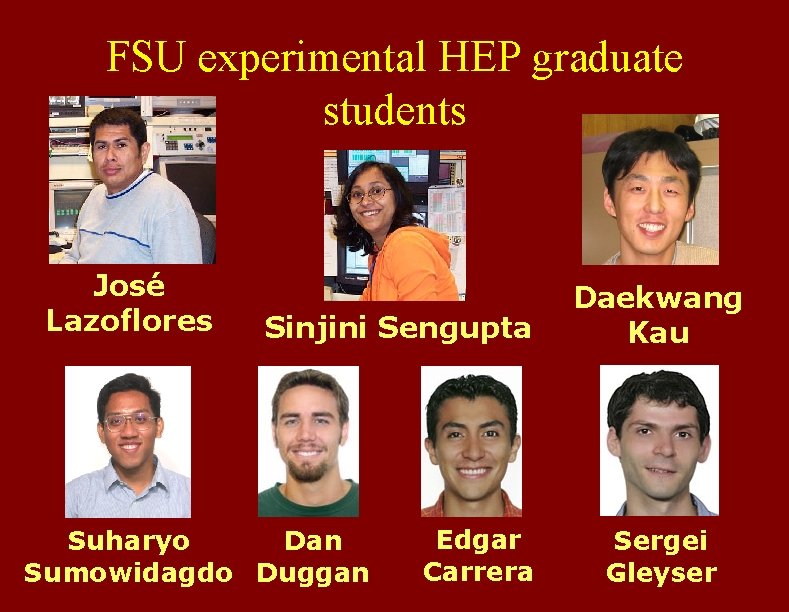
FSU experimental HEP graduate students José Lazoflores Sinjini Sengupta Suharyo Dan Sumowidagdo Duggan Edgar Carrera Daekwang Kau Sergei Gleyser
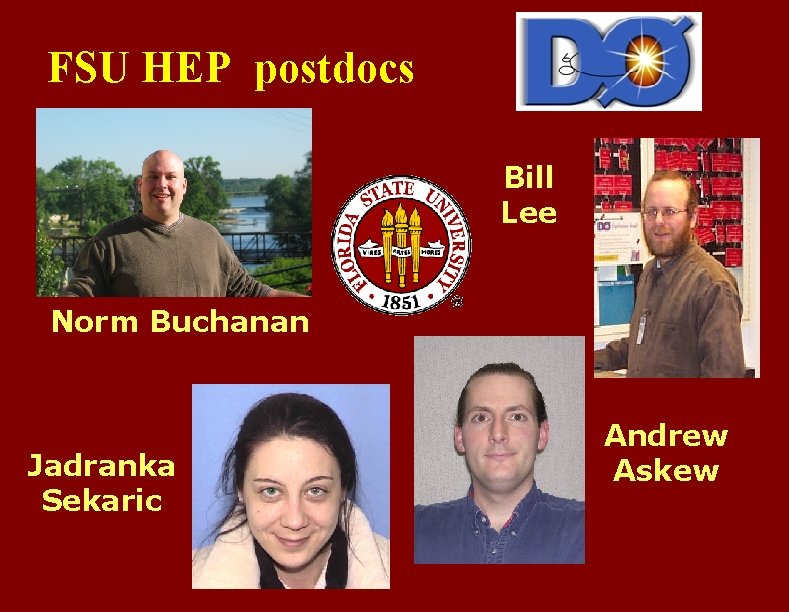
FSU HEP postdocs Bill Lee Norm Buchanan Jadranka Sekaric Andrew Askew
Examples of FSU graduates § § Jeff Mc. Donald (DØ, Ph. D 1999) § Dissertation: study of single top production § Now at FSU (Research Scientist), was at U. of Pittsburgh Dan Karmgard (DØ, Ph. D 1999) § Dissertation: search for leptoquarks § Now at U. Notre Dame (CMS) Richard Cavanaugh (Aleph, Ph. D 1999) § Dissertation: measurement of W mass § U. Florida (working on CMS, Grid), was at U. of Heidelberg Brian Connolly (DØ, Ph. D 2002) § Dissertation: measurement of top quark mass in hadronic decay § Now at Columbia University (Hi. Res – cosmic rays)
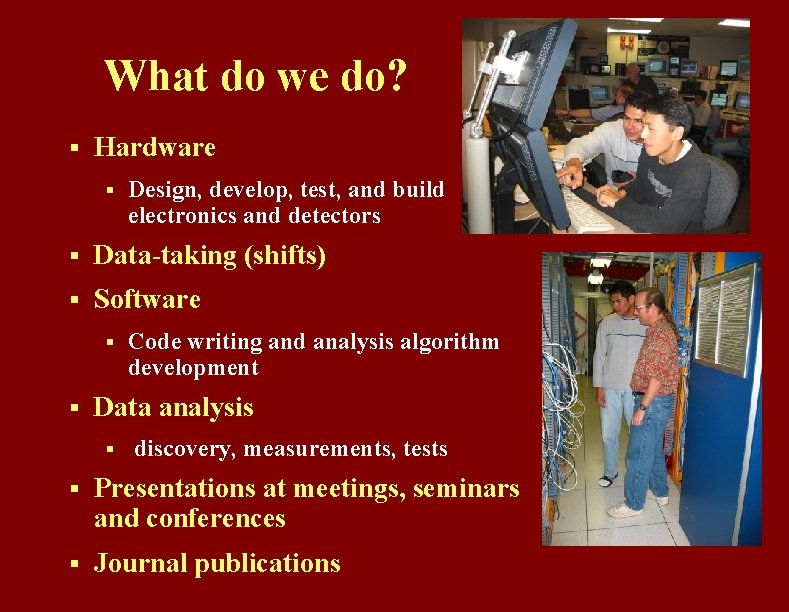
What do we do? § Hardware § Design, develop, test, and build electronics and detectors § Data-taking (shifts) § Software § § Code writing and analysis algorithm development Data analysis § discovery, measurements, tests § Presentations at meetings, seminars and conferences § Journal publications
What will you do? 1. 2. 3. 4. First 2 years 1. Finish coursework 2. Spend summers at Fermilab learning the experiment Next several years 1. Hardware project - calorimeter 2. Data taking 3. Programming (C++, Linux, scripting) 4. Data analysis on your thesis topic Final year 1. Presentation and publication of thesis work 2. Thesis defense You will spend significant time at Fermilab
Possible Thesis Topics Search for/Discover the Higgs Boson Search for new particles such as Supersymmetry, Technicolor, Leptoquarks, Cold Dark Matter, Extra Dimensions etc. Top Quark Physics QCD Studies including measuring the contents of the proton W mass measurements
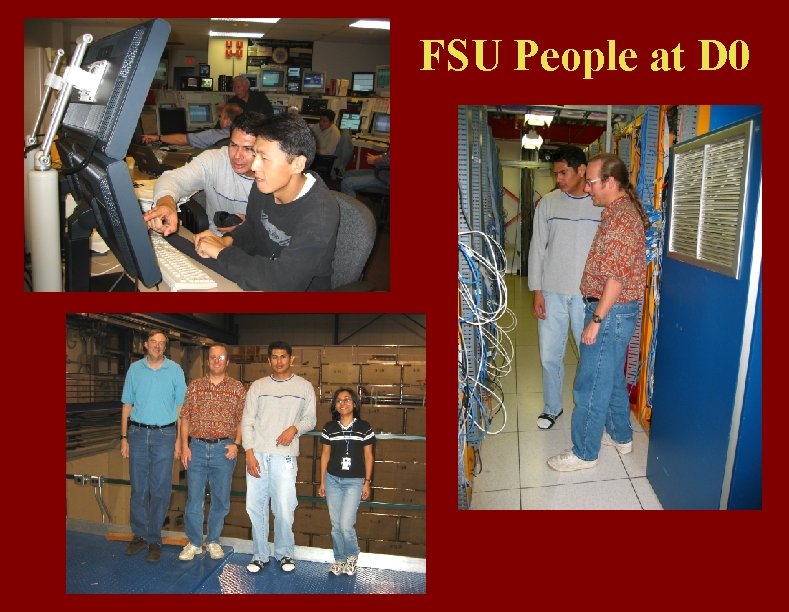
FSU People at D 0