
The Standard Model Cf E Higher Particles and

- Slides: 34
The Standard Model Cf. E Higher: Particles and Waves
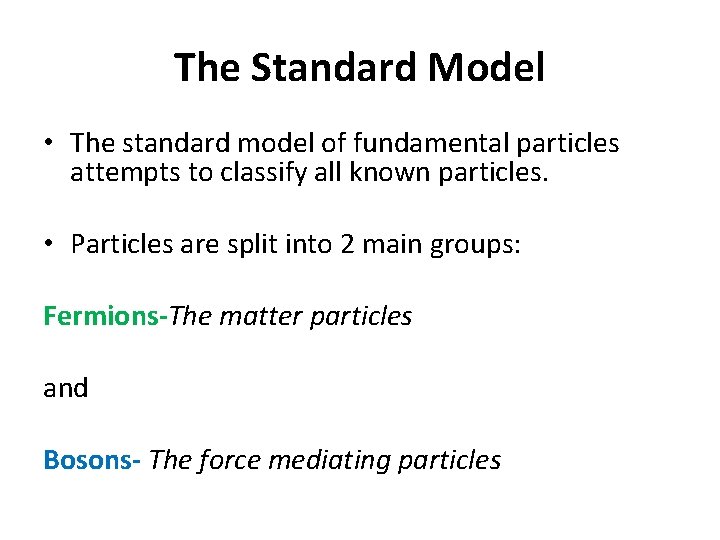
The Standard Model • The standard model of fundamental particles attempts to classify all known particles. • Particles are split into 2 main groups: Fermions-The matter particles and Bosons- The force mediating particles
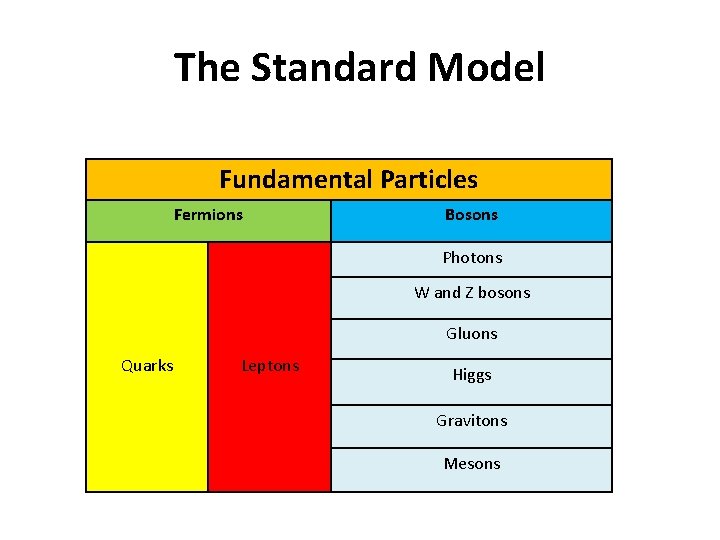
The Standard Model Fundamental Particles Fermions Bosons Photons W and Z bosons Gluons Quarks Leptons Higgs Gravitons Mesons
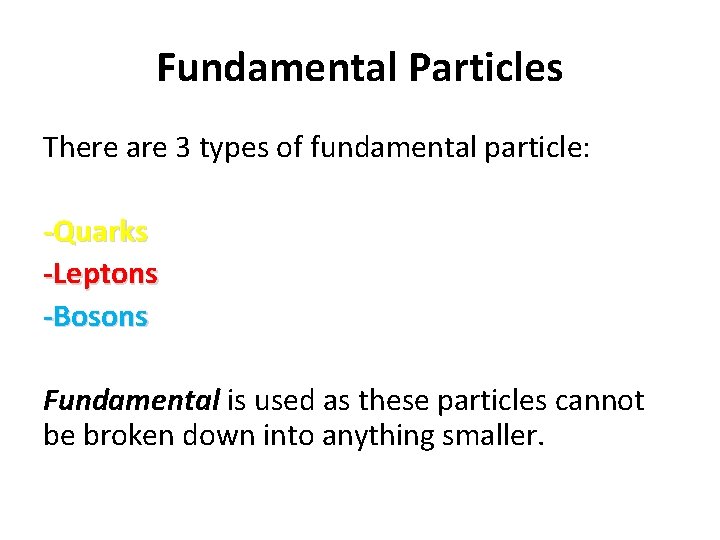
Fundamental Particles There are 3 types of fundamental particle: -Quarks -Leptons -Bosons Fundamental is used as these particles cannot be broken down into anything smaller.
Fermions
Fermions give rise to all matter. They can be split into 2 groups: -Quarks and -Leptons
Quarks
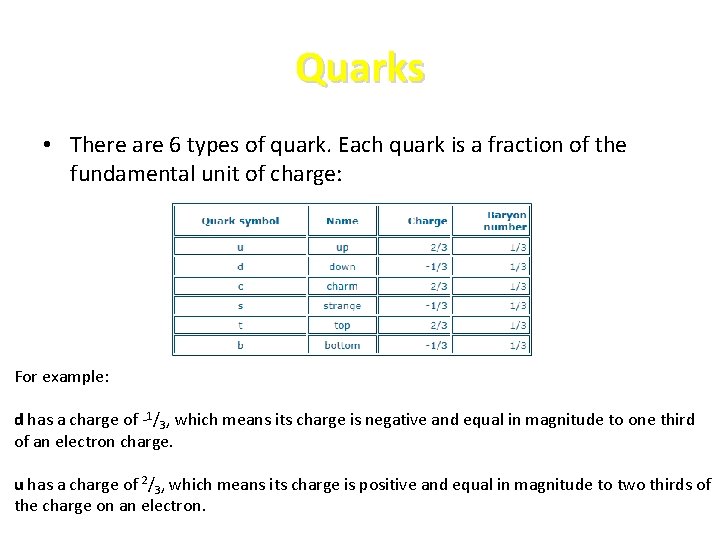
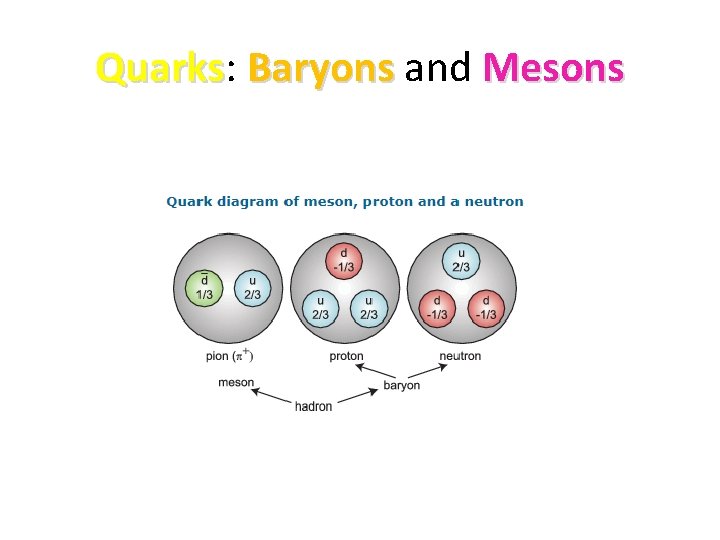
Quarks • There are 6 types of quark. Each quark is a fraction of the fundamental unit of charge: For example: d has a charge of -1/3, which means its charge is negative and equal in magnitude to one third of an electron charge. u has a charge of 2/3, which means its charge is positive and equal in magnitude to two thirds of the charge on an electron.
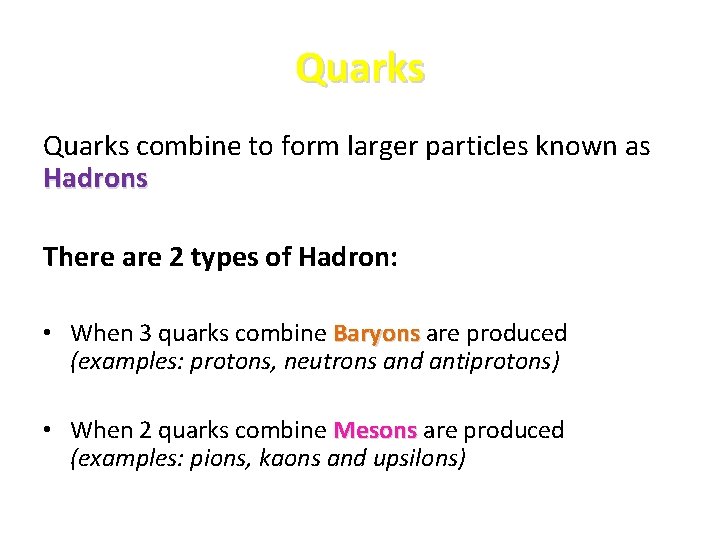
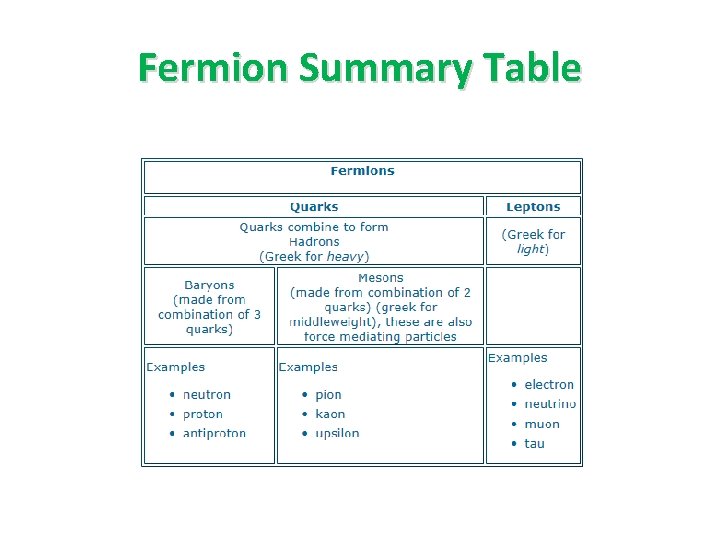
Quarks combine to form larger particles known as Hadrons There are 2 types of Hadron: • When 3 quarks combine Baryons are produced (examples: protons, neutrons and antiprotons) • When 2 quarks combine Mesons are produced (examples: pions, kaons and upsilons)
Half Life of Hadrons Most of the hadrons decay spontaneously into other particles. They tend to have lifetimes of around 10 -23 s, a very short time. Free neutrons have a half-life of about 15 minutes. Free protons are often said to be stable as their predicted half life is an extremely long period of time (1023 years). Protons and neutrons are relatively stable when bound in a nucleus. However in certain nuclides they can decay to produce positive and negative beta particles
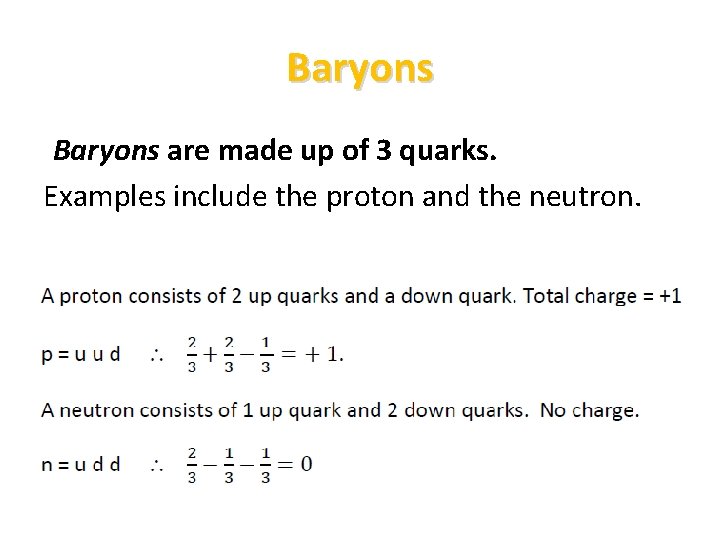
Baryons are made up of 3 quarks. Examples include the proton and the neutron.
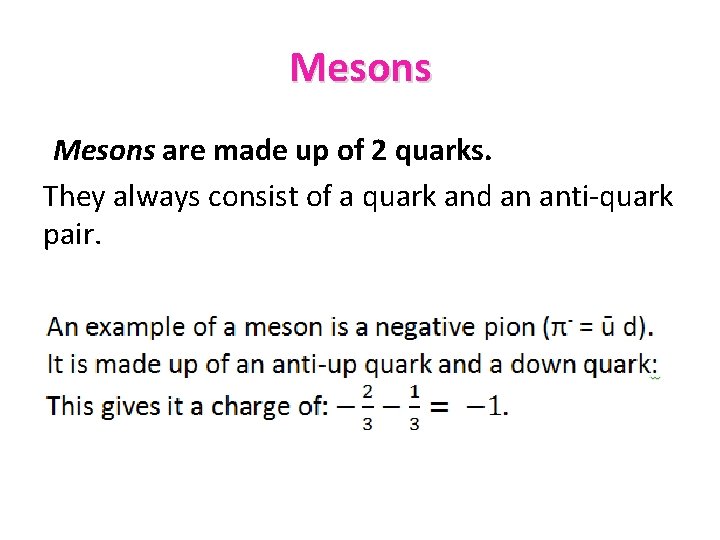
Mesons are made up of 2 quarks. They always consist of a quark and an anti-quark pair.
Quarks: Quarks Baryons and Mesons
Leptons
Leptons are fundamental particles. They cannot be broken down into anything smaller which means they do not contain quarks. Like quarks, quarks leptons also cause matter. Examples of leptons include: -electrons -neutrinos -muons -tau
Fermion Summary Table
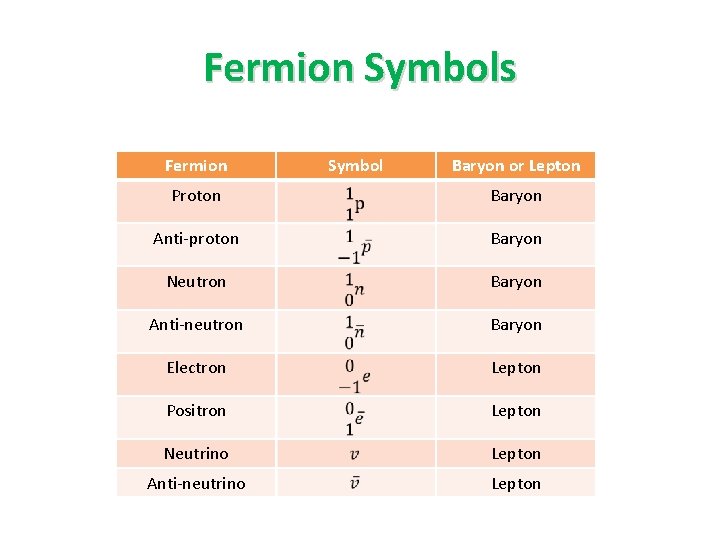
Fermion Symbols Fermion Symbol Baryon or Lepton Proton Baryon Anti-proton Baryon Neutron Baryon Anti-neutron Baryon Electron Lepton Positron Lepton Neutrino Lepton Anti-neutrino Lepton
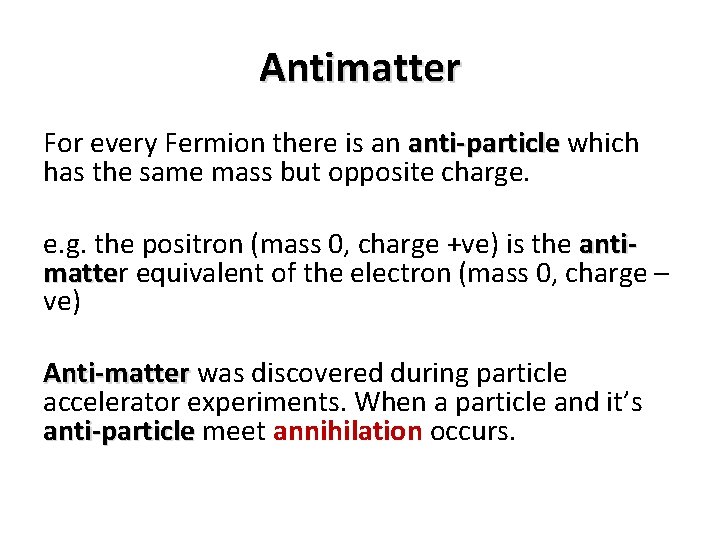
Antimatter For every Fermion there is an anti-particle which has the same mass but opposite charge. e. g. the positron (mass 0, charge +ve) is the antimatter matte equivalent of the electron (mass 0, charge – ve) Anti-matter was discovered during particle accelerator experiments. When a particle and it’s anti-particle meet annihilation occurs.
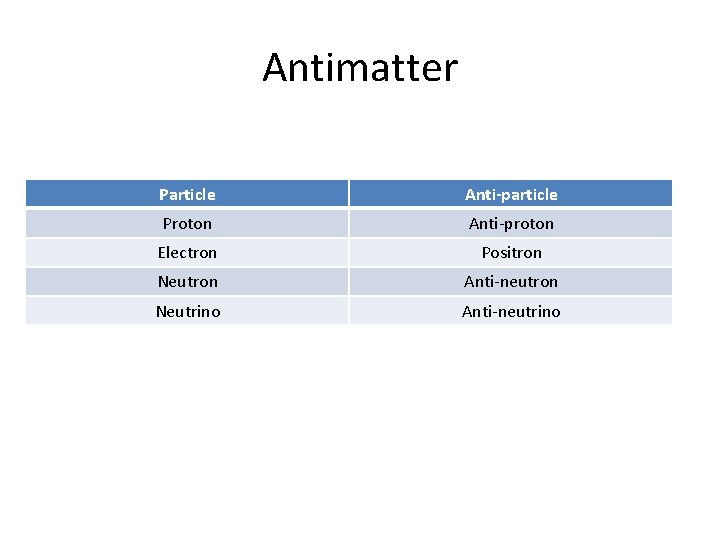
Antimatter Particle Anti-particle Proton Anti-proton Electron Positron Neutron Anti-neutron Neutrino Anti-neutrino
Fundamental Forces
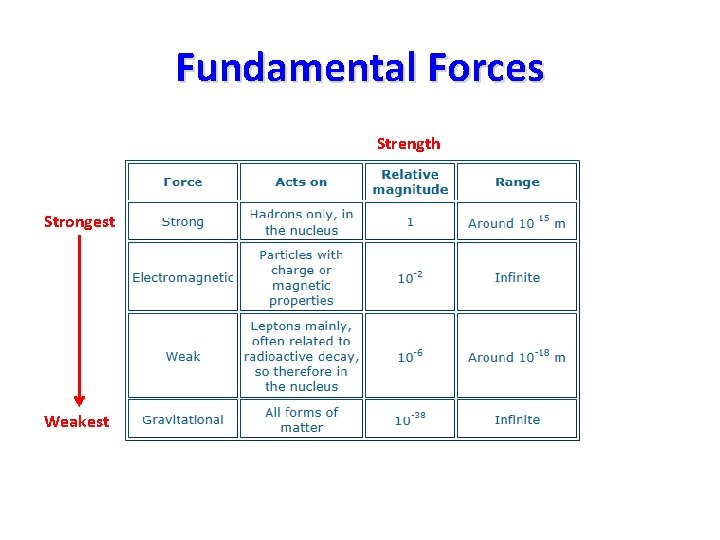
Fundamental Forces There are 4 forces that are fundamental to the interaction of particles…
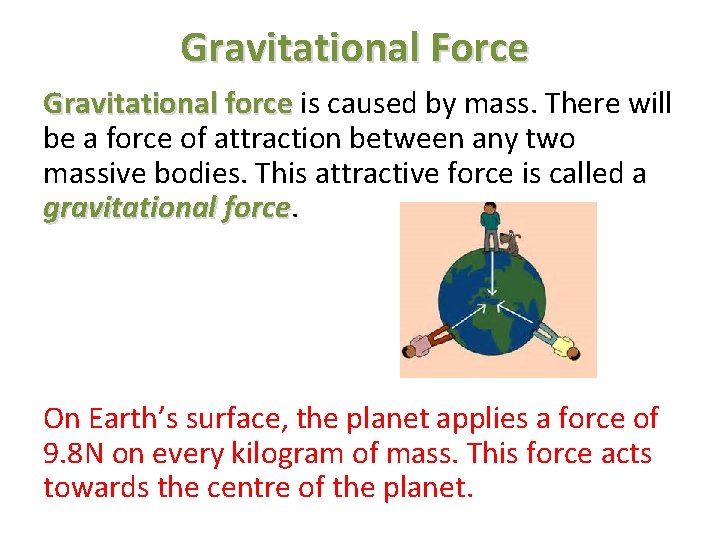
Gravitational Force Gravitational force is caused by mass. There will be a force of attraction between any two massive bodies. This attractive force is called a gravitational force On Earth’s surface, the planet applies a force of 9. 8 N on every kilogram of mass. This force acts towards the centre of the planet.
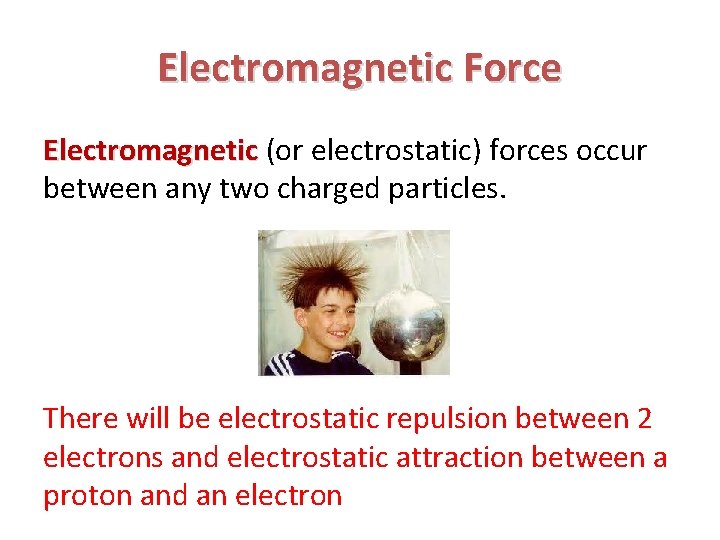
Electromagnetic Force Electromagnetic (or electrostatic) forces occur between any two charged particles. There will be electrostatic repulsion between 2 electrons and electrostatic attraction between a proton and an electron
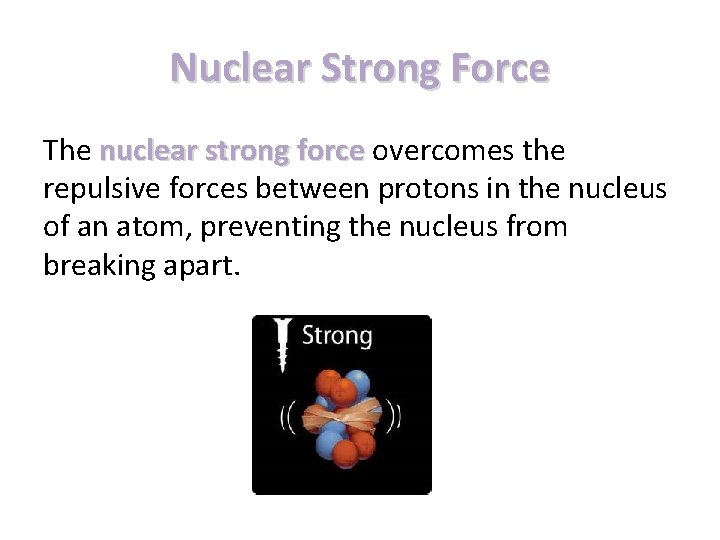
Nuclear Strong Force The nuclear strong force overcomes the repulsive forces between protons in the nucleus of an atom, preventing the nucleus from breaking apart.
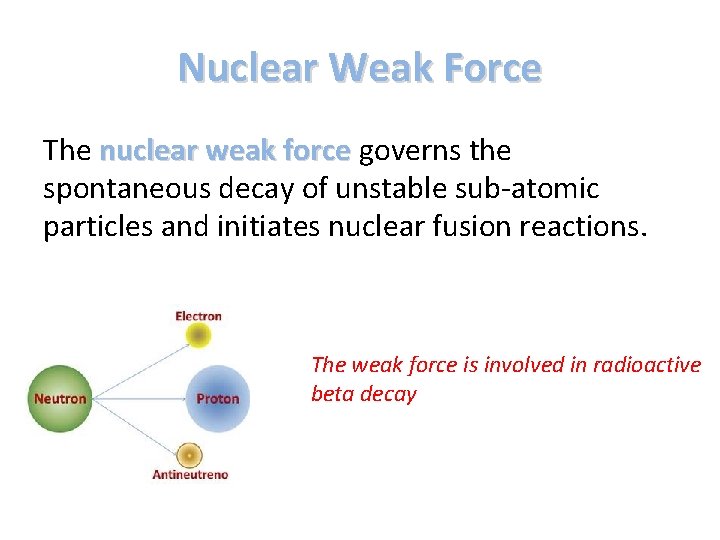
Nuclear Weak Force The nuclear weak force governs the spontaneous decay of unstable sub-atomic particles and initiates nuclear fusion reactions. The weak force is involved in radioactive beta decay
Beta Decay There are 2 types of beta decay: • During radioactive beta decay, an electron and an anti-neutrino are ejected from an atom. • During neutron beta decay, a neutron in the atomic nucleus decays into a proton, an electron and an anti-neutrino.
Fundamental Forces Strength Strongest Weakest
Bosons
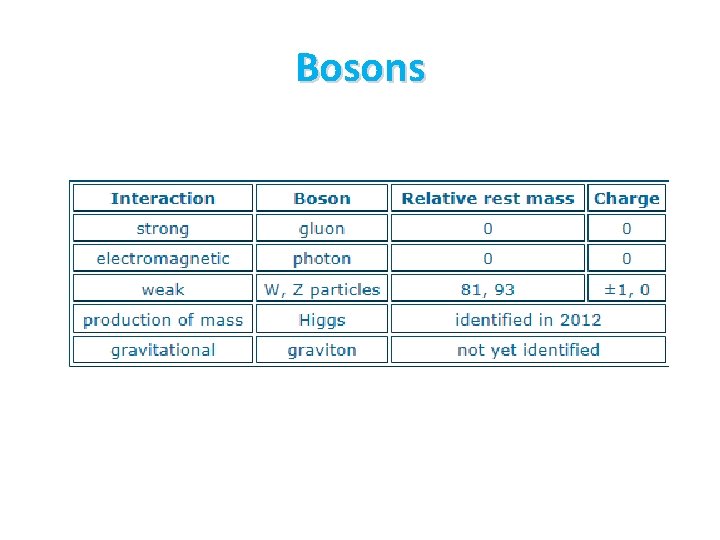
Bosons • Bosons are force mediating (or force carrying) particles. This means a boson enables a force to act between two particles. • Individual bosons are associated with different fundamental forces…
Bosons
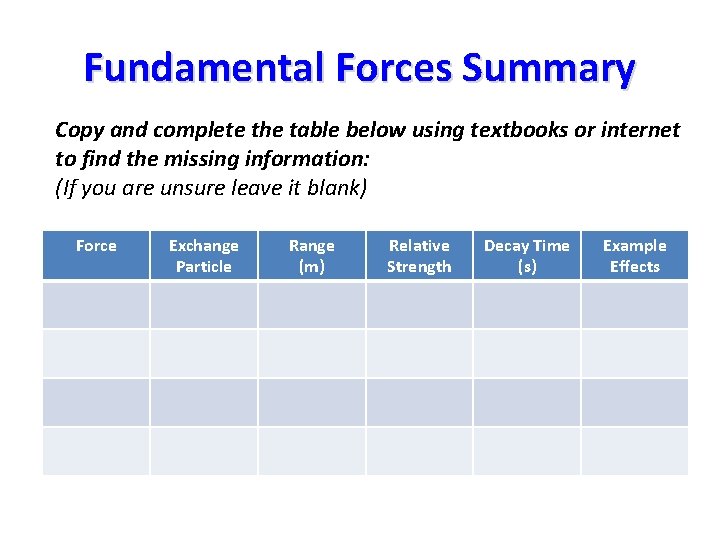
Fundamental Forces Summary Copy and complete the table below using textbooks or internet to find the missing information: (If you are unsure leave it blank) Force Exchange Particle Range (m) Relative Strength Decay Time (s) Example Effects
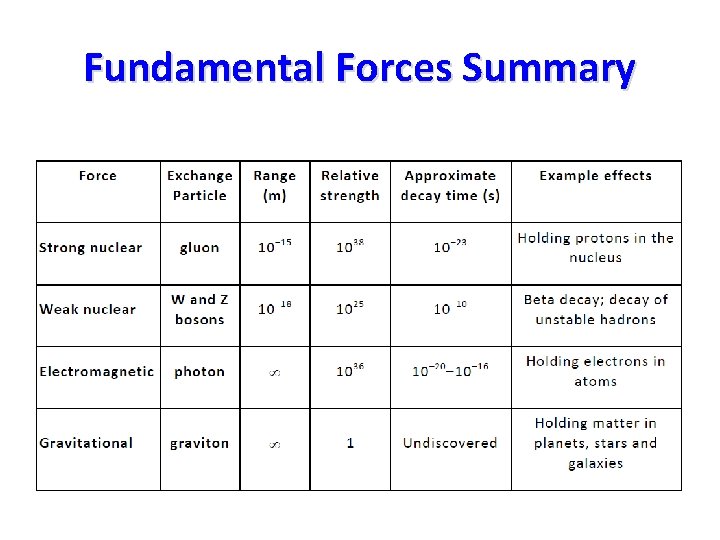
Fundamental Forces Summary
Why does the nucleus not fly apart? If all the protons within it are positively charged, then electrostatic repulsion should make them fly apart. There must be another force holding them together that, over the short range within a nucleus, balances the electrostatic repulsion. This force is called the strong nuclear force As its name suggests, it is the strongest of the four fundamental forces but it is also extremely short range in action. It is also only experienced by quarks and therefore by the baryons and mesons that are formed by the combination of quarks It is the exchange of gluons (bosons) between the hadrons in the nucleus which mediate (cause the action of) the strong force which holds the nucleus together. The exact mechanism by which these bosons mediate the force is difficult to understand. For Higher Cf. E Physics all you need to know is that these bosons exist and are used in the explanation of the four fundamental forces Be clear that boson is not the force, it only enables the force to act. All of the forces and the reactions associated with them obey the conservation laws for energy, momentum, angular momentum and charge. The reactions of particles under the action of these forces also obey other conservation laws. One of these is called conservation of baryon number and another for hadrons is conservation of strangeness.
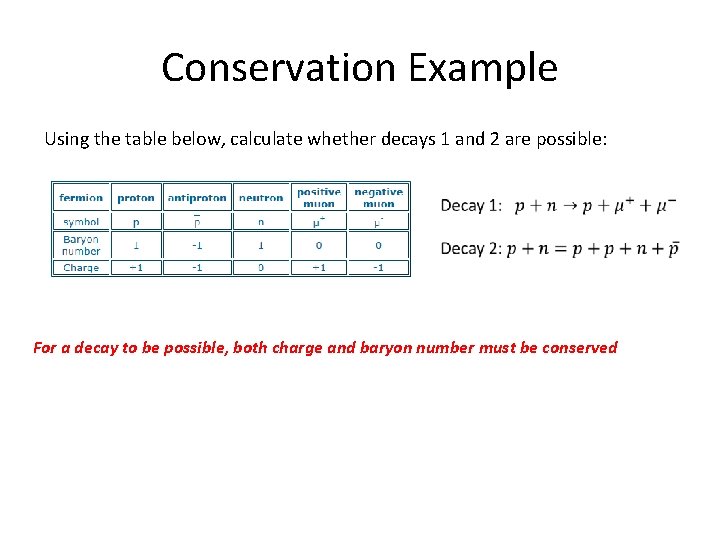
Conservation Example Using the table below, calculate whether decays 1 and 2 are possible: For a decay to be possible, both charge and baryon number must be conserved