
The Spruce Budworm Outbreak Model The spruce budworm
The Spruce Budworm Outbreak Model • The spruce budworm is one of the most destructive native insects in the northern spruce and fir forests of the Eastern United States and Canada. • Outbreaks lead to tree mortality and effect regeneration – During an outbreak, a forest of firs can be defoliated in ~ 4 years, birch take over, firs eventually repopulate but it takes ~ 50 -100 years
Building the Model • Assume the budworm population grows logistically in the absence of predation – Logistic growth is reasonable because K is related to the foliage density and some ways of estimating this parameter have been suggested • Assume predation occurs and leads to an enhanced mortality of the budworm population

Building the Model • What form should predation take? • The main predators are birds – When budworm density is low, predation is small – When budworm density is high, predation is large

Building the Model • What form should predation take? b b/2 a N • When n < a , predation is small • When n > a, predation is switched on

The Spruce Budworm Model

Nondimensionalize Choose Arbitrary Scales: Substitute in Model:

Nondimensionalize Choices:

Nondimensionalize

Nondimensional Equation

Steady States u = 0 is a steady state
Steady States • Steady states are intersections of the straight line g(u) with the curve h(u).
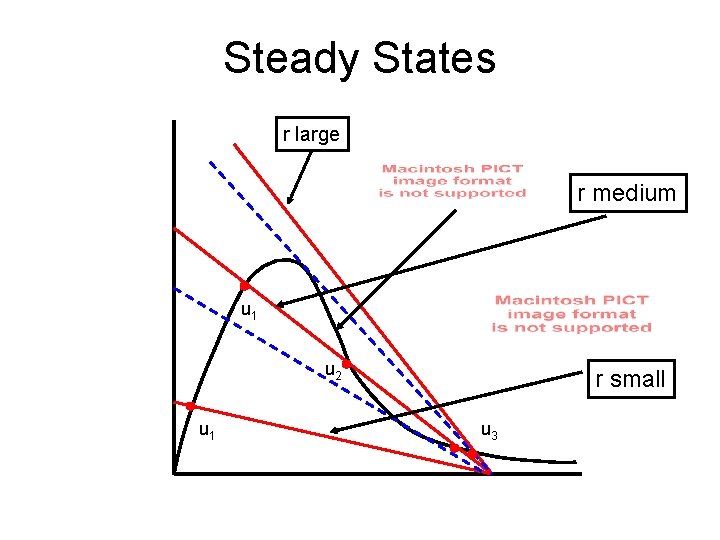
Steady States r large r medium u 1 u 2 u 1 r small u 3
Steady State Summary • As the parameter r increases, the number of steady states change – Therefore, r is a bifurcation parameter • For small r, there is one nonzero steady state – This steady, u 1, represents normal population levels • For medium r, there are three nonzero steady states • For large r, there is one nonzero steady state – This steady state, u 3, represents outbreak population levels
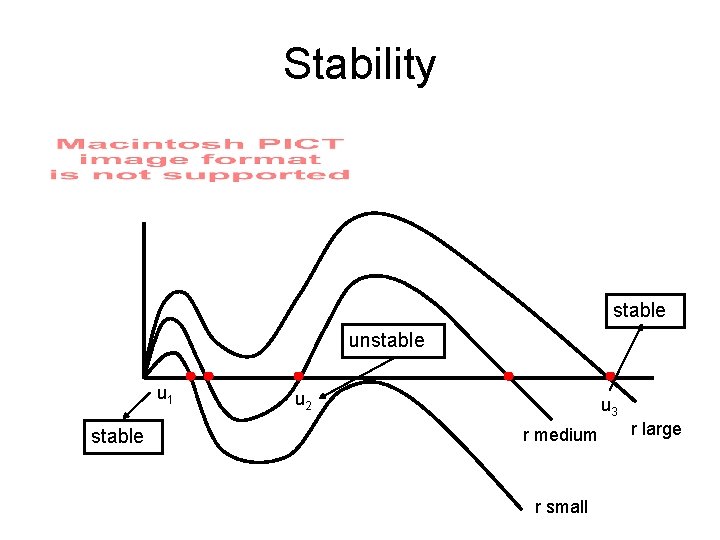
Stability stable unstable u 1 stable u 2 u 3 r medium r small r large
Stability Summary • The steady state u 1 exists for a finite range of r and is always stable when it exists • The steady state u 2 exists for a finite range of r and is always unstable when it exists • The outbreak state, u 3, exists if r is sufficiently large and is always stable when it exists • If u 1 and u 3 both exist, then initial conditions determine which state is approached.
Interpretation of Model Results • Recall, the goal is to control the pest population – That is keep the budworm population at u 1 and away from u 3 – Given that the intrinsic growth parameters allow for the existence of all three nonzero steady states, an outbreak can occur if – The initial population size is greater than u 2 • So the unstable steady state is a threshold. – If parameters drift in such a way that u 1 disappears and only u 3 remains. • Note, this drift does not have to be very large
The Plot Thickens • The situation is actually worse than it appears, because even if parameters are restored to their original values, the population will not relax back to the normal steady state. • This system exhibits hysteresis
Hysteresis • A phenomenon wherein two (or more) physical quantities bear a relationship which depends on prior history. • More specifically, the response (ie the steady state that is approached) takes on different values for an increasing input (changes in the bifurcation parameter r) than for a decreasing input. – This is sometimes called path-dependence • In other words, there is a lack of reversibility in the dynamics as a parameter changes
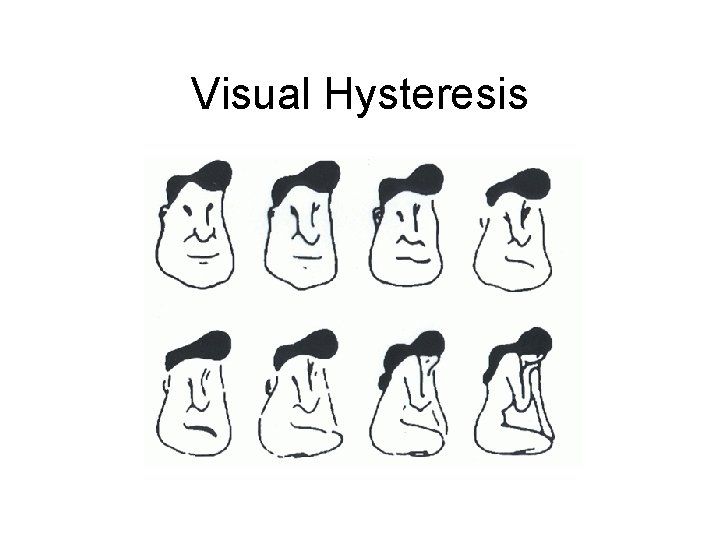
Visual Hysteresis

Steady States Bifurcation Diagram r 1 r 2 r
- Slides: 20