
The Spread of Lyme Disease Amelia Wurzburg and
The Spread of Lyme Disease Amelia Wurzburg and Anna Driscoll
Outline l Overview of Lyme disease l Life cycle of the tick l Transmission of the disease l History of Lyme disease l Environmental factors l Controlling the spread of Lyme disease
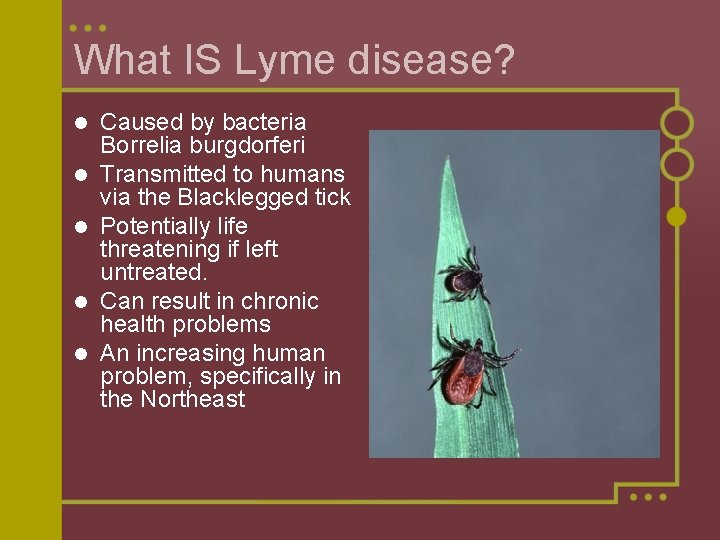
What IS Lyme disease? l l l Caused by bacteria Borrelia burgdorferi Transmitted to humans via the Blacklegged tick Potentially life threatening if left untreated. Can result in chronic health problems An increasing human problem, specifically in the Northeast
Symptoms • Early stages Fever, headache, fatigue, chills, swollen lymph nodes • Similar to symptoms of many other common illnesses. • Rash (Erythma Migrans) •
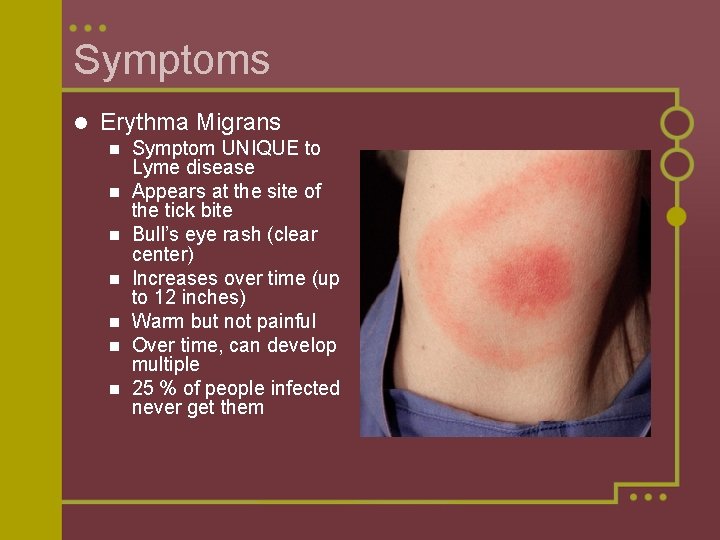
Symptoms l Erythma Migrans n n n n Symptom UNIQUE to Lyme disease Appears at the site of the tick bite Bull’s eye rash (clear center) Increases over time (up to 12 inches) Warm but not painful Over time, can develop multiple 25 % of people infected never get them
Symptoms l Later stages Can occur months or years after tick bite Loss of muscle tone in face, nervous system problems, severe headaches and neck stiffness due to meningitis, heart palpitations, dizziness, severe fatigue, joint pain and swelling (esp large joints) n 10 -20% of untreated Lyme disease patients have chronic arthritis n 5% of untreated Lyme disease patients develop neurological symptoms such as problems with short-term memory and concentration. n n
Treatment l l l The sooner the disease is detected the simpler and more effective the treatment. Treated with antibiotics More specific antibiotics needed if neurological or cardiac symptoms occur. Untreated Lyme disease may require 2 rounds of antibiotic treatment Some symptoms persist even after antibiotic treatment
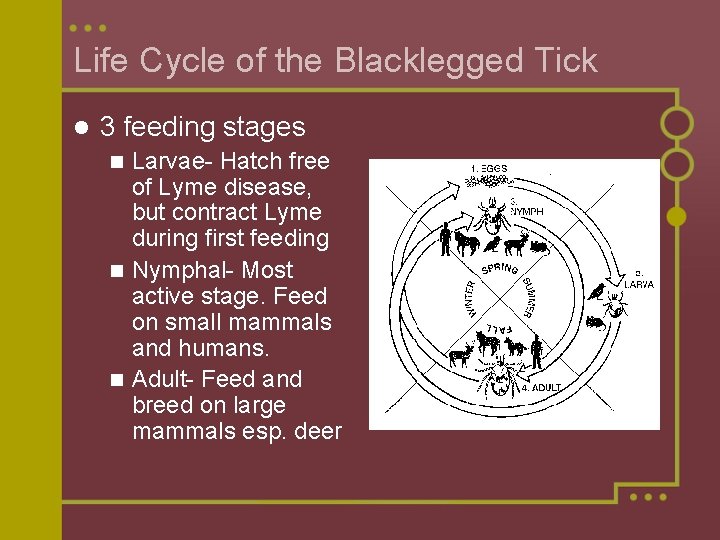
Life Cycle of the Blacklegged Tick l 3 feeding stages Larvae- Hatch free of Lyme disease, but contract Lyme during first feeding n Nymphal- Most active stage. Feed on small mammals and humans. n Adult- Feed and breed on large mammals esp. deer n
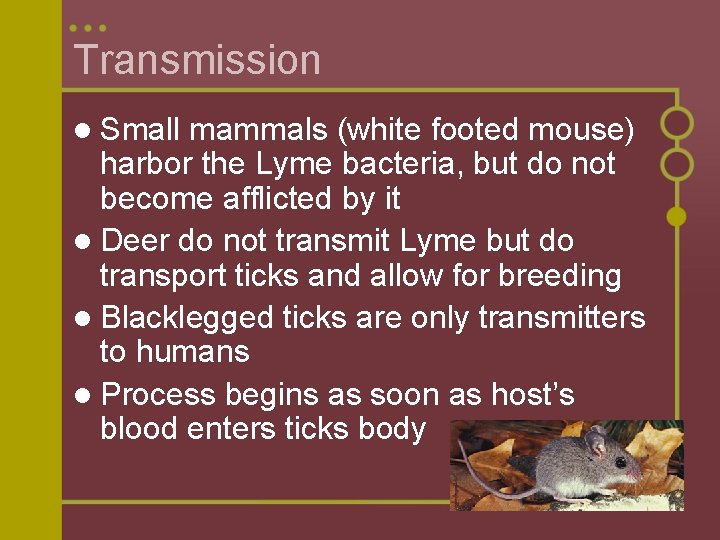
Transmission l Small mammals (white footed mouse) harbor the Lyme bacteria, but do not become afflicted by it l Deer do not transmit Lyme but do transport ticks and allow for breeding l Blacklegged ticks are only transmitters to humans l Process begins as soon as host’s blood enters ticks body
Transmission l Takes 24 -48 hours of tick feeding for host to become infected. l Untreated Lyme can be transmitted from mother to fetus during pregnancy l No other means of transmission have been discovered. l However, Lyme bacteria is known to survive in stored blood.
History of Lyme Disease l Identified in 1970 s in Old Lyme Connecticut l First case documented 1988 in New Jersey l Believed to be present in the Northeastern US for 10, 000 years l Lyme disease has increased dramatically in Vermont in the last few years

Lyme Disease In Vermont
Environmental Factors l Global warming n Spread of disease carrying vectors n Warmer winters = less winter kill n Warmer summers = longer breeding and transmission season
Environmental Factors l Decreased Biodiversity n Higher biodiversity = lower rate of infectious disease n Humans have wiped out predators of animals that are important in the transmission of Lyme n Killing off of possible barrier hosts (Western fence lizard) n Dominance of White-tailed deer and White-footed mouse increase prevalence of Lyme
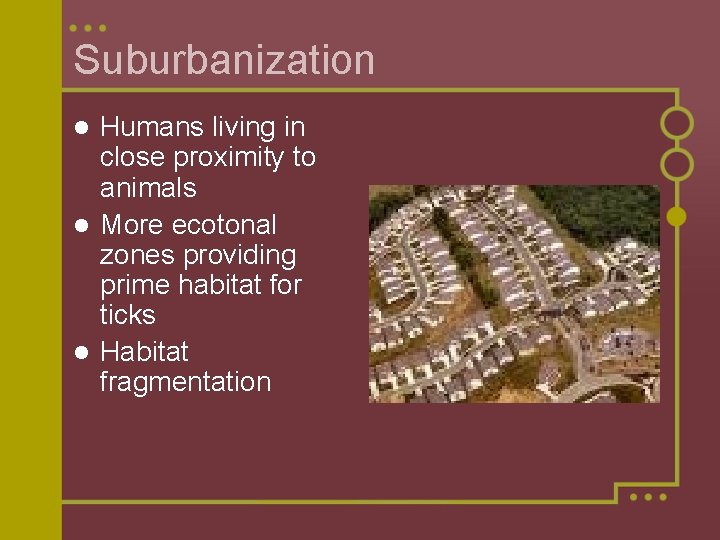
Suburbanization Humans living in close proximity to animals l More ecotonal zones providing prime habitat for ticks l Habitat fragmentation l
Controlling Lyme Disease l Personal n Avoid Prevention tick habitats especially during May, June, and July n Insect repellants n Long clothing n Checking for ticks often n Keep lawn sunny and dry - bad tick habitat
Controlling Lyme Disease l Large scale prevention n Minimizing deer herds (controversial) n Reducing global warming n Reducing habitat fragmentation and suburbanization n Increasing biodiversity These are complex problems with complex solutions
- Slides: 17