
The SPIRIT Consortium DAC 2006 Overview and Partner
- Slides: 37
The SPIRIT Consortium DAC 2006 Overview and Partner Demos
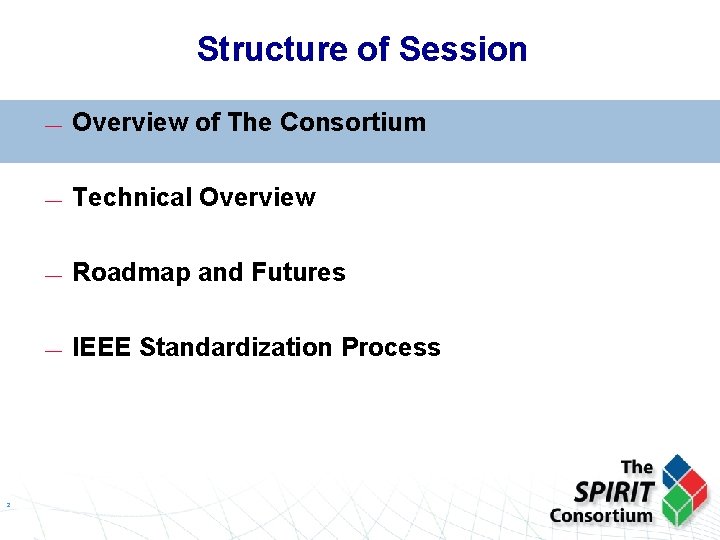
Structure of Session — Overview of The Consortium 2 — Technical Overview — Roadmap and Futures — IEEE Standardization Process
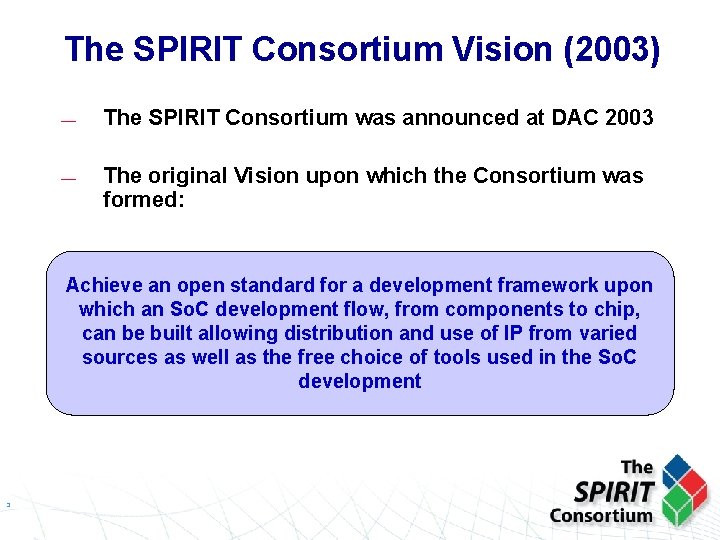
The SPIRIT Consortium Vision (2003) — The SPIRIT Consortium was announced at DAC 2003 — The original Vision upon which the Consortium was formed: Achieve an open standard for a development framework upon which an So. C development flow, from components to chip, can be built allowing distribution and use of IP from varied sources as well as the free choice of tools used in the So. C development 3
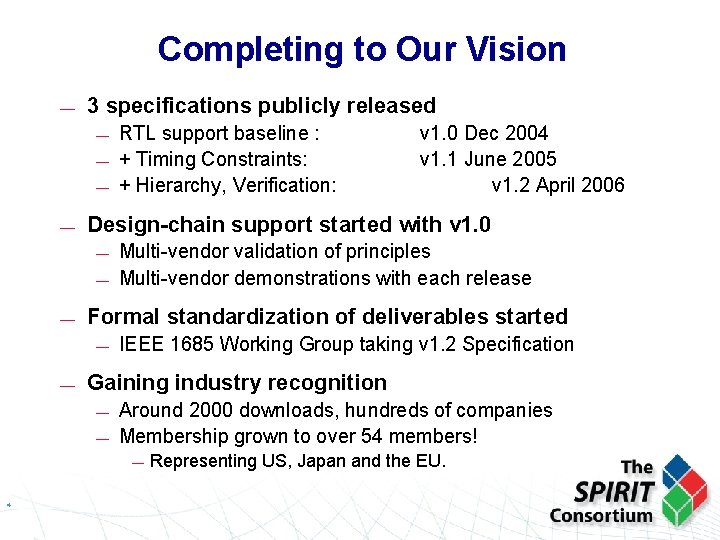
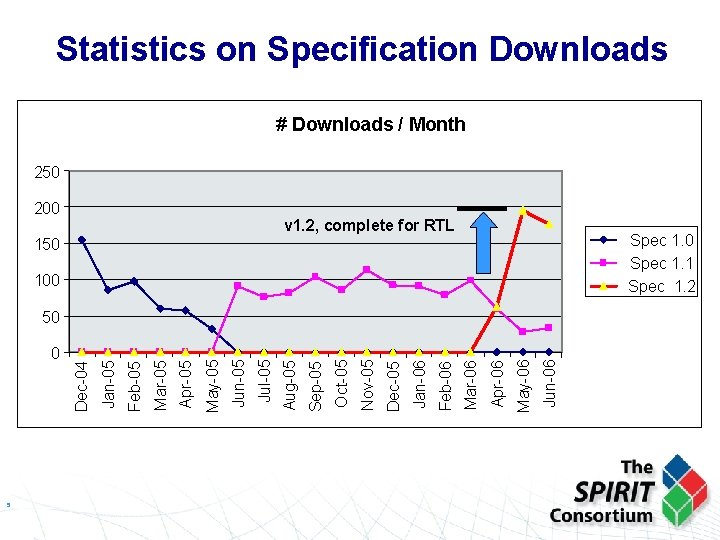
Completing to Our Vision — 3 specifications publicly released — — — Multi-vendor validation of principles Multi-vendor demonstrations with each release Formal standardization of deliverables started — — IEEE 1685 Working Group taking v 1. 2 Specification Gaining industry recognition — — Around 2000 downloads, hundreds of companies Membership grown to over 54 members! — 4 v 1. 0 Dec 2004 v 1. 1 June 2005 v 1. 2 April 2006 Design-chain support started with v 1. 0 — — RTL support baseline : + Timing Constraints: + Hierarchy, Verification: Representing US, Japan and the EU.
Statistics on Specification Downloads # Downloads / Month 250 200 v 1. 2, complete for RTL Spec 1. 0 Spec 1. 1 Spec 1. 2 150 100 5 Jun-06 May-06 Apr-06 Mar-06 Feb-06 Jan-06 Dec-05 Nov-05 Oct-05 Sep-05 Aug-05 Jul-05 Jun-05 May-05 Apr-05 Mar-05 Feb-05 Jan-05 0 Dec-04 50
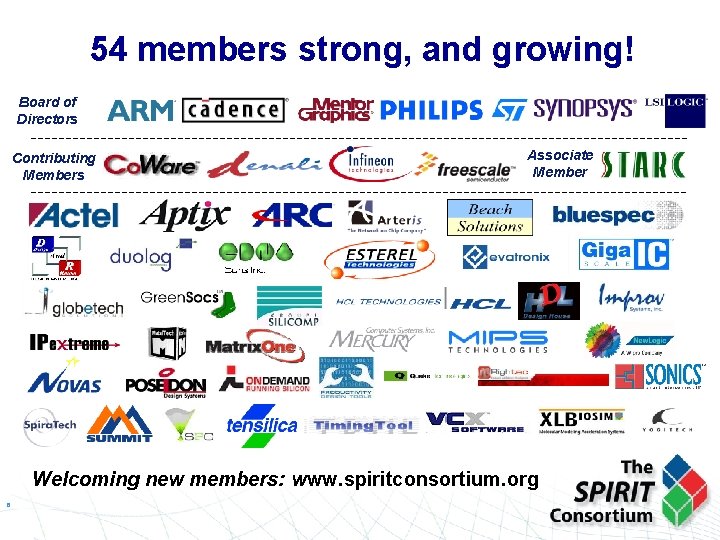
54 members strong, and growing! Board of Directors Contributing Members Associate Member Welcoming new members: www. spiritconsortium. org 6
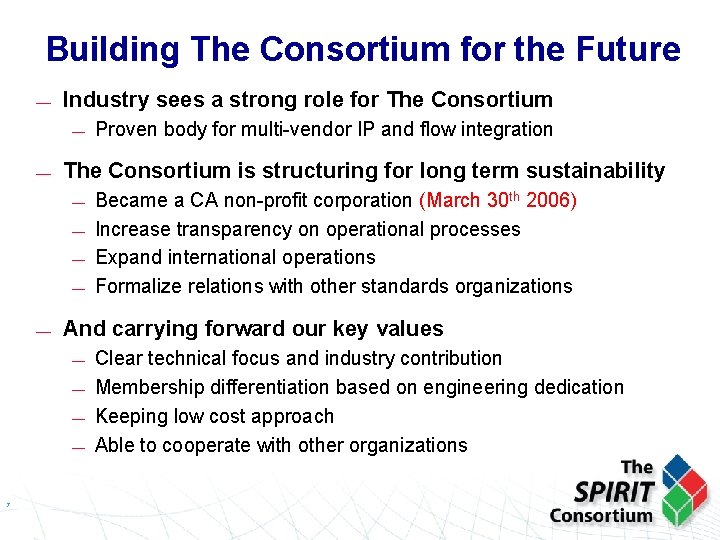
Building The Consortium for the Future — Industry sees a strong role for The Consortium — — The Consortium is structuring for long term sustainability — — — Became a CA non-profit corporation (March 30 th 2006) Increase transparency on operational processes Expand international operations Formalize relations with other standards organizations And carrying forward our key values — — 7 Proven body for multi-vendor IP and flow integration Clear technical focus and industry contribution Membership differentiation based on engineering dedication Keeping low cost approach Able to cooperate with other organizations
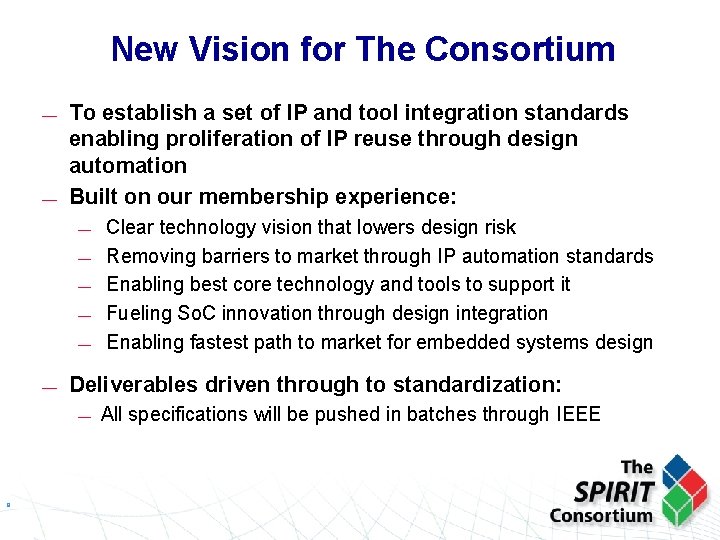
New Vision for The Consortium — — To establish a set of IP and tool integration standards enabling proliferation of IP reuse through design automation Built on our membership experience: — — — Deliverables driven through to standardization: — 8 Clear technology vision that lowers design risk Removing barriers to market through IP automation standards Enabling best core technology and tools to support it Fueling So. C innovation through design integration Enabling fastest path to market for embedded systems design All specifications will be pushed in batches through IEEE
With New Brands and Room for Growth — — IP-XACT: The Meta-Data Specifications — IP-XACT is the name for the meta-data specifications delivered by The Consortium — The Consortium may consider new specification families that promote our vision The SPIRIT Consortium: The Organization — 9 The Consortium has a new logo!
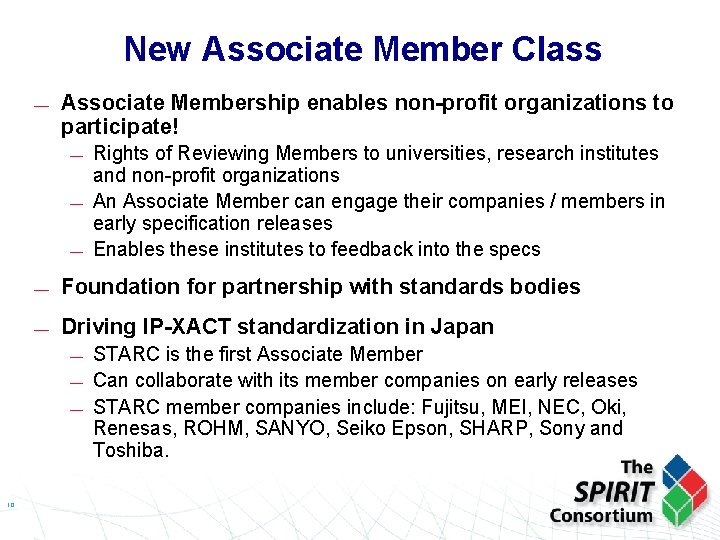
New Associate Member Class — Associate Membership enables non-profit organizations to participate! — — — Rights of Reviewing Members to universities, research institutes and non-profit organizations An Associate Member can engage their companies / members in early specification releases Enables these institutes to feedback into the specs — Foundation for partnership with standards bodies — Driving IP-XACT standardization in Japan STARC is the first Associate Member — Can collaborate with its member companies on early releases — STARC member companies include: Fujitsu, MEI, NEC, Oki, Renesas, ROHM, SANYO, Seiko Epson, SHARP, Sony and Toshiba. — 10
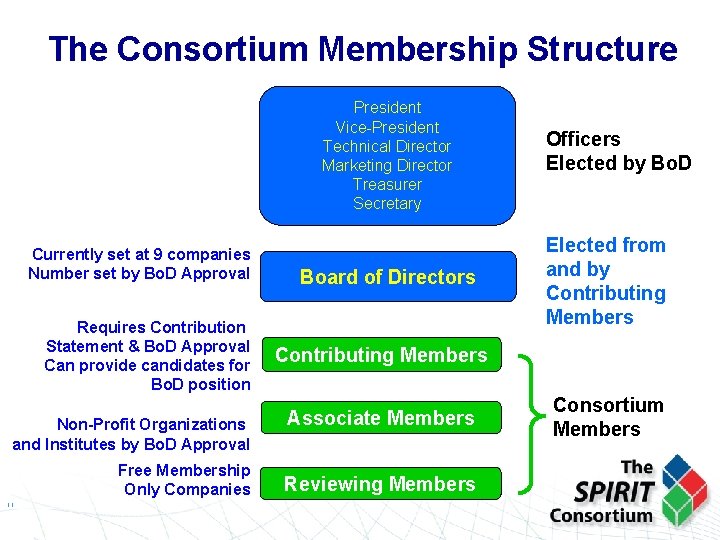
The Consortium Membership Structure President Vice-President Technical Director Marketing Director Treasurer Secretary Currently set at 9 companies Number set by Bo. D Approval Requires Contribution Statement & Bo. D Approval Can provide candidates for Bo. D position Non-Profit Organizations and Institutes by Bo. D Approval Free Membership Only Companies 11 Board of Directors Officers Elected by Bo. D Elected from and by Contributing Members Associate Members Reviewing Members Consortium Members
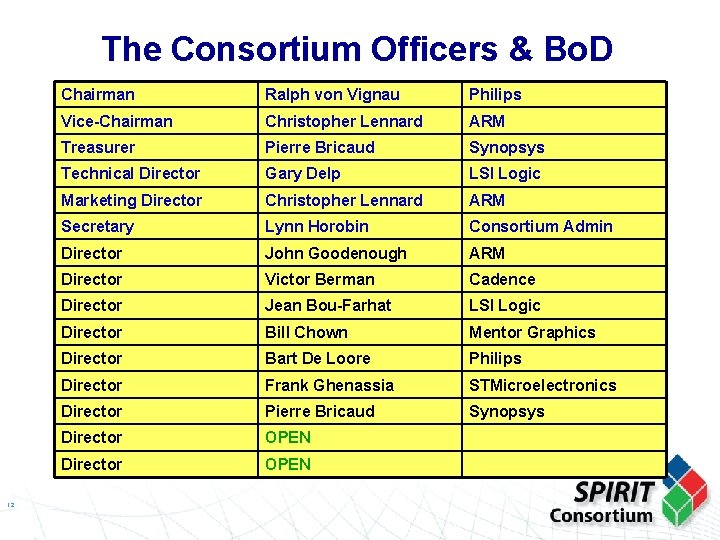
The Consortium Officers & Bo. D 12 Chairman Ralph von Vignau Philips Vice-Chairman Christopher Lennard ARM Treasurer Pierre Bricaud Synopsys Technical Director Gary Delp LSI Logic Marketing Director Christopher Lennard ARM Secretary Lynn Horobin Consortium Admin Director John Goodenough ARM Director Victor Berman Cadence Director Jean Bou-Farhat LSI Logic Director Bill Chown Mentor Graphics Director Bart De Loore Philips Director Frank Ghenassia STMicroelectronics Director Pierre Bricaud Synopsys Director OPEN
Structure of Session — Overview of The Consortium 13 — Technical Overview — Roadmap and Futures — IEEE Standardization Process
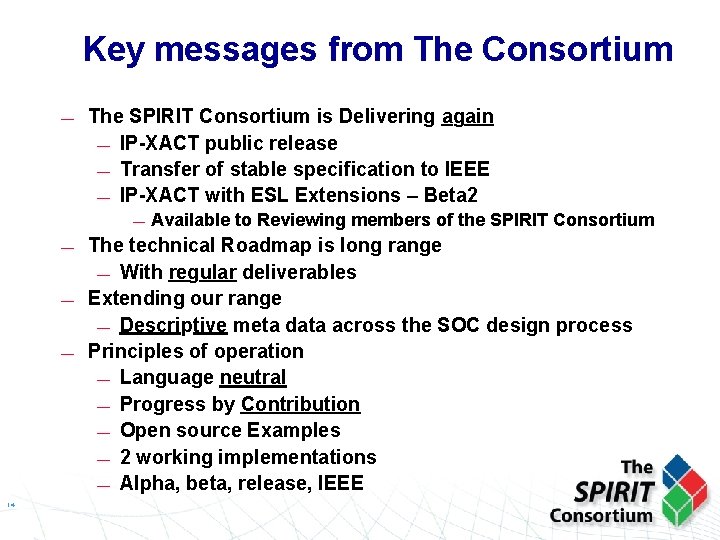
Key messages from The Consortium — The SPIRIT Consortium is Delivering again — IP-XACT public release — Transfer of stable specification to IEEE — IP-XACT with ESL Extensions – Beta 2 — — 14 Available to Reviewing members of the SPIRIT Consortium The technical Roadmap is long range — With regular deliverables Extending our range — Descriptive meta data across the SOC design process Principles of operation — Language neutral — Progress by Contribution — Open source Examples — 2 working implementations — Alpha, beta, release, IEEE
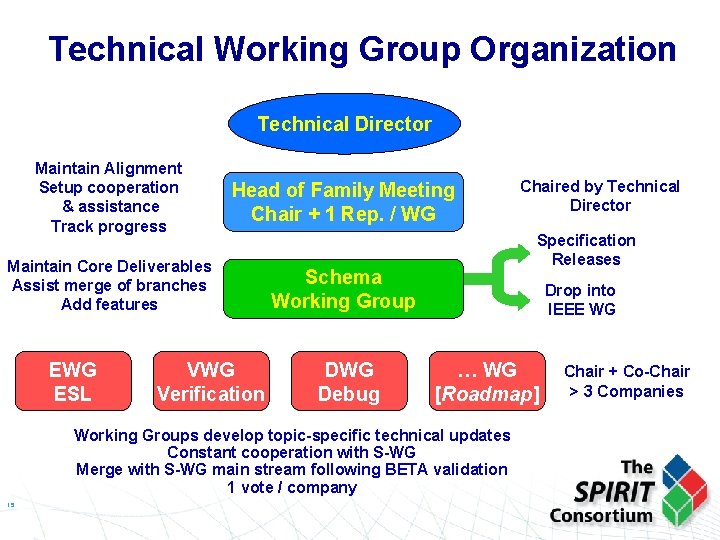
Technical Working Group Organization Technical Director Maintain Alignment Setup cooperation & assistance Track progress Head of Family Meeting Chair + 1 Rep. / WG Maintain Core Deliverables Assist merge of branches Add features Schema Working Group EWG ESL VWG Verification DWG Debug Specification Releases Drop into IEEE WG … WG [Roadmap] Working Groups develop topic-specific technical updates Constant cooperation with S-WG Merge with S-WG main stream following BETA validation 1 vote / company 15 Chaired by Technical Director Chair + Co-Chair > 3 Companies
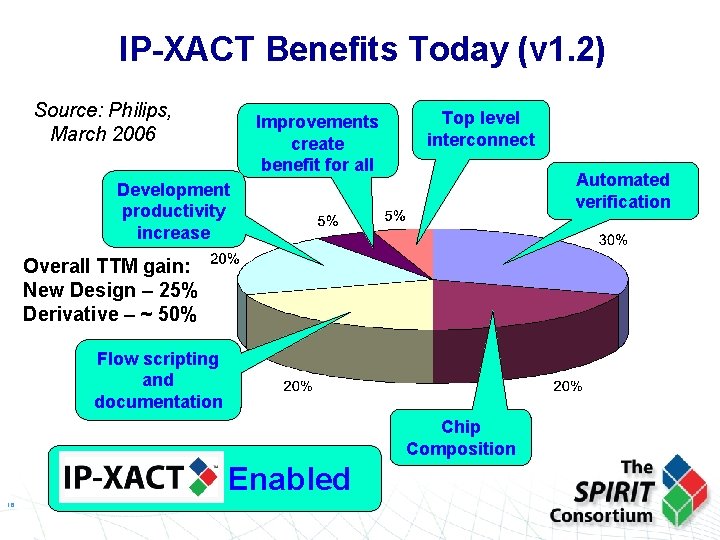
IP-XACT Benefits Today (v 1. 2) Source: Philips, March 2006 Improvements create benefit for all Top level interconnect Automated verification Development productivity increase Overall TTM gain: New Design – 25% Derivative – ~ 50% Flow scripting and documentation Chip Composition Enabled 16
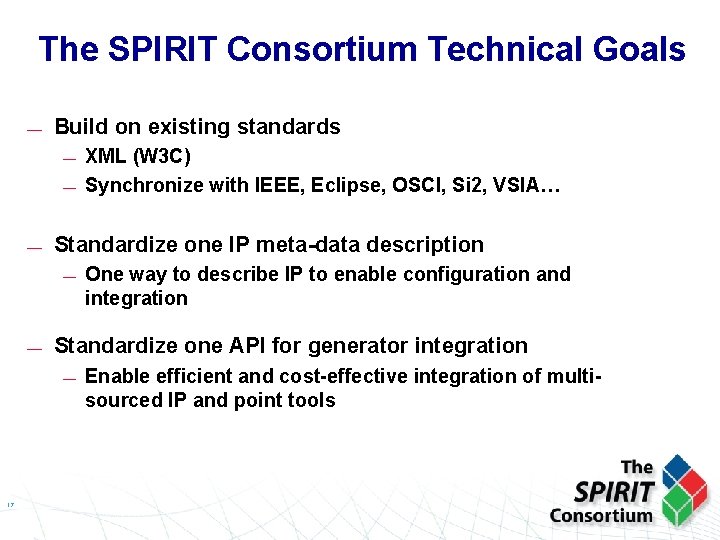
The SPIRIT Consortium Technical Goals — Build on existing standards — — — Standardize one IP meta-data description — — One way to describe IP to enable configuration and integration Standardize one API for generator integration — 17 XML (W 3 C) Synchronize with IEEE, Eclipse, OSCI, Si 2, VSIA… Enable efficient and cost-effective integration of multisourced IP and point tools
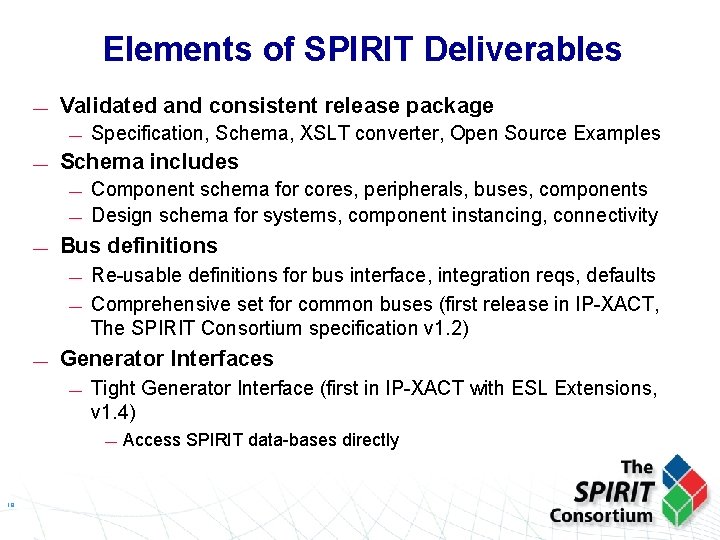
Elements of SPIRIT Deliverables — Validated and consistent release package — — Schema includes — — — Component schema for cores, peripherals, buses, components Design schema for systems, component instancing, connectivity Bus definitions — — — Specification, Schema, XSLT converter, Open Source Examples Re-usable definitions for bus interface, integration reqs, defaults Comprehensive set for common buses (first release in IP-XACT, The SPIRIT Consortium specification v 1. 2) Generator Interfaces — Tight Generator Interface (first in IP-XACT with ESL Extensions, v 1. 4) — 18 Access SPIRIT data-bases directly
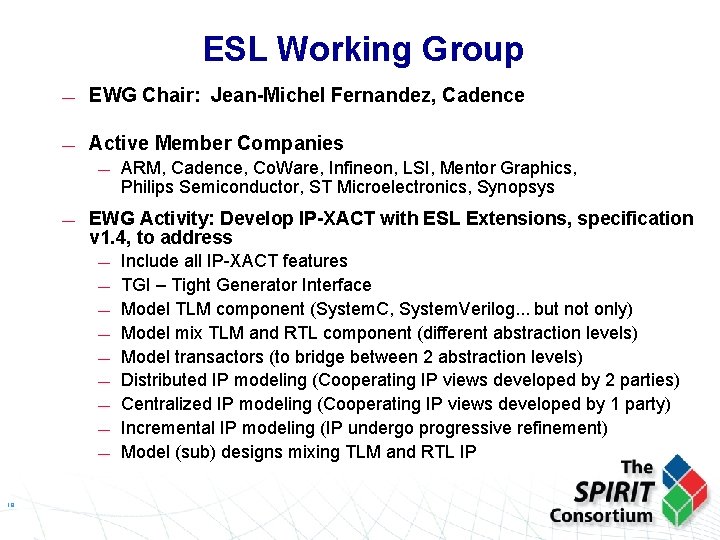
ESL Working Group — EWG Chair: Jean-Michel Fernandez, Cadence — Active Member Companies — — EWG Activity: Develop IP-XACT with ESL Extensions, specification v 1. 4, to address — — — — — 19 ARM, Cadence, Co. Ware, Infineon, LSI, Mentor Graphics, Philips Semiconductor, ST Microelectronics, Synopsys Include all IP-XACT features TGI – Tight Generator Interface Model TLM component (System. C, System. Verilog. . . but not only) Model mix TLM and RTL component (different abstraction levels) Model transactors (to bridge between 2 abstraction levels) Distributed IP modeling (Cooperating IP views developed by 2 parties) Centralized IP modeling (Cooperating IP views developed by 1 party) Incremental IP modeling (IP undergo progressive refinement) Model (sub) designs mixing TLM and RTL IP
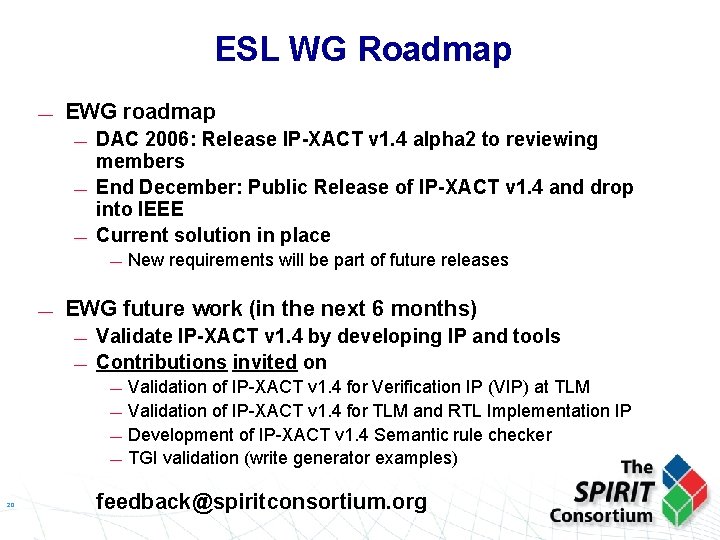
ESL WG Roadmap — EWG roadmap — — — DAC 2006: Release IP-XACT v 1. 4 alpha 2 to reviewing members End December: Public Release of IP-XACT v 1. 4 and drop into IEEE Current solution in place — — EWG future work (in the next 6 months) — — Validate IP-XACT v 1. 4 by developing IP and tools Contributions invited on — — 20 New requirements will be part of future releases Validation of IP-XACT v 1. 4 for Verification IP (VIP) at TLM Validation of IP-XACT v 1. 4 for TLM and RTL Implementation IP Development of IP-XACT v 1. 4 Semantic rule checker TGI validation (write generator examples) feedback@spiritconsortium. org
Verification Working Group — — VWG Chair: John Swanson, Synopsys Active Member Companies — — VWG Activity: Made 1. 2 Schema enhancements needed for RTL Verification including — — — 21 ARM, Cadence, LSI, Mentor Graphics, Phillips, ST, Synopsys Assertions Monitors Passive interfaces Verification file sets Mixed language verification Testbench generation (RTL)
VWG Roadmap — VWG roadmap — — DAC 2006: Release IP-XACT v 1. 4 alpha 2 to reviewing members VWG future work (in the next 6 months) — — — Validation of IP-XACT 1. 4 for mixed abstraction verification Mixed abstraction testbench generation Unit test migration into system environment TL VIP packaging Contributions invited on: — — Validation of IP-XACT v 1. 4 for Verification IP (VIP) at TLM Validation of IP-XACT v 1. 4 for TLM and RTL verification TGI validation (write generator examples) Invitation to new contributors to bring new ideas into VWG! contribute@spiritconsortium. org 22
Approved New Working Group Call for participation! Debug Working Group: Anthony Berent, ARM, chair — Charter — — — Energize major debug tools vendors to become Contributing Members of The Consortium in this work group Create technical exchange with the Eclipse DSDP group Define requirements for describing HW targets to SW debuggers Identify extensions, clarifications and semantic rules required to ensure IP-XACT meets the additional requirements Demonstrate that IP-XACT can be generated by design tools and used by a variety of debug tools Scope — — Ensure use of IP-XACT to describe IP to debug tools Extension of IP-XACT technical capabilities to cover at least — — — 23 The additional information required by debug tools about registers and memory The description of debugger access (e. g. JTAG) The identification of processor architectures and versions
Approved New Technical Sub-Group Call for participation! — Subteam in the SWG: Data Model Examination — — Alex Zamfirescu, Denali Software, chair Charter — — Scope — — — 24 Examine various system description languages Evaluate data model to ensure IP-XACT can contain the description Make recommendations to the SWG for inclusion into IP-XACT System. RDL – contributor present Debug – cooperation from Debug WG Additional – Call for participation!
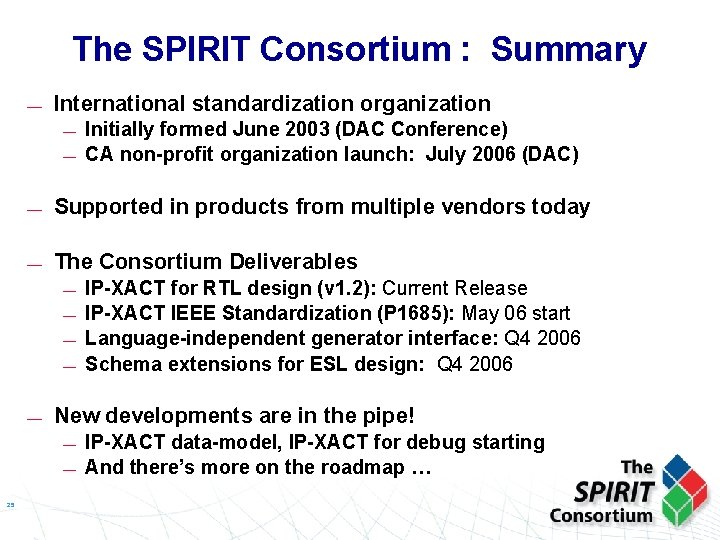
The SPIRIT Consortium : Summary — International standardization organization — — — Supported in products from multiple vendors today — The Consortium Deliverables — — — IP-XACT for RTL design (v 1. 2): Current Release IP-XACT IEEE Standardization (P 1685): May 06 start Language-independent generator interface: Q 4 2006 Schema extensions for ESL design: Q 4 2006 New developments are in the pipe! — — 25 Initially formed June 2003 (DAC Conference) CA non-profit organization launch: July 2006 (DAC) IP-XACT data-model, IP-XACT for debug starting And there’s more on the roadmap …
Structure of Session — Overview of The Consortium 26 — Technical Overview — Roadmap and Futures — IEEE Standardization Process
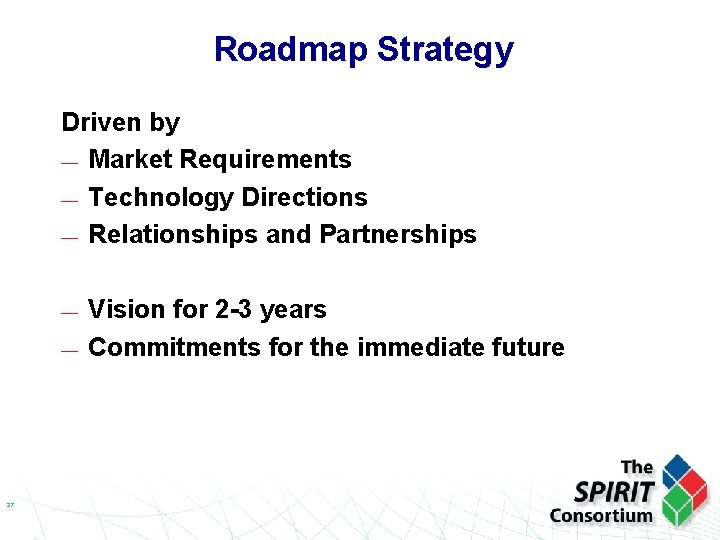
Roadmap Strategy Driven by — Market Requirements — Technology Directions — Relationships and Partnerships — — 27 Vision for 2 -3 years Commitments for the immediate future
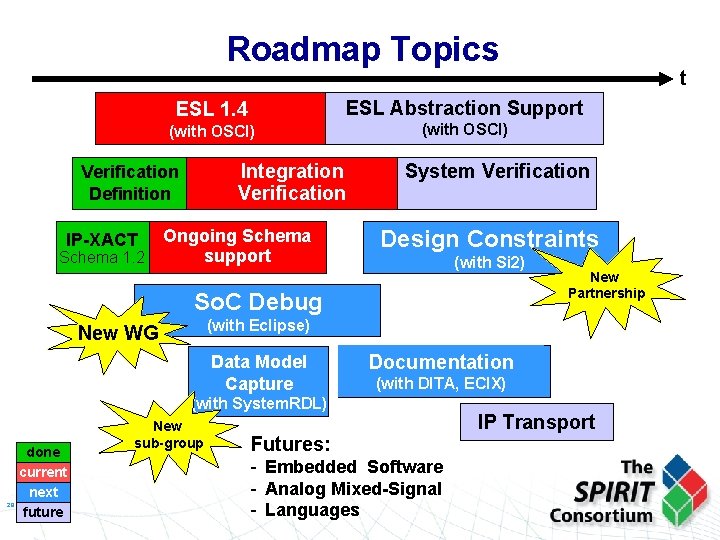
Roadmap Topics ESL 1. 4 ESL Abstraction Support (with OSCI) Integration Verification Definition IP-XACT Schema 1. 2 Ongoing Schema support (with OSCI) System Verification Design Constraints (with Si 2) So. C Debug Data Model Capture Documentation (with DITA, ECIX) (with System. RDL) 28 New Partnership (with Eclipse) New WG done current next future t New sub-group Futures: - Embedded Software - Analog Mixed-Signal - Languages IP Transport
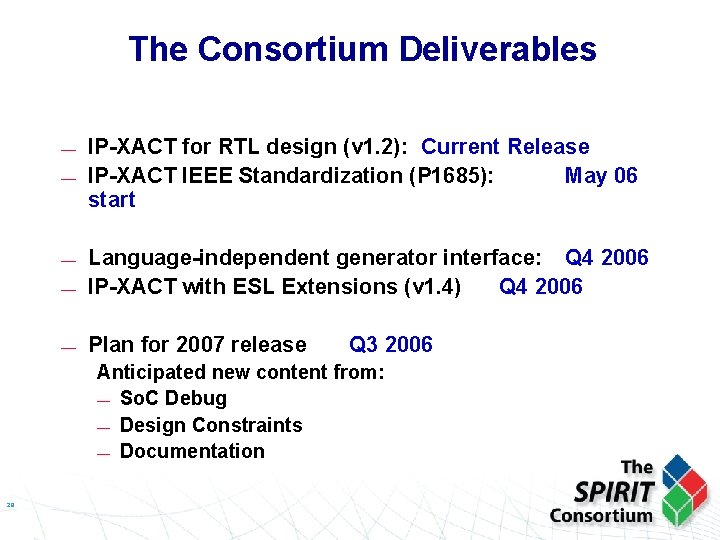
The Consortium Deliverables — — IP-XACT for RTL design (v 1. 2): Current Release IP-XACT IEEE Standardization (P 1685): May 06 start — Language-independent generator interface: Q 4 2006 IP-XACT with ESL Extensions (v 1. 4) Q 4 2006 — Plan for 2007 release — Q 3 2006 Anticipated new content from: — So. C Debug — Design Constraints — Documentation 29
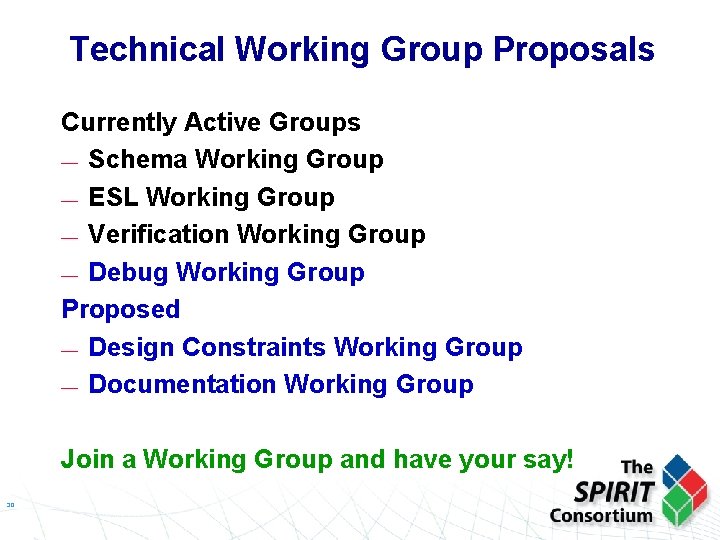
Technical Working Group Proposals Currently Active Groups — Schema Working Group — ESL Working Group — Verification Working Group — Debug Working Group Proposed — Design Constraints Working Group — Documentation Working Group Join a Working Group and have your say! 30
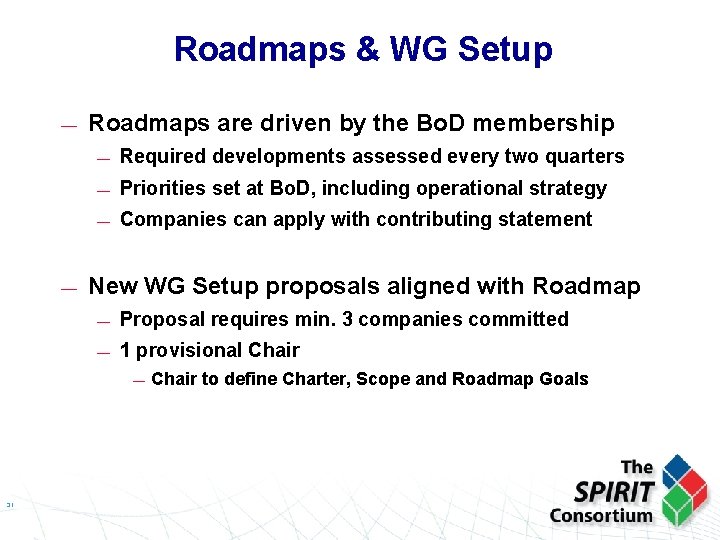
Roadmaps & WG Setup — — Roadmaps are driven by the Bo. D membership — Required developments assessed every two quarters — Priorities set at Bo. D, including operational strategy — Companies can apply with contributing statement New WG Setup proposals aligned with Roadmap — Proposal requires min. 3 companies committed — 1 provisional Chair — 31 Chair to define Charter, Scope and Roadmap Goals
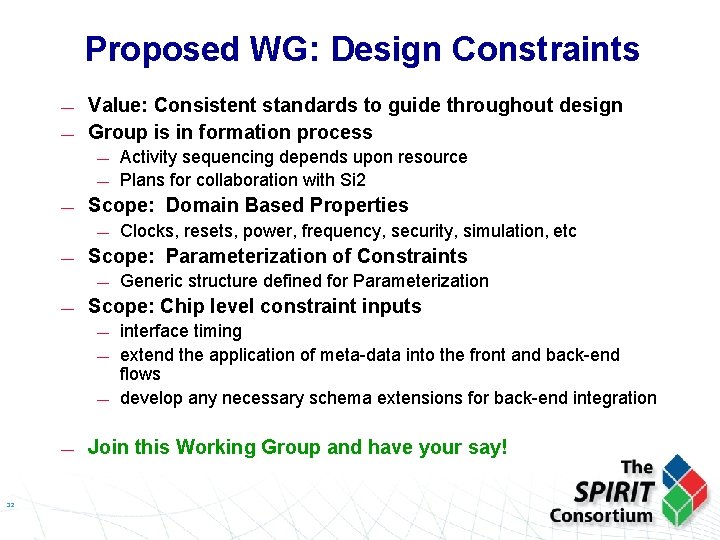
Proposed WG: Design Constraints — — Value: Consistent standards to guide throughout design Group is in formation process — — — Scope: Domain Based Properties — — 32 Generic structure defined for Parameterization Scope: Chip level constraint inputs — — Clocks, resets, power, frequency, security, simulation, etc Scope: Parameterization of Constraints — — Activity sequencing depends upon resource Plans for collaboration with Si 2 interface timing extend the application of meta-data into the front and back-end flows develop any necessary schema extensions for back-end integration Join this Working Group and have your say!
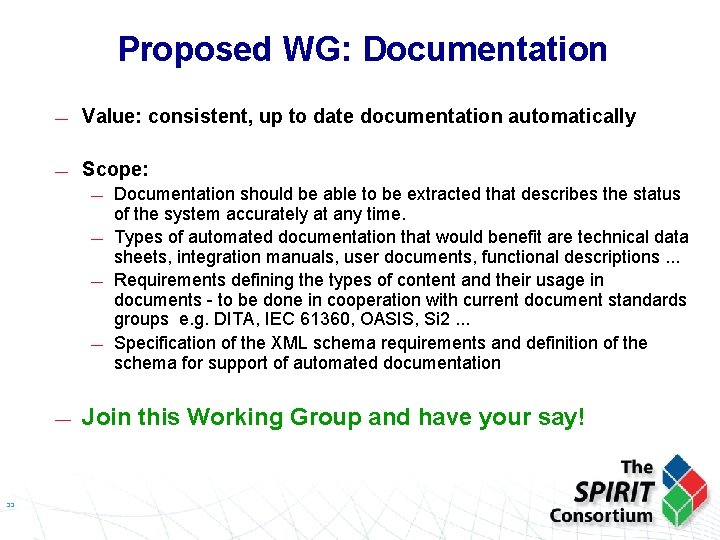
Proposed WG: Documentation — Value: consistent, up to date documentation automatically — Scope: — — — 33 Documentation should be able to be extracted that describes the status of the system accurately at any time. Types of automated documentation that would benefit are technical data sheets, integration manuals, user documents, functional descriptions. . . Requirements defining the types of content and their usage in documents - to be done in cooperation with current document standards groups e. g. DITA, IEC 61360, OASIS, Si 2. . . Specification of the XML schema requirements and definition of the schema for support of automated documentation Join this Working Group and have your say!
Invitation to Participate! — Join the Current Working Groups Schema — ESL — Verification — So. C Debug — — Help form these proposed WGs Design Constraints — Documentation — 34 — Propose New Working Groups — participate@spiritconsortium. org
Structure of Session — Overview of The Consortium 35 — Technical Overview — Roadmap and Futures — IEEE Standardization Process
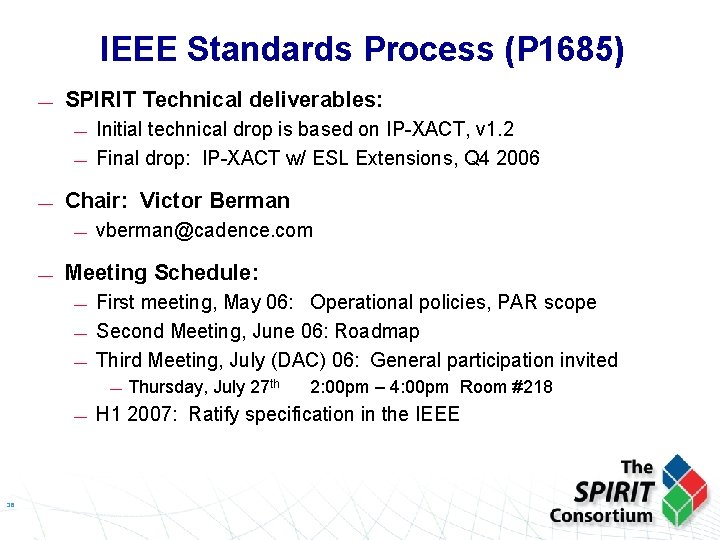
IEEE Standards Process (P 1685) — SPIRIT Technical deliverables: — — — Chair: Victor Berman — — Initial technical drop is based on IP-XACT, v 1. 2 Final drop: IP-XACT w/ ESL Extensions, Q 4 2006 vberman@cadence. com Meeting Schedule: — — — First meeting, May 06: Operational policies, PAR scope Second Meeting, June 06: Roadmap Third Meeting, July (DAC) 06: General participation invited — — 36 Thursday, July 27 th 2: 00 pm – 4: 00 pm Room #218 H 1 2007: Ratify specification in the IEEE
IEEE P 1685 — Organization — — Entity based WG – one company one vote Self funded through member dues on sliding scale > $1 B pay $10 K > $1 M pay $ 5 K < $1 M pay $ 1 K — Current Membership — — — Current Web Site http: //www. eda. org/spirit-p 1685/ Tracking to an expedited schedule — — — 37 ARM, Cadence, Co. Ware, Denali, Freescale, LSI, Mentor, Philips, Sonics, ST, Synopsys Will use IEEE funded services to expedite ballot and publication Will use professional technical editor final documents Will provide hosting of XML schema for free use