
The Spinothalamic System Learning Module Click to Begin
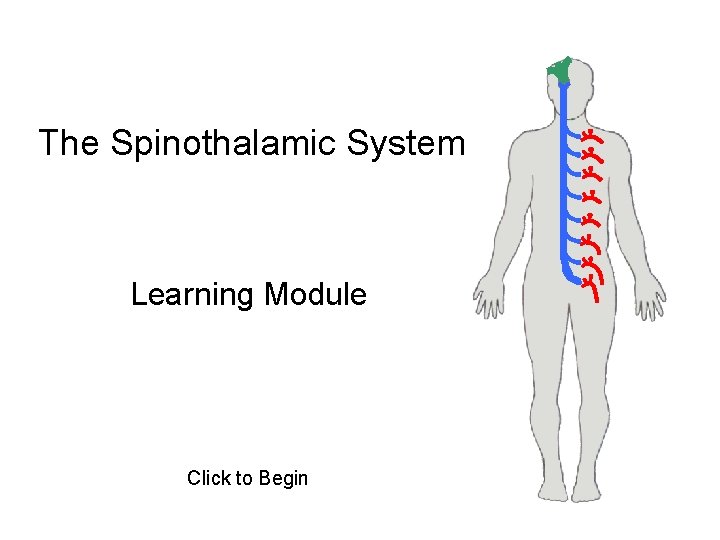
The Spinothalamic System Learning Module Click to Begin
Main Menu Overview describes the module content & learning objectives Please complete this section first! Contents overview of the Spinothalamic System under normal conditions and 3 interactive examples of lesion effects. Patient Cases provides practice with feedback using patient cases. Exit
Overview Introduction Learning Objectives Overview Menu Main Menu Exit
Introduction • This module reviews the Spinothalamic System. • Module organization consists of three components. Overview consists of this Introduction and the Learning Objectives. Contents consists of Navigation Instructions, a Legend, Review of the normal structure and function of the DCML, and 3 interactive lesion lessons. Cases consists of Instructions and 3 interactive patient cases with feedback. • At the bottom of each page a navigation bar contains options to move throughout the module. • Material is presented at both the behavioral level and the neuroanatomical level. • The behavioral level is presented first and depicts a patient’s clinical presentation. • The neuroanatomical level depicts the detailed anatomy of first-order, second-order and third-order neurons. • The neuroanatomical level accounts for the patient’s behavioral presentation on examination under normal and lesioned conditions. Overview Menu Main Menu Exit
Learning Objectives After completing this module you should be able to: 1. describe, in detail, the structure and function of the lateral spinothalamic system. 2. given a lesion, identify the signs and symptoms that would be expected. 3. given a patient case (examination results and chief complaint), identify the location of the lesion causing the signs and symptoms. 4. correlate neurology information between the behavioral and neuroanatomical levels. Overview Menu Main Menu Exit
Contents Read these Instructions! Legend: symbols used throughout the module Review of the Lateral Spinothalamic Tract Lesion lessons Lateral spinothalamic tract lesion Internal capsule lesion Lateral medulla lesion Main Menu Exit
Instructions • This module contains 3 interactive lesion lessons with animation. • Lesson lessons begin with a question about the symptoms produced by that particular lesion. • Clicking the answer button will reveal the answer to the question. • Clicking the explanation button will lead to both behavioral and neuroanatomical explanations of the lesion. • Each presentation is launched by clicking the animation button. The same button serves to replay the animation if desired. • Any of the lessons may be accessed by simply clicking on the lesion title on the Contents page. • Please refer to the Legend that defines the symbols used throughout the module. Main Menu Content Menu Exit
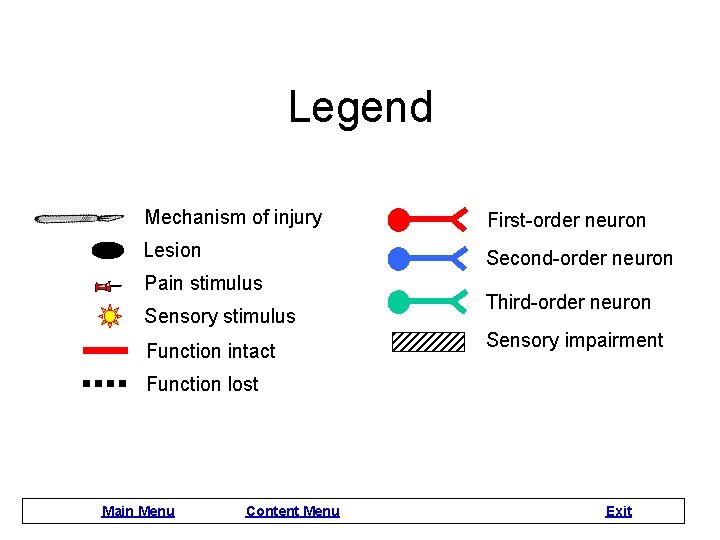
Legend Mechanism of injury First-order neuron Lesion Second-order neuron Pain stimulus Sensory stimulus Function intact Third-order neuron Sensory impairment Function lost Main Menu Content Menu Exit
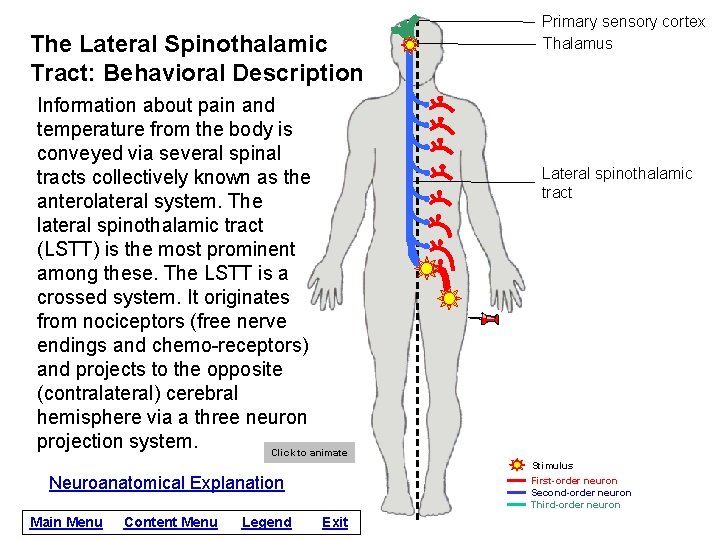
The Lateral Spinothalamic Tract: Behavioral Description Information about pain and temperature from the body is conveyed via several spinal tracts collectively known as the anterolateral system. The lateral spinothalamic tract (LSTT) is the most prominent among these. The LSTT is a crossed system. It originates from nociceptors (free nerve endings and chemo-receptors) and projects to the opposite (contralateral) cerebral hemisphere via a three neuron projection system. Click to animate Primary sensory cortex Thalamus Lateral spinothalamic tract Stimulus Neuroanatomical Explanation Main Menu Content Menu Legend First-order neuron Second-order neuron Third-order neuron Exit

The Lateral Spinothalamic Tract: Neuroanatomical Description First-order neurons Cell body: dorsal root ganglion (DRG) Distal axon: innervates nociceptors via peripheral nerves Proximal axon: enter the spinal cord, diverge 1 -3 levels and terminate on second-order neurons in the dorsal horn Second-order neurons Cell body: dorsal horn Axon: decussates at or about the level of entry and projects to the contralateral thalamus (ventral posterior lateral nucleus, VPL) via the lateral spinothalamic tract Third-order neurons Cell body: VPL of thalamus Axon: ascends via the posterior limb of the internal capsule and terminates in the primary somatosensory cortex Behavioral Explanation DRG Click to animate Lateral spinothalamic tract Main Menu Content Menu Legend Exit
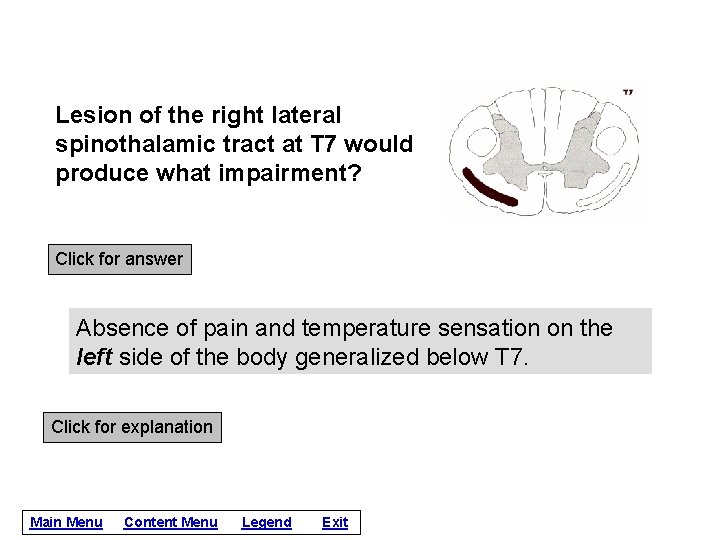
Lesion of the right lateral spinothalamic tract at T 7 would produce what impairment? Click for answer Absence of pain and temperature sensation on the left side of the body generalized below T 7. Click for explanation Main Menu Content Menu Legend Exit
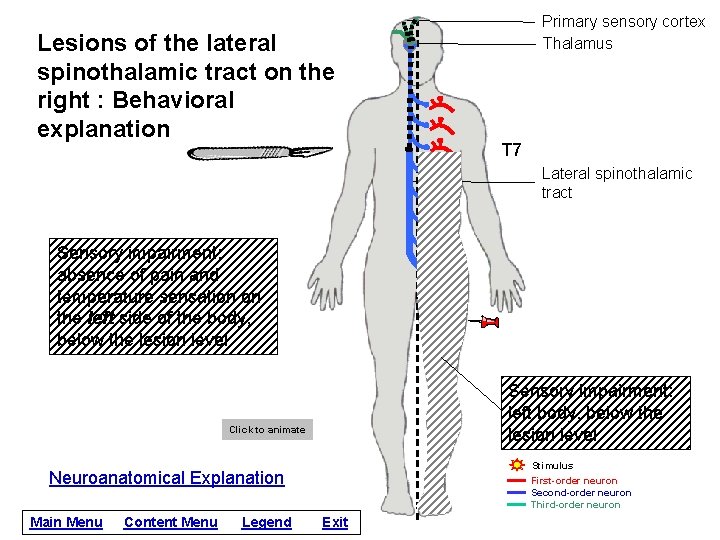
Lesions of the lateral spinothalamic tract on the right : Behavioral explanation Primary sensory cortex Thalamus T 7 Lateral spinothalamic tract Sensory impairment: absence of pain and temperature sensation on the left side of the body, below the lesion level. Sensory impairment: left body, below the lesion level. Click to animate Stimulus Neuroanatomical Explanation Main Menu Content Menu Legend First-order neuron Second-order neuron Third-order neuron Exit
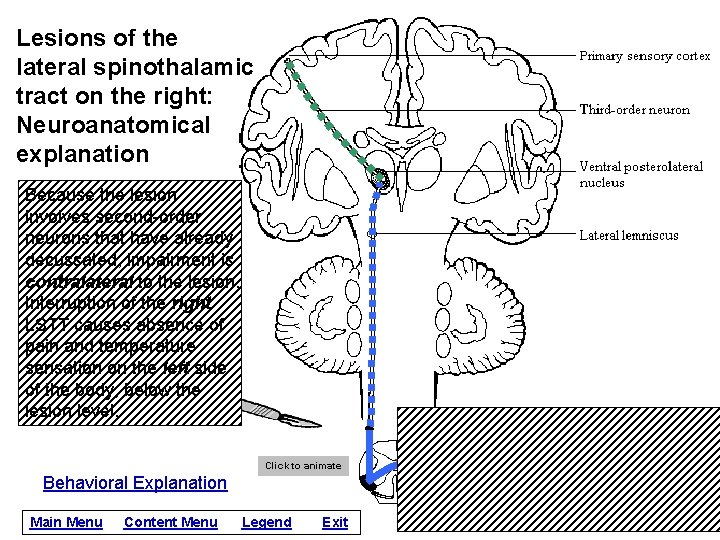
Lesions of the lateral spinothalamic tract on the right: Neuroanatomical explanation Because the lesion involves second-order neurons that have already decussated, impairment is contralateral to the lesion. Interruption of the right LSTT causes absence of pain and temperature sensation on the left side of the body, below the lesion level. Click to animate Behavioral Explanation Main Menu Content Menu Legend Exit
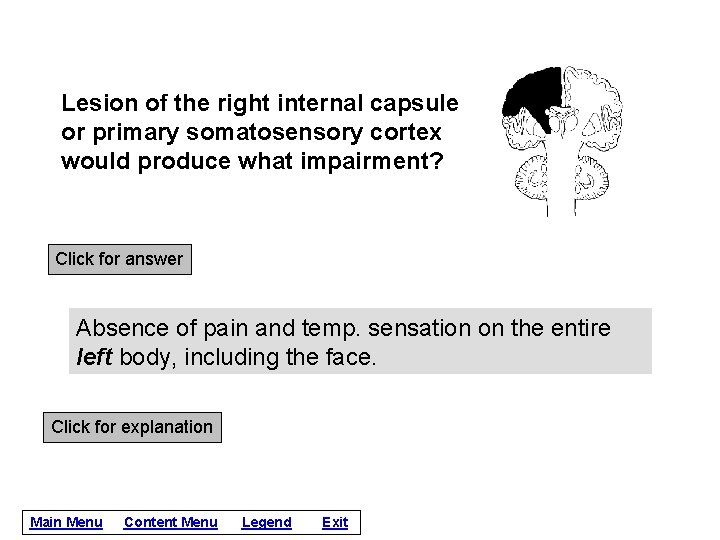
Lesion of the right internal capsule or primary somatosensory cortex would produce what impairment? Click for answer Absence of pain and temp. sensation on the entire left body, including the face. Click for explanation Main Menu Content Menu Legend Exit
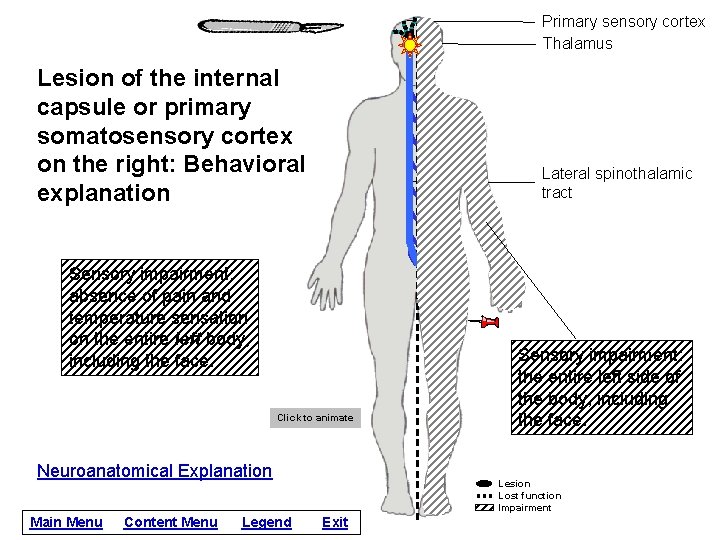
Primary sensory cortex Thalamus Lesion of the internal capsule or primary somatosensory cortex on the right: Behavioral explanation Lateral spinothalamic tract Sensory impairment: absence of pain and temperature sensation on the entire left body, including the face. Click to animate Neuroanatomical Explanation Main Menu Content Menu Legend Sensory impairment: the entire left side of the body, including the face. Lesion Lost function Impairment Exit
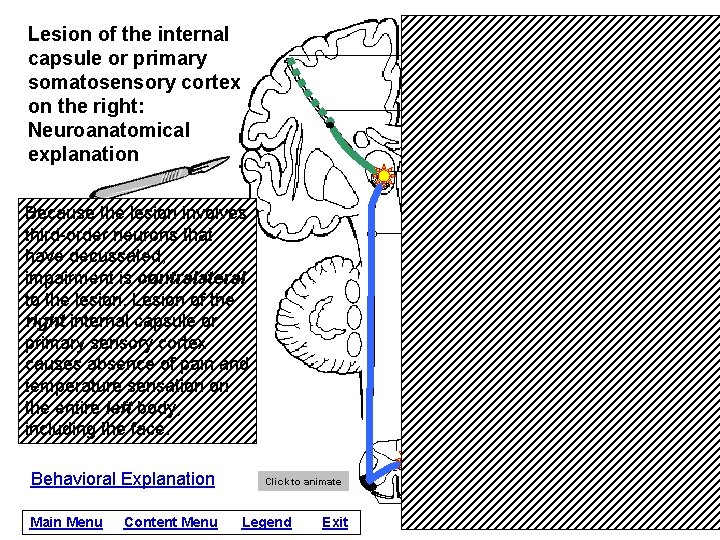
Lesion of the internal capsule or primary somatosensory cortex on the right: Neuroanatomical explanation Because the lesion involves third-order neurons that have decussated, impairment is contralateral to the lesion. Lesion of the right internal capsule or primary sensory cortex causes absence of pain and temperature sensation on the entire left body, including the face. Behavioral Explanation Main Menu Content Menu Click to animate Legend Exit
Lesion of the right lateral medulla would produce what impairment? Click for answer Absence of pain and temperature sensation on the ipsilateral face and contralateral body. Click for explanation Main Menu Content Menu Legend Exit
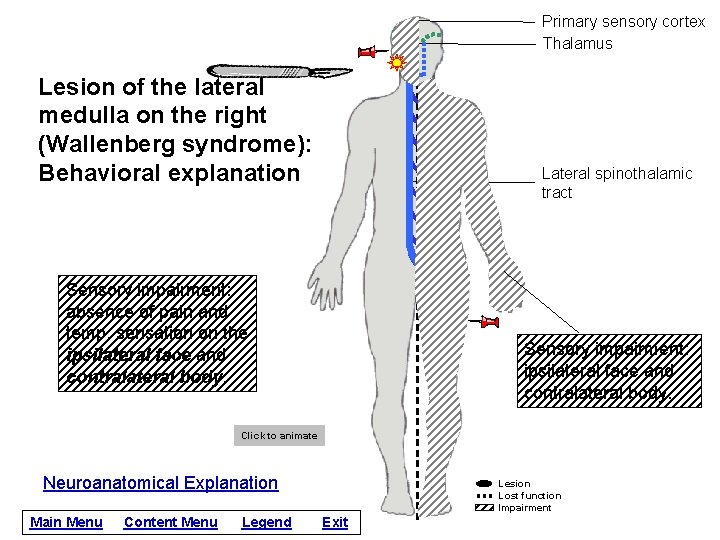
Primary sensory cortex Thalamus Lesion of the lateral medulla on the right (Wallenberg syndrome): Behavioral explanation Lateral spinothalamic tract Sensory impairment: absence of pain and temp. sensation on the ipsilateral face and contralateral body. Sensory impairment: ipsilateral face and contralateral body. Click to animate Neuroanatomical Explanation Main Menu Content Menu Legend Lesion Lost function Impairment Exit
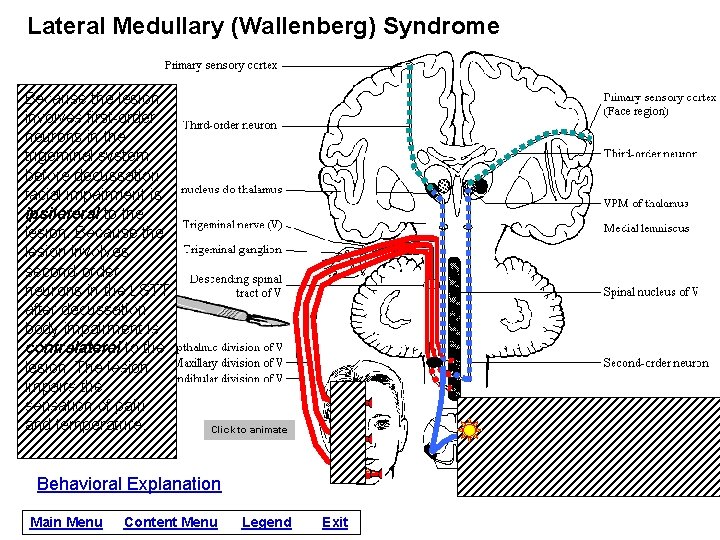
Lateral Medullary (Wallenberg) Syndrome Because the lesion involves first-order neurons in the trigeminal system before decussation, facial impairment is ipsilateral to the lesion. Because the lesion involves second-order neurons in the LSTT after decussation, body impairment is contralateral to the lesion. The lesion impairs the sensation of pain and temperature. Click to animate Behavioral Explanation Main Menu Content Menu Legend Exit
Case-based Practice Read these instructions! Patient Case #1 Patient Case #2 Patient Case #3 Main Menu Exit
Case Instructions • These patient cases are intended to facilitate the integration and clinical application of information about the spinothalamic tract by coupling the findings on examination and patient interview with their neuroanatomical correlates. • Cases are presented from two perspectives. What lesion would account for a given set of examination results and patient history? For a given lesion, what signs and symptoms would be expected on examination? • Click on a Case number to begin the exercise. Main Menu Case Menu Exit
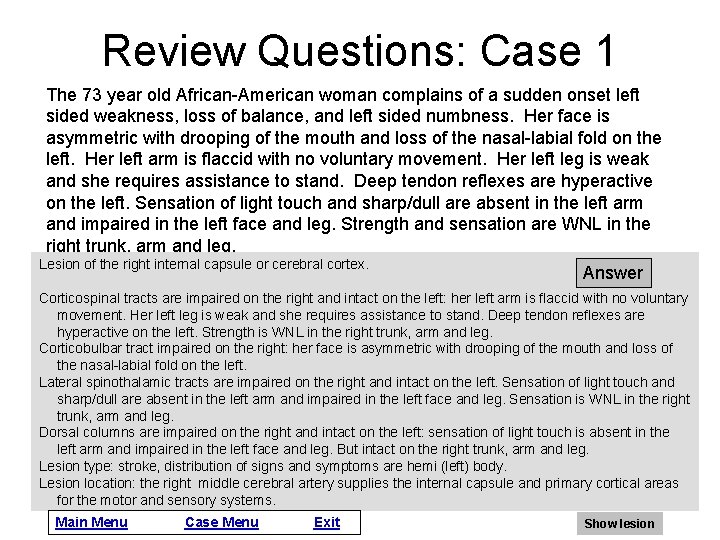
Review Questions: Case 1 The 73 year old African-American woman complains of a sudden onset left sided weakness, loss of balance, and left sided numbness. Her face is asymmetric with drooping of the mouth and loss of the nasal-labial fold on the left. Her left arm is flaccid with no voluntary movement. Her left leg is weak and she requires assistance to stand. Deep tendon reflexes are hyperactive on the left. Sensation of light touch and sharp/dull are absent in the left arm and impaired in the left face and leg. Strength and sensation are WNL in the right trunk, arm and leg. Lesion of the right internal capsule or cerebral cortex. Damage to what system(s) is causing this patient’s problems? Answer Corticospinal tracts are impaired on the right and intact on the left: her left arm is flaccid with no voluntary movement. Her left leg is weak and she requires assistance to stand. Deep tendon reflexes are hyperactive on the left. Strength is WNL in the right trunk, arm and leg. Corticobulbar tract impaired on the right: her face is asymmetric with drooping of the mouth and loss of the nasal-labial fold on the left. Lateral spinothalamic tracts are impaired on the right and intact on the left. Sensation of light touch and sharp/dull are absent in the left arm and impaired in the left face and leg. Sensation is WNL in the right trunk, arm and leg. Dorsal columns are impaired on the right and intact on the left: sensation of light touch is absent in the left arm and impaired in the left face and leg. But intact on the right trunk, arm and leg. Lesion type: stroke, distribution of signs and symptoms are hemi (left) body. Lesion location: the right middle cerebral artery supplies the internal capsule and primary cortical areas for the motor and sensory systems. Main Menu Case Menu Exit Show lesion
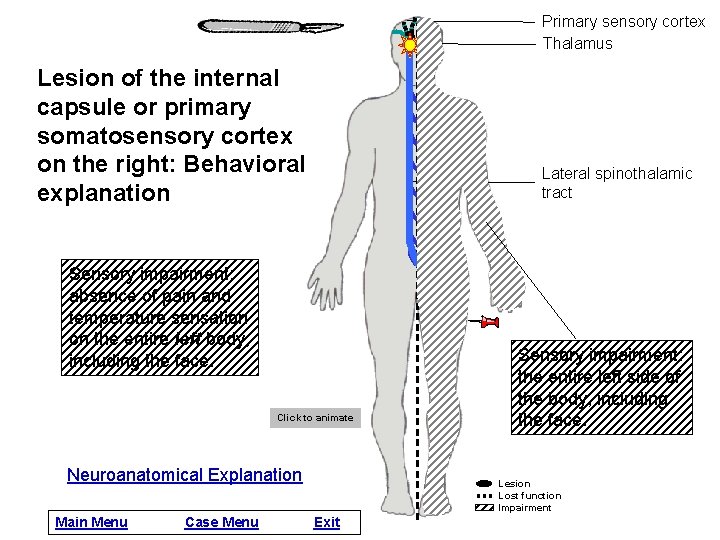
Primary sensory cortex Thalamus Lesion of the internal capsule or primary somatosensory cortex on the right: Behavioral explanation Lateral spinothalamic tract Sensory impairment: absence of pain and temperature sensation on the entire left body, including the face. Click to animate Neuroanatomical Explanation Main Menu Case Menu Sensory impairment: the entire left side of the body, including the face. Lesion Lost function Impairment Exit
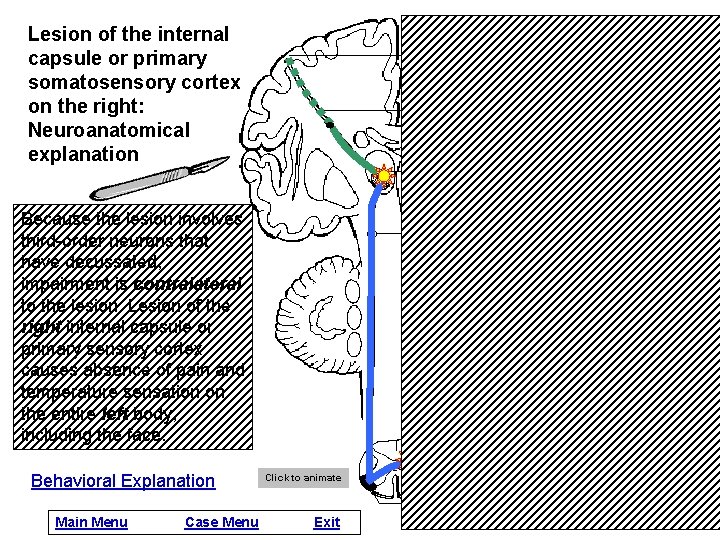
Lesion of the internal capsule or primary somatosensory cortex on the right: Neuroanatomical explanation Because the lesion involves third-order neurons that have decussated, impairment is contralateral to the lesion. Lesion of the right internal capsule or primary sensory cortex causes absence of pain and temperature sensation on the entire left body, including the face. Behavioral Explanation Main Menu Case Menu Click to animate Exit
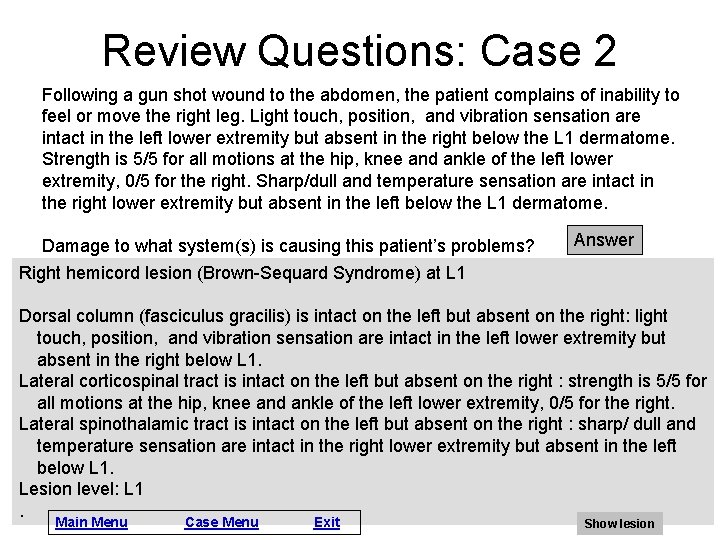
Review Questions: Case 2 Following a gun shot wound to the abdomen, the patient complains of inability to feel or move the right leg. Light touch, position, and vibration sensation are intact in the left lower extremity but absent in the right below the L 1 dermatome. Strength is 5/5 for all motions at the hip, knee and ankle of the left lower extremity, 0/5 for the right. Sharp/dull and temperature sensation are intact in the right lower extremity but absent in the left below the L 1 dermatome. Damage to what system(s) is causing this patient’s problems? Answer Right hemicord lesion (Brown-Sequard Syndrome) at L 1 Dorsal column (fasciculus gracilis) is intact on the left but absent on the right: light touch, position, and vibration sensation are intact in the left lower extremity but absent in the right below L 1. Lateral corticospinal tract is intact on the left but absent on the right : strength is 5/5 for all motions at the hip, knee and ankle of the left lower extremity, 0/5 for the right. Lateral spinothalamic tract is intact on the left but absent on the right : sharp/ dull and temperature sensation are intact in the right lower extremity but absent in the left below L 1. Lesion level: L 1. Main Menu Case Menu Exit Show lesion
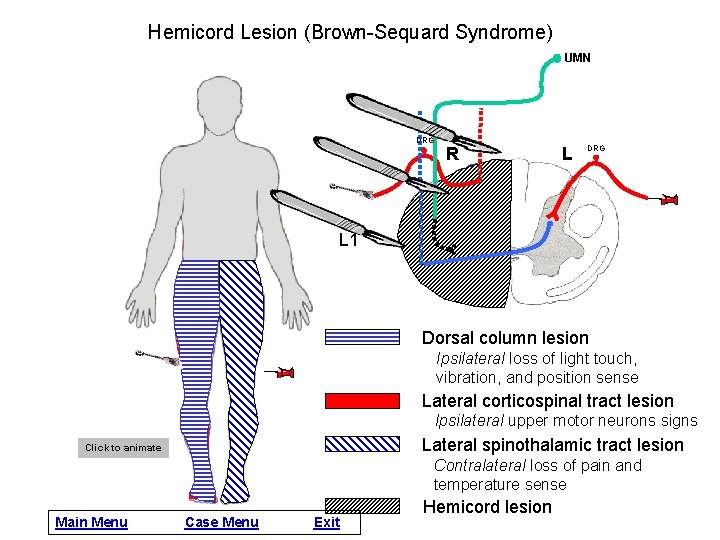
Hemicord Lesion (Brown-Sequard Syndrome) UMN DRG R L DRG L 1 Dorsal column lesion Ipsilateral loss of light touch, vibration, and position sense Lateral corticospinal tract lesion Ipsilateral upper motor neurons signs Lateral spinothalamic tract lesion Click to animate Contralateral loss of pain and temperature sense Main Menu Case Menu Exit Hemicord lesion
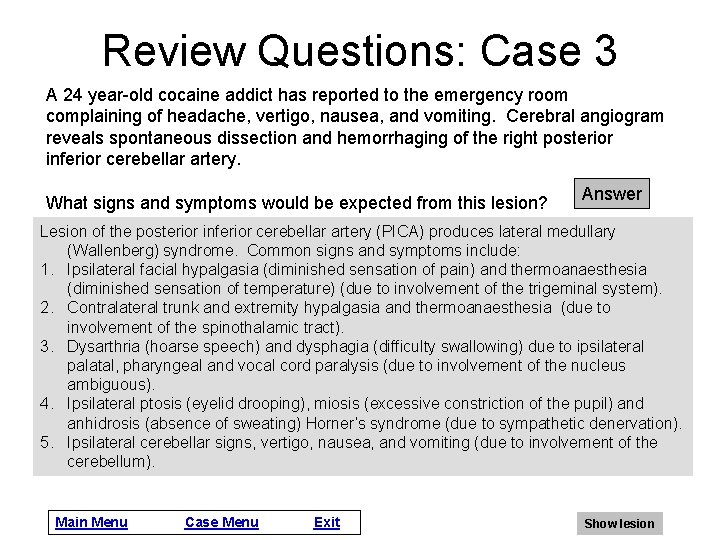
Review Questions: Case 3 A 24 year-old cocaine addict has reported to the emergency room complaining of headache, vertigo, nausea, and vomiting. Cerebral angiogram reveals spontaneous dissection and hemorrhaging of the right posterior inferior cerebellar artery. What signs and symptoms would be expected from this lesion? Answer Lesion of the posterior inferior cerebellar artery (PICA) produces lateral medullary (Wallenberg) syndrome. Common signs and symptoms include: 1. Ipsilateral facial hypalgasia (diminished sensation of pain) and thermoanaesthesia (diminished sensation of temperature) (due to involvement of the trigeminal system). 2. Contralateral trunk and extremity hypalgasia and thermoanaesthesia (due to involvement of the spinothalamic tract). 3. Dysarthria (hoarse speech) and dysphagia (difficulty swallowing) due to ipsilateral palatal, pharyngeal and vocal cord paralysis (due to involvement of the nucleus ambiguous). 4. Ipsilateral ptosis (eyelid drooping), miosis (excessive constriction of the pupil) and anhidrosis (absence of sweating) Horner’s syndrome (due to sympathetic denervation). 5. Ipsilateral cerebellar signs, vertigo, nausea, and vomiting (due to involvement of the cerebellum). Main Menu Case Menu Exit Show lesion
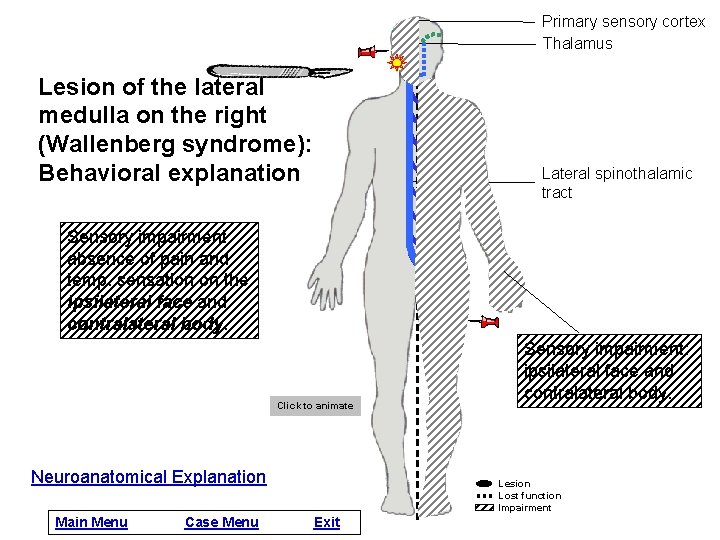
Primary sensory cortex Thalamus Lesion of the lateral medulla on the right (Wallenberg syndrome): Behavioral explanation Lateral spinothalamic tract Sensory impairment: absence of pain and temp. sensation on the ipsilateral face and contralateral body. Click to animate Neuroanatomical Explanation Main Menu Case Menu Sensory impairment: ipsilateral face and contralateral body. Lesion Lost function Impairment Exit
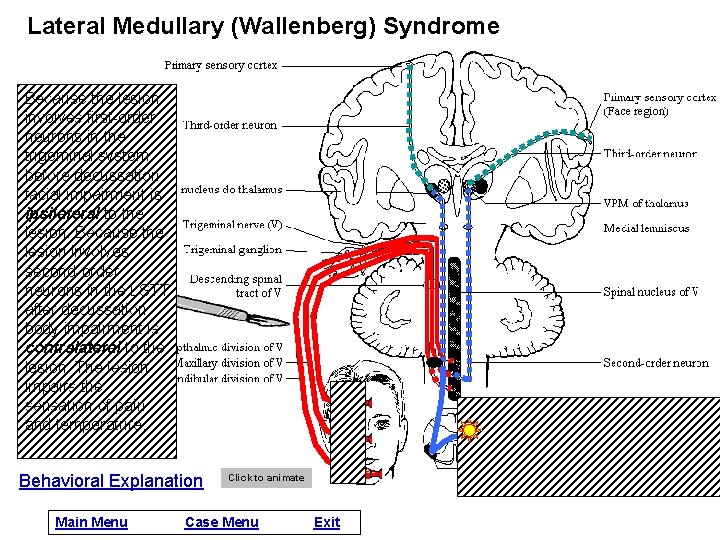
Lateral Medullary (Wallenberg) Syndrome Because the lesion involves first-order neurons in the trigeminal system before decussation, facial impairment is ipsilateral to the lesion. Because the lesion involves second-order neurons in the LSTT after decussation, body impairment is contralateral to the lesion. The lesion impairs the sensation of pain and temperature. Behavioral Explanation Main Menu Click to animate Case Menu Exit
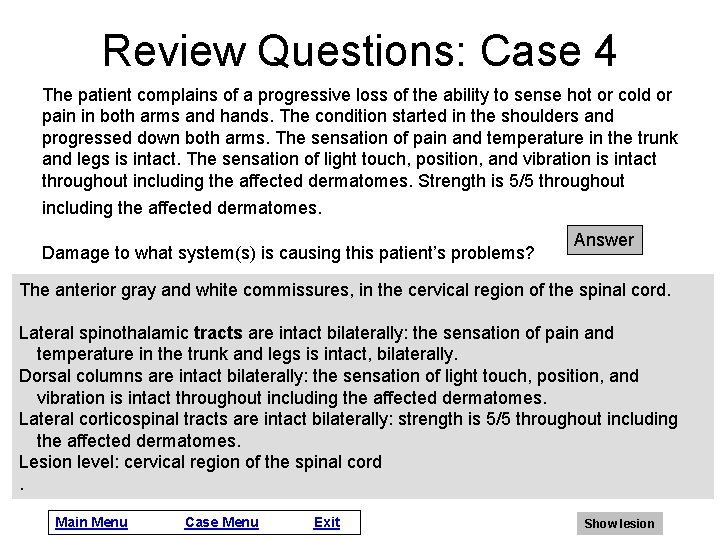
Review Questions: Case 4 The patient complains of a progressive loss of the ability to sense hot or cold or pain in both arms and hands. The condition started in the shoulders and progressed down both arms. The sensation of pain and temperature in the trunk and legs is intact. The sensation of light touch, position, and vibration is intact throughout including the affected dermatomes. Strength is 5/5 throughout including the affected dermatomes. Damage to what system(s) is causing this patient’s problems? Answer The anterior gray and white commissures, in the cervical region of the spinal cord. Lateral spinothalamic tracts are intact bilaterally: the sensation of pain and temperature in the trunk and legs is intact, bilaterally. Dorsal columns are intact bilaterally: the sensation of light touch, position, and vibration is intact throughout including the affected dermatomes. Lateral corticospinal tracts are intact bilaterally: strength is 5/5 throughout including the affected dermatomes. Lesion level: cervical region of the spinal cord. Main Menu Case Menu Exit Show lesion
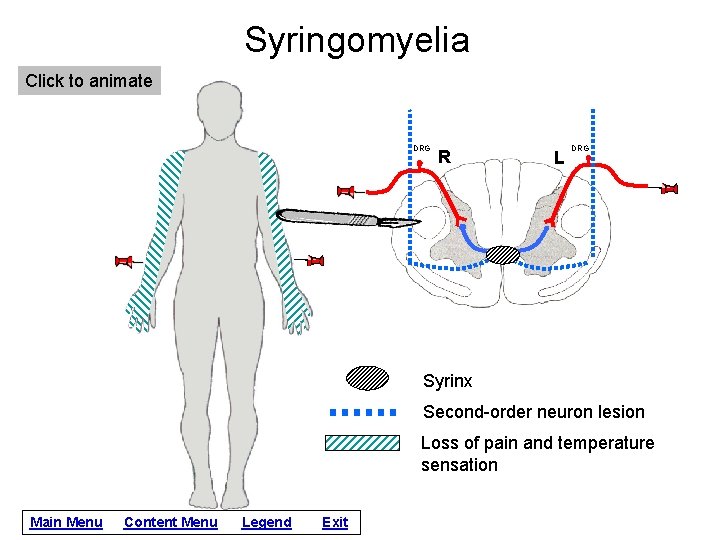
Syringomyelia Click to animate DRG R L DRG Syrinx Second-order neuron lesion Loss of pain and temperature sensation Main Menu Content Menu Legend Exit
The End D. Michael Mc. Keough, PT, Ed. D 2008
- Slides: 32