
The Spectrum of Markarian 421 Above 100 Ge
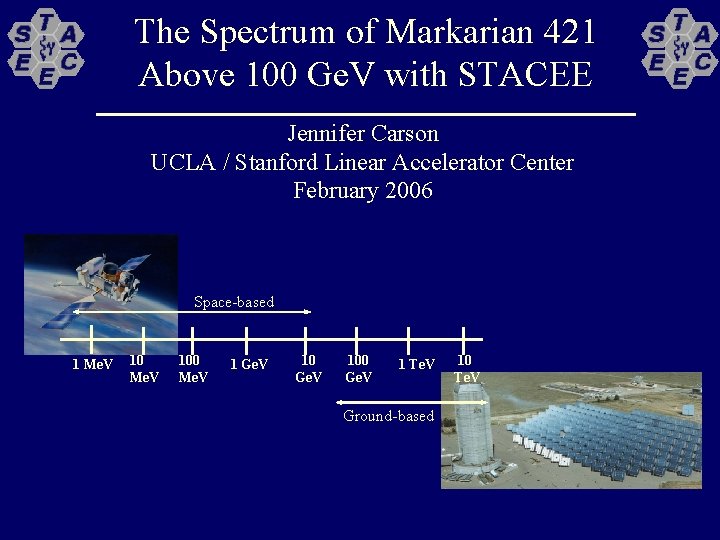
The Spectrum of Markarian 421 Above 100 Ge. V with STACEE Jennifer Carson UCLA / Stanford Linear Accelerator Center February 2006 Space-based 1 Me. V 100 Me. V 1 Ge. V 100 Ge. V 1 Te. V Ground-based 10 Te. V
Outline I. Science goal for -ray detections from active galaxies • Understanding particle acceleration II. Brief overview of VHE gamma-ray astronomy III. Ground-based detection techniques • Atmospheric Cherenkov technique • Imaging vs. wavefront sampling IV. STACEE V. Markarian 421 • First STACEE spectrum • Detection of high-energy peak? VI. Prospects for the future
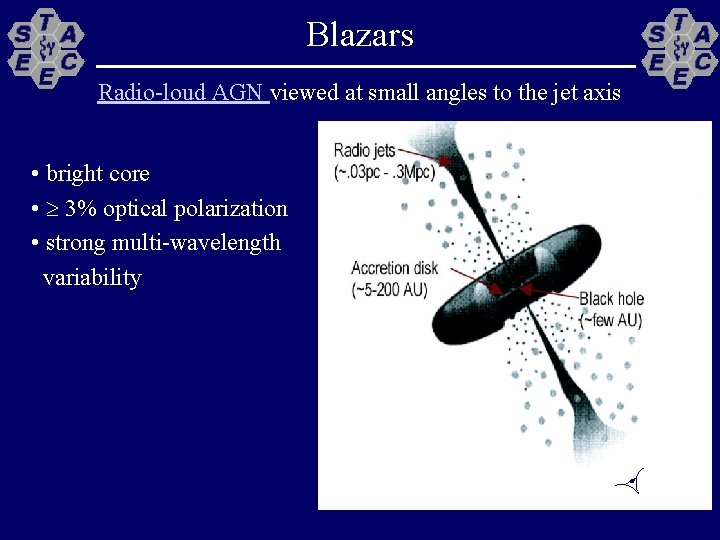
Blazars Radio-loud AGN viewed at small angles to the jet axis • bright core • 3% optical polarization • strong multi-wavelength variability
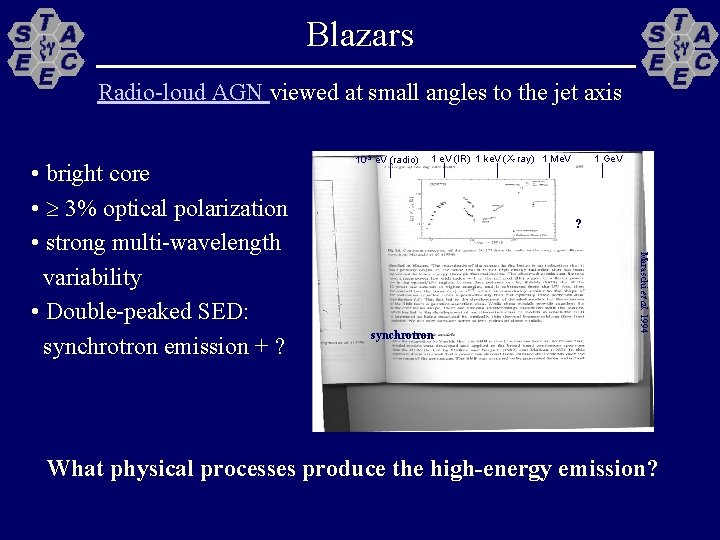
Blazars Radio-loud AGN viewed at small angles to the jet axis 1 e. V (IR) 1 ke. V (X-ray) 1 Me. V 1 Ge. V ? synchrotron Maraschi et al. 1994 • bright core • 3% optical polarization • strong multi-wavelength variability • Double-peaked SED: synchrotron emission + ? 10 -3 e. V (radio) What physical processes produce the high-energy emission?
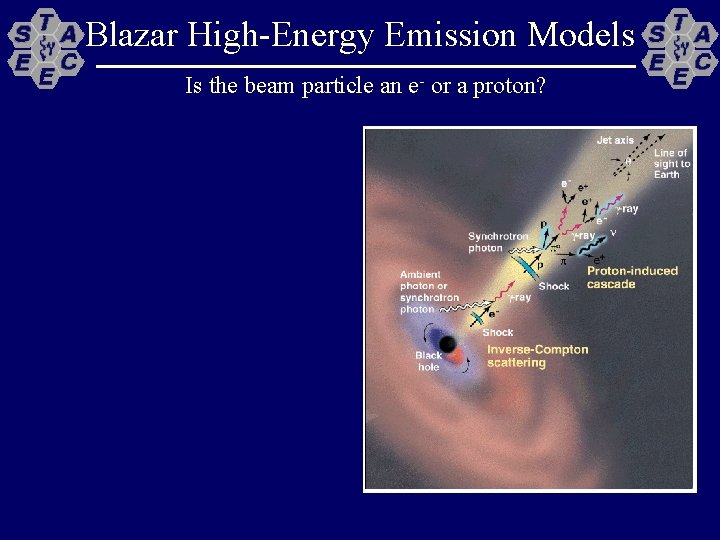
Blazar High-Energy Emission Models Is the beam particle an e- or a proton?
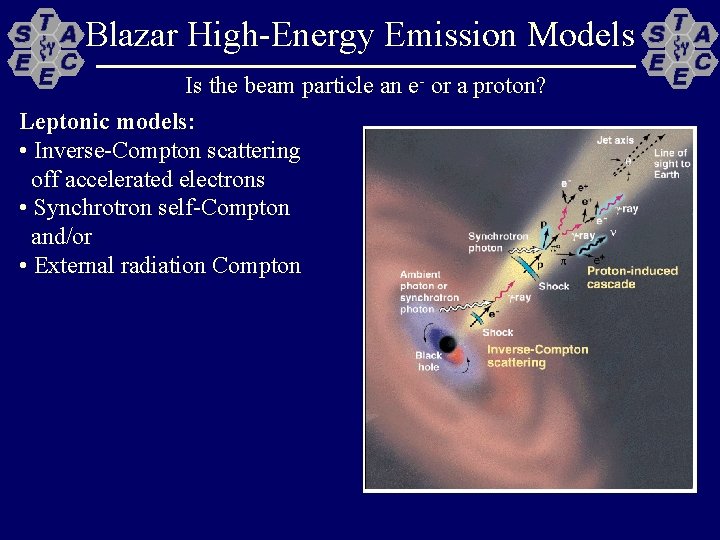
Blazar High-Energy Emission Models Is the beam particle an e- or a proton? Leptonic models: • Inverse-Compton scattering off accelerated electrons • Synchrotron self-Compton and/or • External radiation Compton
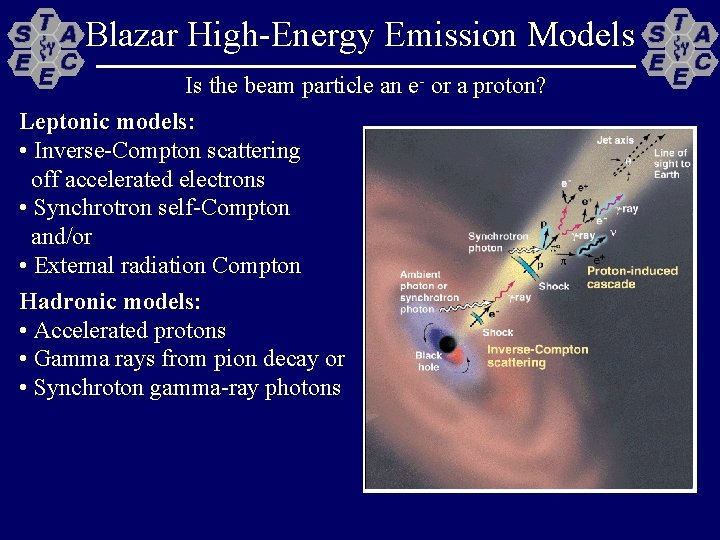
Blazar High-Energy Emission Models Is the beam particle an e- or a proton? Leptonic models: • Inverse-Compton scattering off accelerated electrons • Synchrotron self-Compton and/or • External radiation Compton Hadronic models: • Accelerated protons • Gamma rays from pion decay or • Synchroton gamma-ray photons
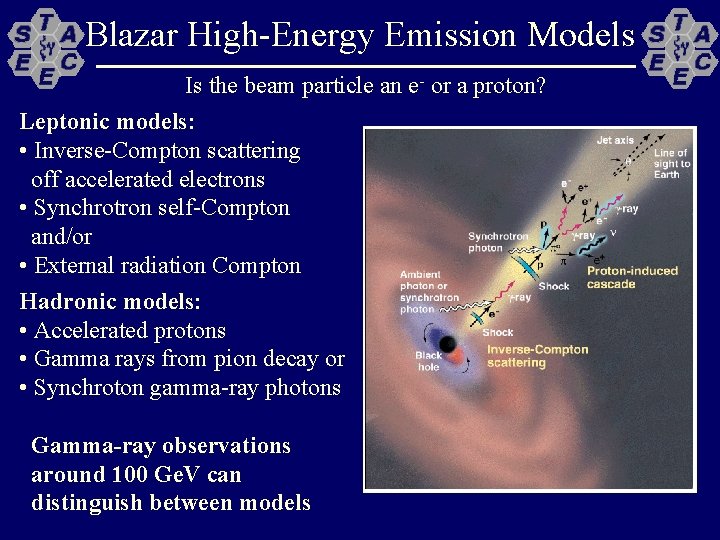
Blazar High-Energy Emission Models Is the beam particle an e- or a proton? Leptonic models: • Inverse-Compton scattering off accelerated electrons • Synchrotron self-Compton and/or • External radiation Compton Hadronic models: • Accelerated protons • Gamma rays from pion decay or • Synchroton gamma-ray photons Gamma-ray observations around 100 Ge. V can distinguish between models
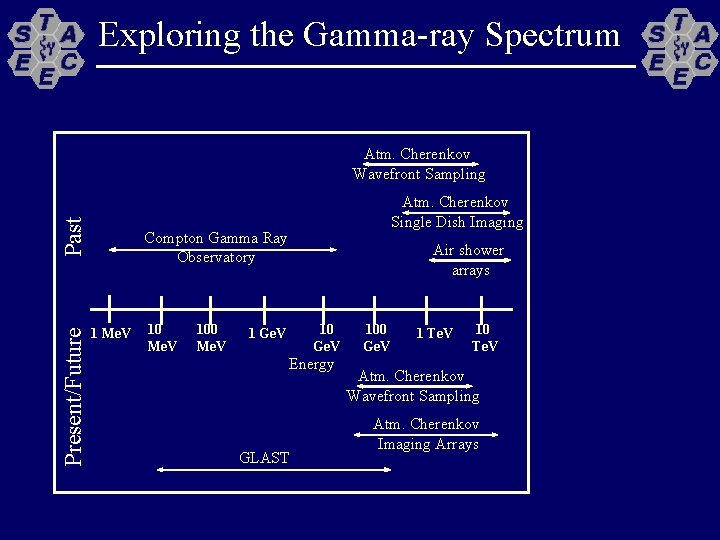
Exploring the Gamma-ray Spectrum Present/Future Past Atm. Cherenkov Wavefront Sampling Atm. Cherenkov Single Dish Imaging Compton Gamma Ray Observatory 1 Me. V 100 Me. V Air shower arrays 10 Ge. V 1 Ge. V Energy GLAST 100 Ge. V 1 Te. V 10 Te. V Atm. Cherenkov Wavefront Sampling Atm. Cherenkov Imaging Arrays
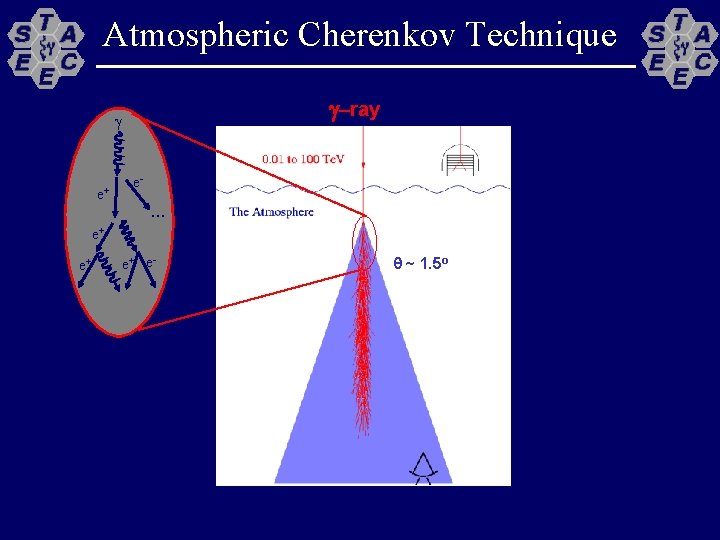
Atmospheric Cherenkov Technique g-ray e+ e… e+ e+ e+ e- q ~ 1. 5 o
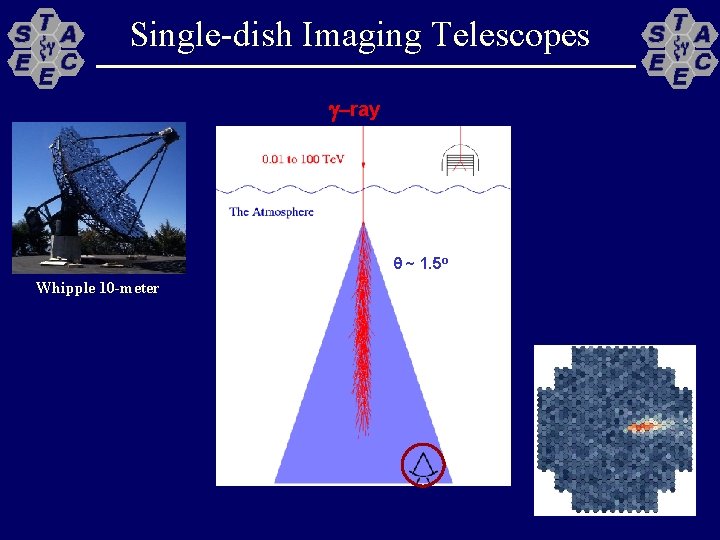
Single-dish Imaging Telescopes g-ray q ~ 1. 5 o Whipple 10 -meter
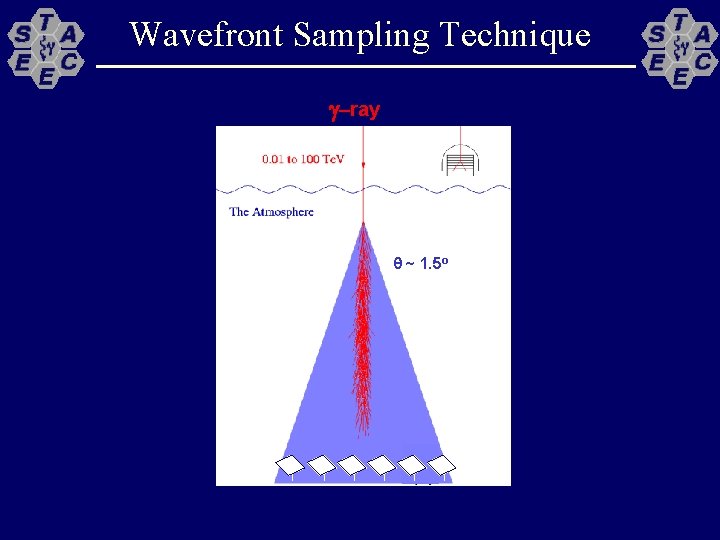
Wavefront Sampling Technique g-ray q ~ 1. 5 o
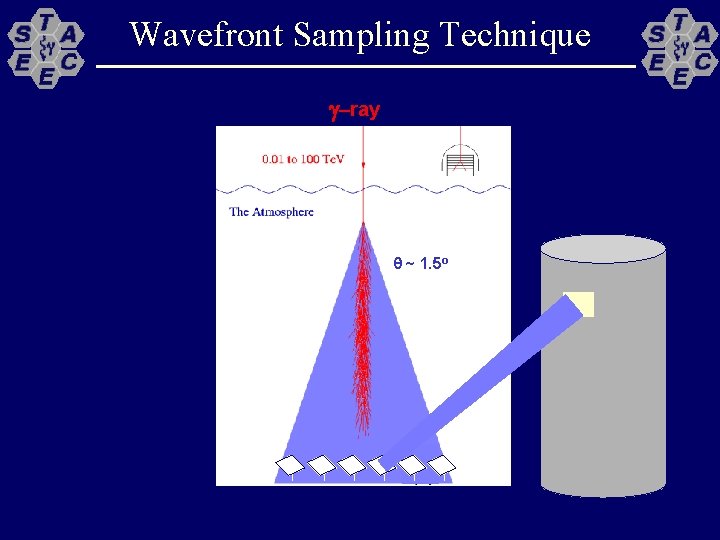
Wavefront Sampling Technique g-ray q ~ 1. 5 o
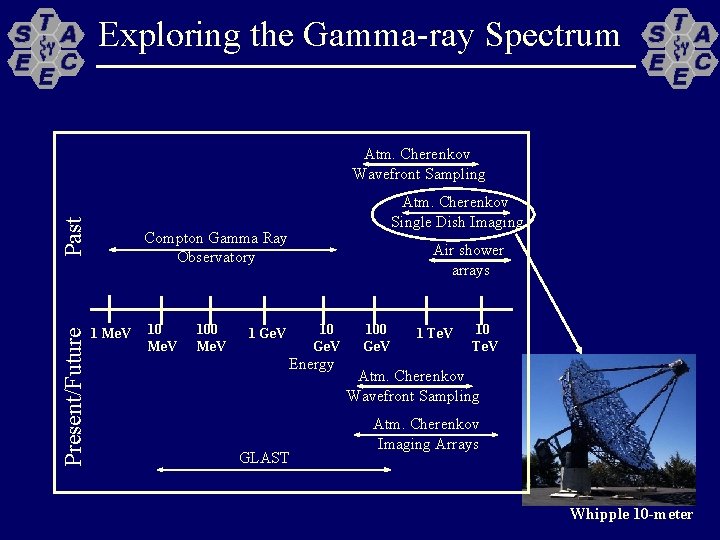
Exploring the Gamma-ray Spectrum Present/Future Past Atm. Cherenkov Wavefront Sampling Atm. Cherenkov Single Dish Imaging Compton Gamma Ray Observatory 1 Me. V 100 Me. V Air shower arrays 10 Ge. V 1 Ge. V Energy GLAST 100 Ge. V 1 Te. V 10 Te. V Atm. Cherenkov Wavefront Sampling Atm. Cherenkov Imaging Arrays Whipple 10 -meter
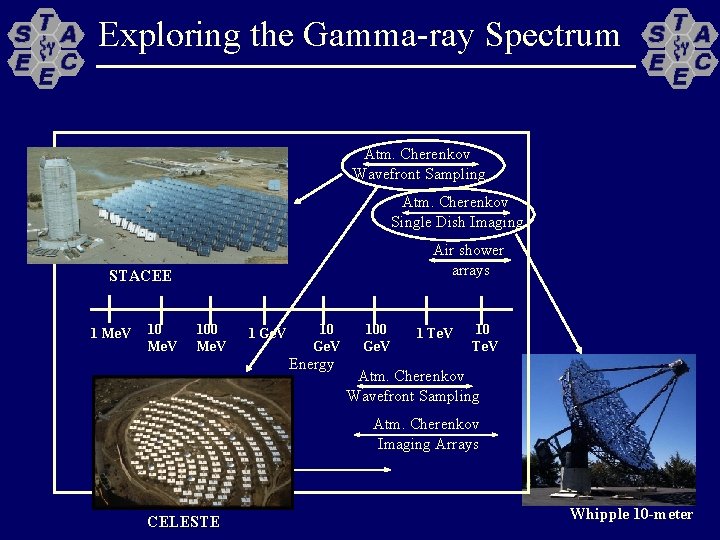
Exploring the Gamma-ray Spectrum Atm. Cherenkov Wavefront Sampling Atm. Cherenkov Single Dish Imaging Air shower arrays STACEE 1 Me. V 100 Me. V 10 Ge. V 1 Ge. V Energy GLAST CELESTE 100 Ge. V 1 Te. V 10 Te. V Atm. Cherenkov Wavefront Sampling Atm. Cherenkov Imaging Arrays Whipple 10 -meter
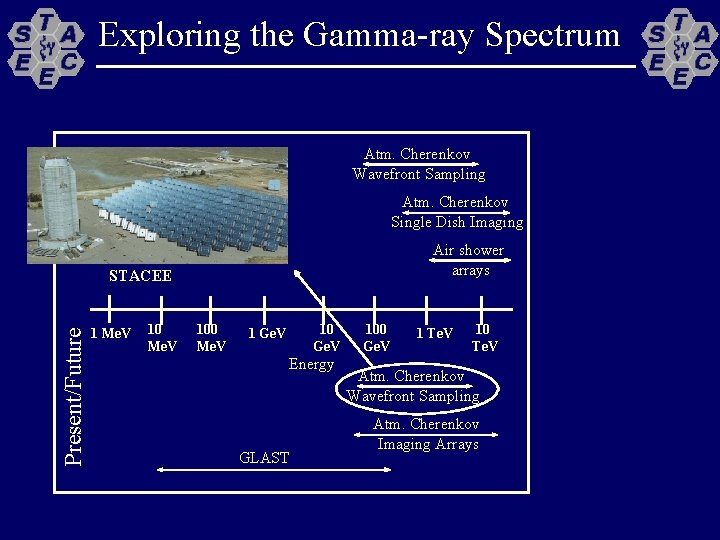
Exploring the Gamma-ray Spectrum Atm. Cherenkov Wavefront Sampling Atm. Cherenkov Single Dish Imaging Air shower arrays Present/Future STACEE 1 Me. V 100 Me. V 10 Ge. V 1 Ge. V Energy GLAST 100 Ge. V 1 Te. V 10 Te. V Atm. Cherenkov Wavefront Sampling Atm. Cherenkov Imaging Arrays
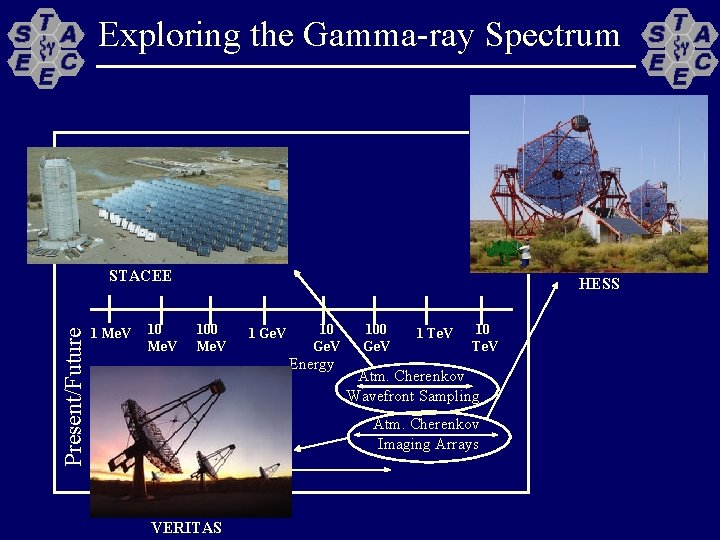
Exploring the Gamma-ray Spectrum Present/Future STACEE 1 Me. V 10 Me. V HESS 100 Me. V 10 Ge. V 1 Ge. V Energy GLAST VERITAS 100 Ge. V 1 Te. V 10 Te. V Atm. Cherenkov Wavefront Sampling Atm. Cherenkov Imaging Arrays
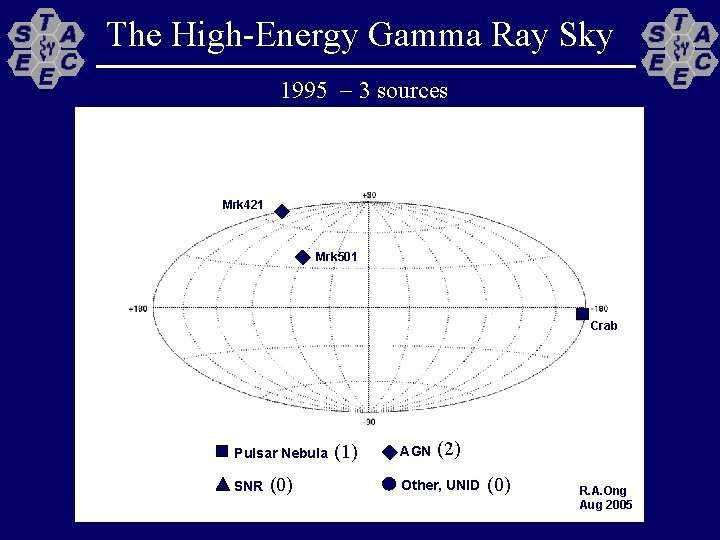
The High-Energy Gamma Ray Sky 1995 3 sources Mrk 421 Mrk 501 Crab Pulsar Nebula SNR (0) (1) AGN (2) Other, UNID (0) R. A. Ong Aug 2005
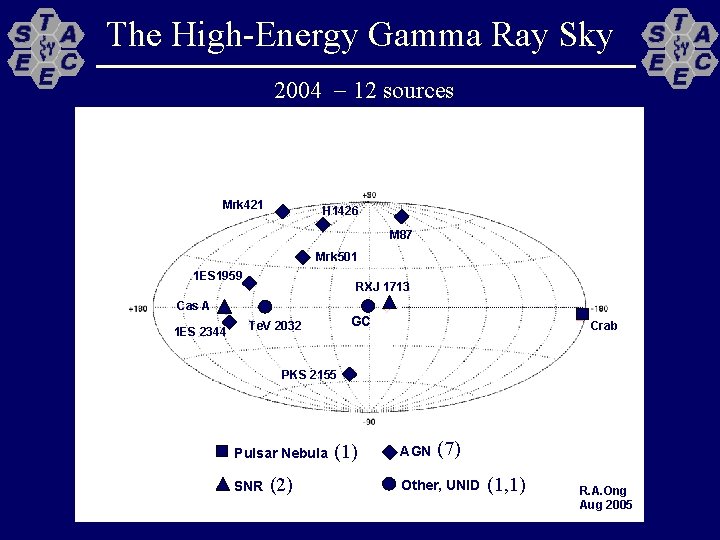
The High-Energy Gamma Ray Sky 2004 12 sources Mrk 421 H 1426 M 87 Mrk 501 1 ES 1959 RXJ 1713 Cas A 1 ES 2344 GC Te. V 2032 Crab PKS 2155 Pulsar Nebula SNR (2) (1) AGN (7) Other, UNID (1, 1) R. A. Ong Aug 2005
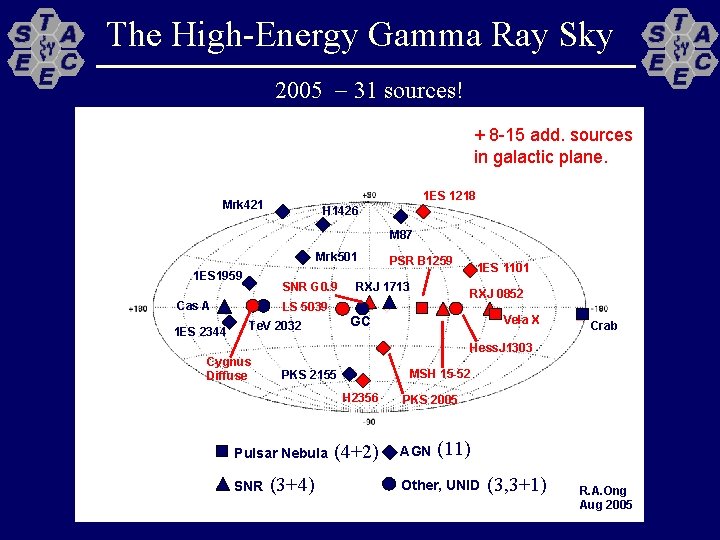
The High-Energy Gamma Ray Sky 2005 31 sources! + 8 -15 add. sources in galactic plane. 1 ES 1218 Mrk 421 H 1426 M 87 Mrk 501 1 ES 1959 SNR G 0. 9 Cas A 1 ES 2344 LS 5039 PSR B 1259 RXJ 1713 1 ES 1101 RXJ 0852 Vela X GC Te. V 2032 Crab Hess. J 1303 Cygnus Diffuse MSH 15 -52 PKS 2155 H 2356 Pulsar Nebula SNR (3+4) (4+2) PKS 2005 AGN (11) Other, UNID (3, 3+1) R. A. Ong Aug 2005
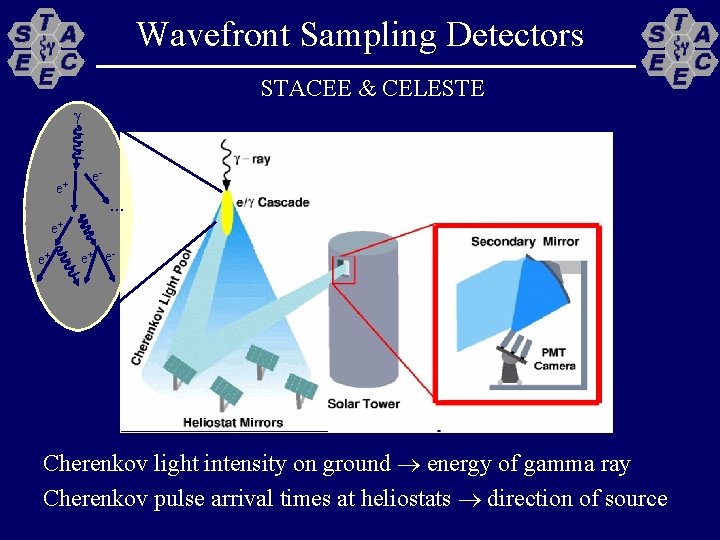
Wavefront Sampling Detectors STACEE & CELESTE e+ e… e+ e+ e+ e- Cherenkov light intensity on ground energy of gamma ray Cherenkov pulse arrival times at heliostats direction of source
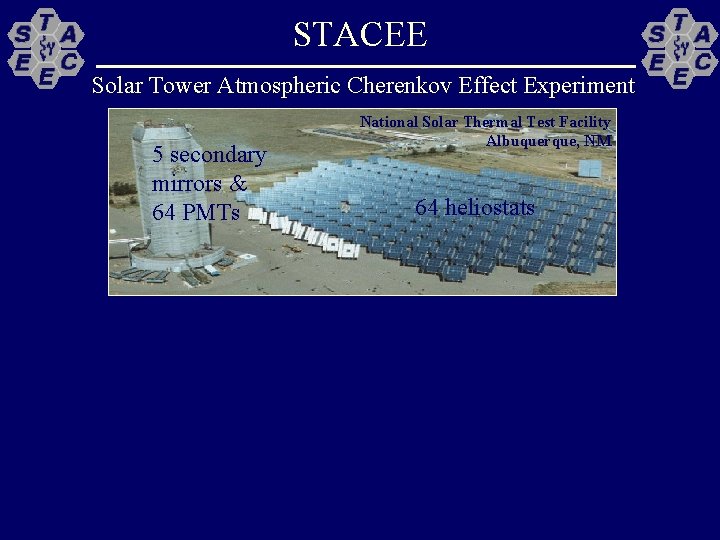
STACEE Solar Tower Atmospheric Cherenkov Effect Experiment 5 secondary mirrors & 64 PMTs National Solar Thermal Test Facility Albuquerque, NM 64 heliostats
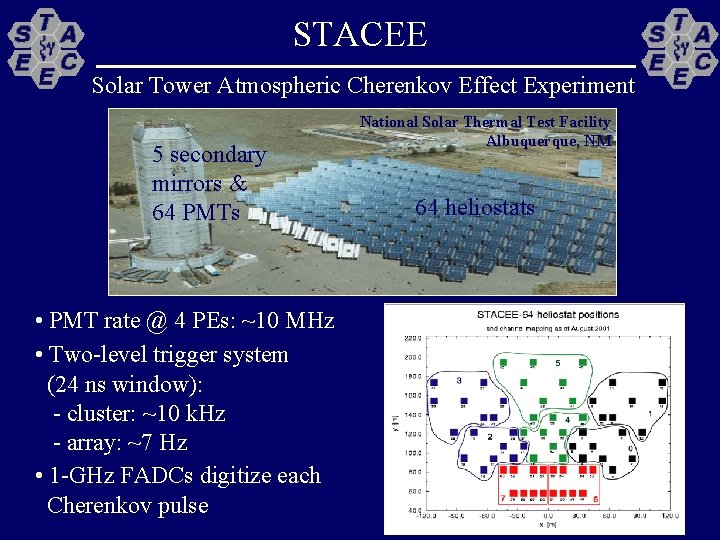
STACEE Solar Tower Atmospheric Cherenkov Effect Experiment 5 secondary mirrors & 64 PMTs • PMT rate @ 4 PEs: ~10 MHz • Two-level trigger system (24 ns window): - cluster: ~10 k. Hz - array: ~7 Hz • 1 -GHz FADCs digitize each Cherenkov pulse National Solar Thermal Test Facility Albuquerque, NM 64 heliostats
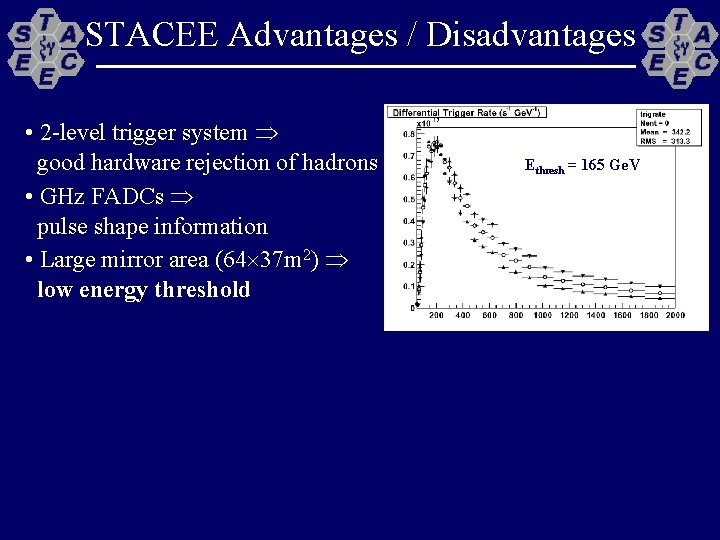
STACEE Advantages / Disadvantages • 2 -level trigger system good hardware rejection of hadrons • GHz FADCs pulse shape information • Large mirror area (64 37 m 2) low energy threshold Ethresh = 165 Ge. V
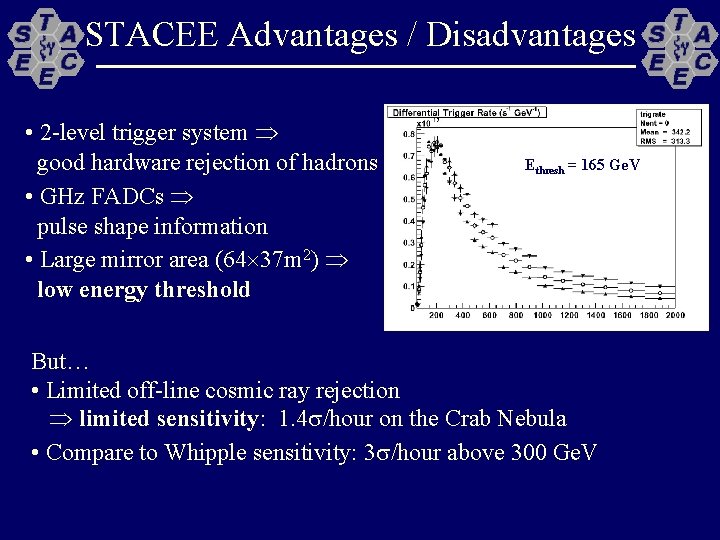
STACEE Advantages / Disadvantages • 2 -level trigger system good hardware rejection of hadrons • GHz FADCs pulse shape information • Large mirror area (64 37 m 2) low energy threshold Ethresh = 165 Ge. V But… • Limited off-line cosmic ray rejection limited sensitivity: 1. 4 /hour on the Crab Nebula • Compare to Whipple sensitivity: 3 /hour above 300 Ge. V
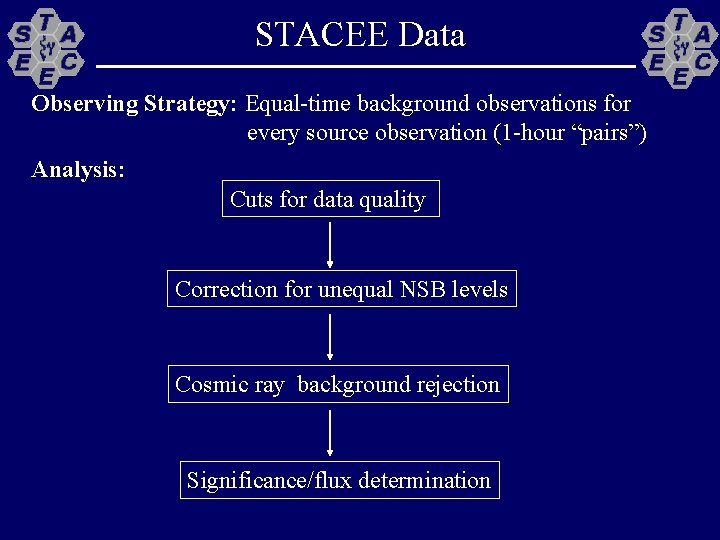
STACEE Data Observing Strategy: Equal-time background observations for every source observation (1 -hour “pairs”) Analysis: Cuts for data quality Correction for unequal NSB levels Cosmic ray background rejection Significance/flux determination
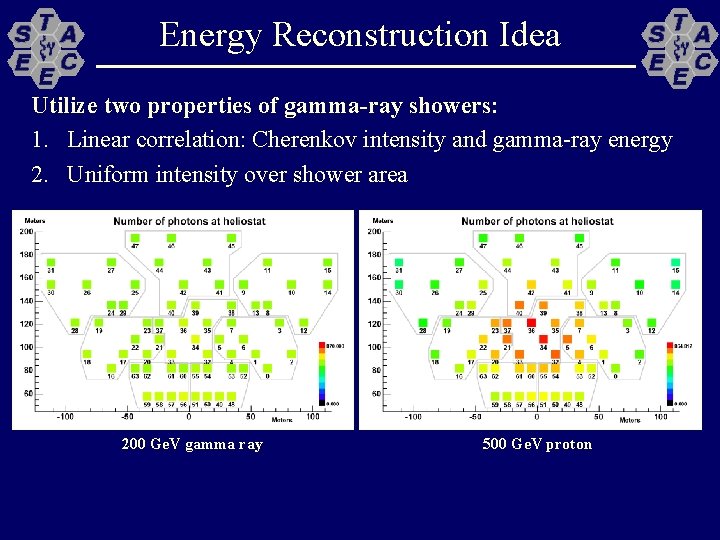
Energy Reconstruction Idea Utilize two properties of gamma-ray showers: 1. Linear correlation: Cherenkov intensity and gamma-ray energy 2. Uniform intensity over shower area 200 Ge. V gamma ray 500 Ge. V proton
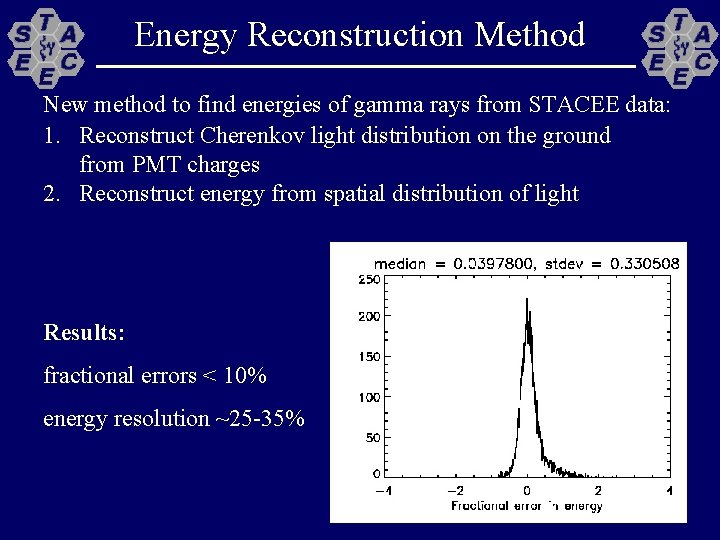
Energy Reconstruction Method New method to find energies of gamma rays from STACEE data: 1. Reconstruct Cherenkov light distribution on the ground from PMT charges 2. Reconstruct energy from spatial distribution of light Results: fractional errors < 10% energy resolution ~25 -35%
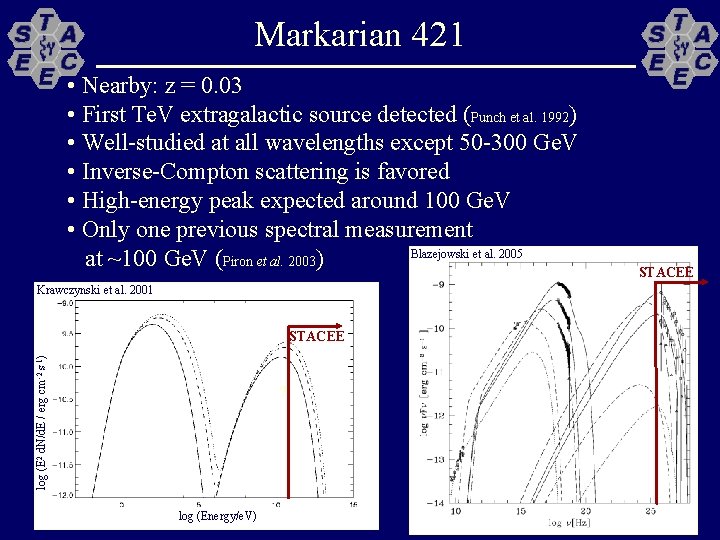
Markarian 421 • Nearby: z = 0. 03 • First Te. V extragalactic source detected (Punch et al. 1992) • Well-studied at all wavelengths except 50 -300 Ge. V • Inverse-Compton scattering is favored • High-energy peak expected around 100 Ge. V • Only one previous spectral measurement Blazejowski et al. 2005 at ~100 Ge. V (Piron et al. 2003) Krawczynski et al. 2001 log (E 2 d. N/d. E / erg cm-2 s-1) STACEE ? log (Energy/e. V) STACEE
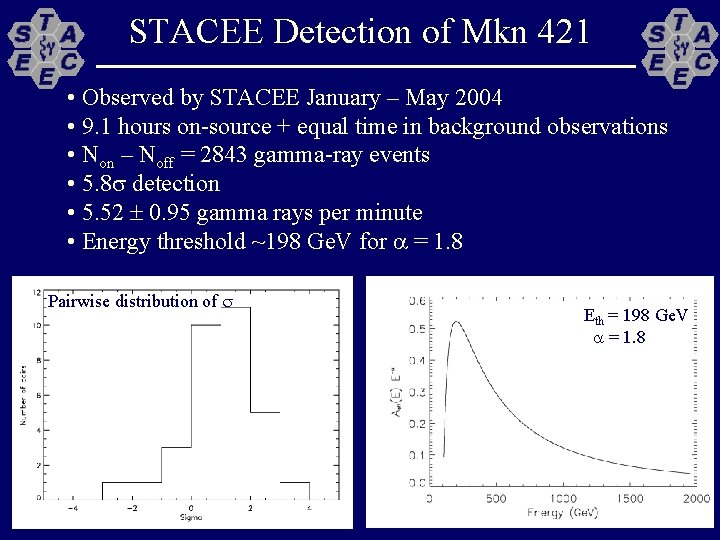
STACEE Detection of Mkn 421 • Observed by STACEE January – May 2004 • 9. 1 hours on-source + equal time in background observations • Non – Noff = 2843 gamma-ray events • 5. 8 detection • 5. 52 0. 95 gamma rays per minute • Energy threshold ~198 Ge. V for = 1. 8 Pairwise distribution of Eth = 198 Ge. V = 1. 8
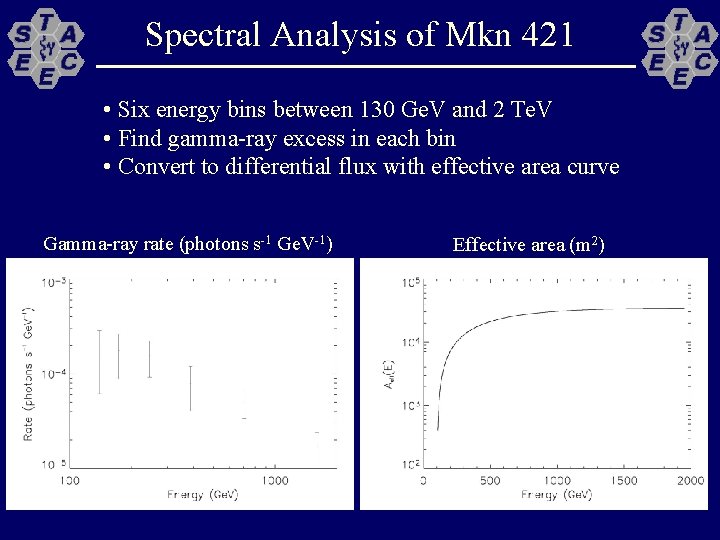
Spectral Analysis of Mkn 421 • Six energy bins between 130 Ge. V and 2 Te. V • Find gamma-ray excess in each bin • Convert to differential flux with effective area curve Effective area (m 2) Aeff(E) (m 2) Rate (photons s-1 Ge. V-1) Gamma-ray rate (photons s-1 Ge. V-1) Energy (Ge. V)
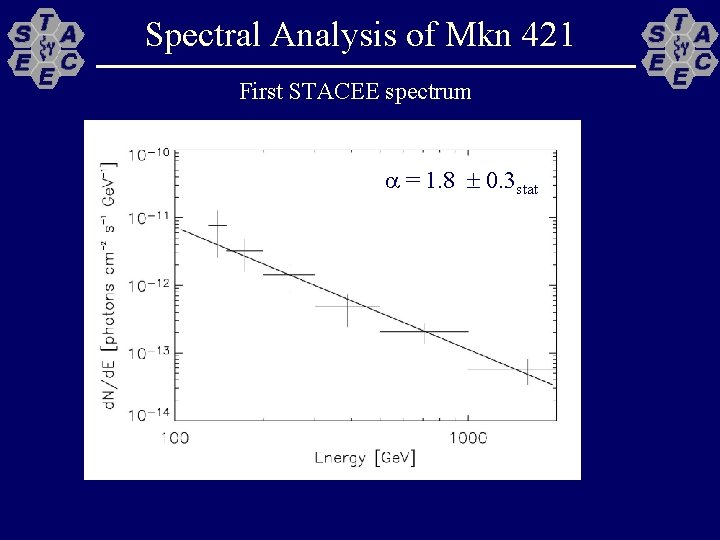
Spectral Analysis of Mkn 421 First STACEE spectrum = 1. 8 0. 3 stat
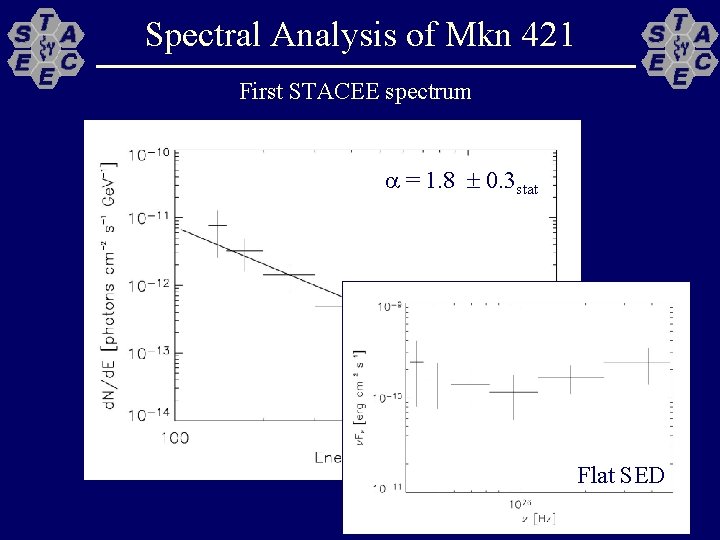
Spectral Analysis of Mkn 421 First STACEE spectrum = 1. 8 0. 3 stat Flat SED
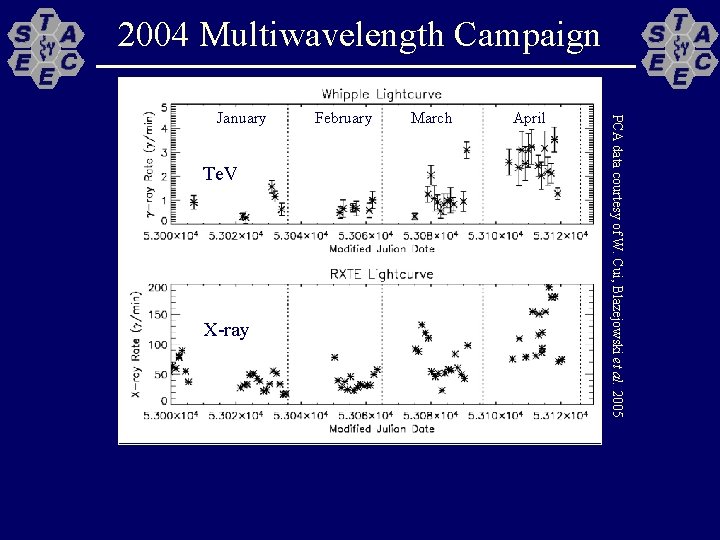
2004 Multiwavelength Campaign Te. V X-ray February March April PCA data courtesy of W. Cui, Blazejowski et al. 2005 January
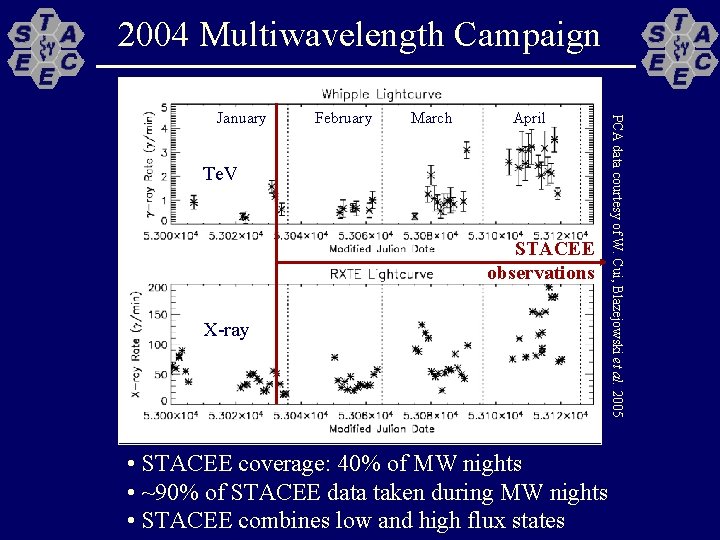
2004 Multiwavelength Campaign February March April Te. V STACEE observations X-ray • STACEE coverage: 40% of MW nights • ~90% of STACEE data taken during MW nights • STACEE combines low and high flux states PCA data courtesy of W. Cui, Blazejowski et al. 2005 January
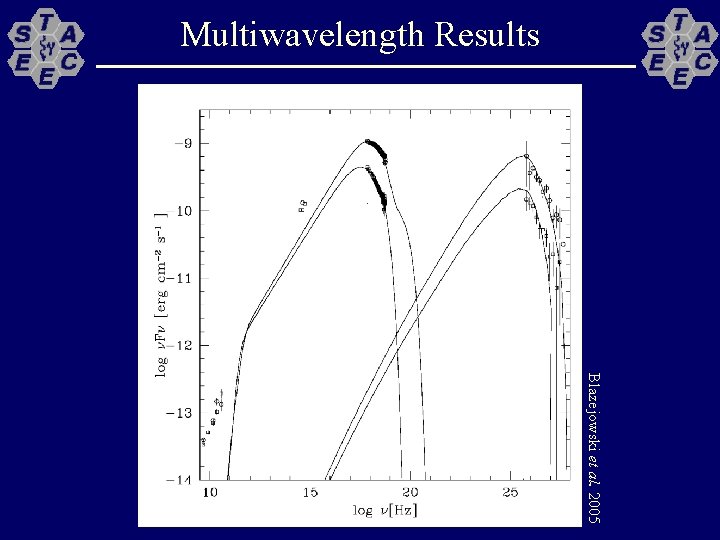
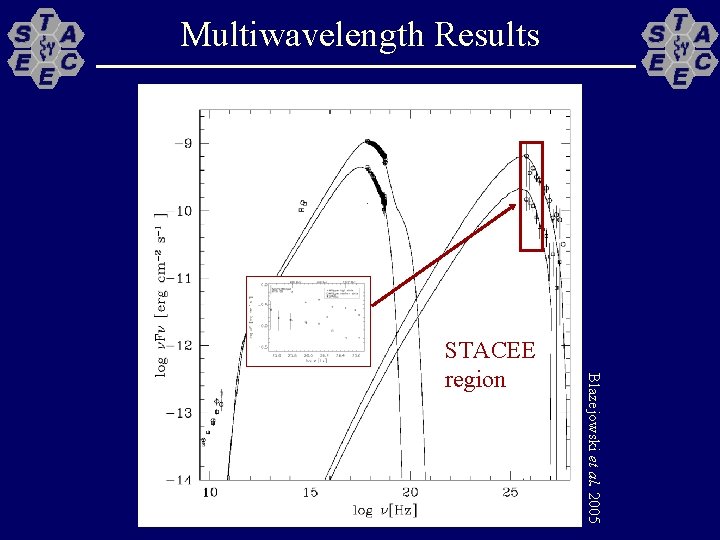
Multiwavelength Results Blazejowski et al. 2005
Multiwavelength Results Blazejowski et al. 2005 STACEE region
STACEE + Whipple Results
STACEE + Whipple Results
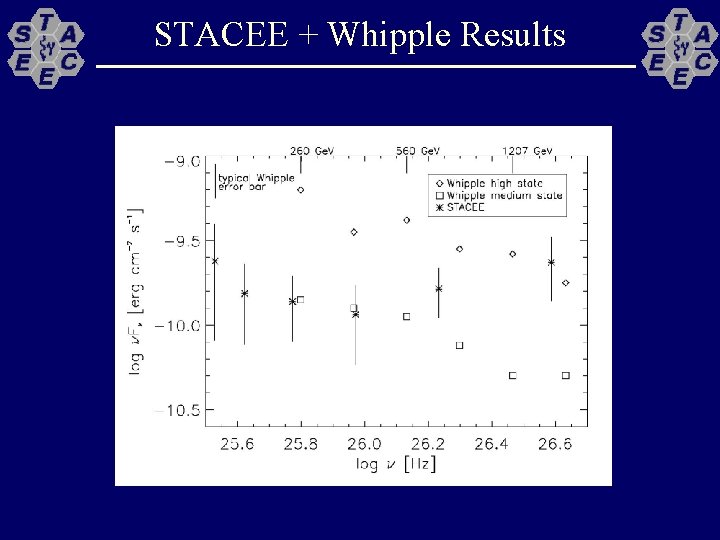
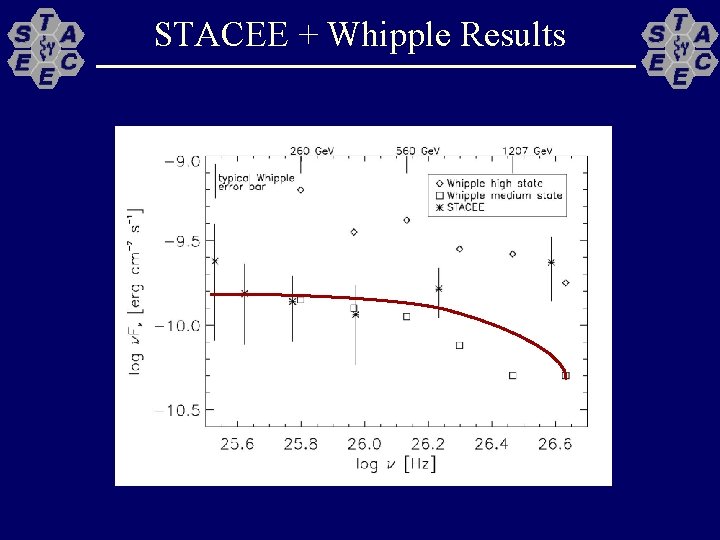
Science Interpretation • STACEE’s first energy bin is ~120 Ge. V below Whipple’s. • STACEE result: is consistent with a flat or rising SED. suggests that the high-energy peak is above ~200 Ge. V. slghtly is inconsistent with most past IC modeling. • Combined STACEE/Whipple data suggest that the peak is around 200 -500 Ge. V. • SED peak reflects peak of electron energy distribution.
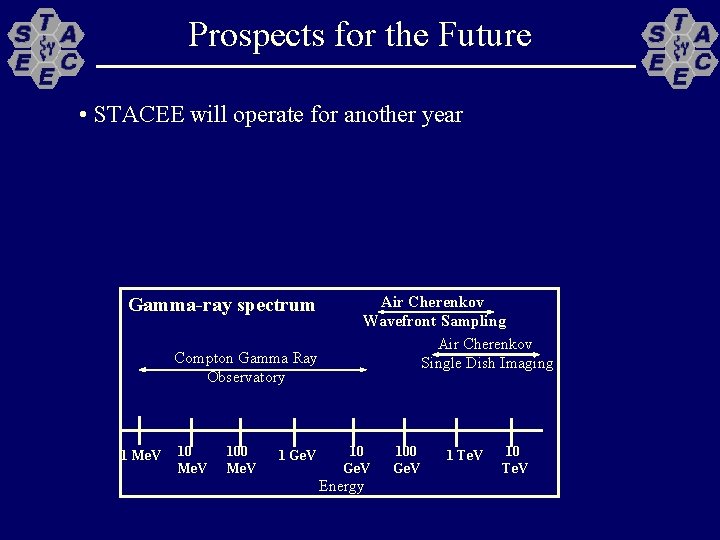
Prospects for the Future • STACEE will operate for another year Gamma-ray spectrum Compton Gamma Ray Observatory 1 Me. V 100 Me. V 1 Ge. V Air Cherenkov Wavefront Sampling Air Cherenkov Single Dish Imaging 10 Ge. V Energy 100 Ge. V 1 Te. V 10 Te. V
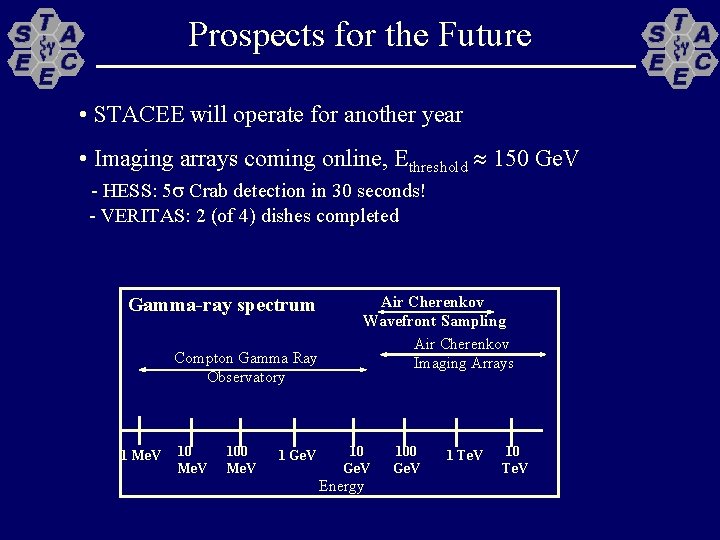
Prospects for the Future • STACEE will operate for another year • Imaging arrays coming online, Ethreshold 150 Ge. V - HESS: 5 Crab detection in 30 seconds! - VERITAS: 2 (of 4) dishes completed Gamma-ray spectrum Compton Gamma Ray Observatory 1 Me. V 100 Me. V 1 Ge. V Air Cherenkov Wavefront Sampling Air Cherenkov Imaging Arrays 10 Ge. V Energy 100 Ge. V 1 Te. V 10 Te. V
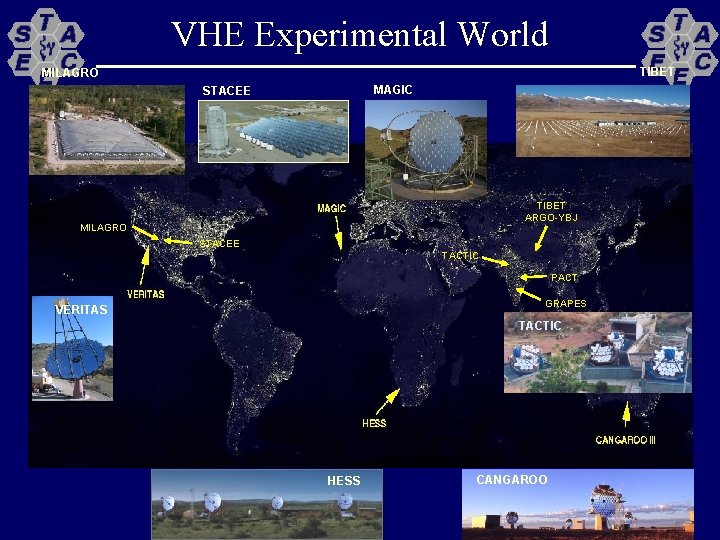
VHE Experimental World TIBET MILAGRO MAGIC STACEE TIBET ARGO-YBJ MILAGRO STACEE TACTIC PACT GRAPES VERITAS TACTIC HESS CANGAROO
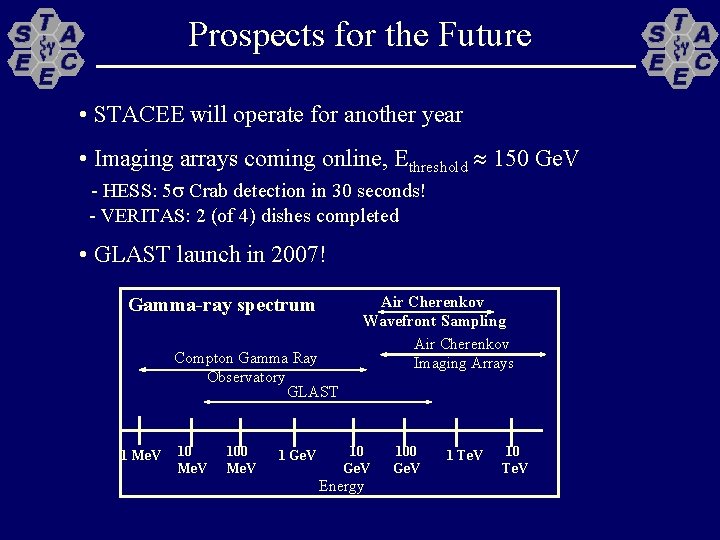
Prospects for the Future • STACEE will operate for another year • Imaging arrays coming online, Ethreshold 150 Ge. V - HESS: 5 Crab detection in 30 seconds! - VERITAS: 2 (of 4) dishes completed • GLAST launch in 2007! Gamma-ray spectrum Compton Gamma Ray Observatory GLAST 1 Me. V 100 Me. V 1 Ge. V Air Cherenkov Wavefront Sampling Air Cherenkov Imaging Arrays 10 Ge. V Energy 100 Ge. V 1 Te. V 10 Te. V
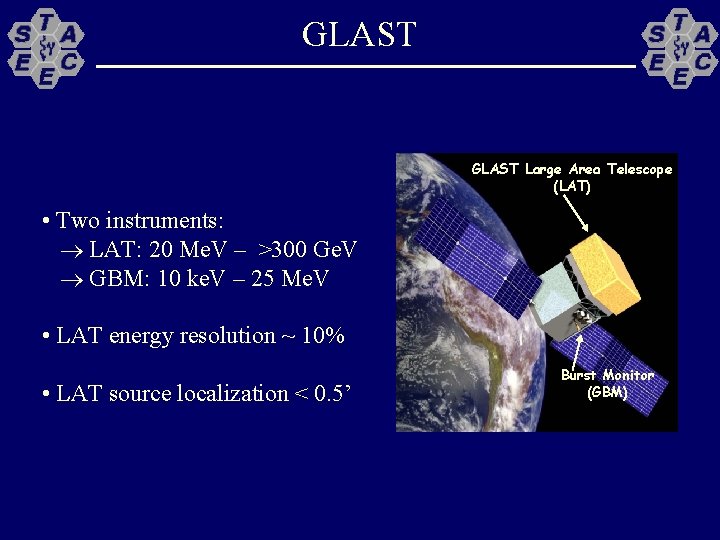
GLAST Large Area Telescope (LAT) • Two instruments: LAT: 20 Me. V – >300 Ge. V GBM: 10 ke. V – 25 Me. V • LAT energy resolution ~ 10% • LAT source localization < 0. 5’ Burst Monitor (GBM)
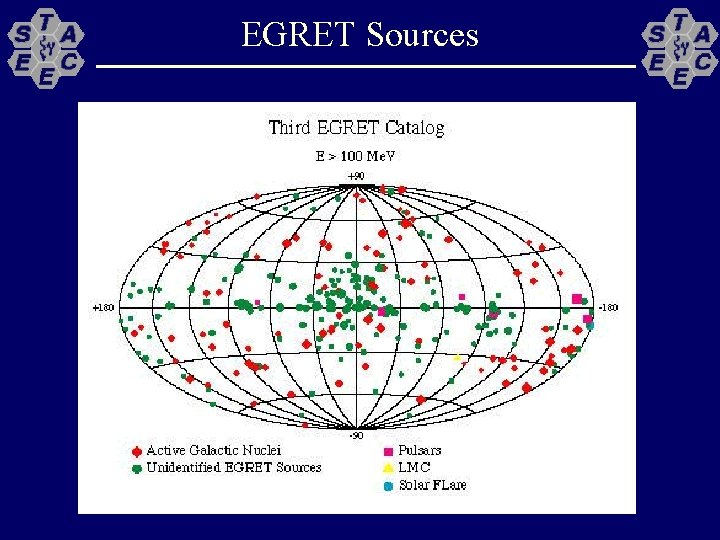
EGRET Sources
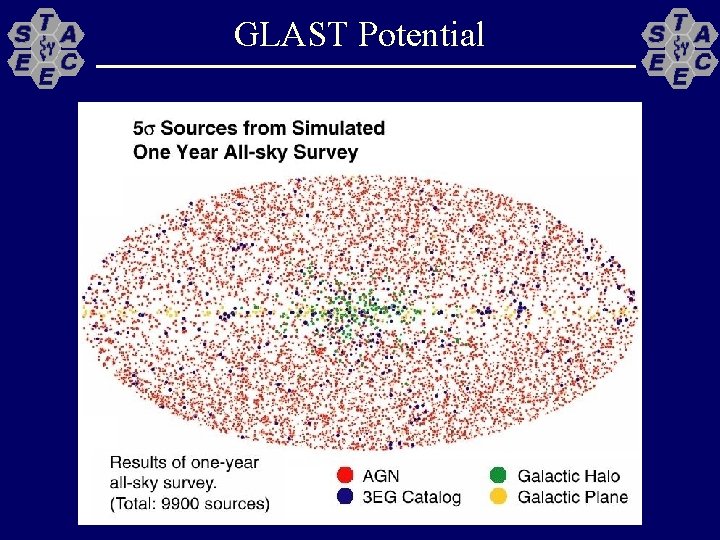
GLAST Potential
Conclusions • Gamma-ray observations of AGN are key to understanding particle acceleration in the inner jets • Many new VHE gamma-ray detectors & detections • STACEE - “ 1 st-generation” instrument sensitive to ~100 Ge. V gamma rays - Energy reconstruction is successful - 5. 8 detection of Markarian 421 - Preliminary spectrum between 130 Ge. V and 2 Te. V - Second spectrum of Mkn 421 at 100 -300 Ge. V - High-energy peak is above ~200 Ge. V • Bright future for gamma-ray astronomy
- Slides: 48