
The Spectrum of Guidewires Available to Recanalize CTO
The Spectrum of Guidewires Available to Recanalize CTO and How to Choose the Wire/Device Hybrid CTO PCI 2011 Craig A. Thompson, M. D. , MMSc. Director, Invasive Cardiology and Vascular Medicine Yale University School of Medicine/Yale New Haven Hospital Executive Director, Yale-University College London Cardiovascular Device Development Program Consultant (Hon) Heart Hospital, London and London Chest Hospital Author : John K. Forrest, M. D Updated : June 2009 CRT 2011, Washington DC
Craig A. Thompson, MD § Consulting Fees – Abbott Vascular – Bridgepoint – Terumo – Volcano I intend to reference off label or unapproved uses of drugs or devices in my presentation. I intend to discuss DES, guidewires, PTCA balloons/catheters in CTO
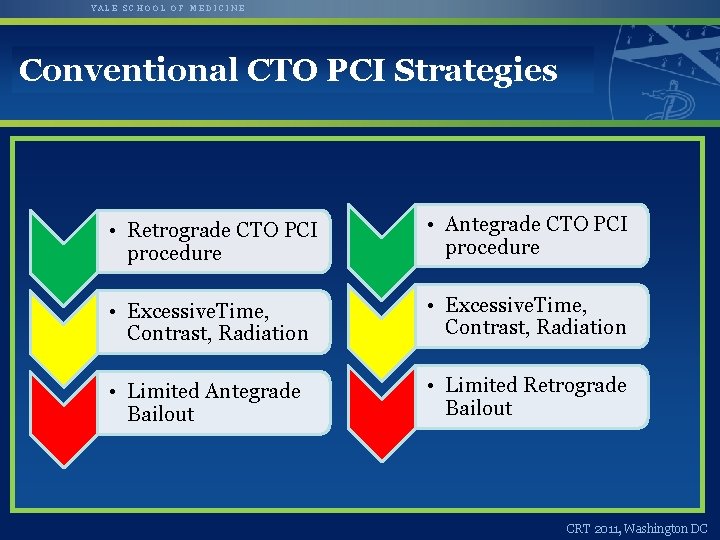
YALE SCHOOL OF MEDICINE Conventional CTO PCI Strategies • Retrograde CTO PCI procedure • Antegrade CTO PCI procedure • Excessive. Time, Contrast, Radiation • Limited Antegrade Bailout • Limited Retrograde Bailout CRT 2011, Washington DC

YALE SCHOOL OF MEDICINE The Continuum of CTO PCI Retrograde Dissection Reentry Antegrade Adoption of only 1 or 2 of these limbs will limit the patients that can be treated on the basis of coronary anatomy CRT 2011, Washington DC
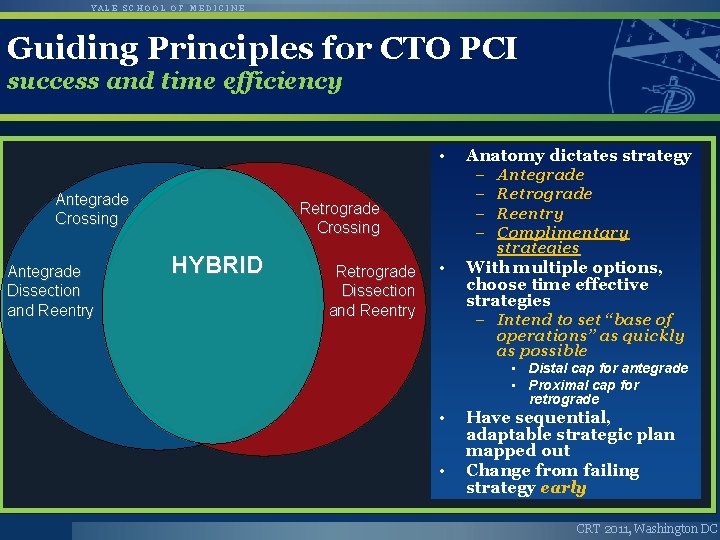
YALE SCHOOL OF MEDICINE Guiding Principles for CTO PCI success and time efficiency • Antegrade Crossing Antegrade Dissection and Reentry Retrograde Crossing HYBRID Anatomy dictates strategy – Antegrade – Retrograde – Reentry – Complimentary strategies Retrograde Dissection and Reentry • With multiple options, choose time effective strategies – Intend to set “base of operations” as quickly as possible • Distal cap for antegrade • Proximal cap for retrograde • • Have sequential, adaptable strategic plan mapped out Change from failing strategy early CRT 2011, Washington DC

YALE SCHOOL OF MEDICINE Hybrid CTO PCI Strategy Simple retrograde Simple Antegrade Hybrid Strategy Complex Retrograde Complex Antegrade • Interchange freely between approaches • Optimize best applications from antegrade, retrograde, and reentry • “Toggle” back and forth between strategies as needed and opportunity permits CRT 2011, Washington DC
YALE SCHOOL OF MEDICINE Hybrid CTO PCI basic principles • Procedural efficiency, contrast, radiation with greater priority – Maintain safety, improve efficacy • Always make progress…don’t let case stall • Preplanned multistep procedural strategy • Setup for seamless transition between antegrade wire escalation, dissection reentry, and retrograde • Quick transition to alternate plans when failure mode occurs – Opportunity for contigency plan success – Can return to more focused attempt to earlier strategies if needed CRT 2011, Washington DC
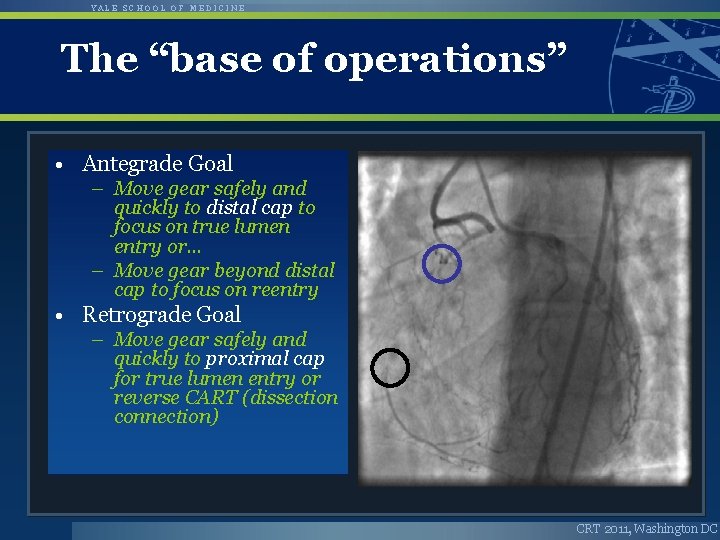
YALE SCHOOL OF MEDICINE The “base of operations” • Antegrade Goal – Move gear safely and quickly to distal cap to focus on true lumen entry or… – Move gear beyond distal cap to focus on reentry • Retrograde Goal – Move gear safely and quickly to proximal cap for true lumen entry or reverse CART (dissection connection) CRT 2011, Washington DC
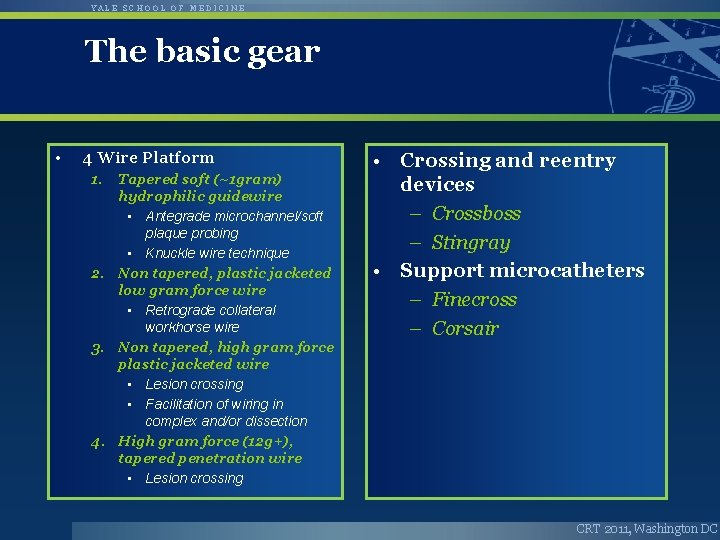
YALE SCHOOL OF MEDICINE The basic gear • 4 Wire Platform 1. Tapered soft (~1 gram) hydrophilic guidewire • Antegrade microchannel/soft plaque probing • Knuckle wire technique 2. Non tapered, plastic jacketed low gram force wire • Retrograde collateral workhorse wire 3. Non tapered, high gram force plastic jacketed wire • Lesion crossing • Facilitation of wiring in complex and/or dissection 4. High gram force (12 g+), tapered penetration wire • Lesion crossing • Crossing and reentry devices – Crossboss – Stingray • Support microcatheters – Finecross – Corsair CRT 2011, Washington DC
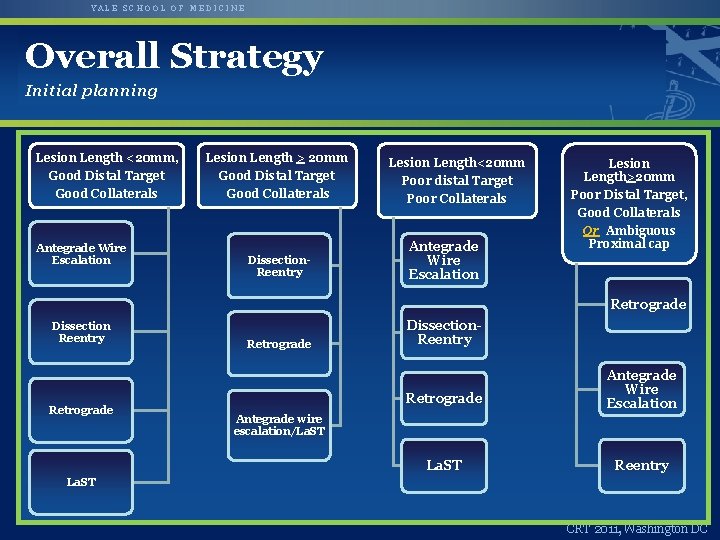
YALE SCHOOL OF MEDICINE Overall Strategy Initial planning Lesion Length <20 mm, Lesion Length > 20 mm Good Distal Target Good Collaterals Antegrade Wire Escalation Dissection. Reentry Lesion Length<20 mm Poor distal Target Poor Collaterals Antegrade Wire Escalation Lesion Length>20 mm Poor Distal Target, Good Collaterals Or Ambiguous Proximal cap Retrograde Dissection Reentry Retrograde Dissection. Reentry Retrograde Antegrade Wire Escalation La. ST Reentry Antegrade wire escalation/La. ST CRT 2011, Washington DC
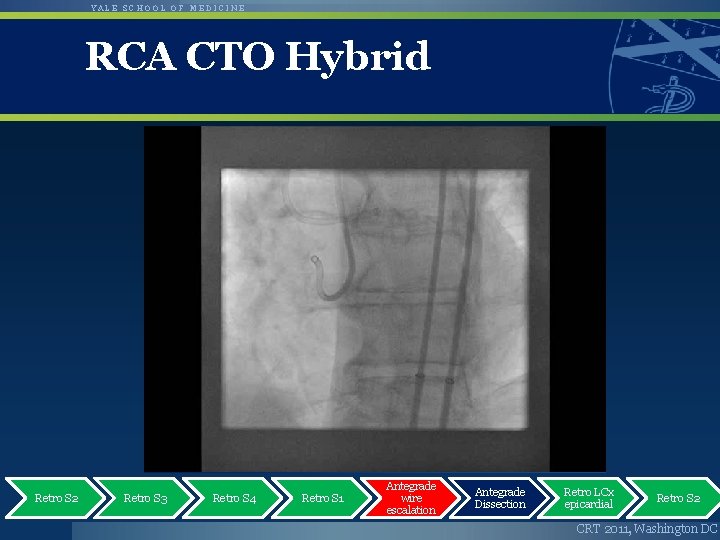
YALE SCHOOL OF MEDICINE RCA CTO Hybrid Retro S 2 Retro S 3 Retro S 4 Retro S 1 Antegrade wire escalation Antegrade Dissection Retro LCx epicardial Retro S 2 CRT 2011, Washington DC

YALE SCHOOL OF MEDICINE LCx CTO Hybrid Antegrade Wire 1 Antegrade Wire 2 Retro D 3 Retro D 1 Antegrade La. ST CRT 2011, Washington DC
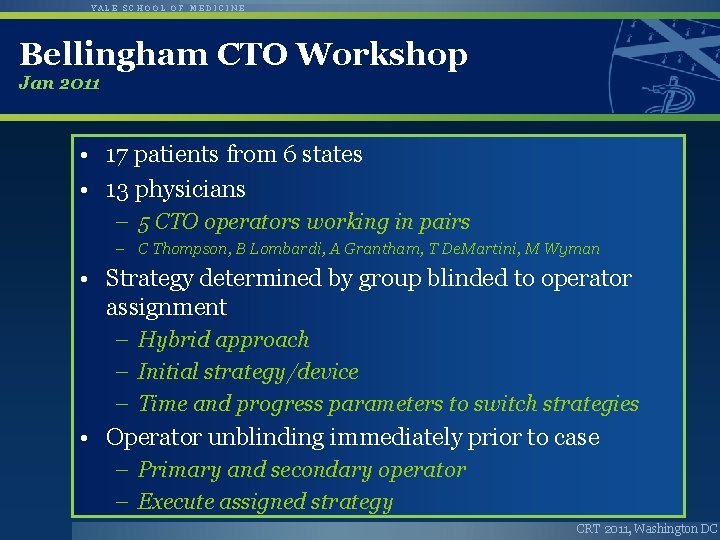
YALE SCHOOL OF MEDICINE Bellingham CTO Workshop Jan 2011 • 17 patients from 6 states • 13 physicians – 5 CTO operators working in pairs – C Thompson, B Lombardi, A Grantham, T De. Martini, M Wyman • Strategy determined by group blinded to operator assignment – Hybrid approach – Initial strategy/device – Time and progress parameters to switch strategies • Operator unblinding immediately prior to case – Primary and secondary operator – Execute assigned strategy CRT 2011, Washington DC
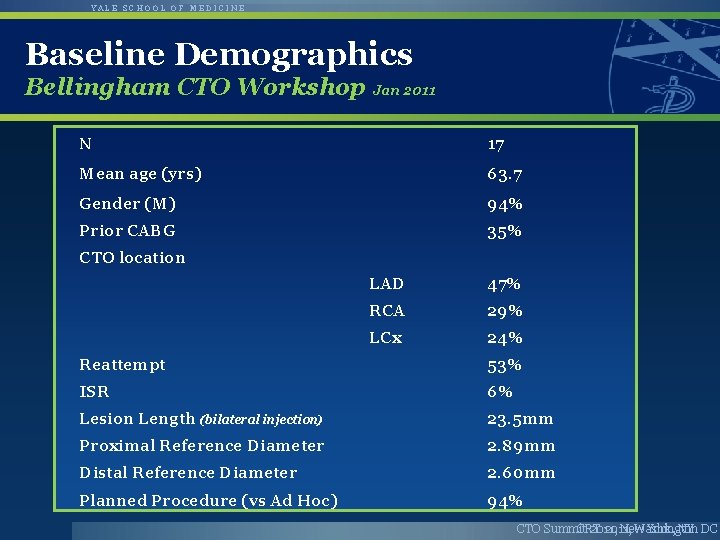
YALE SCHOOL OF MEDICINE Baseline Demographics Bellingham CTO Workshop Jan 2011 N 17 Mean age (yrs) 63. 7 Gender (M) 94% Prior CABG 35% CTO location LAD 47% RCA 29% LCx 24% Reattempt 53% ISR 6% Lesion Length (bilateral injection) 23. 5 mm Proximal Reference Diameter 2. 89 mm Distal Reference Diameter 2. 60 mm Planned Procedure (vs Ad Hoc) 94% CTO Summit CRT 2011, New Washington York, NY DC
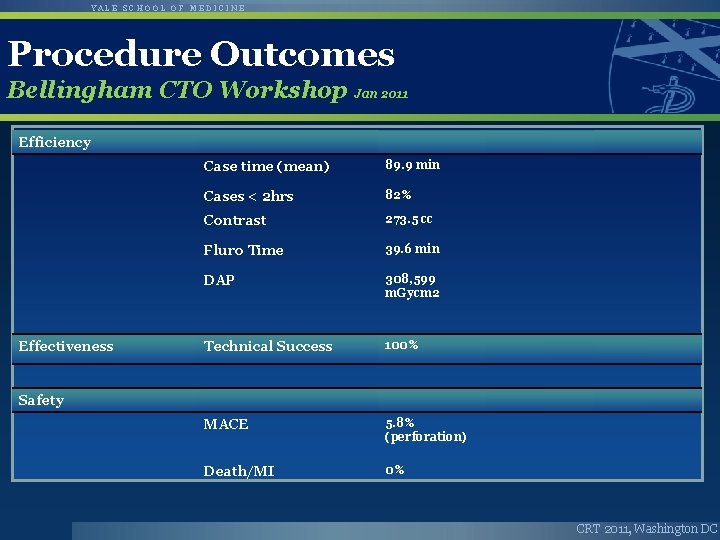
YALE SCHOOL OF MEDICINE Procedure Outcomes Bellingham CTO Workshop Jan 2011 Efficiency Effectiveness Case time (mean) 89. 9 min Cases < 2 hrs 82% Contrast 273. 5 cc Fluro Time 39. 6 min DAP 308, 599 m. Gycm 2 Technical Success 100% MACE 5. 8% (perforation) Death/MI 0% Safety CRT 2011, Washington DC
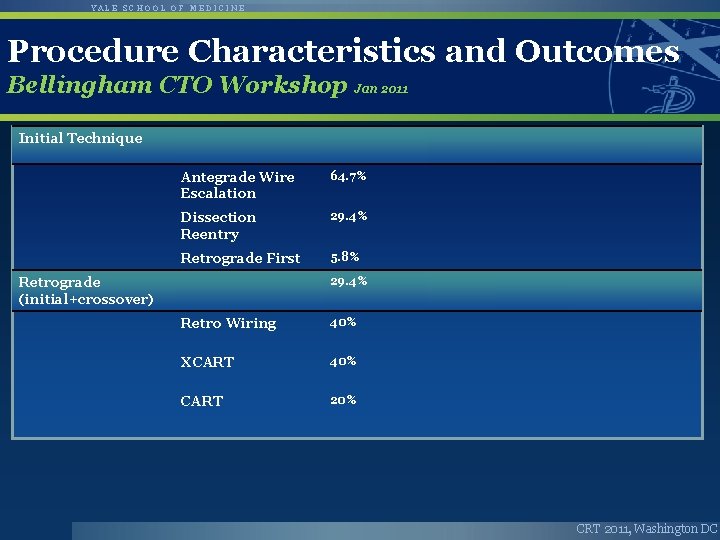
YALE SCHOOL OF MEDICINE Procedure Characteristics and Outcomes Bellingham CTO Workshop Jan 2011 Initial Technique Antegrade Wire Escalation 64. 7% Dissection Reentry 29. 4% Retrograde First 5. 8% 29. 4% Retrograde (initial+crossover) Retro Wiring 40% XCART 40% CART 20% CRT 2011, Washington DC
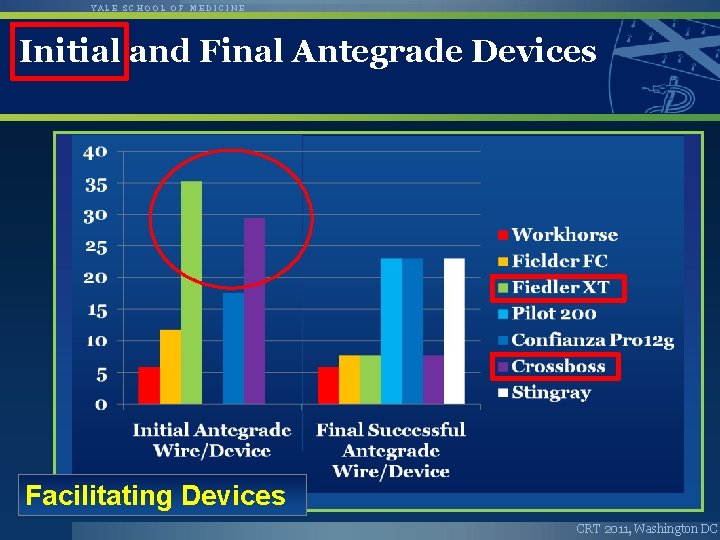
YALE SCHOOL OF MEDICINE Initial and Final Antegrade Devices Facilitating Devices CRT 2011, Washington DC
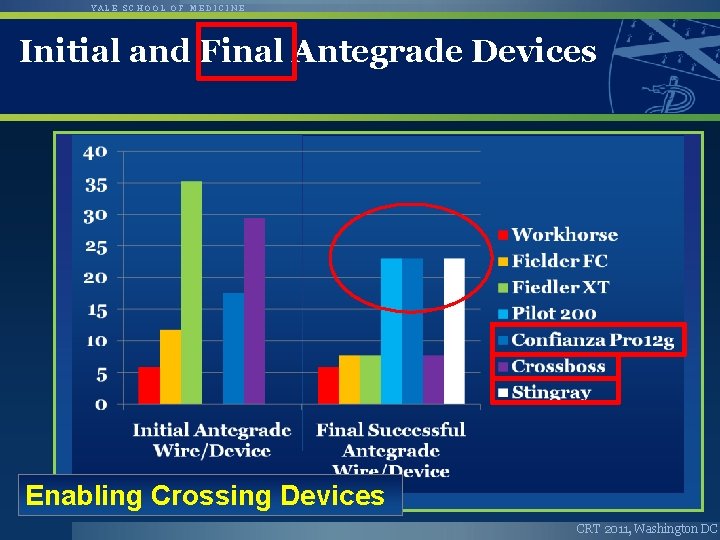
YALE SCHOOL OF MEDICINE Initial and Final Antegrade Devices Enabling Crossing Devices CRT 2011, Washington DC
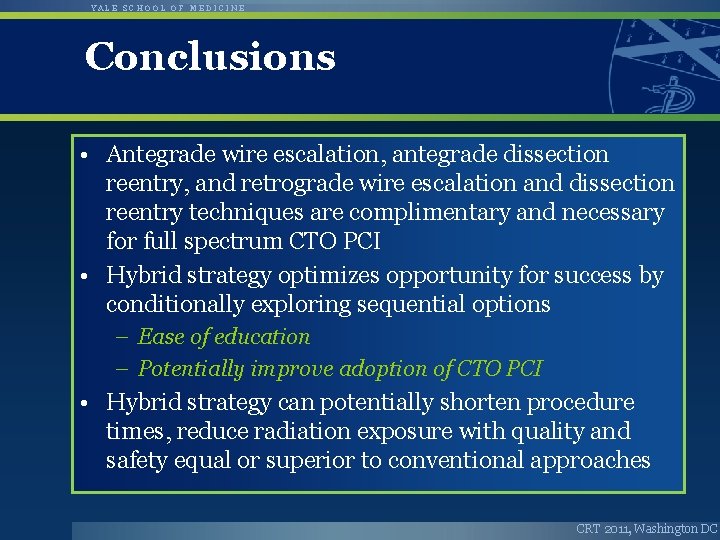
YALE SCHOOL OF MEDICINE Conclusions • Antegrade wire escalation, antegrade dissection reentry, and retrograde wire escalation and dissection reentry techniques are complimentary and necessary for full spectrum CTO PCI • Hybrid strategy optimizes opportunity for success by conditionally exploring sequential options – Ease of education – Potentially improve adoption of CTO PCI • Hybrid strategy can potentially shorten procedure times, reduce radiation exposure with quality and safety equal or superior to conventional approaches CRT 2011, Washington DC
- Slides: 19