
The spectrum of 15 NH 3 in the






![References [1] S. Yu, J. C. Pearson, B. J. Drouin, K. Sung. O. Pirali,](https://slidetodoc.com/presentation_image_h2/e8c0aa5c4bf350fbd16a8714f3a84410/image-21.jpg "References [1] S. Yu, J. C. Pearson, B. J. Drouin, K. Sung. O. Pirali,")
- Slides: 21
The spectrum of 15 NH 3 in the 66 -2000 cm-1 region Adriana Predoi-Crossa, Hoimonti Rozarioa, Michel Hermanb, Elisabetta Canéc, Gianfranco Di Lonardoc, and Luciano Fusinac a. Department of Physics and Astronomy, University of Lethbridge, 4401 University Drive, Lethbridge AB, T 1 K 3 M 4, Canada; b. Laboratoire de Chimie Quantique et Photophysique, CP 160/09, Faculté des Sciences, Université Libre de Bruxelles, 50 Av. Roosevelt, B-1050 Bruxelles, Belgium; c. Dipartimento di Chimica Industriale “Toso Montanari”, Università di Bologna, Viale Risorgimento 40136 Bologna, Italy University of Bologna University of Lethbridge Universite Libre de Bruxelles
Overview of Presentation 1. Motivation for this spectroscopic study and the current status of knowledge 2. Experimental Details 3. Spectroscopic analysis 4. Data interpretation and comparisons with other studies 5. Conclusions and directions for future work 6. Acknowledgements University of Bologna University of Lethbridge Universite Libre de Bruxelles
The Importance of Ammonia in the Atmosphere Ø Ammonia is a gas readily released into the air from a variety of biological sources, as well as from industrial and combustion processes. Ø While NH 3 has many beneficial uses, it can detrimentally affect the quality of the environment through eutrophication of natural ecosystems, the associated loss of biodiversity, and the formation of secondary particles in the atmosphere, which can reduce visibility. Ø Possible health effects of ammonia gas in the atmosphere include short-term irritation of the eyes and lungs and the long-term effects on the cardiovascular system through inhalation of fine particulate matter formed from ammonia in the atmosphere. Ø The dominant source of NH 3 emissions in the Canada is agriculture (~85%), largely from animal waste and commercial fertilizer application. University of Bologna Source: http: //nadp. sws. uiuc. edu/amon/ University of Lethbridge AMo. N (Ammonia Monitoring Network) field site at Sequoia National Park, USA Universite Libre de Bruxelles
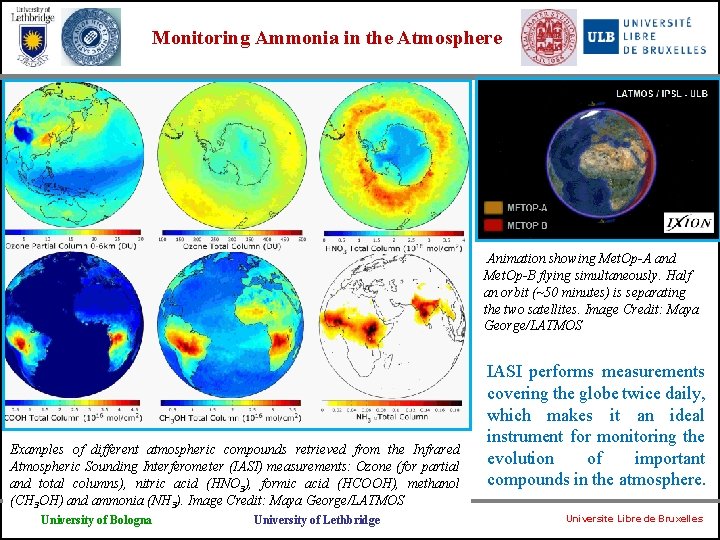
Monitoring Ammonia in the Atmosphere Animation showing Met. Op-A and Met. Op-B flying simultaneously. Half an orbit (~50 minutes) is separating the two satellites. Image Credit: Maya George/LATMOS Examples of different atmospheric compounds retrieved from the Infrared Atmospheric Sounding Interferometer (IASI) measurements: Ozone (for partial and total columns), nitric acid (HNO 3), formic acid (HCOOH), methanol (CH 3 OH) and ammonia (NH 3). Image Credit: Maya George/LATMOS University of Bologna University of Lethbridge IASI performs measurements covering the globe twice daily, which makes it an ideal instrument for monitoring the evolution of important compounds in the atmosphere. Universite Libre de Bruxelles
Interstellar Ammonia Ø The composition of the interstellar medium determines the composition of the objects which form from it such as stars and planets. The information provided by the study of atoms and molecules in interstellar space is crucial to our understanding of star formation and galactic evolution. Ø Interstellar molecules, such as water and ammonia and atoms such as oxygen and carbon are detected in the infrared in many parts of our galaxy. These molecules are found in the cool clouds of dust and gas within which new stars and planets are formed. Ø Ammonia (NH 3) was the first polyatomic molecule detected in interstellar space. Since its initial discovery by Cheung et al. (1968), because of its large number of transitions sensitive to a wide range of excitation conditions and the fact that it can be detected in a great variety of regions, NH 3 is perhaps second only to carbon monoxide (CO) in importance. Ammonia is found on Pluto, Jupiter and, in small amounts, on Uranus. IRAS image of the vicinity of the Barnard~1 cloud in the constellation Perseus, where triply deuterated ammonia was detected at the CSO. The 10. 4 -meter Leighton telescope of the Caltech Submillimeter Observatory (CSO) atop Mauna Kea, Hawaii. University of Bologna Source: http: //www. spaceflightnow. com/ University of Lethbridge news/n 0205/31 ammonia/ Universite Libre de Bruxelles
Nitrogen Isotopic Fractionation in Interstellar Ammonia Using the Green Bank Telescope (GBT), D. C. Lis et al. Astrophys. J. (2010) have obtained accurate measurements of the 14 N/15 N isotopic ratio in ammonia in two nearby cold, dense molecular clouds, Barnard~1 and NGC 1333. The 14 N/15 N ratio in Barnard~1, 334± 50, is particularly well constrained and falls in between the local interstellar medium/proto-solar value of ∼ 450 and the terrestrial atmospheric value of 272. Spectra of the ammonia inversion lines in Barnard~1 and NGC 1333 University of Bologna University of Lethbridge Universite Libre de Bruxelles
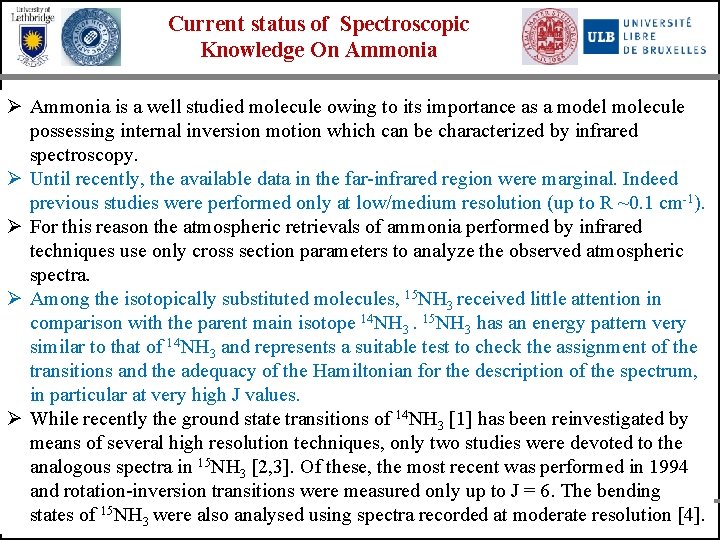
Current status of Spectroscopic Knowledge On Ammonia Ø Ammonia is a well studied molecule owing to its importance as a model molecule possessing internal inversion motion which can be characterized by infrared spectroscopy. Ø Until recently, the available data in the far-infrared region were marginal. Indeed previous studies were performed only at low/medium resolution (up to R ~0. 1 cm-1). Ø For this reason the atmospheric retrievals of ammonia performed by infrared techniques use only cross section parameters to analyze the observed atmospheric spectra. Ø Among the isotopically substituted molecules, 15 NH 3 received little attention in comparison with the parent main isotope 14 NH 3. 15 NH 3 has an energy pattern very similar to that of 14 NH 3 and represents a suitable test to check the assignment of the transitions and the adequacy of the Hamiltonian for the description of the spectrum, in particular at very high J values. Ø While recently the ground state transitions of 14 NH 3 [1] has been reinvestigated by means of several high resolution techniques, only two studies were devoted to the analogous spectra in 15 NH 3 [2, 3]. Of these, the most recent was performed in 1994 and rotation-inversion transitions were measured only up to J = 6. The bending states of of 15 Bologna NH 3 were also analysed spectra recorded at moderate resolution [4]. Universite Libre de Bruxelles University using of Lethbridge
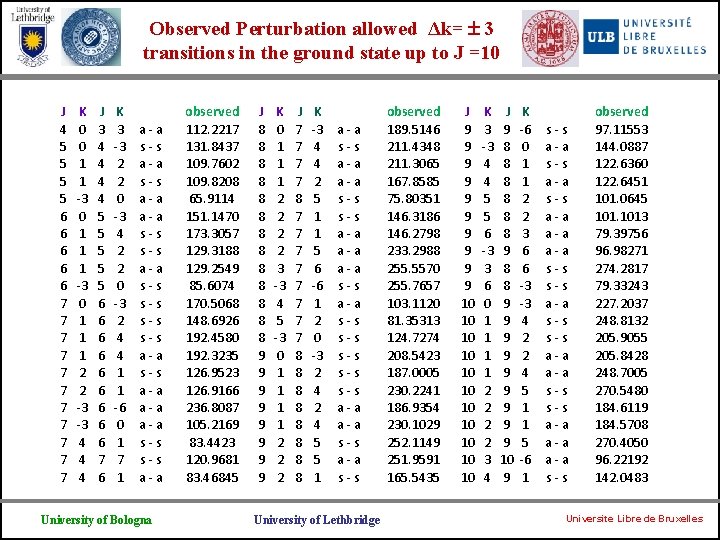
Spectroscopic Goals for this study Ø The use of infrared techniques to retrieved tropospheric species is a very powerful technique, provided that accurate spectroscopic parameters are used to analyze the observed spectra. Ø The goal of the present study is to perform the first detailed infrared study of 15 NH 3 in the far-infrared region. The target task, in the near future, will be to provide a precise and consistent list of 15 NH 3 lines involving accurate line position, intensity and air-broadening parameters. Ø Since the knowledge of the ground state energy pattern is essential to investigate the vibrationally excited states we recorded the far infrared spectrum of the molecule at very high resolution and path length in order to observe very high J transitions and also the rotation-inversion spectrum in the lowest excited vibrational states. Ø We aimed to observe perturbation allowed transitions, which are essential to better characterize the rotation and distortion parameters related to the axis of symmetry, C, DK, HK, . . Ø The spectral range we aim to investigate extends from 60 to 2000 cm-1 allowing the observation of transitions 2 ← GS, 4 ← GS, 2 2 ← GS and the hot bands 2 2 ← 2 , 4 ← 2 and 2 2 ← 4. University of Bologna University of Lethbridge Universite Libre de Bruxelles
Experimental Conditions 2 m gas cell absorption paths up to 80 m coolable to ~80 K - The high resolution of the Bruker Fourier transform spectrometer at the FIR beamline, coupled with the high brightness of the synchrotron in the difficult 60 -400 cm-1 region, represented a powerful capability for this study. - In the FIR region, Doppler broadening of the spectral lines is small, so that the high-resolution of the spectrometer was exploited to the full, while the high brightness gives greatly improved SNR ratio. - The sample was supplied by Sigma-Aldrich with a purity of 98% and used without any further purification. Range (cm-1) Pressure (Torr) 60 -370 0. 002 60 -370 1 60 -370 0. 05 896 -1149 0. 05 1100 -1700 0. 005 University 16002085 of Bologna 0. 005 Pathlength (m) Temperature (K) Resolution (cm-1) 8 72 72 72 University 72 of Lethbridge 298 298 Source Synchrotron 0. 00096 Globar 0. 003 Globar Bruxelles 0. 003 Universite Libre de
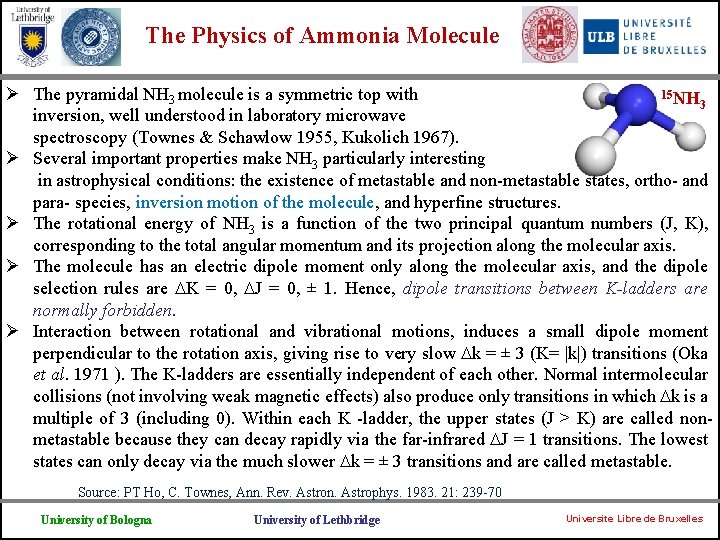
The Physics of Ammonia Molecule 15 NH Ø The pyramidal NH 3 molecule is a symmetric top with 3 inversion, well understood in laboratory microwave spectroscopy (Townes & Schawlow 1955, Kukolich 1967). Ø Several important properties make NH 3 particularly interesting in astrophysical conditions: the existence of metastable and non-metastable states, ortho- and para- species, inversion motion of the molecule, and hyperfine structures. Ø The rotational energy of NH 3 is a function of the two principal quantum numbers (J, K), corresponding to the total angular momentum and its projection along the molecular axis. Ø The molecule has an electric dipole moment only along the molecular axis, and the dipole selection rules are K = 0, J = 0, ± 1. Hence, dipole transitions between K-ladders are normally forbidden. Ø Interaction between rotational and vibrational motions, induces a small dipole moment perpendicular to the rotation axis, giving rise to very slow k = ± 3 (K= |k|) transitions (Oka et al. 1971 ). The K-ladders are essentially independent of each other. Normal intermolecular collisions (not involving weak magnetic effects) also produce only transitions in which k is a multiple of 3 (including 0). Within each K -ladder, the upper states (J > K) are called nonmetastable because they can decay rapidly via the far-infrared J = 1 transitions. The lowest states can only decay via the much slower k = ± 3 transitions and are called metastable. Source: PT Ho, C. Townes, Ann. Rev. Astron. Astrophys. 1983. 21: 239 -70 University of Bologna University of Lethbridge Universite Libre de Bruxelles
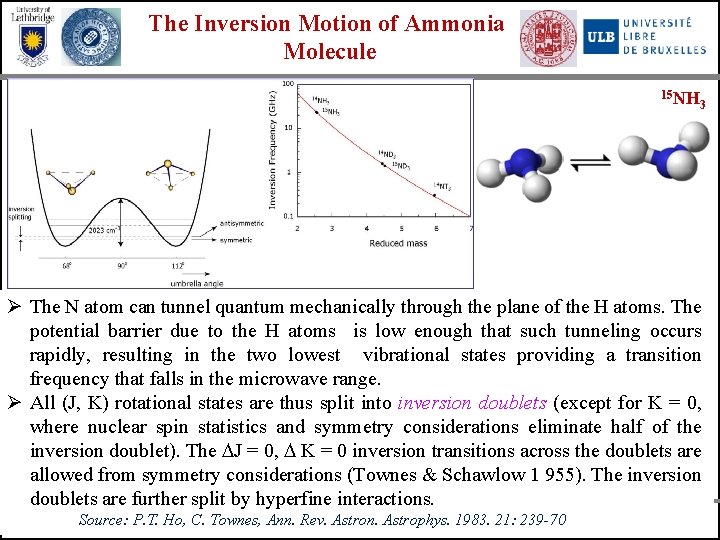
The Inversion Motion of Ammonia Molecule 15 NH 3 Ø The N atom can tunnel quantum mechanically through the plane of the H atoms. The potential barrier due to the H atoms is low enough that such tunneling occurs rapidly, resulting in the two lowest vibrational states providing a transition frequency that falls in the microwave range. Ø All (J, K) rotational states are thus split into inversion doublets (except for K = 0, where nuclear spin statistics and symmetry considerations eliminate half of the inversion doublet). The J = 0, K = 0 inversion transitions across the doublets are allowed from symmetry considerations (Townes & Schawlow 1 955). The inversion doublets are further split by hyperfine interactions. University of Bologna Source: P. T. University of Lethbridge Ho, C. Townes, Ann. Rev. Astron. Astrophys. 1983. 21: 239 -70 Universite Libre de Bruxelles
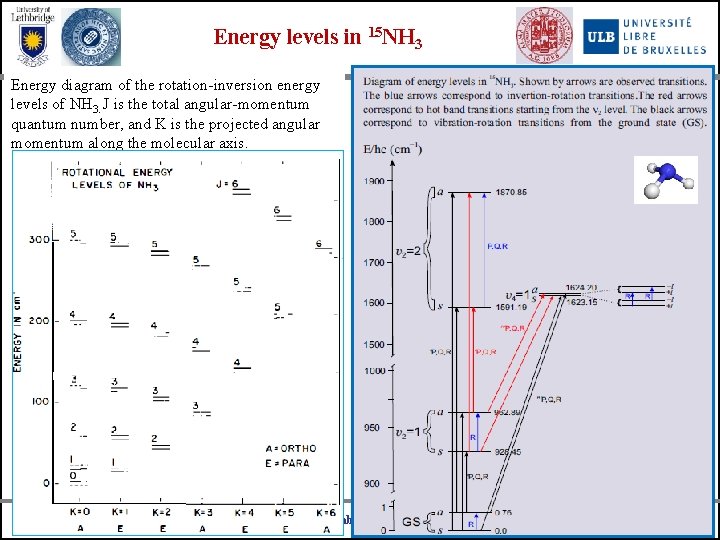
Energy levels in 15 NH 3 Energy diagram of the rotation-inversion energy levels of NH 3. J is the total angular-momentum quantum number, and K is the projected angular momentum along the molecular axis. University of Bologna University of Lethbridge Universite Libre de Bruxelles
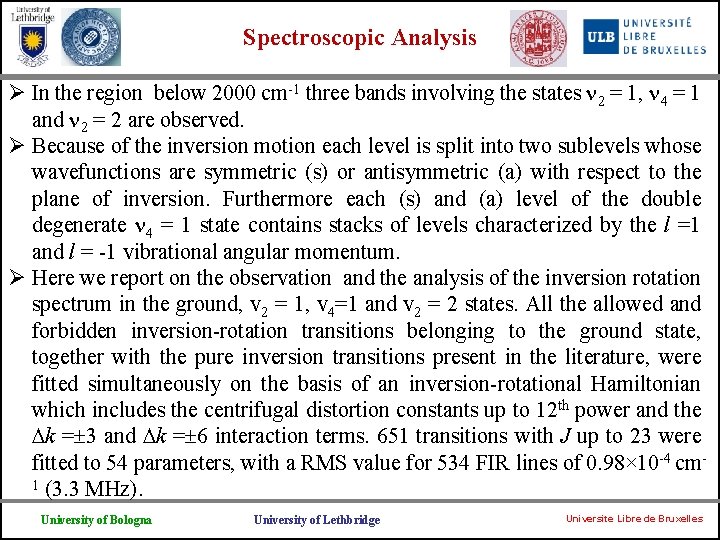
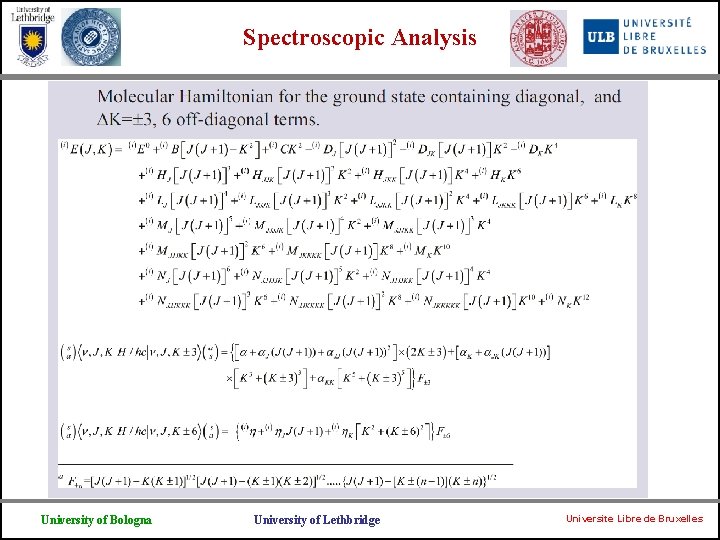
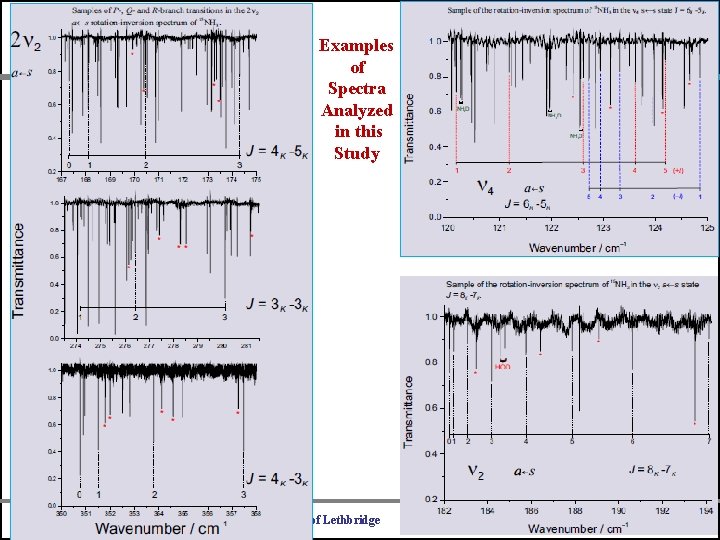
Spectroscopic Analysis Ø In the region below 2000 cm-1 three bands involving the states 2 = 1, 4 = 1 and 2 = 2 are observed. Ø Because of the inversion motion each level is split into two sublevels whose wavefunctions are symmetric (s) or antisymmetric (a) with respect to the plane of inversion. Furthermore each (s) and (a) level of the double degenerate 4 = 1 state contains stacks of levels characterized by the l =1 and l = -1 vibrational angular momentum. Ø Here we report on the observation and the analysis of the inversion rotation spectrum in the ground, v 2 = 1, v 4=1 and v 2 = 2 states. All the allowed and forbidden inversion-rotation transitions belonging to the ground state, together with the pure inversion transitions present in the literature, were fitted simultaneously on the basis of an inversion-rotational Hamiltonian which includes the centrifugal distortion constants up to 12 th power and the k = 3 and k = 6 interaction terms. 651 transitions with J up to 23 were fitted to 54 parameters, with a RMS value for 534 FIR lines of 0. 98× 10 -4 cm 1 (3. 3 MHz). University of Bologna University of Lethbridge Universite Libre de Bruxelles
Spectroscopic Analysis University of Bologna University of Lethbridge Universite Libre de Bruxelles
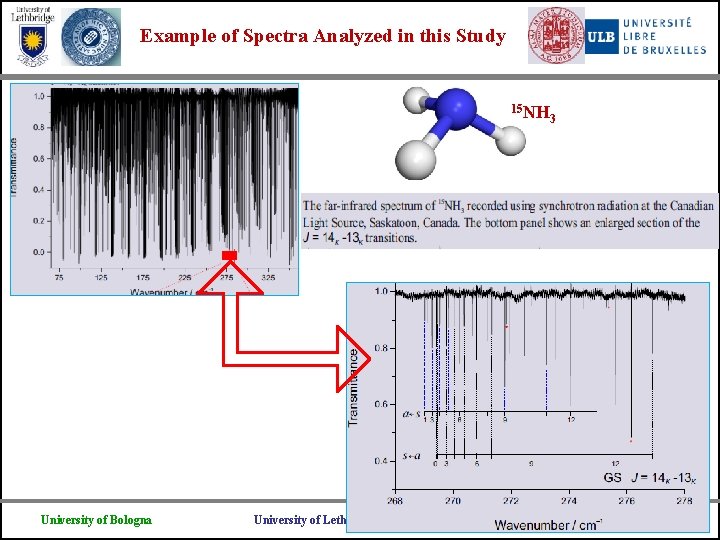
Example of Spectra Analyzed in this Study 15 NH University of Bologna University of Lethbridge 3 Universite Libre de Bruxelles
Examples of Spectra Analyzed in this Study University of Bologna University of Lethbridge Universite Libre de Bruxelles
Observed Perturbation allowed Δk= 3 transitions in the ground state up to J =10 J 4 5 5 6 6 6 7 7 7 K 0 0 1 1 -3 0 1 1 1 2 2 -3 -3 4 4 4 J 3 4 4 5 5 5 6 6 6 6 6 7 6 K 3 -3 2 2 0 -3 4 2 2 0 -3 2 4 4 1 1 -6 0 1 7 1 a-a s-s a-a s-s s-s a-a a-a s-s a-a University of Bologna observed 112. 2217 131. 8437 109. 7602 109. 8208 65. 9114 151. 1470 173. 3057 129. 3188 129. 2549 85. 6074 170. 5068 148. 6926 192. 4580 192. 3235 126. 9523 126. 9166 236. 8087 105. 2169 83. 4423 120. 9681 83. 46845 J 8 8 8 8 9 9 9 9 K 0 1 1 1 2 2 3 -3 4 5 -3 0 1 1 2 2 2 J 7 7 8 7 7 7 7 8 8 8 8 K -3 4 4 2 5 1 1 5 6 -6 1 2 0 -3 2 4 5 5 1 a-a s-s a-a a-a s-s s-s s-s a-a s-s University of Lethbridge observed 189. 5146 211. 4348 211. 3065 167. 8585 75. 80351 146. 3186 146. 2798 233. 2988 255. 5570 255. 7657 103. 1120 81. 35313 124. 7274 208. 5423 187. 0005 230. 2241 186. 9354 230. 1029 252. 1149 251. 9591 165. 5435 J 9 9 9 9 9 10 10 10 K 3 -3 4 4 5 5 6 -3 3 6 0 1 1 2 2 3 4 J 9 8 8 8 9 9 9 9 9 10 9 K -6 0 1 1 2 2 3 6 6 -3 -3 4 2 2 4 5 1 1 5 -6 1 s-s a-a s-s a-a a-a s-s observed 97. 11553 144. 0887 122. 6360 122. 6451 101. 0645 1013 79. 39756 96. 98271 274. 2817 79. 33243 227. 2037 248. 8132 205. 9055 205. 8428 248. 7005 270. 5480 184. 6119 184. 5708 270. 4050 96. 22192 142. 0483 Universite Libre de Bruxelles
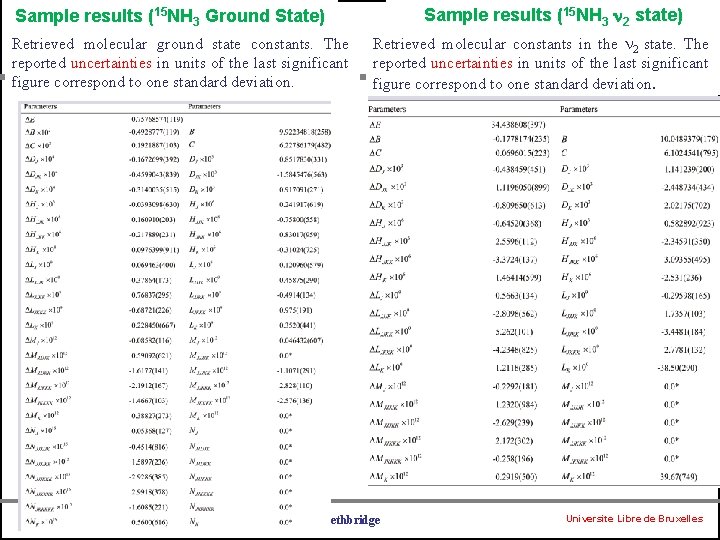
Sample results (15 NH 3 2 state) Sample results (15 NH 3 Ground State) Retrieved molecular ground state constants. The reported uncertainties in units of the last significant figure correspond to one standard deviation. University of Bologna Retrieved molecular constants in the 2 state. The reported uncertainties in units of the last significant figure correspond to one standard deviation. University of Lethbridge Universite Libre de Bruxelles
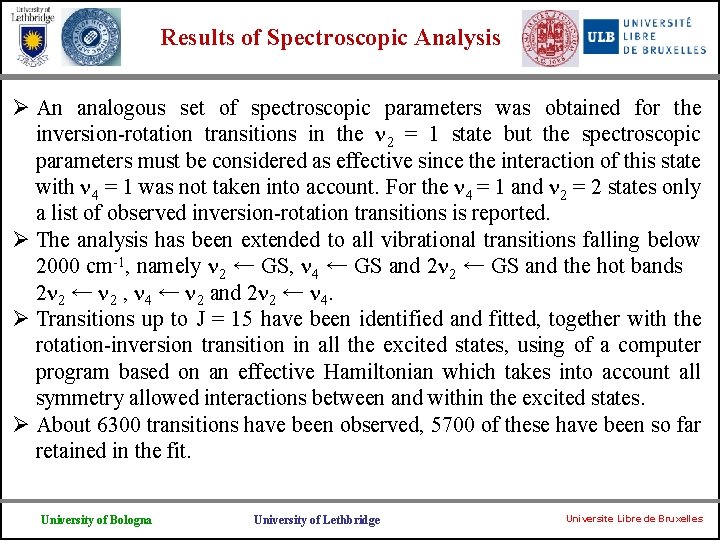
Results of Spectroscopic Analysis Ø An analogous set of spectroscopic parameters was obtained for the inversion-rotation transitions in the 2 = 1 state but the spectroscopic parameters must be considered as effective since the interaction of this state with 4 = 1 was not taken into account. For the 4 = 1 and 2 = 2 states only a list of observed inversion-rotation transitions is reported. Ø The analysis has been extended to all vibrational transitions falling below 2000 cm-1, namely 2 ← GS, 4 ← GS and 2 2 ← GS and the hot bands 2 2 ← 2 , 4 ← 2 and 2 2 ← 4. Ø Transitions up to J = 15 have been identified and fitted, together with the rotation-inversion transition in all the excited states, using of a computer program based on an effective Hamiltonian which takes into account all symmetry allowed interactions between and within the excited states. Ø About 6300 transitions have been observed, 5700 of these have been so far retained in the fit. University of Bologna University of Lethbridge Universite Libre de Bruxelles
Conclusions and Directions for Future Work ØTransmission spectra in spectral range 60 – 2085 cm-1 have been analyzed and the results for molecular constants are presented grouped by bands. Ø We were also able to determine several molecular constants, among them are the rotational constant C and centrifugal distortion Dk and Hk parameters. ØCurrently we are retrieving intensities for the newly assigned transitions. Of special interest are the observed forbidden transitions. University of Bologna University of Lethbridge Universite Libre de Bruxelles
References [1] S. Yu, J. C. Pearson, B. J. Drouin, K. Sung. O. Pirali, M. Vervloet, M. -A. Martin -Droumel, C. P. Endres, T. Shiraiashi, K. Kobayashi, F. Matsushima, Submillimeter -wave and far-infrared spectroscopy of high-J transitions of the ground and 2=1 states of ammonia, J. Chem. Phys. 133 174317 (2010). [2] M. Carlotti, A. Trombetti, B. Velino, J. Vrbancich, The rotation-invesion spectrum of 15 NH 3, J. Mol. Spectrosc. 83 401 (1980). [3] S. Urban, S. Klee and K. M. T. Yamada, Ground-state ro-inversional transitions of (NH 3)-N-15 in the far-infrared region, J. Mol. Spectrosc. 168 384 (1994). [4] G. Di. Lonardo, L. Fusina, A. Trombetti, and I. M. Mills, The 2, 2 2, 3 2, 4 and 1+ 4 bands of 15 NH 3 J. Mol. Spectrosc. 92 298 (1982). Acknowledgements The spectroscopy group at University of Lethbridge was funded by NSERC, Canada. Research described in this work was also performed at the Dipartimento di Chimica Industriale “Toso Montanari”, Università di Bologna, Italy and Laboratoire de Chimie Quantique et Photophysique, Université Libre de Bruxelles, Belgium under contracts and cooperative agreements. University of Bologna University of Lethbridge Universite Libre de Bruxelles