
The Spectrum Framework Review A consultation on how



- Slides: 24
The Spectrum Framework Review A consultation on how radio spectrum should be managed 23 November 2004 ©Ofcom
Contents • The Scope of the Review • The Radio Spectrum & its Current Allocation • Ofcom’s Spectrum Management Agenda • The Key Strategic Issues • Our Vision for Spectrum Management ©Ofcom 1
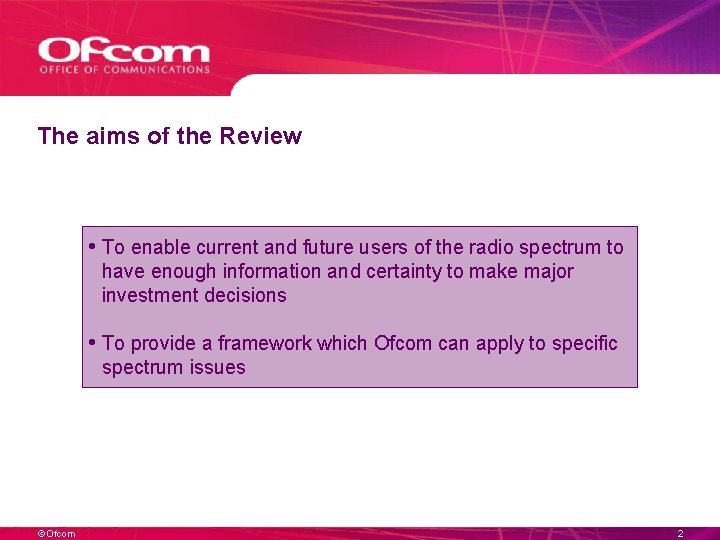
The aims of the Review • To enable current and future users of the radio spectrum to have enough information and certainty to make major investment decisions • To provide a framework which Ofcom can apply to specific spectrum issues ©Ofcom 2
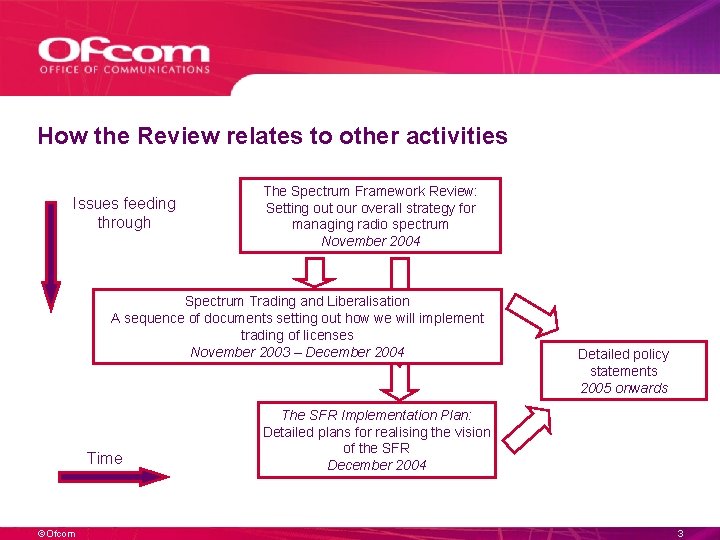
How the Review relates to other activities Issues feeding through The Spectrum Framework Review: Setting out our overall strategy for managing radio spectrum November 2004 Spectrum Trading and Liberalisation A sequence of documents setting out how we will implement trading of licenses November 2003 – December 2004 Time ©Ofcom Detailed policy statements 2005 onwards The SFR Implementation Plan: Detailed plans for realising the vision of the SFR December 2004 3
Contents • The Scope of the Review • The Radio Spectrum & its Current Allocation • Ofcom’s Spectrum Management Agenda • The Key Strategic Issues • Our Vision for Spectrum Management ©Ofcom 4
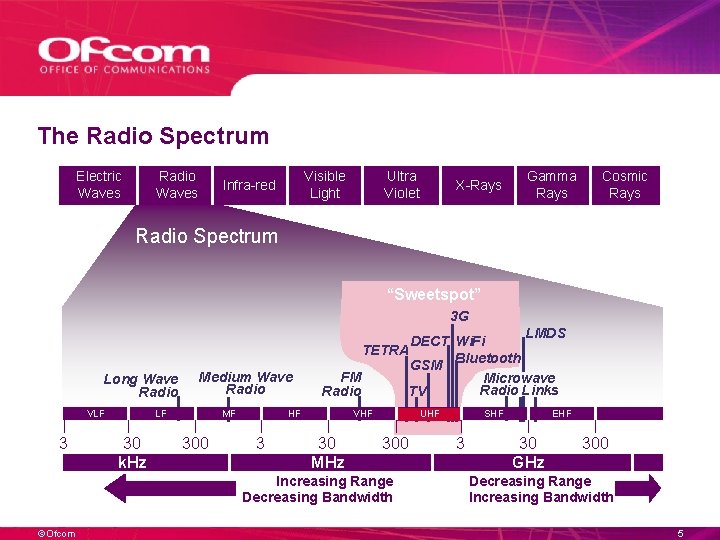
The Radio Spectrum Electric Waves Radio Waves Visible Light Infra-red Ultra Violet X-Rays Gamma Rays Cosmic Rays Radio Spectrum “Sweetspot” 3 G Long Wave Radio VLF 3 Medium Wave Radio LF 30 k. Hz MF 300 LMDS DECT Wi. Fi TETRA Bluetooth GSM FM Microwave Radio Links Radio TV HF 3 VHF 30 MHz UHF 300 Increasing Range Decreasing Bandwidth ©Ofcom SHF 3 EHF 30 GHz 300 Decreasing Range Increasing Bandwidth 5
Current Allocation of the Radio Spectrum Note: Weighted by Frequency ©Ofcom 6
Contents • The Scope of the Review • The Radio Spectrum & its Current Allocation • Ofcom’s Spectrum Management Agenda • The Key Strategic Issues • Our Vision for Spectrum Management ©Ofcom 7
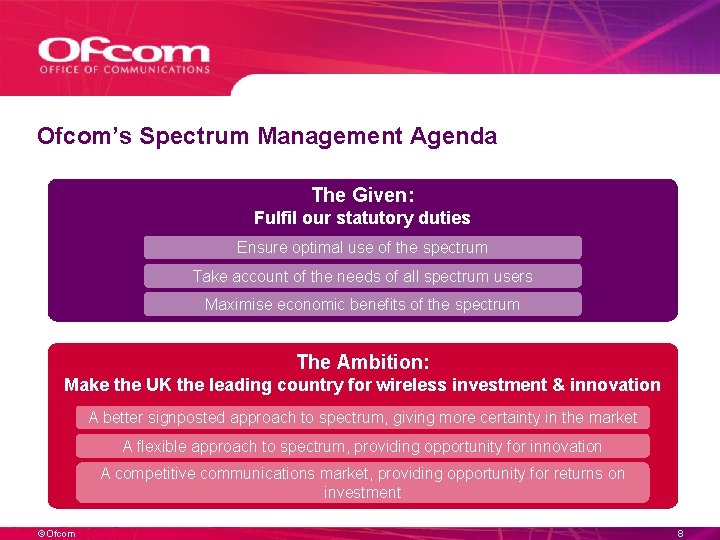
Ofcom’s Spectrum Management Agenda The Given: Fulfil our statutory duties Ensure optimal use of the spectrum Take account of the needs of all spectrum users Maximise economic benefits of the spectrum The Ambition: Make the UK the leading country for wireless investment & innovation A better signposted approach to spectrum, giving more certainty in the market A flexible approach to spectrum, providing opportunity for innovation A competitive communications market, providing opportunity for returns on investment ©Ofcom 8
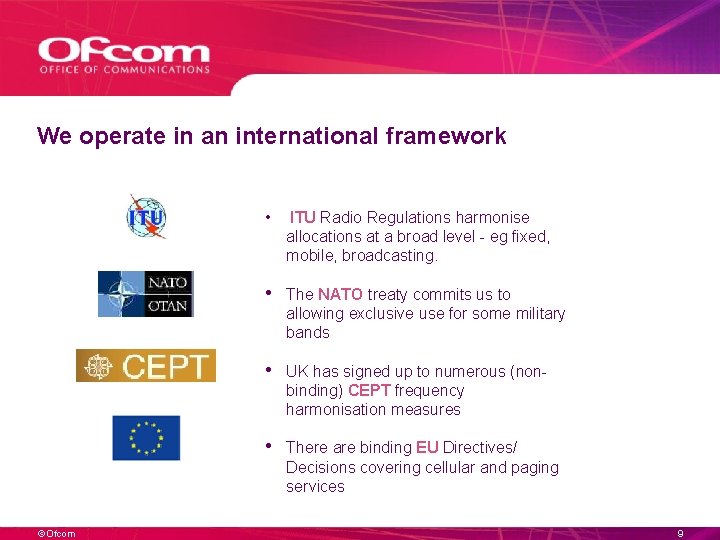
We operate in an international framework • ITU Radio Regulations harmonise allocations at a broad level - eg fixed, mobile, broadcasting. • The NATO treaty commits us to allowing exclusive use for some military bands • UK has signed up to numerous (nonbinding) CEPT frequency harmonisation measures • There are binding EU Directives/ Decisions covering cellular and paging services ©Ofcom 9
Contents • The Scope of the Review • The Radio Spectrum & its Current Allocation • Ofcom’s Spectrum Management Agenda • The Key Strategic Issues • Our Vision for Spectrum Management ©Ofcom 10
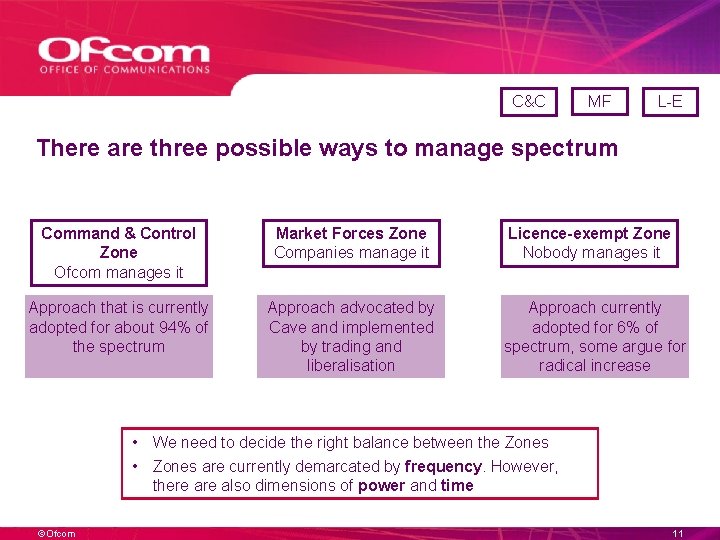
C&C MF L-E There are three possible ways to manage spectrum Command & Control Zone Ofcom manages it Market Forces Zone Companies manage it Approach that is currently adopted for about 94% of the spectrum Approach advocated by Cave and implemented by trading and liberalisation Licence-exempt Zone Nobody manages it Approach currently adopted for 6% of spectrum, some argue for radical increase • We need to decide the right balance between the Zones • Zones are currently demarcated by frequency. However, there also dimensions of power and time ©Ofcom 11
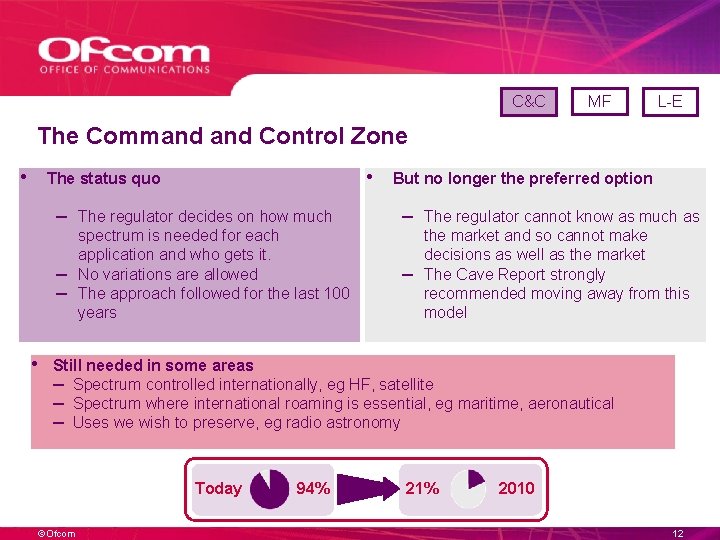
C&C MF L-E The Command Control Zone • • The status quo – The regulator decides on how much – – spectrum is needed for each application and who gets it. No variations are allowed The approach followed for the last 100 years But no longer the preferred option – The regulator cannot know as much as – the market and so cannot make decisions as well as the market The Cave Report strongly recommended moving away from this model • Still needed in some areas – Spectrum controlled internationally, eg HF, satellite – Spectrum where international roaming is essential, eg maritime, aeronautical – Uses we wish to preserve, eg radio astronomy Today ©Ofcom 94% 21% 2010 12
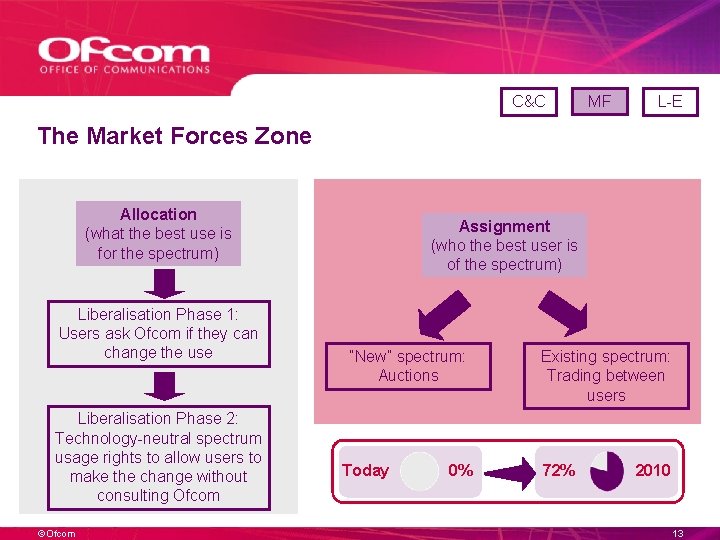
C&C MF L-E The Market Forces Zone Allocation (what the best use is for the spectrum) Liberalisation Phase 1: Users ask Ofcom if they can change the use Liberalisation Phase 2: Technology-neutral spectrum usage rights to allow users to make the change without consulting Ofcom ©Ofcom Assignment (who the best user is of the spectrum) “New” spectrum: Auctions Today 0% Existing spectrum: Trading between users 72% 2010 13
C&C MF L-E The Licence-exempt Zone Increasing licence-exempt allocation to 7% of total spectrum allows enough for everyone to install equipment capable of delivering 100 Mbits/s data services in homes or offices Key area for innovation but we do not need much more Focus on removing restrictions, eg higher power in rural areas Today ©Ofcom 6% 7% 2010 14
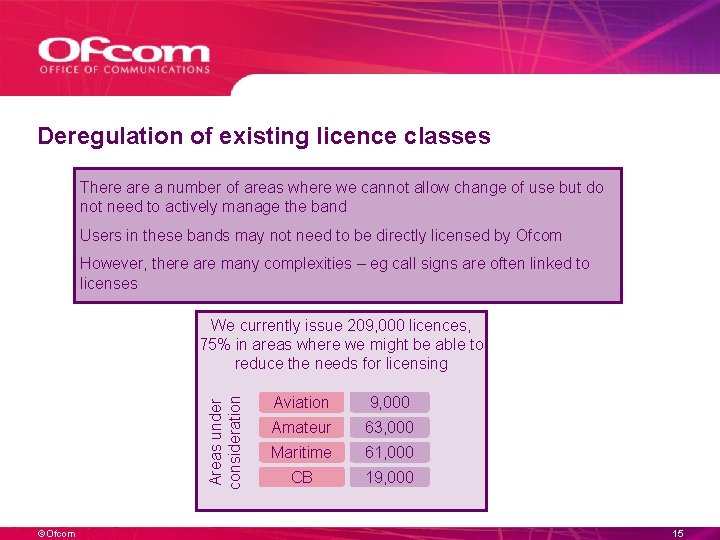
Deregulation of existing licence classes There a number of areas where we cannot allow change of use but do not need to actively manage the band Users in these bands may not need to be directly licensed by Ofcom However, there are many complexities – eg call signs are often linked to licenses Areas under consideration We currently issue 209, 000 licences, 75% in areas where we might be able to reduce the needs for licensing ©Ofcom Aviation 9, 000 Amateur 63, 000 Maritime 61, 000 CB 19, 000 15
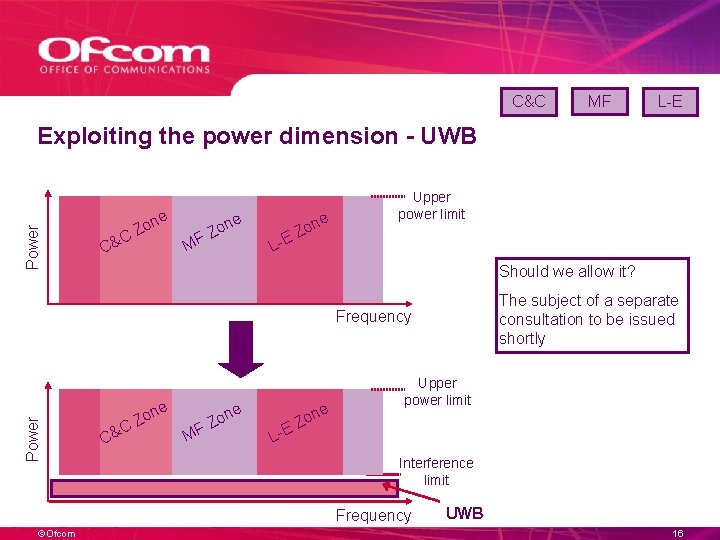
C&C MF L-E Power Exploiting the power dimension - UWB e C C& n Zo e ne Zo F M on Z E Upper power limit L- Should we allow it? The subject of a separate consultation to be issued shortly Power Frequency C& o CZ ne e e MF n Zo L-E n Zo Upper power limit Interference limit Frequency ©Ofcom UWB 16
C&C MF L-E Accessing the time dimension - Cognitive radio Power e m i T • Cognitive radios access the spectrum o CZ ne C& e ne M o FZ on Z E • L- Frequency Power e m i T o CZ C& ne e ne M o FZ on Z E L- • at full power during the time the licence holder is not using it We could allow this as an “easement” to property rights – However, licence holders could act in a manner to make it worthless (eg by transmitting constantly) – We are not sure it can be implemented technically in this fashion We would rather allow the licence holders to permit it in a direct transaction with the cognitive radio user Frequency ©Ofcom 17
Contents • The Scope of the Review • The Radio Spectrum & its Current Allocation • Ofcom’s Spectrum Management Agenda • The Key Strategic Issues • Our Vision for Spectrum Management ©Ofcom 18
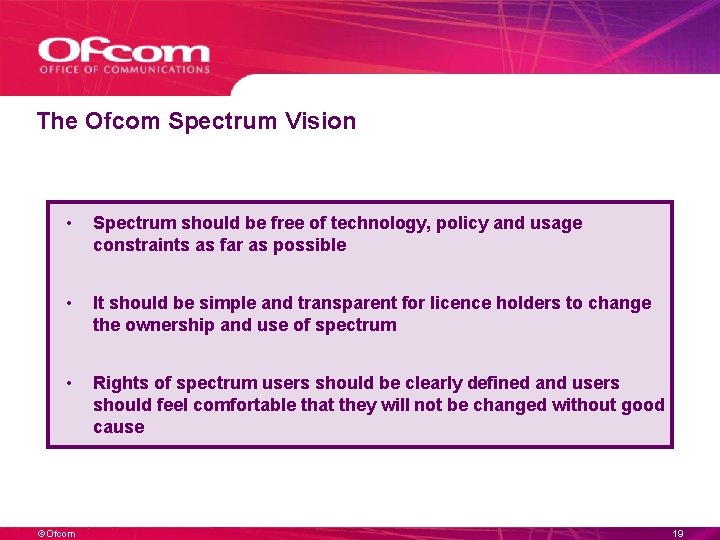
The Ofcom Spectrum Vision • Spectrum should be free of technology, policy and usage constraints as far as possible • It should be simple and transparent for licence holders to change the ownership and use of spectrum • Rights of spectrum users should be clearly defined and users should feel comfortable that they will not be changed without good cause ©Ofcom 19
Next Steps ©Ofcom
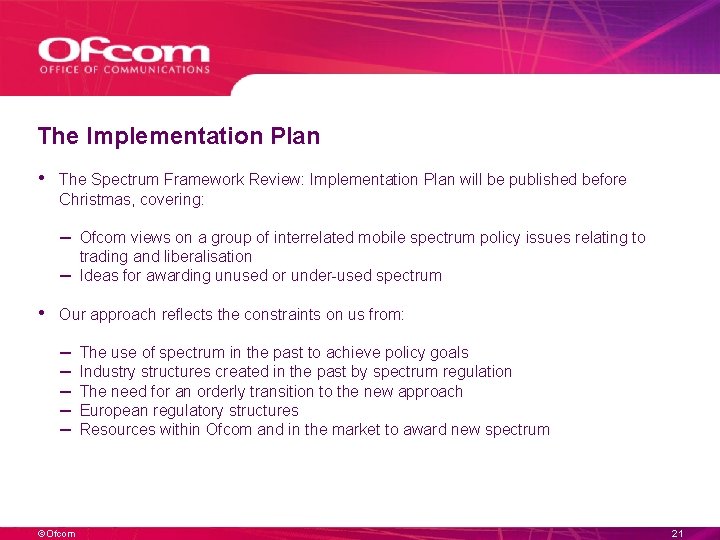
The Implementation Plan • The Spectrum Framework Review: Implementation Plan will be published before Christmas, covering: – Ofcom views on a group of interrelated mobile spectrum policy issues relating to – trading and liberalisation Ideas for awarding unused or under-used spectrum • Our approach reflects the constraints on us from: – – – ©Ofcom The use of spectrum in the past to achieve policy goals Industry structures created in the past by spectrum regulation The need for an orderly transition to the new approach European regulatory structures Resources within Ofcom and in the market to award new spectrum 21
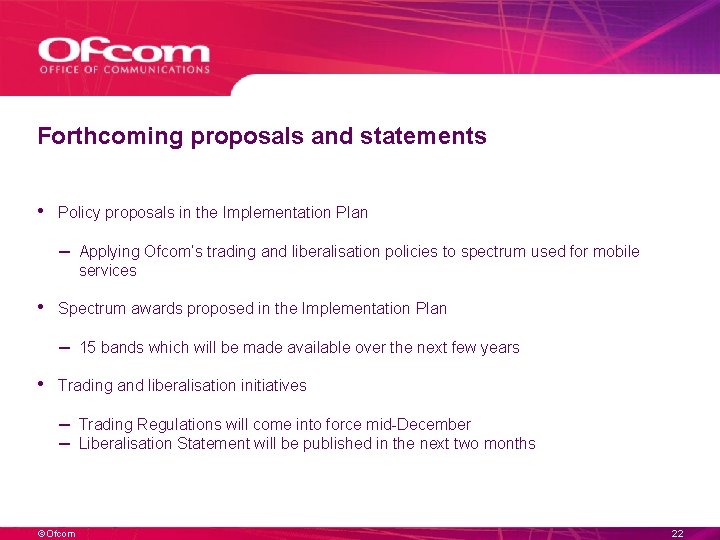
Forthcoming proposals and statements • Policy proposals in the Implementation Plan – Applying Ofcom’s trading and liberalisation policies to spectrum used for mobile services • Spectrum awards proposed in the Implementation Plan – 15 bands which will be made available over the next few years • Trading and liberalisation initiatives – Trading Regulations will come into force mid-December – Liberalisation Statement will be published in the next two months ©Ofcom 22
Spectrum Framework Review Q&A ©Ofcom