
The Spectrophotometric Standard Stars Grid for the Gaia


- Slides: 18
The Spectrophotometric Standard Stars Grid for the Gaia absolute calibration Giuseppe Altavilla & G. Cocozza, S. Galleti, S. Ragaini E. Pancino, M. Bellazzini, A. Bragaglia, C. Cacciari, L. Federici, P. Montegriffo, S. Marinoni, G. Tessicini, G. Valentini
Gaia objectives • The largest and most precise 3 D chart of our Galaxy (6 D space survey: α, δ, π, μα, μδ + complementary radial velocities) + astrophysical parameters • Composition, Formation and Evolution of our Galaxy, unraveling the chemical and dynamical history of our Galaxy. . . And much more! Astrometric accuracy: the Hyades D 47 pc 1960 1993 2022
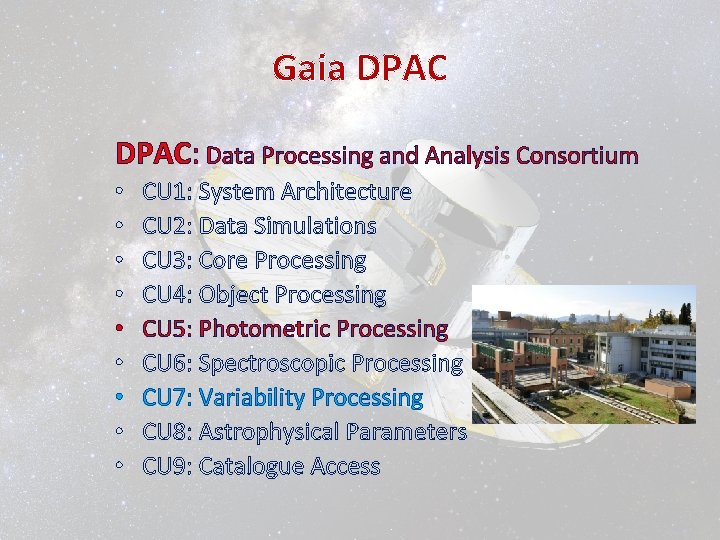
Gaia DPAC: Data Processing and Analysis Consortium • • • CU 1: System Architecture CU 2: Data Simulations CU 3: Core Processing CU 4: Object Processing CU 5: Photometric Processing CU 6: Spectroscopic Processing CU 7: Variability Processing CU 8: Astrophysical Parameters CU 9: Catalogue Access
Gaia DPAC: Data Processing and Analysis Consortium • • • CU 1: System Architecture CU 2: Data Simulations CU 3: Core Processing CU 4: Object Processing CU 5: Photometric Processing CU 6: Spectroscopic Processing CU 7: Variability Processing CU 8: Astrophysical Parameters CU 9: Catalogue Access
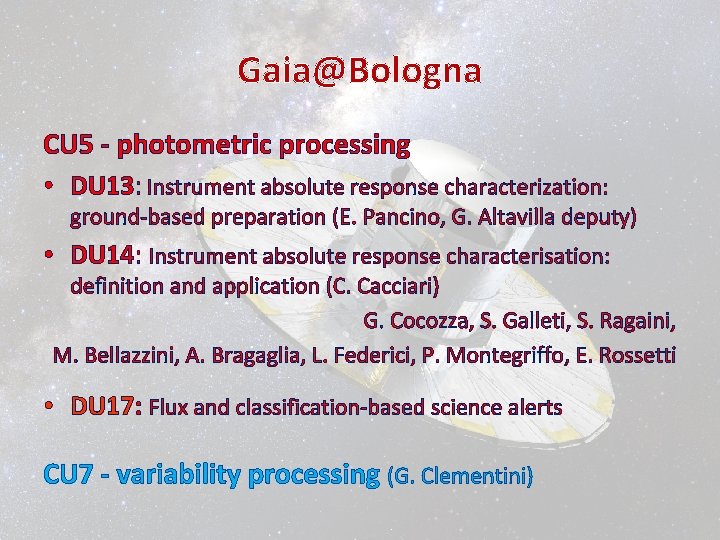
Gaia@Bologna CU 5 - photometric processing • DU 13: Instrument absolute response characterization: ground-based preparation (E. Pancino, G. Altavilla deputy) • DU 14: Instrument absolute response characterisation: definition and application (C. Cacciari) G. Cocozza, S. Galleti, S. Ragaini, M. Bellazzini, A. Bragaglia, L. Federici, P. Montegriffo, E. Rossetti • DU 17: Flux and classification-based science alerts CU 7 - variability processing (G. Clementini)
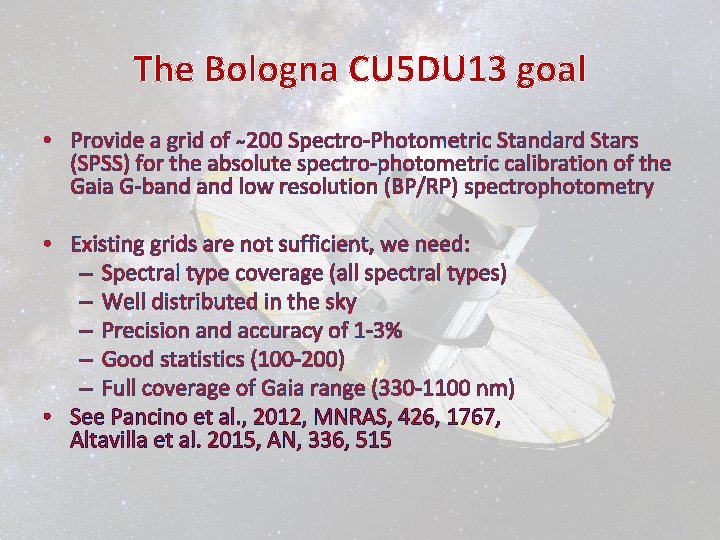
The Bologna CU 5 DU 13 goal • Provide a grid of 200 Spectro-Photometric Standard Stars (SPSS) for the absolute spectro-photometric calibration of the Gaia G-band low resolution (BP/RP) spectrophotometry • Existing grids are not sufficient, we need: – Spectral type coverage (all spectral types) – Well distributed in the sky – Precision and accuracy of 1 -3% – Good statistics (100 -200) – Full coverage of Gaia range (330 -1100 nm) • See Pancino et al. , 2012, MNRAS, 426, 1767, Altavilla et al. 2015, AN, 336, 515
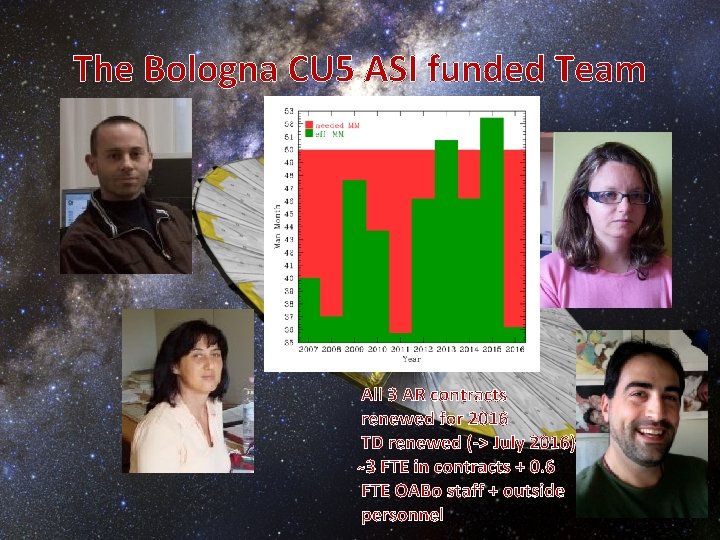
The Bologna CU 5 ASI funded Team All 3 AR contracts renewed for 2016 TD renewed (-> July 2016) 3 FTE in contracts + 0. 6 FTE OABo staff + outside personnel
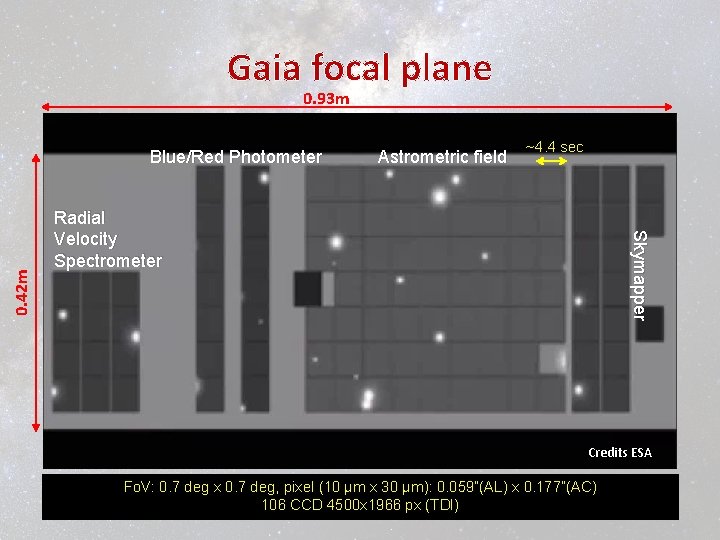
Gaia focal plane 0. 93 m Astrometric field ~4. 4 sec Radial Velocity Spectrometer Skymapper 0. 42 m Blue/Red Photometer Credits ESA Fo. V: 0. 7 deg x 0. 7 deg, pixel (10 µm x 30 µm): 0. 059”(AL) x 0. 177”(AC) 106 CCD 4500 x 1966 px (TDI)
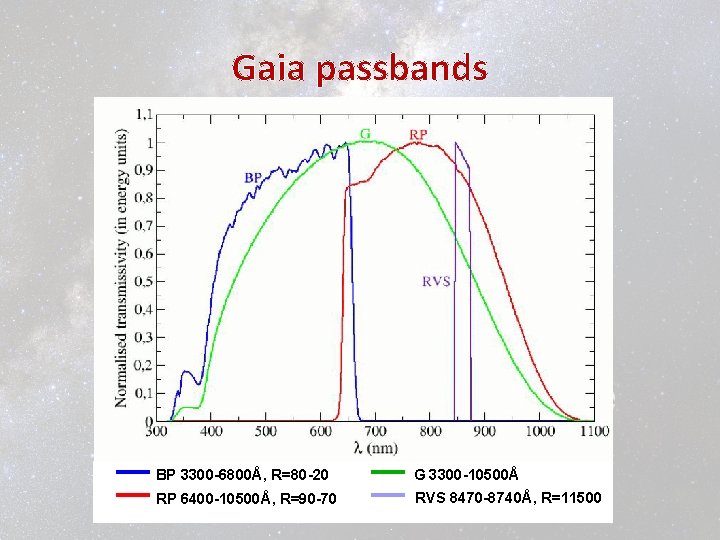
Gaia passbands BP 3300 -6800Å, R=80 -20 G 3300 -10500Å RP 6400 -10500Å, R=90 -70 RVS 8470 -8740Å, R=11500
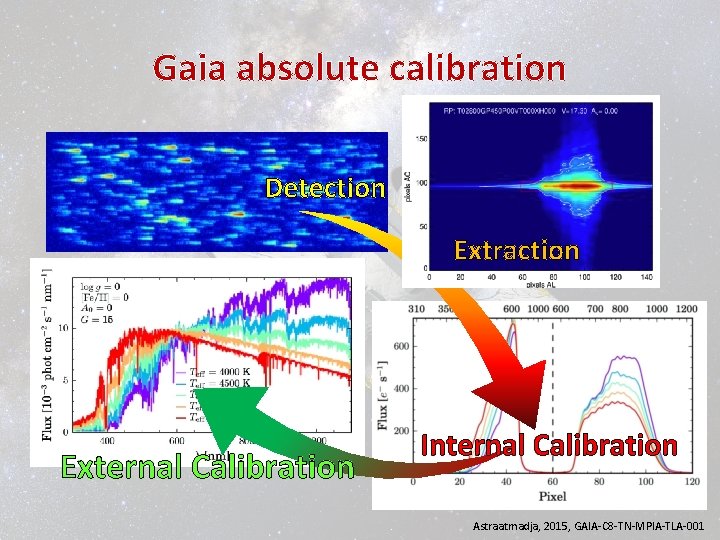
Gaia absolute calibration Detection Extraction External Calibration Internal Calibration Astraatmadja, 2015, GAIA-C 8 -TN-MPIA-TLA-001
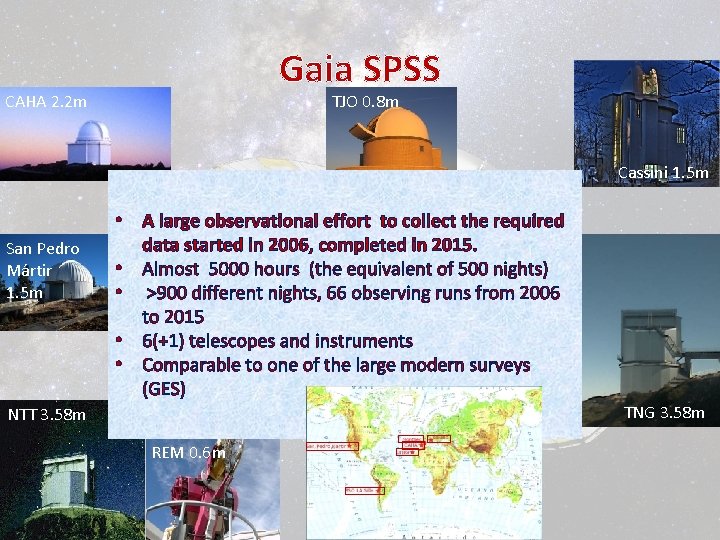
Gaia SPSS CAHA 2. 2 m TJO 0. 8 m Cassini 1. 5 m San Pedro Mártir 1. 5 m • A large observational effort to collect the required data started in 2006, completed in 2015. • Almost 5000 hours (the equivalent of 500 nights) • >900 different nights, 66 observing runs from 2006 to 2015 • 6(+1) telescopes and instruments • Comparable to one of the large modern surveys (GES) TNG 3. 58 m NTT 3. 58 m REM 0. 6 m
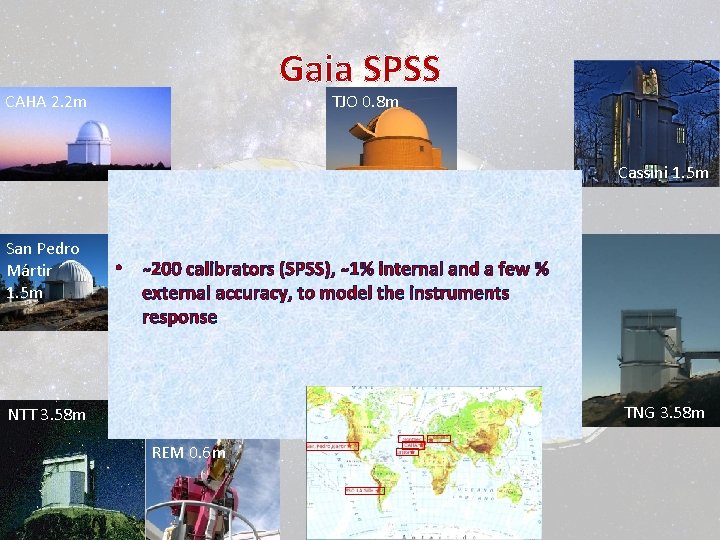
Gaia SPSS CAHA 2. 2 m TJO 0. 8 m Cassini 1. 5 m San Pedro Mártir 1. 5 m • 200 calibrators (SPSS), 1% internal and a few % external accuracy, to model the instruments response TNG 3. 58 m NTT 3. 58 m REM 0. 6 m
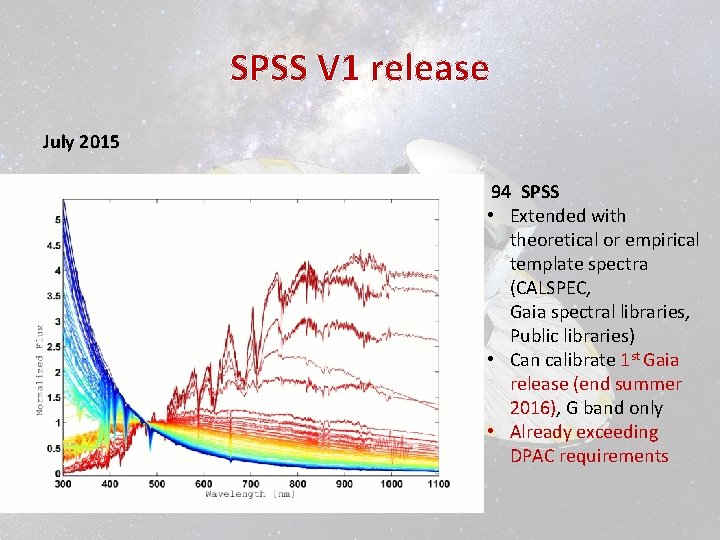
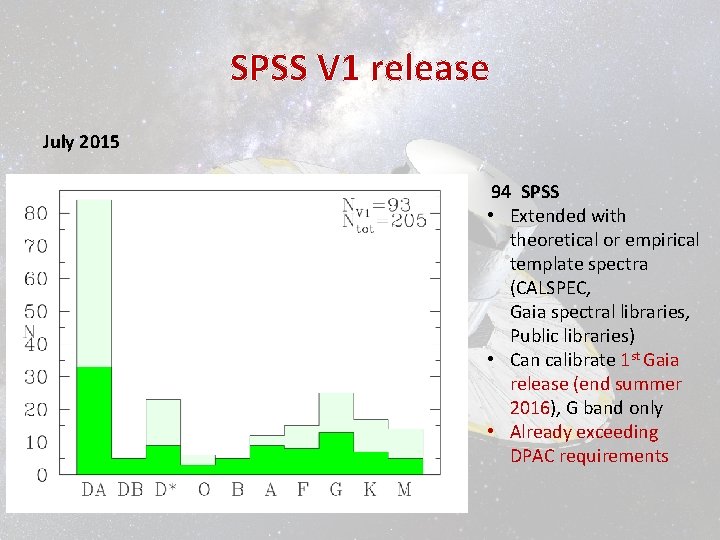
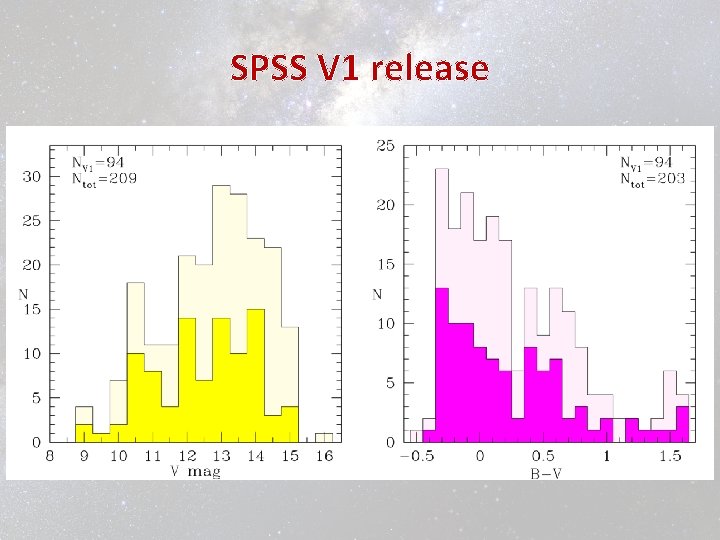
SPSS V 1 release July 2015 94 SPSS • Extended with theoretical or empirical template spectra (CALSPEC, Gaia spectral libraries, Public libraries) • Can calibrate 1 st Gaia release (end summer 2016), G band only • Already exceeding DPAC requirements
SPSS V 1 release July 2015 94 SPSS • Extended with theoretical or empirical template spectra (CALSPEC, Gaia spectral libraries, Public libraries) • Can calibrate 1 st Gaia release (end summer 2016), G band only • Already exceeding DPAC requirements
SPSS V 1 release
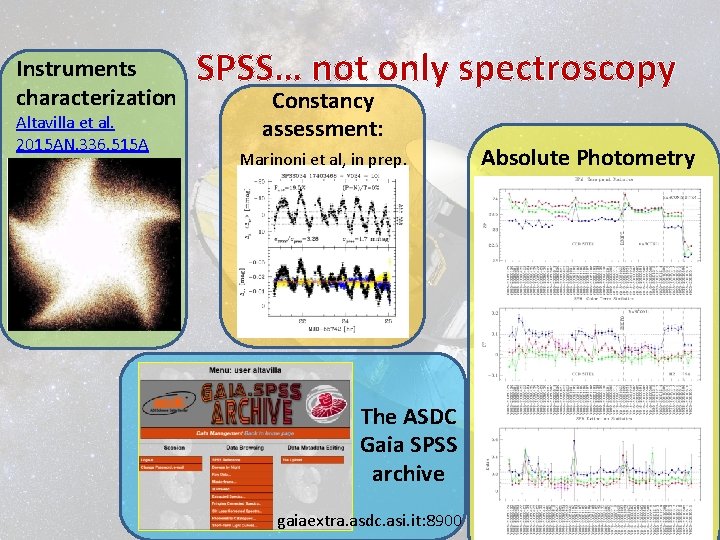
Instruments characterization Altavilla et al. 2015 AN. 336. 515 A SPSS… not only spectroscopy Constancy assessment: Marinoni et al, in prep. The ASDC Gaia SPSS archive gaiaextra. asdc. asi. it: 8900 Absolute Photometry
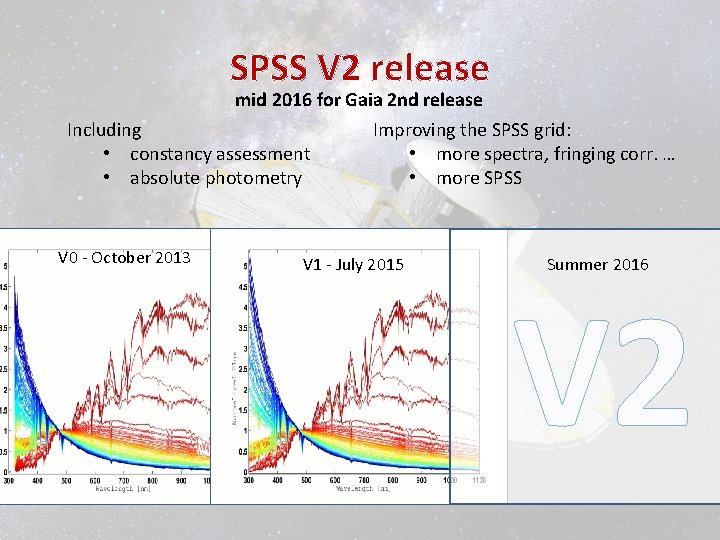
SPSS V 2 release mid 2016 for Gaia 2 nd release Including • constancy assessment • absolute photometry V 0 - October 2013 Improving the SPSS grid: • more spectra, fringing corr. … • more SPSS V 1 - July 2015 Summer 2016 V 2
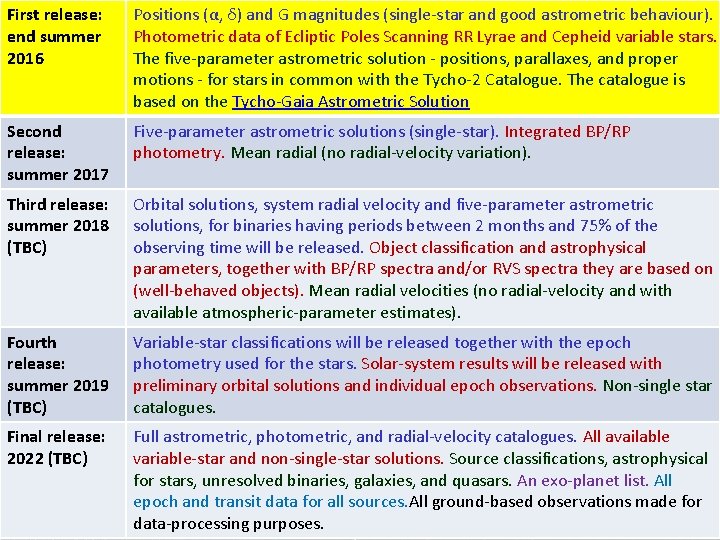
First release: end summer 2016 Positions (α, δ) and G magnitudes (single-star and good astrometric behaviour). Photometric data of Ecliptic Poles Scanning RR Lyrae and Cepheid variable stars. The five-parameter astrometric solution - positions, parallaxes, and proper motions - for stars in common with the Tycho-2 Catalogue. The catalogue is based on the Tycho-Gaia Astrometric Solution Second release: summer 2017 Five-parameter astrometric solutions (single-star). Integrated BP/RP photometry. Mean radial (no radial-velocity variation). Third release: summer 2018 (TBC) Orbital solutions, system radial velocity and five-parameter astrometric solutions, for binaries having periods between 2 months and 75% of the observing time will be released. Object classification and astrophysical parameters, together with BP/RP spectra and/or RVS spectra they are based on (well-behaved objects). Mean radial velocities (no radial-velocity and with available atmospheric-parameter estimates). Fourth release: summer 2019 (TBC) Variable-star classifications will be released together with the epoch photometry used for the stars. Solar-system results will be released with preliminary orbital solutions and individual epoch observations. Non-single star catalogues. Final release: 2022 (TBC) Full astrometric, photometric, and radial-velocity catalogues. All available variable-star and non-single-star solutions. Source classifications, astrophysical for stars, unresolved binaries, galaxies, and quasars. An exo-planet list. All epoch and transit data for all sources. All ground-based observations made for data-processing purposes.