
The spectral transform method by Nils Wedi wediecmwf
The spectral transform method by Nils Wedi wedi@ecmwf. int © ECMWF March 8, 2021 European Centre for Medium Range Weather Forecasts
The Integrated Forecasting System (IFS) technology applied at ECMWF for the last 30 years … • A spectral transform, semi-Lagrangian, semi-implicit (compressible) (non-)hydrostatic model Outline: - Theoretical foundations Aliasing control Spectral – gridpoint dual space Speeding up the computations - FFT / Fast Legendre transforms - Accelerator use (GPUs, optical) - MPI parallelization and “global” communications - The cost and competitiveness of spectral transforms in NWP and climate simulations EUROPEAN CENTRE FOR MEDIUM-RANGE WEATHER FORECASTS October 29, 2014 2
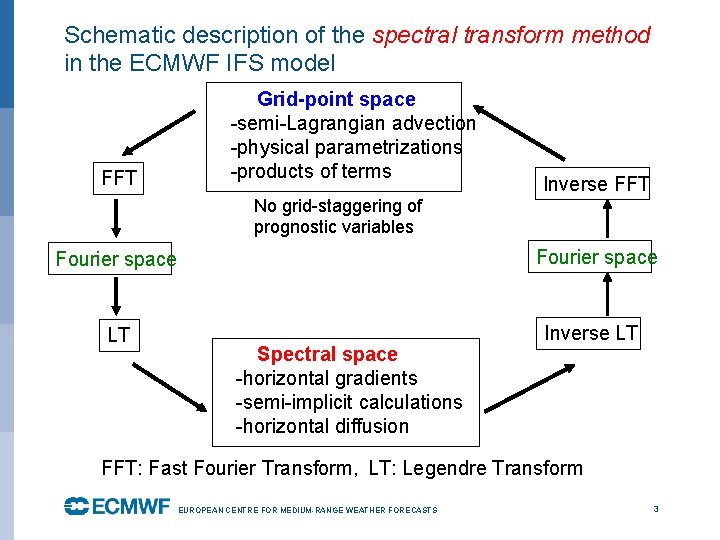
Schematic description of the spectral transform method in the ECMWF IFS model FFT Grid-point space -semi-Lagrangian advection -physical parametrizations -products of terms Inverse FFT No grid-staggering of prognostic variables Fourier space LT Inverse LT Spectral space -horizontal gradients -semi-implicit calculations -horizontal diffusion FFT: Fast Fourier Transform, LT: Legendre Transform EUROPEAN CENTRE FOR MEDIUM-RANGE WEATHER FORECASTS October 29, 2014 3
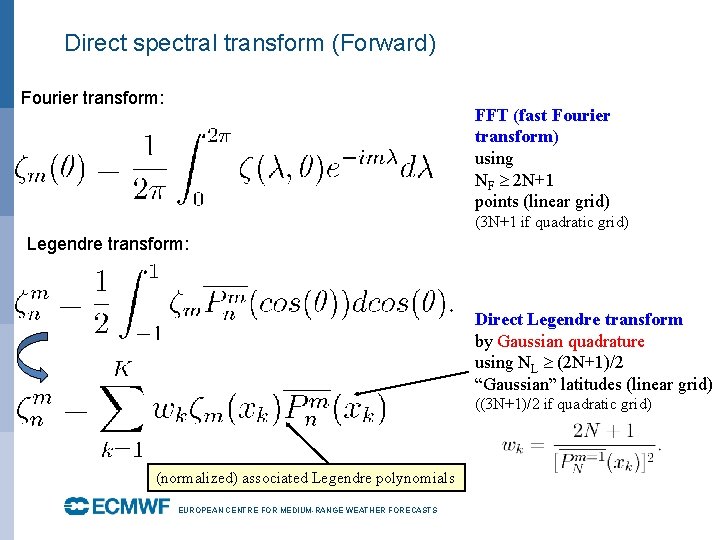
Direct spectral transform (Forward) Fourier transform: FFT (fast Fourier transform) using NF 2 N+1 points (linear grid) (3 N+1 if quadratic grid) Legendre transform: Direct Legendre transform by Gaussian quadrature using NL (2 N+1)/2 “Gaussian” latitudes (linear grid) ((3 N+1)/2 if quadratic grid) (normalized) associated Legendre polynomials EUROPEAN CENTRE FOR MEDIUM-RANGE WEATHER FORECASTS October 29, 2014
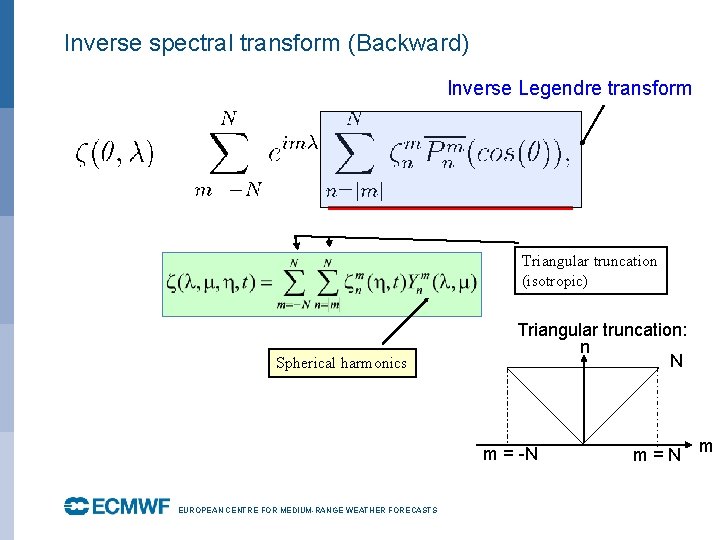
Inverse spectral transform (Backward) Inverse Legendre transform Triangular truncation (isotropic) Spherical harmonics Triangular truncation: n N m = -N EUROPEAN CENTRE FOR MEDIUM-RANGE WEATHER FORECASTS October 29, 2014 m=N m
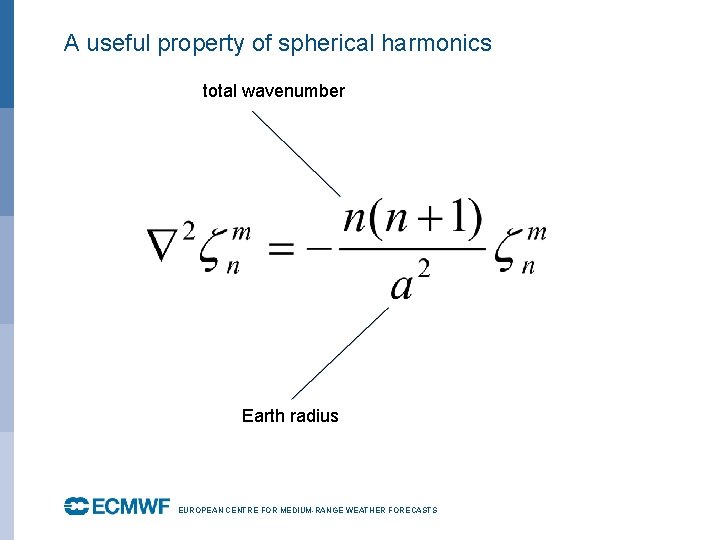
A useful property of spherical harmonics total wavenumber Earth radius EUROPEAN CENTRE FOR MEDIUM-RANGE WEATHER FORECASTS October 29, 2014
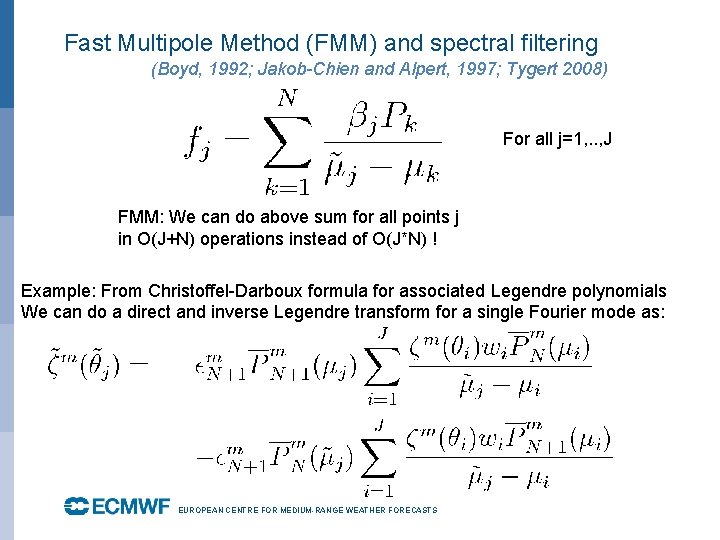
Fast Multipole Method (FMM) and spectral filtering (Boyd, 1992; Jakob-Chien and Alpert, 1997; Tygert 2008) For all j=1, . . , J FMM: We can do above sum for all points j in O(J+N) operations instead of O(J*N) ! Example: From Christoffel-Darboux formula for associated Legendre polynomials We can do a direct and inverse Legendre transform for a single Fourier mode as: EUROPEAN CENTRE FOR MEDIUM-RANGE WEATHER FORECASTS October 29, 2014
Aliasing control • Aliasing of quadratic (or cubic) terms on the linear grid (2 N+1 gridpoints per N waves), where the product of two (or three) variables transformed to spectral space cannot be accurately represented with the available number of waves (as quadratic terms would need a 3 N+1 gridpoints with N waves and cubic terms 4 N+1 gridpoints with N waves). • Example of de-aliasing in IFS: By subtracting the difference between a specially filtered and the unfiltered pressure gradient term at every time-step the stationary noise patterns can be removed at a cost of approx. 5% at TL 1279 (2 extra transforms); this is not needed when a “quadratic” or “cubic” grid is used with above gridpoint to wavenumber ratios. EUROPEAN CENTRE FOR MEDIUM-RANGE WEATHER FORECASTS October 29, 2014
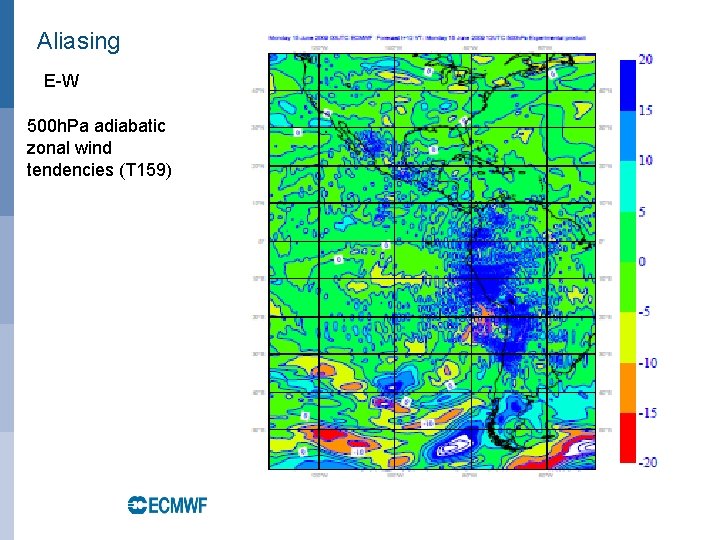
Aliasing E-W 500 h. Pa adiabatic zonal wind tendencies (T 159)
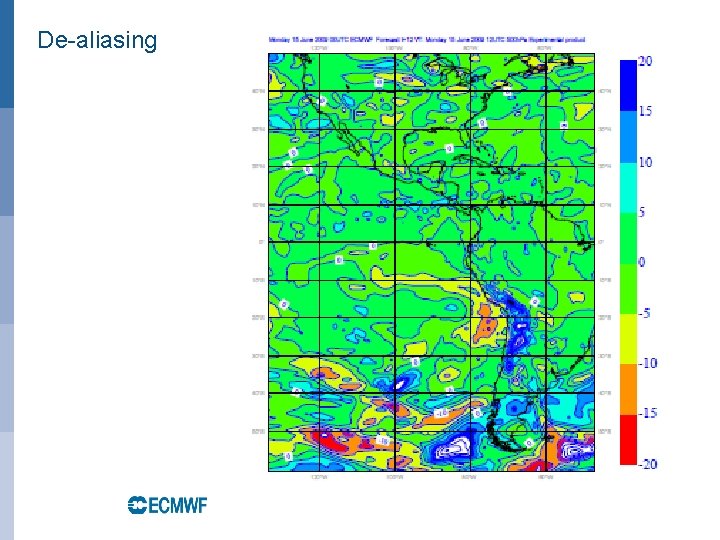
De-aliasing
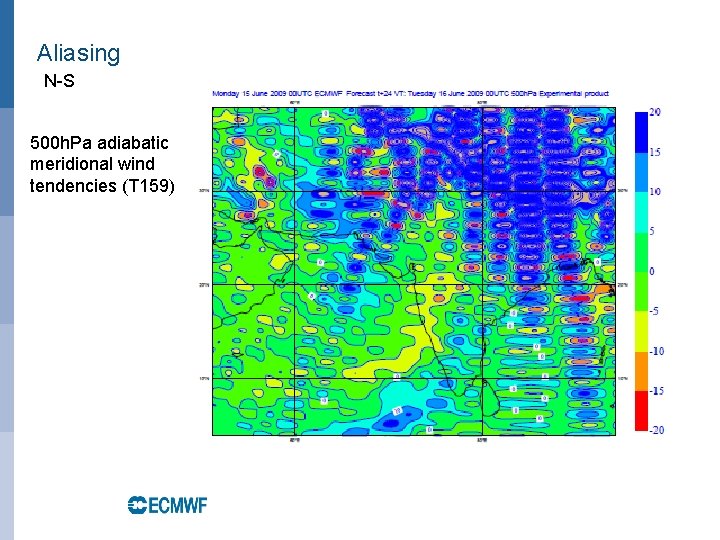
Aliasing N-S 500 h. Pa adiabatic meridional wind tendencies (T 159)
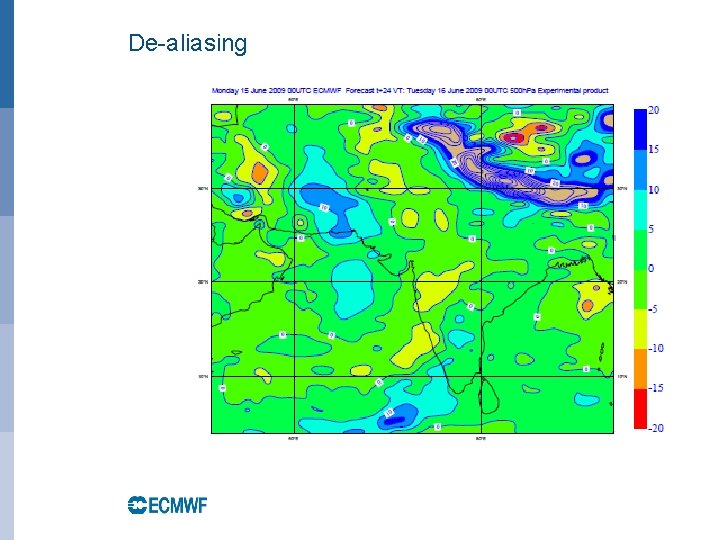
De-aliasing
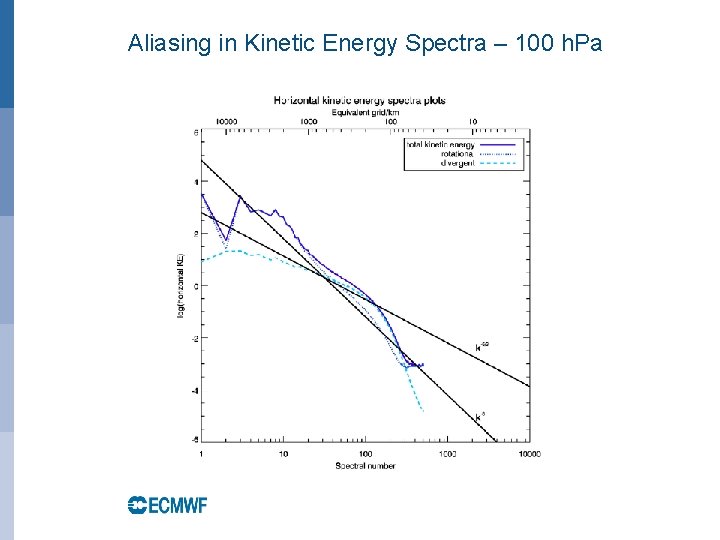
Aliasing in Kinetic Energy Spectra – 100 h. Pa
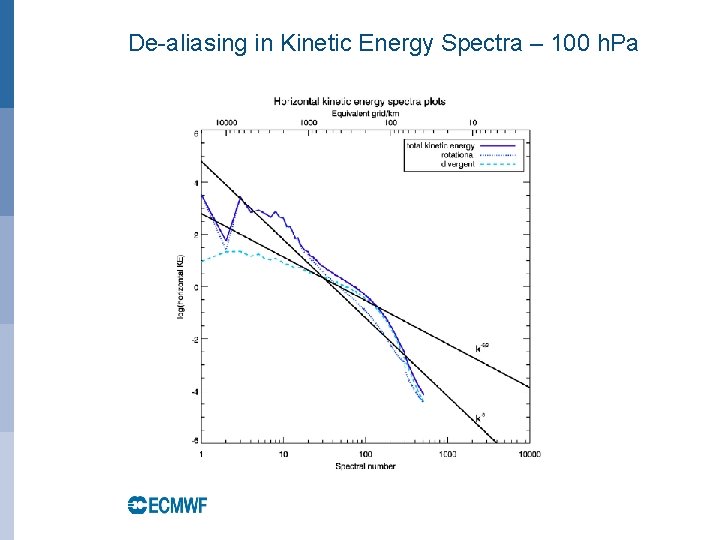
De-aliasing in Kinetic Energy Spectra – 100 h. Pa
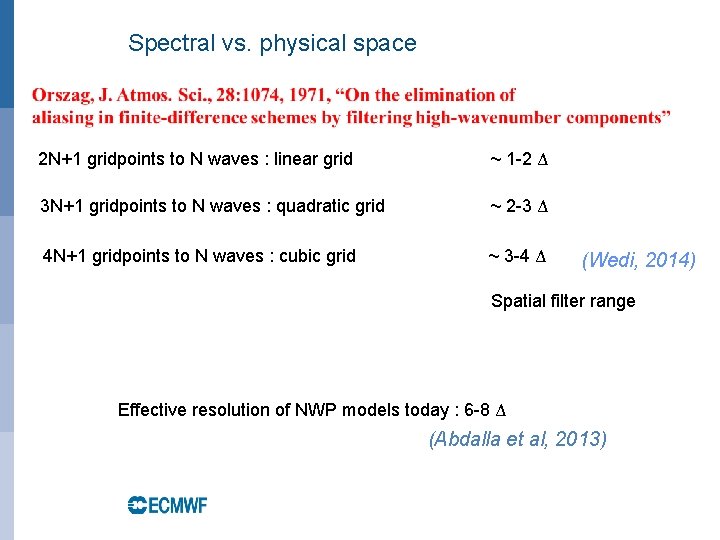
Spectral vs. physical space 2 N+1 gridpoints to N waves : linear grid ~ 1 -2 Δ 3 N+1 gridpoints to N waves : quadratic grid ~ 2 -3 Δ 4 N+1 gridpoints to N waves : cubic grid ~ 3 -4 Δ (Wedi, 2014) Spatial filter range Effective resolution of NWP models today : 6 -8 Δ (Abdalla et al, 2013)
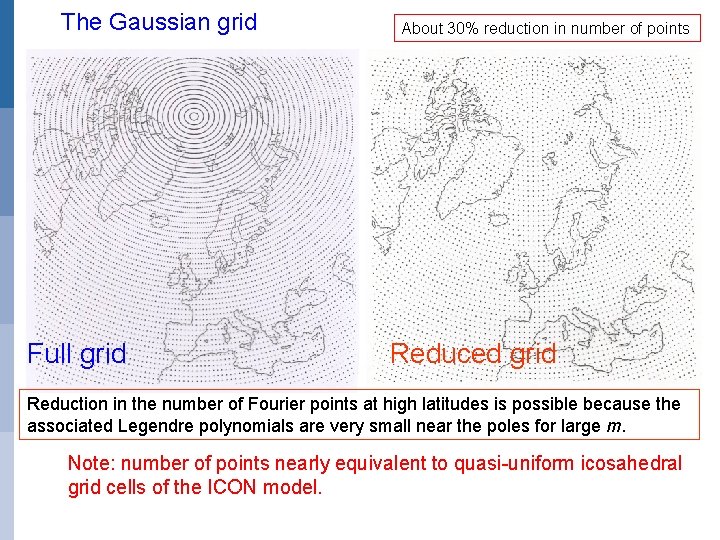
The Gaussian grid Full grid About 30% reduction in number of points Reduced grid Reduction in the number of Fourier points at high latitudes is possible because the associated Legendre polynomials are very small near the poles for large m. Note: number of points nearly equivalent to quasi-uniform icosahedral grid cells of the ICON model.
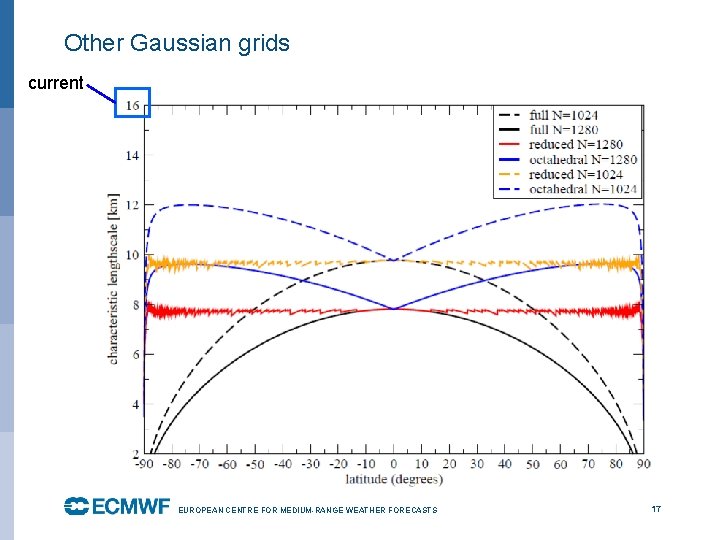
Other Gaussian grids current EUROPEAN CENTRE FOR MEDIUM-RANGE WEATHER FORECASTS October 29, 2014 17
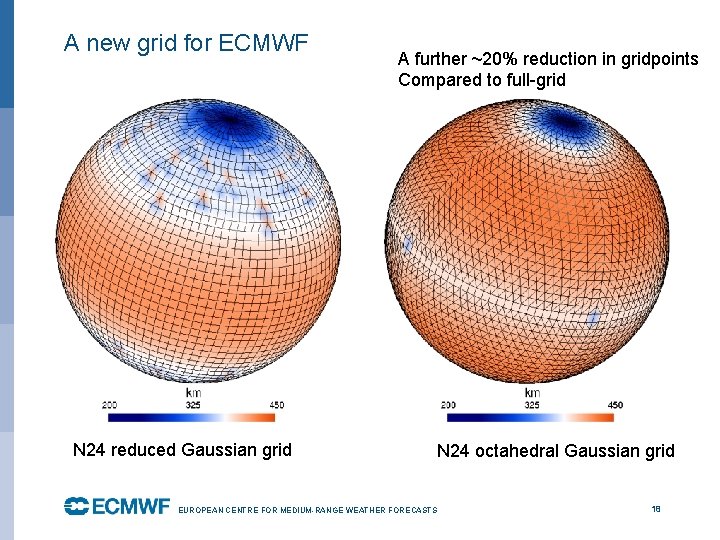
A new grid for ECMWF N 24 reduced Gaussian grid A further ~20% reduction in gridpoints Compared to full-grid N 24 octahedral Gaussian grid EUROPEAN CENTRE FOR MEDIUM-RANGE WEATHER FORECASTS October 29, 2014 18
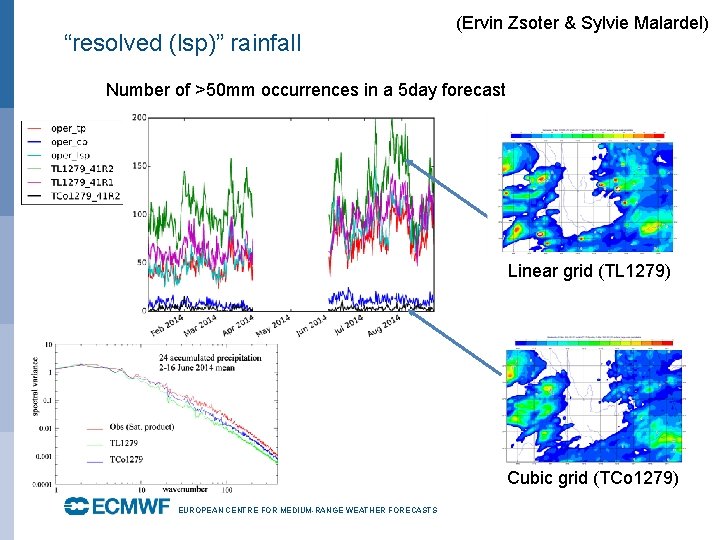
“resolved (lsp)” rainfall (Ervin Zsoter & Sylvie Malardel) Number of >50 mm occurrences in a 5 day forecast Linear grid (TL 1279) Cubic grid (TCo 1279) EUROPEAN CENTRE FOR MEDIUM-RANGE WEATHER FORECASTS October 29, 2014
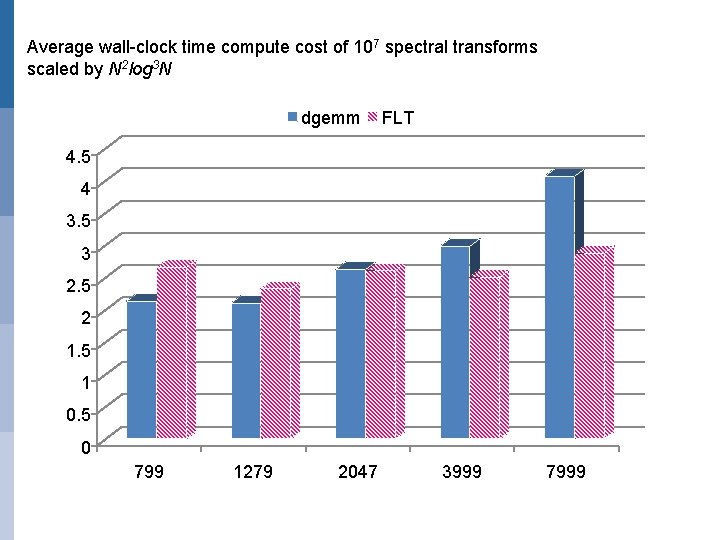
A fast Legendre transform (FLT) (O’Neil, Woolfe, Rokhlin, 2009; Tygert 2008, 2010) t The computational complexity of the ordinary spectral transform is O(N^3) (where N is the truncation number of the series expansion in spherical harmonics) and it was therefore believed to be not computationally competitive with other methods at very high resolution t The FLT is found to be O(N^2 log N^3) for horizontal resolutions up to T 7999 (Wedi et al, 2013) EUROPEAN CENTRE FOR MEDIUM-RANGE WEATHER FORECASTS October 29, 2014
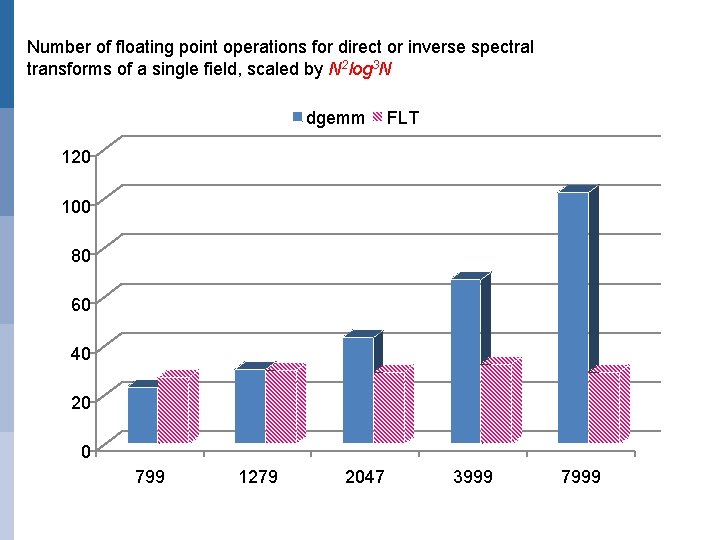
Number of floating point operations for direct or inverse spectral transforms of a single field, scaled by N 2 log 3 N dgemm FLT 120 100 80 60 40 20 0 799 1279 2047 3999 7999
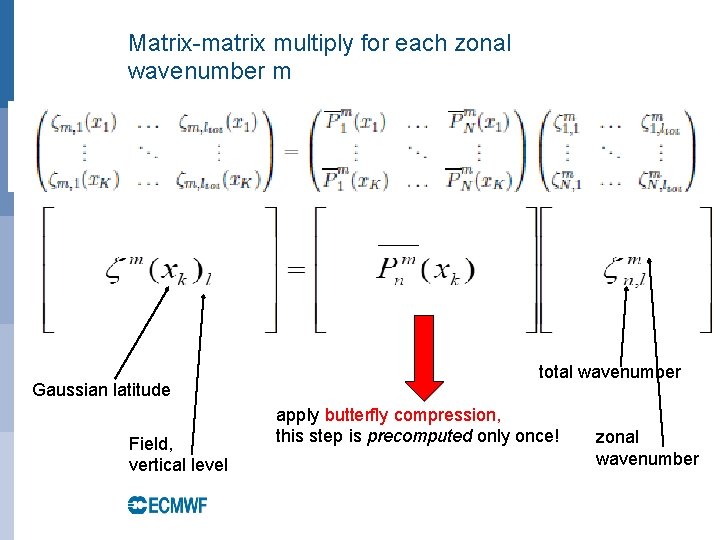
Matrix-matrix multiply for each zonal wavenumber m Gaussian latitude Field, vertical level total wavenumber apply butterfly compression, this step is precomputed only once! zonal wavenumber

Butterfly algorithm: pre-compute With each level l, double the columns and half the rows
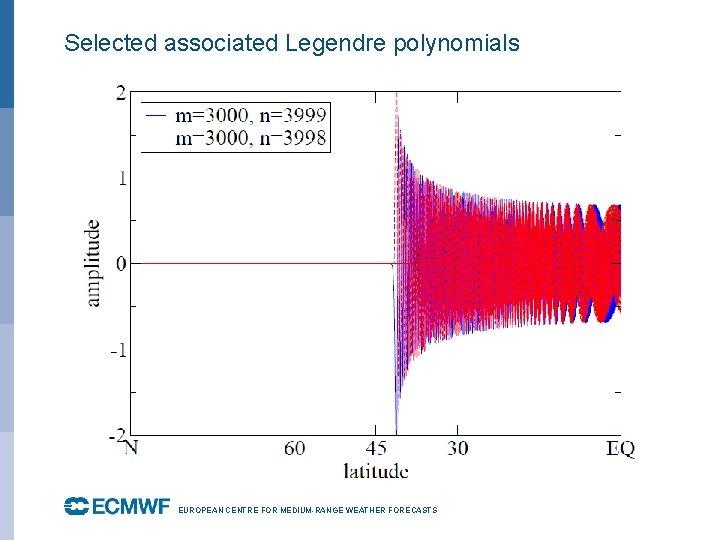
Selected associated Legendre polynomials EUROPEAN CENTRE FOR MEDIUM-RANGE WEATHER FORECASTS October 29, 2014
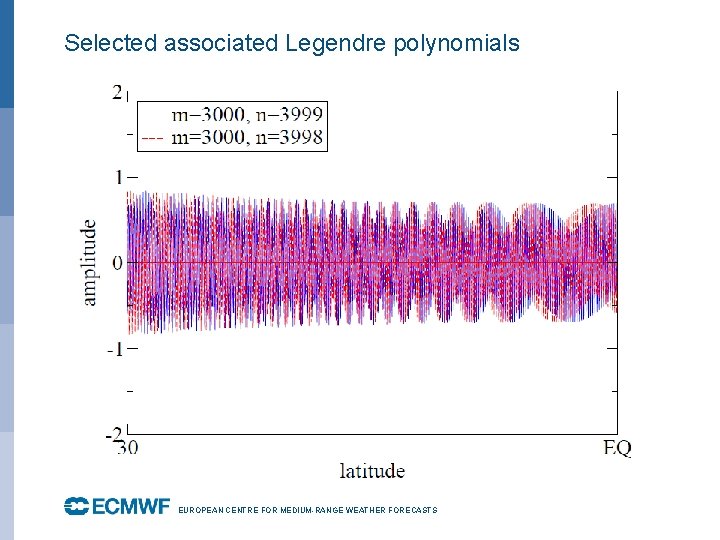
Selected associated Legendre polynomials EUROPEAN CENTRE FOR MEDIUM-RANGE WEATHER FORECASTS October 29, 2014

Butterfly algorithm: apply
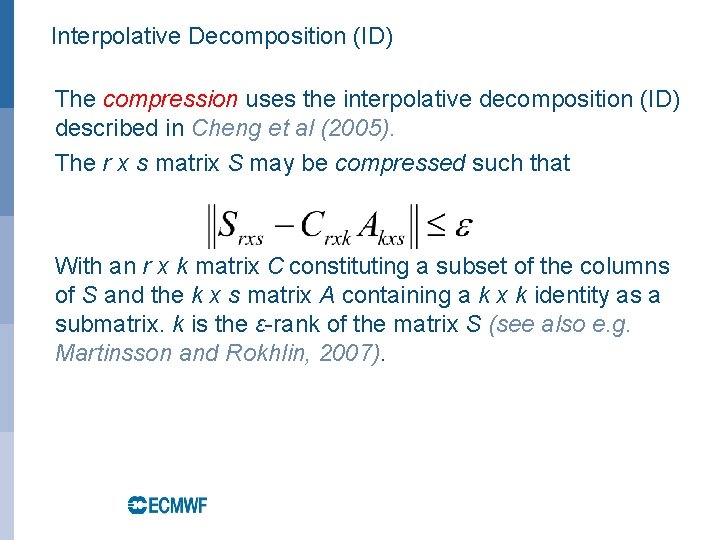
Interpolative Decomposition (ID) • The compression uses the interpolative decomposition (ID) described in Cheng et al (2005). • The r x s matrix S may be compressed such that With an r x k matrix C constituting a subset of the columns of S and the k x s matrix A containing a k x k identity as a submatrix. k is the ε-rank of the matrix S (see also e. g. Martinsson and Rokhlin, 2007).
The FLT in a nutshell – O(N 2 log 3 N) • Speed-up the sums of (matrix) products between associated Legendre polynomials at all Gaussian latitudes and the corresponding spectral coefficients of a field (e. g. temperature on given level) • The essence of the FLT: – Exploit similarities of associated Legendre polynomials at all (Gaussian) latitudes but different total wavenumber – Pre-compute (once, 0. 1% of the total cost of a 10 day forecast) a compressed (approximate) representation of the matrices (for each m) involved – Apply the compressed (reduced) representation at every time-step of the simulation. EUROPEAN CENTRE FOR MEDIUM-RANGE WEATHER FORECASTS October 29, 2014
Average wall-clock time compute cost of 107 spectral transforms scaled by N 2 log 3 N dgemm FLT 4. 5 4 3. 5 3 2. 5 2 1. 5 1 0. 5 0 799 1279 2047 3999 7999
Other ways of speeding up the computations • Accelerators – GPUs – Optical processors EUROPEAN CENTRE FOR MEDIUM-RANGE WEATHER FORECASTS October 29, 2014
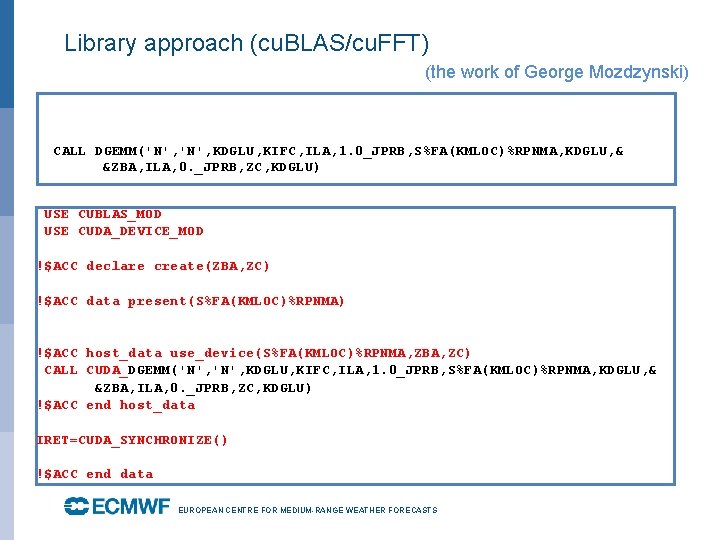
Library approach (cu. BLAS/cu. FFT) (the work of George Mozdzynski) CALL DGEMM('N', KDGLU, KIFC, ILA, 1. 0_JPRB, S%FA(KMLOC)%RPNMA, KDGLU, & &ZBA, ILA, 0. _JPRB, ZC, KDGLU) USE CUBLAS_MOD USE CUDA_DEVICE_MOD !$ACC declare create(ZBA, ZC) !$ACC data present(S%FA(KMLOC)%RPNMA) !$ACC host_data use_device(S%FA(KMLOC)%RPNMA, ZBA, ZC) CALL CUDA_DGEMM('N', KDGLU, KIFC, ILA, 1. 0_JPRB, S%FA(KMLOC)%RPNMA, KDGLU, & &ZBA, ILA, 0. _JPRB, ZC, KDGLU) !$ACC end host_data IRET=CUDA_SYNCHRONIZE() !$ACC end data EUROPEAN CENTRE FOR MEDIUM-RANGE WEATHER FORECASTS October 29, 2014
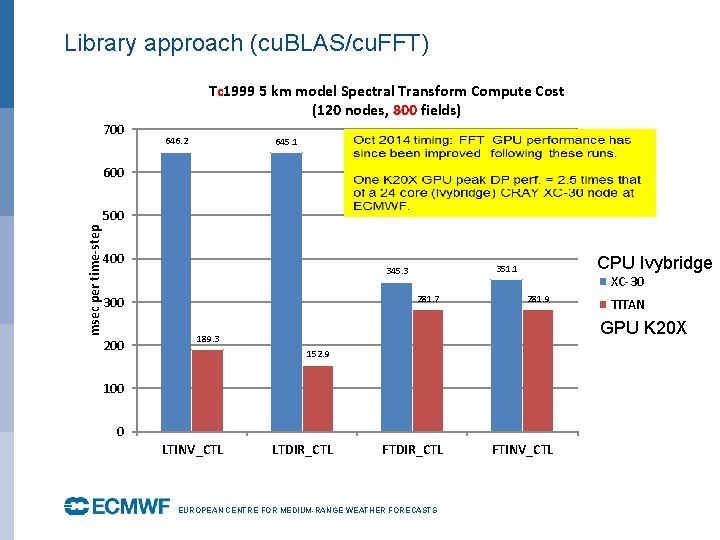
Library approach (cu. BLAS/cu. FFT) Tc 1999 5 km model Spectral Transform Compute Cost (120 nodes, 800 fields) 700 646. 2 645. 1 600 msec per time-step 500 400 281. 7 300 200 CPU Ivybridge 351. 1 345. 3 XC-30 281. 9 GPU K 20 X 189. 3 152. 9 100 0 LTINV_CTL TITAN LTDIR_CTL FTDIR_CTL EUROPEAN CENTRE FOR MEDIUM-RANGE WEATHER FORECASTS FTINV_CTL October 29, 2014
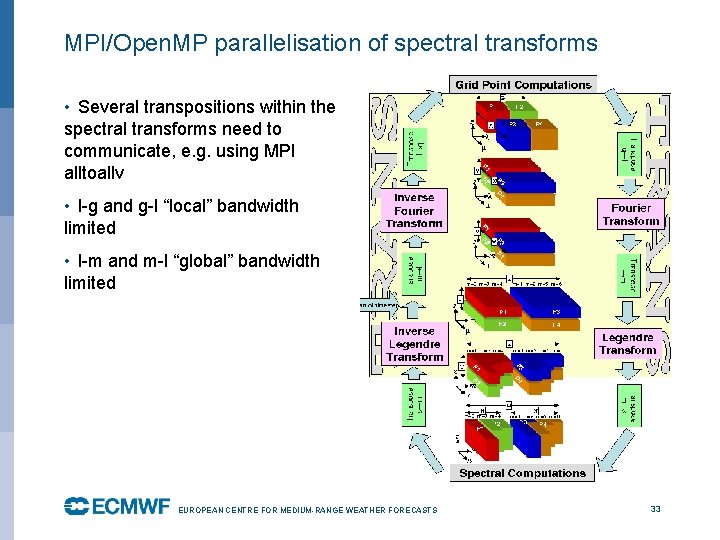
MPI/Open. MP parallelisation of spectral transforms • Several transpositions within the spectral transforms need to communicate, e. g. using MPI alltoallv • l-g and g-l “local” bandwidth limited • l-m and m-l “global” bandwidth limited EUROPEAN CENTRE FOR MEDIUM-RANGE WEATHER FORECASTS October 29, 2014 33
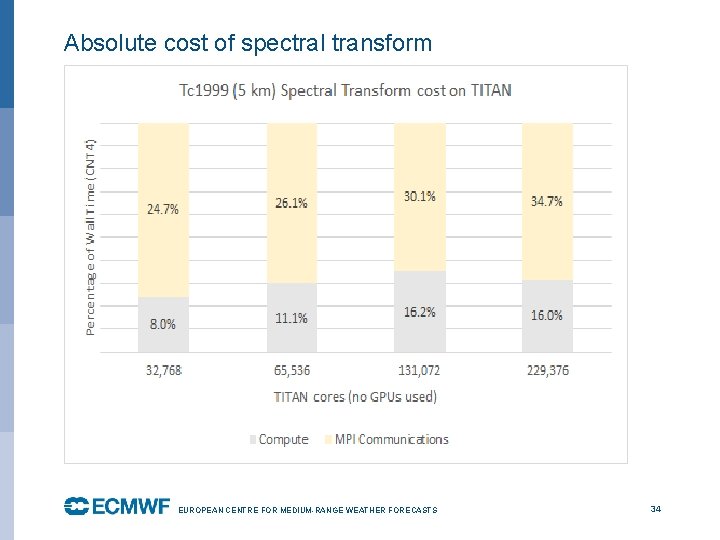
Absolute cost of spectral transform EUROPEAN CENTRE FOR MEDIUM-RANGE WEATHER FORECASTS October 29, 2014 34
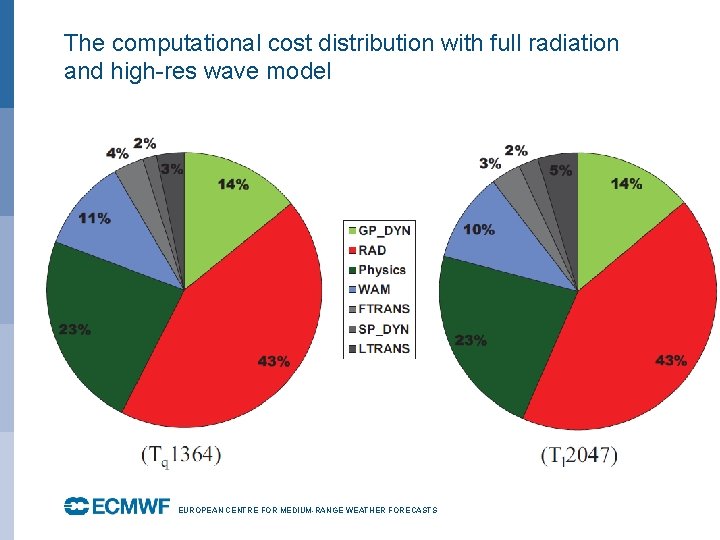
The computational cost distribution with full radiation and high-res wave model EUROPEAN CENTRE FOR MEDIUM-RANGE WEATHER FORECASTS October 29, 2014
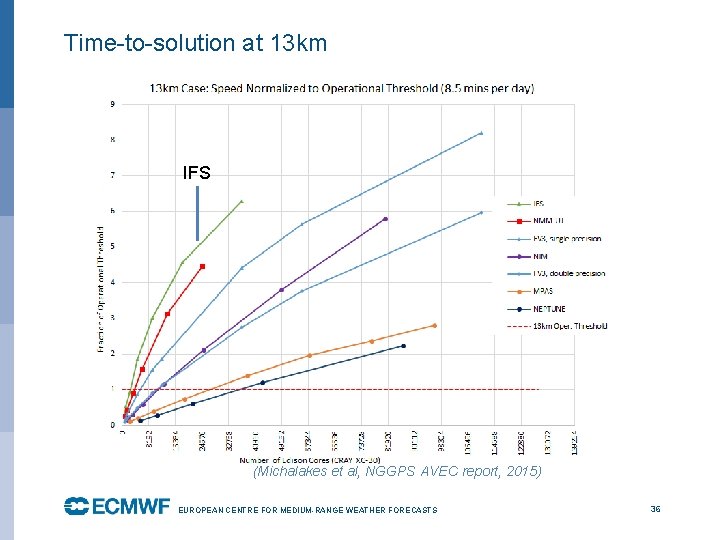
Time-to-solution at 13 km IFS (Michalakes et al, NGGPS AVEC report, 2015) EUROPEAN CENTRE FOR MEDIUM-RANGE WEATHER FORECASTS October 29, 2014 36
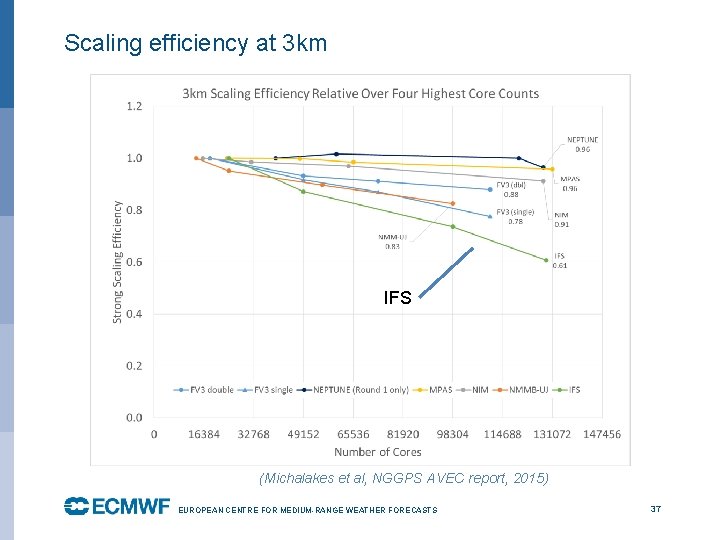
Scaling efficiency at 3 km IFS (Michalakes et al, NGGPS AVEC report, 2015) EUROPEAN CENTRE FOR MEDIUM-RANGE WEATHER FORECASTS October 29, 2014 37
Communication and HPC interconnect requirements • MPI communication performance is influenced by – Latency (1 -10 ms) – Bandwidth (e. g. measured by injection bandwidth per node) • In the past: fully connected networks of nodes (“fat-trees”, “crossbars”) were popular but too expensive as the number of nodes rises (i. e. too many cables) • Today hierarchical and managed networks are used, i. e. where the network topology matters and managing adaptively and dynamically the routing of messages through limited available connections(e. g. Aries network Cray XC 30/40 with Dragonfly topology) • In the future ? ? ? – Avoid communication. . . (let’s be clear, this is not an option for NWP!) – Use algorithms that reduce data movement, communication and synchronization (other lectures in this training course) – Notably the fastest wireless connection measured to date is 7 Gbyte/s … EUROPEAN CENTRE FOR MEDIUM-RANGE WEATHER FORECASTS October 29, 2014 38
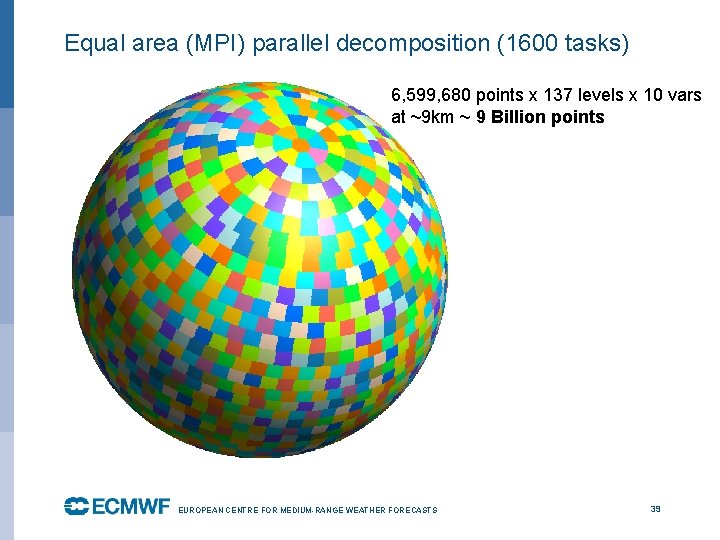
Equal area (MPI) parallel decomposition (1600 tasks) 6, 599, 680 points x 137 levels x 10 vars at ~9 km ~ 9 Billion points EUROPEAN CENTRE FOR MEDIUM-RANGE WEATHER FORECASTS October 29, 2014 39
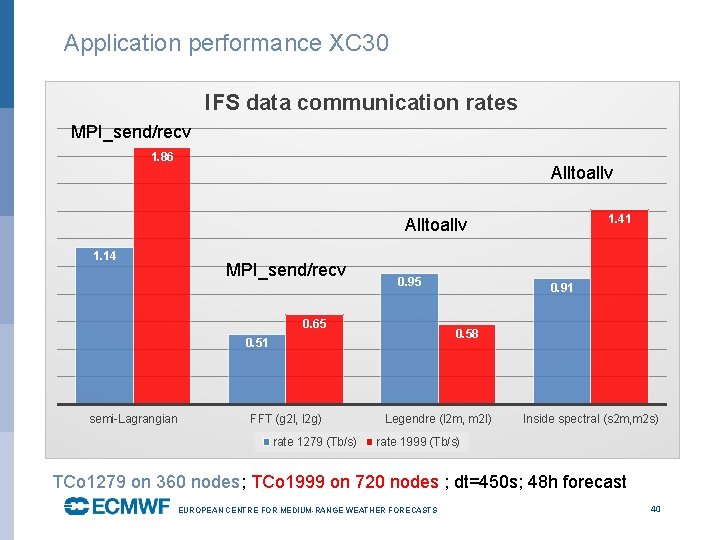
Application performance XC 30 IFS data communication rates MPI_send/recv 1. 86 Alltoallv 1. 41 Alltoallv 1. 14 MPI_send/recv 0. 95 0. 65 0. 58 0. 51 semi-Lagrangian FFT (g 2 l, l 2 g) rate 1279 (Tb/s) 0. 91 Legendre (l 2 m, m 2 l) Inside spectral (s 2 m, m 2 s) rate 1999 (Tb/s) TCo 1279 on 360 nodes; TCo 1999 on 720 nodes ; dt=450 s; 48 h forecast EUROPEAN CENTRE FOR MEDIUM-RANGE WEATHER FORECASTS October 29, 2014 40
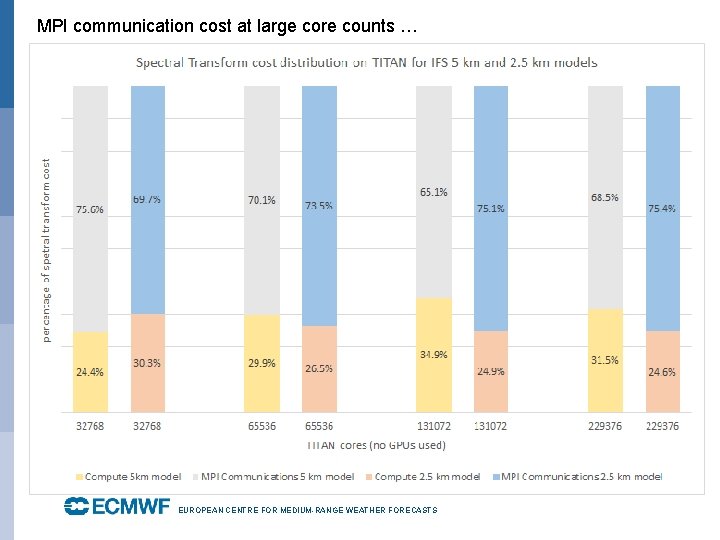
MPI communication cost at large core counts … EUROPEAN CENTRE FOR MEDIUM-RANGE WEATHER FORECASTS October 29, 2014
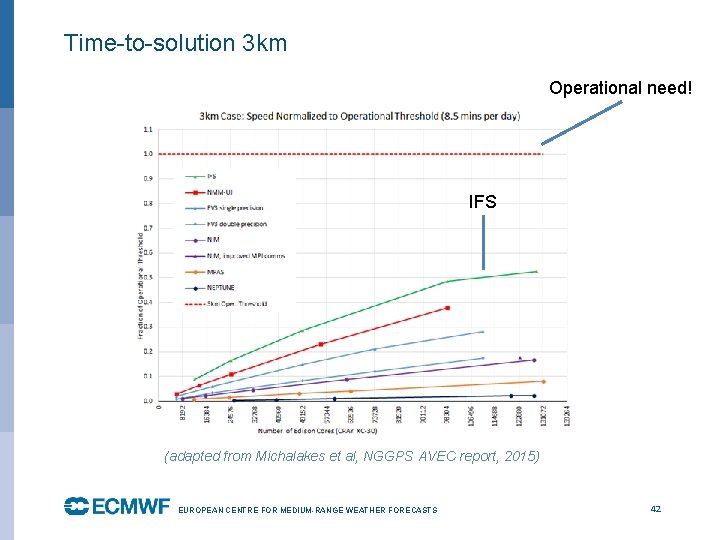
Time-to-solution 3 km Operational need! IFS (adapted from Michalakes et al, NGGPS AVEC report, 2015) EUROPEAN CENTRE FOR MEDIUM-RANGE WEATHER FORECASTS October 29, 2014 42
- Slides: 42