
The Spectra of Solid Xenon Luminescence Excited by
The Spectra of Solid Xenon Luminescence Excited by the Bulk Electrical Discharge E. B. Gordon, Institute of Problems of Chemical Physics RAS, Chernogolovka 142432, Russia, gordon@ficp. ac. ru V. I. Matyushenko, V. D. Sizov Institute of Energy Problems of Chemical Physics RAS Chernogolovka 142432, Russia, Ohio, Columbus, June 23, 2009
The goal of this study is to use the electrical discharge in a solid to reveal the nature of excitons and polarons as the electrical discharge in a gas is commonly used to study the excitations of separate molecules, radicals and ions
The common scheme of electrical discharge • primary electrons • their acceleration in electric field • their multiplication by ionization in electron avalanche • positive feedback (primary electrons restoration) The bulk electrical discharge is known to be impossible in liquid and solid Why?
The electrical discharge in condensed xenon • primary electrons exist • their acceleration in electric field in spite of formally low E/P ratio the electron drift in solid Xe is similar to that in Xe gas at pressure lower than 100 mbar (electron analog of Huygens principle for light) exists
The electrical discharge in condensed xenon • primary electrons exist • their acceleration in electric field in spite of formally low E/P ratio the electron drift in solid Xe is similar to that in Xe gas at pressure lower than 100 mbar (electron analog of Huygens principle for light) exists • their multiplication by ionization in electron avalanche no ionization, only electronic excitation • positive feedback (primary electrons restoration) cathode sensitive to the exciton emission
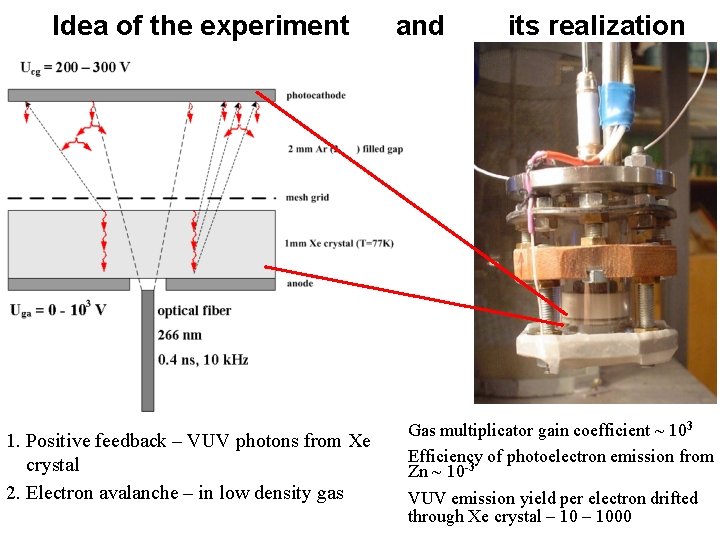
Idea of the experiment 1. Positive feedback – VUV photons from Xe crystal 2. Electron avalanche – in low density gas and its realization Gas multiplicator gain coefficient ~ 103 Efficiency of photoelectron emission from Zn ~ 10 -3 VUV emission yield per electron drifted through Xe crystal – 1000
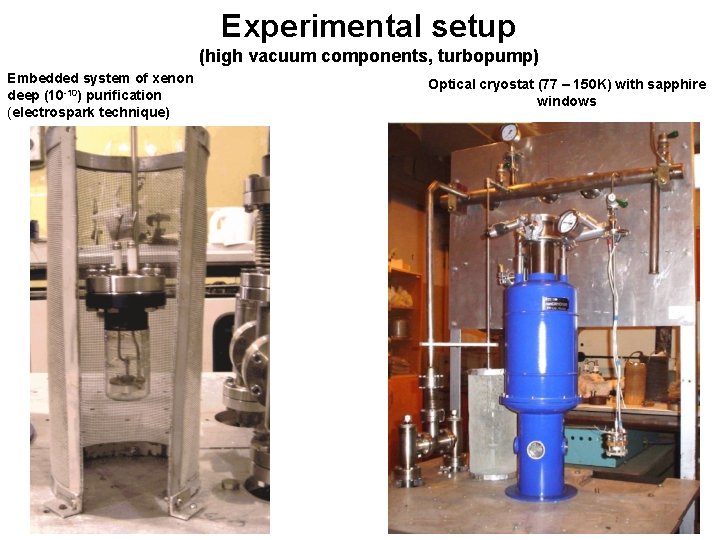
Experimental setup (high vacuum components, turbopump) Embedded system of xenon deep (10 -10) purification (electrospark technique) Optical cryostat (77 – 150 K) with sapphire windows
Two regimes of solid state discharge take place • Normal, limited by space charge of impurities gradually filled by drifting electrons. • Powerful, when the process of electron traps depopulation by drifting electrons keeps the space charge low enough (it can be achieved only by pre-ionization).
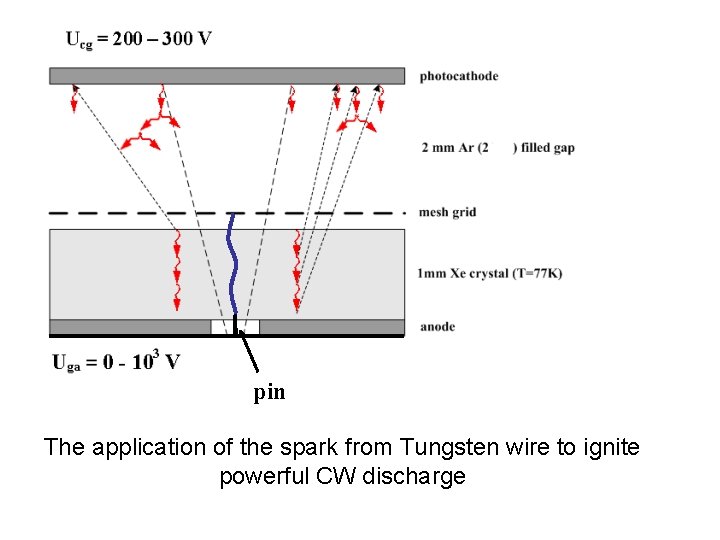
pin The application of the spark from Tungsten wire to ignite powerful CW discharge
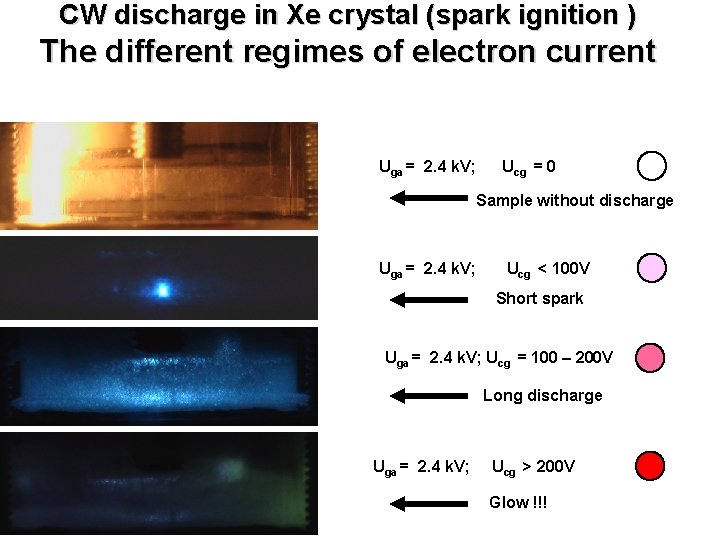
CW discharge in Xe crystal (spark ignition ) The different regimes of electron current Uga = 2. 4 k. V; Ucg = 0 Sample without discharge Uga = 2. 4 k. V; Ucg < 100 V Short spark Uga = 2. 4 k. V; Ucg = 100 – 200 V Long discharge Uga = 2. 4 k. V; Ucg > 200 V Glow !!!
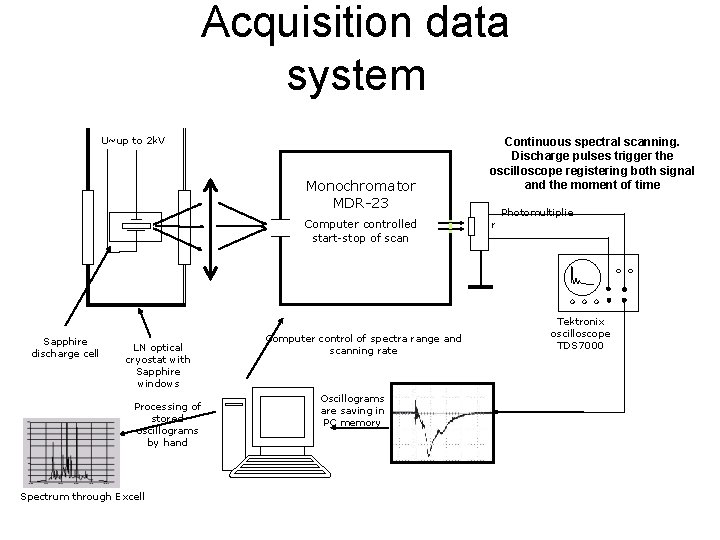
Acquisition data system U~up to 2 k. V Monochromator MDR-23 Computer controlled start-stop of scan Sapphire discharge cell LN optical cryostat with Sapphire windows Processing of stored oscillograms by hand Spectrum through Excell Computer control of spectra range and scanning rate Oscillograms are saving in PC memory Continuous spectral scanning. Discharge pulses trigger the oscilloscope registering both signal and the moment of time r Photomultiplie Tektronix oscilloscope TDS 7000
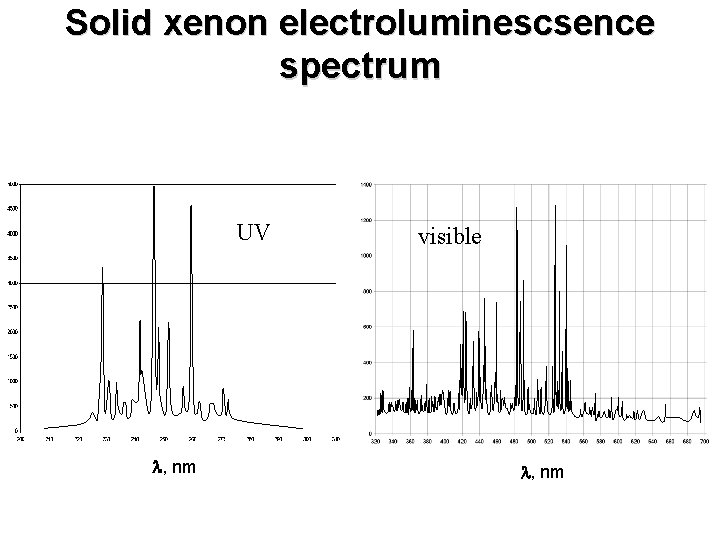
Solid xenon electroluminescsence spectrum UV , nm visible , nm
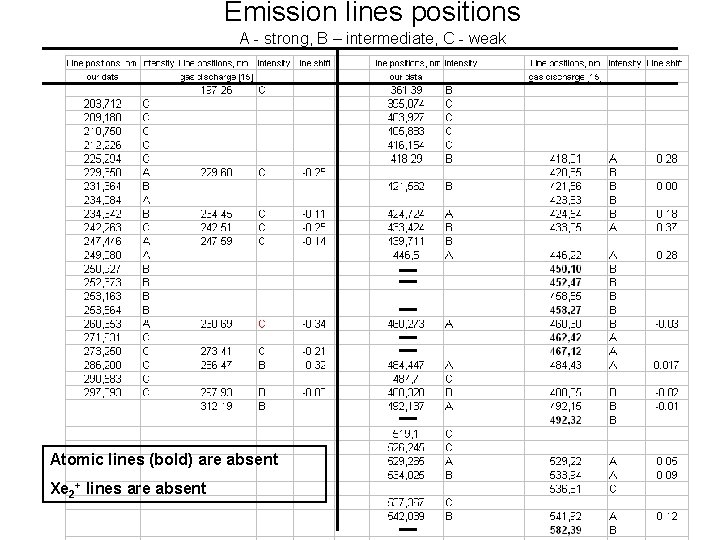
Emission lines positions A - strong, B – intermediate, C - weak Atomic lines (bold) are absent Xe 2+ lines are absent
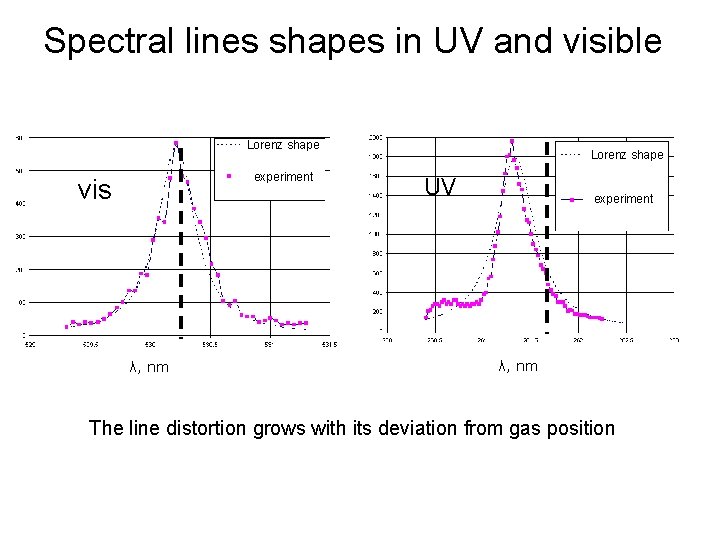
Spectral lines shapes in UV and visible Lorenz shape experiment I, arb. units vis λ, nm Lorenz shape UV experiment λ, nm The line distortion grows with its deviation from gas position
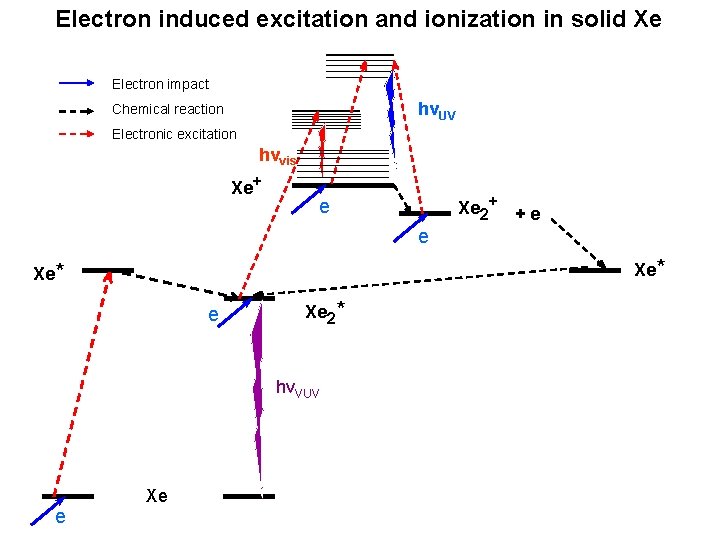
Electron induced excitation and ionization in solid Xe Electron impact hνUV Chemical reaction Electronic excitation hνvis Xe+ Xe 2+ + e e e Xe* e Xe 2* hνVUV e Xe
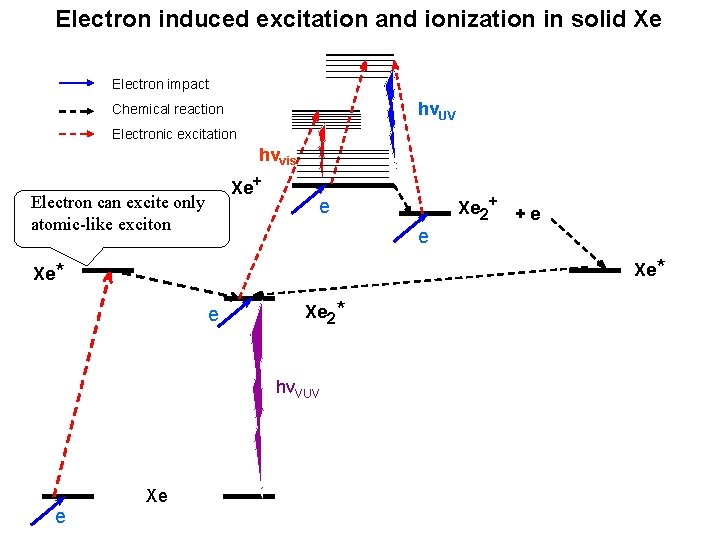
Electron induced excitation and ionization in solid Xe Electron impact hνUV Chemical reaction Electronic excitation hνvis Xe+ Electron can excite only atomic-like exciton e Xe* e Xe 2* hνVUV e Xe 2+ + e e Xe
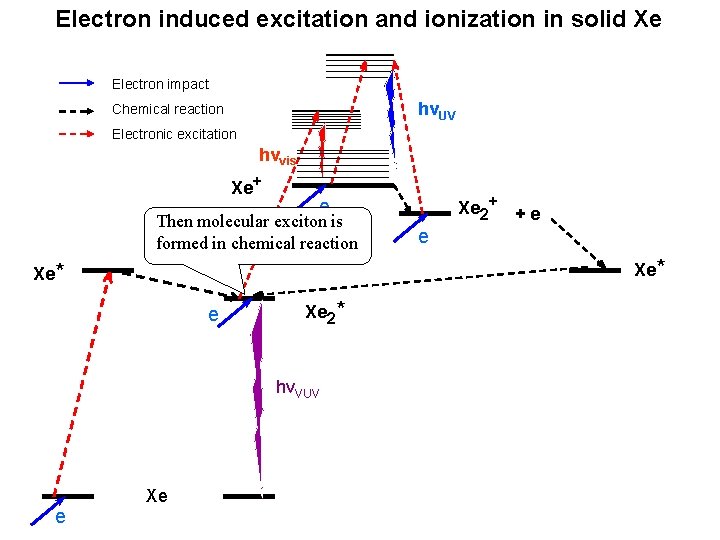
Electron induced excitation and ionization in solid Xe Electron impact hνUV Chemical reaction Electronic excitation hνvis Xe+ Then molecular exciton is formed in chemical reaction e Xe* e Xe 2* hνVUV e Xe 2+ + e e Xe
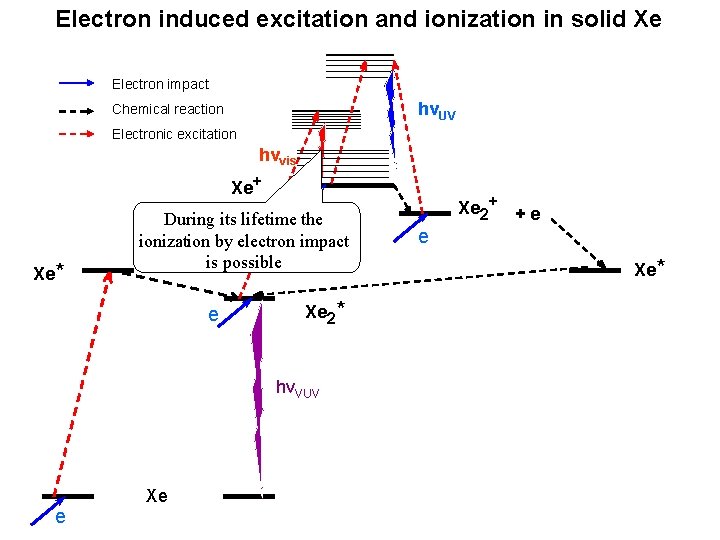
Electron induced excitation and ionization in solid Xe Electron impact hνUV Chemical reaction Electronic excitation hνvis Xe+ Xe* During its lifetime the ionization by electron impact is possible e Xe 2* hνVUV e Xe Xe 2+ + e e e Xe*
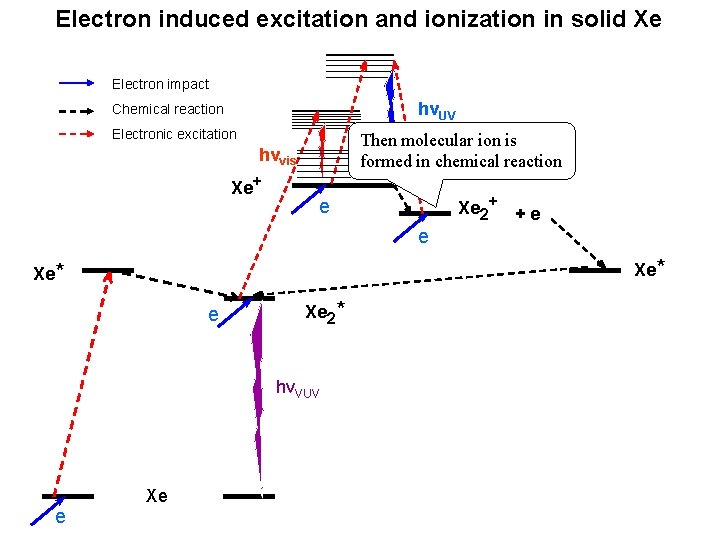
Electron induced excitation and ionization in solid Xe Electron impact hνUV Chemical reaction Electronic excitation Then molecular ion is formed in chemical reaction hνvis Xe+ Xe 2+ + e e e Xe* e Xe 2* hνVUV e Xe
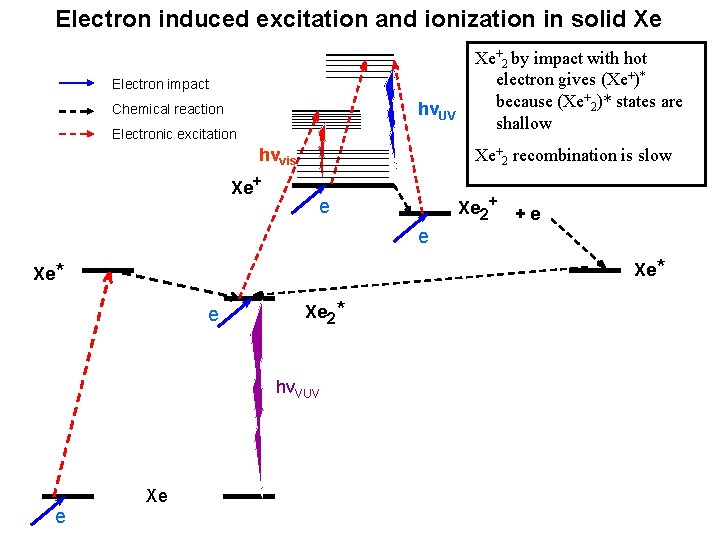
Electron induced excitation and ionization in solid Xe Electron impact hνUV Chemical reaction Electronic excitation hνvis Xe+2 by impact with hot electron gives (Xe+)* because (Xe+2)* states are shallow Xe+2 recombination is slow Xe 2+ + e e e Xe* e Xe 2* hνVUV e Xe
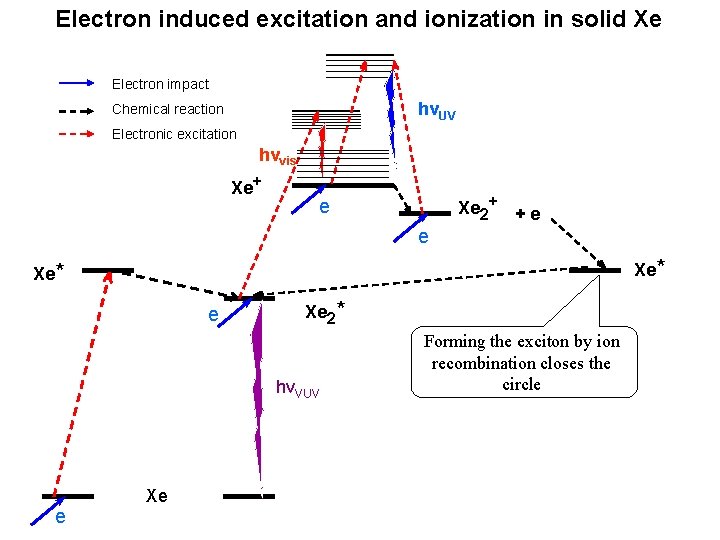
Electron induced excitation and ionization in solid Xe Electron impact hνUV Chemical reaction Electronic excitation hνvis Xe+ Xe 2+ + e e e Xe* e Xe 2* hνVUV e Xe Forming the exciton by ion recombination closes the circle
Conclusion • No atomic emission lines in solid Xe • Many Xe+ emission lines close to their gas positions • No Xe+2 emission lines • The scheme of electron induced excitation and ionization in solid Xe has been proposed
1. E. B. Gordon, V. V. Khmelenko, and O. S. Rzhevsky. Quantum Electronics 21, 227 (1994). 2. E. B. Gordon, V. V. Khmelenko, and O. S. Rzhevsky, Chem. Phys. Lett. 217, 605 (1994). 3. E. B. Gordon, G. Frossati and A. Usenko, J. Exp. Theor. Phys. , , 96, 846 (2003). 4. A. Usenko, G. Frossati and E. B. Gordon, Phys. Rev. Lett. , 90, 1532017 (2003). 5. E. B. Gordon and A. F. Shestakov, Low Temp. Phys. , 27, 883, (2001). 6. E. B. Gordon and B. M. Smirnov, J. Exp. Theor. Phys. 98, 924 (2004). 7. E. B. Gordon and B. M. Smirnov, J. Exp. Theor. Phys. , 101, 186 (2005). 8. E. B. Gordon and B. M. Smirnov, J. Exp. Theor. Phys. , 107, 274 (2008). 9. E. B. Gordon, V. I. Matyushenko, V. D. Sizov and B. M. Smirnov, LTP , 34, 1203 (2008) 10. E. B. Gordon, V. I. Matyushenko, V. D. Sizov and V. M. Fomin, Optics and Spectroscopy, 34, 786 (2009).
- Slides: 23