
The Special Education Process Presented by Doreen Babis
The Special Education Process Presented by Doreen Babis, Supervisor of Special Services and Judith Koebli, Speech Language Pathologist
Child Find Every Local Education Agency (LEA) has an obligation to establish procedures to ensure that all children with disabilities are properly identified and evaluated to determine whether they are entitled to receive special education services.
Preschool Eligibility for Special Education • • 3 -5 year olds with an identified disabling condition adversely affecting learning/development AND must establish relevant impact and need for special education Developmental delay of 33% in one developmental area Or 25% delay in two developmental areas • Intellectual • Communication • Social/emotional • Adaptive • Physical • Gross/fine motor Sensory (vision/hearing)
Pre-K Eligibility • Child must demonstrate a need for special education • Curricular modifications • Specialized instructional strategies • Supplementary aids (www. nj. gov/education) • Not just a need for a related service • Speech therapy • Occupational therapy • Physical therapy
Prereferral • Intervention and Referral Services • Request for assistance • Collect information • Notify parents • Problem solve • Action plan • Support and evaluate • Problem resolved or referral to CST
Referral First step in special education process • Written request from parent, teacher, principal, or guidance counselor • CST conducts a planning meeting within 20 days of referral
Primary Purposes of Evaluations • To determine if the student is a child with a disability as defined in section 1401(3) of the IDEA, and • To determine the educational needs of the child
Identification Initial Planning/Identification meeting • CST members, parents, teachers • Speech Only? • Are assessments warranted? Suspected disability? • Parental consent required • 90 day timeline
Who Attends the Meeting? • Parent • Case Manager • Social Worker • School Psychologist • Learning Consultant • Student (optional) • General Education Teacher (classroom teacher) • Special Education Teacher (if warranted) • Related Service members (if warranted) • Others
Eligibility Does the disablity adversely affect the student’s educational performance and does it require special education and related services? Classifications • Auditory impairment Specific Learning Disability • Autistic Traumatic Brain Injury • Intellectually disabled • Communication impaired Social maladjustment Other Health Impaired • Emotionally disturbed Orthopedically Impaired • Multiply disabled Deaf/Blindness
Specific Learning Disability Must be a discrepancy between ability and achievement in one or more of these areas: • • Basic Reading Skills Comprehension Oral Expression Listening Comprehension Mathematical Calculations Problem Solving Written Expression Reading Fluency
School Age Eligibility Criteria for Speech Tx. • Articulation • Delayed based upon Iowa-Nebraska norms • Norms state at what age 90% of the population have master a specific phoneme • Fluency • • Dysfluent 5% of the time or more Voice • Need script from an ENT
Negative Impact upon Education • Speech pattern is influencing spelling • Student writes how they speak • Intelligibility is reduced • Adults and peers can not understand the student’s speech • Student avoids speaking in class • Won’t raise hand/volunteer • Apprehensive or refuses to speak in front of peers • Speech pattern negatively impact social interactions. • Peers have difficulty understanding student • Peers do not interact with student in a positive way.
Eligibility based upon Language Skills • Student scores 1. 5 standard deviations below the mean on two standardized language tests. • One of the two language tests must look at both receptive and expressive language skills • The second test is usually focused upon a specific language weakness the child demonstrates. • Negative impact on education • Poor grammar impacts on students ability to write clearly and/or correctly • Student has difficulty expressing his thoughts in a cohesive and/or grammatically correct way • Student avoids participating in class discussions, or answering questions
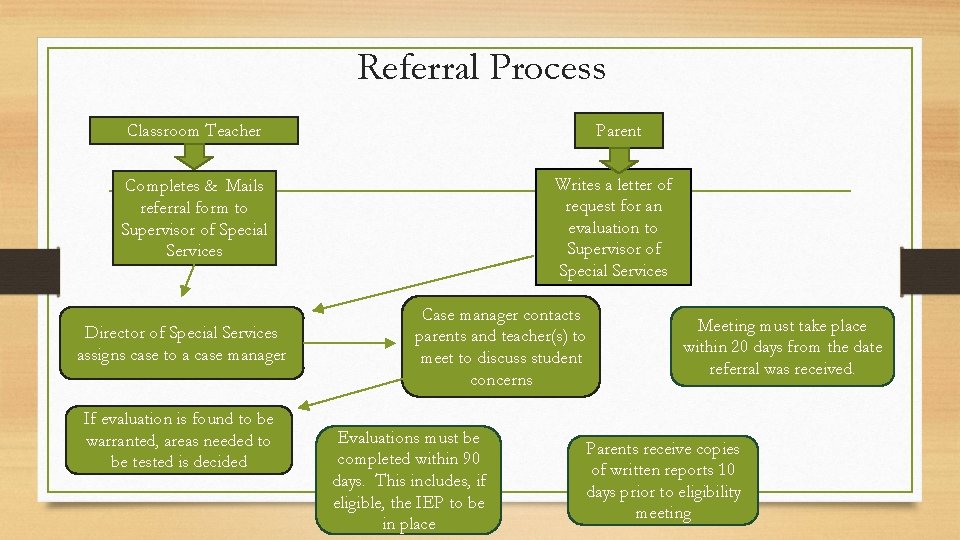
Referral Process Parent Classroom Teacher Writes a letter of request for an evaluation to Supervisor of Special Services Completes & Mails referral form to Supervisor of Special Services Director of Special Services assigns case to a case manager If evaluation is found to be warranted, areas needed to be tested is decided Case manager contacts parents and teacher(s) to meet to discuss student concerns Evaluations must be completed within 90 days. This includes, if eligible, the IEP to be in place Meeting must take place within 20 days from the date referral was received. Parents receive copies of written reports 10 days prior to eligibility meeting
INDIVIDUALIZED EDUCATION PROGRAM (IEP) • The IEP is a written plan that describes in detail the student’s special education program. • The IEP is implemented for one year at which point an annual review of the IEP is conducted. • A reevaluation to determine eligibility for special education and related services occurs every 3 years.
Parental Rights • PRISE • Mediation Due Process
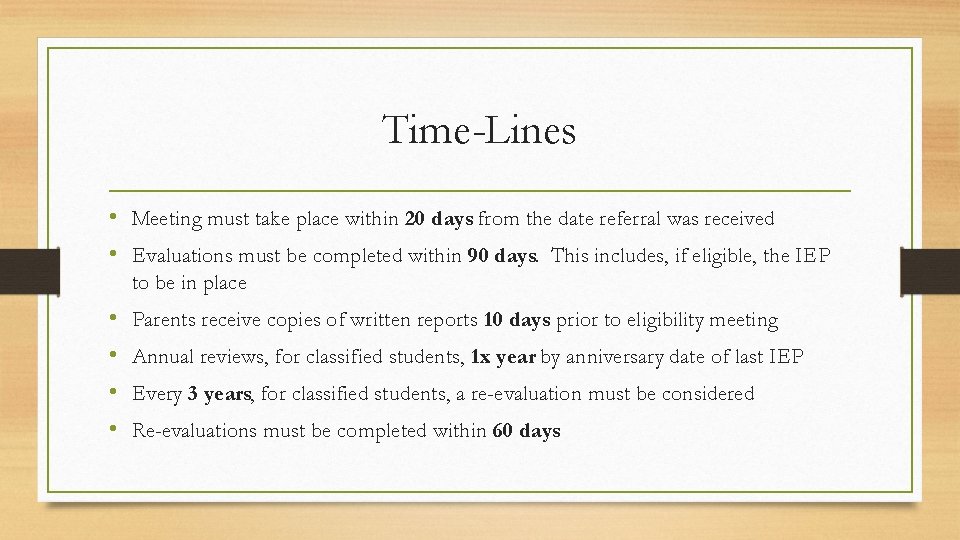
Time-Lines • Meeting must take place within 20 days from the date referral was received • Evaluations must be completed within 90 days. This includes, if eligible, the IEP to be in place • • Parents receive copies of written reports 10 days prior to eligibility meeting Annual reviews, for classified students, 1 x year by anniversary date of last IEP Every 3 years, for classified students, a re-evaluation must be considered Re-evaluations must be completed within 60 days
Frequently Asked Questions • What are the guidelines for how a disorder (or diagnosis) impacts education? • What if it is not impacting education? • Do they not get picked up for services then?
Articulation and Language Concerns? • For a child referred for articulation issues and during their planning meeting or evaluation, teachers state that there are learning/language issues, can the SLP test for language at that time, or does there need to be a referral to the Child Study Team for an evaluation?
Answer To the team. Whenever there are language concerns a referral must go to the entire CST. The philosophy is that if there are language concerns, then other areas of learning may be affected. SLP may not test language independent of the team.
When is Parental consent required? • Prior to conducting any assessment as part of an initial evaluation
When is Parental consent required? • Prior to conducting any assessment as part of an initial evaluation • Prior to implementation of the initial IEP resulting from above
When is Parental consent required? • Prior to conducting any assessment as part of an initial evaluation • Prior to implementation of the initial IEP resulting from above • Prior to conducting any assessment as part of a re-evaluation, except if the BOE can demonstrate that it had taken reasonable measures to obtain consent and the parent failed to respond • Prior to the release of student records according to NJAC 6: 3 -6. section 6 A: 14 -2. 3(a)
What can the district do if the parent Refuses to give consent? • If a parent refuses to provide consent for an initial evaluation, the district can request a due process hearing according to NJAC. 6 A: 14 -2. 7(b) • If a parent refuses to consent to implement an initial IEP, the district may not request a due process hearing. 6 A: 14 -2. 3(b)
What are the considerations for placement in the Least Restrictive Environment? • Whether the student can be educated satisfactorily in a regular classroom with supplementary aids and services; • A comparison of the benefits provided in a regular class and the benefits provided in a special education class; • The potentially beneficial or harmful effects which a placement may have on the student with disabilities or the other students in the class. section 6 A: 144. 2(a)8
Thank You ?
- Slides: 27