
THE SPANISHAMERICAN WAR CHAPTER 5 LESSON 2 Causes
- Slides: 10
THE SPANISH-AMERICAN WAR CHAPTER 5 LESSON 2
Causes of the War Economic Interests American entrepreneurs had invested $50 million in sugar cane plantations and other ventures in Cuba (Growing Market/Unstable). Cuban patriot Jose Marti launched a war for independence from Spain. � Guerrilla Tactics: Hit and Run Raids � Attacked U. S. plantations in order to get America involved Spanish General Valeriano Weyler: sent thousands of Cubans to concentration camps � Ten of thousand died from starvation/disease.
�Yellow Press: Newspapers Causes of the War Yellow Press that used sensational headlines and exaggerated stories in order to promote readership. Joseph Pulitzer – New York World William Randolph Hearst – New York Journal Told about Spanish atrocities and compared Cuban rebels to the patriots of the American Revolution.
�De Lome Letter Causes of the War Failure of Diplomacy Enrique Dupuy de Lome, Spain’s ambassador to Washington, D. C. wrote a letter that was stolen by Cuban rebels. Letter called President Mc. Kinley a weak and stupid politician. Hearst published the letter in the Journal – “worst insult in American history” �*USS Maine - exploded in Havana harbor (266). America blamed Spain. The Teller Amendment – Prior to war, the U. S. promised it could not take possession of Cuba “Remember the Maine and to hell with Spain!” Congress declares war – April 19, 1898
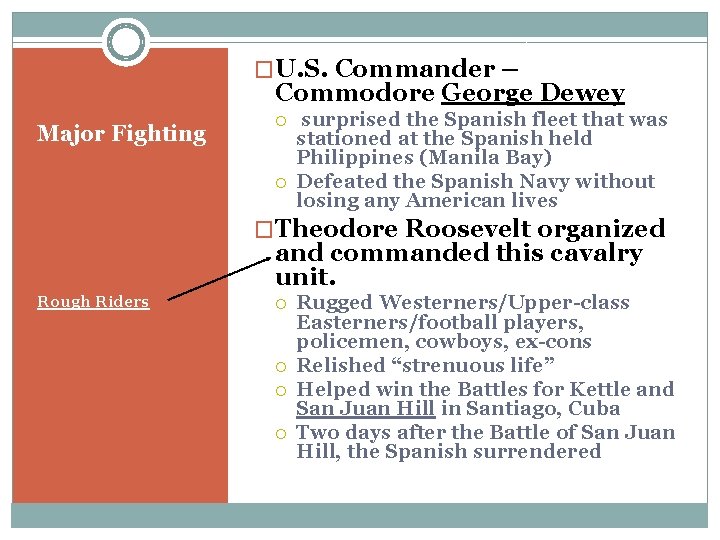
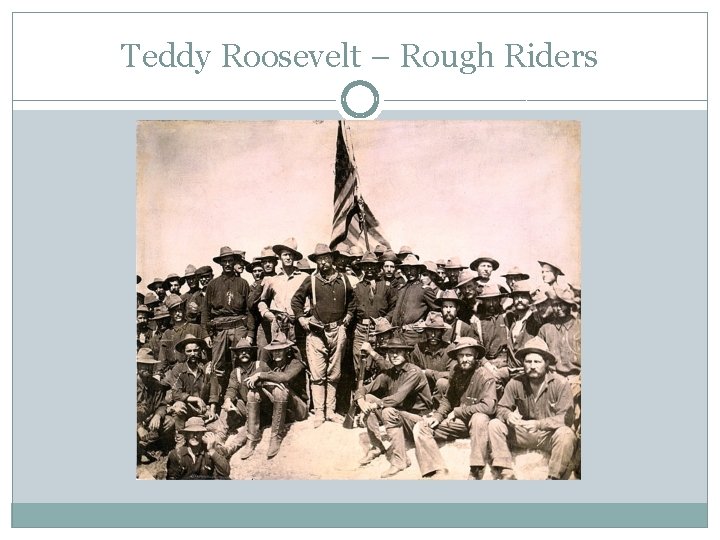
�U. S. Commander – Commodore George Dewey Major Fighting surprised the Spanish fleet that was stationed at the Spanish held Philippines (Manila Bay) Defeated the Spanish Navy without losing any American lives �Theodore Roosevelt organized and commanded this cavalry unit. Rough Riders Rugged Westerners/Upper-class Easterners/football players, policemen, cowboys, ex-cons Relished “strenuous life” Helped win the Battles for Kettle and San Juan Hill in Santiago, Cuba Two days after the Battle of San Juan Hill, the Spanish surrendered
Teddy Roosevelt – Rough Riders
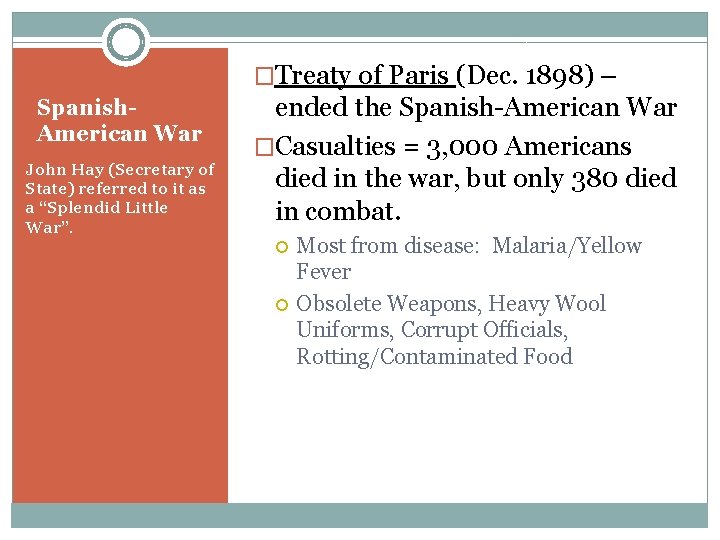
�Treaty of Paris (Dec. 1898) – Spanish. American War John Hay (Secretary of State) referred to it as a “Splendid Little War”. ended the Spanish-American War �Casualties = 3, 000 Americans died in the war, but only 380 died in combat. Most from disease: Malaria/Yellow Fever Obsolete Weapons, Heavy Wool Uniforms, Corrupt Officials, Rotting/Contaminated Food
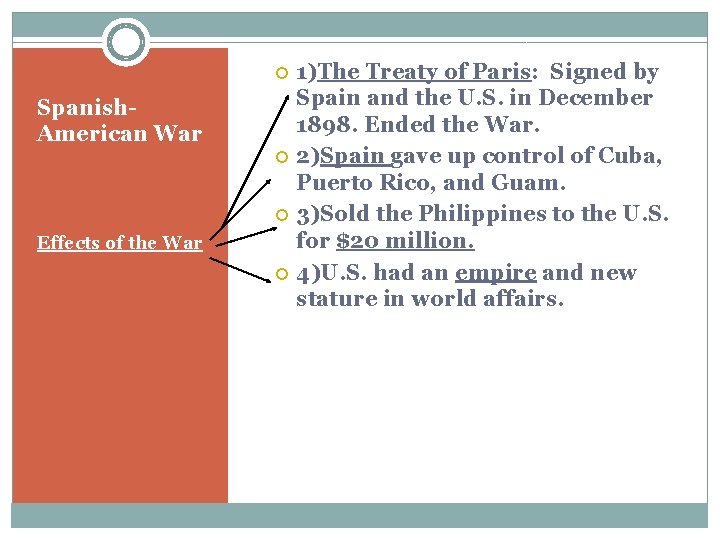
Spanish. American War Effects of the War 1)The Treaty of Paris: Signed by Spain and the U. S. in December 1898. Ended the War. 2)Spain gave up control of Cuba, Puerto Rico, and Guam. 3)Sold the Philippines to the U. S. for $20 million. 4)U. S. had an empire and new stature in world affairs.
Americans Debate Imperialism �Cuba The Platt Amendment Established Cuba as a U. S. protectorate – heavy U. S. influence in Cuba �The Philippines Purchased from Spain for $20 million Mc. Kinley said U. S. should rule – educate and civilize Filipinos If U. S. were to give up Philippines, other European Nations would control Access to trade in China �Anti-Imperialists League: “open disloyalty to the distinctive principles of our government” William Jennings Bryan/Mark Twain
Writing Response �Answer the following questions in paragraph form 1) What were the short and long term causes of the Spanish. American War? 2) Why was the Spanish-American War referred to as a “Splendid Little War? ” 3) How did the U. S. expand its role in world affairs with its victory in the Spanish-American War?