
The Spanish American War By Annie Jacobs Bell
The Spanish American War By : Annie Jacobs Bell : 7
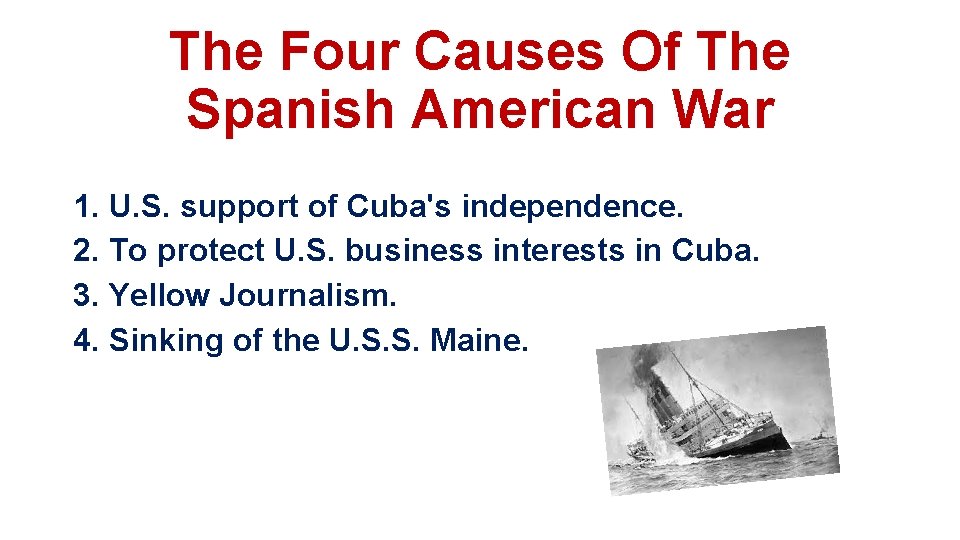
The Four Causes Of The Spanish American War 1. U. S. support of Cuba's independence. 2. To protect U. S. business interests in Cuba. 3. Yellow Journalism. 4. Sinking of the U. S. S. Maine.
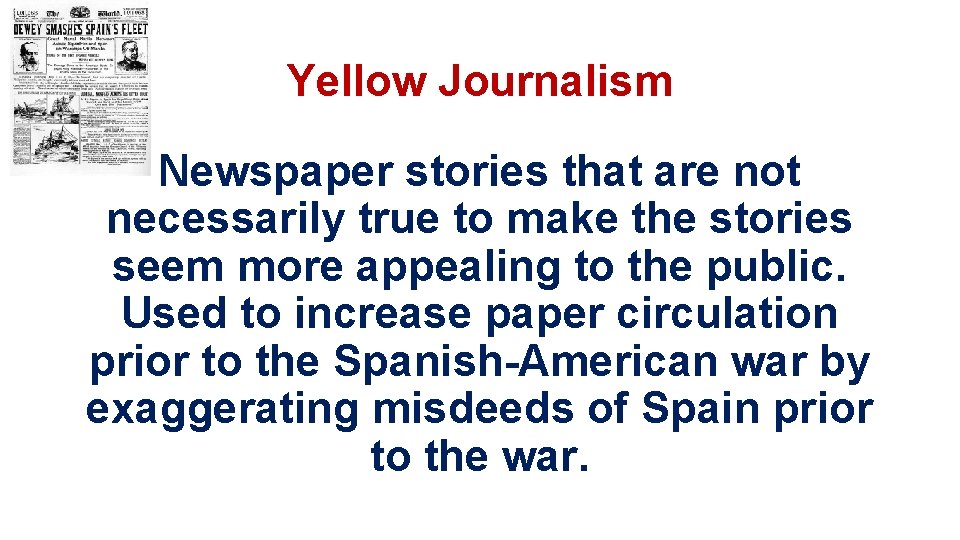
Yellow Journalism Newspaper stories that are not necessarily true to make the stories seem more appealing to the public. Used to increase paper circulation prior to the Spanish-American war by exaggerating misdeeds of Spain prior to the war.
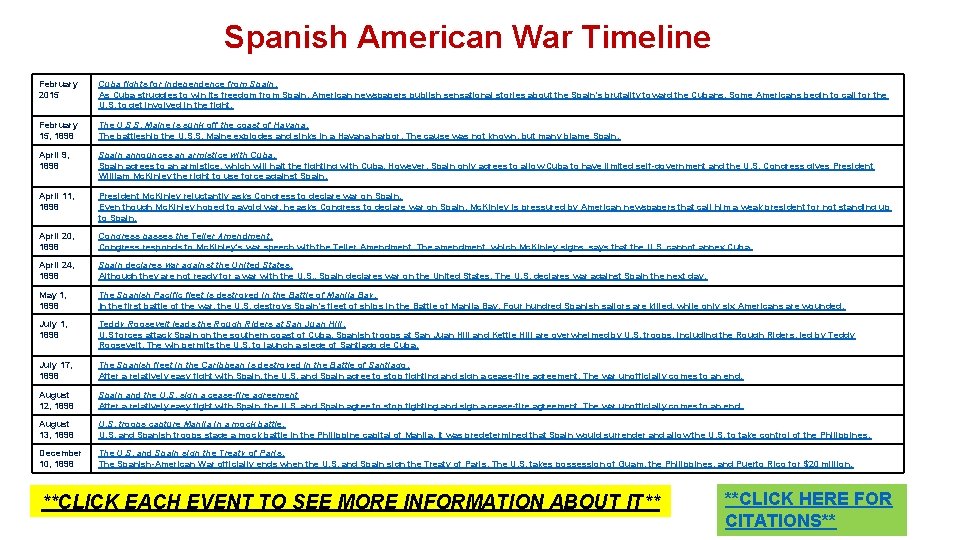
Spanish American War Timeline February 2015 Cuba fights for independence from Spain. As Cuba struggles to win its freedom from Spain, American newspapers publish sensational stories about the Spain's brutality toward the Cubans. Some Americans begin to call for the U. S. to get involved in the fight. February 15, 1898 The U. S. S. Maine is sunk off the coast of Havana. The battleship the U. S. S. Maine explodes and sinks in a Havana harbor. The cause was not known, but many blame Spain. April 9, 1898 Spain announces an armistice with Cuba. Spain agrees to an armistice, which will halt the fighting with Cuba. However, Spain only agrees to allow Cuba to have limited self-government and the U. S. Congress gives President William Mc. Kinley the right to use force against Spain. April 11, 1898 President Mc. Kinley reluctantly asks Congress to declare war on Spain. Even though Mc. Kinley hoped to avoid war, he asks Congress to declare war on Spain. Mc. Kinley is pressured by American newspapers that call him a weak president for not standing up to Spain. April 20, 1898 Congress passes the Teller Amendment. Congress responds to Mc. Kinley's war speech with the Teller Amendment. The amendment, which Mc. Kinley signs, says that the U. S. cannot annex Cuba. April 24, 1898 Spain declares war against the United States. Although they are not ready for a war with the U. S. , Spain declares war on the United States. The U. S. declares war against Spain the next day. May 1, 1898 The Spanish Pacific fleet is destroyed in the Battle of Manila Bay. In the first battle of the war, the U. S. destroys Spain's fleet of ships in the Battle of Manila Bay. Four hundred Spanish sailors are killed, while only six Americans are wounded. July 1, 1898 Teddy Roosevelt leads the Rough Riders at San Juan Hill. U. S forces attack Spain on the southern coast of Cuba. Spanish troops at San Juan Hill and Kettle Hill are overwhelmed by U. S. troops, including the Rough Riders, led by Teddy Roosevelt. The win permits the U. S. to launch a siege of Santiago de Cuba. July 17, 1898 The Spanish fleet in the Caribbean is destroyed in the Battle of Santiago. After a relatively easy fight with Spain, the U. S. and Spain agree to stop fighting and sign a cease-fire agreement. The war unofficially comes to an end. August 12, 1898 Spain and the U. S. sign a cease-fire agreement After a relatively easy fight with Spain, the U. S. and Spain agree to stop fighting and sign a cease-fire agreement. The war unofficially comes to an end. August 13, 1898 U. S. troops capture Manila in a mock battle. U. S. and Spanish troops stage a mock battle in the Philippine capital of Manila. It was predetermined that Spain would surrender and allow the U. S. to take control of the Philippines. December 10, 1898 The U. S. and Spain sign the Treaty of Paris. The Spanish-American War officially ends when the U. S. and Spain sign the Treaty of Paris. The U. S. takes possession of Guam, the Philippines, and Puerto Rico for $20 million. **CLICK EACH EVENT TO SEE MORE INFORMATION ABOUT IT** **CLICK HERE FOR CITATIONS**
Cuba's Independence From Spain The dream of Cuban independence had existed for over onehundred years before the final war for independence from Spain began in February 1895. By 1825, most of Spain's colonies in the new world had achieved their independence, and only Cuba and Puerto Rico remained. Reacting to the prospect of a united Mexican. Colombian military expedition to help liberate Puerto Rico and Cuba in 1824, the U. S. government (with the backing of England) issued a series of threatening notes to Mexico and Colombia, declaring that the U. S. would "not remain indifferent" to the freeing of Cuba. Back
The U. S. S. Maine is sunk off the coast of Havana. On February 15, 1898 a massive explosion of unknown origin sinks the battleship USS Maine in Cuba’s Havana harbor, killing 260 of the fewer than 400 American crew members aboard. Back
Spain announces an armistice with Cuba. On April 8, 1898 Spain agrees to an armistice, which will halt the fighting with Cuba. However, Spain only agrees to allow Cuba to have limited self-government and the U. S. Congress gives President William Mc. Kinley the right to use force against Spain. Back
President Mc. Kinley reluctantly asks Congress to declare war on Spain. On April 20, 1898 President William Mc. Kinley asks Congress to declare war on Spain. Mc. Kinley originally tried to avoid an armed conflict with Spain, but the American media, led by newspaper baron Randolph Hearst, lambasted Mc. Kinley as weak and whipped up popular sentiment for a war to give Cubans their independence. Back
Congress passes the Teller Amendment. In April 1898 Senator Henry M. Teller (Colorado) proposed an amendment to the U. S. declaration of war against Spain which proclaimed that the United States would not establish permanent control over Cuba. It stated that the United States "hereby disclaims any disposition of intention to exercise sovereignty, jurisdiction, or control over said island except for pacification thereof, and asserts its determination, when that is accomplished, to leave the government and control of the island to its people. " The Senate passed the amendment on April 19. True to the letter of the Teller Amendment, after Spanish troops left the island in 1898, the United States occupied Cuba until 1902. The Teller Amendment was succeeded by the Platt Amendment introduced by Senator Orville Platt (R-Connecticut) in February 1901. It allowed the United States "the right to intervene for the preservation of Cuban independence, the maintenance of a government adequate for the protection of life, property, and individual liberty. . . " The Platt Amendment was finally abrogated on May 29, 1934. Back
Spain declares war against the United States. Spain declared war on the United States on April 24, followed by a U. S. declaration of war on the 25 th, which was made retroactive to April 21. Back
The Spanish Pacific fleet is destroyed in the Battle of Manila Bay On May 1, 1898 at around 5: 40 a. m. , Dewey turned to the captain of his flagship, the Olympia, and said, “You may fire when ready, Gridley. ” Two hours later, the Spanish fleet was decimated, and Dewey ordered a pause in the fighting. He met with his captains and ordered the crews a second breakfast. The surviving Spanish vessels, trapped in the little harbor at Cavite, refused to surrender, and late that morning fighting resumed. Early that afternoon, a signal was sent from the gunboat USS Petrel to Dewey’s flagship announcing that the enemy has surrendered. Spanish losses were estimated at more than 370 troops, while American casualties were fewer than 10. Back
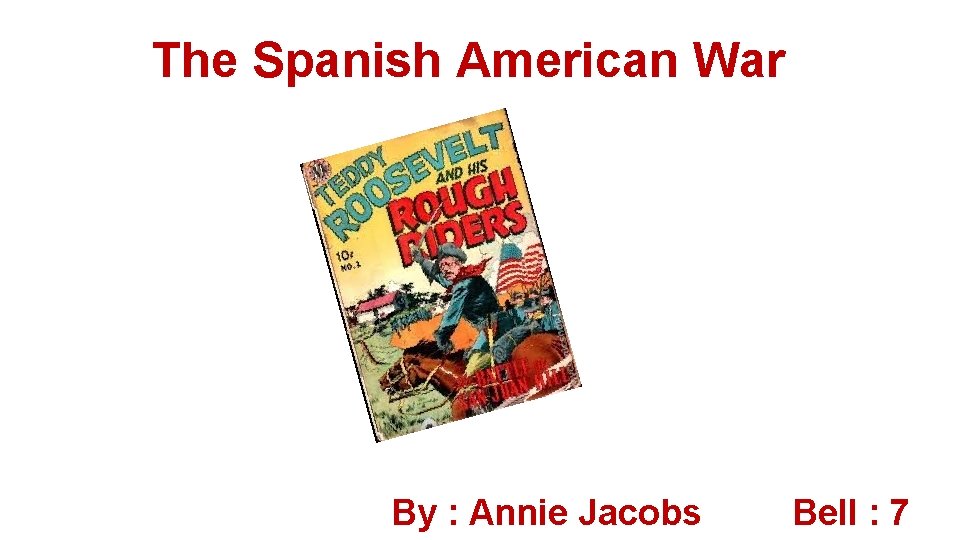
Theodore Roosevelt led the rough riders up San Juan Hill On July 1, 1898 Lieutenant Colonel Roosevelt, in total disregard for his personal safety, and accompanied by only four or five men, led a desperate and gallant charge up San Juan Hill, encouraging his troops to continue the assault through withering enemy fire over open countryside. Facing the enemy's heavy fire, he displayed extraordinary bravery throughout the charge, and was the first to reach the enemy trenches, where he quickly killed one of the enemy with his pistol, allowing his men to continue the assault. His leadership and valor turned the tide in the Battle for San Juan Hill. Back
The Spanish fleet in the Caribbean is destroyed in the Battle of Santiago. The Battle of Santiago de Cuba, fought between Spain and the United States on July 3, 1898, was one of the key naval engagements of the Spanish–American War, which resulted in the destruction of the Spanish Navy's Caribbean Squadron. Back
Spain and the U. S. sign a cease-fire agreement On Aug. 12, 1898, the United States signed a cease-fire agreement with Spain that brought an end to the Spanish. American War. Spain agreed to grant independence to Cuba and hand over Guam, Puerto Rico and the Philippines to the United States. Back
U. S. troops capture Manila in a mock battle. The battle left American forces in control of Intramuros, the center of Manila, surrounded by Philippine revolutionary forces, creating the conditions for the Battle of Manila of 1899 and the start of the Philippine-American War. Back
The U. S. and Spain sign the Treaty of Paris On December 10, 1898 in France, the Treaty of Paris is signed, formally ending the Spanish-American War and granting the United States its first overseas empire. Back
Sources Used • www. Softschools. com • www. Theodore-Roosevelt. com • www. historyofcuba. com • www. history. com • www. loc. gov • www. history. state. gov • www. millitaryhistroy. about. com • www. homeofheroes. com • www. Wikipedia. com • www. learning. blogs. nytimes. com • www. quizlet. com
- Slides: 17