
The SovietAfghan War 1979 1989 Setting and Background

The Soviet-Afghan War (1979 -1989)
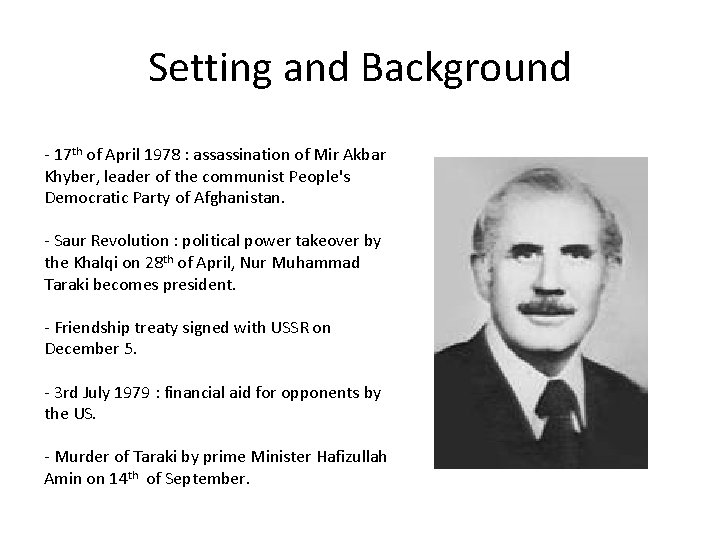
Setting and Background - 17 th of April 1978 : assassination of Mir Akbar Khyber, leader of the communist People's Democratic Party of Afghanistan. - Saur Revolution : political power takeover by the Khalqi on 28 th of April, Nur Muhammad Taraki becomes president. - Friendship treaty signed with USSR on December 5. - 3 rd July 1979 : financial aid for opponents by the US. - Murder of Taraki by prime Minister Hafizullah Amin on 14 th of September.
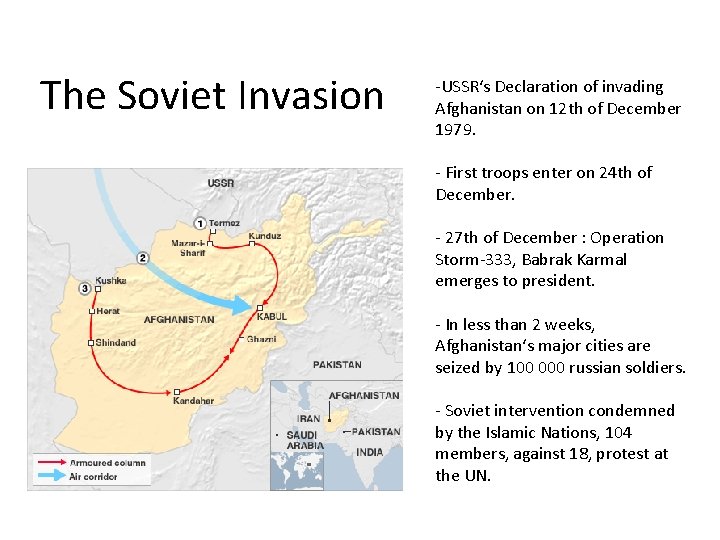
The Soviet Invasion -USSR‘s Declaration of invading Afghanistan on 12 th of December 1979. - First troops enter on 24 th of December. - 27 th of December : Operation Storm-333, Babrak Karmal emerges to president. - In less than 2 weeks, Afghanistan‘s major cities are seized by 100 000 russian soldiers. - Soviet intervention condemned by the Islamic Nations, 104 members, against 18, protest at the UN.
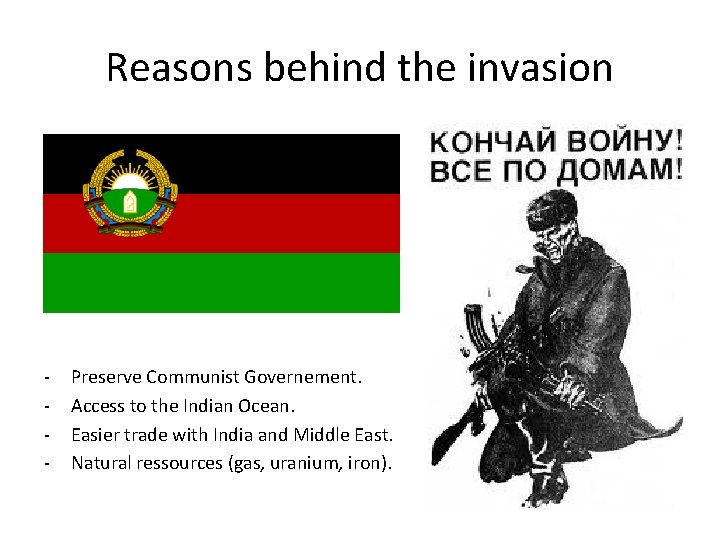
Reasons behind the invasion - Preserve Communist Governement. Access to the Indian Ocean. Easier trade with India and Middle East. Natural ressources (gas, uranium, iron).
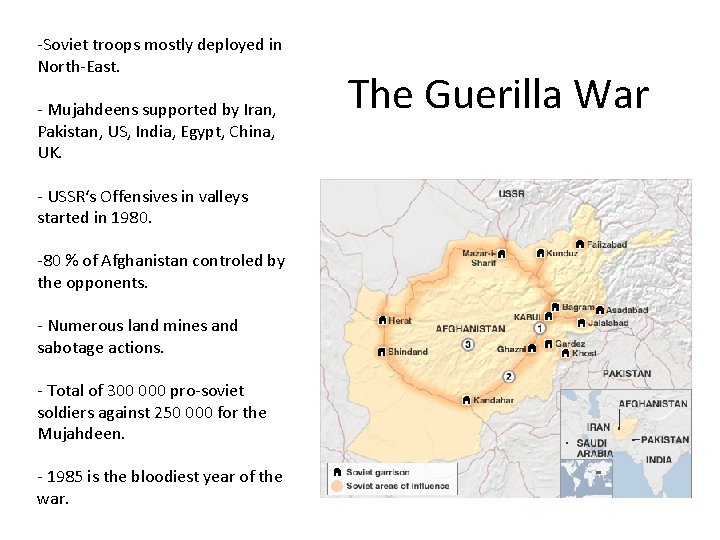
-Soviet troops mostly deployed in North-East. - Mujahdeens supported by Iran, Pakistan, US, India, Egypt, China, UK. - USSR‘s Offensives in valleys started in 1980. -80 % of Afghanistan controled by the opponents. - Numerous land mines and sabotage actions. - Total of 300 000 pro-soviet soldiers against 250 000 for the Mujahdeen. - 1985 is the bloodiest year of the war. The Guerilla War
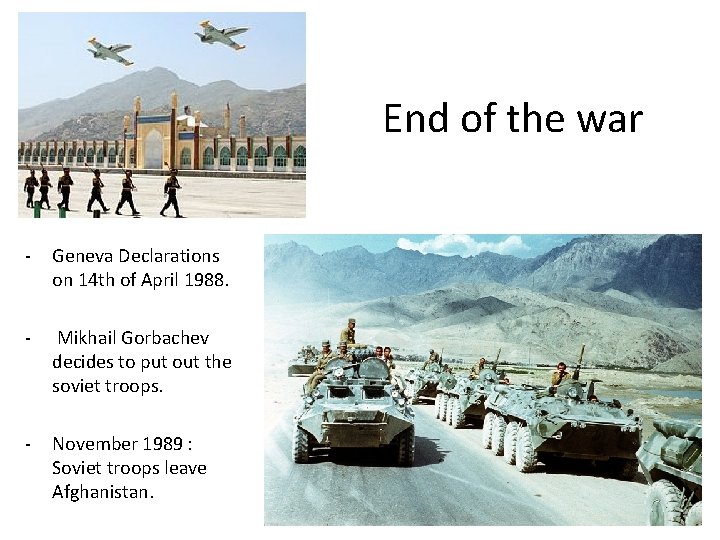
End of the war - Geneva Declarations on 14 th of April 1988. - Mikhail Gorbachev decides to put out the soviet troops. - November 1989 : Soviet troops leave Afghanistan.
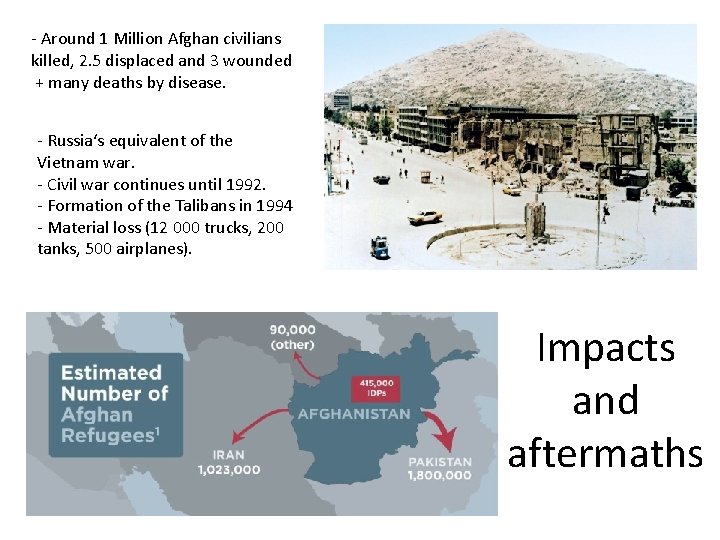
- Around 1 Million Afghan civilians killed, 2. 5 displaced and 3 wounded + many deaths by disease. - Russia‘s equivalent of the Vietnam war. - Civil war continues until 1992. - Formation of the Talibans in 1994 - Material loss (12 000 trucks, 200 tanks, 500 airplanes). Impacts and aftermaths
- Slides: 7