
The Soviet Empire Behind the Iron Curtain USSR
The Soviet Empire: Behind the Iron Curtain USSR & Eastern Europe 1945 -1970 Mr. Meester
Vocabulary • • • Nikita Khrushchev Iron Curtain Josip “Tito” Broz Prague Spring Leonid Brezhnev
The Reign of Stalin • After WWII, Russia was a mess. – Soviet citizens worked hard for little pay, and poor living conditions. • 3 years after the end of WWII, Soviet industrial production reached prewar levels (that’s a good thing). – This growth was mainly in the military, tanks/guns/nuclear weapons.
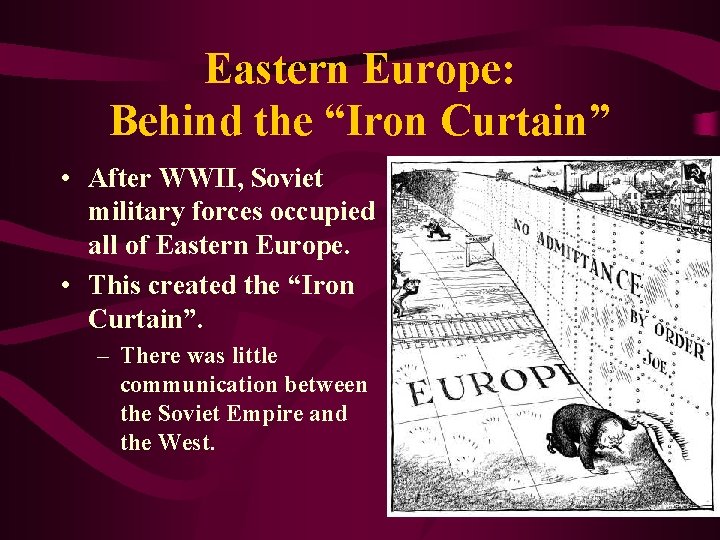
Eastern Europe: Behind the “Iron Curtain” • After WWII, Soviet military forces occupied all of Eastern Europe. • This created the “Iron Curtain”. – There was little communication between the Soviet Empire and the West.
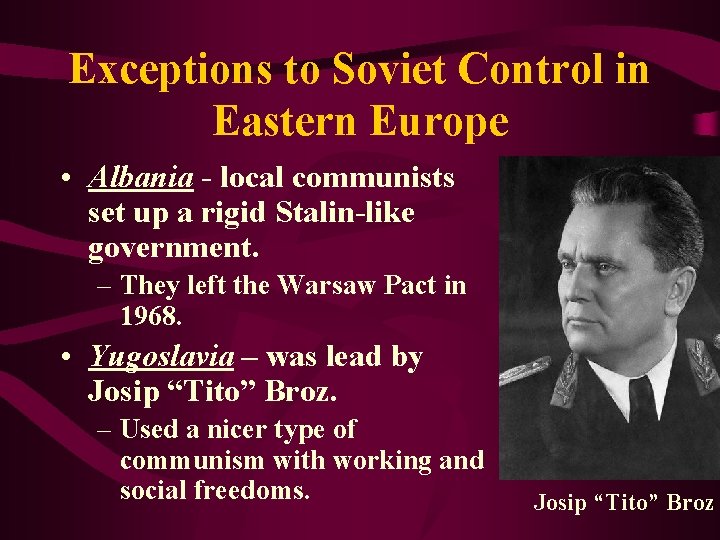
Exceptions to Soviet Control in Eastern Europe • Albania - local communists set up a rigid Stalin-like government. – They left the Warsaw Pact in 1968. • Yugoslavia – was lead by Josip “Tito” Broz. – Used a nicer type of communism with working and social freedoms. Josip “Tito” Broz

Stalin’s Last Years • In the early 1950’s Stalin began another series of purges and became increasingly paranoid. – A great fear spread throughout the USSR, only Stalin’s death (cause still unknown) stopped the madness.
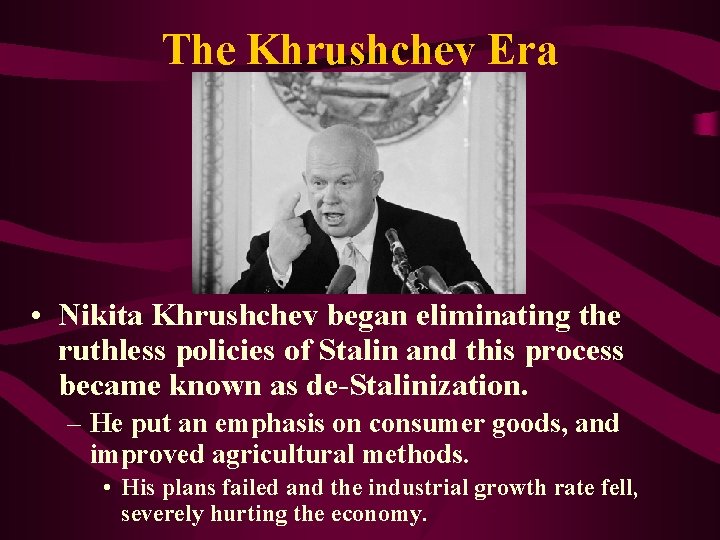
The Khrushchev Era • Nikita Khrushchev began eliminating the ruthless policies of Stalin and this process became known as de-Stalinization. – He put an emphasis on consumer goods, and improved agricultural methods. • His plans failed and the industrial growth rate fell, severely hurting the economy.
Eastern Europe Resistance • 1956, after Khrushchev started de. Stalinization, many countries saw an opportunity to break free. • Poland - Declared they had the right to follow its own socialist path. – Particularly in the area of religion. – Khrushchev allows the change.
The Resistance Spreads • Hungary – 1956 revolted against the USSR – Declared Hungary a free nation – Soviet forces attacked the capitol (Budapest) • Reestablished Soviet control • Czechoslovakia – 1968 Alexander Dubcek promised “communism with a human face” – Wanted free speech, press, and travel – Was crushed by the Soviets – Known as the Prague Spring
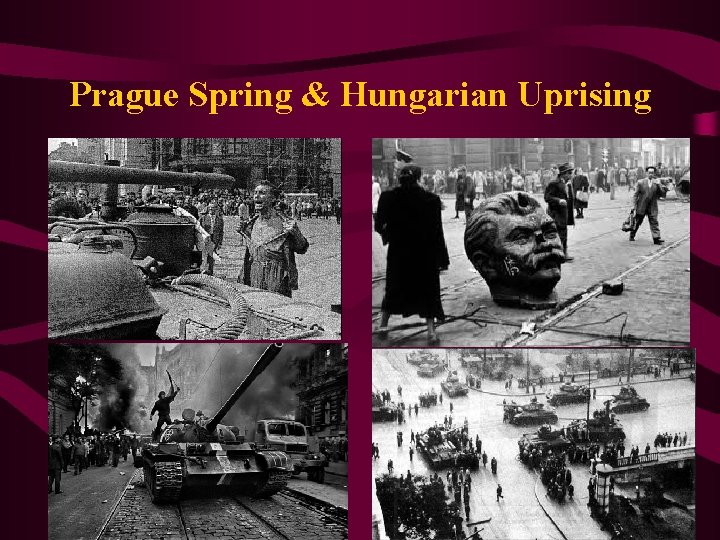
Prague Spring & Hungarian Uprising
Khrushchev’s Fall • Khrushchev’s domestic policies had weaken the Soviet economy – His personality had angered high ranking Soviet officials – His foreign policy failures had also damaged his reputation • While on vacation in 1964, the Soviet leaders voted him out of office due to “deteriorating health”
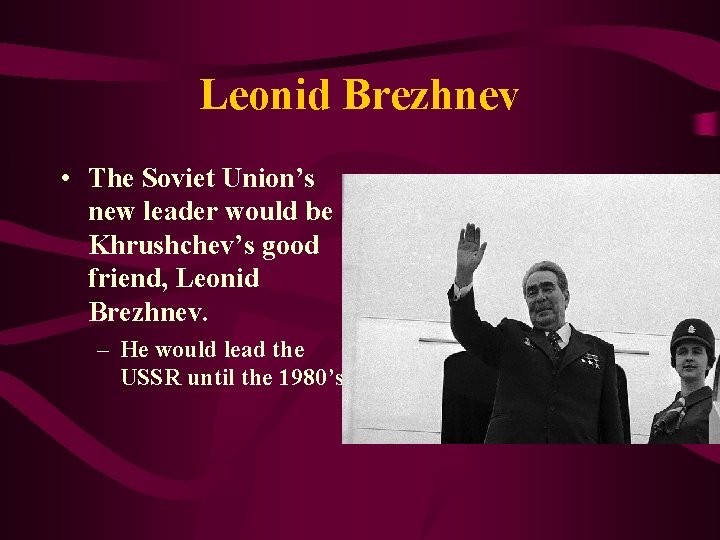
Leonid Brezhnev • The Soviet Union’s new leader would be Khrushchev’s good friend, Leonid Brezhnev. – He would lead the USSR until the 1980’s.
- Slides: 12