
The Southern Ocean geography principal fronts and oceanographic
- Slides: 21
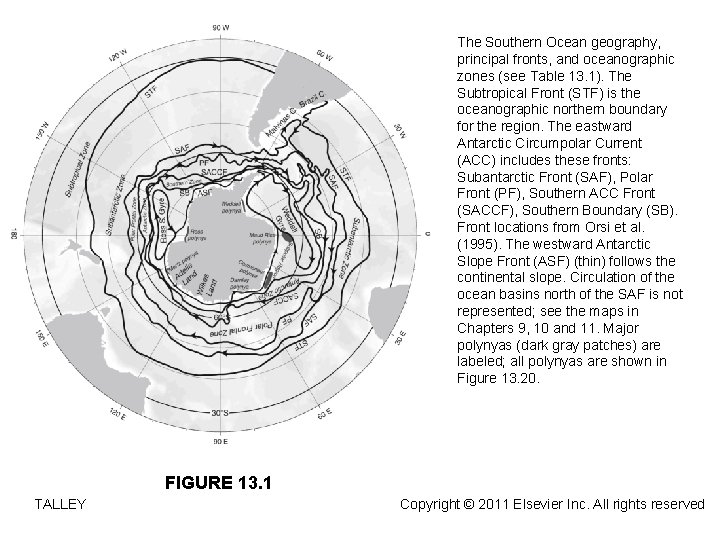
The Southern Ocean geography, principal fronts, and oceanographic zones (see Table 13. 1). The Subtropical Front (STF) is the oceanographic northern boundary for the region. The eastward Antarctic Circumpolar Current (ACC) includes these fronts: Subantarctic Front (SAF), Polar Front (PF), Southern ACC Front (SACCF), Southern Boundary (SB). Front locations from Orsi et al. (1995). The westward Antarctic Slope Front (ASF) (thin) follows the continental slope. Circulation of the ocean basins north of the SAF is not represented; see the maps in Chapters 9, 10 and 11. Major polynyas (dark gray patches) are labeled; all polynyas are shown in Figure 13. 20. FIGURE 13. 1 TALLEY Copyright © 2011 Elsevier Inc. All rights reserved
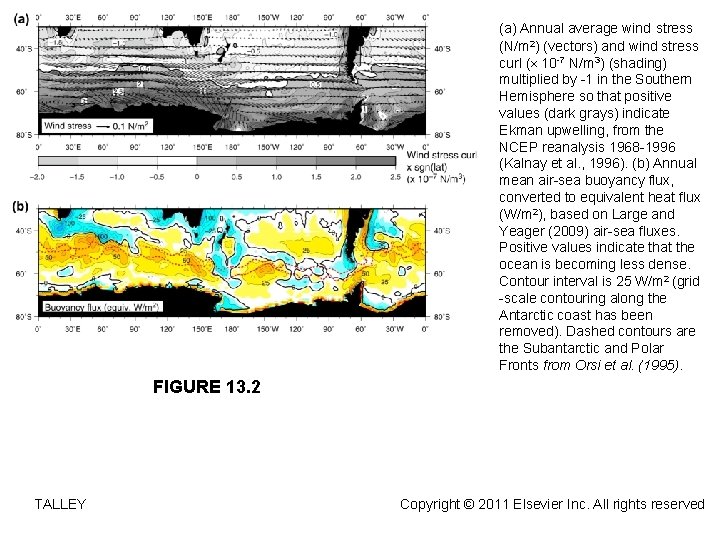
(a) Annual average wind stress (N/m 2) (vectors) and wind stress curl (´ 10 -7 N/m 3) (shading) multiplied by -1 in the Southern Hemisphere so that positive values (dark grays) indicate Ekman upwelling, from the NCEP reanalysis 1968 -1996 (Kalnay et al. , 1996). (b) Annual mean air-sea buoyancy flux, converted to equivalent heat flux (W/m 2), based on Large and Yeager (2009) air-sea fluxes. Positive values indicate that the ocean is becoming less dense. Contour interval is 25 W/m 2 (grid -scale contouring along the Antarctic coast has been removed). Dashed contours are the Subantarctic and Polar Fronts from Orsi et al. (1995). FIGURE 13. 2 TALLEY Copyright © 2011 Elsevier Inc. All rights reserved
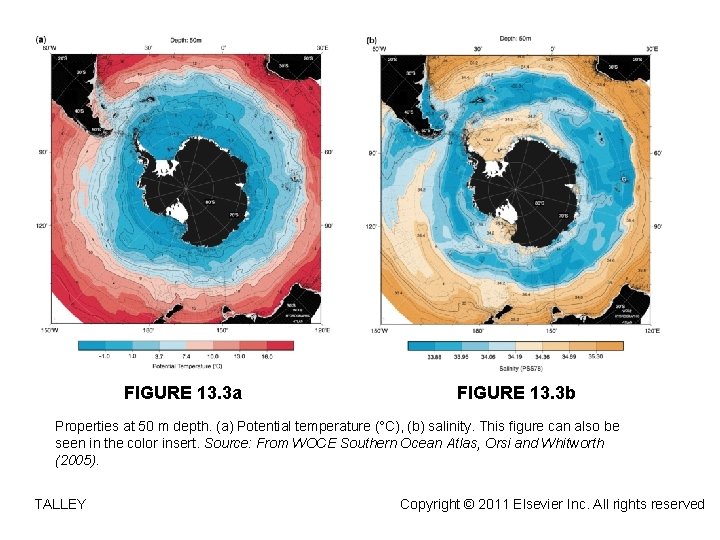
FIGURE 13. 3 a FIGURE 13. 3 b Properties at 50 m depth. (a) Potential temperature (°C), (b) salinity. This figure can also be seen in the color insert. Source: From WOCE Southern Ocean Atlas, Orsi and Whitworth (2005). TALLEY Copyright © 2011 Elsevier Inc. All rights reserved
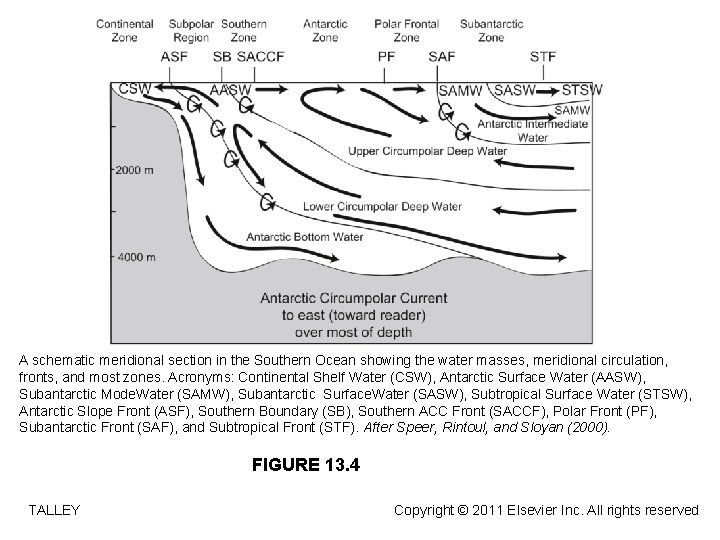
A schematic meridional section in the Southern Ocean showing the water masses, meridional circulation, fronts, and most zones. Acronyms: Continental Shelf Water (CSW), Antarctic Surface Water (AASW), Subantarctic Mode. Water (SAMW), Subantarctic Surface. Water (SASW), Subtropical Surface Water (STSW), Antarctic Slope Front (ASF), Southern Boundary (SB), Southern ACC Front (SACCF), Polar Front (PF), Subantarctic Front (SAF), and Subtropical Front (STF). After Speer, Rintoul, and Sloyan (2000). FIGURE 13. 4 TALLEY Copyright © 2011 Elsevier Inc. All rights reserved
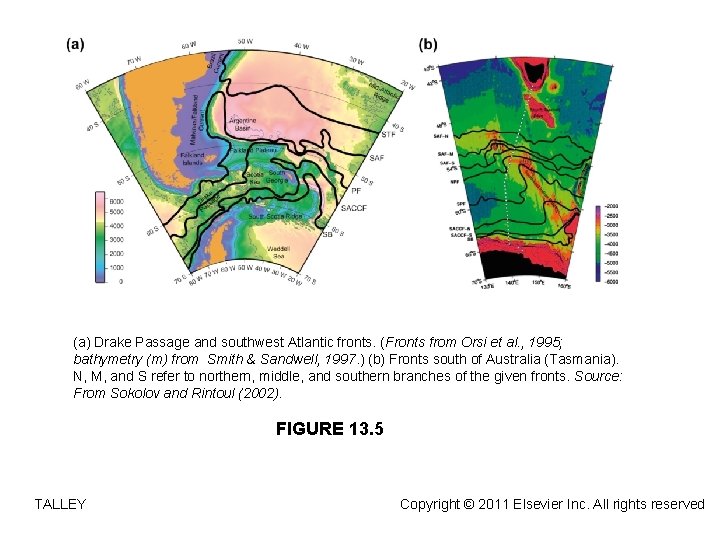
(a) Drake Passage and southwest Atlantic fronts. (Fronts from Orsi et al. , 1995; bathymetry (m) from Smith & Sandwell, 1997. ) (b) Fronts south of Australia (Tasmania). N, M, and S refer to northern, middle, and southern branches of the given fronts. Source: From Sokolov and Rintoul (2002). FIGURE 13. 5 TALLEY Copyright © 2011 Elsevier Inc. All rights reserved
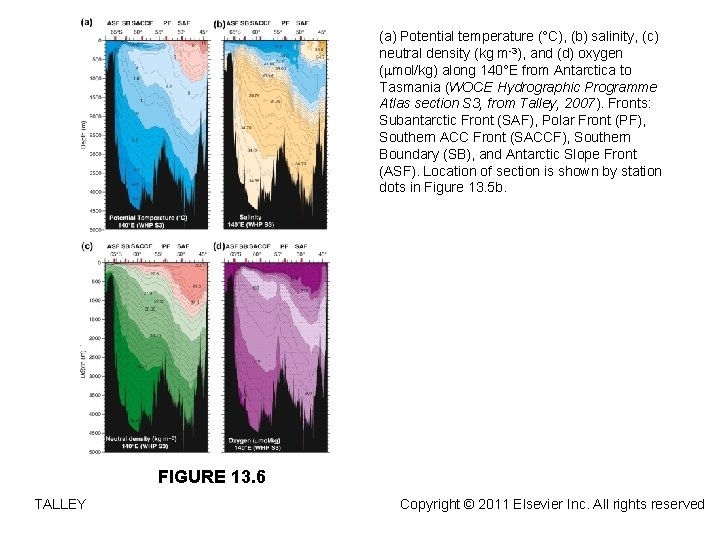
(a) Potential temperature (°C), (b) salinity, (c) neutral density (kg m-3), and (d) oxygen (mmol/kg) along 140°E from Antarctica to Tasmania (WOCE Hydrographic Programme Atlas section S 3, from Talley, 2007). Fronts: Subantarctic Front (SAF), Polar Front (PF), Southern ACC Front (SACCF), Southern Boundary (SB), and Antarctic Slope Front (ASF). Location of section is shown by station dots in Figure 13. 5 b. FIGURE 13. 6 TALLEY Copyright © 2011 Elsevier Inc. All rights reserved
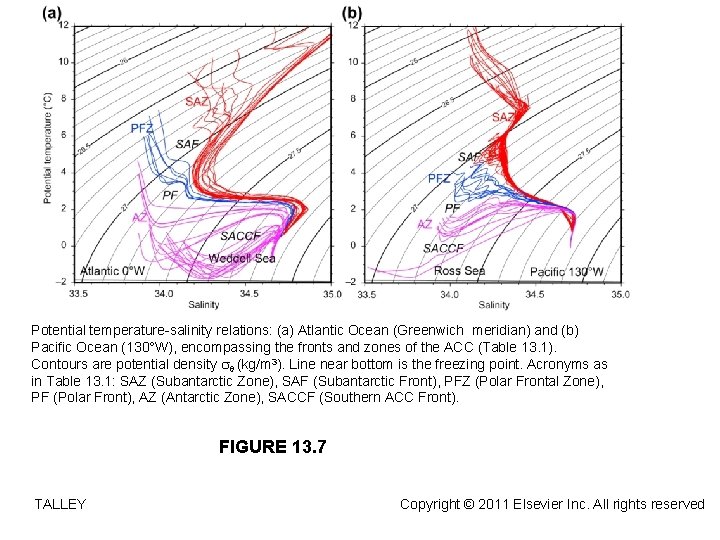
Potential temperature-salinity relations: (a) Atlantic Ocean (Greenwich meridian) and (b) Pacific Ocean (130°W), encompassing the fronts and zones of the ACC (Table 13. 1). Contours are potential density sq (kg/m 3). Line near bottom is the freezing point. Acronyms as in Table 13. 1: SAZ (Subantarctic Zone), SAF (Subantarctic Front), PFZ (Polar Frontal Zone), PF (Polar Front), AZ (Antarctic Zone), SACCF (Southern ACC Front). FIGURE 13. 7 TALLEY Copyright © 2011 Elsevier Inc. All rights reserved
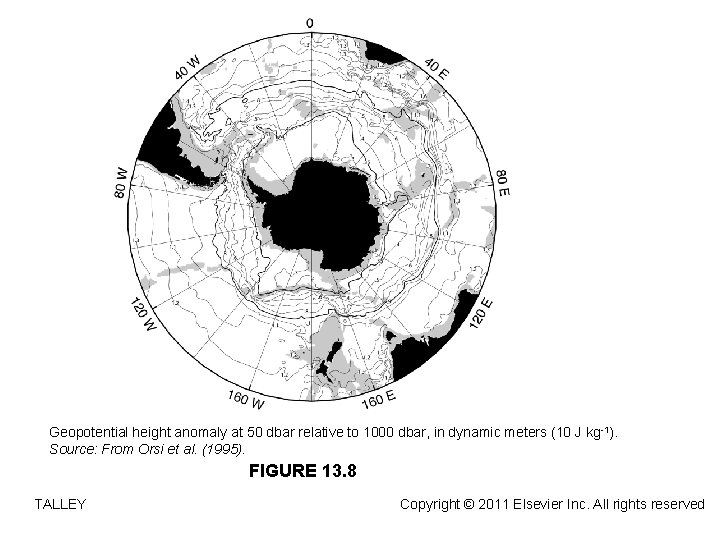
Geopotential height anomaly at 50 dbar relative to 1000 dbar, in dynamic meters (10 J kg-1). Source: From Orsi et al. (1995). FIGURE 13. 8 TALLEY Copyright © 2011 Elsevier Inc. All rights reserved
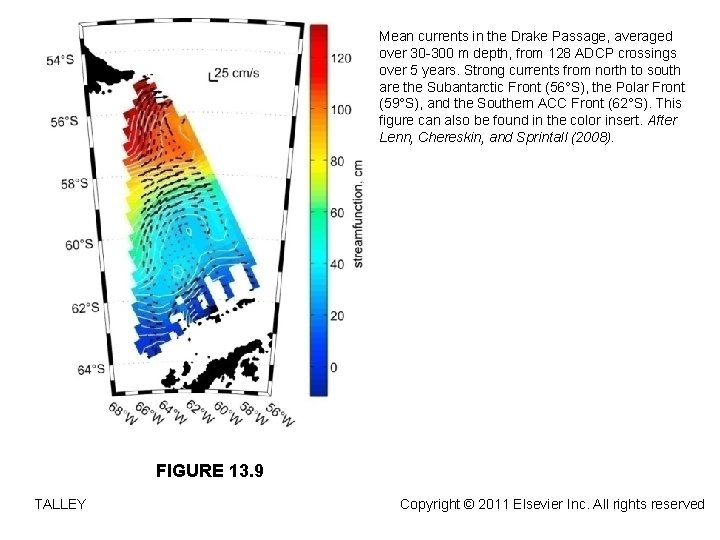
Mean currents in the Drake Passage, averaged over 30 -300 m depth, from 128 ADCP crossings over 5 years. Strong currents from north to south are the Subantarctic Front (56°S), the Polar Front (59°S), and the Southern ACC Front (62°S). This figure can also be found in the color insert. After Lenn, Chereskin, and Sprintall (2008). FIGURE 13. 9 TALLEY Copyright © 2011 Elsevier Inc. All rights reserved
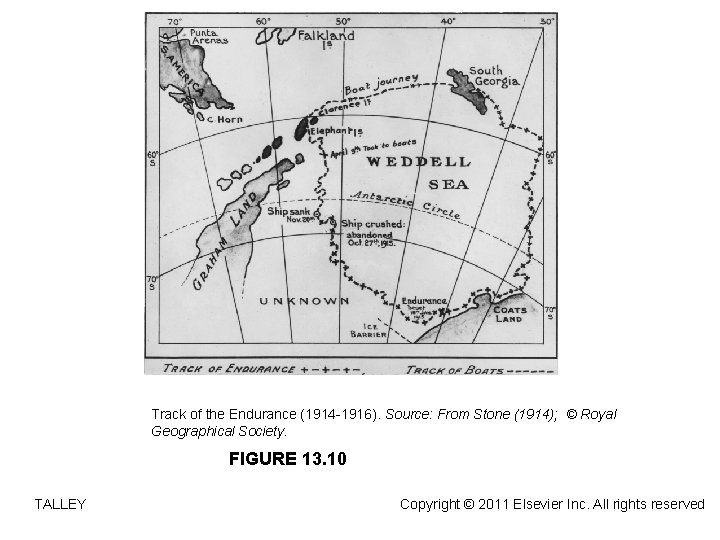
Track of the Endurance (1914 -1916). Source: From Stone (1914); © Royal Geographical Society. FIGURE 13. 10 TALLEY Copyright © 2011 Elsevier Inc. All rights reserved
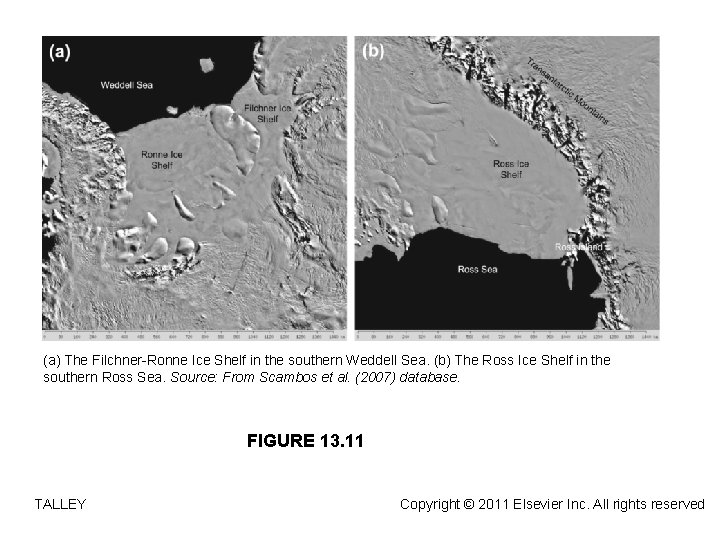
(a) The Filchner-Ronne Ice Shelf in the southern Weddell Sea. (b) The Ross Ice Shelf in the southern Ross Sea. Source: From Scambos et al. (2007) database. FIGURE 13. 11 TALLEY Copyright © 2011 Elsevier Inc. All rights reserved
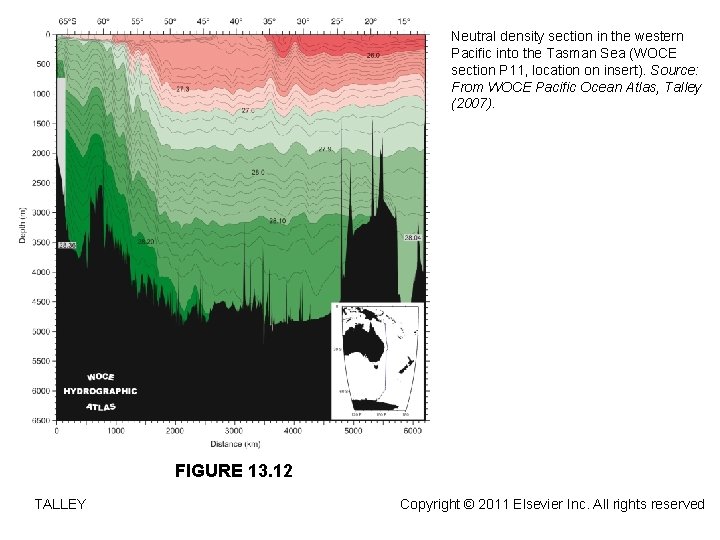
Neutral density section in the western Pacific into the Tasman Sea (WOCE section P 11, location on insert). Source: From WOCE Pacific Ocean Atlas, Talley (2007). FIGURE 13. 12 TALLEY Copyright © 2011 Elsevier Inc. All rights reserved
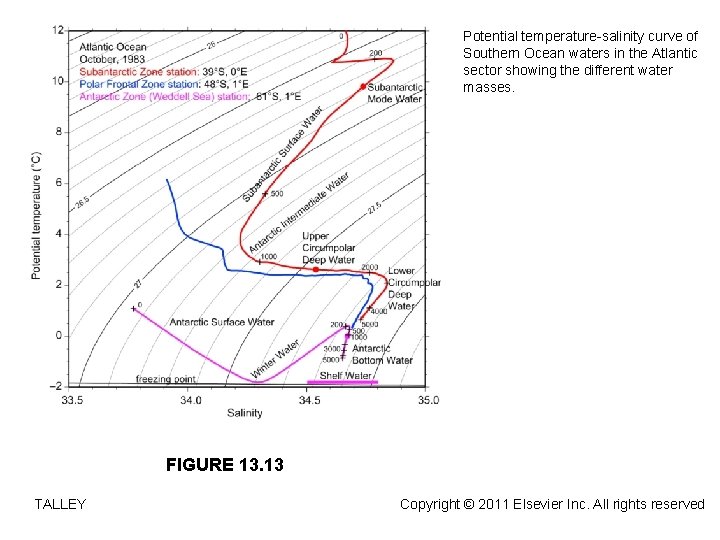
Potential temperature-salinity curve of Southern Ocean waters in the Atlantic sector showing the different water masses. FIGURE 13. 13 TALLEY Copyright © 2011 Elsevier Inc. All rights reserved
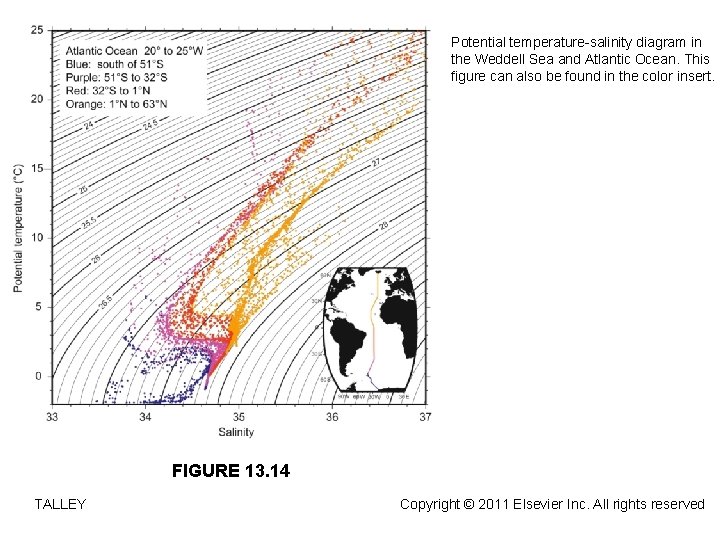
Potential temperature-salinity diagram in the Weddell Sea and Atlantic Ocean. This figure can also be found in the color insert. FIGURE 13. 14 TALLEY Copyright © 2011 Elsevier Inc. All rights reserved
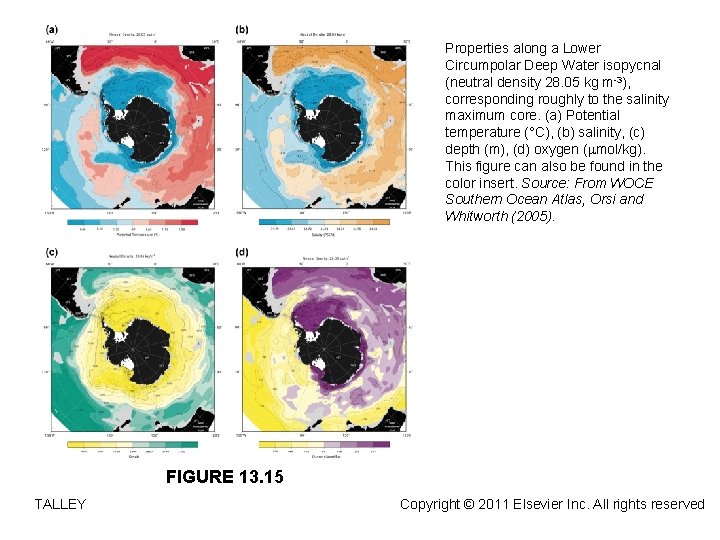
Properties along a Lower Circumpolar Deep Water isopycnal (neutral density 28. 05 kg m-3), corresponding roughly to the salinity maximum core. (a) Potential temperature (°C), (b) salinity, (c) depth (m), (d) oxygen (mmol/kg). This figure can also be found in the color insert. Source: From WOCE Southern Ocean Atlas, Orsi and Whitworth (2005). FIGURE 13. 15 TALLEY Copyright © 2011 Elsevier Inc. All rights reserved
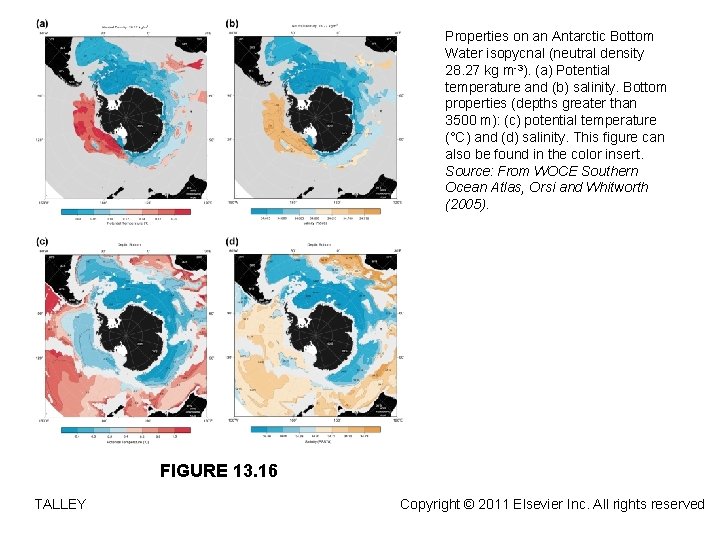
Properties on an Antarctic Bottom Water isopycnal (neutral density 28. 27 kg m-3). (a) Potential temperature and (b) salinity. Bottom properties (depths greater than 3500 m): (c) potential temperature (°C) and (d) salinity. This figure can also be found in the color insert. Source: From WOCE Southern Ocean Atlas, Orsi and Whitworth (2005). FIGURE 13. 16 TALLEY Copyright © 2011 Elsevier Inc. All rights reserved
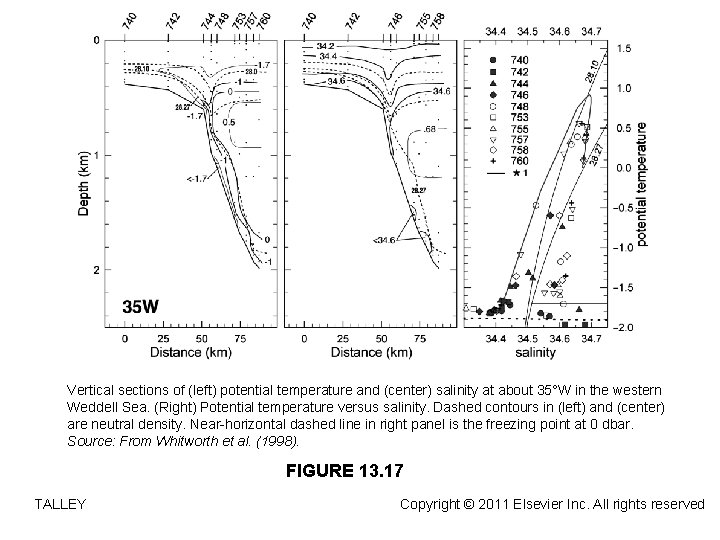
Vertical sections of (left) potential temperature and (center) salinity at about 35°W in the western Weddell Sea. (Right) Potential temperature versus salinity. Dashed contours in (left) and (center) are neutral density. Near-horizontal dashed line in right panel is the freezing point at 0 dbar. Source: From Whitworth et al. (1998). FIGURE 13. 17 TALLEY Copyright © 2011 Elsevier Inc. All rights reserved
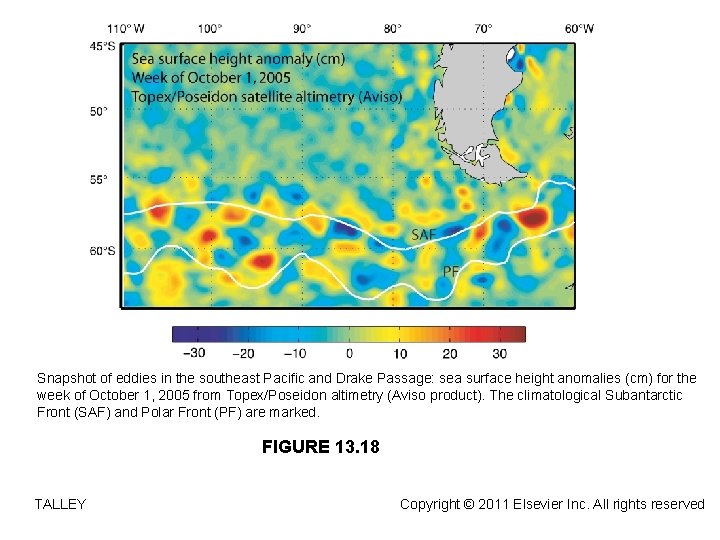
Snapshot of eddies in the southeast Pacific and Drake Passage: sea surface height anomalies (cm) for the week of October 1, 2005 from Topex/Poseidon altimetry (Aviso product). The climatological Subantarctic Front (SAF) and Polar Front (PF) are marked. FIGURE 13. 18 TALLEY Copyright © 2011 Elsevier Inc. All rights reserved
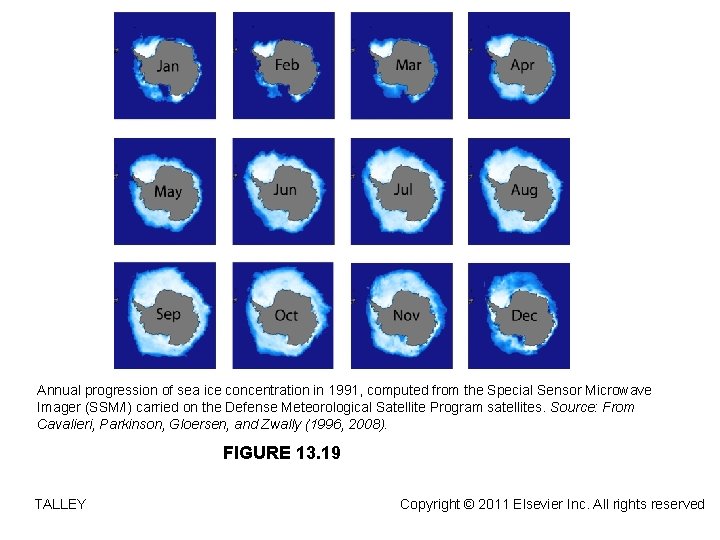
Annual progression of sea ice concentration in 1991, computed from the Special Sensor Microwave Imager (SSM/I) carried on the Defense Meteorological Satellite Program satellites. Source: From Cavalieri, Parkinson, Gloersen, and Zwally (1996, 2008). FIGURE 13. 19 TALLEY Copyright © 2011 Elsevier Inc. All rights reserved
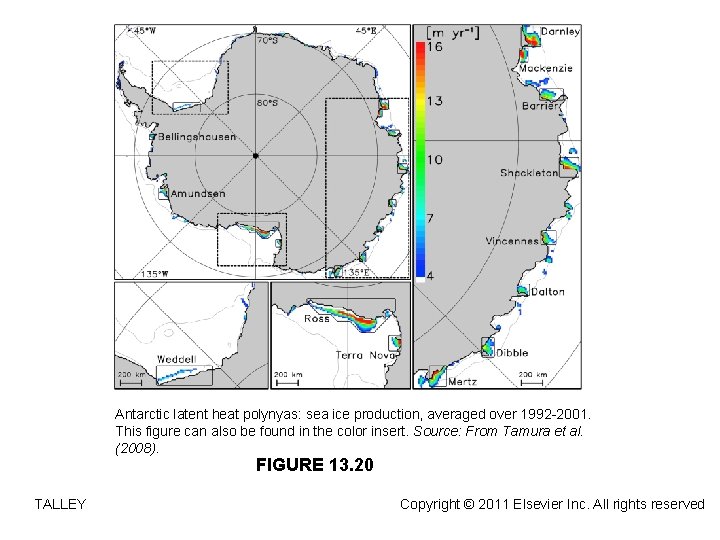
Antarctic latent heat polynyas: sea ice production, averaged over 1992 -2001. This figure can also be found in the color insert. Source: From Tamura et al. (2008). FIGURE 13. 20 TALLEY Copyright © 2011 Elsevier Inc. All rights reserved
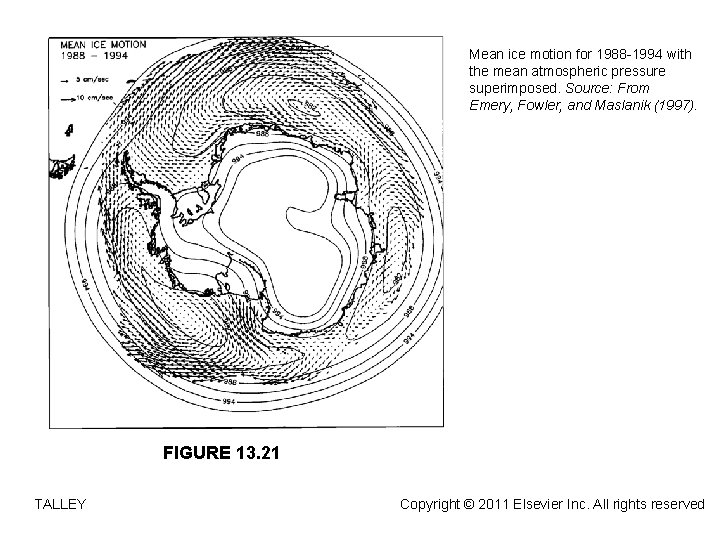
Mean ice motion for 1988 -1994 with the mean atmospheric pressure superimposed. Source: From Emery, Fowler, and Maslanik (1997). FIGURE 13. 21 TALLEY Copyright © 2011 Elsevier Inc. All rights reserved