
THE SOUTH AFRICAN NATIONAL ROADS AGENCY LIMITED SANRAL



- Slides: 34
THE SOUTH AFRICAN NATIONAL ROADS AGENCY LIMITED (SANRAL) BUDGET 2006/2007 AND STRATEGIC PLAN 2006 – 2009 Portfolio Committee on Transport 16 March 2006 #191459 v 2
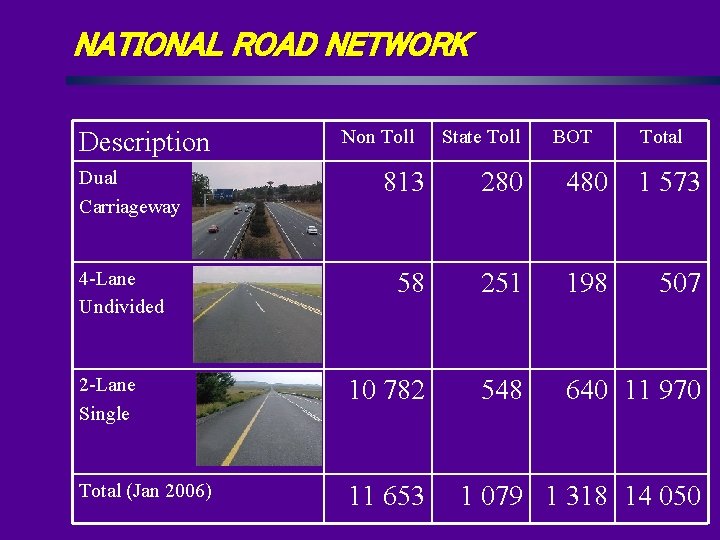
NATIONAL ROAD NETWORK Description Dual Carriageway Non Toll State Toll BOT Total 813 280 480 1 573 58 251 198 507 2 -Lane Single 10 782 548 640 11 970 Total (Jan 2006) 11 653 4 -Lane Undivided 1 079 1 318 14 050
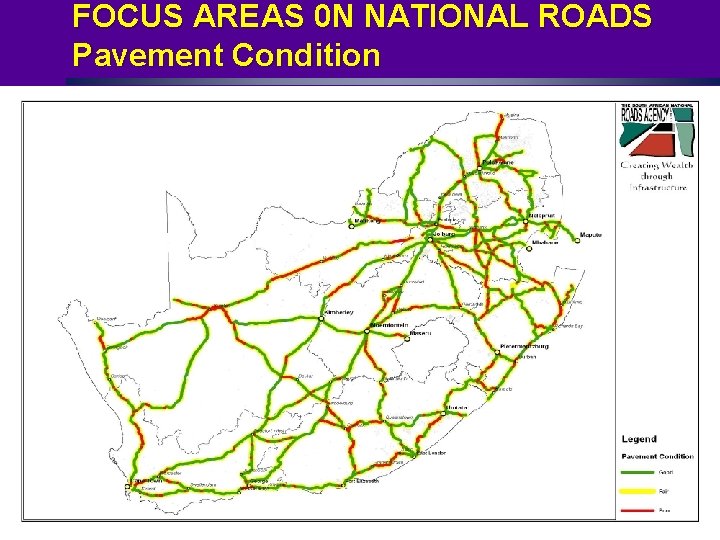
FOCUS AREAS 0 N NATIONAL ROADS Pavement Condition
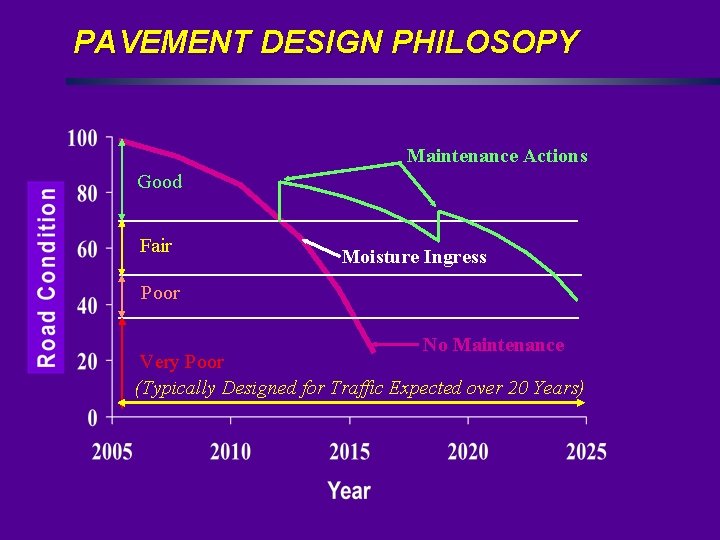
PAVEMENT DESIGN PHILOSOPY Maintenance Actions Good Fair Moisture Ingress Poor No Maintenance Very Poor (Typically Designed for Traffic Expected over 20 Years)
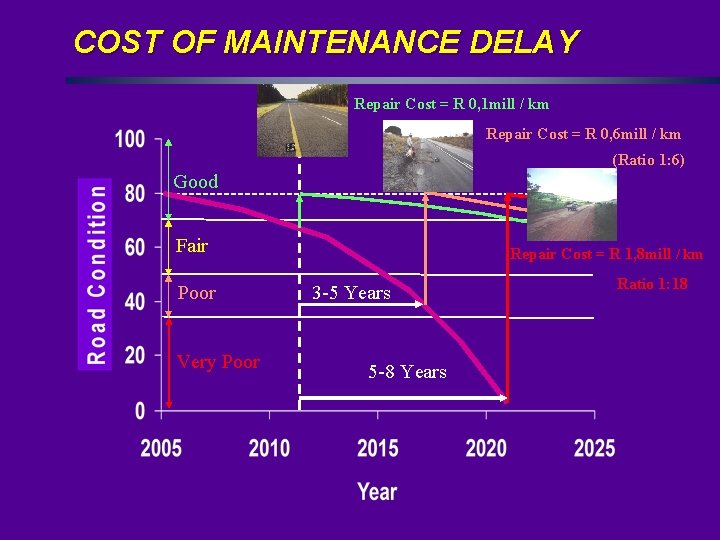
COST OF MAINTENANCE DELAY Repair Cost = R 0, 1 mill / km Repair Cost = R 0, 6 mill / km (Ratio 1: 6) Good Fair Poor Very Poor Repair Cost = R 1, 8 mill / km 3 -5 Years 5 -8 Years Ratio 1: 18
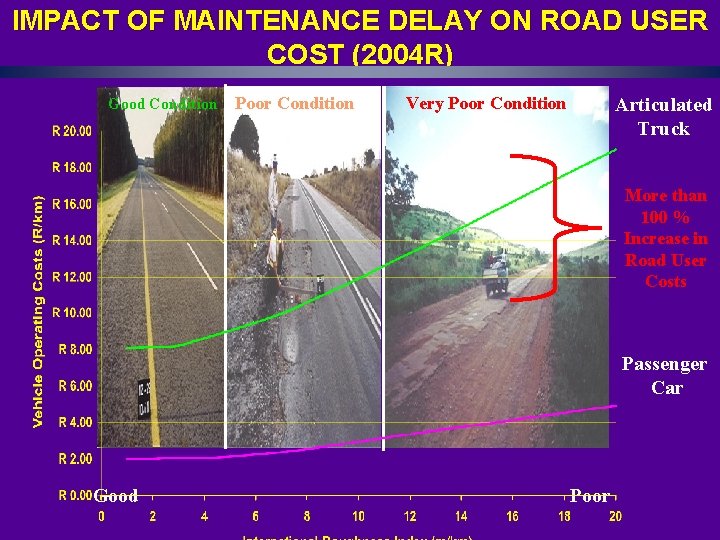
IMPACT OF MAINTENANCE DELAY ON ROAD USER COST (2004 R) Good Condition Poor Condition Very Poor Condition Articulated Truck More than 100 % Increase in Road User Costs Passenger Car Good Poor
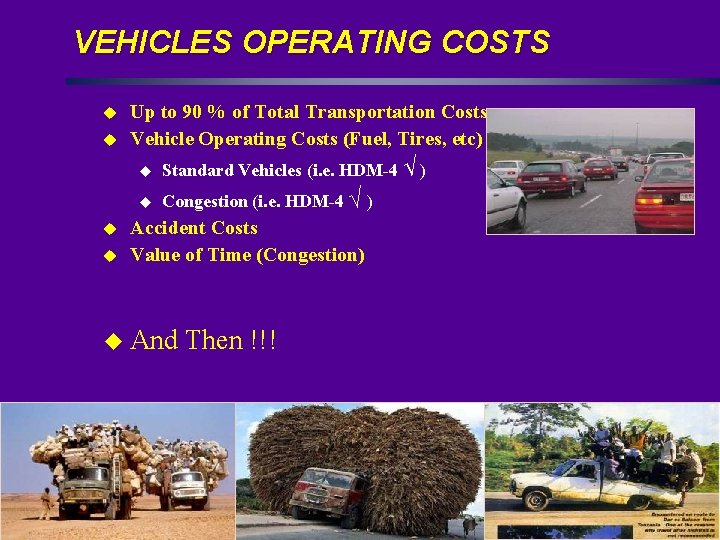
VEHICLES OPERATING COSTS u u Up to 90 % of Total Transportation Costs Vehicle Operating Costs (Fuel, Tires, etc) u Standard Vehicles (i. e. HDM-4 √ ) u Congestion (i. e. HDM-4 √ ) Accident Costs Value of Time (Congestion) u And Then !!!
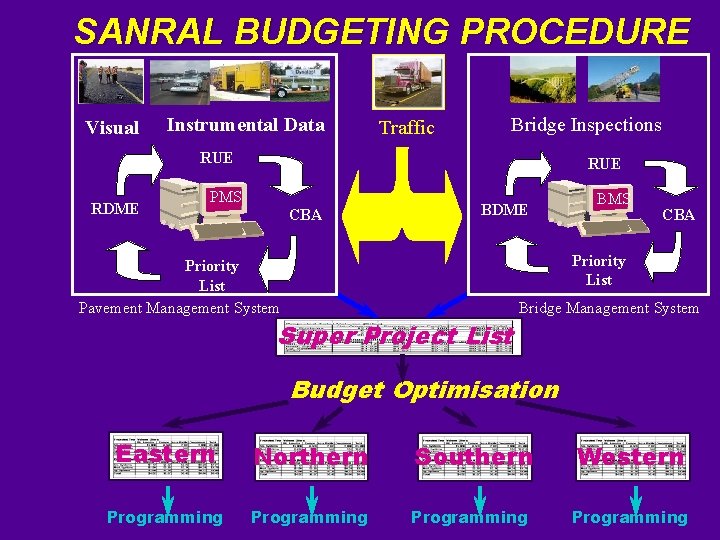
SANRAL BUDGETING PROCEDURE Visual Instrumental Data Traffic Bridge Inspections RUE RDME RUE PMS CBA BDME BMS CBA Priority List Pavement Management System Super Project List Bridge Management System Budget Optimisation Eastern Northern Southern Programming Western Programming
Optimisation Function Minimization of Total Transportation Costs (High Traffic)
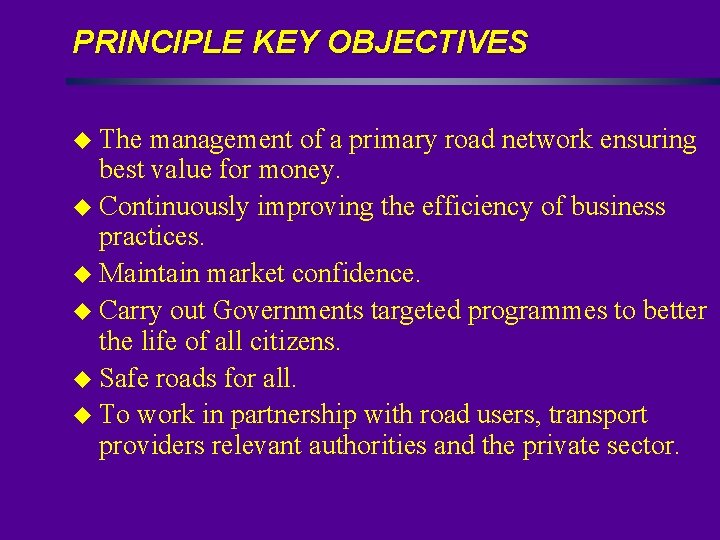
PRINCIPLE KEY OBJECTIVES u The management of a primary road network ensuring best value for money. u Continuously improving the efficiency of business practices. u Maintain market confidence. u Carry out Governments targeted programmes to better the life of all citizens. u Safe roads for all. u To work in partnership with road users, transport providers relevant authorities and the private sector.
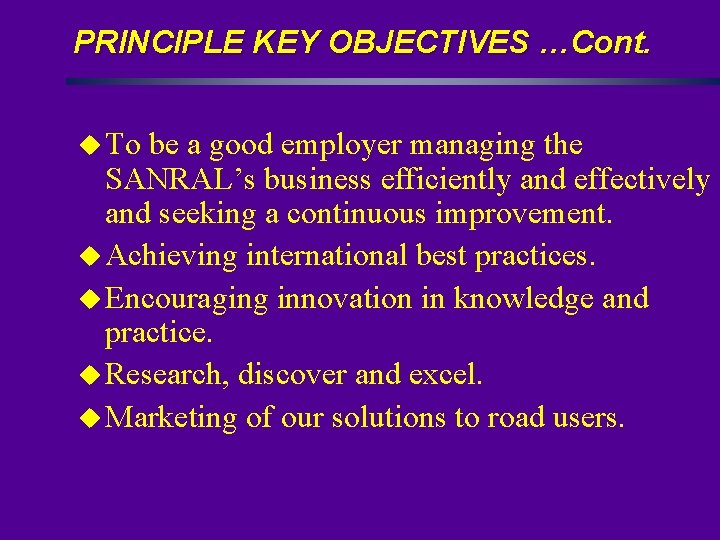
PRINCIPLE KEY OBJECTIVES …Cont. u To be a good employer managing the SANRAL’s business efficiently and effectively and seeking a continuous improvement. u Achieving international best practices. u Encouraging innovation in knowledge and practice. u Research, discover and excel. u Marketing of our solutions to road users.
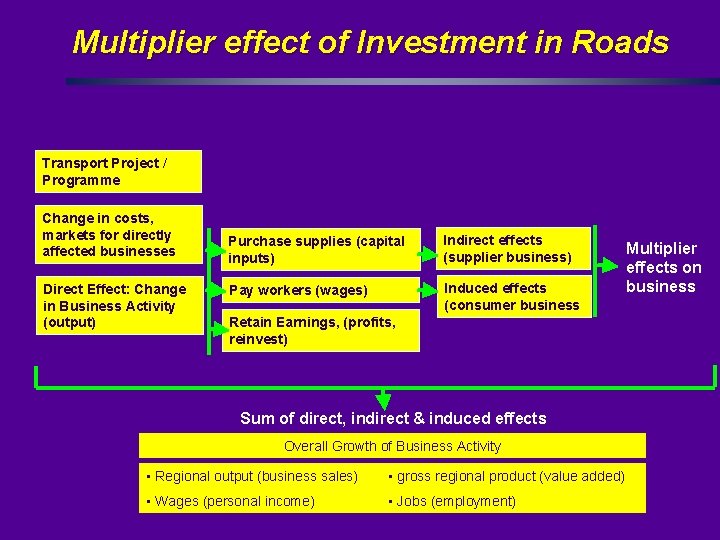
Multiplier effect of Investment in Roads Transport Project / Programme Change in costs, markets for directly affected businesses Direct Effect: Change in Business Activity (output) Purchase supplies (capital inputs) Indirect effects (supplier business) Pay workers (wages) Induced effects (consumer business Retain Earnings, (profits, reinvest) Sum of direct, indirect & induced effects Overall Growth of Business Activity • Regional output (business sales) • gross regional product (value added) • Wages (personal income) • Jobs (employment) Multiplier effects on business
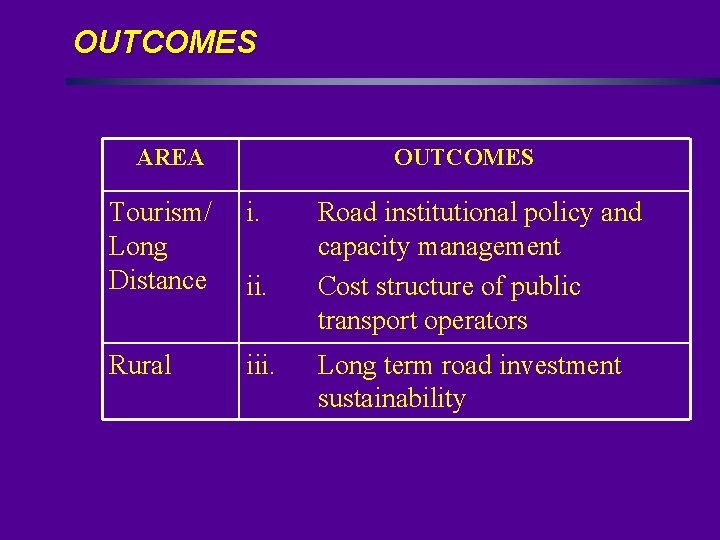
OUTCOMES AREA OUTCOMES Tourism/ Long Distance i. Rural iii. Road institutional policy and capacity management Cost structure of public transport operators Long term road investment sustainability
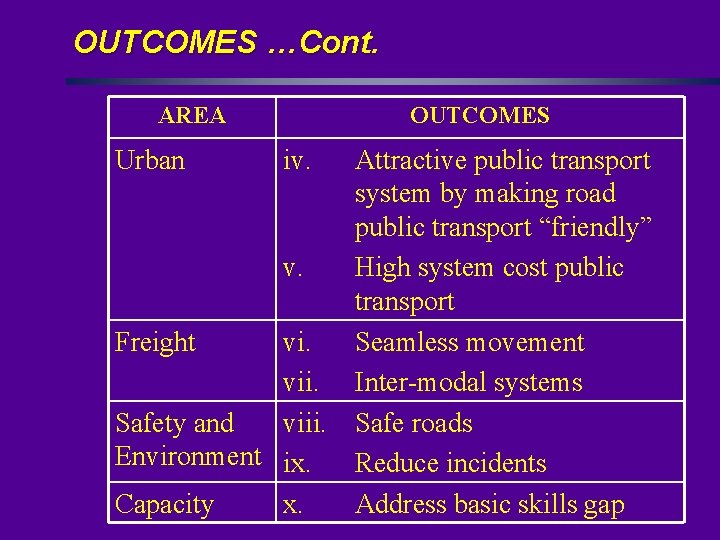
OUTCOMES …Cont. AREA Urban OUTCOMES iv. Attractive public transport system by making road public transport “friendly” v. High system cost public transport Freight vi. Seamless movement vii. Inter-modal systems Safety and viii. Safe roads Environment ix. Reduce incidents Capacity x. Address basic skills gap
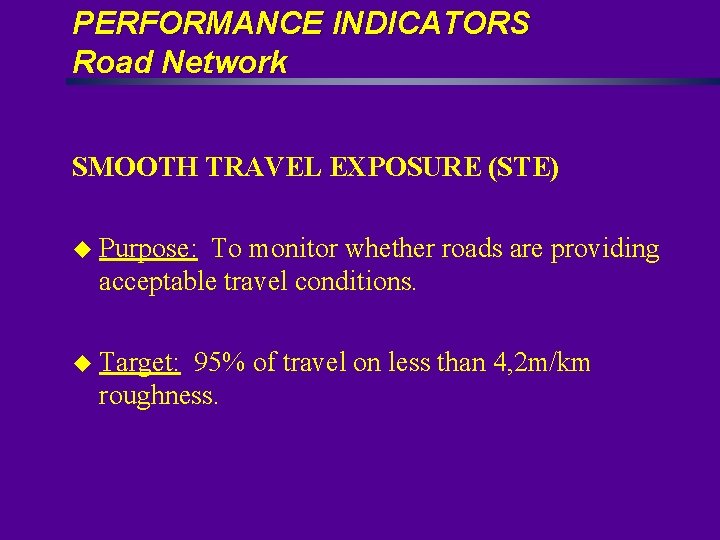
PERFORMANCE INDICATORS Road Network SMOOTH TRAVEL EXPOSURE (STE) u Purpose: To monitor whether roads are providing acceptable travel conditions. u Target: 95% of travel on less than 4, 2 m/km roughness.
PERFORMANCE INDICATORS Road Network …Cont. LOW RUT EXPOSURE (LRE) u Purpose: To monitor whether roads are providing acceptable travel conditions. u Target: 95% of travel on less than 20 mm rut depth.
PERFORMANCE INDICATORS Road Network …Cont. HIGH TEXTURE EXPOSURE (HTE) u Purpose: To monitor whether roads are providing acceptable travel conditions. u Target: 95% of travel on higher than 0, 4 mm texture.
PERFORMANCE INDICATORS Road Network …Cont. BRIDGE CONDITION EXPOSURE (BCE) u Purpose: To monitor whether bridges are providing acceptable travel conditions. u Target: 90% of travel over and under bridges with OCI higher than 80.
PERFORMANCE INDICATORS Financial …Cont. EXPENDITURE EFFICIENCY INDEX (EEI) u Purpose: u Target: To monitor the efficiency of the SANRAL. ≤ 5%
PERFORMANCE INDICATORS Financial …Cont. PRIVATE SECTOR INVESTMENT INDEX (PSII) u Purpose: To monitor the attraction of private sector investment. u Target: 0, 85
Proposed SANRAL road safety strategy u How do we go to the next level? u Develop a SANRAL Culture of Emphasis on Road Safety in all we do. u Efficient co-ordination and management of resources to focus on road safety u Results driven u It is with this in mind that a Road Safety Management System is proposed for SANRAL.
Proposed SANRAL road safety strategy u Although SANRAL does a lot of good road safety work, there is a need for a more co-ordinated approach towards road safety. u A Road Safety Management System is proposed. u What is a Safety Management System? u Approach to road safety followed by road authorities internationally. u Widely supported method of managing the road network to improve safety. u Is an integral part of the overall management system for the road network.
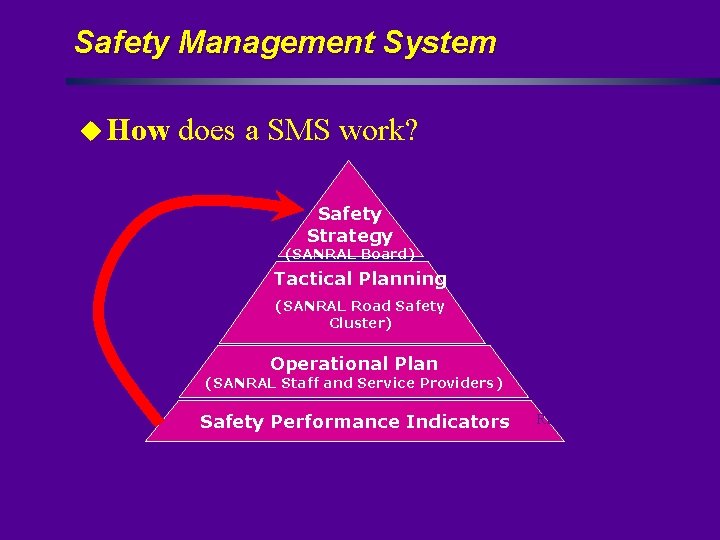
Safety Management System u How does a SMS work? Safety Strategy DIRECTION (SANRAL Board) Tactical Planning (SANRAL Road Safety Cluster) Operational Plan MEANS OF DELIVERY CONTROL (SANRAL Staff and Service Providers) Safety Performance Indicators REVIEW
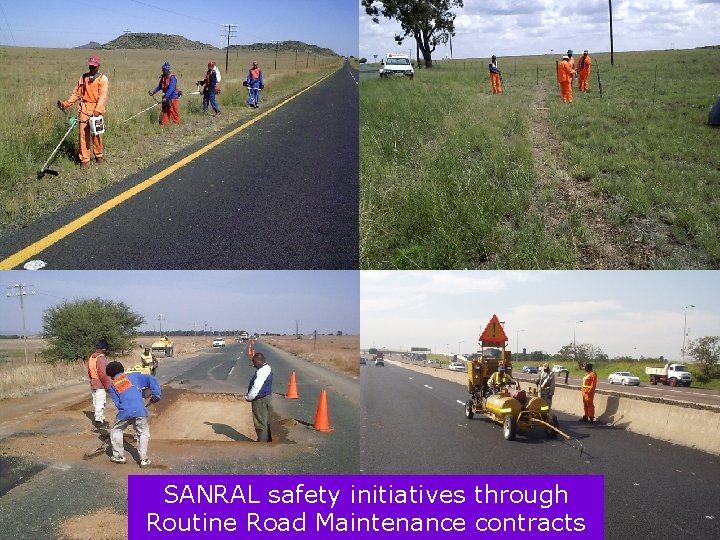
Current SANRAL road safety initiatives: Engineering u Routine road maintenance u Collation of accident statistics u Safety maintenance (potholes, fencing, guardrails, road marking etc. ) u Safety improvements on periodic maintenance projects u Special road safety projects
SANRAL safety initiatives through Routine Road Maintenance contracts
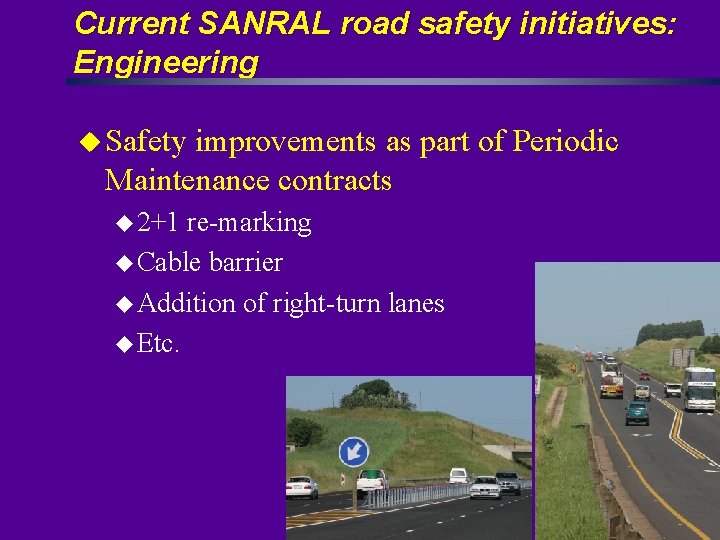
Current SANRAL road safety initiatives: Engineering u Safety improvements as part of Periodic Maintenance contracts u 2+1 re-marking u Cable barrier u Addition of right-turn lanes u Etc.
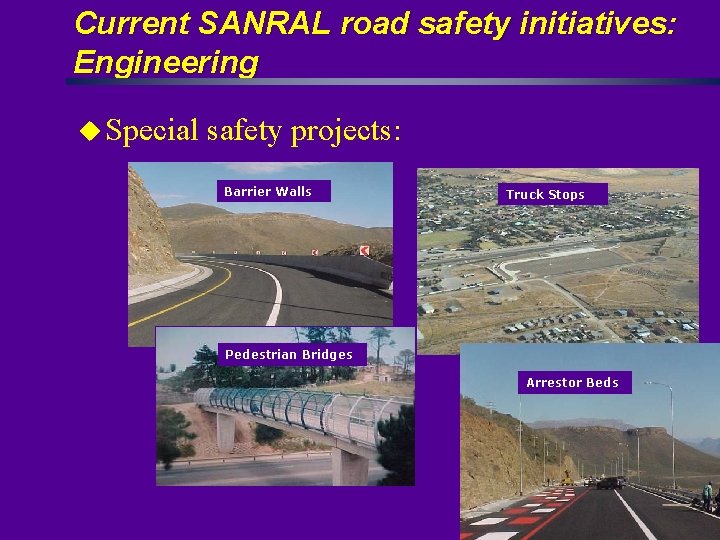
Current SANRAL road safety initiatives: Engineering u Special safety projects: Barrier Walls Truck Stops Pedestrian Bridges Arrestor Beds
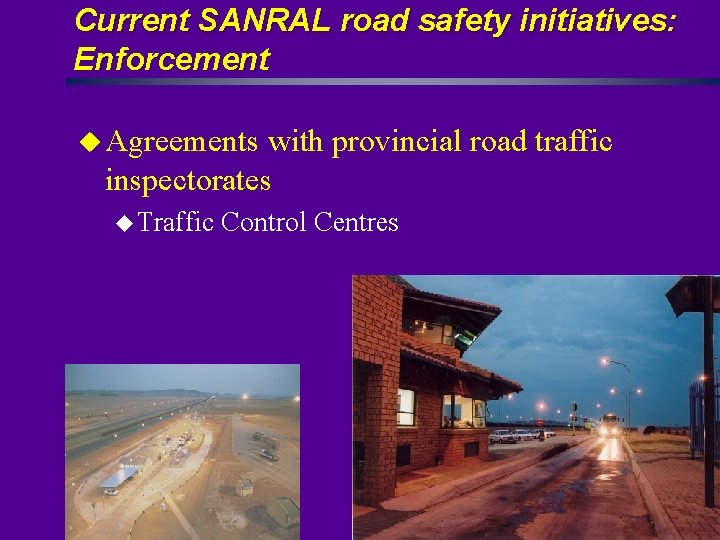
Current SANRAL road safety initiatives: Enforcement u Agreements with provincial road traffic inspectorates u Traffic Control Centres
THE NEED FOR IMS u The trend for commercial transportation on South African roads, has steadily increased over the years. u The same can also be said for non-commercial vehicles. u Unfortunately the above can be linked to standard of safety on roads. u Every year our roads have their fair share of incidents which result with road closure, loss of lives, damage to property, at huge costs to all involved u Where incidents cannot be prevented at least they should be efficiently managed
THE OBJECTIVES OF IMS u Enable Managers to secure agreements among emergency services u Allow for facilitation of on-scene co-ordination and co-operation between emergency services u Streamlining of communication u Ensure that incidents are cleared as quickly as possible.
THE ACHIEVEMENT OF IMS u u u Programming and Pre-planning (Guidelines and Protocols) Resources allocation and management Communication/Communication Technology improvements Capacity building, skills development and training System maintenance, monitoring, reporting and evaluation