
The source and destination of the NHS Reform


- Slides: 20
The source and destination of the NHS “Reform”: from insurance industry marketing to insurance industry takeover Dr Lucy Reynolds Health Policy Progress Group Brighton, 20 April 2016
Research report Wellcome Foundation History Grant • Reason for work 1: Senior health policy expert colleague remarked on category error concerning source material on NHS “reform” or “modernisation”, with unevidenced generalisations treated as truisms or like evidenced facts by academics and pundits
Research report Wellcome Foundation History Grant • Reason for work 2: When I read the Health and Social Care Bill 2011 (became HASCA 2012), I learnt that it set out the conversion of the NHS funding pool into a set of competing state-owned insurance funds or “Health Maintenance Units”, which were set up in 2012 and are now called CCGs (for Clinical Commissioning Groups). This plan was also the centrepiece of a 1988 pamphlet published by Keith Joseph’s Centre for Policy Studies think-tank, called “Britain’s Biggest Enterprise: ideas for radical reform of the NHS”. That pamphlet also exactly described, as recommendations, many of the changes which have happened to the NHS since then.
Britain’s Biggest Enterprise: source The pro-market Centre for Policy Studies (CPS), the key Conservative think-tank in the 1980 s, was founded by City of London Lord Mayor’s son Keith Joseph. The CPS published a series of papers setting out options to increase private health care provision within the NHS. Conservative Party Special Adviser Oliver Letwin, son of Keith Joseph’s friend Shirley, coauthored a CPS pamphlet with MP John Redwood suggesting an NHS reform, called “Britain's biggest enterprise: ideas for radical reform of the NHS”. Letwin O, Redwood J. Britain's biggest enterprise: ideas for radical reform of the NHS. 1988 Centre for Policy Studies. http: //www. scribd. com/doc/56986348/Britain-s-Biggest-Enterprise
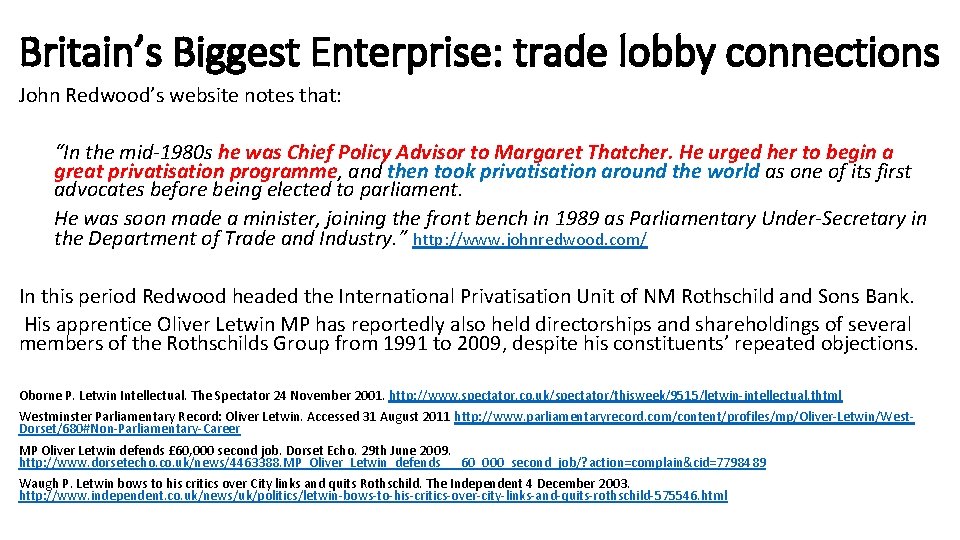
Britain’s Biggest Enterprise: trade lobby connections John Redwood’s website notes that: “In the mid-1980 s he was Chief Policy Advisor to Margaret Thatcher. He urged her to begin a great privatisation programme, and then took privatisation around the world as one of its first advocates before being elected to parliament. He was soon made a minister, joining the front bench in 1989 as Parliamentary Under-Secretary in the Department of Trade and Industry. ” http: //www. johnredwood. com/ In this period Redwood headed the International Privatisation Unit of NM Rothschild and Sons Bank. His apprentice Oliver Letwin MP has reportedly also held directorships and shareholdings of several members of the Rothschilds Group from 1991 to 2009, despite his constituents’ repeated objections. Oborne P. Letwin Intellectual. The Spectator 24 November 2001. http: //www. spectator. co. uk/spectator/thisweek/9515/letwin-intellectual. thtml Westminster Parliamentary Record: Oliver Letwin. Accessed 31 August 2011 http: //www. parliamentaryrecord. com/content/profiles/mp/Oliver-Letwin/West. Dorset/680#Non-Parliamentary-Career MP Oliver Letwin defends £ 60, 000 second job. Dorset Echo. 29 th June 2009. http: //www. dorsetecho. co. uk/news/4463388. MP_Oliver_Letwin_defends___60_000_second_job/? action=complain&cid=7798489 Waugh P. Letwin bows to his critics over City links and quits Rothschild. The Independent 4 December 2003. http: //www. independent. co. uk/news/uk/politics/letwin-bows-to-his-critics-over-city-links-and-quits-rothschild-575546. html
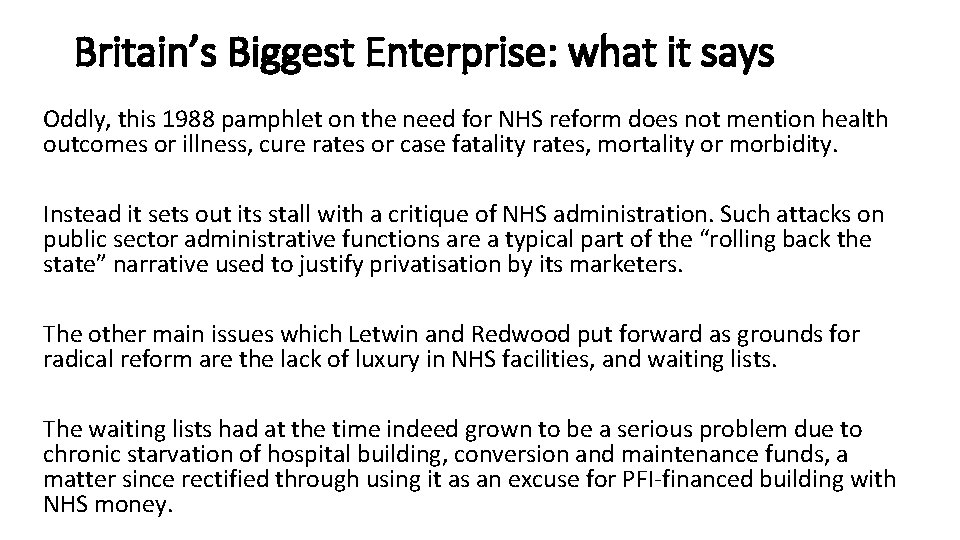
Britain’s Biggest Enterprise: what it says Oddly, this 1988 pamphlet on the need for NHS reform does not mention health outcomes or illness, cure rates or case fatality rates, mortality or morbidity. Instead it sets out its stall with a critique of NHS administration. Such attacks on public sector administrative functions are a typical part of the “rolling back the state” narrative used to justify privatisation by its marketers. The other main issues which Letwin and Redwood put forward as grounds for radical reform are the lack of luxury in NHS facilities, and waiting lists. The waiting lists had at the time indeed grown to be a serious problem due to chronic starvation of hospital building, conversion and maintenance funds, a matter since rectified through using it as an excuse for PFI-financed building with NHS money.
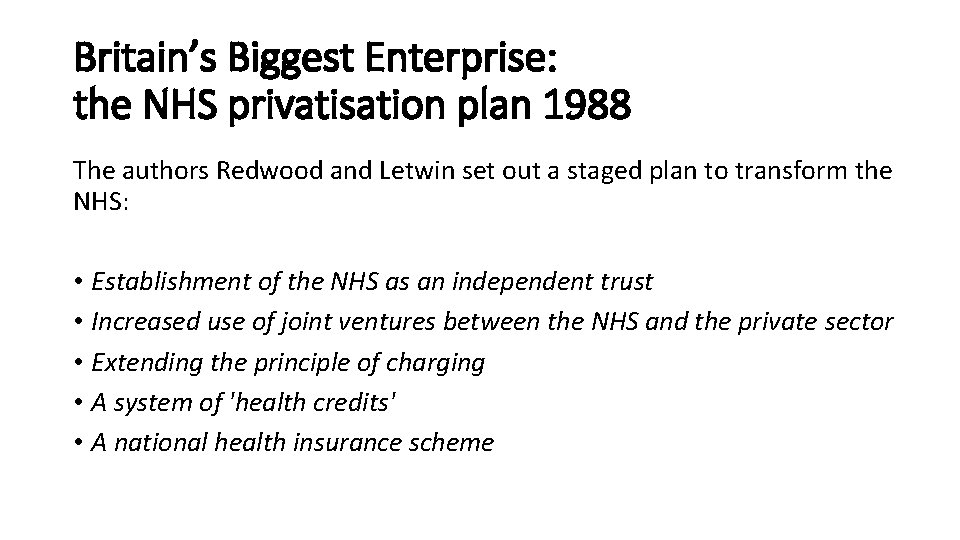
Britain’s Biggest Enterprise: the NHS privatisation plan 1988 The authors Redwood and Letwin set out a staged plan to transform the NHS: • Establishment of the NHS as an independent trust • Increased use of joint ventures between the NHS and the private sector • Extending the principle of charging • A system of 'health credits' • A national health insurance scheme
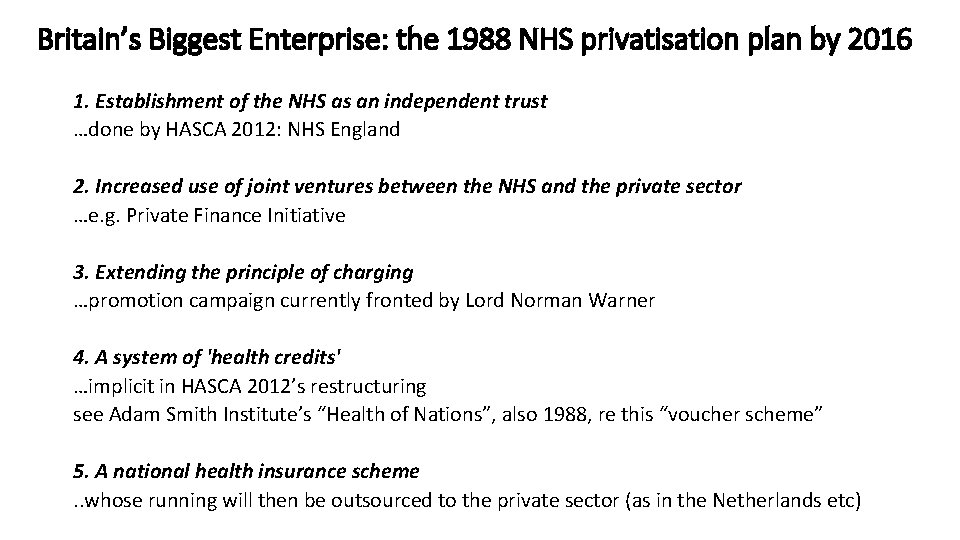
Britain’s Biggest Enterprise: the 1988 NHS privatisation plan by 2016 1. Establishment of the NHS as an independent trust …done by HASCA 2012: NHS England 2. Increased use of joint ventures between the NHS and the private sector …e. g. Private Finance Initiative 3. Extending the principle of charging …promotion campaign currently fronted by Lord Norman Warner 4. A system of 'health credits' …implicit in HASCA 2012’s restructuring see Adam Smith Institute’s “Health of Nations”, also 1988, re this “voucher scheme” 5. A national health insurance scheme. . whose running will then be outsourced to the private sector (as in the Netherlands etc)
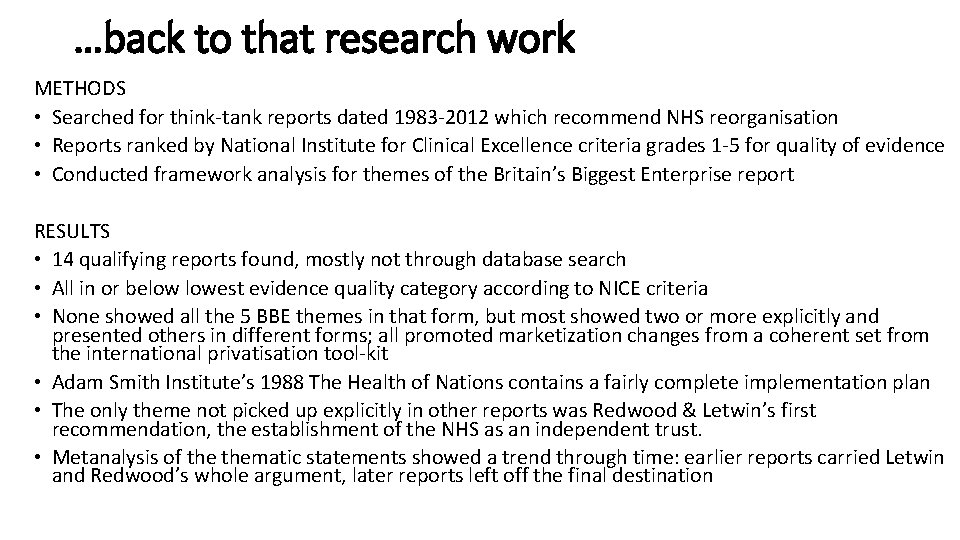
…back to that research work METHODS • Searched for think-tank reports dated 1983 -2012 which recommend NHS reorganisation • Reports ranked by National Institute for Clinical Excellence criteria grades 1 -5 for quality of evidence • Conducted framework analysis for themes of the Britain’s Biggest Enterprise report RESULTS • 14 qualifying reports found, mostly not through database search • All in or below lowest evidence quality category according to NICE criteria • None showed all the 5 BBE themes in that form, but most showed two or more explicitly and presented others in different forms; all promoted marketization changes from a coherent set from the international privatisation tool-kit • Adam Smith Institute’s 1988 The Health of Nations contains a fairly complete implementation plan • The only theme not picked up explicitly in other reports was Redwood & Letwin’s first recommendation, the establishment of the NHS as an independent trust. • Metanalysis of thematic statements showed a trend through time: earlier reports carried Letwin and Redwood’s whole argument, later reports left off the final destination
If he who pays the piper calls the tune….
…can we tell who paid the piper by examining the tune?
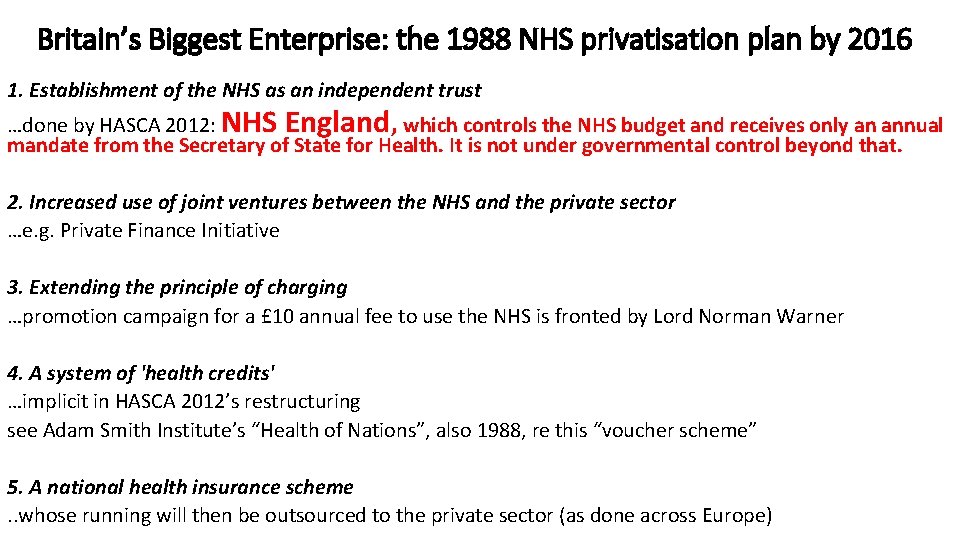
Britain’s Biggest Enterprise: the 1988 NHS privatisation plan by 2016 1. Establishment of the NHS as an independent trust …done by HASCA 2012: NHS England, which controls the NHS budget and receives only an annual mandate from the Secretary of State for Health. It is not under governmental control beyond that. 2. Increased use of joint ventures between the NHS and the private sector …e. g. Private Finance Initiative 3. Extending the principle of charging …promotion campaign for a £ 10 annual fee to use the NHS is fronted by Lord Norman Warner 4. A system of 'health credits' …implicit in HASCA 2012’s restructuring see Adam Smith Institute’s “Health of Nations”, also 1988, re this “voucher scheme” 5. A national health insurance scheme. . whose running will then be outsourced to the private sector (as done across Europe)
Simon Stevens’ CV: groomed to run NHS privatisation ØBA in Philosophy, Politics and Economics (PPE, Oxford) 1987 ØLed economics team in debt-forced privatisation of Guyana Sugar Corporation, aged only 21, 1987 -1988
Simon Stevens’ CV: groomed to run NHS privatisation Taken on to NHS Graduate Management programme and employed 1988 – 1994 and 1995 - 1997 to manage hospitals, including • “Group Manager” at privatisation pioneers Guy’s & St Thomas • General Manager for Mental Health Services for North Tyneside & Northumberland Mental Health Services • Director of East Sussex, Brighton and Hove Health Authority;
Simon Stevens’ CV: groomed to run NHS privatisation Sent to New York State Health Department to learn about US healthcare financing through insurance 1994 – 1995; MBA Strathclyde 1996 (Master’s in Business Administration) Worked on EU-funded debt-forced healthcare privatisation on Malawi/Mozambique border, and co-wrote a chapter of an International Monetary Fund privatisation manual, 1998
Simon Stevens’ CV: groomed to run NHS privatisation Health policy adviser to government 1997 - 2004, for Frank Dobson, Alan Milburn and Tony Blair • Oversaw incorporation of NHS facilities as “Foundation Trust Hospitals” and introduction of the first external market in the NHS in 2006 • Set up arrangements for United. Health to be a preferred provider in the NHS, allowing it to run GP surgeries • Attracted criticism for lobbying for United. Health contracts in the NHS, September 2004;
Simon Stevens’ CV: groomed to run NHS privatisation United. Health Group Vice-President and/or Chief Executive Officer of United. Health group companies 2004 – 2014 • His duties at United. Health included lobbying for the NHS to be included in the Transatlantic Trade and Investment Partnership (TTIP) Since 2014, he has been at the head of NHS England, in charge of implementing the five-year plan for “integrated care” which is the very insurance-based NHS privatisation plan set out in the CPS pamphlet in 1988.
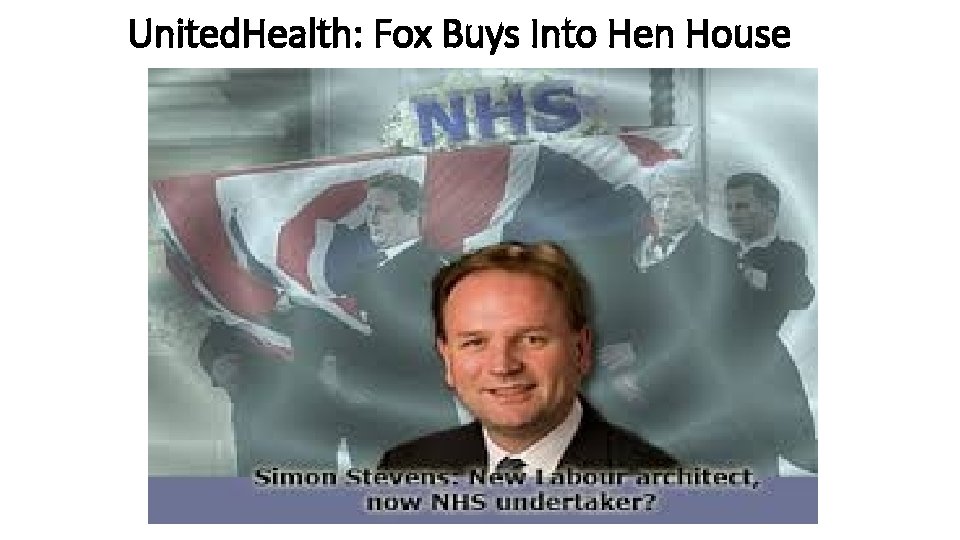
United. Health: Fox Buys Into Hen House
Britain’s Biggest Enterprise: what lies beneath
THE END