
The Sonnet Form History of the Sonnet form

- Slides: 11
The Sonnet Form
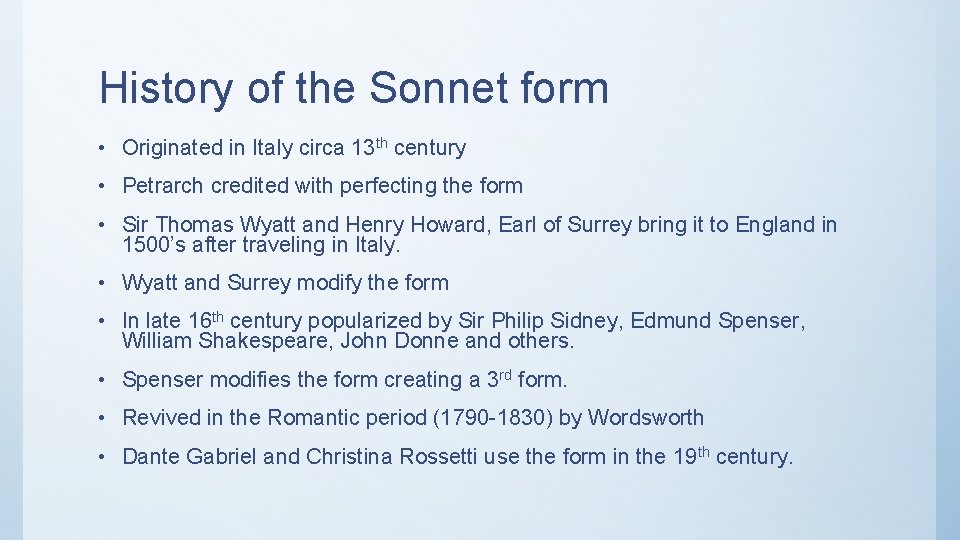
History of the Sonnet form • Originated in Italy circa 13 th century • Petrarch credited with perfecting the form • Sir Thomas Wyatt and Henry Howard, Earl of Surrey bring it to England in 1500’s after traveling in Italy. • Wyatt and Surrey modify the form • In late 16 th century popularized by Sir Philip Sidney, Edmund Spenser, William Shakespeare, John Donne and others. • Spenser modifies the form creating a 3 rd form. • Revived in the Romantic period (1790 -1830) by Wordsworth • Dante Gabriel and Christina Rossetti use the form in the 19 th century.
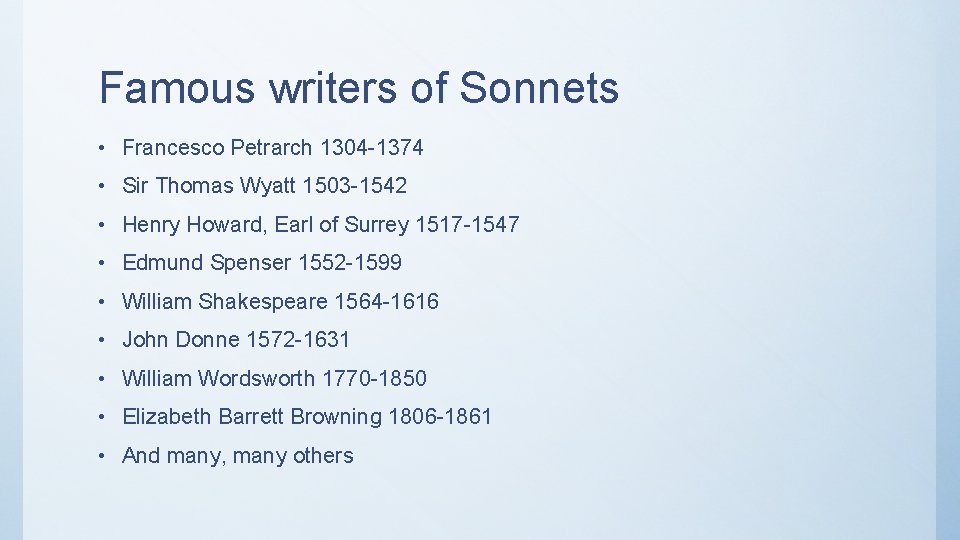
Famous writers of Sonnets • Francesco Petrarch 1304 -1374 • Sir Thomas Wyatt 1503 -1542 • Henry Howard, Earl of Surrey 1517 -1547 • Edmund Spenser 1552 -1599 • William Shakespeare 1564 -1616 • John Donne 1572 -1631 • William Wordsworth 1770 -1850 • Elizabeth Barrett Browning 1806 -1861 • And many, many others
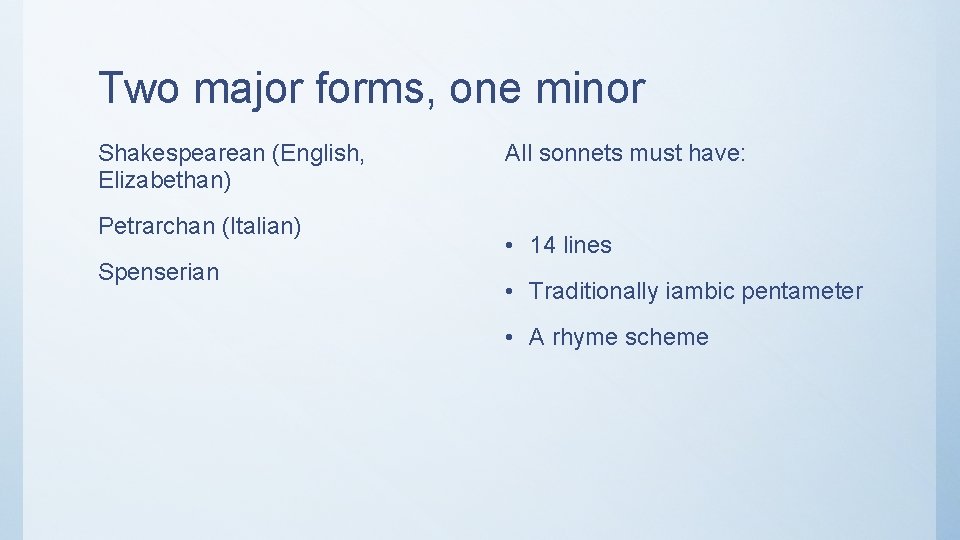
Two major forms, one minor Shakespearean (English, Elizabethan) Petrarchan (Italian) Spenserian All sonnets must have: • 14 lines • Traditionally iambic pentameter • A rhyme scheme
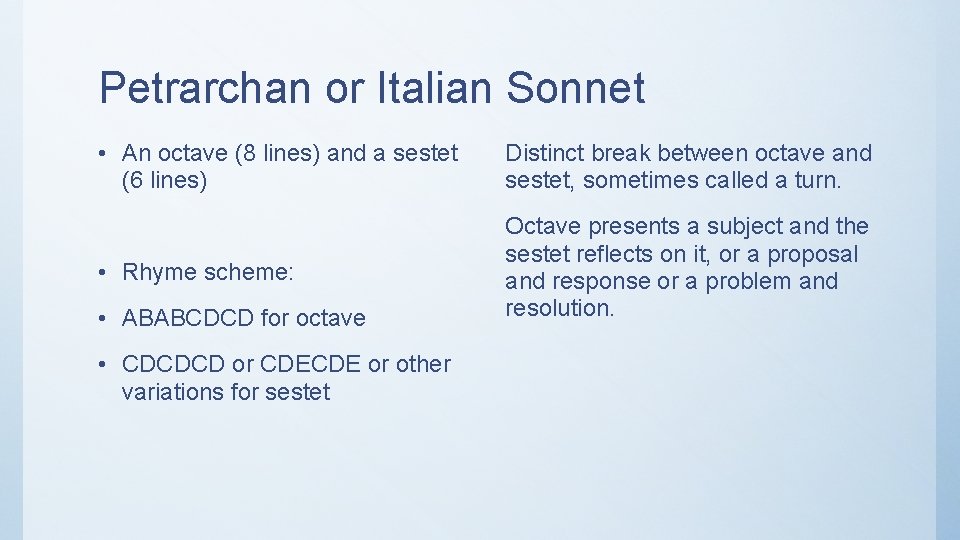
Petrarchan or Italian Sonnet • An octave (8 lines) and a sestet (6 lines) Distinct break between octave and sestet, sometimes called a turn. • Rhyme scheme: Octave presents a subject and the sestet reflects on it, or a proposal and response or a problem and resolution. • ABABCDCD for octave • CDCDCD or CDECDE or other variations for sestet
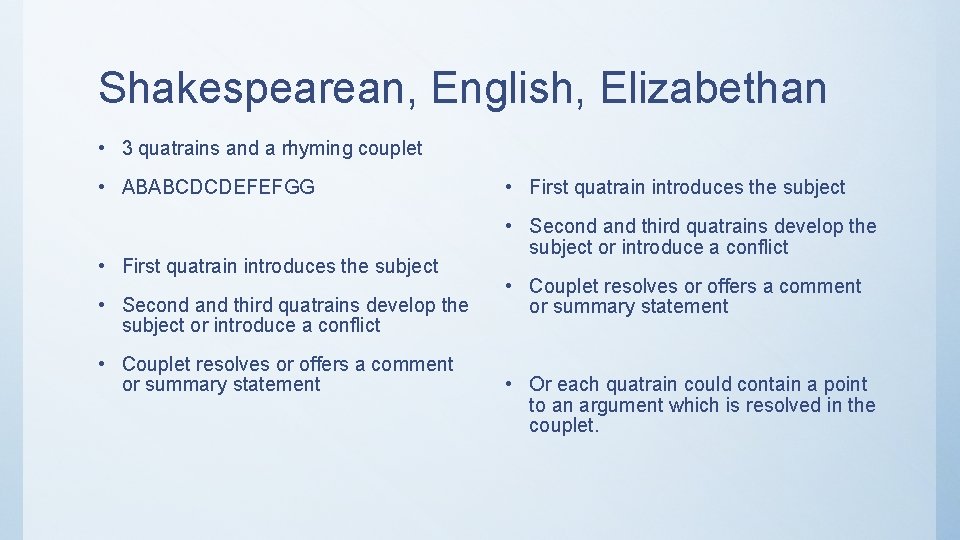
Shakespearean, English, Elizabethan • 3 quatrains and a rhyming couplet • ABABCDCDEFEFGG • First quatrain introduces the subject • Second and third quatrains develop the subject or introduce a conflict • Couplet resolves or offers a comment or summary statement • Or each quatrain could contain a point to an argument which is resolved in the couplet.
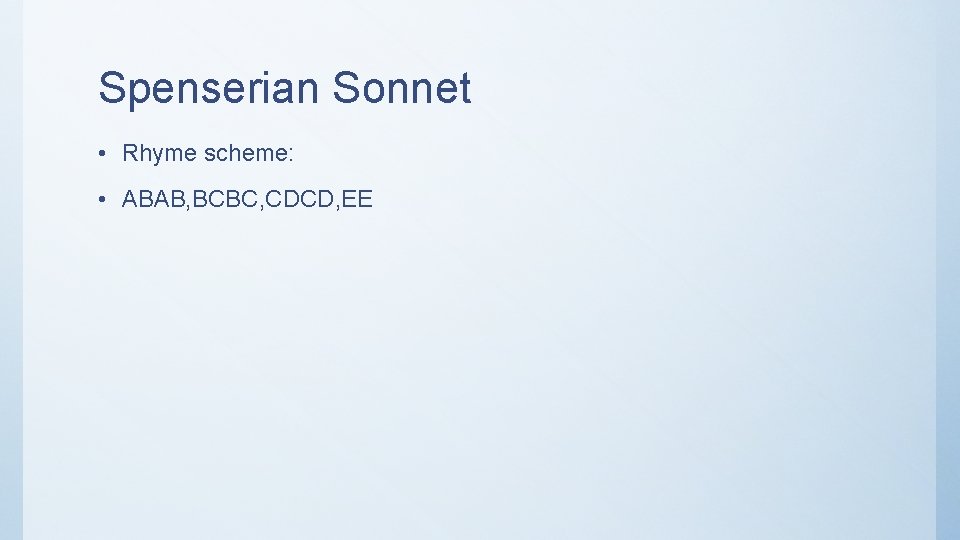
Spenserian Sonnet • Rhyme scheme: • ABAB, BCBC, CDCD, EE
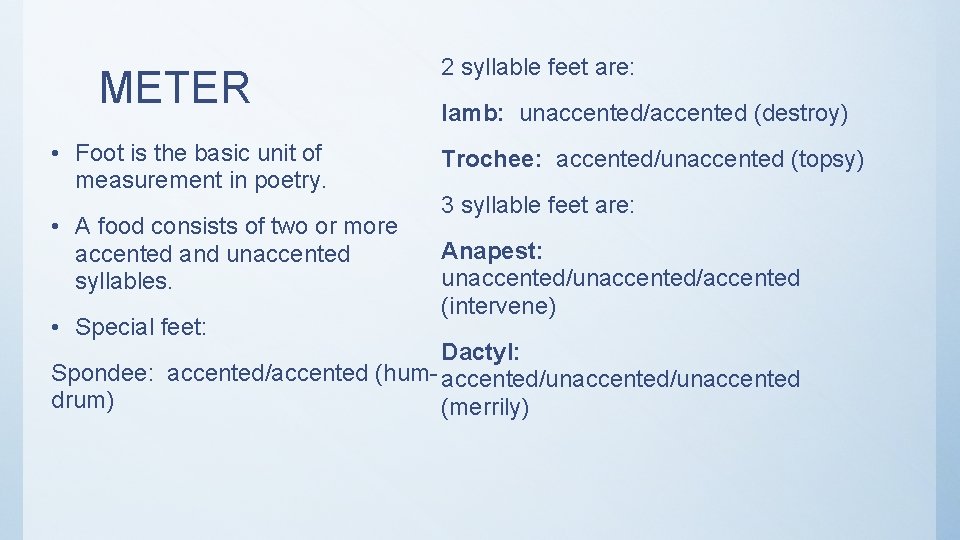
METER • Foot is the basic unit of measurement in poetry. • A food consists of two or more accented and unaccented syllables. • Special feet: 2 syllable feet are: Iamb: unaccented/accented (destroy) Trochee: accented/unaccented (topsy) 3 syllable feet are: Anapest: unaccented/accented (intervene) Dactyl: Spondee: accented/accented (hum- accented/unaccented drum) (merrily)
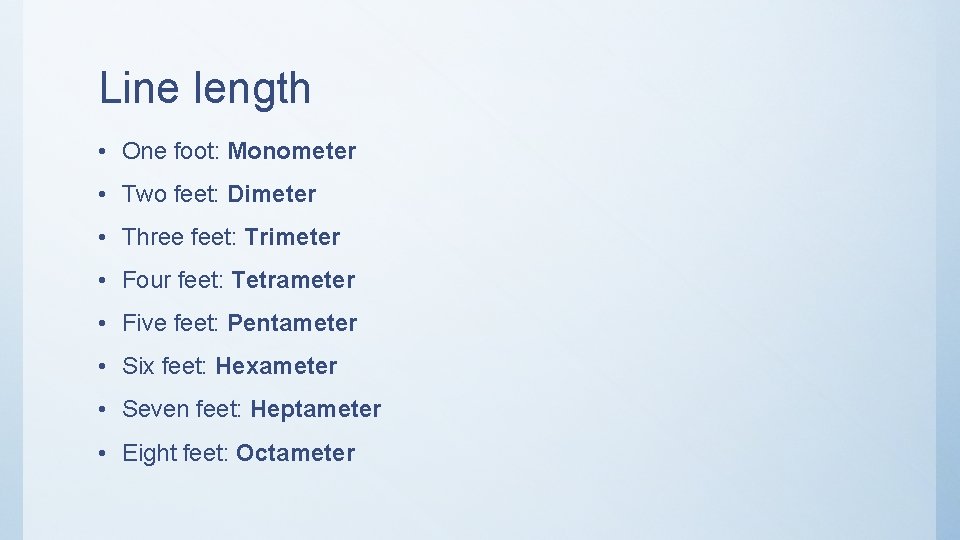
Line length • One foot: Monometer • Two feet: Dimeter • Three feet: Trimeter • Four feet: Tetrameter • Five feet: Pentameter • Six feet: Hexameter • Seven feet: Heptameter • Eight feet: Octameter
Composed Upon Westminster Bridge -William Wordsworth Earth has not anything to show more fair: Dull would he be of soul who could pass by A sight so touching in its majesty: This City now doth, like a garment, wear The beauty of the morning; silent, bare, Ships, towers, domes, theatres, and temples lie Open unto the fields, and to the sky; All bright and glittering in the smokeless air. Never did sun more beautifully steep In his first splendour, valley, rock, or hill; Ne’er saw I, never felt, a calm so deep! The river glideth at his own sweet will: Dear God! the very houses seem asleep; And all that mighty heart is lying still!
Dawn in New York Claude Mc. Kay The Dawn! The crimson-tinted, comes Out of the low still skies, over the hills, Manhattan's roofs and spires and cheerless domes! The Dawn! My spirit to its spirit thrills. Almost the mighty city is asleep, No pushing crowd, no tramping, tramping feet. But here and there a few cars groaning creep Along, above, and underneath the street, Bearing their strangely-ghostly burdens by, The women and the men of garish nights, Their eyes wine-weakened and their clothes awry, Grotesques beneath the strong electric lights. The shadows wane. The Dawn comes to New York. And I go darkly-rebel to my work.