
The Solubility Product Constant Ksp Many ionic compounds
The Solubility Product Constant, Ksp • Many ionic compounds are only slightly soluble in water and equations are written to represent the equilibrium between the compound and the ions present in a saturated aqueous solution. • The equilibrium system is a heterogeneous system. • The solubility product constant, Ksp, is the product of the concentrations of the ions involved in a solubility equilibrium, each raised to a power equal to the stoichiometric coefficient of that ion in the chemical equation for the equilibrium.
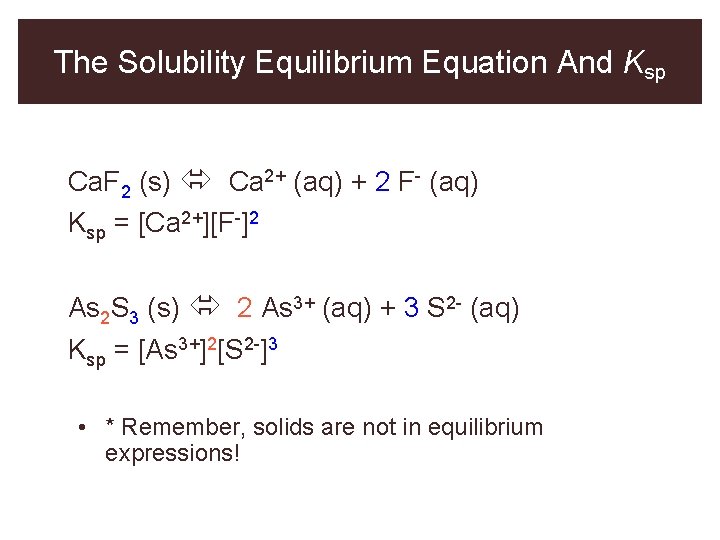
The Solubility Equilibrium Equation And Ksp Ca. F 2 (s) Ca 2+ (aq) + 2 F- (aq) Ksp = [Ca 2+][F-]2 As 2 S 3 (s) 2 As 3+ (aq) + 3 S 2 - (aq) Ksp = [As 3+]2[S 2 -]3 • * Remember, solids are not in equilibrium expressions!
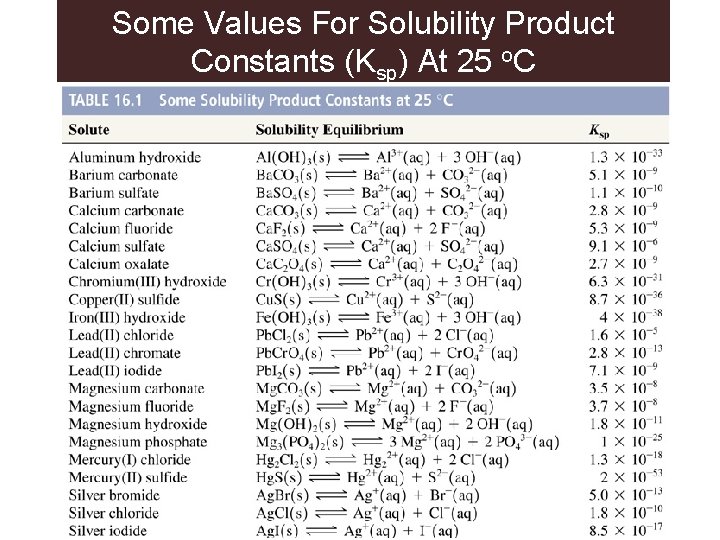
Some Values For Solubility Product Constants (Ksp) At 25 o. C
Ksp And Molar Solubility • The solubility product constant (Ksp) is related to the solubility of an ionic solute, but Ksp and Molar Solubility are not the same thing. • Molar Solubility - the molarity (concentration) of a solute in a saturated aqueous solution • Calculating solubility equilibria fall into two categories: – determining a value of Ksp from experimental data – calculating equilibrium concentrations when Ksp is known.
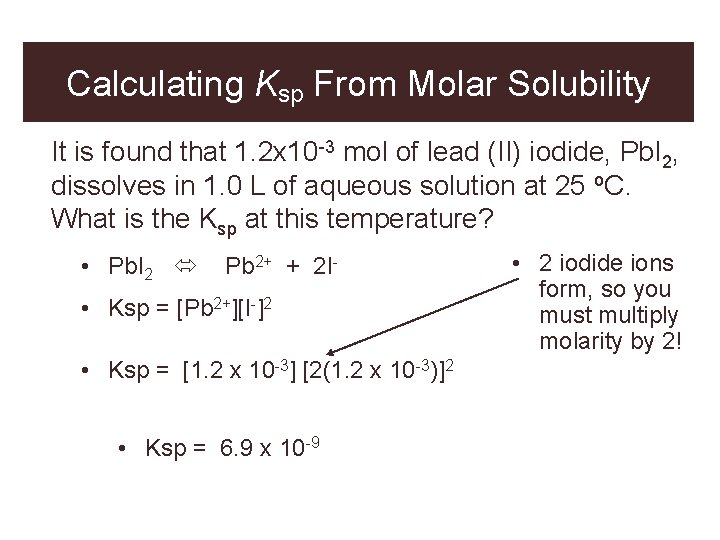
Calculating Ksp From Molar Solubility It is found that 1. 2 x 10 -3 mol of lead (II) iodide, Pb. I 2, dissolves in 1. 0 L of aqueous solution at 25 o. C. What is the Ksp at this temperature? • Pb. I 2 Pb 2+ + 2 I- • Ksp = [Pb 2+][I-]2 • Ksp = [1. 2 x 10 -3] [2(1. 2 x 10 -3)]2 • Ksp = 6. 9 x 10 -9 • 2 iodide ions form, so you must multiply molarity by 2!
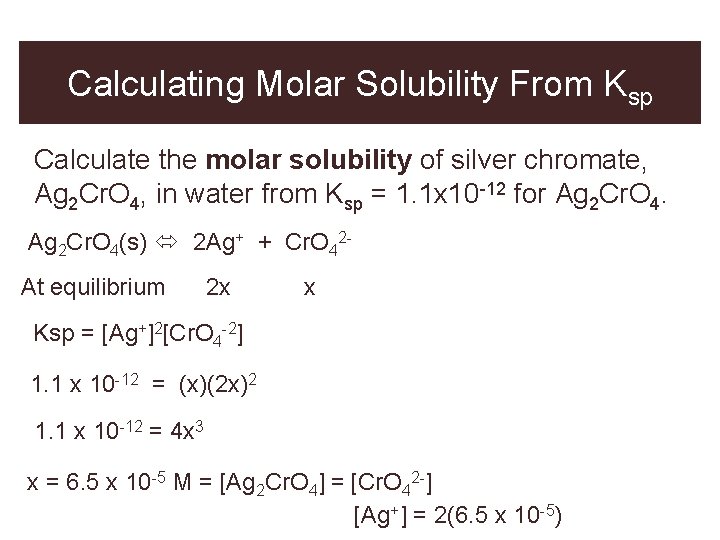
Calculating Molar Solubility From Ksp Calculate the molar solubility of silver chromate, Ag 2 Cr. O 4, in water from Ksp = 1. 1 x 10 -12 for Ag 2 Cr. O 4(s) 2 Ag+ + Cr. O 42 At equilibrium 2 x x Ksp = [Ag+]2[Cr. O 4 -2] 1. 1 x 10 -12 = (x)(2 x)2 1. 1 x 10 -12 = 4 x 3 x = 6. 5 x 10 -5 M = [Ag 2 Cr. O 4] = [Cr. O 42 -] [Ag+] = 2(6. 5 x 10 -5)
Try These • Page 464 #1 -4 Prentice-Hall © 2002 Chapter Sixteen Slide 7 of 32
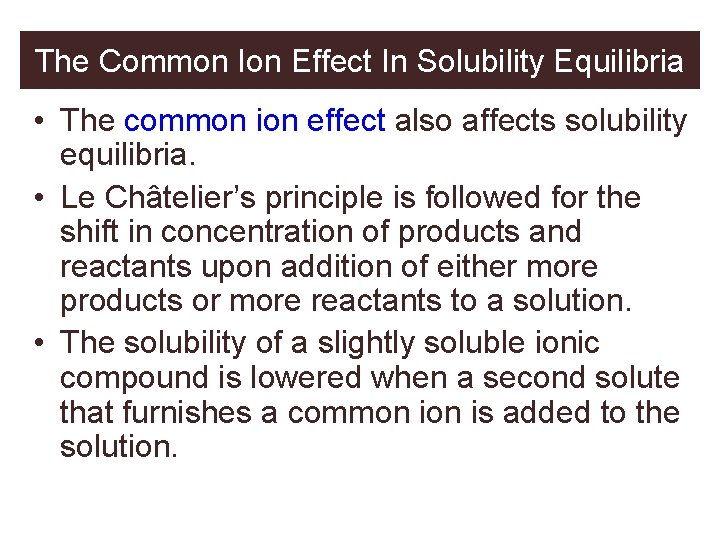
The Common Ion Effect In Solubility Equilibria • The common ion effect also affects solubility equilibria. • Le Châtelier’s principle is followed for the shift in concentration of products and reactants upon addition of either more products or more reactants to a solution. • The solubility of a slightly soluble ionic compound is lowered when a second solute that furnishes a common is added to the solution.
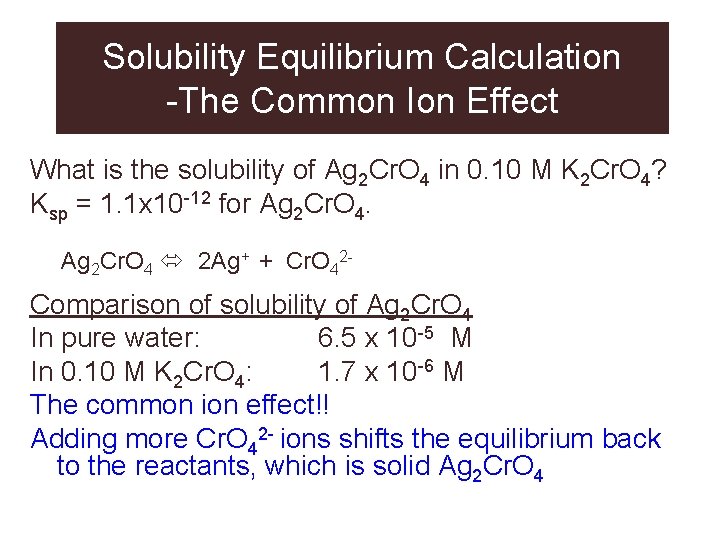
Solubility Equilibrium Calculation -The Common Ion Effect What is the solubility of Ag 2 Cr. O 4 in 0. 10 M K 2 Cr. O 4? Ksp = 1. 1 x 10 -12 for Ag 2 Cr. O 4 2 Ag+ + Cr. O 42 - Comparison of solubility of Ag 2 Cr. O 4 In pure water: 6. 5 x 10 -5 M In 0. 10 M K 2 Cr. O 4: 1. 7 x 10 -6 M The common ion effect!! Adding more Cr. O 42 - ions shifts the equilibrium back to the reactants, which is solid Ag 2 Cr. O 4
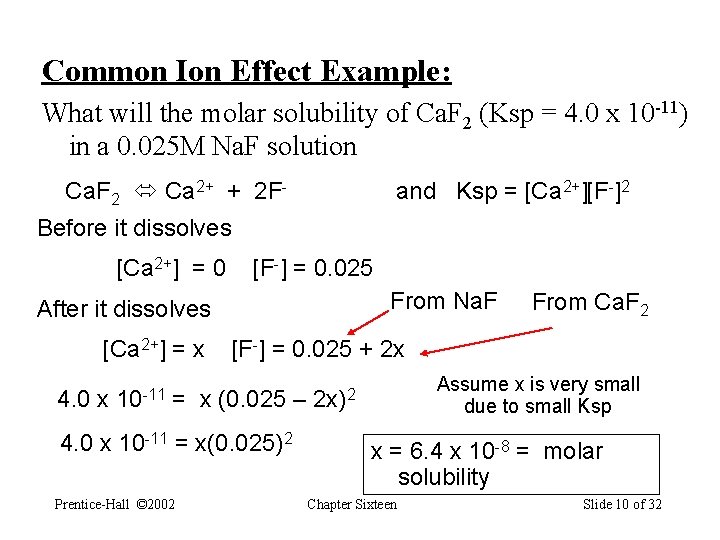
Common Ion Effect Example: What will the molar solubility of Ca. F 2 (Ksp = 4. 0 x 10 -11) in a 0. 025 M Na. F solution Ca. F 2 Ca 2+ + 2 F- and Ksp = [Ca 2+][F-]2 Before it dissolves [Ca 2+] = 0 [F-] = 0. 025 From Na. F After it dissolves [Ca 2+] = x 4. 0 x 10 -11 [F-] = 0. 025 + 2 x = x (0. 025 – 4. 0 x 10 -11 = x(0. 025)2 Prentice-Hall © 2002 From Ca. F 2 Assume x is very small due to small Ksp 2 x)2 x = 6. 4 x 10 -8 = molar solubility Chapter Sixteen Slide 10 of 32
Try These • Page 470 #1 -3 Prentice-Hall © 2002 Chapter Sixteen Slide 11 of 32
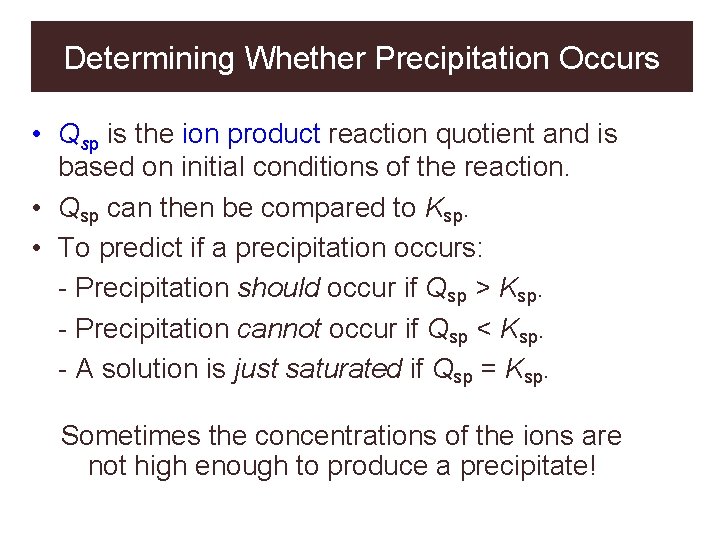
Determining Whether Precipitation Occurs • Qsp is the ion product reaction quotient and is based on initial conditions of the reaction. • Qsp can then be compared to Ksp. • To predict if a precipitation occurs: - Precipitation should occur if Qsp > Ksp. - Precipitation cannot occur if Qsp < Ksp. - A solution is just saturated if Qsp = Ksp. Sometimes the concentrations of the ions are not high enough to produce a precipitate!
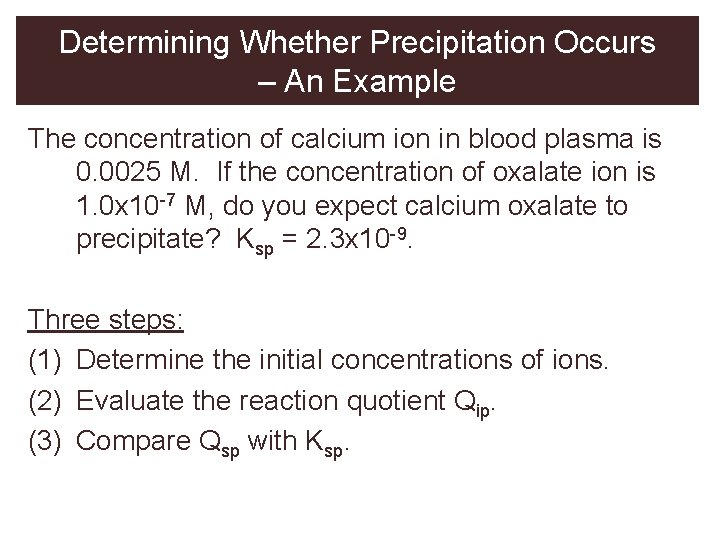
Determining Whether Precipitation Occurs – An Example The concentration of calcium ion in blood plasma is 0. 0025 M. If the concentration of oxalate ion is 1. 0 x 10 -7 M, do you expect calcium oxalate to precipitate? Ksp = 2. 3 x 10 -9. Three steps: (1) Determine the initial concentrations of ions. (2) Evaluate the reaction quotient Qip. (3) Compare Qsp with Ksp.
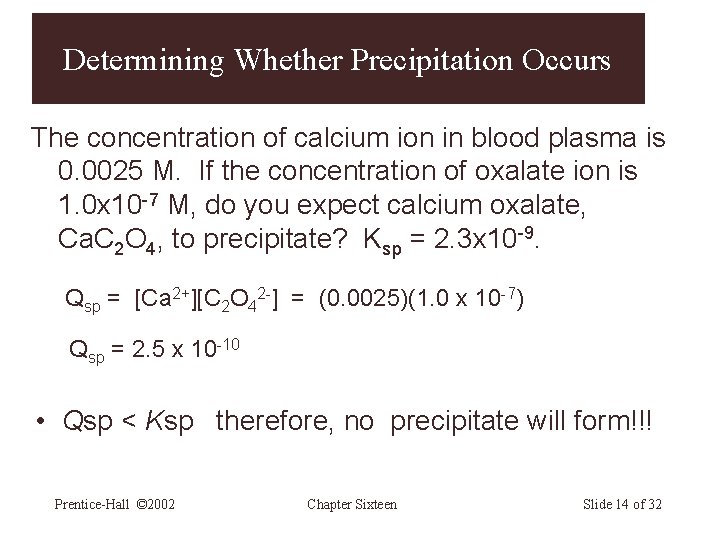
Determining Whether Precipitation Occurs The concentration of calcium ion in blood plasma is 0. 0025 M. If the concentration of oxalate ion is 1. 0 x 10 -7 M, do you expect calcium oxalate, Ca. C 2 O 4, to precipitate? Ksp = 2. 3 x 10 -9. Qsp = [Ca 2+][C 2 O 42 -] = (0. 0025)(1. 0 x 10 -7) Qsp = 2. 5 x 10 -10 • Qsp < Ksp therefore, no precipitate will form!!! Prentice-Hall © 2002 Chapter Sixteen Slide 14 of 32
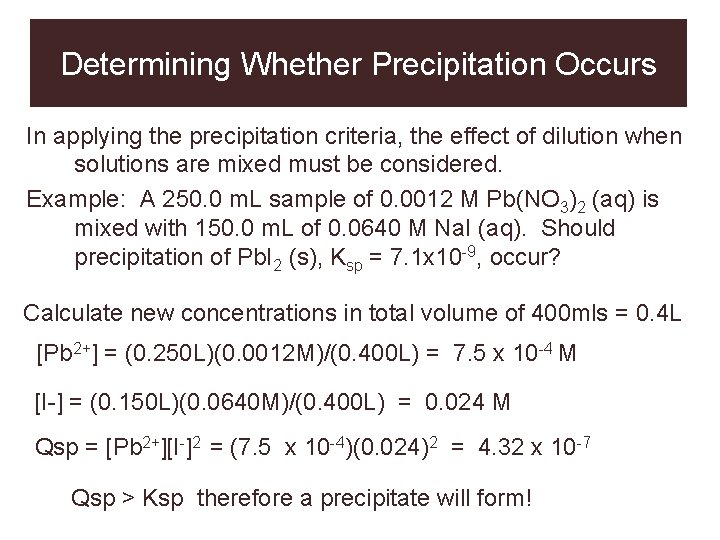
Determining Whether Precipitation Occurs In applying the precipitation criteria, the effect of dilution when solutions are mixed must be considered. Example: A 250. 0 m. L sample of 0. 0012 M Pb(NO 3)2 (aq) is mixed with 150. 0 m. L of 0. 0640 M Na. I (aq). Should precipitation of Pb. I 2 (s), Ksp = 7. 1 x 10 -9, occur? Calculate new concentrations in total volume of 400 mls = 0. 4 L [Pb 2+] = (0. 250 L)(0. 0012 M)/(0. 400 L) = 7. 5 x 10 -4 M [I-] = (0. 150 L)(0. 0640 M)/(0. 400 L) = 0. 024 M Qsp = [Pb 2+][I-]2 = (7. 5 x 10 -4)(0. 024)2 = 4. 32 x 10 -7 Qsp > Ksp therefore a precipitate will form!
Try These • Page 468 #1 -4 Prentice-Hall © 2002 Chapter Sixteen Slide 16 of 32
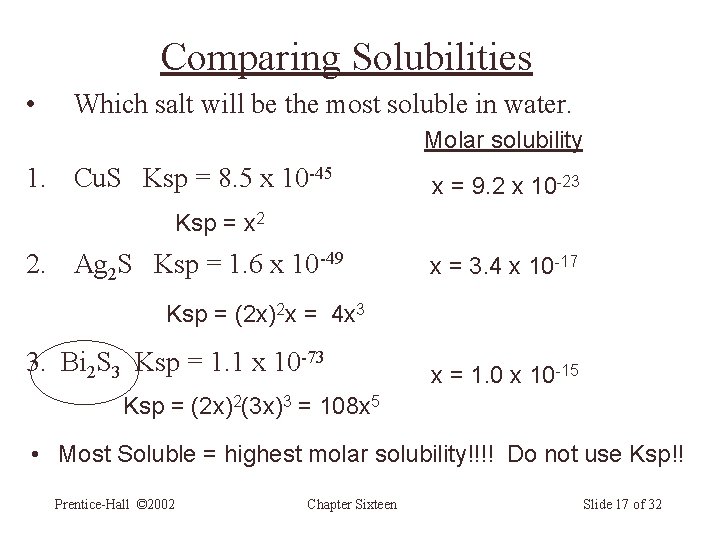
Comparing Solubilities • Which salt will be the most soluble in water. Molar solubility 1. Cu. S Ksp = 8. 5 x 10 -45 x = 9. 2 x 10 -23 Ksp = x 2 2. Ag 2 S Ksp = 1. 6 x 10 -49 x = 3. 4 x 10 -17 Ksp = (2 x)2 x = 4 x 3 3. Bi 2 S 3 Ksp = 1. 1 x 10 -73 x = 1. 0 x 10 -15 Ksp = (2 x)2(3 x)3 = 108 x 5 • Most Soluble = highest molar solubility!!!! Do not use Ksp!! Prentice-Hall © 2002 Chapter Sixteen Slide 17 of 32
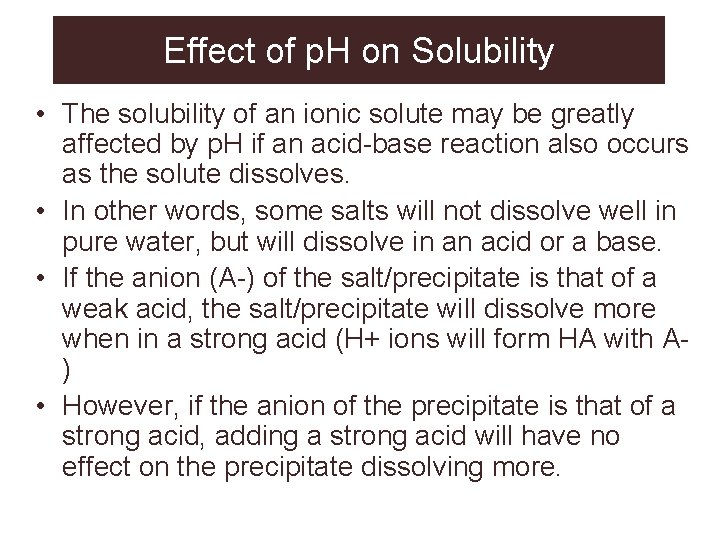
Effect of p. H on Solubility • The solubility of an ionic solute may be greatly affected by p. H if an acid-base reaction also occurs as the solute dissolves. • In other words, some salts will not dissolve well in pure water, but will dissolve in an acid or a base. • If the anion (A-) of the salt/precipitate is that of a weak acid, the salt/precipitate will dissolve more when in a strong acid (H+ ions will form HA with A) • However, if the anion of the precipitate is that of a strong acid, adding a strong acid will have no effect on the precipitate dissolving more.
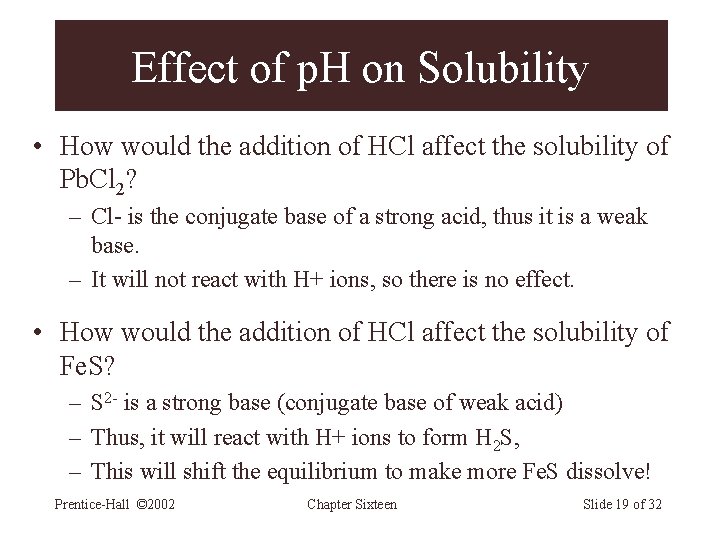
Effect of p. H on Solubility • How would the addition of HCl affect the solubility of Pb. Cl 2? – Cl- is the conjugate base of a strong acid, thus it is a weak base. – It will not react with H+ ions, so there is no effect. • How would the addition of HCl affect the solubility of Fe. S? – S 2 - is a strong base (conjugate base of weak acid) – Thus, it will react with H+ ions to form H 2 S, – This will shift the equilibrium to make more Fe. S dissolve! Prentice-Hall © 2002 Chapter Sixteen Slide 19 of 32
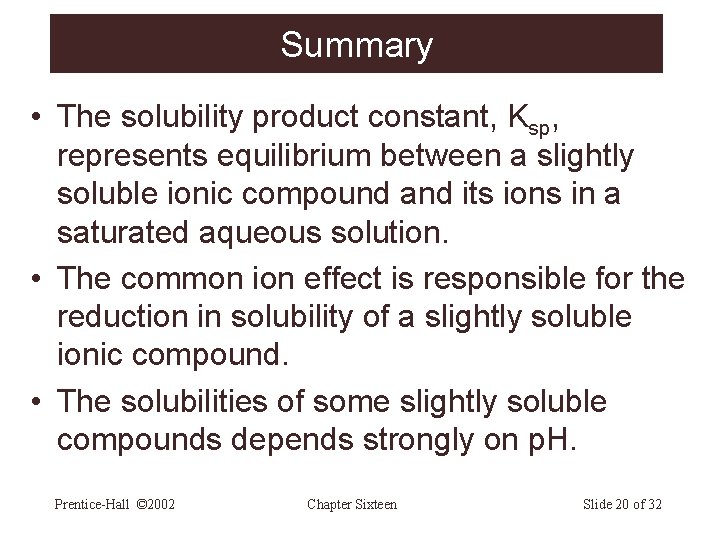
Summary • The solubility product constant, Ksp, represents equilibrium between a slightly soluble ionic compound and its ions in a saturated aqueous solution. • The common ion effect is responsible for the reduction in solubility of a slightly soluble ionic compound. • The solubilities of some slightly soluble compounds depends strongly on p. H. Prentice-Hall © 2002 Chapter Sixteen Slide 20 of 32
Qualitative Inorganic Analysis • Acid-base chemistry, precipitation reactions, oxidation-reduction, and complex-ion formation all come into sharp focus in an area of analytical chemistry called classical qualitative inorganic analysis. • “Qualitative” signifies that the interest is in determining what is present, not how much is present. • Although classical qualitative analysis is not as widely used today as instrumental methods, it is still a good vehicle for applying all the basic concepts of equilibria in aqueous solutions.
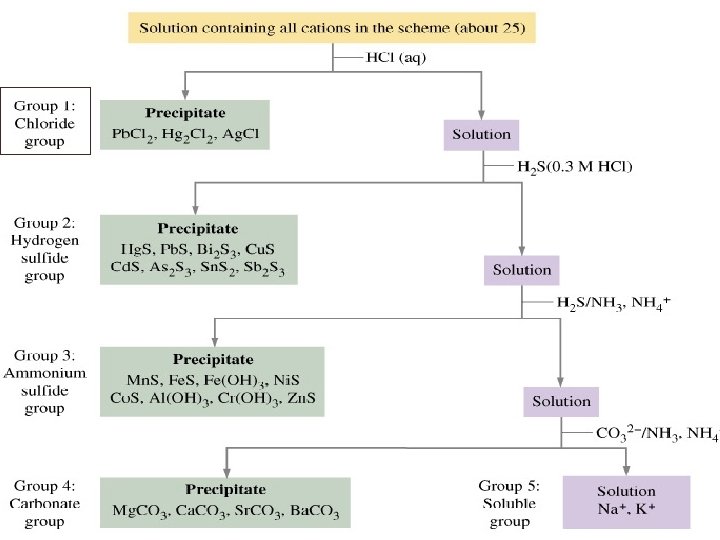
Cations of Group 1 • If aqueous HCl is added to an unknown solution of cations, and a precipitate forms, then the unknown contains one or more of these cations: Pb 2+, Hg 22+, or Ag+. • These are the only ions to form insoluble chlorides. • If there is no precipitate, then these ions must be absent from the mixture. • If there is a precipitate, it is filtered off and saved for further analysis. • The supernatant liquid is also saved for further analysis.
Cation Group 1 (continued) Analyzing For Pb 2+ • Of the three possible ions in solution, Pb. Cl 2 is the most soluble in water. • The precipitate is washed with hot water and the washings then treated with aqueous K 2 Cr. O 4. • If Pb 2+ is present, chromate ion combines with lead ion to form a precipitate of yellow lead chromate, which is less soluble than Pb. Cl 2. • If Pb 2+ is absent, then the washings just become tinged yellow but no precipitate is in evidence.
Cation Group 1 (continued) Analyzing For Ag+ • Next, the undissolved precipitate is treated with aqueous ammonia. • If Ag. Cl is present, it will dissolve in this solution. • If there is any remaining precipitate, it is separated from the supernatant liquid and saved for further analysis. • The supernatant liquid (which contains the Ag+, if present) is then treated with aqueous nitric acid. • If a precipitate reforms, then Ag+ was present in the solution, if no precipitate forms, then Ag+ was not present in the solution.
Cation Group 1 (continued) Analyzing For Hg 22+ • When precipitate was treated with aqueous ammonia in the previous step, any Hg 22+ underwent an oxidation-reduction reaction to form a dark gray mixture of elemental mercury and Hg. NH 2 Cl that precipitates from the solution. • If this dark gray precipitate was observed, then mercury was present in the original unknown sample. • If this dark gray precipitate was not observed, then mercury must have been absent from the original unknown sample.
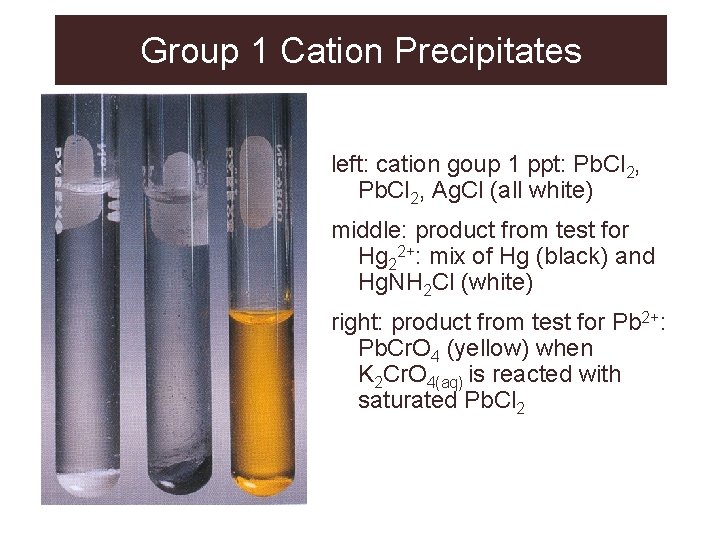
Group 1 Cation Precipitates left: cation goup 1 ppt: Pb. Cl 2, Ag. Cl (all white) middle: product from test for Hg 22+: mix of Hg (black) and Hg. NH 2 Cl (white) right: product from test for Pb 2+: Pb. Cr. O 4 (yellow) when K 2 Cr. O 4(aq) is reacted with saturated Pb. Cl 2
- Slides: 27