
The Solar System See body of Powerpoint for
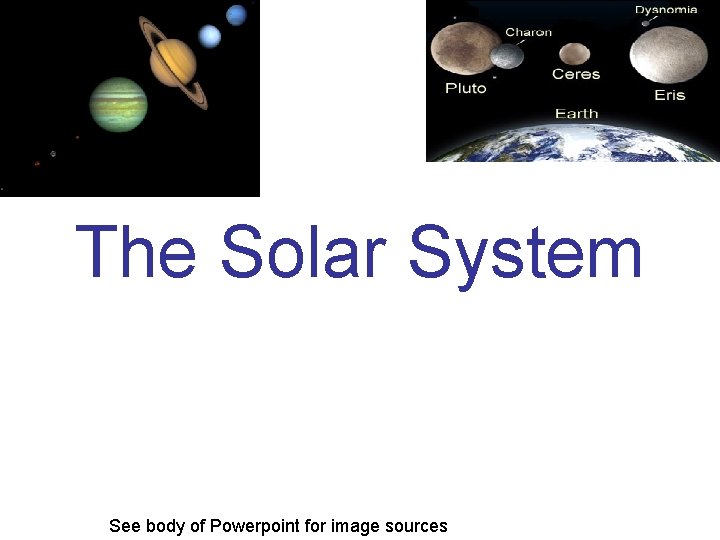
The Solar System See body of Powerpoint for image sources
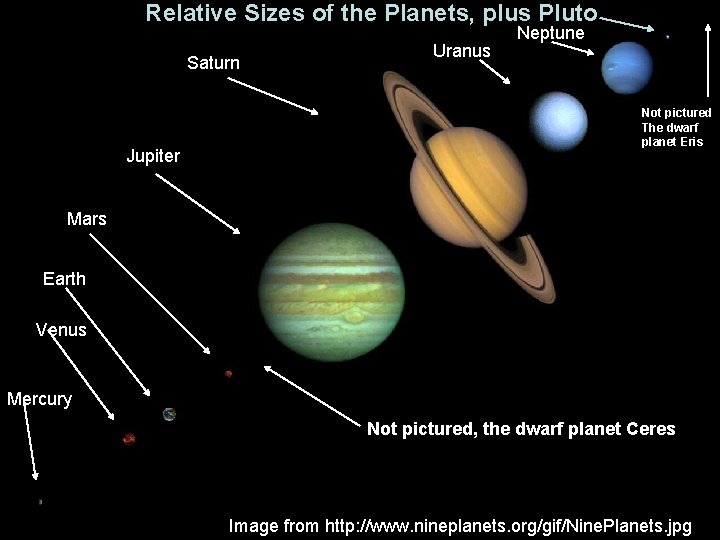
Relative Sizes of the Planets, plus Pluto Saturn Jupiter Uranus Neptune Not pictured The dwarf planet Eris Mars Earth Venus Mercury Not pictured, the dwarf planet Ceres 2 Image from http: //www. nineplanets. org/gif/Nine. Planets. jpg
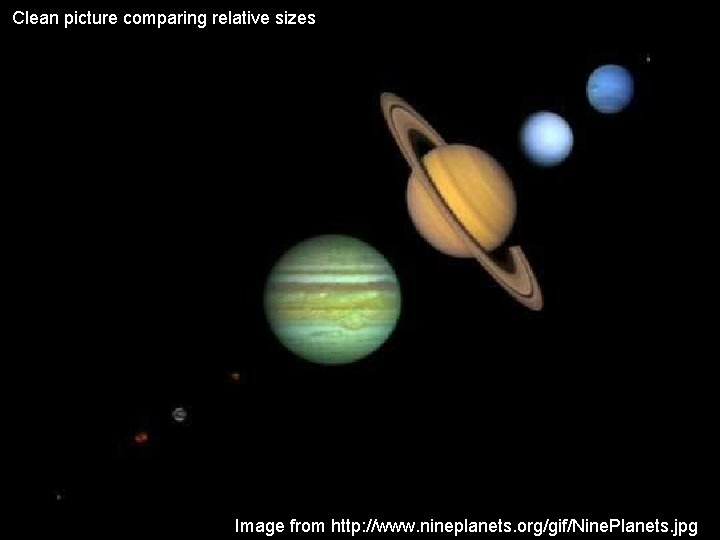
Clean picture comparing relative sizes 3 Image from http: //www. nineplanets. org/gif/Nine. Planets. jpg
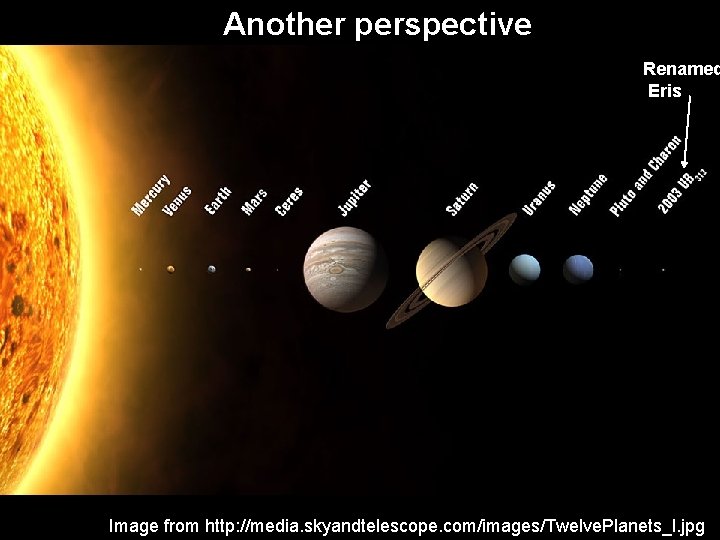
Another perspective Renamed Eris 4 Image from http: //media. skyandtelescope. com/images/Twelve. Planets_l. jpg
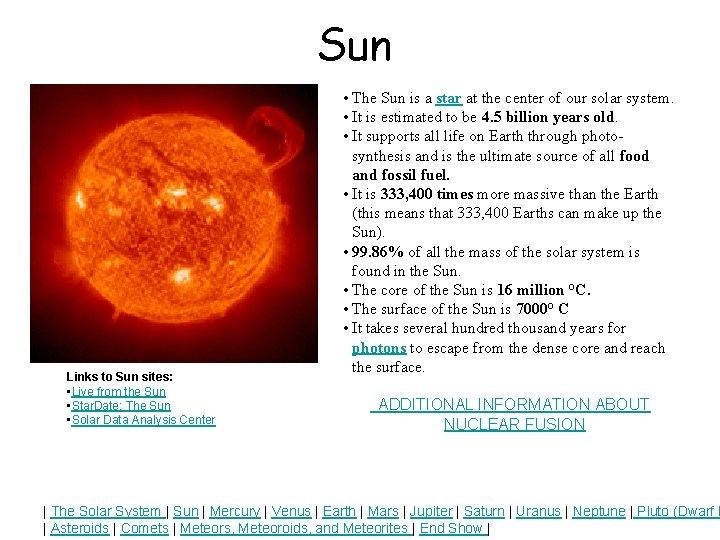
Sun Links to Sun sites: • Live from the Sun • Star. Date: The Sun • Solar Data Analysis Center • The Sun is a star at the center of our solar system. • It is estimated to be 4. 5 billion years old. • It supports all life on Earth through photosynthesis and is the ultimate source of all food and fossil fuel. • It is 333, 400 times more massive than the Earth (this means that 333, 400 Earths can make up the Sun). • 99. 86% of all the mass of the solar system is found in the Sun. • The core of the Sun is 16 million °C. • The surface of the Sun is 7000° C • It takes several hundred thousand years for photons to escape from the dense core and reach the surface. ADDITIONAL INFORMATION ABOUT NUCLEAR FUSION | The Solar System | Sun | Mercury | Venus | Earth | Mars | Jupiter | Saturn | Uranus | Neptune | Pluto (Dwarf P | Asteroids | Comets | Meteors, Meteoroids, and Meteorites | End Show |
Nuclear Fusion in the Sun The Sun is basically a huge ball of hydrogen gas held together by the gravity created by its own mass. Under the intense pressure created at the center of the Sun by gravity, hydrogen nuclei are fused together to produce helium nuclei. Very simply stated, four hydrogen nuclei are fused into one helium nucleus, however one helium atom has less mass than four hydrogen atoms. The fusion process releases enough energy to account for the lost mass. The energy released by nuclear fusion in the Sun's core heats the Sun. The hot Sun radiates light into space, warming the Earth and the other planets. VIDEO NUCLEAR FUSION IN THE SUN | The Solar System | Sun | Mercury | Venus | Earth | Mars | Jupiter | Saturn | Uranus | Neptune | Pluto (Dwarf P | Asteroids | Comets | Meteors, Meteoroids, and Meteorites | End Show |
The Inner Planets • • Mercury Venus Earth Mars 7
Characteristics of the Inner Planets • They are 4 planets closest to the sun: Mercury, Venus, Earth and Mars. Located inside Asteroid Belt • Very similar to each other, they are small and have rocky surfaces. They are dense. Do NOT have rings • Often called “terrestrial planets” because they resemble Earth, “terra-” means “Earth” 8
Mercury • Size- about 38% of Earth’s diameter it is 4878 km • Distance from sun- about 39% of Earth’s distance it is 58, 000 km • Surface- thin, hard rocky surface covered with many plains and craters • Atmosphere- very thin, some sodium and other gases 9
Mercury(cont’d) • Ability to support life- none, there is NOT any sign of life on Mercury, lack of water and oxygen along with hot temperatures make life unlikely • Moons- none • Rotation- 59 Earth days • Revolution-. 24 Earth years • Daytime(sunlit side) temperature 430ºC Nighttime(shaded side) temperature -190ºC 10
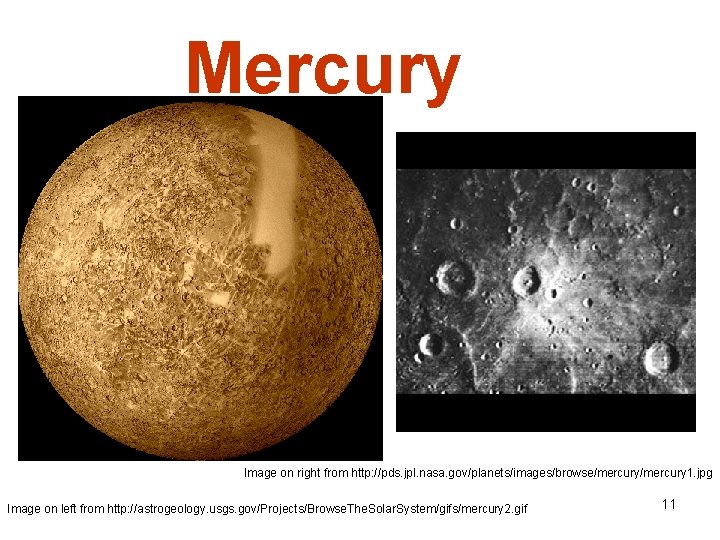
Mercury Image on right from http: //pds. jpl. nasa. gov/planets/images/browse/mercury 1. jpg Image on left from http: //astrogeology. usgs. gov/Projects/Browse. The. Solar. System/gifs/mercury 2. gif 11
Venus • Size- slightly smaller than Earth 95% of Earth’s diameter, it is 12, 104 km • Distance from sun- about 2/3 of Earth’s, it is 108, 000 km from sun • Surface- covered with rock similar to some parts of Earth, has volcanoes with lava flows and strange domes 12
Venus (cont’d) • Atmosphere- Very thick and cloudy, mostly carbon dioxide, clouds partly sulfuric acid • Atmospheric pressure is 90 times heavier than Earth’s and would crush a human 13
Venus (cont’d) • Atmosphere continued- Mostly carbon dioxide so greenhouse effect is strong • Has clouds of sulfuric acid • Ability to support life- Life does NOT appear to exist on Venus, lack of water along with harsh temperatures and atmosphere make life on Venus unlikely 14
Venus (cont’d) • Sometimes called “Earth’s twin” or “Earth’s sister planet” due to similarity • Retrograde rotation- rotates “backward” from east to west (opposite of Earth) • Rotates very slowly, one rotation takes about 8 Earth months and one revolution around sun takes about 7. 5 Earth months (One day is longer than one year) • Moons- None 15
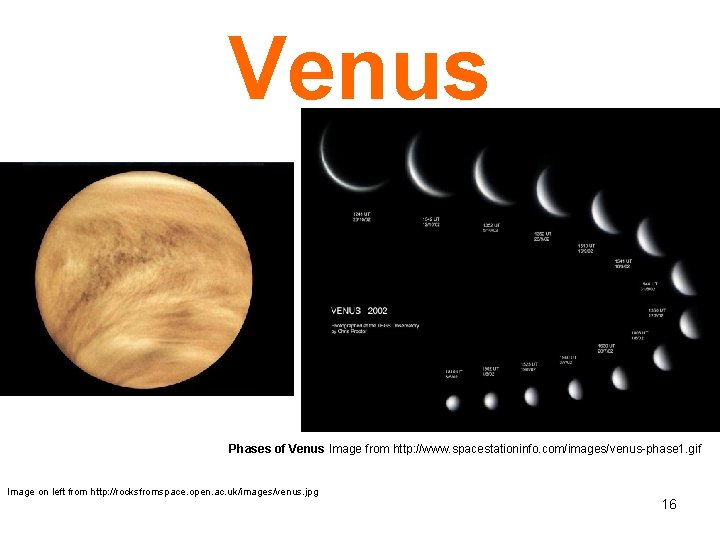
Venus Phases of Venus Image from http: //www. spacestationinfo. com/images/venus-phase 1. gif Image on left from http: //rocksfromspace. open. ac. uk/images/venus. jpg 16
Earth • Size- 12, 756 km diameter • Distance from Sun- 150, 000 km • Surface- Crust is a solid rocky surface, 70% is covered by water • Atmosphere- up to 100 km thick, made up of 78% Nitrogen, 21% Oxygen, 1% other gases 17
Earth • Ability to Support Life- Life does exist on Earth. Gaseous oxygen, liquid water and moderate temperatures are hospitable for life on Earth • Rotation takes 24 hours • Revolution takes 365. 25 days • Earth has one moon 18
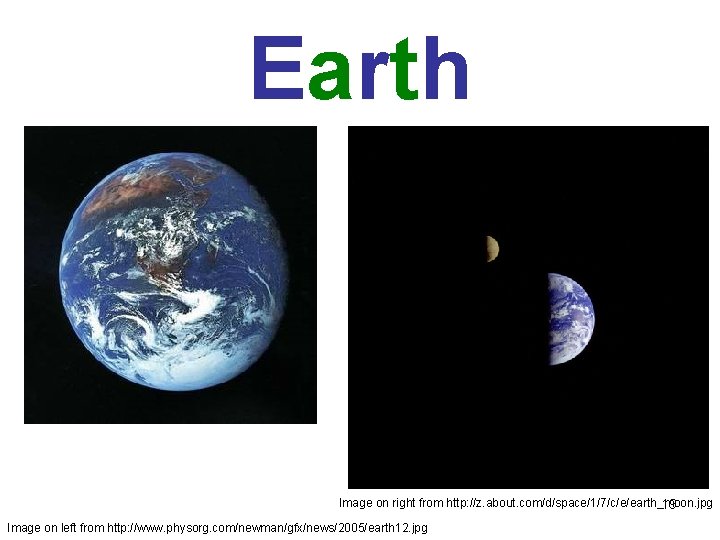
Earth Image on right from http: //z. about. com/d/space/1/7/c/e/earth_moon. jpg 19 Image on left from http: //www. physorg. com/newman/gfx/news/2005/earth 12. jpg
Mars • Size- 53% of Earth’s diameter, it is 6794 km • Distance from Sun- about 1. 5 times distance of Earth It is 228, 000 km from sun • Surface-Rocky surface with carbonite rocks high in iron, creating red color Polar ice caps contain frozen water and carbon dioxide 20
Mars • Atmosphere- Very thin, with thin clouds Mostly carbon dioxide, only 1% of Earth’s atmospheric pressure • Ability to support life- It is possible that primitive bacteria may have lived on Mars or may now live there but none has been found. Existence of liquid water makes life on Mars a possibility 21
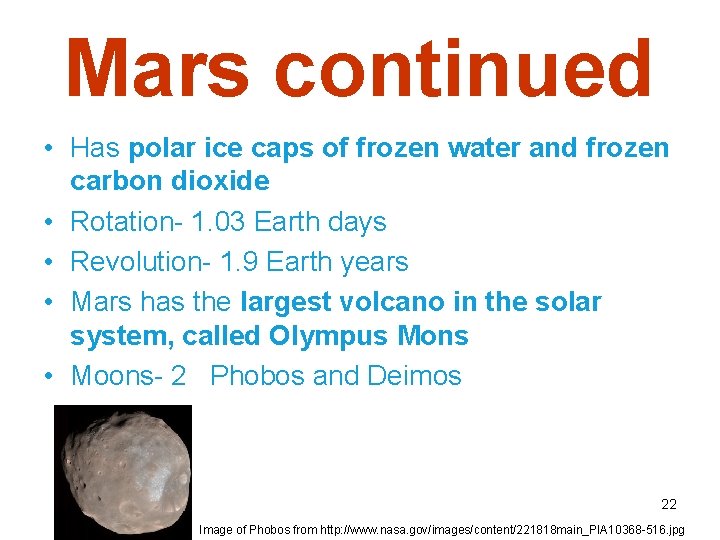
Mars continued • Has polar ice caps of frozen water and frozen carbon dioxide • Rotation- 1. 03 Earth days • Revolution- 1. 9 Earth years • Mars has the largest volcano in the solar system, called Olympus Mons • Moons- 2 Phobos and Deimos 22 Image of Phobos from http: //www. nasa. gov/images/content/221818 main_PIA 10368 -516. jpg
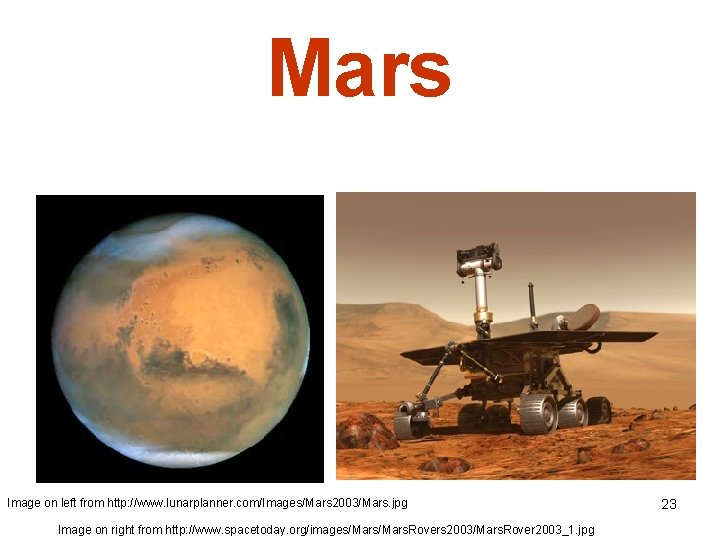
Mars Image on left from http: //www. lunarplanner. com/Images/Mars 2003/Mars. jpg Image on right from http: //www. spacetoday. org/images/Mars. Rovers 2003/Mars. Rover 2003_1. jpg 23
The Outer Planets • • • Jupiter Saturn Uranus pronounced “YOOR-a-nus” see http: //www. nineplanets. org/say/uranus. au Neptune Pluto (a dwarf Planet) 24
Characteristics of The Outer Planets • These are the planets outside of the Asteroid Belt, they are: Jupiter, Saturn, Uranus, Neptune and the dwarf planets Pluto and Eris • Jupiter, Saturn, Uranus, and Neptune are called “Gas Giants”. They are much larger than Earth and do not have solid surfaces 25
Characteristics of The Outer Planets • Pluto and Eris are small and rocky, like the terrestrial planets. • The gas giants do not have well-defined surfaces but have deep atmospheres that are typically about 75% hydrogen, 24% helium, and 1% other elements • Gas giants likely have solid cores of rock, ice, frozen carbon dioxide and other compounds 26
Jupiter • Size- diameter is 11 times Earth’s, It is 142, 800 km • Distance from Sun- 5. 2 times further than Earth. It is 778, 000 km • Surface and atmosphere of gas and liquid it does not have a well-defined surface • Has a deep atmosphere of about 86 % hydrogen, 14 % helium, and tiny amounts of methane, ammonia, phosphine, water, acetylene, ethane, germanium, and carbon monoxide. 27
Jupiter continued • Ability to support life- Lacks water, oxygen and moderate temperatures needed to support life. NO known life • Largest planet in solar system with 300 times the mass of Earth • Rotation-. 41 Earth days (fastest) • Revolution- 29 Earth years 28
Jupiter continued • Moons- 17 (book), 63 (web), 16 that are 10 km or larger and many smaller ones(NASA), Europa may have water • Has dark rings • Great Red Spot is storm on Jupiter, twice as big as Earth 29
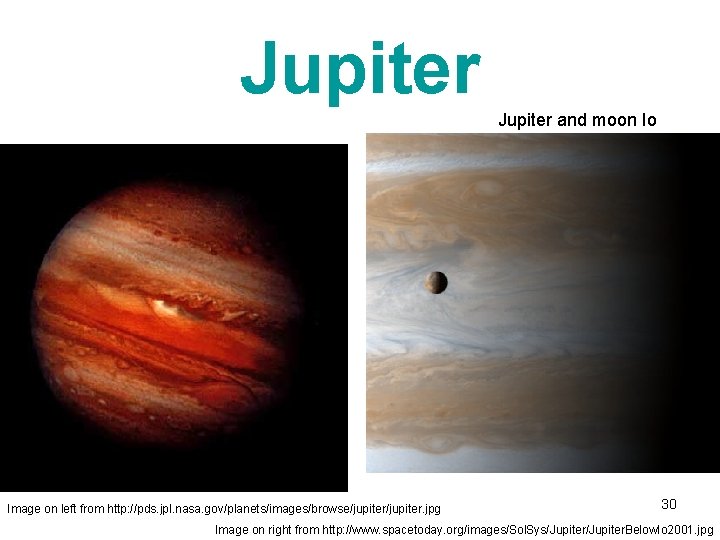
Jupiter and moon Io Image on left from http: //pds. jpl. nasa. gov/planets/images/browse/jupiter. jpg 30 Image on right from http: //www. spacetoday. org/images/Sol. Sys/Jupiter. Below. Io 2001. jpg
Saturn • Size- About 9. 44 times size of Earth. It is 120, 540 km • Distance from sun- About 9. 5 times distance from sun as Earth. 1, 427, 000 km • Surface and atmosphere of a gas giant, it does not have a well-defined surface but has mixture of helium and hydrogen and a thick atmosphere of gaseous helium and hydrogen 31
Saturn continued • Ability to support life- Lacks water, oxygen, and moderate temperatures needed to support life • Second largest planet in solar system • Rotation- 0. 43 Earth days • Revolution- 29 Earth years 32
Saturn continued • Moons- 53 moons • Low density planet, could float in water • Prominent rings- diameter of 250, 000 km or more but only about 1 kilometer thick, mostly chunks of ice and rocks 33
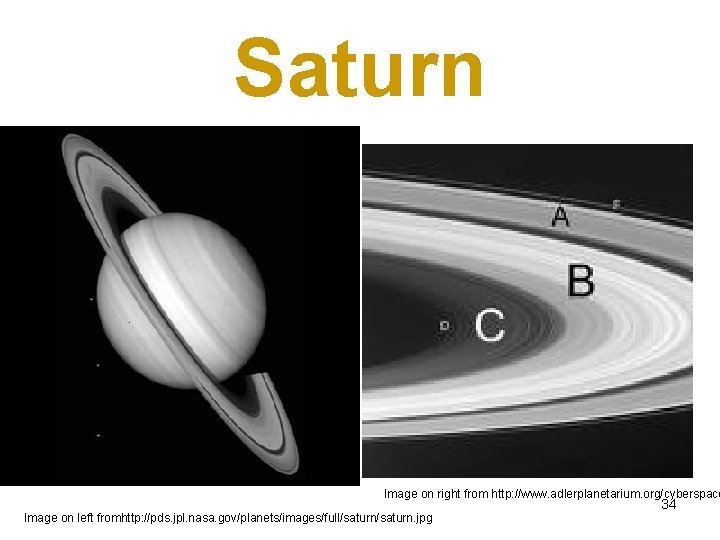
Saturn Image on right from http: //www. adlerplanetarium. org/cyberspace Image on left fromhttp: //pds. jpl. nasa. gov/planets/images/full/saturn. jpg 34
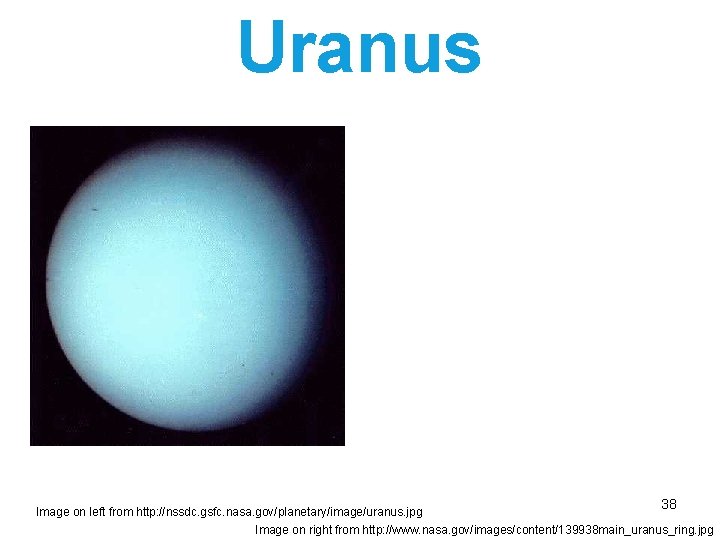
Uranus • pronounced “YOOR-a-nus” • Size- About 4 times diameter of Earth. It is 51, 200 km • Distance from Sun- About 19 times farther from sun than Earth. It is 2, 871, 000 km • Surface and atmosphere of a gas giant, it does not have a well-defined surface, 35
Uranus continued • the surface of Uranus consists of bluegreen clouds made up of tiny ice crystals of methane, and rock. The crystals of methane have frozen out of the planet's atmosphere. • Uranus' atmosphere is about 83% hydrogen, 15% helium and 2% methane. 36
Uranus continued • Ability to support life- Lacks water, oxygen, and moderate temperatures needed to support life, NO known life • Rotation- 0. 72 Earth days, is retrograde rotation like Venus, and rotates on side • Revolution- 84 Earth years • Moons- 27 moons- half of them are made of ice • Rings- 11 dark rings 37
Uranus 38 Image on left from http: //nssdc. gsfc. nasa. gov/planetary/image/uranus. jpg Image on right from http: //www. nasa. gov/images/content/139938 main_uranus_ring. jpg
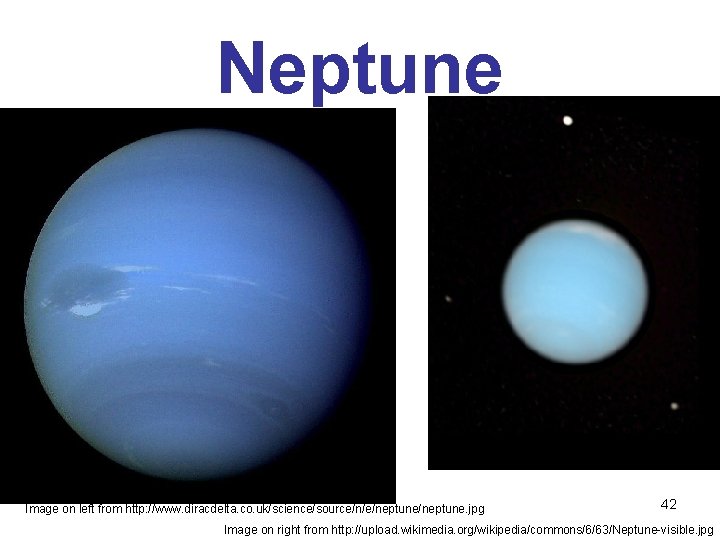
Neptune • Size- Almost 4 times diameter of Earth. It is 49, 500 km • Distance from Sun- Almost 30 times farther from sun than Earth. It is 4, 497, 000 km • Surface and atmosphere of a gas giant, it does not have a well-defined surface • Neptune's composition is probably similar to Uranus': various "ices" and Silicates (rock) with about 15% hydrogen, some water, and a little helium 39
Neptune continued • Atmosphere is mostly hydrogen and helium with a small amount of methane. • Ability to support life- Lacks significant water, oxygen, and moderate temperatures needed to support life. NO known life. 40
Neptune continued • • • Rotation- 0. 67 Earth days Revolution- 165 Earth years Visible clouds in atmosphere Moons- 13 moons 3 Very dark rings, 1 very faint ring 41
Neptune Image on left from http: //www. diracdelta. co. uk/science/source/n/e/neptune. jpg 42 Image on right from http: //upload. wikimedia. org/wikipedia/commons/6/63/Neptune-visible. jpg
Pluto • Size- about 17% of diameter of Earth. It is 2200 km • Distance from sun- more than 39 times farther than Earth. It is 5, 913, 000 kilometers • Rocky, icy surface is very small • Thin atmosphere of methane gas 43
Pluto continued • Ability to support life- Lacks water, oxygen, and warmth needed for life NO known life • Moons- 1 Charon (book), 3 - Charon, Hydra and Nix (web and NASA) • Rotation- 6. 4 Earth days • Revolution- 248 Earth years 44
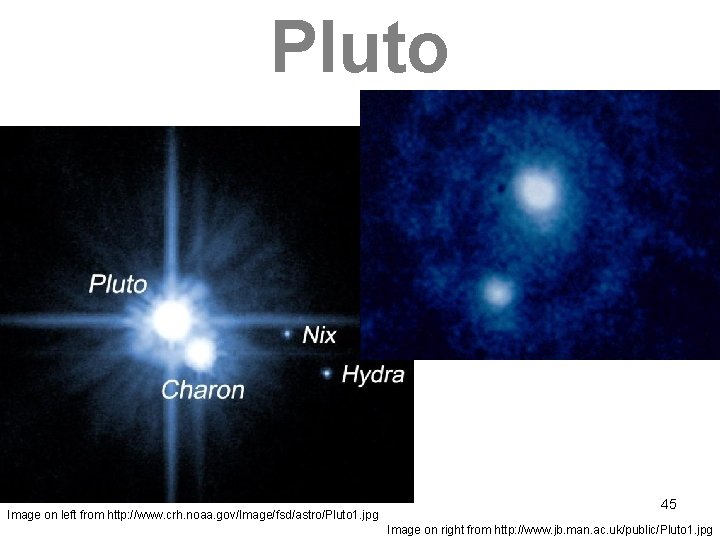
Pluto Image on left from http: //www. crh. noaa. gov/Image/fsd/astro/Pluto 1. jpg 45 Image on right from http: //www. jb. man. ac. uk/public/Pluto 1. jpg
The Dwarf Planets • Ceres- new dwarf planet, it was classified as the largest asteroid in the Asteroid Belt (it is between Mars & Jupiter). Say sir’eez • Pluto- was classified as a planet, now classified as a dwarf planet • Eris- new dwarf planet, past Pluto it is an icy body near the edge of our solar system. Say ee’ris 46
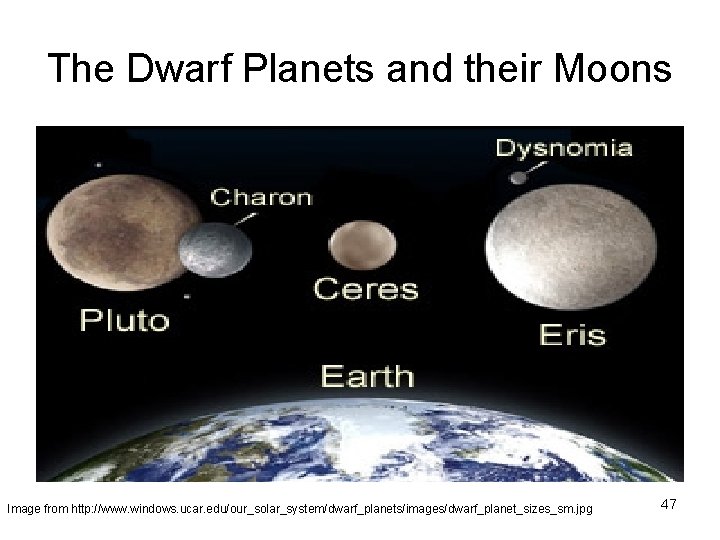
The Dwarf Planets and their Moons Image from http: //www. windows. ucar. edu/our_solar_system/dwarf_planets/images/dwarf_planet_sizes_sm. jpg 47
Planets and Dwarf Planets compared • Dwarf planets are smaller than planets • Both orbit the Sun • Both are large enough that their gravity pulls them into the shape of a sphere • Planets clear smaller objects out of their orbit. Dwarf planets can not because of their weaker gravity 48 Information from http: //www. windows. ucar. edu/tour/link=/our_solar_system/dwarf_planets. html
Background info on Dwarf Planets • There are currently three official dwarf planets. Pluto, formerly the smallest of the nine "traditional" planets, was demoted to dwarf planet status. Ceres, the largest asteroid in the main asteroid belt between Mars and Jupiter, was also declared a dwarf planet. The third and final (for now!) dwarf planet is Eris, an icy body on the edge of our Solar System that was discovered recently in 2005. Eris was temporarily labeled 2003 UB 313 when it was first discovered, and given the nickname "Xena", before astronomers settled on the official name of Eris. Text from http: //www. windows. ucar. edu/tour/link=/our_solar_system/dwarf_planets. html 49
Background info on Dwarf Planets continued • What's the difference between regular planets and dwarf planets? As you might guess, it's partly an issue of size, with dwarf planets being smaller. But just how big does a planet need to become a full-fledged planet instead of a dwarf? You might think the minimum size requirement is arbitrary, but the size cutoff is actually based on other properties of the object and its history in the Solar System. Both planets and dwarf planets orbit the Sun, not other planets (in which case we call them moons). Both must be large enough that their own gravity pulls them into the shapes of spheres; this rules out numerous smaller bodies like most asteroids, many of which have irregular shapes. Planets clear smaller objects out of their orbits by sucking the small bodies into themselves or flinging them out of orbit. Dwarf planets, with their weaker gravities, are unable to clear out their orbits. Though there are just three dwarf planets now, their number is expected to grow. Scientists estimate there may be 70 dwarf planets amongst outer solar system objects that have been discovered already. Since we don't know the actual sizes or shapes of many of the objects we've found (because they are so far away), we can't yet determine whether they are actually dwarf planets or not. More observations and better telescopes will help us determine which other objects are dwarf planets. Astronomers speculate that there may be 200 or so dwarf planets out through the distance of the Kuiper Belt, an icy band of frozen planetoids on the edge of our Solar System. Text from http: //www. windows. ucar. edu/tour/link=/our_solar_system/dwarf_planets. html 50
Additional Sources • http: //www. windows. ucar. edu/tour/link=/our_solar_system/dwarf_pla nets/dwarf_planets. html • http: //www. pantheon. org/miscellaneous/pronunciations. html • http: //www. nasa. gov • http: //www. nineplanets. org 51
- Slides: 51