
The Solar System Part 1 Who came up
- Slides: 11
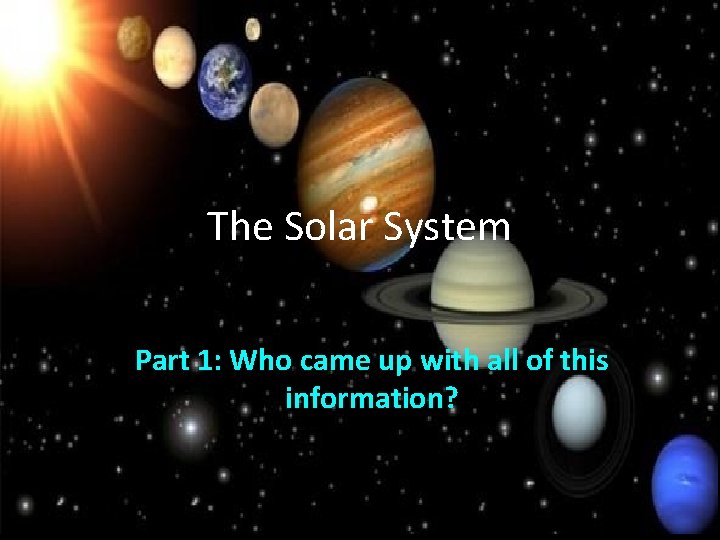
The Solar System Part 1: Who came up with all of this information?
Thinking like a scientist • What if I were to tell you that the sky was actually green and grass was blue… – What would you say? – How could you prove you were right and I was wrong
But first…some vocabulary • Solar System- sun and all of the celestial bodies that orbit the sun • Heliocentric- sun centered- planets orbit the sun • Geocentric- earth centered- planets, sun, and moon circle the earth
Where did we get these ideas
Aristotle • Greek astronomer • Geocentric model • Decided that if the solar system was heliocentric then the position of the stars would change – Parallax= apparent displacement of an object when viewed from a different location
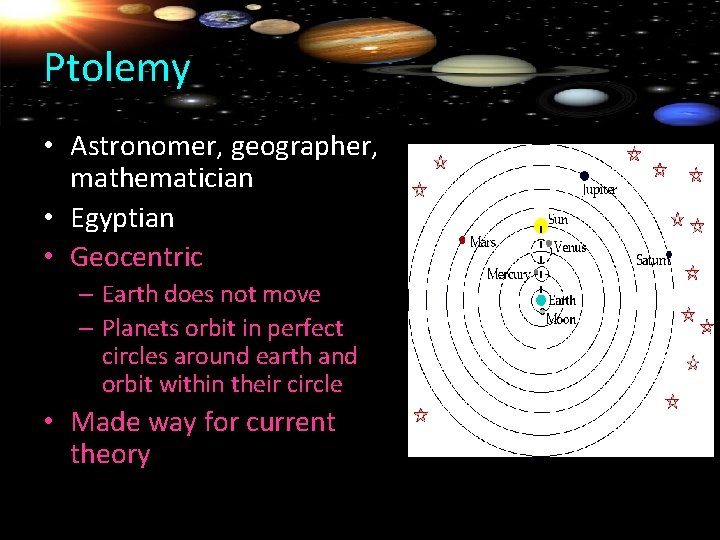
Ptolemy • Astronomer, geographer, mathematician • Egyptian • Geocentric – Earth does not move – Planets orbit in perfect circles around earth and orbit within their circle • Made way for current theory
Kepler • Develop current orbit theory – 3 Laws • Orbits are ellipses • Planets move faster in orbit when closest to sun • Distance from the sun relates to how long it takes a planet to orbit
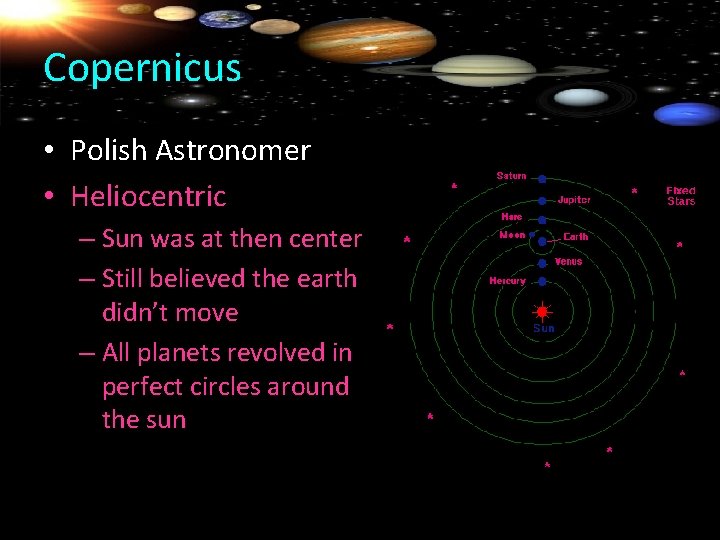
Copernicus • Polish Astronomer • Heliocentric – Sun was at then center – Still believed the earth didn’t move – All planets revolved in perfect circles around the sun
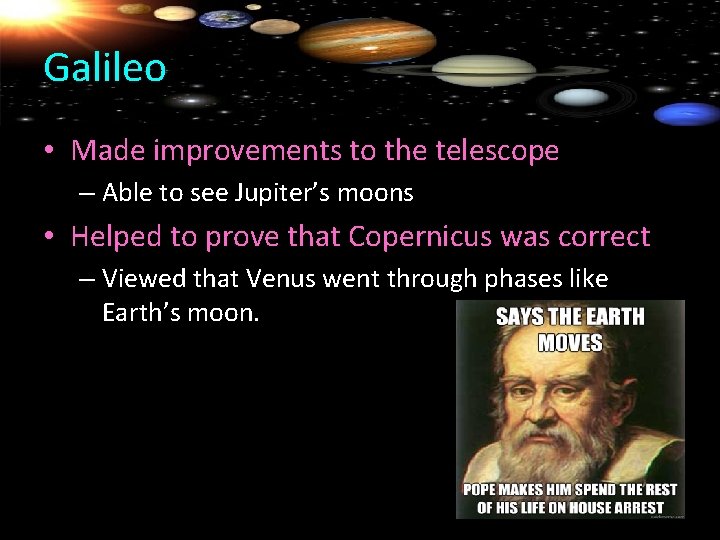
Galileo • Made improvements to the telescope – Able to see Jupiter’s moons • Helped to prove that Copernicus was correct – Viewed that Venus went through phases like Earth’s moon.