
The Solar System Just how big is it
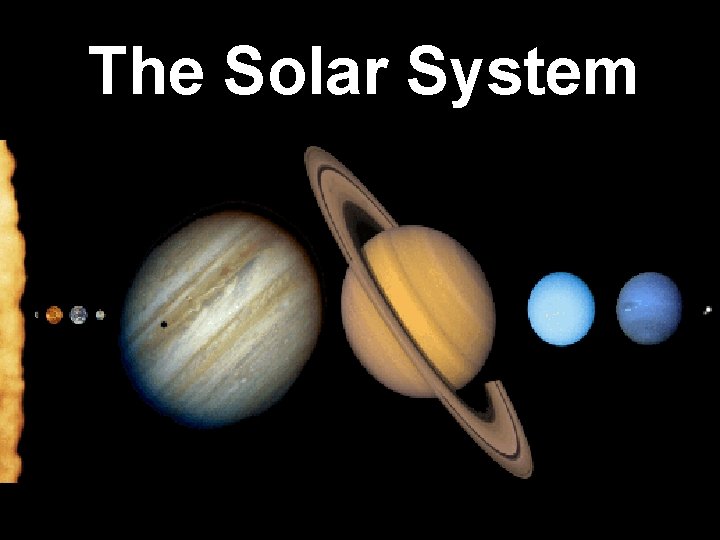
The Solar System
Just how big is it? “The Solar System is enormous! On a diagram of the Solar System to scale, with the Earth reduced to the diameter of a pea, Jupiter would be over 300 m away and Pluto would be two and a half kilometers distance (and the size of a bacterium, so you wouldn’t be able to see it anyway). On the same scale, Proxima Centauri, our nearest star, would be 16, 000 km away. Even if you shrank down everything so that Jupiter was as small as the full stop at the end of this sentence, and Pluto was no bigger than a molecule, Pluto would be over 10 m away”. Bill Bryson
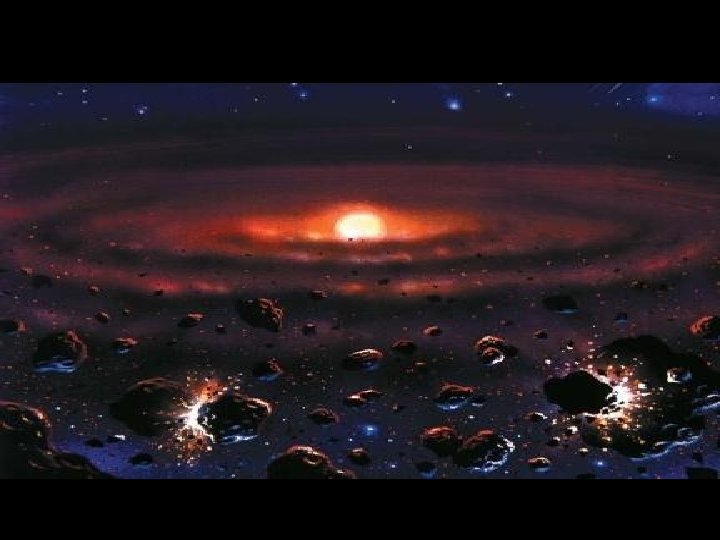
What makes up our Solar System? • The solar system is made up of the Sun, the 9 planets and their 169 known moons, asteroids, comets, dust and gas. The planets, asteroids, and comets travel around the Sun, the center of our solar system. • Most of the bodies in the solar system travel around the Sun along nearly circular paths or orbits, and all the planets travel about the Sun in the anticlockwise direction (when viewed from above). • Solar system formation began billions (4. 6) of years ago, when gases and dust began to come together to form the Sun, planets, and other bodies of the solar system.
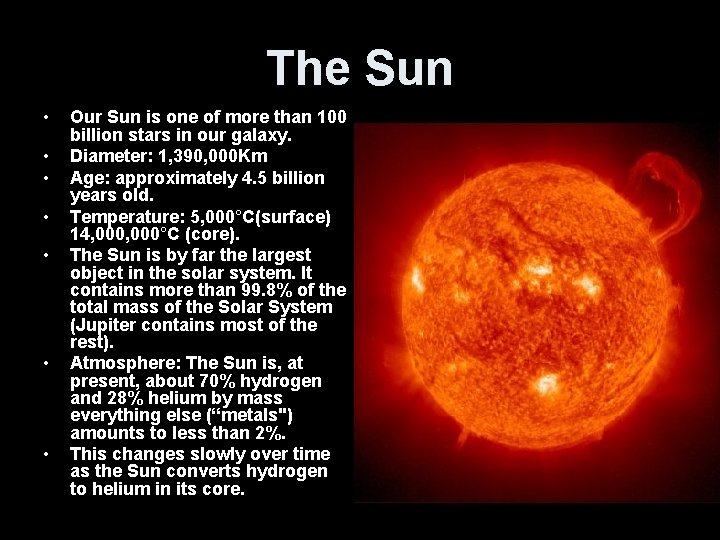
The Sun • • Our Sun is one of more than 100 billion stars in our galaxy. Diameter: 1, 390, 000 Km Age: approximately 4. 5 billion years old. Temperature: 5, 000°C(surface) 14, 000°C (core). The Sun is by far the largest object in the solar system. It contains more than 99. 8% of the total mass of the Solar System (Jupiter contains most of the rest). Atmosphere: The Sun is, at present, about 70% hydrogen and 28% helium by mass everything else (“metals") amounts to less than 2%. This changes slowly over time as the Sun converts hydrogen to helium in its core.
• Watch Video on the Sun
The Inner Planets Mercury - facts • • Diameter: 4, 878 km Day length: 59 days Year length: 88 days Temperature: can reach 400°C in the daytime, and drop to -170°C at night. Varies between very hot and very cold conditions due to it’s closeness to the Sun and slow rotation. Atmosphere: 1000 times thinner than Earth’s. The surface: covered in craters and is probably high in iron. Gravity: 0. 38 times Earth’s Astonomical unit: 0. 387
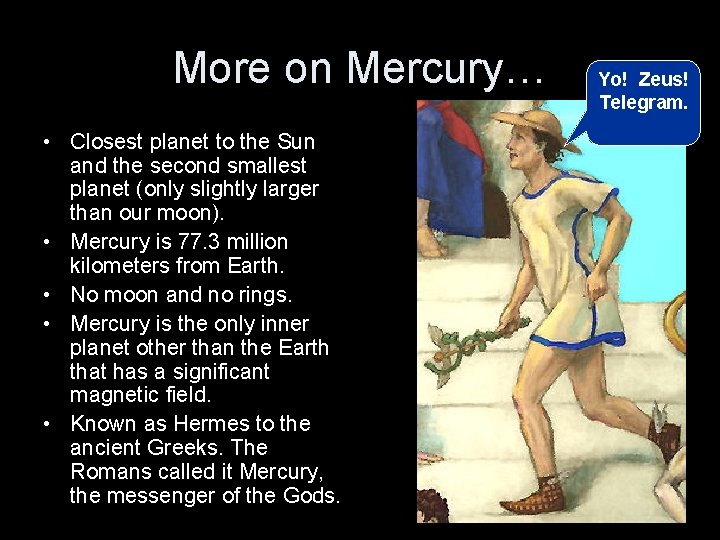
More on Mercury… • Closest planet to the Sun and the second smallest planet (only slightly larger than our moon). • Mercury is 77. 3 million kilometers from Earth. • No moon and no rings. • Mercury is the only inner planet other than the Earth that has a significant magnetic field. • Known as Hermes to the ancient Greeks. The Romans called it Mercury, the messenger of the Gods. Yo! Zeus! Telegram.
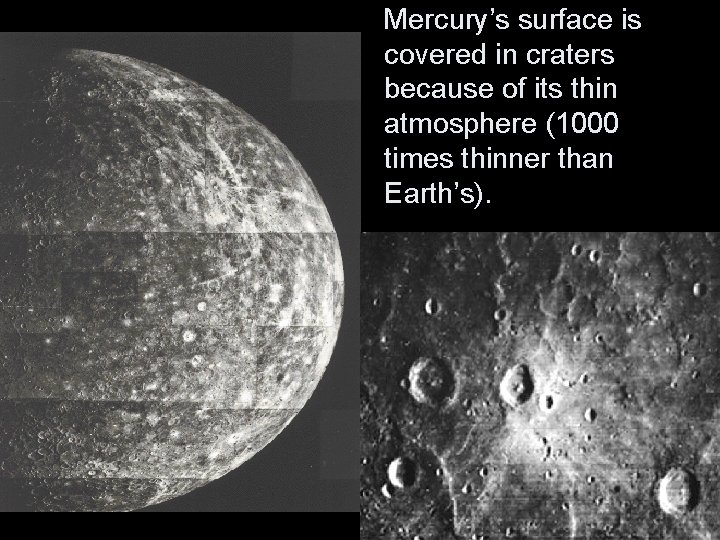
Mercury’s surface is covered in craters because of its thin atmosphere (1000 times thinner than Earth’s).
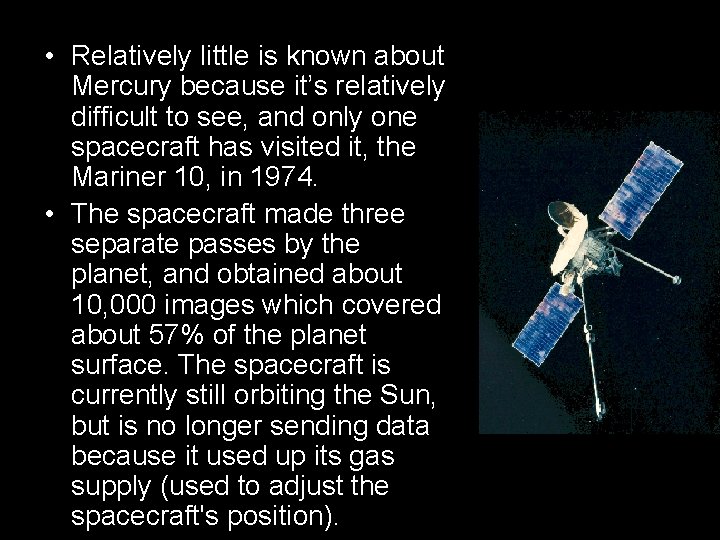
• Relatively little is known about Mercury because it’s relatively difficult to see, and only one spacecraft has visited it, the Mariner 10, in 1974. • The spacecraft made three separate passes by the planet, and obtained about 10, 000 images which covered about 57% of the planet surface. The spacecraft is currently still orbiting the Sun, but is no longer sending data because it used up its gas supply (used to adjust the spacecraft's position).
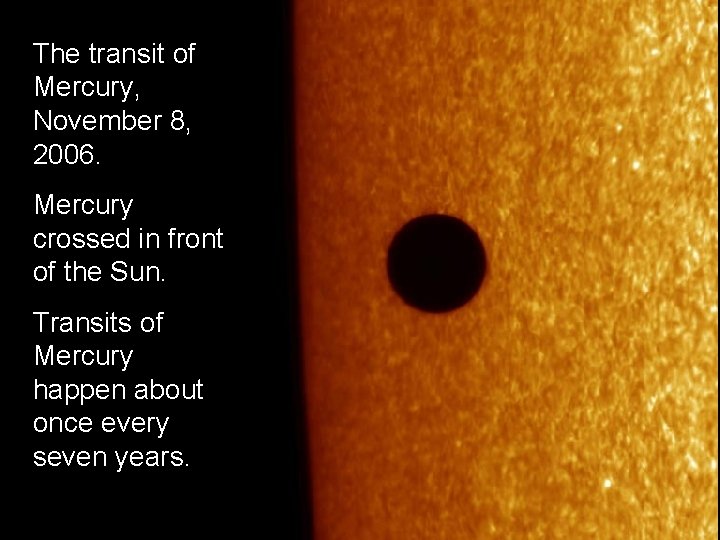
The transit of Mercury, November 8, 2006. Mercury crossed in front of the Sun. Transits of Mercury happen about once every seven years.
• Watch Video on Mercury
• • • Venus - facts Diameter: 12, 103. 6 km Day length: 243 days Year length: 225 days Temperature: The average temperature is 480°C. Atmosphere: The atmosphere mainly contains CO 2 and H 2 SO 4, creating the yellow glow. Pressure: The atmosphere creates a huge pressure on the surface, 90 times greater than that of Earth. The surface: the surface of Venus consists of 2 large continents and is covered with craters, over 1600 major volcanoes, mountains, large highland terrains, and vast lava plains. Gravity: 0. 9 times that of Earth’s Astonomical unit: 0. 72
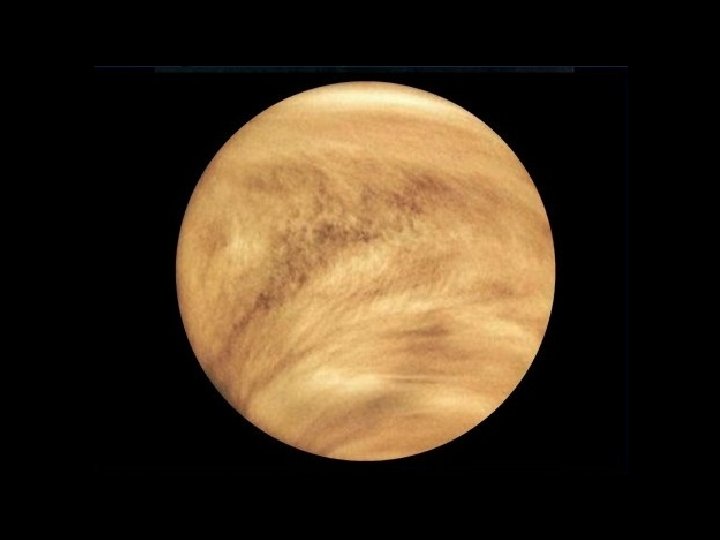
More on Venus… • Venus (Greek: Aphrodite; Babylonian: Ishtar) is the goddess of love and beauty. The planet is so named probably because it is the brightest of the planets known to the ancients. • Venus is 40 million kilometers from Earth, our closest planet. • Venus is sometimes regarded as Earth’s sister planet. In some ways they are very similar: - Venus is only slightly smaller than Earth (95% of Earth's diameter, 80% of Earth's mass). - Both have few craters indicating relatively young surfaces. - Their densities and chemical compositions are similar. • There is no moon and no rings. • Venus has been visited by many spacecraft, including Venera and Magellan.
• Watch Video on Venus
Earth - facts • • • Diameter: 12, 753 km Day length: 24 hours Year length: 365 days Temperature: -89°C to 57. 7°C Atmosphere: The atmosphere surrounds Earth and protects us by blocking out dangerous rays from the sun. The atmosphere is a mixture of gases that becomes thinner until it gradually reaches space. It is composed of Nitrogen (78%), Oxygen (21%), and other gases (1%). • Gravity: 9. 78 m/s/s • Astonomical unit: 1. 0 (approx. 150 million km from the Sun)
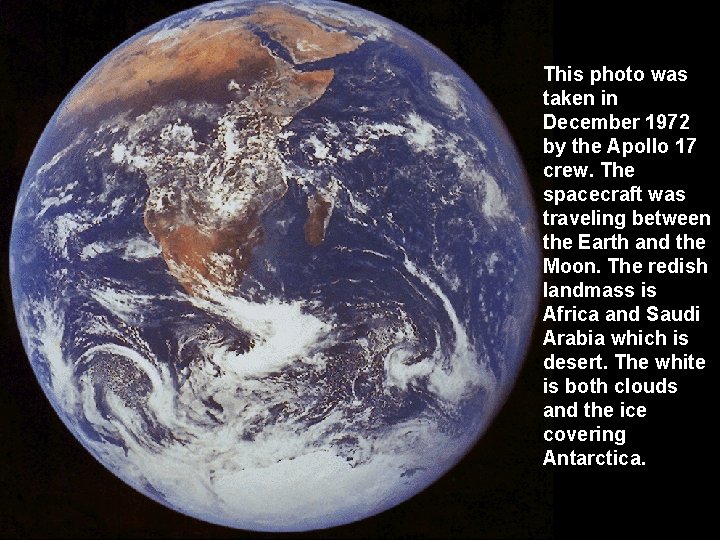
This photo was taken in December 1972 by the Apollo 17 crew. The spacecraft was traveling between the Earth and the Moon. The redish landmass is Africa and Saudi Arabia which is desert. The white is both clouds and the ice covering Antarctica.
• • • Mars - facts Diameter: 6, 785 km Day length: 24 hours and 37 minutes Year length: 686 days Temperature: Surface temperatures range from -129°C to 0°C (averaging a to -10°C). Atmosphere: The atmosphere of Mars is much thinner than that of Earth. It is composed mainly of carbon dioxide (95. 3%), nitrogen (2. 7%), and argon (1. 6%), with small amounts of other gases. Oxygen, which is so important to us on earth, makes up only 0. 13% of the atmosphere at Mars. There is only one-fourth as much water vapor in the atmosphere. Pressure: the surface pressure averages 1/100 th of Earth’s surface. The surface: The reddish color is caused by rust (iron oxide) in the soil. Some of its features include; volcanoes, canyon systems, river beds, and cratered terrain. Gravity: 0. 37 times Earth’s Astonomical unit: 1. 52
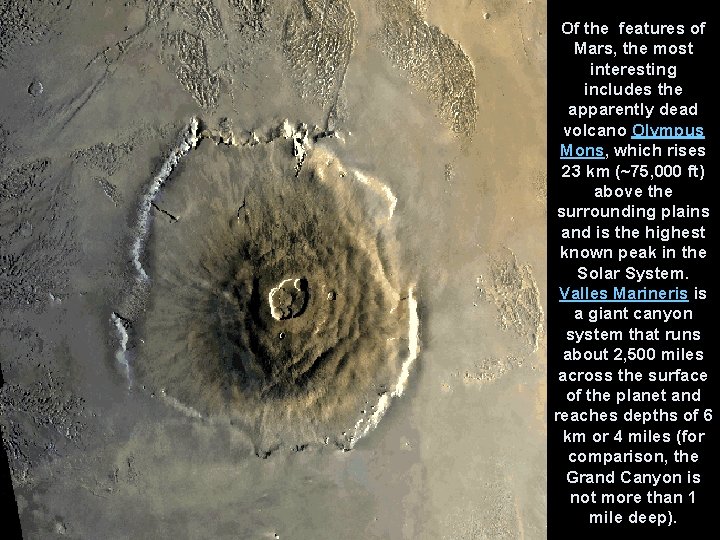
Of the features of Mars, the most interesting includes the apparently dead volcano Olympus Mons, which rises 23 km (~75, 000 ft) above the surrounding plains and is the highest known peak in the Solar System. Valles Marineris is a giant canyon system that runs about 2, 500 miles across the surface of the planet and reaches depths of 6 km or 4 miles (for comparison, the Grand Canyon is not more than 1 mile deep).
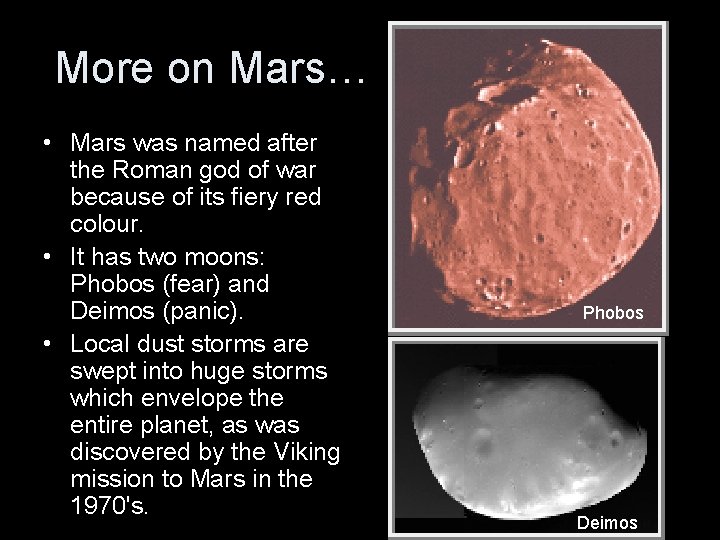
More on Mars… • Mars was named after the Roman god of war because of its fiery red colour. • It has two moons: Phobos (fear) and Deimos (panic). • Local dust storms are swept into huge storms which envelope the entire planet, as was discovered by the Viking mission to Mars in the 1970's. Phobos Deimos
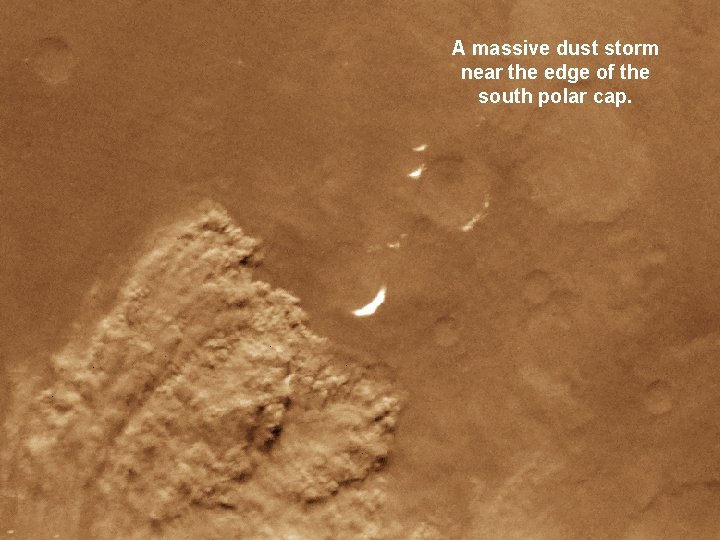
A massive dust storm near the edge of the south polar cap.
The first spacecraft to visit Mars was Mariner 4 in 1965. Several others followed including Mars 2, the first spacecraft to land on Mars and the two Viking landers in 1976. Ending a long 20 year hiatus, Mars Pathfinder landed successfully on Mars on 1997 July 4. In 2004 the Mars Expedition Rovers "Spirit" and "Opportunity" landed on Mars sending back geologic data and many pictures; they are still operating after more than a year on Mars. Three Mars orbiters (Mars Global Surveyor, Mars Odyssey, and Mars Express) are also currently in operation.
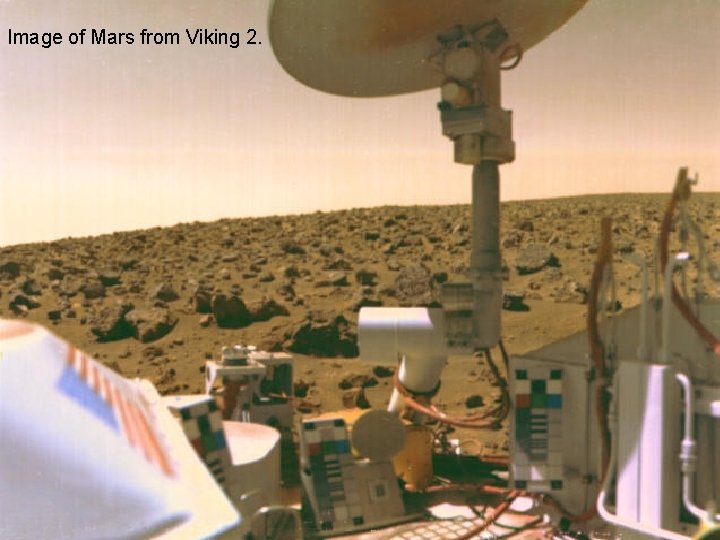
Image of Mars from Viking 2.

• Watch Video on Mars
The Outer Planets Jupiter - facts • • • Diameter: 142, 800 km Day length: 9. 8 hours Year length: 12 years Temperature: at cloud tops it is -150°C Atmosphere: Jupiter is about 90% hydrogen and 10% helium with traces of methane, water, ammonia and "rock". This is very close to the composition of the primordial Solar Nebulae from which the entire solar system was formed. Pressure: the atmospheric pressure on Jupiter has never actually been measured, but Jupiter's atmosphere can crush a metal spaceship like a paper cup. The surface: dymanic atmospheric motion and riveting cloud patterns and storms. Gravity: 2. 64 times Earth’s Astonomical unit: 5. 2
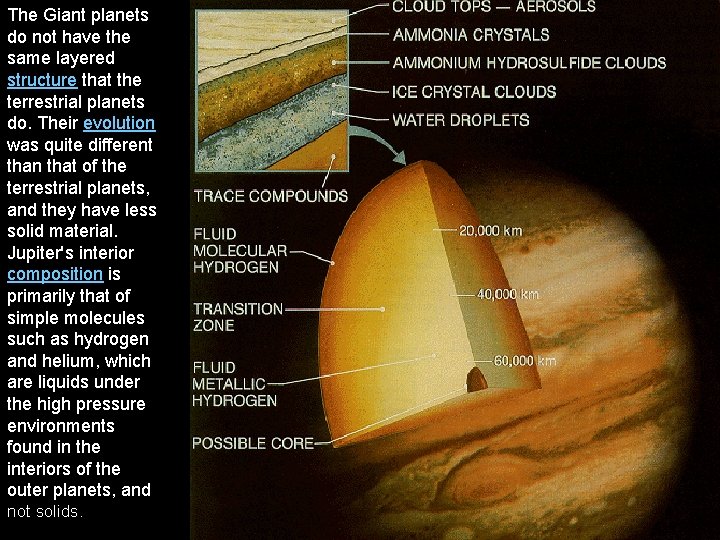
The Giant planets do not have the same layered structure that the terrestrial planets do. Their evolution was quite different than that of the terrestrial planets, and they have less solid material. Jupiter's interior composition is primarily that of simple molecules such as hydrogen and helium, which are liquids under the high pressure environments found in the interiors of the outer planets, and not solids.
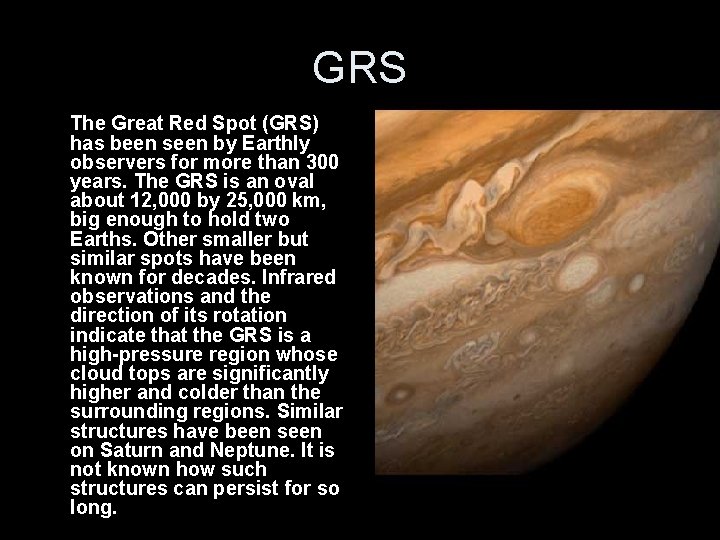
GRS The Great Red Spot (GRS) has been seen by Earthly observers for more than 300 years. The GRS is an oval about 12, 000 by 25, 000 km, big enough to hold two Earths. Other smaller but similar spots have been known for decades. Infrared observations and the direction of its rotation indicate that the GRS is a high-pressure region whose cloud tops are significantly higher and colder than the surrounding regions. Similar structures have been seen on Saturn and Neptune. It is not known how such structures can persist for so long.
More on Jupiter… • • Jupiter has 63 known satellites. Jupiter has one very thin ring. It is 588 million km from Earth (approximately). Jupiter probably has a core of rocky material amounting to something like 10 to 15 Earth-masses. • Jupiter has a huge magnetic field, much stronger than Earth's. Its magnetosphere extends more than 650 million km (past the orbit of Saturn!). • In Roman mythology, Jupiter (Zeus in Greek mythology) was the king of heaven and Earth and of all the Olympian gods. He was also known as the god of justice. • Six exploratory spacecraft have been sent to Jupiter.
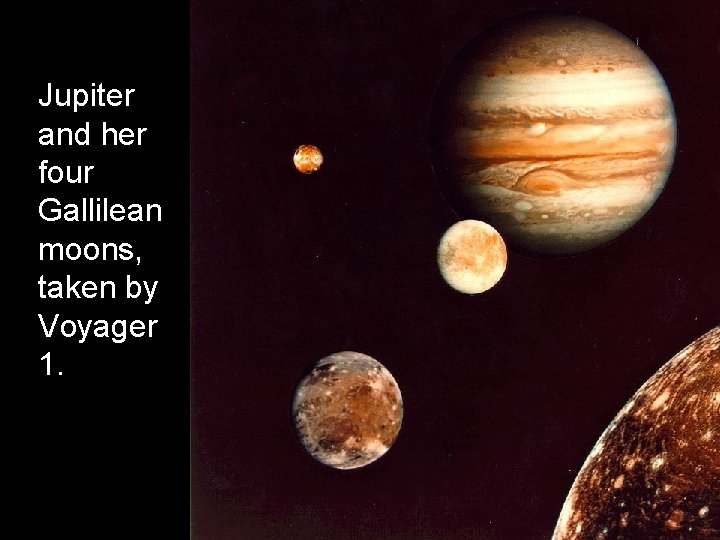
Jupiter and her four Gallilean moons, taken by Voyager 1.
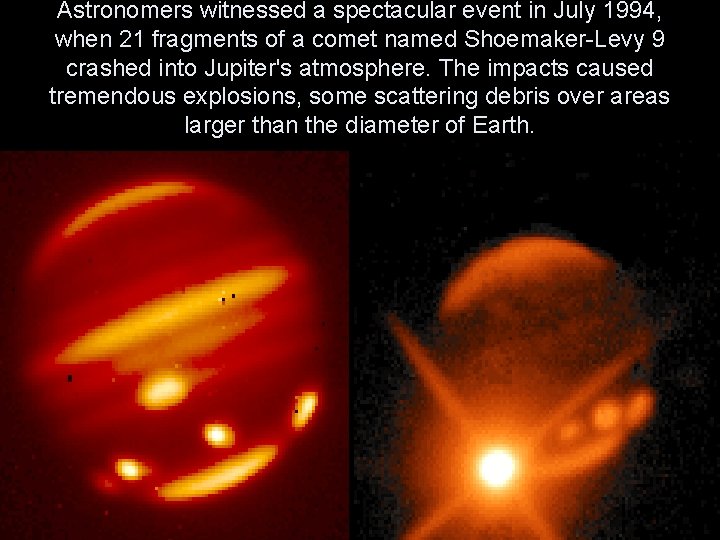
Astronomers witnessed a spectacular event in July 1994, when 21 fragments of a comet named Shoemaker-Levy 9 crashed into Jupiter's atmosphere. The impacts caused tremendous explosions, some scattering debris over areas larger than the diameter of Earth.
• Watch Video on Jupiter
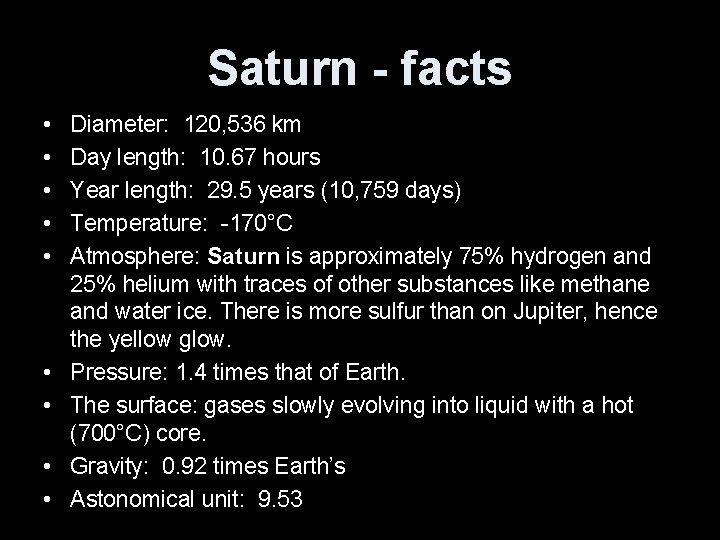
Saturn - facts • • • Diameter: 120, 536 km Day length: 10. 67 hours Year length: 29. 5 years (10, 759 days) Temperature: -170°C Atmosphere: Saturn is approximately 75% hydrogen and 25% helium with traces of other substances like methane and water ice. There is more sulfur than on Jupiter, hence the yellow glow. Pressure: 1. 4 times that of Earth. The surface: gases slowly evolving into liquid with a hot (700°C) core. Gravity: 0. 92 times Earth’s Astonomical unit: 9. 53
More on Saturn… • Saturn is 1. 2 billion km from Earth. • It has 59 known moons and many rings. • The tilt of Saturn's axis causes the sun to heat the planet's northern and southern halves unequally, resulting in seasons and temperature changes. Each season lasts about 7 1/2 Earth years, because Saturn takes about 29 times as long to go around the sun as Earth does. • In Roman mythology, Saturn is the god of agriculture. • There have been four missions to Saturn: - Pioneer 11 launched 1973, arrived 1979 - Voyager 1 launched 1977, arrived 1980 - Voyager 2 launched 1977, arrived 1981 - Cassini launched 1997, arrived 2004
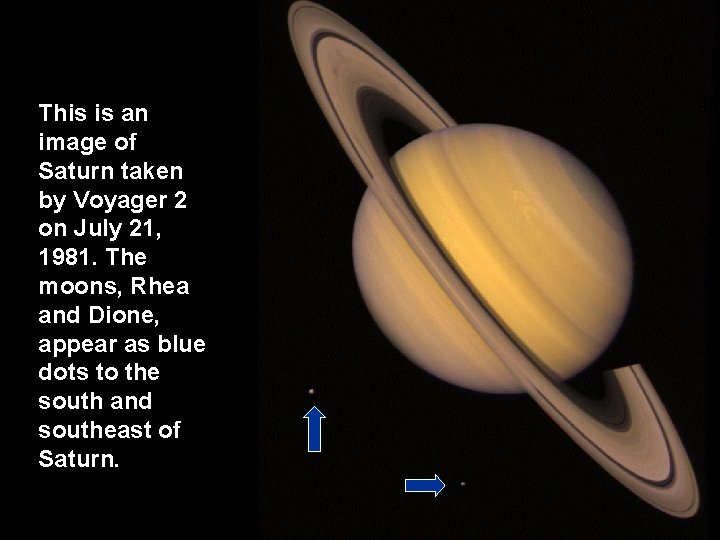
This is an image of Saturn taken by Voyager 2 on July 21, 1981. The moons, Rhea and Dione, appear as blue dots to the south and southeast of Saturn.
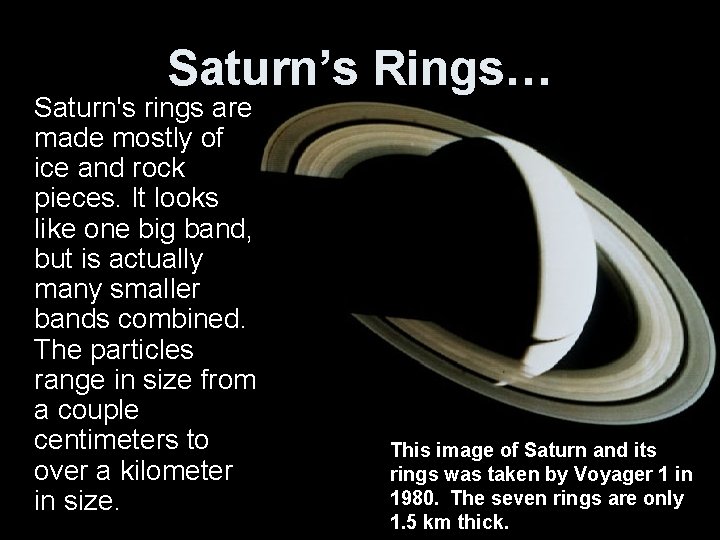
Saturn’s Rings… Saturn's rings are made mostly of ice and rock pieces. It looks like one big band, but is actually many smaller bands combined. The particles range in size from a couple centimeters to over a kilometer in size. This image of Saturn and its rings was taken by Voyager 1 in 1980. The seven rings are only 1. 5 km thick.
• Watch Video on Saturn
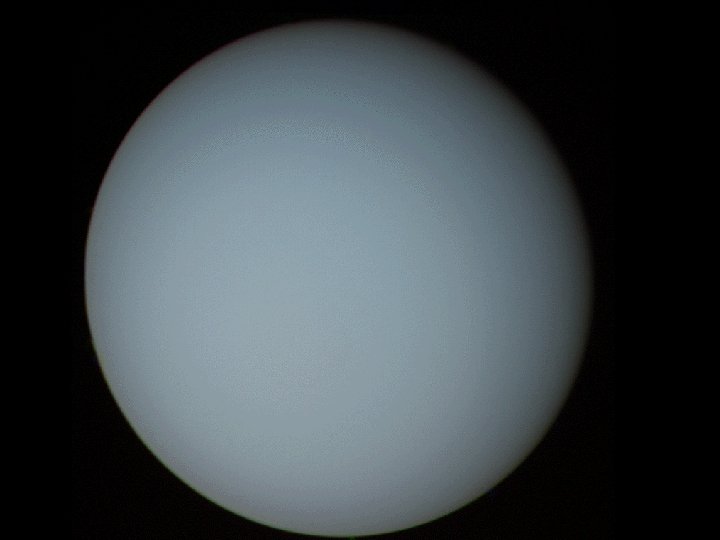
Uranus - facts • • • Diameter: 51, 488 km Day length: 72. 24 hours Year length: 84 years (30, 685 days) Temperature: -200°C Atmosphere: The sameness of the planet's appearance shows that the planet's atmosphere is mostly composed of one thing, methane. The planet appears to be bluegreen because the methane gas of the atmosphere traps red light and does not allow that color to escape. Pressure: about 1. 2 times the atmospheric pressure at the surface of Earth The surface: the fastest winds blow at 720 km per hour. Gravity: 0. 89 times Earth’s Astonomical unit: 19. 19
More on Uranus… • Uranus has 27 fascinating moons, including five large moons, and a complicated ring system. • Uranus stands for the starry sky in the evening. He was the earliest supreme god. • Uranus has been visited by only one spacecraft, Voyager 2 on Jan 24 1986. • Uranus spins on its side, creating unusual seasons. • Uranus is the farthest planet that can be seen without a telescope. • Its average distance from the sun is about 2, 872, 460, 000 km, a distance that takes light about 2 hours 40 minutes to travel.
• Watch Video on Uranus
Neptune - facts • • • Diameter: 49, 493 km Day length: 17. 24 hours Year length: 165 years Temperature: -210°C Atmosphere: The atmosphere of Neptune is very similar to that of Uranus, and unlike that of Saturn and Jupiter. The atmosphere of Neptune contains more of the complex molecules such as methane gas, acetylene, and diacetylene. These constituents collectively are known as "hydrocarbons". • Pressure: 1 - 3 times that of Earth. • The surface: Neptune is surrounded by thick layers of clouds in rapid motion. Winds blow these clouds at speeds up to 1, 100 kilometers per hour. • Gravity: 1. 12 times Earth’s • Astonomical unit: 30. 07
More on Neptune… • Neptune, along with Pluto, cannot be seen without a telescope. • It has 13 known moons with three conspicuous rings and one faint one. • It is approximately 4. 3 billion km from Earth. • Neptune even has a Great Dark Spot similar to Jupiter's Great Red Spot.
• Watch Video on Neptune
Pluto - facts • • • Diameter: 2, 390 km Day length: 6. 387 days Year length: 248 years Temperature: -233°C Atmosphere: The air is made mostly of nitrogen gas, with the addition of carbon monoxide (CO - what comes out of your car) and a molecule called methane. Pressure: 1/100, 000 that of Earth's surface pressure. The surface: icy with clouds and storms. Gravity: 0. 06 times Earth’s Astonomical unit: 39. 48
More on Pluto… • Pluto has three moons. One of the moons is very large. The large moon is named Charon. The other two moons are fairly small. They don't really have names yet. For now they are called S/2005 P 1 and S/2005 P 2. • We don't know whether Pluto has rings or not. Nobody has seen any rings around Pluto so far.
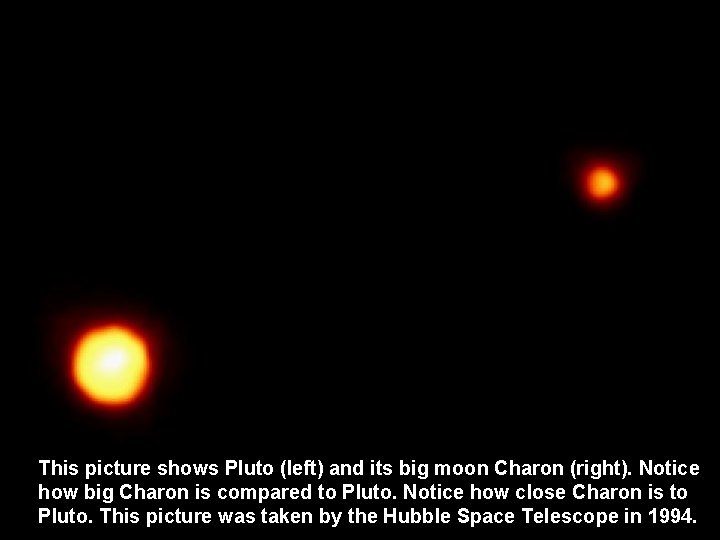
This picture shows Pluto (left) and its big moon Charon (right). Notice how big Charon is compared to Pluto. Notice how close Charon is to Pluto. This picture was taken by the Hubble Space Telescope in 1994.
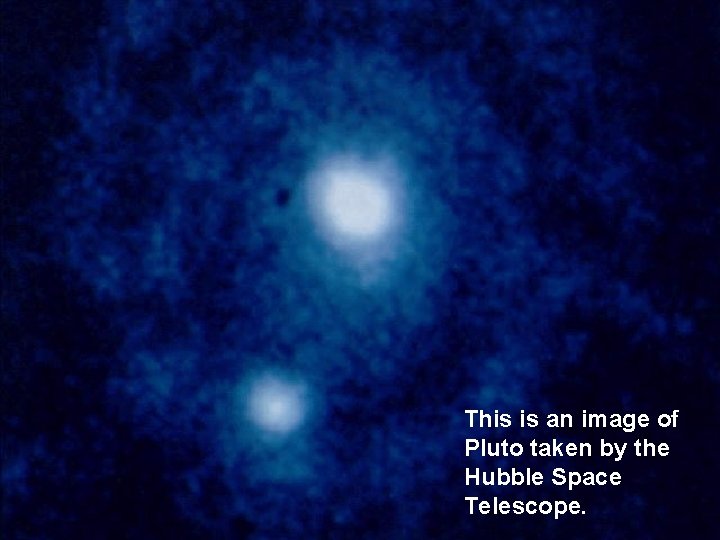
This is an image of Pluto taken by the Hubble Space Telescope.
• Watch Video on Pluto
- Slides: 49