
The Solar System Figure Courtesy NASAJPLCaltech The Sun
- Slides: 44
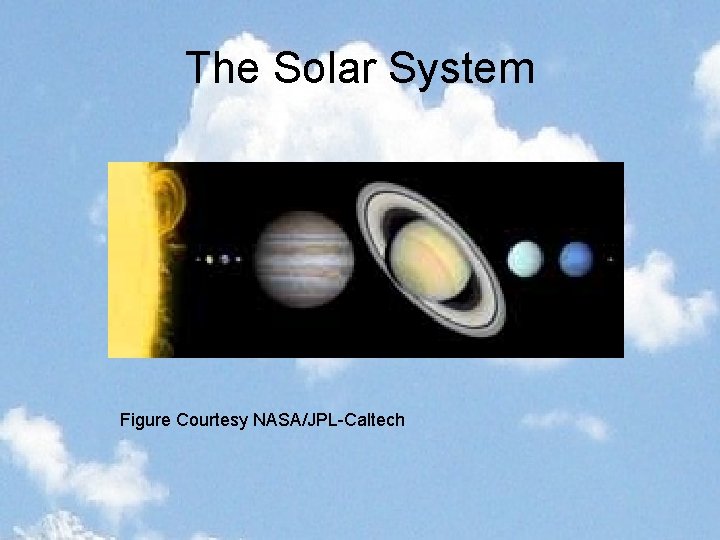
The Solar System Figure Courtesy NASA/JPL-Caltech
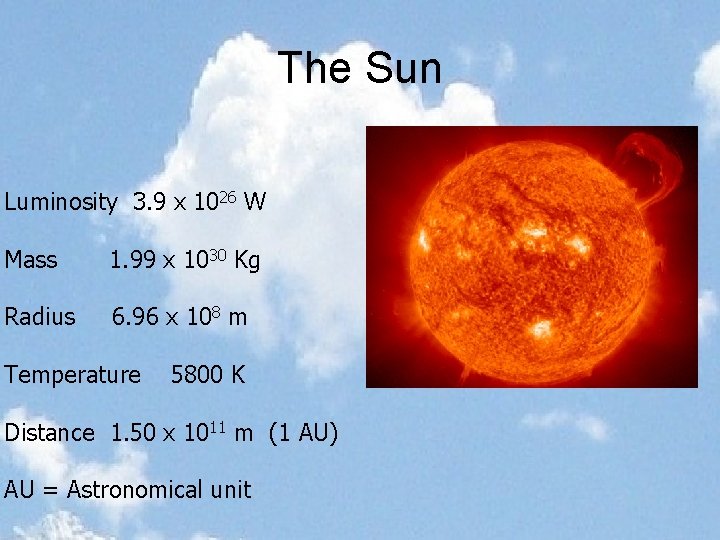
The Sun Luminosity 3. 9 x 1026 W Mass 1. 99 x 1030 Kg Radius 6. 96 x 108 m Temperature 5800 K Distance 1. 50 x 1011 m (1 AU) AU = Astronomical unit
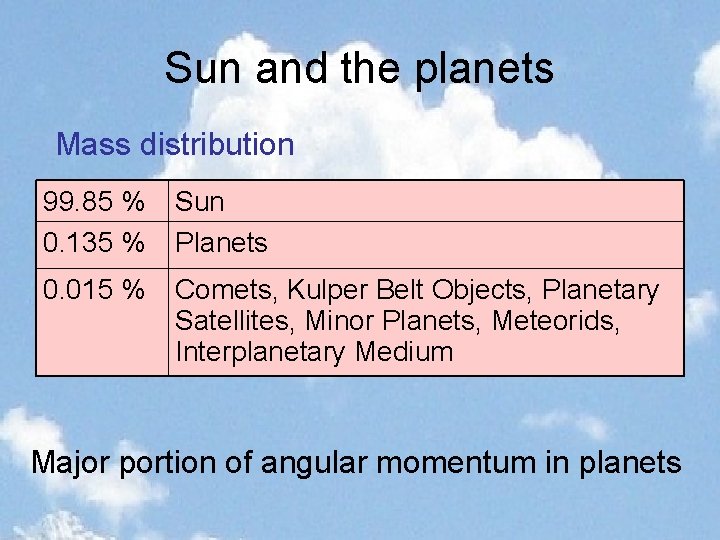
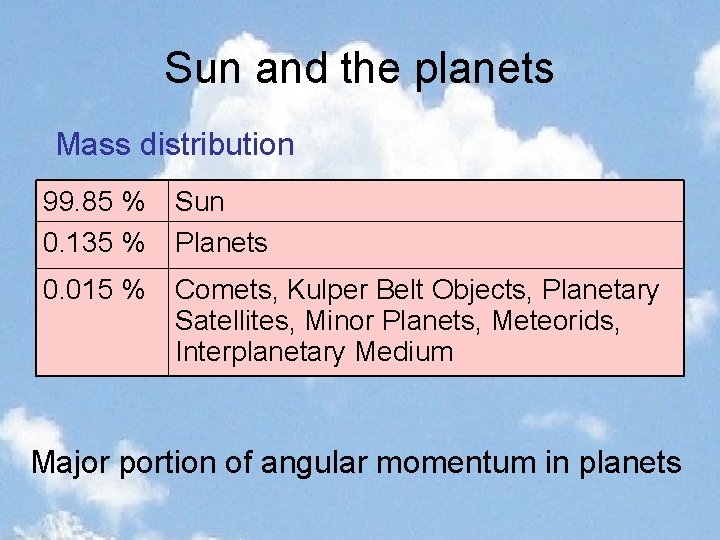
Sun and the planets Mass distribution 99. 85 % 0. 135 % Sun Planets 0. 015 % Comets, Kulper Belt Objects, Planetary Satellites, Minor Planets, Meteorids, Interplanetary Medium Major portion of angular momentum in planets
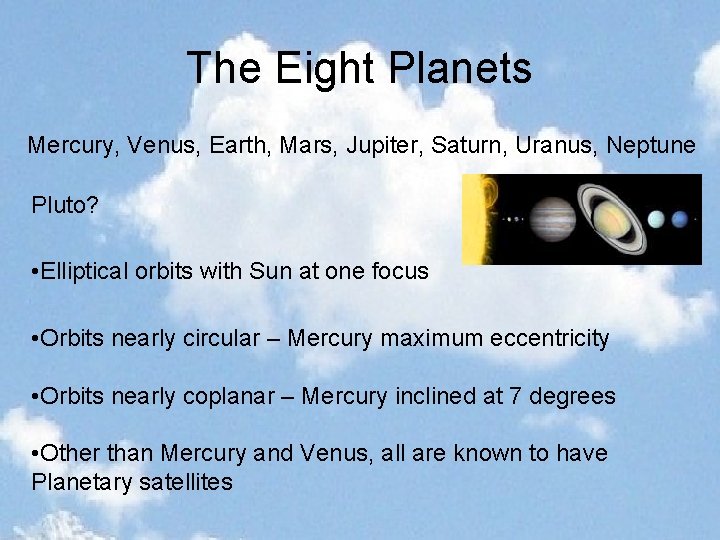
The Eight Planets Mercury, Venus, Earth, Mars, Jupiter, Saturn, Uranus, Neptune Pluto? • Elliptical orbits with Sun at one focus • Orbits nearly circular – Mercury maximum eccentricity • Orbits nearly coplanar – Mercury inclined at 7 degrees • Other than Mercury and Venus, all are known to have Planetary satellites
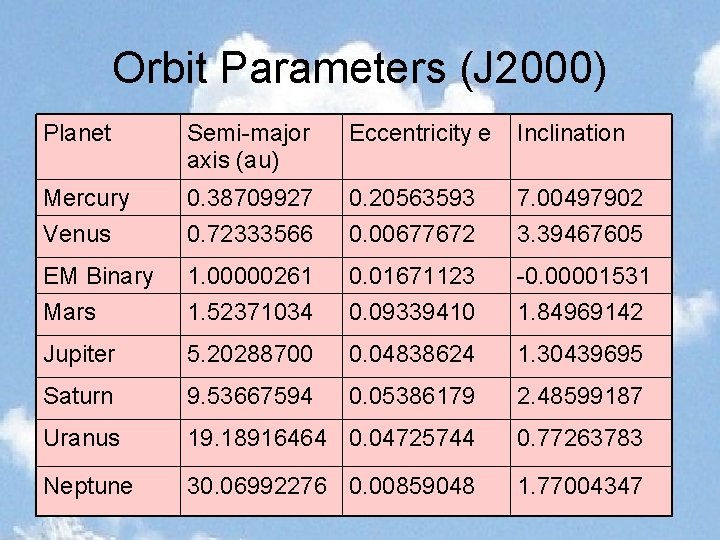
Orbit Parameters (J 2000) Planet Semi-major axis (au) Eccentricity e Inclination Mercury 0. 38709927 0. 20563593 7. 00497902 Venus 0. 72333566 0. 00677672 3. 39467605 EM Binary 1. 00000261 0. 01671123 -0. 00001531 Mars 1. 52371034 0. 09339410 1. 84969142 Jupiter 5. 20288700 0. 04838624 1. 30439695 Saturn 9. 53667594 0. 05386179 2. 48599187 Uranus 19. 18916464 0. 04725744 0. 77263783 Neptune 30. 06992276 0. 00859048 1. 77004347
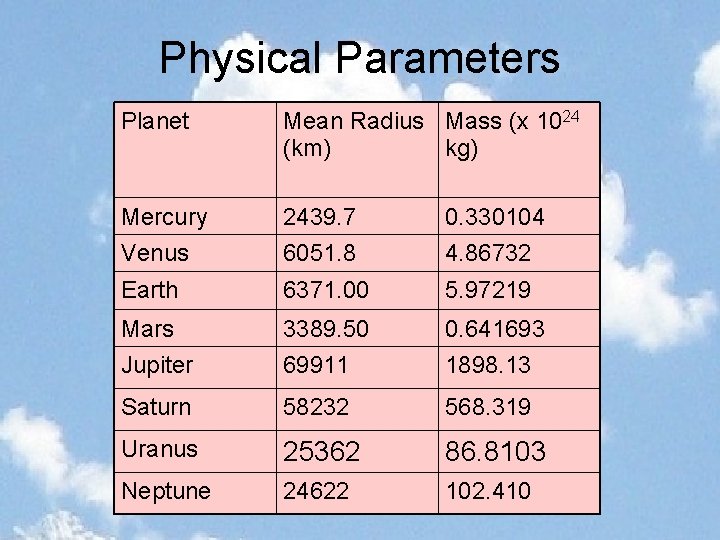
Physical Parameters Planet Mean Radius Mass (x 1024 (km) kg) Mercury 2439. 7 0. 330104 Venus 6051. 8 4. 86732 Earth 6371. 00 5. 97219 Mars 3389. 50 0. 641693 Jupiter 69911 1898. 13 Saturn 58232 568. 319 Uranus 25362 86. 8103 Neptune 24622 102. 410
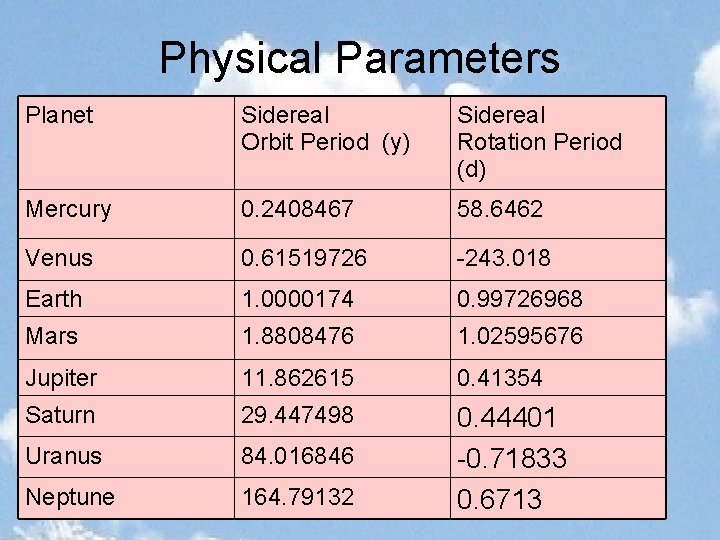
Physical Parameters Planet Sidereal Orbit Period (y) Sidereal Rotation Period (d) Mercury 0. 2408467 58. 6462 Venus 0. 61519726 -243. 018 Earth 1. 0000174 0. 99726968 Mars 1. 8808476 1. 02595676 Jupiter 11. 862615 0. 41354 Saturn 29. 447498 Uranus 84. 016846 Neptune 164. 79132 0. 44401 -0. 71833 0. 6713
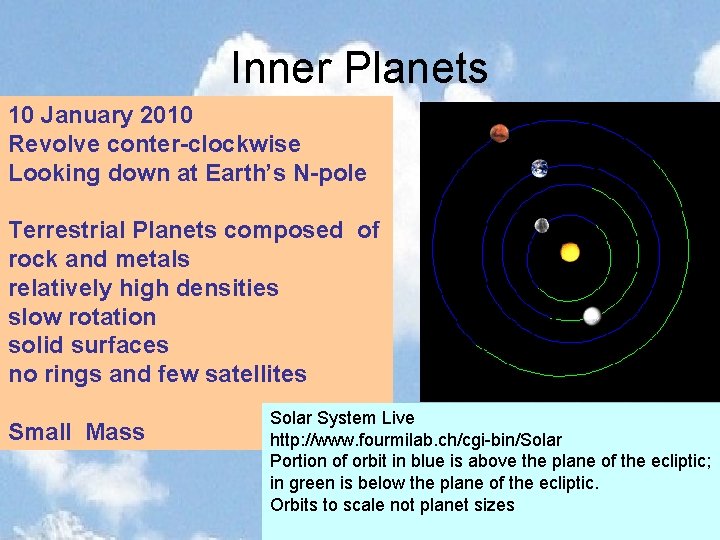
Inner Planets 10 January 2010 Revolve conter-clockwise Looking down at Earth’s N-pole Terrestrial Planets composed of rock and metals relatively high densities slow rotation solid surfaces no rings and few satellites Small Mass Solar System Live http: //www. fourmilab. ch/cgi-bin/Solar Portion of orbit in blue is above the plane of the ecliptic; in green is below the plane of the ecliptic. Orbits to scale not planet sizes
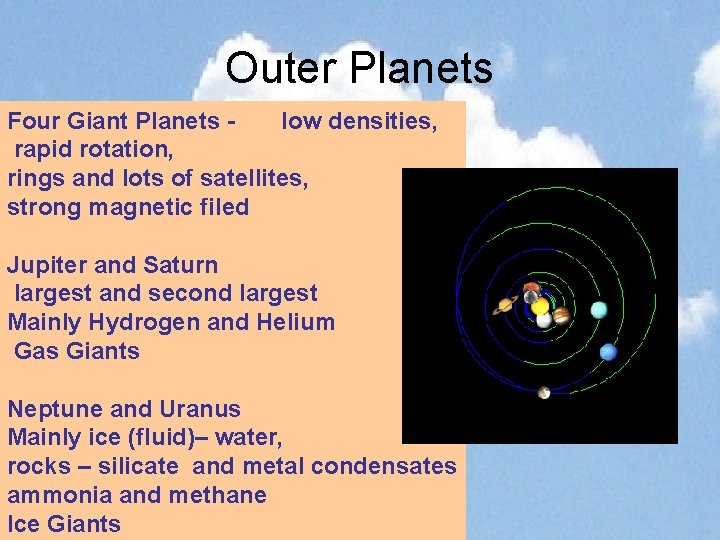
Outer Planets Four Giant Planets low densities, rapid rotation, rings and lots of satellites, strong magnetic filed Jupiter and Saturn largest and second largest Mainly Hydrogen and Helium Gas Giants Neptune and Uranus Mainly ice (fluid)– water, rocks – silicate and metal condensates ammonia and methane Ice Giants
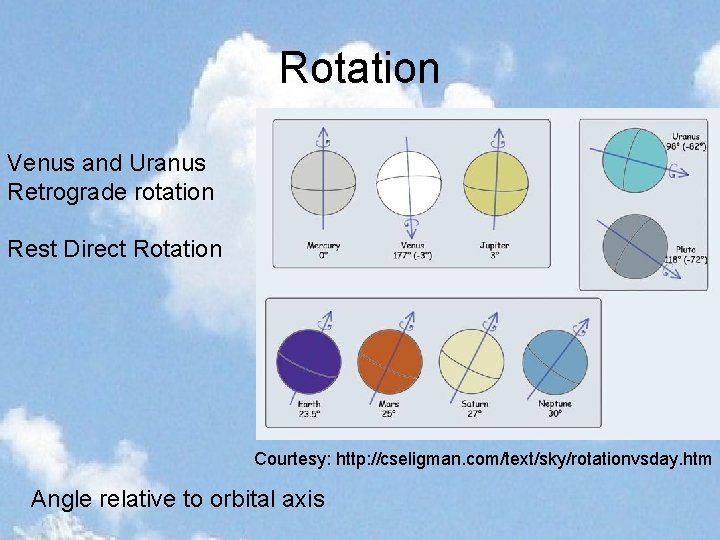
Rotation Venus and Uranus Retrograde rotation Rest Direct Rotation Courtesy: http: //cseligman. com/text/sky/rotationvsday. htm Angle relative to orbital axis
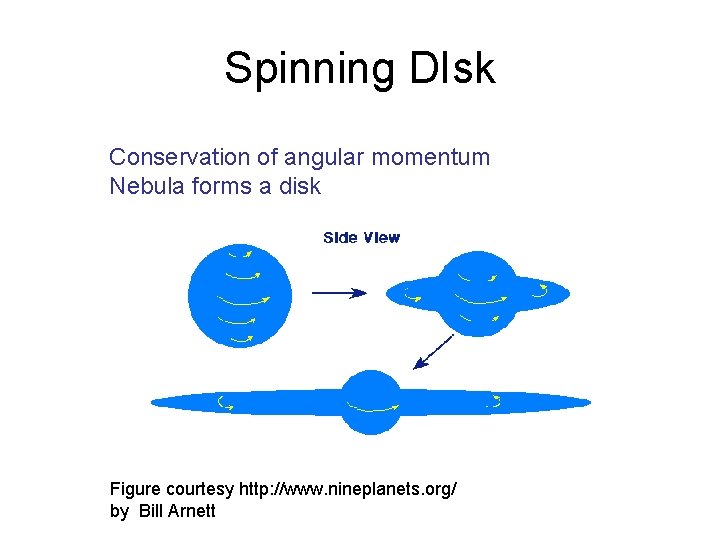
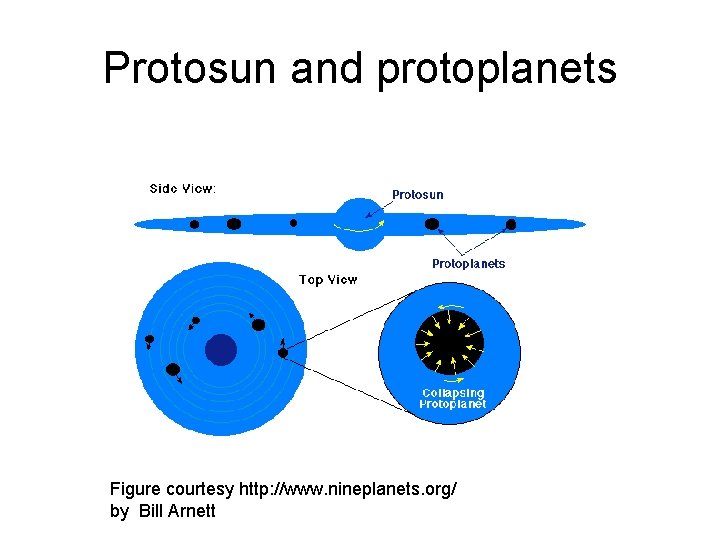
Origin of the Solar System Coplanar orbits – ecliptic plane Rotation axis of nearly all planets and Sun normal to ecliptic Alignment of angular momentum suggests that the Solar System formed by the fragmentation of a spinning disk made of gas and dust 4. 5 billion years ago
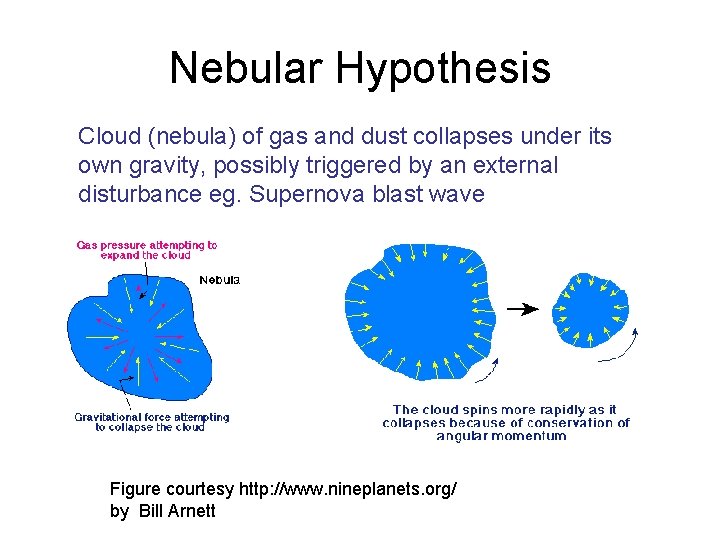
Nebular Hypothesis Cloud (nebula) of gas and dust collapses under its own gravity, possibly triggered by an external disturbance eg. Supernova blast wave Figure courtesy http: //www. nineplanets. org/ by Bill Arnett
Spinning DIsk Conservation of angular momentum Nebula forms a disk Figure courtesy http: //www. nineplanets. org/ by Bill Arnett
Protosun and protoplanets Figure courtesy http: //www. nineplanets. org/ by Bill Arnett
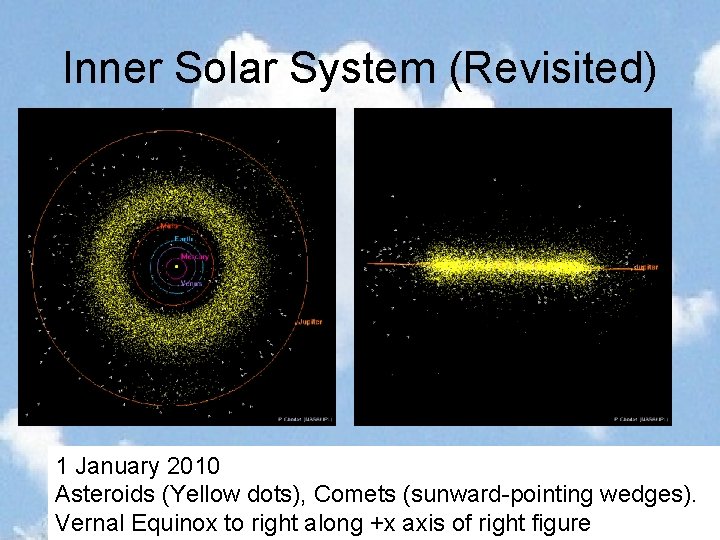
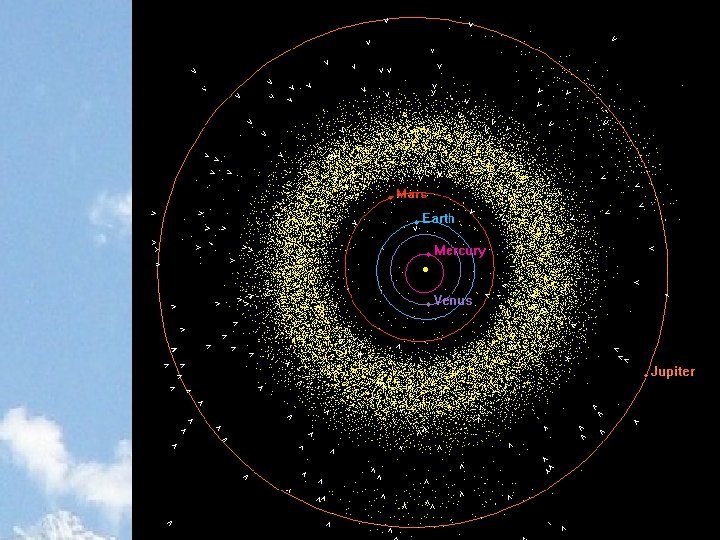
Inner Solar System (Revisited) 1 January 2010 Asteroids (Yellow dots), Comets (sunward-pointing wedges). Vernal Equinox to right along +x axis of right figure
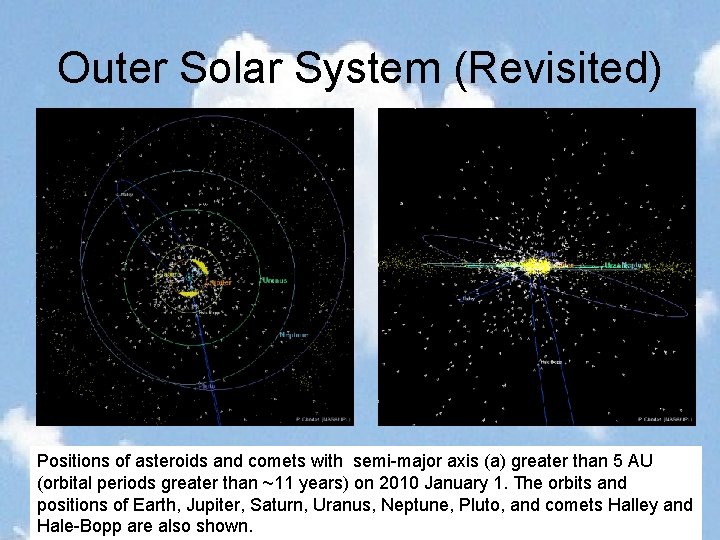
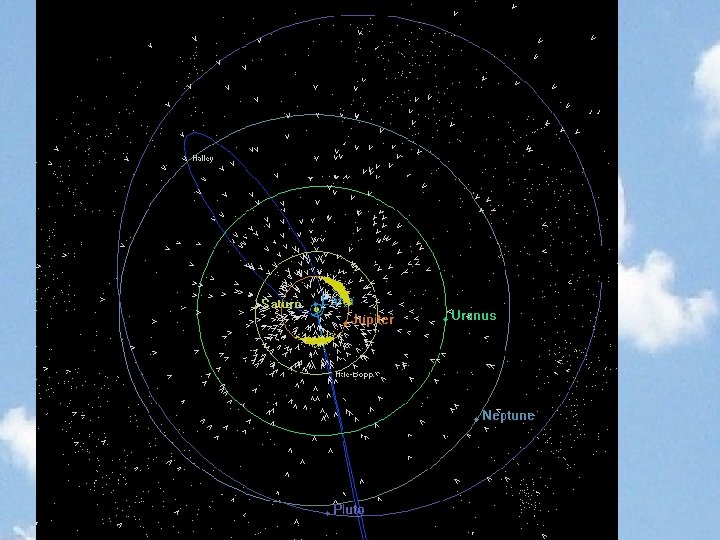
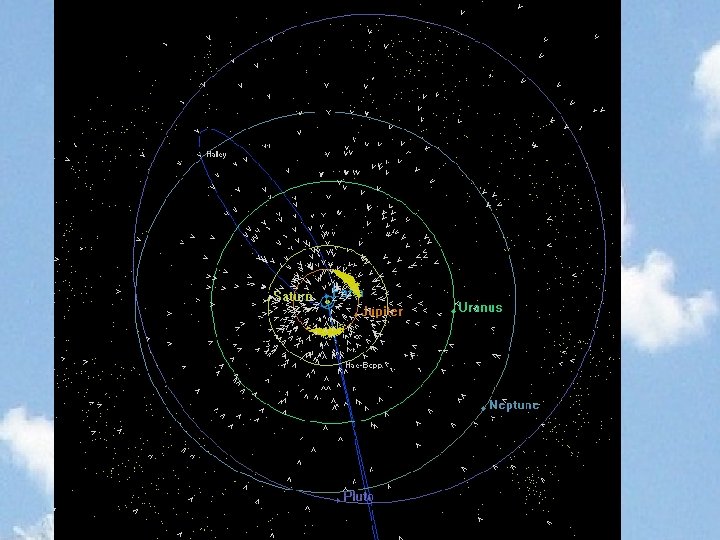
Outer Solar System (Revisited) Positions of asteroids and comets with semi-major axis (a) greater than 5 AU (orbital periods greater than ~11 years) on 2010 January 1. The orbits and positions of Earth, Jupiter, Saturn, Uranus, Neptune, Pluto, and comets Halley and Hale-Bopp are also shown.
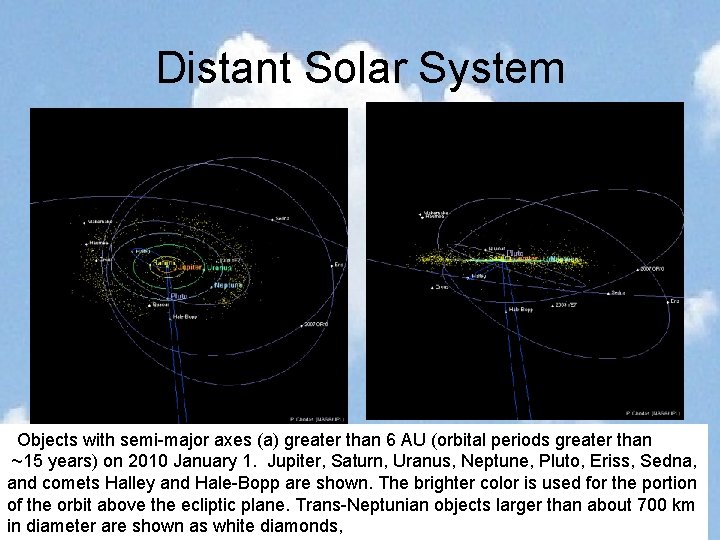
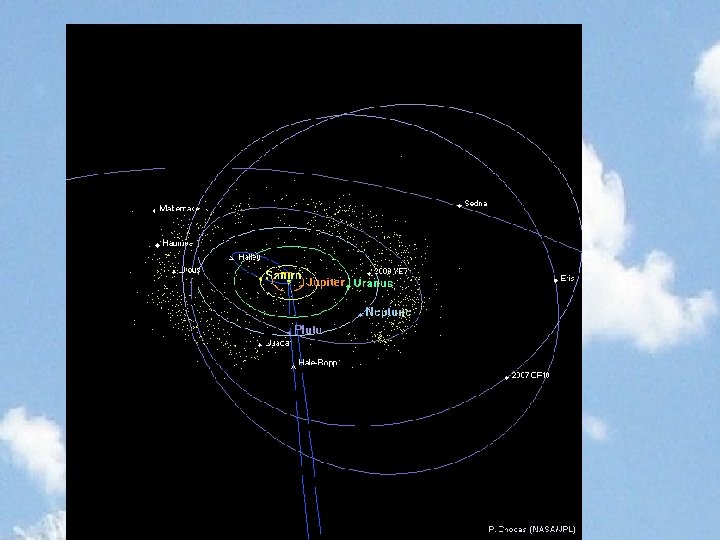
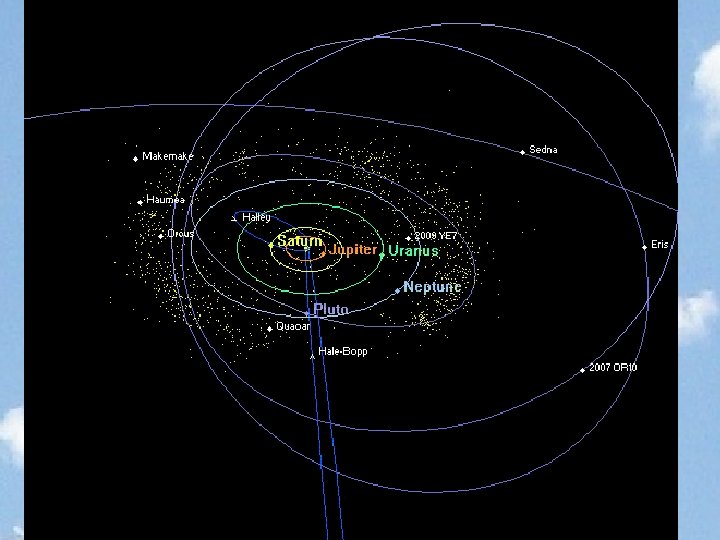
Distant Solar System Objects with semi-major axes (a) greater than 6 AU (orbital periods greater than ~15 years) on 2010 January 1. Jupiter, Saturn, Uranus, Neptune, Pluto, Eriss, Sedna, and comets Halley and Hale-Bopp are shown. The brighter color is used for the portion of the orbit above the ecliptic plane. Trans-Neptunian objects larger than about 700 km in diameter are shown as white diamonds,
Distant Solar System
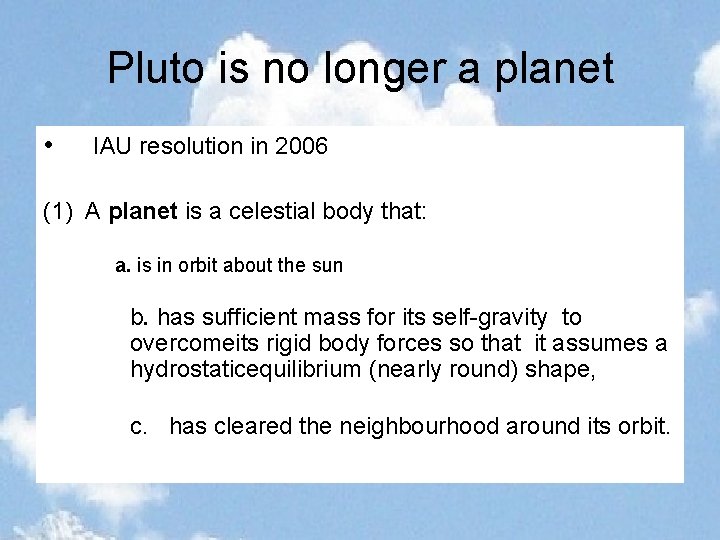
Pluto is no longer a planet • IAU resolution in 2006 (1) A planet is a celestial body that: a. is in orbit about the sun b. has sufficient mass for its self-gravity to overcomeits rigid body forces so that it assumes a hydrostaticequilibrium (nearly round) shape, c. has cleared the neighbourhood around its orbit.
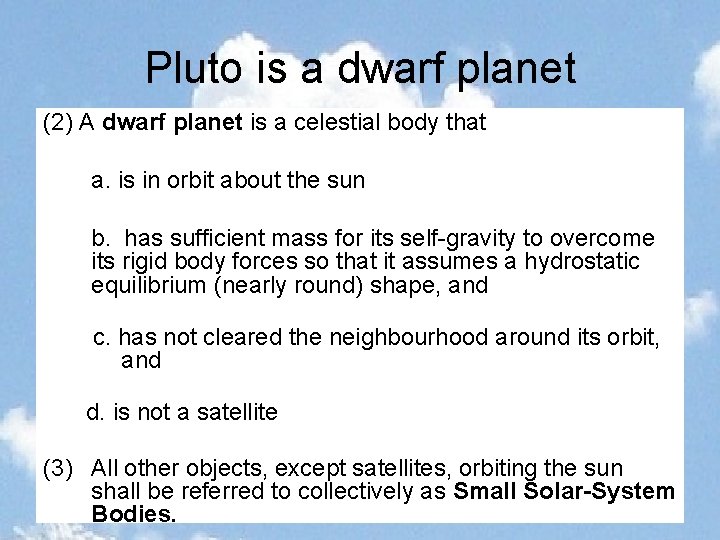
Pluto is a dwarf planet (2) A dwarf planet is a celestial body that a. is in orbit about the sun b. has sufficient mass for its self-gravity to overcome its rigid body forces so that it assumes a hydrostatic equilibrium (nearly round) shape, and c. has not cleared the neighbourhood around its orbit, and d. is not a satellite (3) All other objects, except satellites, orbiting the sun shall be referred to collectively as Small Solar-System Bodies.
Dwarf Planets Pluto is a “dwarf planet” by the above definition and isrecognized as the prototype of a new category of trans-Neptunian objects. Designated Dwarf Planets 1 Ceres, 134340 Pluto, and 136199 Eris
Asteroids • Small rocky bodies • Those observed range in diameter from 948 km (1 Ceres) to a few meters. • Primarily in orbit between Jupiter and Mars (i. e. main-belt). • Near-Earth asteroids (NEAs) are a subset of asteroids whose orbits approach and/or cross the Earth's orbit.
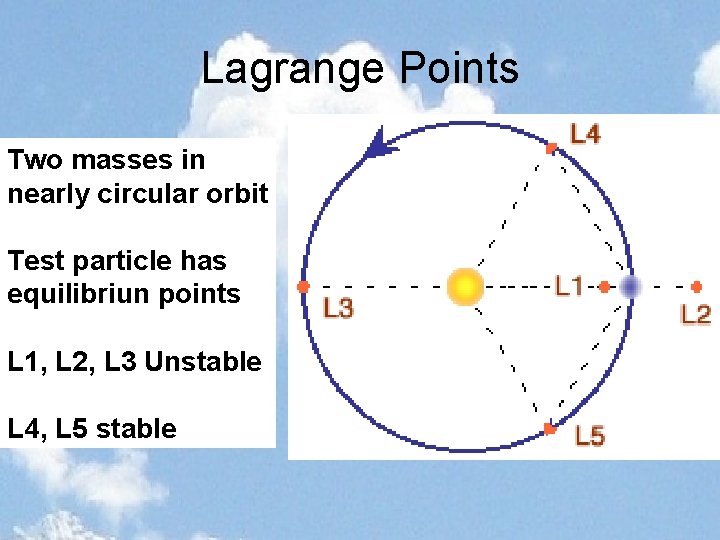
Asteroids • Includes Trojans - bodies captured in Jupiter's 4 th and 5 th Lagrange points • Centaurs - bodies in orbit between Jupiter and Neptune • Trans-Neptunian objects - orbiting beyond Neptune • Minor Planets
Lagrange Points Two masses in nearly circular orbit Test particle has equilibriun points L 1, L 2, L 3 Unstable L 4, L 5 stable
Comets • • Small icy bodies (water and dust) Few km (~1 km) in extent Formed in Outer Solar System – Cold Orbits are disturbed by massive planets Approach the Sun (few AU or less) Vapourised Atmosphere – upto few hundred thousands of km
Comets • • • Reflected light Atmosphere glows – fluorescence Tail pointing away from Sun Gas – pushed by Solar wind Dust – radiation pressure
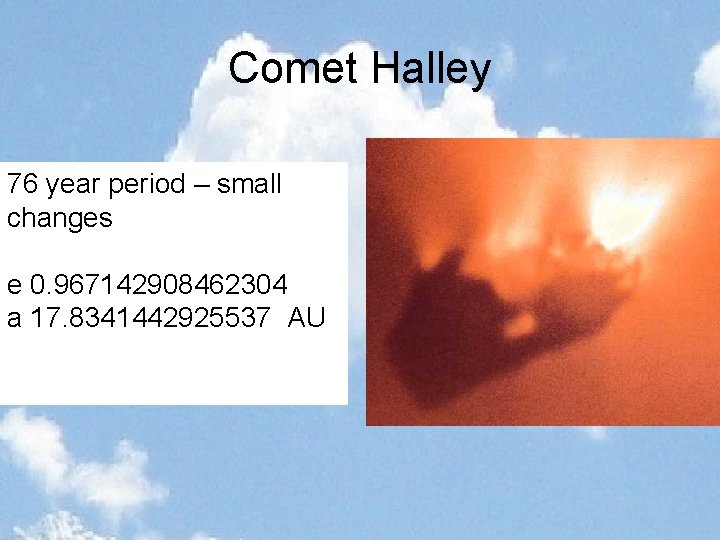
Comet Halley 76 year period – small changes e 0. 967142908462304 a 17. 8341442925537 AU
Comet Halley
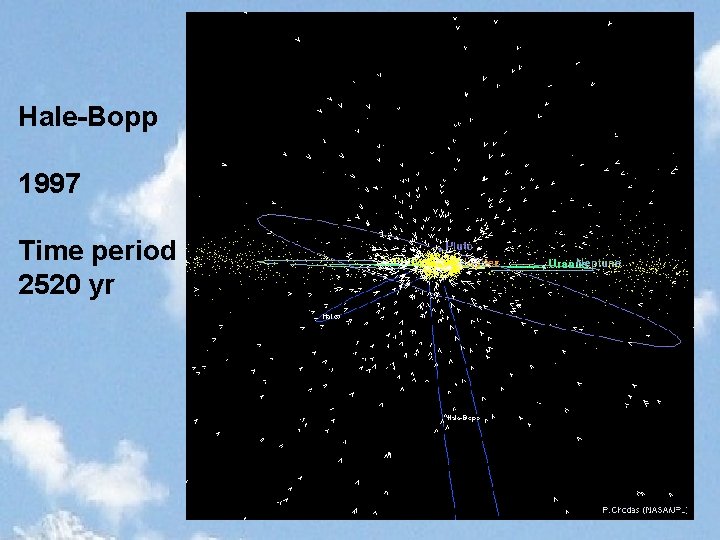
Hale Bopp Hale-Bopp 1997 Time period 2520 yr
Comets • Short period < 200 yrs (eg. Comet Halley) • Orbit often in ecliptic • Period often 5 – 7 yr - frequent passes close to Sun – vaporized • Long period > 200 yrs to millions of years • Example Hale-Bopp • Orbit generally not in ecliptic
Long Period Comets • • • In bound orbits around Sun Apohelion around 50, 000 AU No preferred direction Where do these come from? not from interstellar space
Oort Cloud Oort proposed • A clound of objects at peripheryy of Solar Susyem • 50, 000 AU to 150, 000 AU • Maybe as many as a trillion objects • Come into Solar System due to disturbance from passing star or Galaxy disk • long period Comets
SOURCE OF OORT CLOUD? • Asteroids in orbit between Uranus and Neptune • Disturbed by massive planets • Scattered to Outer parts of Solar System • form the Oort Cloud
Short Period Comets
Trans-Neptunian Objects • Several Scientists have proposed existence of small objects in the Solar System beyond Neptune’s orbit • Disturbance from passing planet • Orbit changed towards interior of Solar System • source of Short Period Comets L
Trans-Neptunian Objects • Leonard (1930), Edgeworth (1945), Kuiper (1951) • Edgeworth-Kuiper Belt or Kuiper. Belt • between 30 to 50 Au from Sun
Edgeworth-Kuiper belt • • First EKBO 1992 (Jewitt and Luu) Around 1000 EKBOs known ~70, 000 predicted larger than 100 km Ice – frozen volatides (methane, ammonia and water) • Temperature ~50 K • Pluto, Makemake, Humea dwarf planets • Pluto largest EKBO
Kuiper Belt possibly not the source of Short Period Comets Scattered Disk – beyond 50 AU
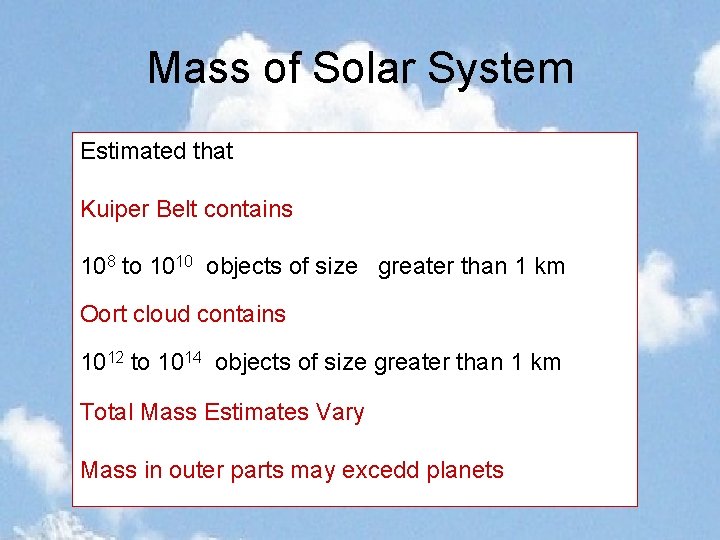
Mass of Solar System Estimated that Kuiper Belt contains 108 to 1010 objects of size greater than 1 km Oort cloud contains 1012 to 1014 objects of size greater than 1 km Total Mass Estimates Vary Mass in outer parts may excedd planets
Sun and the planets Mass distribution 99. 85 % 0. 135 % Sun Planets 0. 015 % Comets, Kulper Belt Objects, Planetary Satellites, Minor Planets, Meteorids, Interplanetary Medium Major portion of angular momentum in planets
Much remains to be explored in the Solar System