
The Solar System Description and Classification of the
- Slides: 9
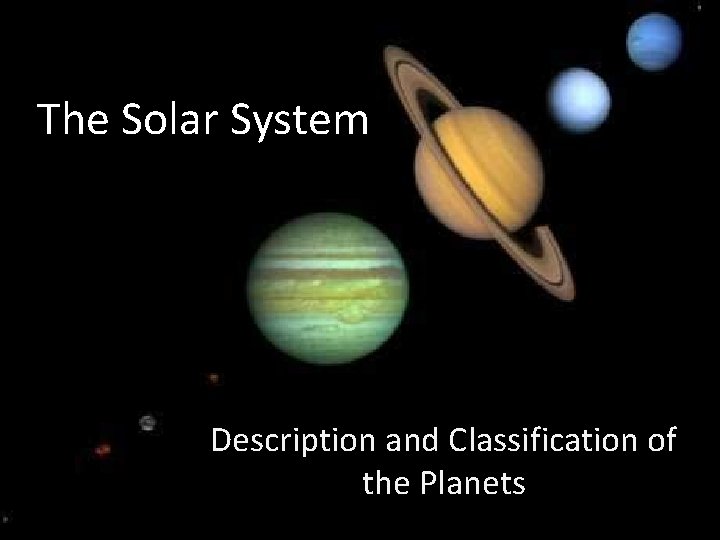
The Solar System Description and Classification of the Planets
DO NOW: • Take out your earth science reference tables and go to page 15. • Look at the solar system data table on the lower half of the page. Answer the following questions: • How many planets are listed on this chart? • Which planet would float on water?
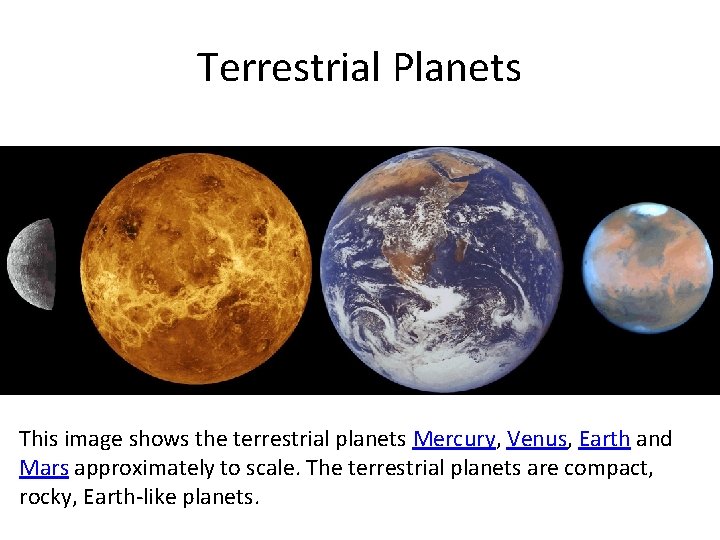
Terrestrial Planets This image shows the terrestrial planets Mercury, Venus, Earth and Mars approximately to scale. The terrestrial planets are compact, rocky, Earth-like planets.
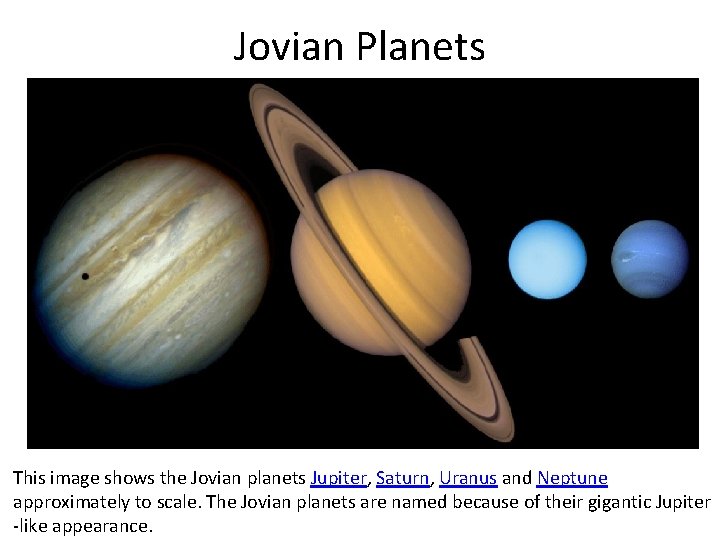
Jovian Planets This image shows the Jovian planets Jupiter, Saturn, Uranus and Neptune approximately to scale. The Jovian planets are named because of their gigantic Jupiter -like appearance.
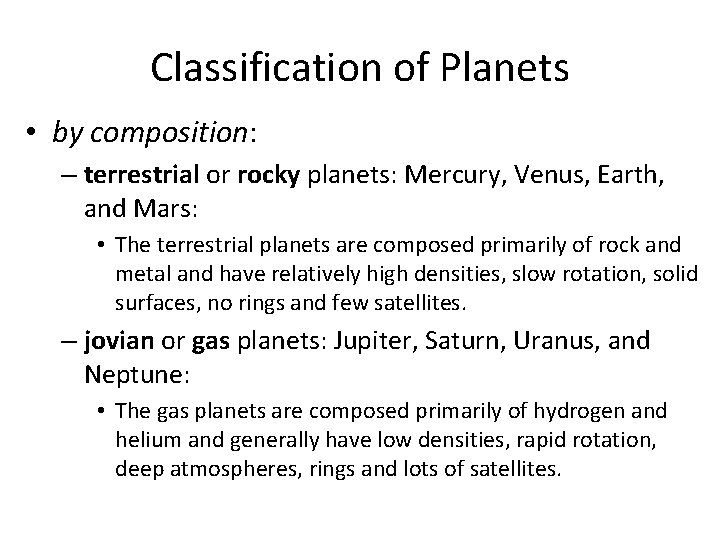
Classification of Planets • by composition: – terrestrial or rocky planets: Mercury, Venus, Earth, and Mars: • The terrestrial planets are composed primarily of rock and metal and have relatively high densities, slow rotation, solid surfaces, no rings and few satellites. – jovian or gas planets: Jupiter, Saturn, Uranus, and Neptune: • The gas planets are composed primarily of hydrogen and helium and generally have low densities, rapid rotation, deep atmospheres, rings and lots of satellites.
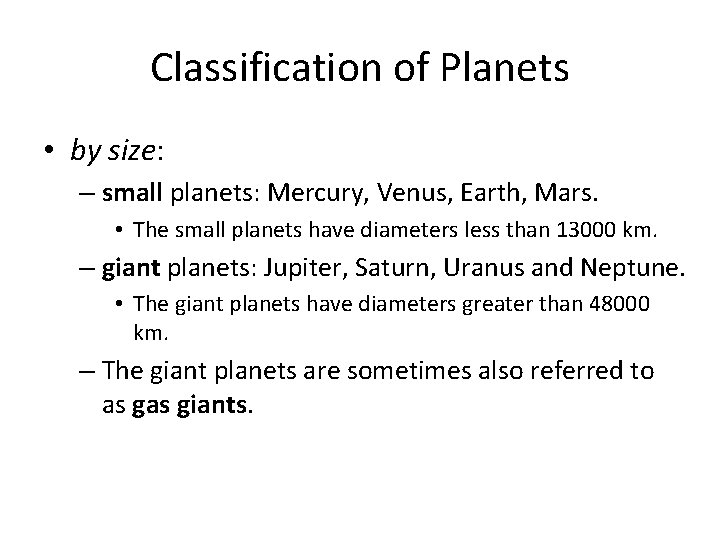
Classification of Planets • by size: – small planets: Mercury, Venus, Earth, Mars. • The small planets have diameters less than 13000 km. – giant planets: Jupiter, Saturn, Uranus and Neptune. • The giant planets have diameters greater than 48000 km. – The giant planets are sometimes also referred to as giants.
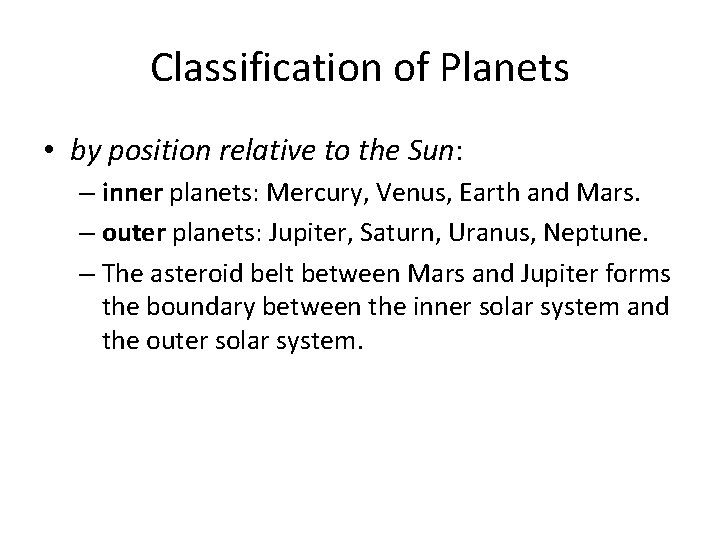
Classification of Planets • by position relative to the Sun: – inner planets: Mercury, Venus, Earth and Mars. – outer planets: Jupiter, Saturn, Uranus, Neptune. – The asteroid belt between Mars and Jupiter forms the boundary between the inner solar system and the outer solar system.
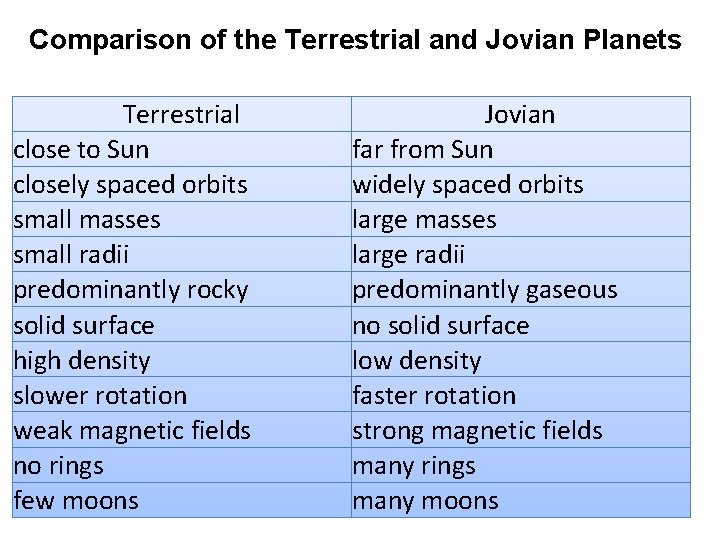
Comparison of the Terrestrial and Jovian Planets Terrestrial close to Sun closely spaced orbits small masses small radii predominantly rocky solid surface high density slower rotation weak magnetic fields no rings few moons Jovian far from Sun widely spaced orbits large masses large radii predominantly gaseous no solid surface low density faster rotation strong magnetic fields many rings many moons
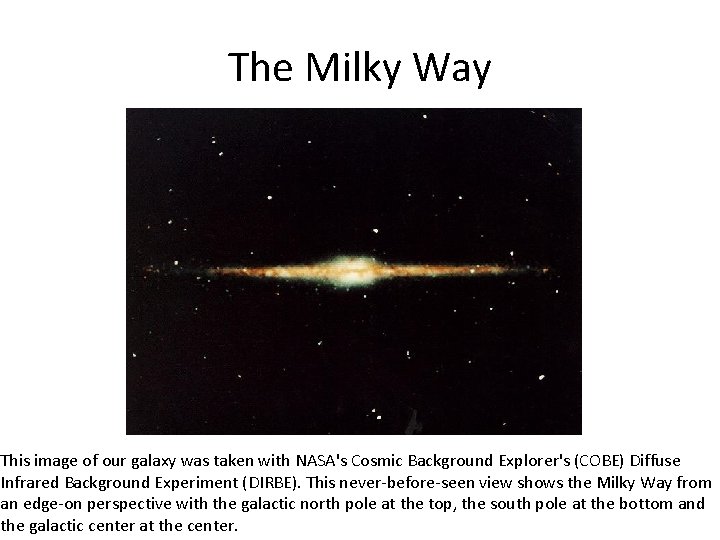
The Milky Way This image of our galaxy was taken with NASA's Cosmic Background Explorer's (COBE) Diffuse Infrared Background Experiment (DIRBE). This never-before-seen view shows the Milky Way from an edge-on perspective with the galactic north pole at the top, the south pole at the bottom and the galactic center at the center.